


 Скачать презентацию NORTHWEST AIDS EDUCATION AND TRAINING CENTER Introduction to
09990e3ca24a984b1c93b4997b928242.ppt
- Количество слайдов: 20
 NORTHWEST AIDS EDUCATION AND TRAINING CENTER Introduction to NW AETC ECHO Christian B. Ramers, MD, MPH Presentation prepared & presented by: Christian Ramers, MD, MPH, Kent Unruh, Ph. D, Mary Annese, MPA, and Laurie Conratt, MBA Last Updated: April 3, 2012
 NW AETC ECHO Telehealth Program NW AETC ECHO Mission • Build capacity to maximize treatment of chronic HIV infection in underserved areas, monitoring outcomes • Catalyze knowledge sharing between clinicians developing treatment expertise across the Pacific Northwest region • Disseminate treatment innovations quickly across a network of clinicians • Maximize HIV care in local communities (FQHC’s, community clinics), treating patients locally with expert knowledge
 BACKGROUND
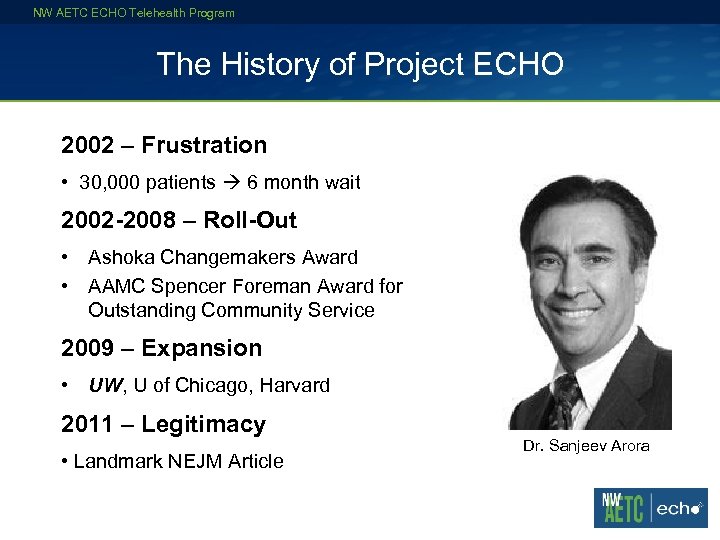 NW AETC ECHO Telehealth Program The History of Project ECHO 2002 – Frustration • 30, 000 patients 6 month wait 2002 -2008 – Roll-Out • Ashoka Changemakers Award • AAMC Spencer Foreman Award for Outstanding Community Service 2009 – Expansion • UW, U of Chicago, Harvard 2011 – Legitimacy • Landmark NEJM Article Dr. Sanjeev Arora
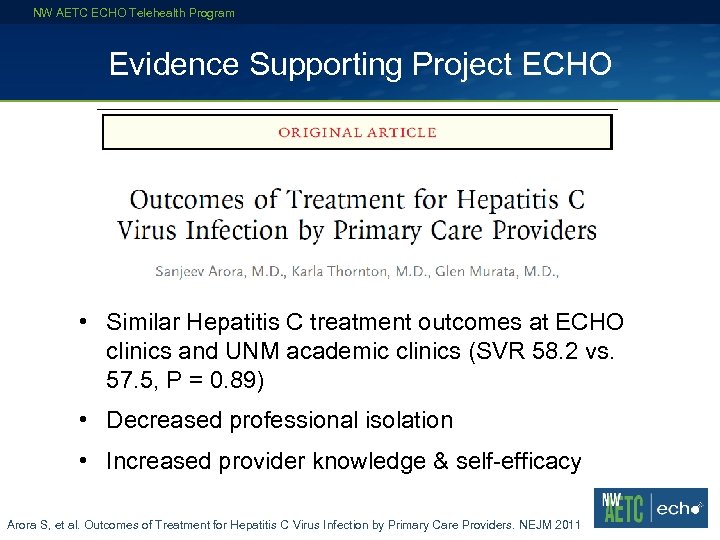 NW AETC ECHO Telehealth Program Evidence Supporting Project ECHO • Similar Hepatitis C treatment outcomes at ECHO clinics and UNM academic clinics (SVR 58. 2 vs. 57. 5, P = 0. 89) • Decreased professional isolation • Increased provider knowledge & self-efficacy Arora S, et al. Outcomes of Treatment for Hepatitis C Virus Infection by Primary Care Providers. NEJM 2011
 SET UP
 NW AETC ECHO Telehealth Program NW AETC ECHO Groundwork • Utilize collaborators and partner networks to recruit eligible clinic sites for participation • Develop tools to meet AETC Telehealth program needs • Develop web-based resources • Identify NW AETC ECHO multidisciplinary team • Develop curricula blocks for didactic sessions • Conduct site visits with interested sites: - Foster buy-in with clinicians and administrators - Baseline needs assessment - Technology assessment
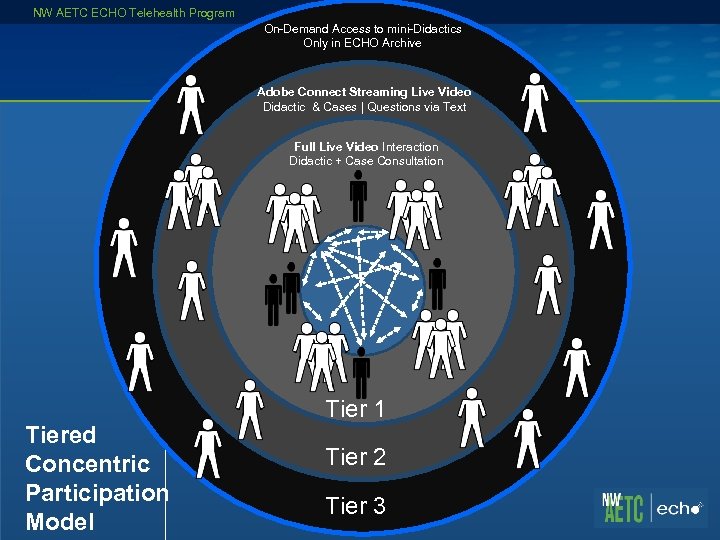 NW AETC ECHO Telehealth Program On-Demand Access to mini-Didactics Only in ECHO Archive Adobe Connect Streaming Live Video Didactic & Cases | Questions via Text Full Live Video Interaction Didactic + Case Consultation Tiered Concentric Participation Model Tier 1 Tier 2 Tier 3
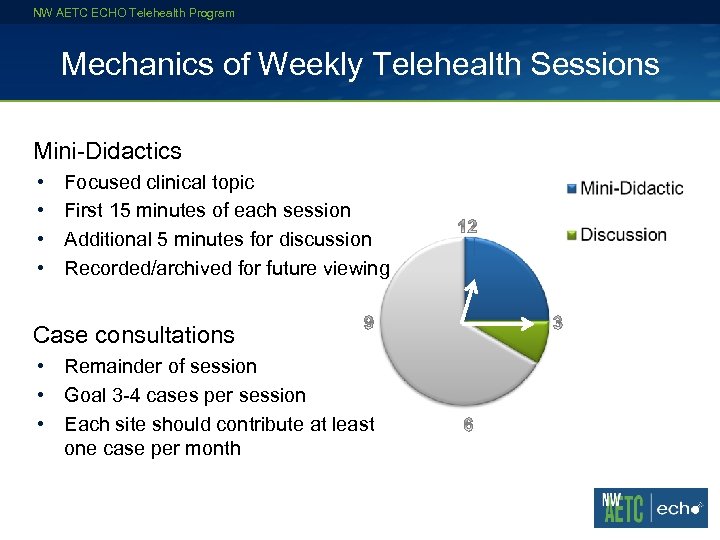 NW AETC ECHO Telehealth Program Mechanics of Weekly Telehealth Sessions Mini-Didactics • • Focused clinical topic First 15 minutes of each session Additional 5 minutes for discussion Recorded/archived for future viewing Case consultations • Remainder of session • Goal 3 -4 cases per session • Each site should contribute at least one case per month
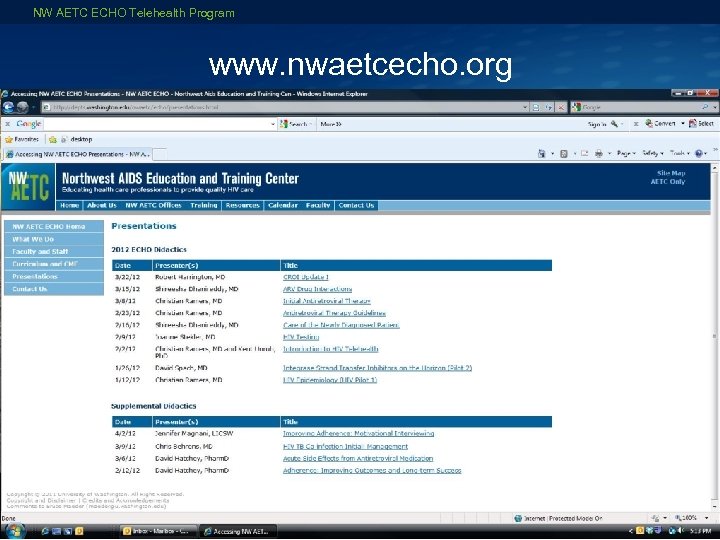
 NW AETC ECHO Telehealth Program Resources for Participants • • Presenting Cases!!! Mini-Didactics (live or archived) Availability of NW AETC ECHO Specialists 24/7 Additional resources via email - Hot topics & Articles of interest • Website: www. nwaetcecho. org - Streaming archive of videos (additional topics!) - Forms , Faculty & contact info - Curriculum, Upcoming session information • CME and CNE available for participants
 EVALUATION PLAN
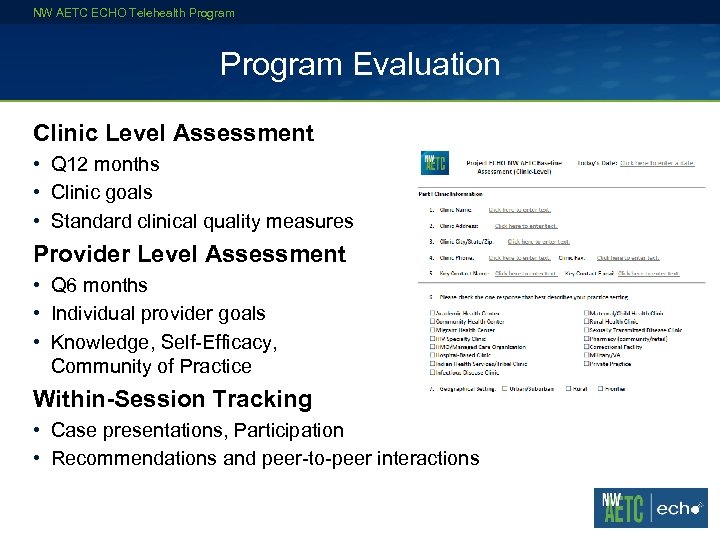 NW AETC ECHO Telehealth Program Evaluation Clinic Level Assessment • Q 12 months • Clinic goals • Standard clinical quality measures Provider Level Assessment • Q 6 months • Individual provider goals • Knowledge, Self-Efficacy, Community of Practice Within-Session Tracking • Case presentations, Participation • Recommendations and peer-to-peer interactions
 PRELIMINARY RESULTS
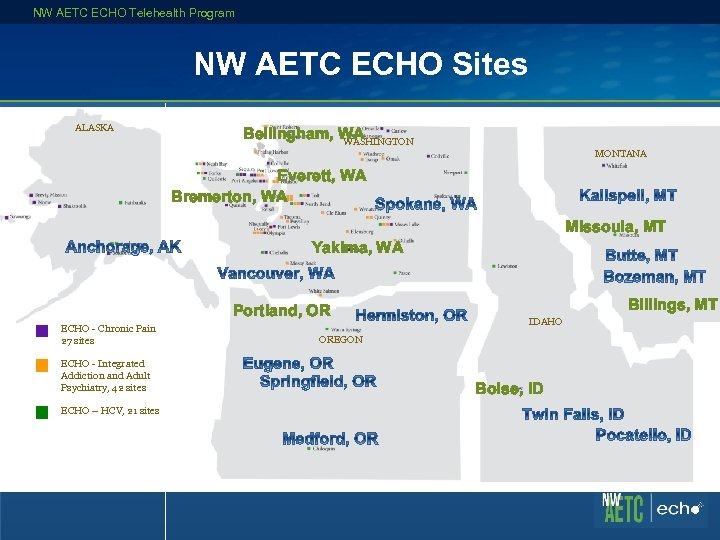 NW AETC ECHO Telehealth Program NW AETC ECHO Sites ALASKA Bellingham, WA WASHINGTON MONTANA Everett, WA Bremerton, WA Missoula, MT Yakima, WA Portland, OR ECHO - Chronic Pain 27 sites ECHO - Integrated Addiction and Adult Psychiatry, 42 sites ECHO – HCV, 21 sites Billings, MT IDAHO OREGON Boise, ID
 NW AETC ECHO Telehealth Program www. nwaetcecho. org Clinic Level Assessment • Q 12 months
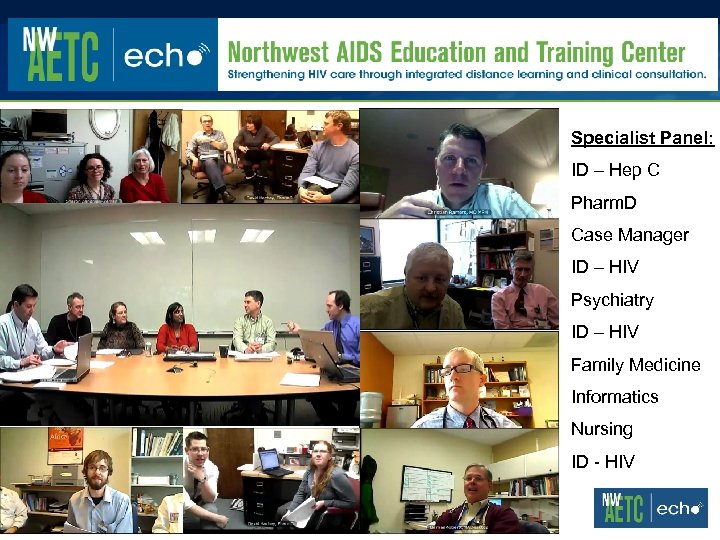 Specialist Panel: ID – Hep C Pharm. D Case Manager ID – HIV Psychiatry ID – HIV Family Medicine Informatics Nursing ID - HIV
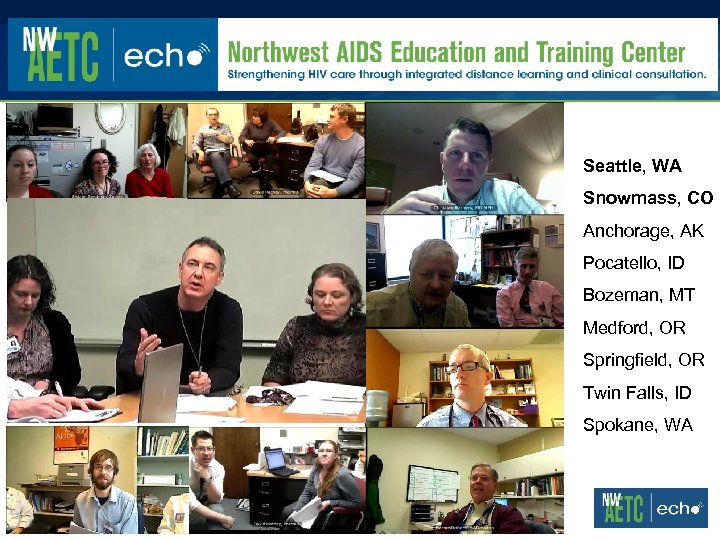 Seattle, WA Snowmass, CO Anchorage, AK Pocatello, ID Bozeman, MT Medford, OR Springfield, OR Twin Falls, ID Spokane, WA
 NW AETC ECHO Telehealth Program Barriers and Solutions • Provider Buy-in - Perceived need for weekly time commitment • Administrative Buy-in - Allowing providers to participate for 1 hour every week - IT barriers • Face-to-face site visit - Build relationships with clinic and providers – program champions Obtain baseline assessment information Assess clinic workflow and technology Case review (level IV training) in clinician’s own environment • Target Audience - Tiered participation model, recorded mini-didactics - Ensuring a diversity of content: basic cutting edge
 NW AETC ECHO Telehealth Program Resources • www. nwaetcecho. org • Recorded Didactics • Curriculum • Staff/Faculty • To join a session: 1. Let us know you’ll be joining: • Christian Ramers: ramers@uw. edu • Kent Unruh: ktunruh@uw. edu 2. At 12: 00 PST, log in to uwsom. adobeconnect. com/echohiv • Sign in as a ‘guest’ • Provider your name & credentials • Any further questions: ramers@uw. edu
 Questions & Discussion How is this relevant to your work? Can you envision an ECHO-like program within your training & mentoring programs? How can ECHO foster cross-FTCC collaboration?