 Скачать презентацию North South problems Done by Ivanchenko Victoriya
north-south.pptx
- Количество слайдов: 16



North – South problems Done by: Ivanchenko Victoriya, 308 group.
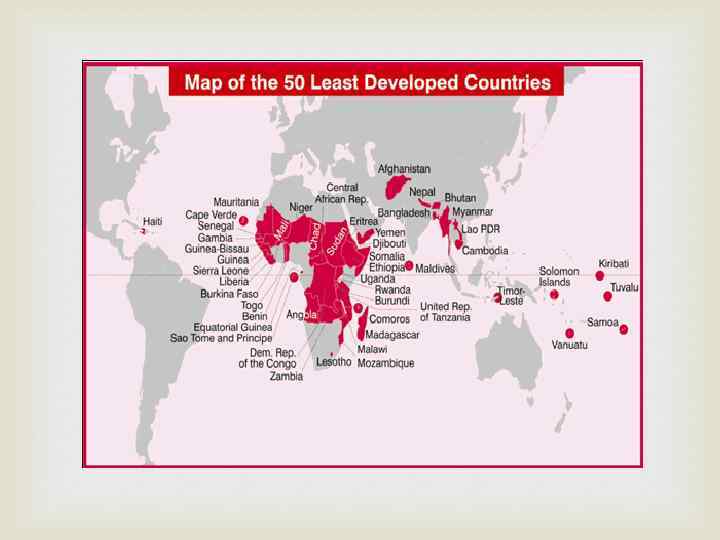
Definition The north–south divide is a socio-economic and political division that exists between the wealthy developed countries, known collectively as "the north", and the poorer developing countries (least developed countries), or "the south. “ Although most nations comprising the "North" are in fact located in the Northern Hemisphere (with the notable exceptions of Australia and New Zealand), the divide is not wholly defined by geography. The North is home to four of the five permanent members of the United Nations Security Council and all members of the G 8. "The North" mostly covers the West and the First World, with much of the Second World. The expression "north–south divide" is still in common use, but the terms "North" and "South" are already somewhat outdated. As nations become economically developed, they may become part of the "North", regardless of geographical location, while any other nations which do not qualify for "developed" status are in effect deemed to be part of the "South. "
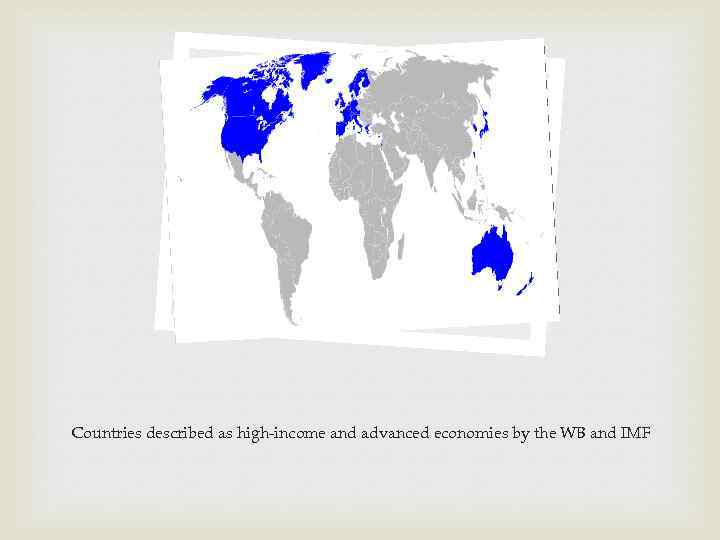
Countries described as high-income and advanced economies by the WB and IMF
History The idea of categorizing countries by their economic and developmental status began during the Cold War with the classifications of East and West. The Soviet Union and China represented the developing East, and the United States and their allies represented the more developed West. Out of this paradigm of development surged the division of the First World [the west] and the Second World [the east] with the even less developed countries constituting the Third World. As some Second World countries joined the First World, and others joined the Third World, a new and simpler classification was needed. The First World became the “North” and the Third World became the “South”.
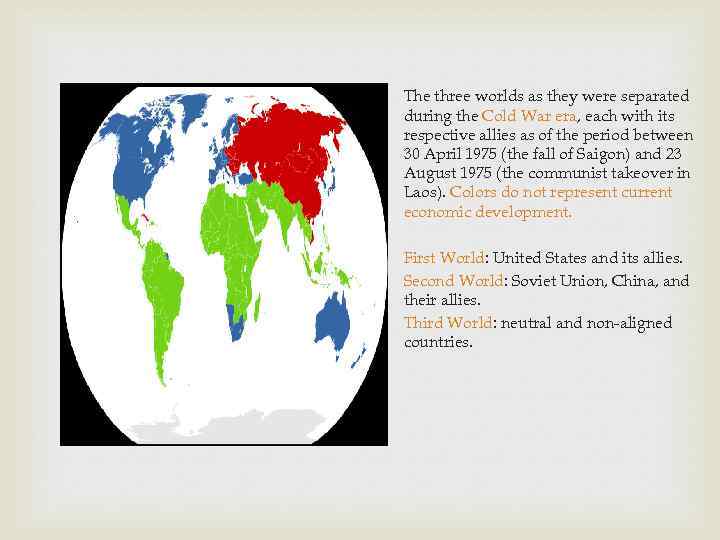
The three worlds as they were separated during the Cold War era, each with its respective allies as of the period between 30 April 1975 (the fall of Saigon) and 23 August 1975 (the communist takeover in Laos). Colors do not represent current economic development. First World: United States and its allies. Second World: Soviet Union, China, and their allies. Third World: neutral and non-aligned countries.
Defining development Being categorized as part of the “North” implies development as opposed to belonging to the “South” which implies a lack thereof. The north becomes synonymous with economic development and industrialization while the South represents the previously colonized countries which are in need of help in the form of international aid agendas In order to understand how this divide occurs, a definition of “development” itself is needed. The Dictionary of Human Geography defines development as “[p]rocesses of social change or [a change] to class and state projects to transform national economies". This definition entails an understanding of economic development which is imperative when trying to understand the north–south divide. Economic Development is a measure of progress in a specific economy. It refers to advancements in technology, a transition from an economy based largely on agriculture to one based on industry and an improvement in living standards. Other factors that are included in the conceptualization of what a developed country is include life expectancy and the levels of education, poverty and employment in that country.
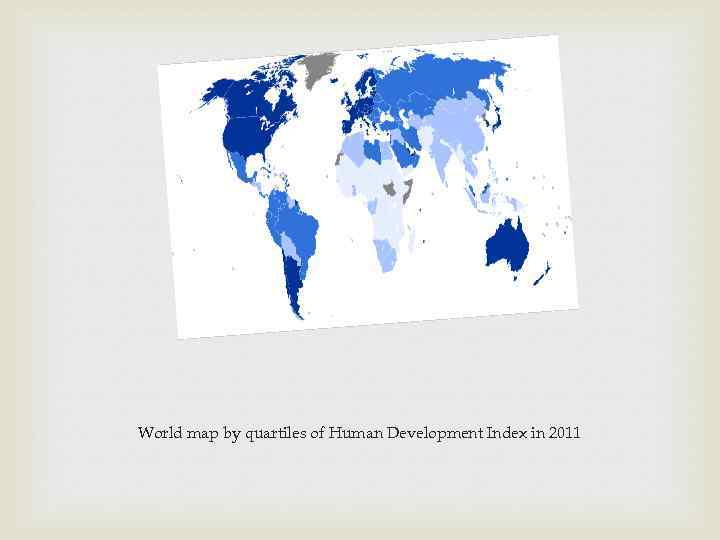
Very High Medium Low Data unavailable World map by quartiles of Human Development Index in 2011
The North-South problem is a general term signifying various problems relating to the economic and social development of the developing countries, particularly the problems of trade and aid. The year 1972 is the fourth year since the second U. N. Conference on Trade and Development (UNCTAD) was held in New Delhi, and the third UNCTAD is scheduled to be held for about five weeks from April 13, 1972, in Santiago, the capital of Chile, at the invitation of the Chilean Government. Tentative items on the agenda, which will receive emphasis, include such new problems for UNCTAD as international finance, the problem of the developing countries that have made a late start, export promotion, economic cooperation between the developing countries, transfer of technology, and environment versus development, in addition to primary products, finished products, semi-finished products, development loans, maritime transportation and other subjects of the North. South problem which have traditionally been discussed as key issues. Since its first meeting in 1964, UNCTAD, as a main forum to discuss the North-South problem, has discussed problems of trade and development and has made such achievements as setting as a target for aid a total flow of capital equivalent to one per cent of GNP, the general preferential duties and the international commodity agreement on sugar. That the tentative items on the agenda of the third UNCTAD cover such a wide range shows that the focus of problems for UNCTAD has become diffused and that it has become difficult to achieve concrete results. It can also be evaluated on the other hand that, as a result of the discussions at the first and second UNCTAD, the participants are now able to discuss their problems in more concrete terms and in a realistic manner, and there has been created to some extent an atmosphere in which the participants try to avoid abstract arguments which tend to cause confrontations between the North and the South. In this context, it is expected that the 141 member countries from all over the world will present problems and suggest means of settlement of the North-South problem to the UNCTAD in Chile and engage in businesslike discussions for the development of the developing countries.
When we are talking about the North-South system, we should notice the difference between the problems of the North-South and Western systems. The North-South system is separate from the Western system because it deals with "lower incomes and resources bases of the developing countries". However, it is also embedded in the Western system because the North, which generally represents the West, has veto power and therefore is able to make important changes in the global market system. The major difference is that the Western system is characterized by the common interest and free access to two types of management: formal and informal. As to the North-South system, only the North is recognized as a dominant decisionmaking authority. Besides, the economies of the Western system get more or less equal treatment, while the South receives far less benefits compared to the North. Why is the North-South issue becoming so important at the end of the twentieth century? First of all, the income gap between the North and the South is increasing. At the same time income per head is raising in the countries of the North where only 15 per cent of the world population live. Besides, the goods produced by the countries of the South become less valuable for the developed countries. Such circumstance enables the poor countries to produce more in order to buy even less products from the rich countries. It reduces the ability of the poor countries to manage the global economy because their products are not needed and their opinion is not counted by the rich countries. That is why poor countries are usually unhappy with the management of the global economy because of the small role that they play in its organization.
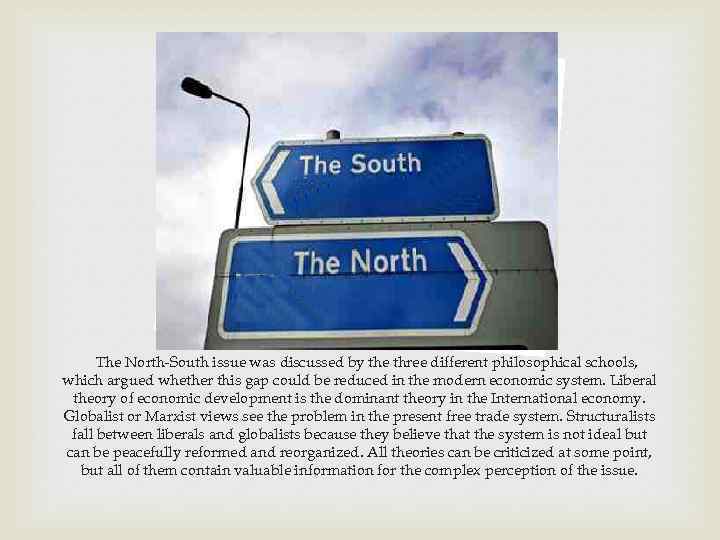
The North-South issue was discussed by the three different philosophical schools, which argued whether this gap could be reduced in the modern economic system. Liberal theory of economic development is the dominant theory in the International economy. Globalist or Marxist views see the problem in the present free trade system. Structuralists fall between liberals and globalists because they believe that the system is not ideal but can be peacefully reformed and reorganized. All theories can be criticized at some point, but all of them contain valuable information for the complex perception of the issue.
According to the historical development of the poor countries, the period of decolonization and industrialization after the World War II was aimed at achieving independence and escaping the poverty. Some theoretical attempts to industrialize the domestic economy were to take advantage of cheap labor in order to attract investors, to produce more food and then invest the money in industry, and to improve educational system. The first idea is not applicable today when the blue-collar workers are less important than before. Production of more food created competition among the countries with similar export. Therefore obtaining enough money for the industrialization from exporting food became more difficult. Education required a lot of time and training, which might work in a long run prospective, but would not immediately contribute to the economic growth to the country. As the result of the decolonization, the poor countries achieved political independence but did not obtain economic one. In many cases developing countries experienced hardships in having some other state but their Mother country as their financial provider. The economies of the developing countries were short of capital and technical skills. Both factors constituted the dependence of the Southern countries on the technology and financial resources of the developed countries. Another wave of dependence was that developing countries based their economies on one exporting material and therefore soon became dependent on their Mother countries, which were interested in one or two industries producing the necessary material and kept other industries undeveloped.
Another way to achieve economic growth for developing countries was to ask the United Nations for help in terms of foreign aid and special trade preferences such as lower tariffs. As a result of this unison cry for changes Group of Seventy-Seven (G-77) was created "to act as a permanent political block representing the interests of the developing countries in the UN". The formation of the United Nations Conference on Trade and Development (UNCTAD), which presented the ideas of structuralists about the greater aid flows, restricting of free trade and control of multinational corporations, reflected the confrontations between rich and poor countries in UN.
Therefore, economic dependency has also brought a problem of social inequality. The North-South gap can be reduced by the reforms, which should be aimed on economic growth of the developing countries and on their social development as an equal member of the society. New forms of foreign participation such as "joint ventures, management contracts, licensing agreements" may bring a difference in the relationship between the North and the South by promoting their cooperation rather than the conflict.

Thank you for your attention!
Скачать презентацию North South problems Done by Ivanchenko Victoriya
north-south.pptx