


 Скачать презентацию Normalization for c DNA Microarray Data Yee Hwa
f8393114b03e55bb97dae6ef283acc58.ppt
- Количество слайдов: 24
 Normalization for c. DNA Microarray Data Yee Hwa Yang, Sandrine Dudoit, Percy Luu and Terry Speed. SPIE BIOS 2001, San Jose, CA January 22, 2001
 Normalization issues Within-slide – What genes to use – Location – Scale Paired-slides (dye swap) – Self-normalization Between slides
 Within-Slide Normalization —Normalization balances red and green intensities. —Imbalances can be caused by – Different incorporation of dyes – Different amounts of m. RNA – Different scanning parameters —In practice, we usually need to increase the red intensity a bit to balance the green
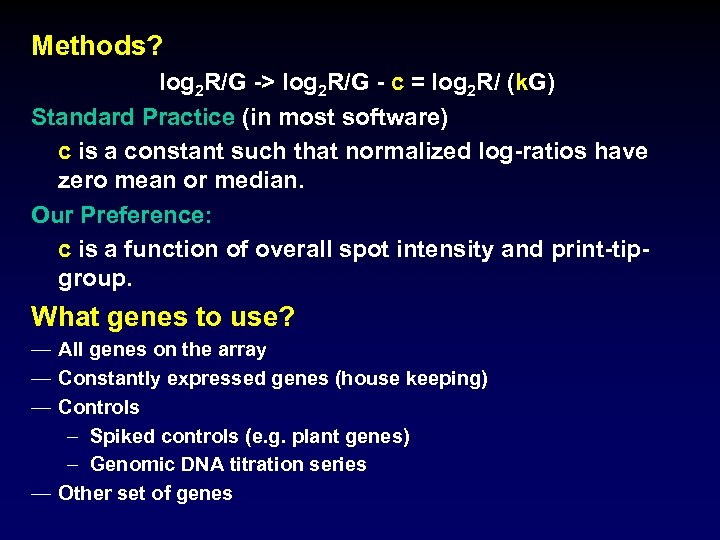 Methods? log 2 R/G -> log 2 R/G - c = log 2 R/ (k. G) Standard Practice (in most software) c is a constant such that normalized log-ratios have zero mean or median. Our Preference: c is a function of overall spot intensity and print-tipgroup. What genes to use? — All genes on the array — Constantly expressed genes (house keeping) — Controls – Spiked controls (e. g. plant genes) – Genomic DNA titration series — Other set of genes
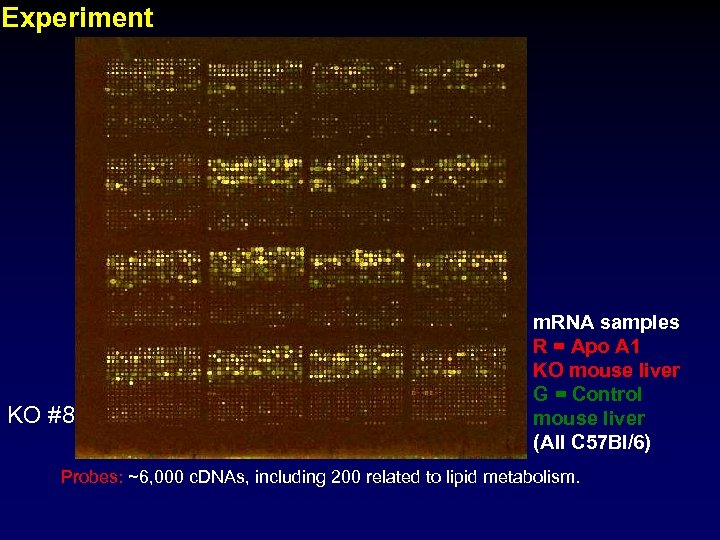 Experiment KO #8 m. RNA samples R = Apo A 1 KO mouse liver G = Control mouse liver (All C 57 Bl/6) Probes: ~6, 000 c. DNAs, including 200 related to lipid metabolism.
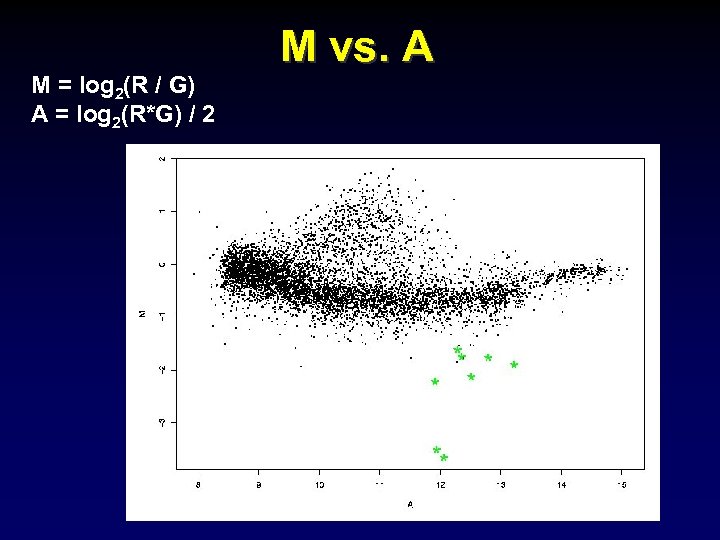 M = log 2(R / G) A = log 2(R*G) / 2 M vs. A
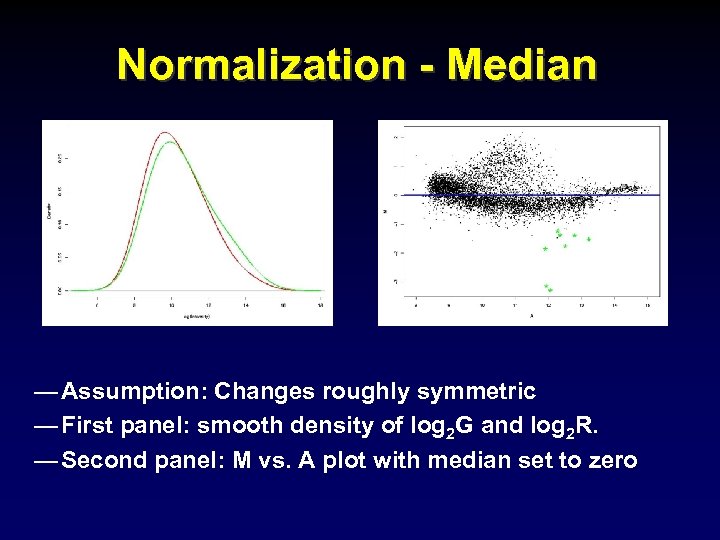 Normalization - Median — Assumption: Changes roughly symmetric — First panel: smooth density of log 2 G and log 2 R. — Second panel: M vs. A plot with median set to zero
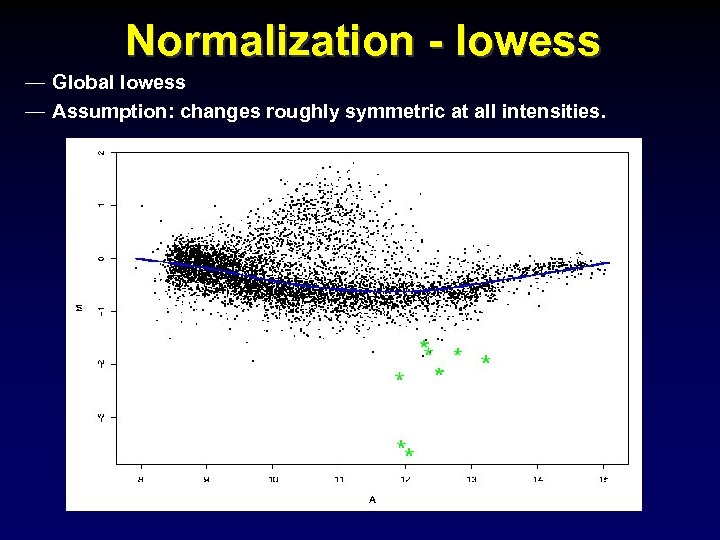 Normalization - lowess — Global lowess — Assumption: changes roughly symmetric at all intensities.
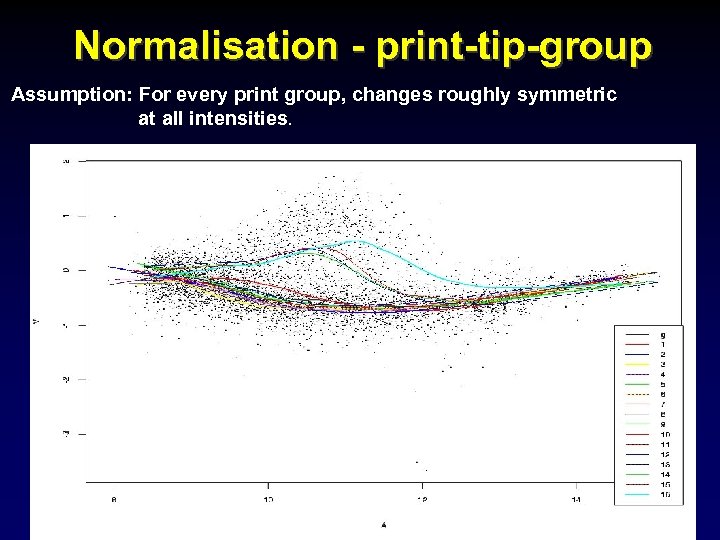 Normalisation - print-tip-group Assumption: For every print group, changes roughly symmetric at all intensities.
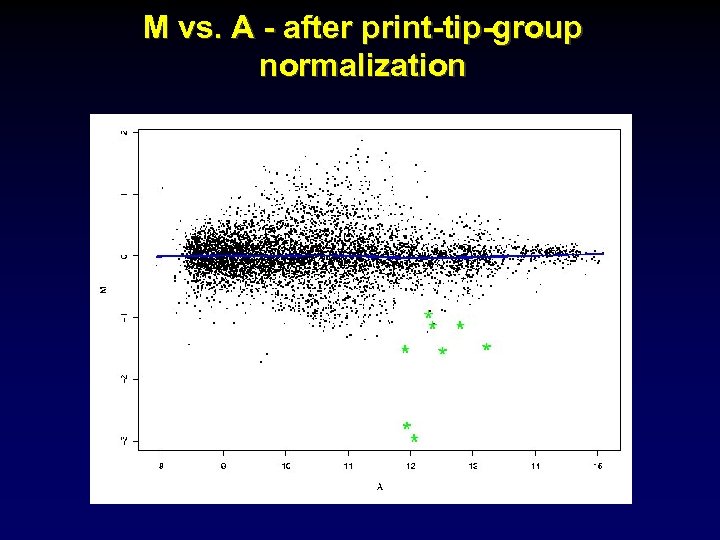 M vs. A - after print-tip-group normalization
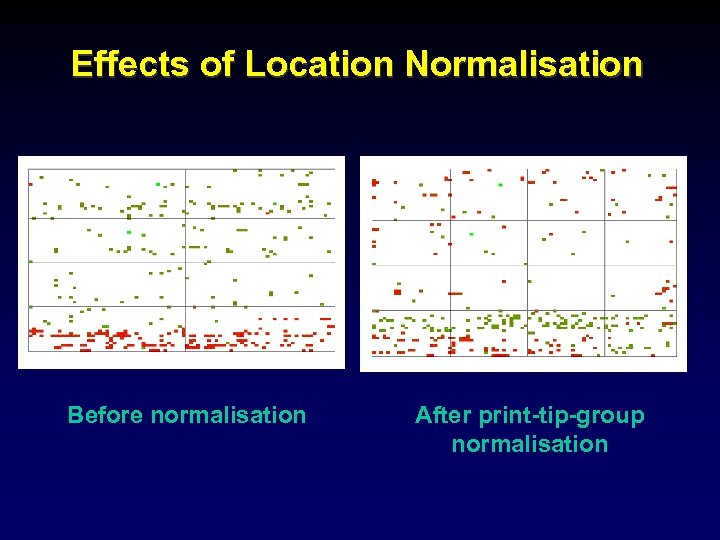 Effects of Location Normalisation Before normalisation After print-tip-group normalisation
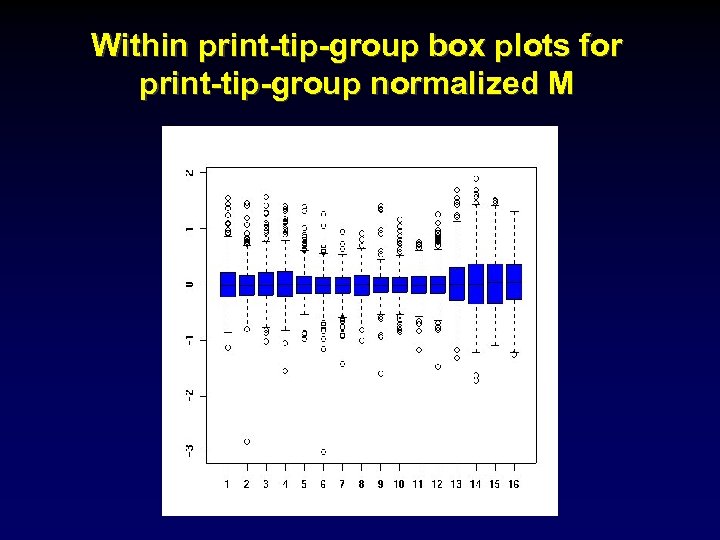 Within print-tip-group box plots for print-tip-group normalized M
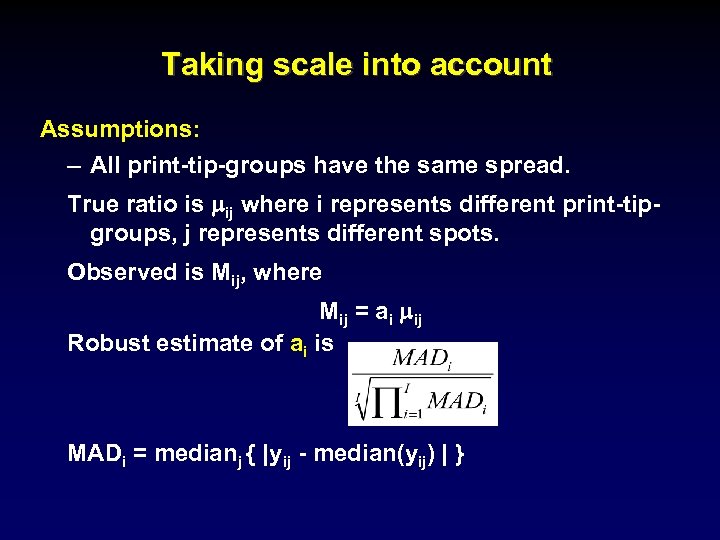 Taking scale into account Assumptions: – All print-tip-groups have the same spread. True ratio is mij where i represents different print-tipgroups, j represents different spots. Observed is Mij, where Mij = ai mij Robust estimate of ai is MADi = medianj { |yij - median(yij) | }
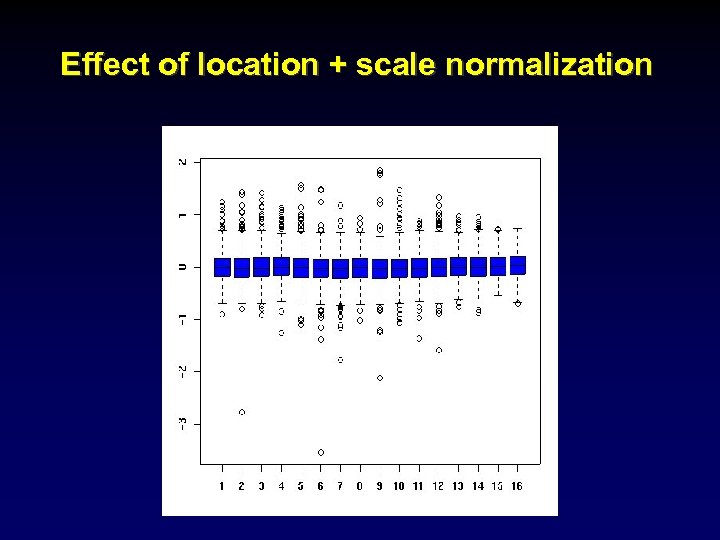 Effect of location + scale normalization
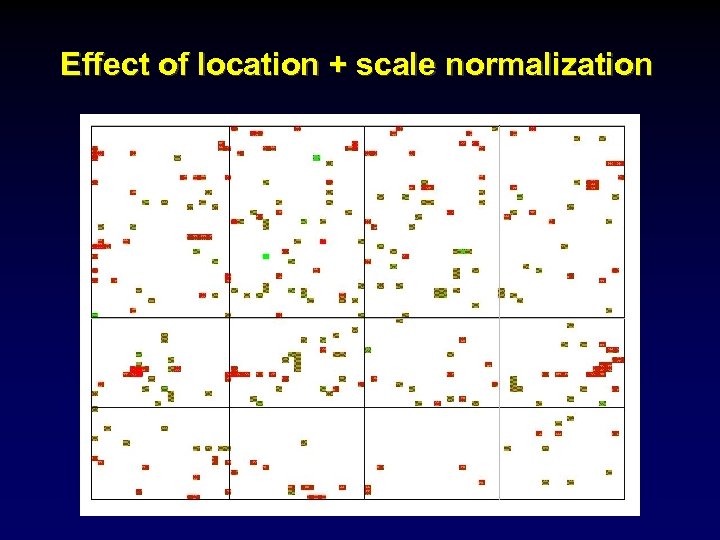 Effect of location + scale normalization
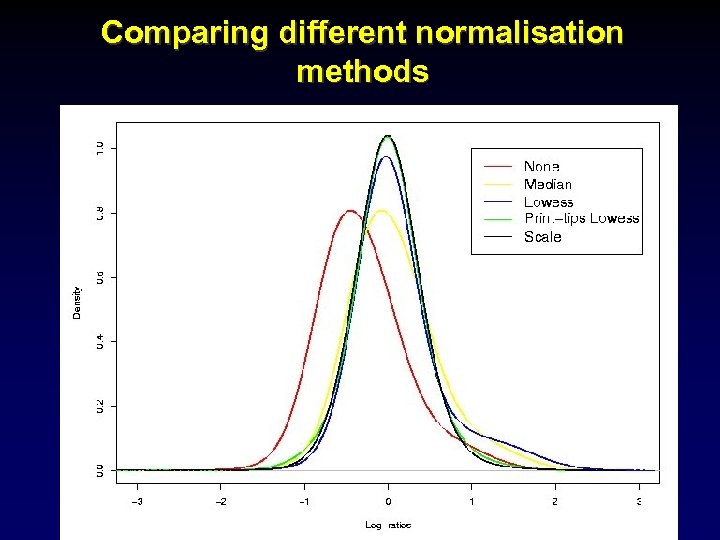 Comparing different normalisation methods
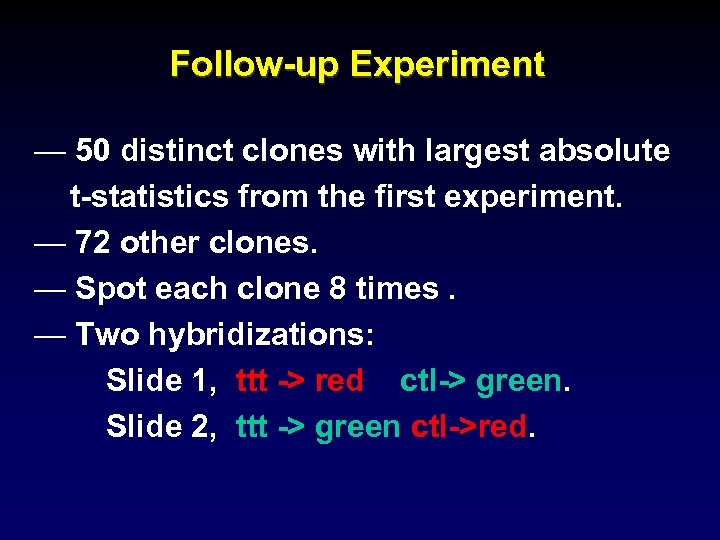 Follow-up Experiment — 50 distinct clones with largest absolute t-statistics from the first experiment. — 72 other clones. — Spot each clone 8 times. — Two hybridizations: Slide 1, ttt -> red ctl-> green. Slide 2, ttt -> green ctl->red.
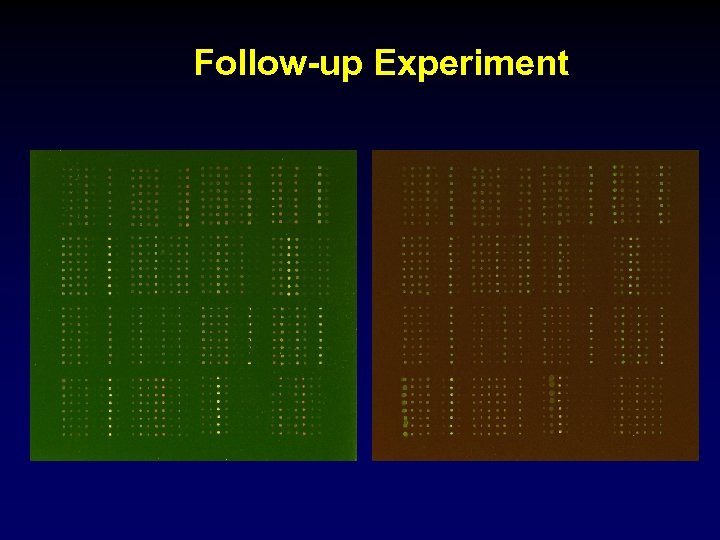 Follow-up Experiment
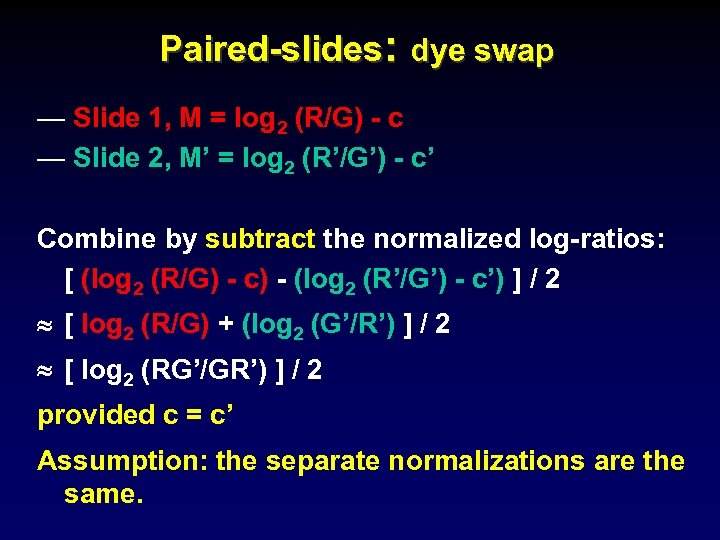 Paired-slides: dye swap — Slide 1, M = log 2 (R/G) - c — Slide 2, M’ = log 2 (R’/G’) - c’ Combine by subtract the normalized log-ratios: [ (log 2 (R/G) - c) - (log 2 (R’/G’) - c’) ] / 2 [ log 2 (R/G) + (log 2 (G’/R’) ] / 2 [ log 2 (RG’/GR’) ] / 2 provided c = c’ Assumption: the separate normalizations are the same.
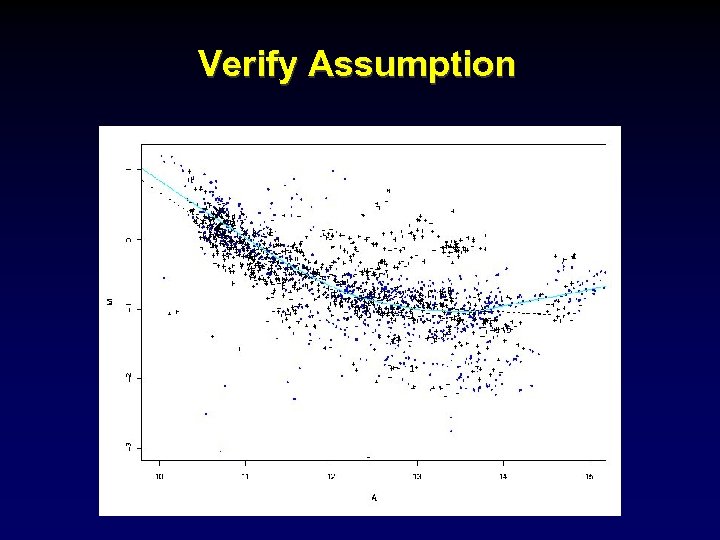 Verify Assumption
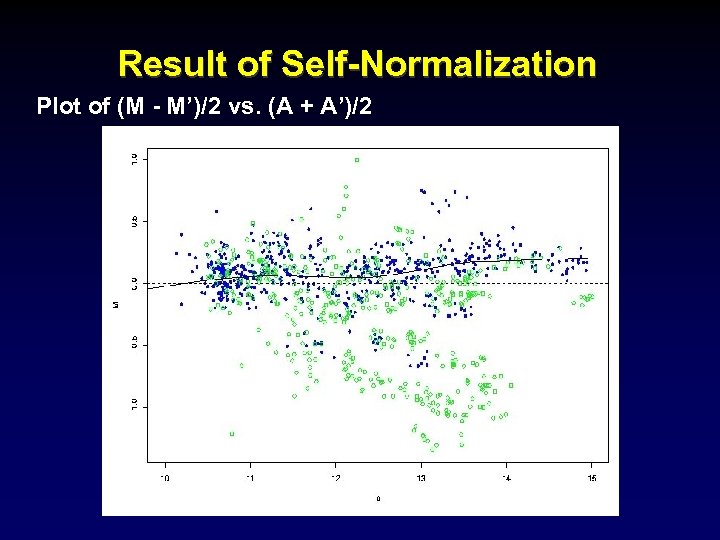 Result of Self-Normalization Plot of (M - M’)/2 vs. (A + A’)/2
 Summary Case 1: A few genes that are likely to change Within-slide: – Location: print-tip-group lowess normalization. – Scale: for all print-tip-groups, adjust MAD to equal the geometric mean for MAD for all print-tip-groups. Between slides (experiments) : – An extension of within-slide scale normalization (future work). Case 2: Many genes changing (paired-slides) – Self-normalization: taking the difference of the two log-ratios. – Check using controls or known information.
 http: //www. stat. berkeley. edu/users/terry/zarray/Html/ Technical Reports from Terry’s group: http: //www. stat. Berkeley. EDU/users/terry/zarray/Html /papersindex. html — Comparison of Discrimination Methods for the Classification of Tumors Using Gene Expression Data — Statistical methods for identifying differentially expressed genes in replicated c. DNA microarray experiments. — Comparison of methods for image analysis on c. DNA microarray data. — Normalization for c. DNA Microarray Data Statistical software R http: //lib. stat. cmu. edu/R/CRAN/
 Acknowledgments Terry Speed Sandrine Dudoit Natalie Roberts Ben Bolstad Matt Callow (LBL) John Ngai’s Lab (UCB) Percy Luu Dave Lin Vivian Pang Elva Diaz