


 Скачать презентацию Nordic study of Country Level CSO Support Models
5d31fc66812875332a09aad0a5c5890b.ppt
- Количество слайдов: 16
 Nordic+ study of Country Level CSO Support Models Ivar Evensmo, Senior Adviser, Civil Society Department, Norad 4 February 2008
 Overview • • Background and process Findings about major trends re: models of country-based CS support Conclusions and recommendations of the Scanteam study Nordic+ - way forward: Analysts' recommendations to donors 2
 Definition: Country-based support for civil society • Support for civil society in the South provided at recipient country level (as opposed to assistance provided through Northern channels, such as through the HQ of Northern CSOs) 3
 Background, process • Nordic+ DG meeting in Nairobi, Nov. 06 • Nordic+ CS partners meeting in Oslo 27 -28 Feb 07: CIDA, SIDA, DFID, Ireland, Finland, Norad (lead) • Six case countries: Bangladesh, Guatemala, Ethiopia, Tanzania, Zambia, Zimbabwe • Scanteam: fieldwork Apr-July 07 • Nordic+ draft Management Response & Conclusions for DGs Dec 07/Jan 08 4
 Key issues • How can models of civil society support help to strengthen CS in the South, promote local ownership and reduce transaction costs? • How can a greater share of funding be channelled directly to Southern CSOs while maintaining the advantages of North-South Partnerships? • What is the right balance between responsive CSO funding and more strategic intervention by direct funding, core/programme support and capacity development? • Which support models will best ensure funding diversity and outreach? • Which support models will best allow CSOs to strengthen their various accountabilities and development effectiveness? 5
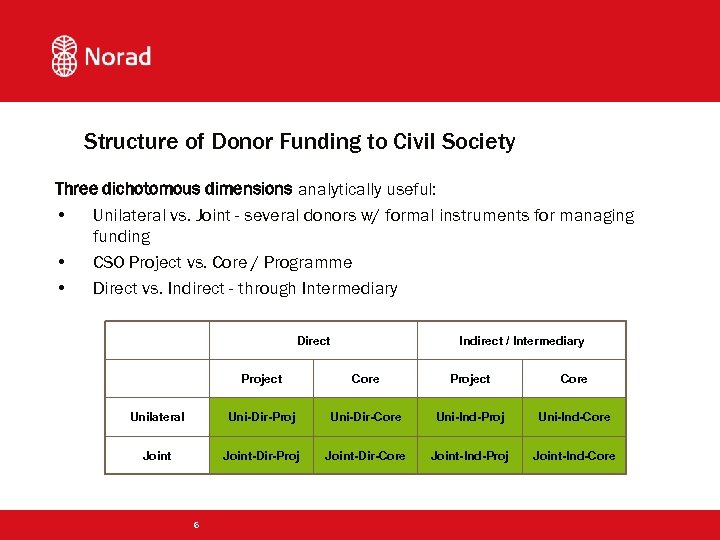 Structure of Donor Funding to Civil Society Three dichotomous dimensions analytically useful: • Unilateral vs. Joint - several donors w/ formal instruments for managing funding • CSO Project vs. Core / Programme • Direct vs. Indirect - through Intermediary Direct Indirect / Intermediary Project Core Unilateral Uni-Dir-Proj Uni-Dir-Core Uni-Ind-Proj Uni-Ind-Core Joint-Dir-Proj Joint-Dir-Core Joint-Ind-Proj Joint-Ind-Core 6
 Status and Trends Status – varies by donor, by country, over time. Can be changed - no need for policy changes! Trends • • From Unilateral to Joint From Direct to Indirect / Use of Intermediary (Probably) from Project to Core / Programme Different driving forces General: moving towards multi-actor, strategic support forms 7
 Objectives and Modalities 1. Aid Effectiveness ("Paris Agenda") • Ownership, Mutual Accountability Joint, longer-term Core/Prog support – BUT w/ better Results Reporting • Harmonisation Donors should move faster IF / WHEN objectives clear • Managing for Results Clarify Objectives • Alignment "with what? ": CS not monolithic … 2. Vibrant, Diverse, Democratic Civil Society: • Outreach: Unclear concept, no operational goals • Accessibility: No strategy for reducing transaction costs Study’s Outcome Statement: Donors lack strategic goals/outcome statements for CS support Unclear goals No criteria for selecting instrument 8
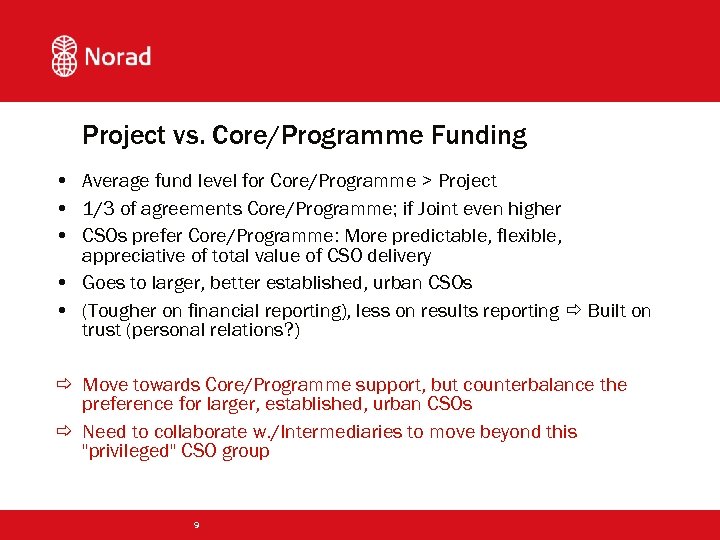 Project vs. Core/Programme Funding • Average fund level for Core/Programme > Project • 1/3 of agreements Core/Programme; if Joint even higher • CSOs prefer Core/Programme: More predictable, flexible, appreciative of total value of CSO delivery • Goes to larger, better established, urban CSOs • (Tougher on financial reporting), less on results reporting Built on trust (personal relations? ) Move towards Core/Programme support, but counterbalance the preference for larger, established, urban CSOs Need to collaborate w. /Intermediaries to move beyond this "privileged" CSO group 9
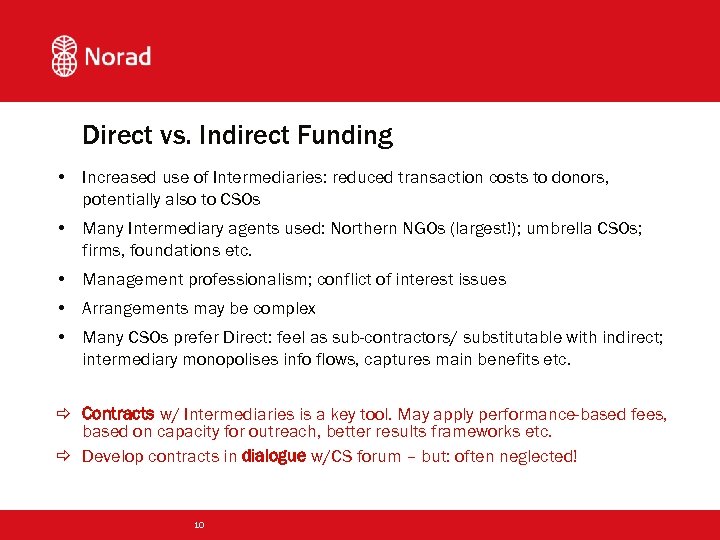 Direct vs. Indirect Funding • Increased use of Intermediaries: reduced transaction costs to donors, potentially also to CSOs • Many Intermediary agents used: Northern NGOs (largest!); umbrella CSOs; firms, foundations etc. • Management professionalism; conflict of interest issues • Arrangements may be complex • Many CSOs prefer Direct: feel as sub-contractors/ substitutable with indirect; intermediary monopolises info flows, captures main benefits etc. Contracts w/ Intermediaries is a key tool. May apply performance-based fees, based on capacity for outreach, better results frameworks etc. Develop contracts in dialogue w/CS forum – but: often neglected! 10
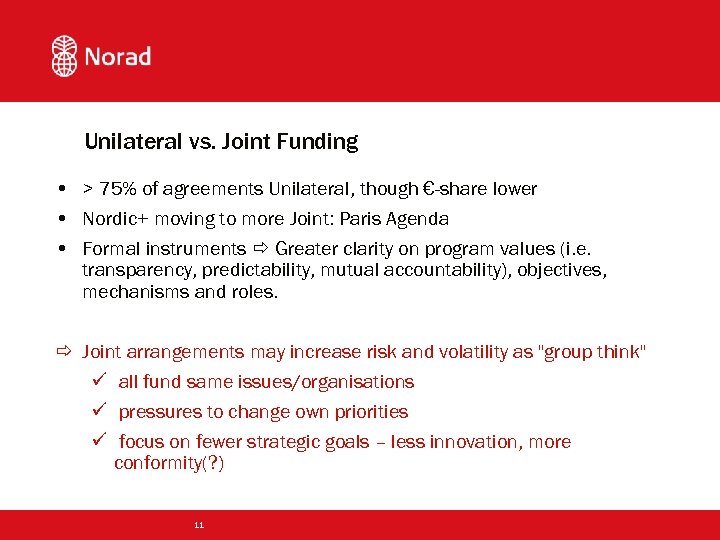 Unilateral vs. Joint Funding • > 75% of agreements Unilateral, though €-share lower • Nordic+ moving to more Joint: Paris Agenda • Formal instruments Greater clarity on program values (i. e. transparency, predictability, mutual accountability), objectives, mechanisms and roles. Joint arrangements may increase risk and volatility as "group think" ü all fund same issues/organisations ü pressures to change own priorities ü focus on fewer strategic goals – less innovation, more conformity(? ) 11
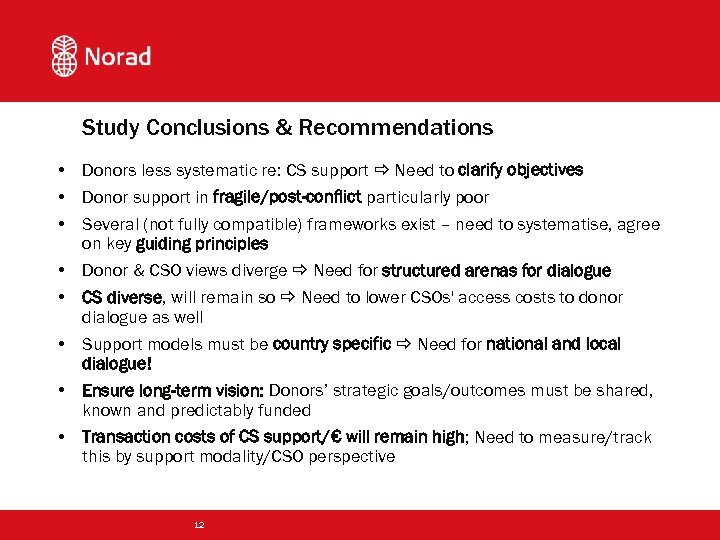 Study Conclusions & Recommendations • Donors less systematic re: CS support Need to clarify objectives • Donor support in fragile/post-conflict particularly poor • Several (not fully compatible) frameworks exist – need to systematise, agree on key guiding principles • Donor & CSO views diverge Need for structured arenas for dialogue • CS diverse, will remain so Need to lower CSOs' access costs to donor dialogue as well • Support models must be country specific Need for national and local dialogue! • Ensure long-term vision: Donors’ strategic goals/outcomes must be shared, known and predictably funded • Transaction costs of CS support/€ will remain high; Need to measure/track this by support modality/CSO perspective 12
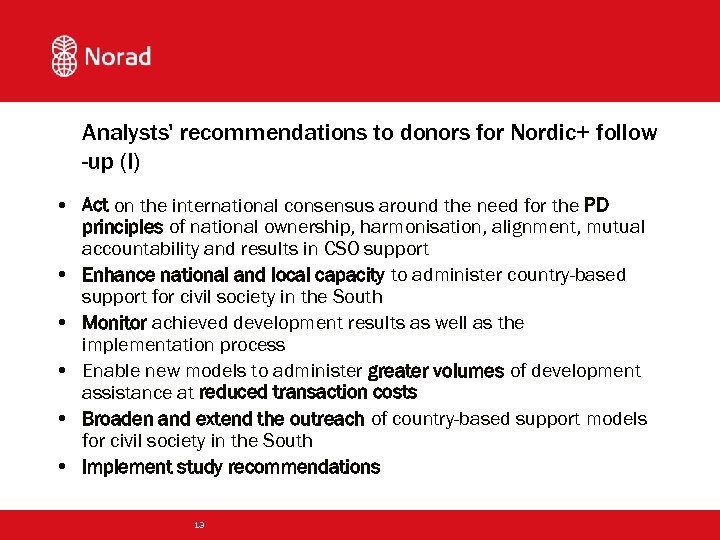 Analysts' recommendations to donors for Nordic+ follow -up (I) • Act on the international consensus around the need for the PD principles of national ownership, harmonisation, alignment, mutual accountability and results in CSO support • Enhance national and local capacity to administer country-based support for civil society in the South • Monitor achieved development results as well as the implementation process • Enable new models to administer greater volumes of development assistance at reduced transaction costs • Broaden and extend the outreach of country-based support models for civil society in the South • Implement study recommendations 13
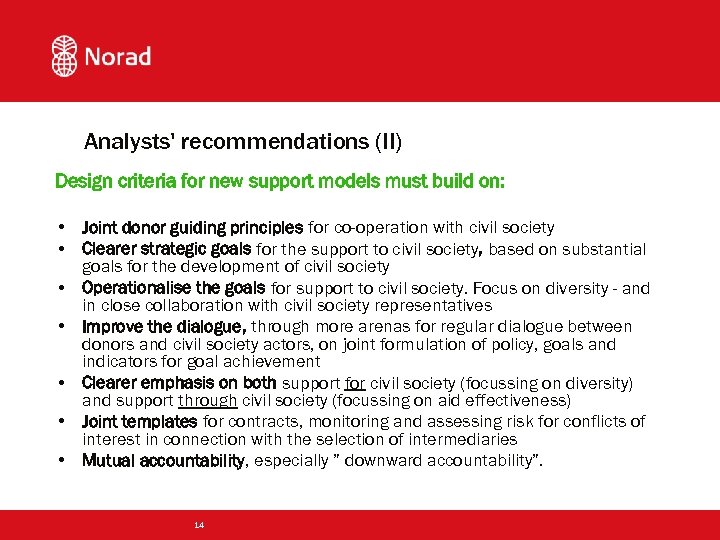 Analysts' recommendations (II) Design criteria for new support models must build on: • Joint donor guiding principles for co-operation with civil society • Clearer strategic goals for the support to civil society, based on substantial goals for the development of civil society • Operationalise the goals for support to civil society. Focus on diversity - and in close collaboration with civil society representatives • Improve the dialogue, through more arenas for regular dialogue between donors and civil society actors, on joint formulation of policy, goals and indicators for goal achievement • Clearer emphasis on both support for civil society (focussing on diversity) and support through civil society (focussing on aid effectiveness) • Joint templates for contracts, monitoring and assessing risk for conflicts of interest in connection with the selection of intermediaries • Mutual accountability, especially ” downward accountability”. 14
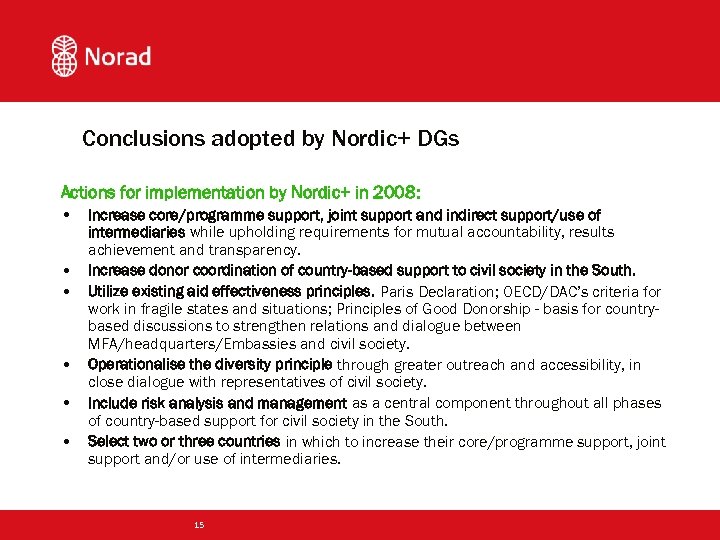 Conclusions adopted by Nordic+ DGs Actions for implementation by Nordic+ in 2008: • Increase core/programme support, joint support and indirect support/use of intermediaries while upholding requirements for mutual accountability, results achievement and transparency. • Increase donor coordination of country-based support to civil society in the South. • Utilize existing aid effectiveness principles. Paris Declaration; OECD/DAC’s criteria for work in fragile states and situations; Principles of Good Donorship - basis for countrybased discussions to strengthen relations and dialogue between MFA/headquarters/Embassies and civil society. • Operationalise the diversity principle through greater outreach and accessibility, in close dialogue with representatives of civil society. • Include risk analysis and management as a central component throughout all phases of country-based support for civil society in the South. • Select two or three countries in which to increase their core/programme support, joint support and/or use of intermediaries. 15
 Questions? 16