


 Скачать презентацию Non-Transcranial Electroanesthesia Group 2 Students Ryan Demeter Matt
b0040a90dd6a68809e9badf0ac9d54c7.ppt
- Количество слайдов: 29
 Non-Transcranial Electroanesthesia Group 2 Students: Ryan Demeter Matt Jackson Caroline Shulman Matt Whitfield Advisors: Dr Paul King and Dr James Berry
 Project Definition • Design, build, and test a system for both administering and recording data related to vagal nerve stimulation. • Topics to cover: Project Background, Vagal Nerve Information, Design Ideas, Stimulation (production and application) Techniques, Testing, Current and Overall Status, and BMEidea 2
 Current Anesthetic Techniques • Sedation Øadministered through vein • Local anesthesia Ølocally numb area • Regional anesthesia Øblock pain signals from single nerve bundle • General anesthesia ØComplete unconsciousness Mayo Clinic 3
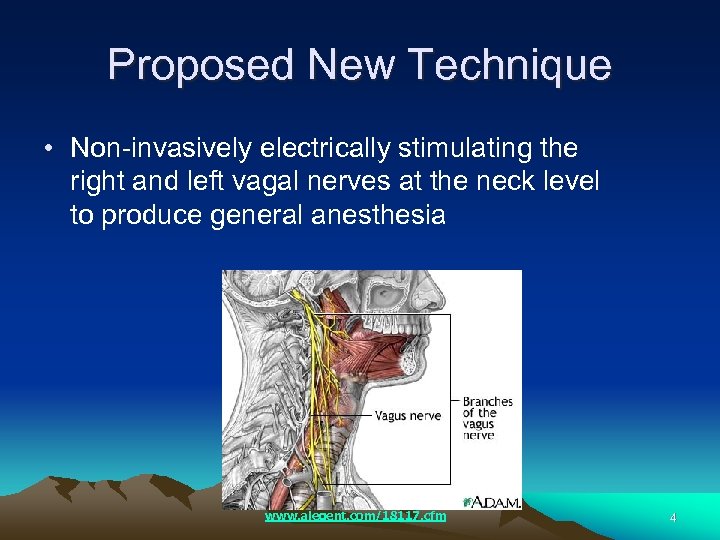 Proposed New Technique • Non-invasively electrically stimulating the right and left vagal nerves at the neck level to produce general anesthesia www. alegent. com/18117. cfm 4
 Background of Electroanethesia • Electroanesthesia can occur by passing electric current through the scalp (Kano et al. 1976) • Quicker recovery time and less biological effect during and after surgery than gas (Photiades, 218 -225) • Heal better (Sances & Larson, 21 -27) • Less of a buildup of gases in the body (Sances & Larson, 218 -219) • Few detrimental effects on EEG or ECG (Sances & Larson, 55 -58) • Electrolyte levels in extracellular and intracellular fluid of the brain (Sances & Larson, 148 -175) • Decreased gastric acid secretion (Sances & Larson, 33 -46) • FDA concerns • Vagal nerve stimulation (Kirchner et al. , Ness et al. ) 5
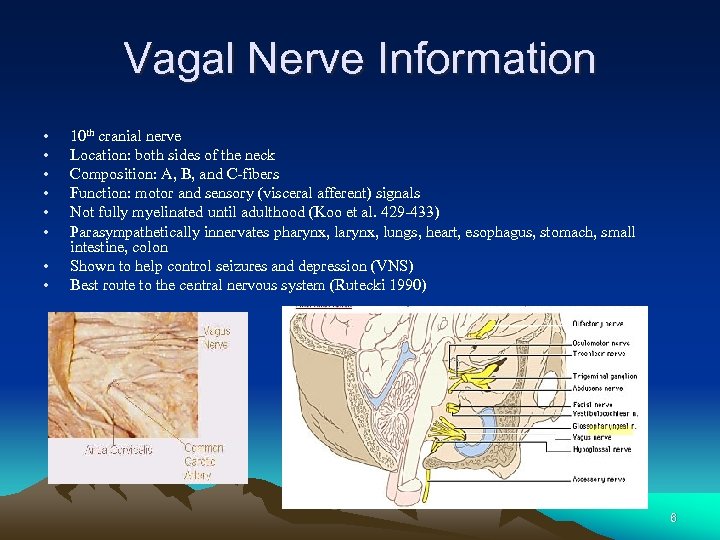 Vagal Nerve Information • • 10 th cranial nerve Location: both sides of the neck Composition: A, B, and C-fibers Function: motor and sensory (visceral afferent) signals Not fully myelinated until adulthood (Koo et al. 429 -433) Parasympathetically innervates pharynx, lungs, heart, esophagus, stomach, small intestine, colon Shown to help control seizures and depression (VNS) Best route to the central nervous system (Rutecki 1990) 6
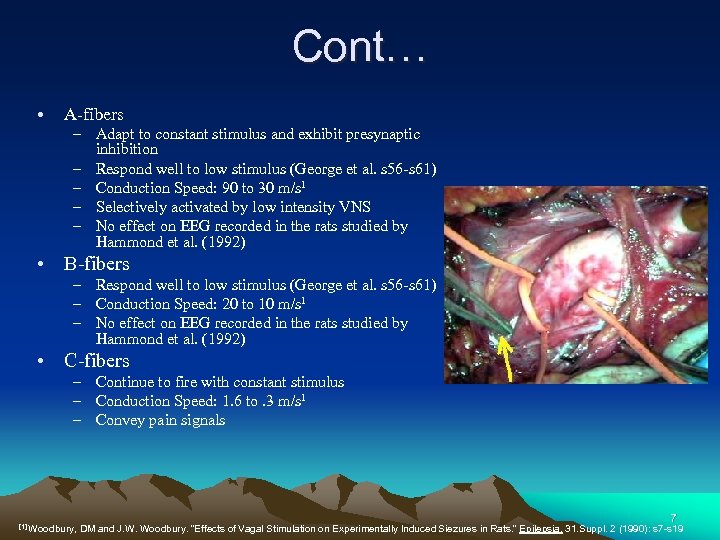 Cont… • A-fibers – Adapt to constant stimulus and exhibit presynaptic inhibition – Respond well to low stimulus (George et al. s 56 -s 61) – Conduction Speed: 90 to 30 m/s 1 – Selectively activated by low intensity VNS – No effect on EEG recorded in the rats studied by Hammond et al. (1992) • B-fibers – Respond well to low stimulus (George et al. s 56 -s 61) – Conduction Speed: 20 to 10 m/s 1 – No effect on EEG recorded in the rats studied by Hammond et al. (1992) • C-fibers – Continue to fire with constant stimulus – Conduction Speed: 1. 6 to. 3 m/s 1 – Convey pain signals 7 [1] Woodbury, DM and J. W. Woodbury. “Effects of Vagal Stimulation on Experimentally Induced Siezures in Rats. ” Epilepsia. 31. Suppl. 2 (1990): s 7 -s 19
 Mechanism: efferent • Over-stimulation of vagal nerve can result in fainting ØParasympathetic innervations ØSlows breathing and heart rate ØReduced O 2 to brain » » fainting û Not desired effect! 8
 Mechanism: afferent • Over-stimulate pain centers in brain ØTotal loss of consciousness? ØLoss of pain perception? • Ideally stimulation needs to be more powerful than VNS, but low enough not to cause efferent effects 9
 Project Background • Currently, electroanesthesia devices are in use in Europe. • In less developed countries where anesthesia technology is lacking, an electroanesthesia device would reduce both the cost of the procedure and the need for technical personal (anesthesiologist). – – – S. Leduc Europe, Japan, Russia, and Germany Activation of a theoretical pain center 35 V, 4 m. A, 100 Hz, rectangular pulsating signal Alternative method • Descending mechanism and the interconnections within the brain 10
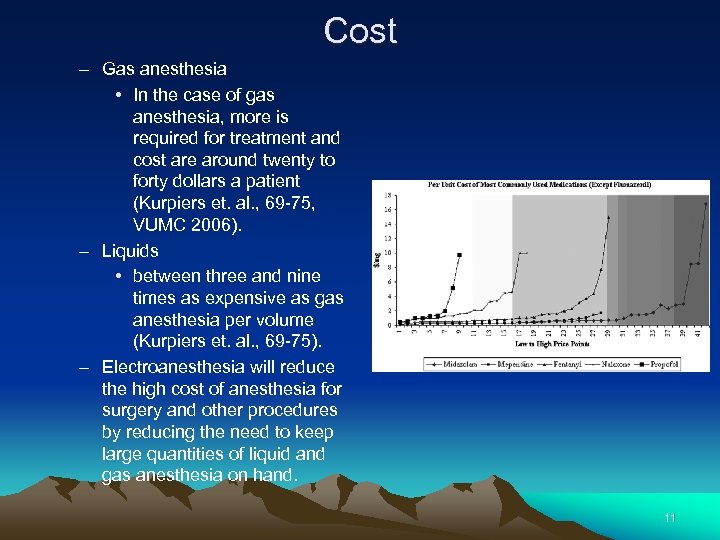 Cost – Gas anesthesia • In the case of gas anesthesia, more is required for treatment and cost are around twenty to forty dollars a patient (Kurpiers et. al. , 69 -75, VUMC 2006). – Liquids • between three and nine times as expensive as gas anesthesia per volume (Kurpiers et. al. , 69 -75). – Electroanesthesia will reduce the high cost of anesthesia for surgery and other procedures by reducing the need to keep large quantities of liquid and gas anesthesia on hand. 11
 Cost cont. Current – Monitor including vital signs • $ 50, 000 – The machine • $70, 000 for – Gas • $100 Ours • vital signs equipment – $2, 000 if added • The laptop cost – $600 • electrical components – $100 • Electricity – $10. 00 12
 Methods • Computer system • Vital signs monitoring equipment • Testing – Phase I: - Device components connected and tested to assure compatibility -Software integrated and tested to assure compatibility and properation -Test inputs and outputs of device – Phase II: Applicator testing to assure proper outputs and operation – Phase III: Testing of device operation with a rat 13
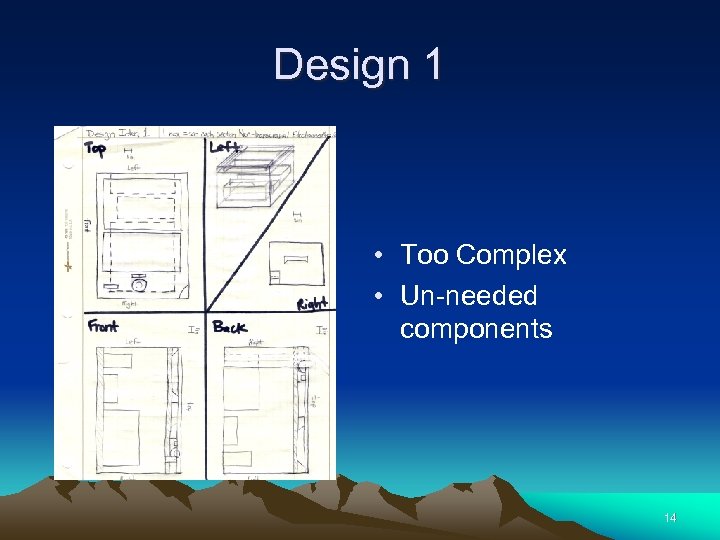 Design 1 • Too Complex • Un-needed components 14
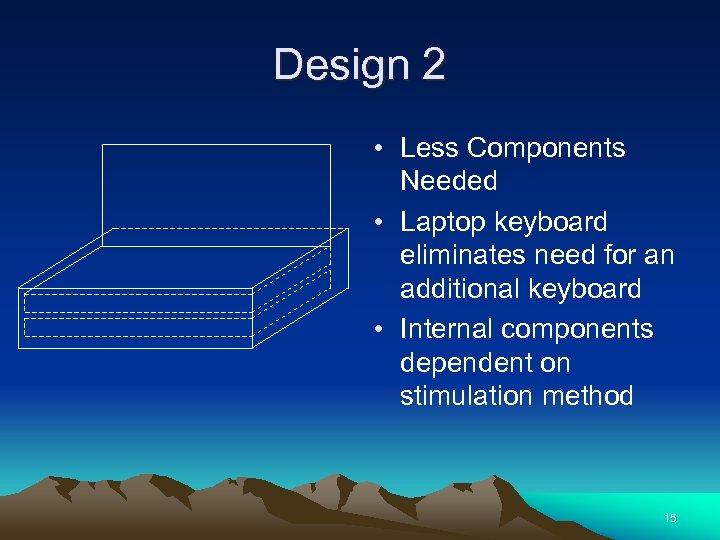 Design 2 • Less Components Needed • Laptop keyboard eliminates need for an additional keyboard • Internal components dependent on stimulation method 15
 Stimulation Parameters • Stimulation of both Vagal Nerves • 20 Hz Rectangular pulse signal • Pulse length of 250 µs (Liporace et al. 885 -886) • 50 µA (Kirchner et al. 1167 -1171) • 25 V • Need to consult more with Dr. Berry to estimate best parameters 16
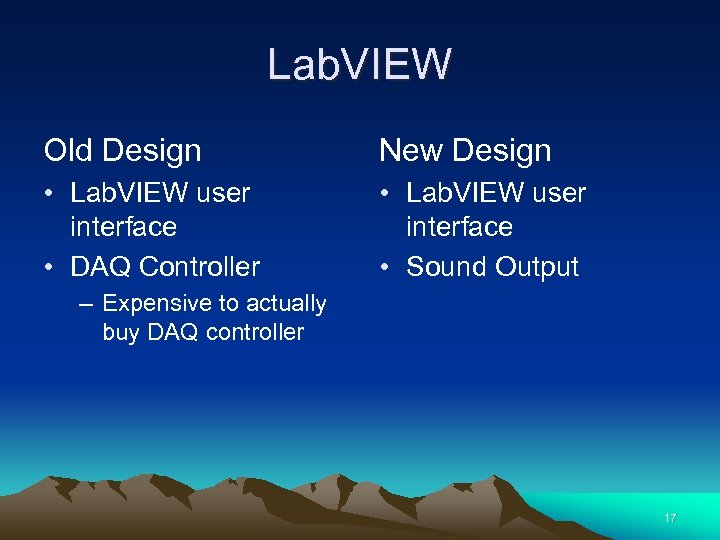 Lab. VIEW Old Design New Design • Lab. VIEW user interface • DAQ Controller • Lab. VIEW user interface • Sound Output – Expensive to actually buy DAQ controller 17
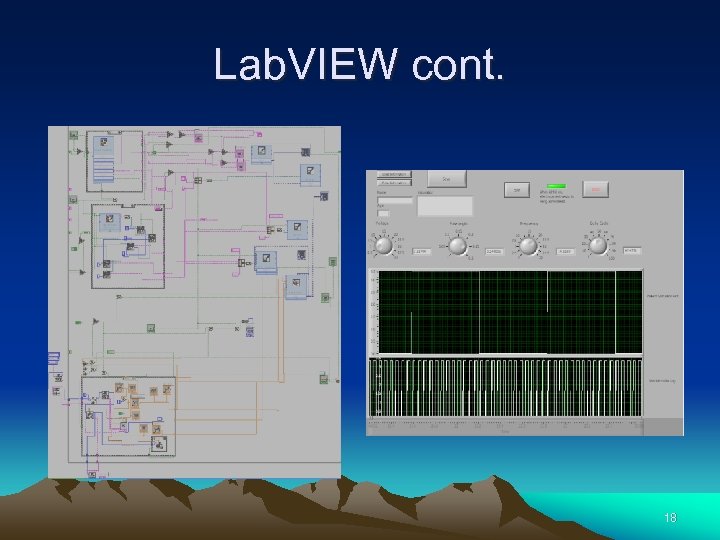 Lab. VIEW cont. 18
 Delivering Electroanesthesia • Gain Stage - Advantage: Computer compatible - Disadvantage: Noise, unforeseen circuitry problems 19
 Details • Sound card (Output only 1 V) – Gain(~25) • Enclosed Circuitry 20
 Recent Contacts • Ray Booker - Simulation engineer at Ctr. for Medical Simulation – Discussed head and neck phantoms • Cost • Availability • Function 21
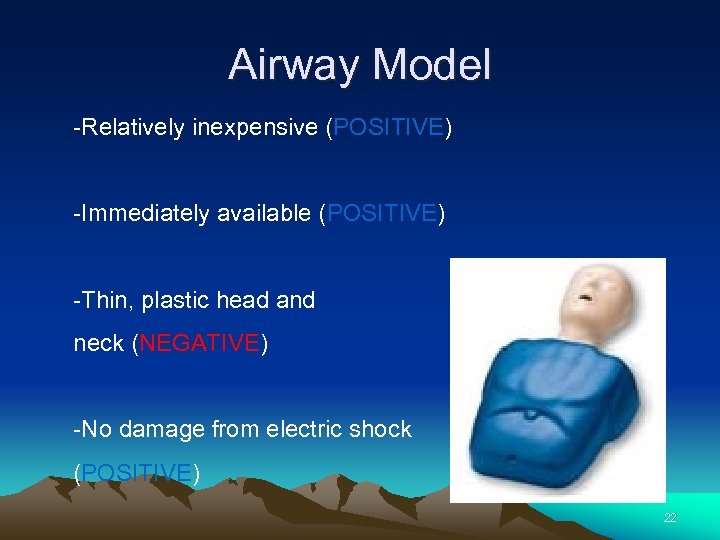 Airway Model -Relatively inexpensive (POSITIVE) -Immediately available (POSITIVE) -Thin, plastic head and neck (NEGATIVE) -No damage from electric shock (POSITIVE) 22
 Impedance testing • Acquire pig head from slaughterhouse – Pig skin has properties like human skin • Testing phase • Signal needs to be effective at a thickness of roughly 2 cm 23
 Patent Search • #6, 393, 319 May 21, 2002 • Data for electrical waveforms stored on CD • Amplified and conditioned for stimulation via electrode on the skin • However…. 24
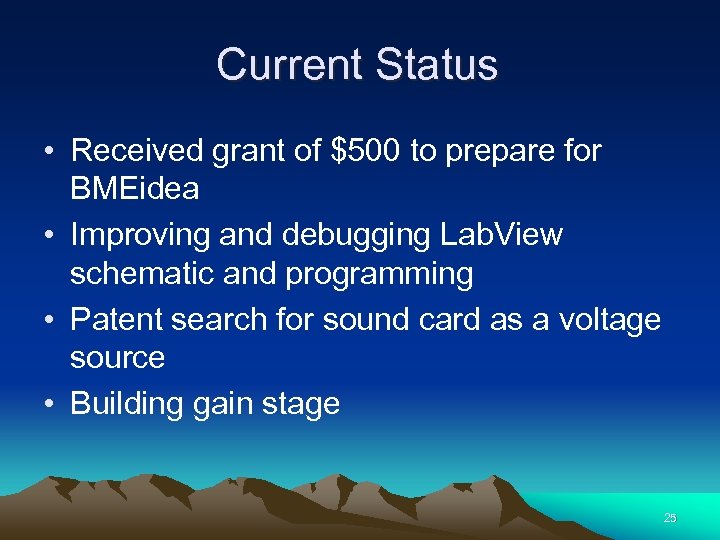 Current Status • Received grant of $500 to prepare for BMEidea • Improving and debugging Lab. View schematic and programming • Patent search for sound card as a voltage source • Building gain stage 25
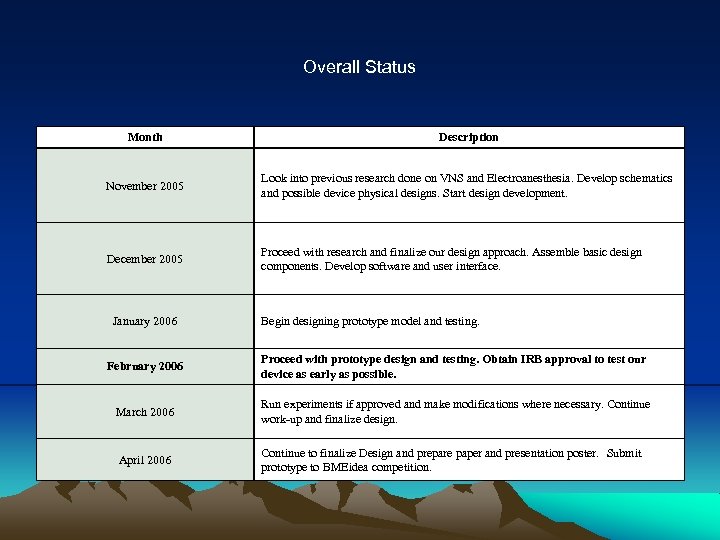 Overall Status Month Description November 2005 Look into previous research done on VNS and Electroanesthesia. Develop schematics and possible device physical designs. Start design development. December 2005 Proceed with research and finalize our design approach. Assemble basic design components. Develop software and user interface. January 2006 Begin designing prototype model and testing. February 2006 Proceed with prototype design and testing. Obtain IRB approval to test our device as early as possible. March 2006 Run experiments if approved and make modifications where necessary. Continue work-up and finalize design. April 2006 Continue to finalize Design and prepare paper and presentation poster. Submit prototype to BMEidea competition.
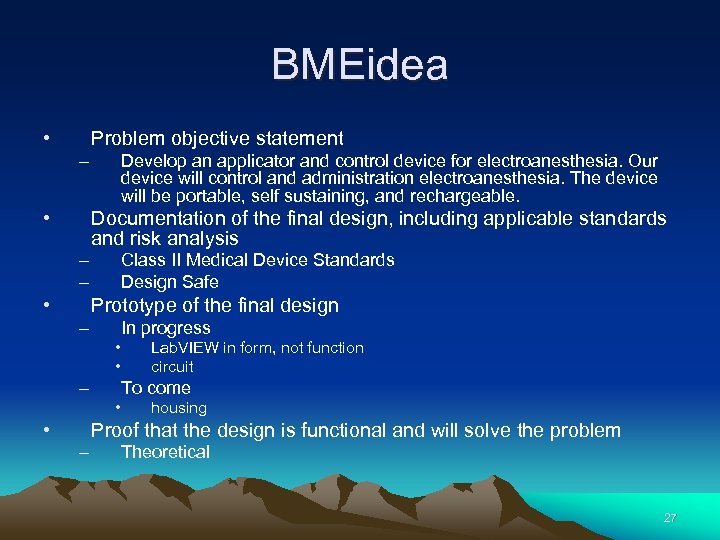 BMEidea • Problem objective statement – • Develop an applicator and control device for electroanesthesia. Our device will control and administration electroanesthesia. The device will be portable, self sustaining, and rechargeable. Documentation of the final design, including applicable standards and risk analysis – – • Class II Medical Device Standards Design Safe Prototype of the final design – In progress • • – To come • • Lab. VIEW in form, not function circuit housing Proof that the design is functional and will solve the problem – Theoretical 27
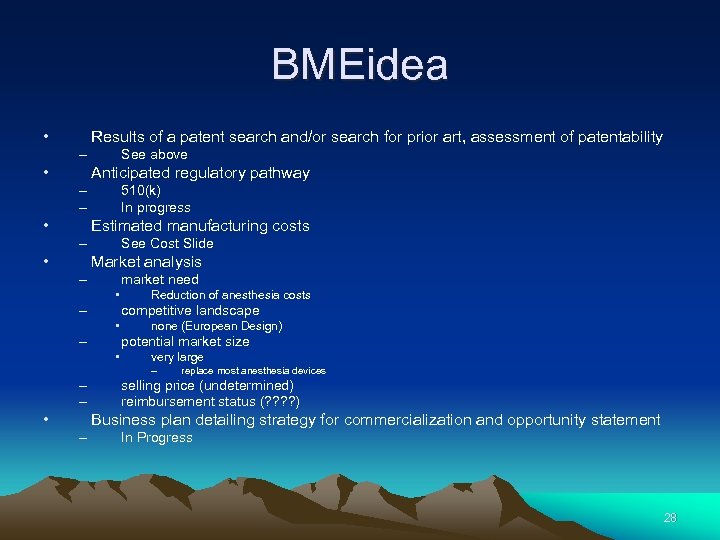 BMEidea • Results of a patent search and/or search for prior art, assessment of patentability – • See above Anticipated regulatory pathway – – • 510(k) In progress Estimated manufacturing costs – • See Cost Slide Market analysis – market need • – Reduction of anesthesia costs competitive landscape • – none (European Design) potential market size • very large – – – • replace most anesthesia devices selling price (undetermined) reimbursement status (? ? ) Business plan detailing strategy for commercialization and opportunity statement – In Progress 28
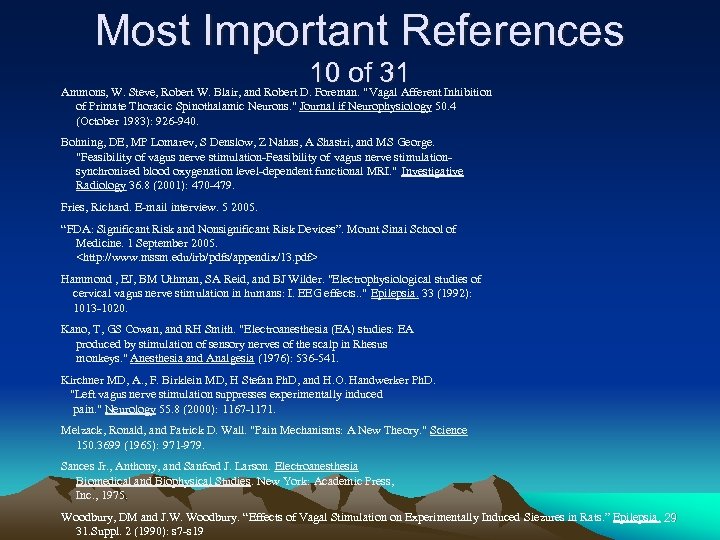 Most Important References 10 of 31 Ammons, W. Steve, Robert W. Blair, and Robert D. Foreman. "Vagal Afferent Inhibition of Primate Thoracic Spinothalamic Neurons. " Journal if Neurophysiology 50. 4 (October 1983): 926 -940. Bohning, DE, MP Lomarev, S Denslow, Z Nahas, A Shastri, and MS George. "Feasibility of vagus nerve stimulation-Feasibility of vagus nerve stimulationsynchronized blood oxygenation level-dependent functional MRI. " Investigative Radiology 36. 8 (2001): 470 -479. Fries, Richard. E-mail interview. 5 2005. “FDA: Significant Risk and Nonsignificant Risk Devices”. Mount Sinai School of Medicine. 1 September 2005.