


 Скачать презентацию Non-Traditional Funding Sources and Strategies for Assistive Technology
d1a8a89f0f563396129d9bd930320ce5.ppt
- Количество слайдов: 31
 Non-Traditional Funding Sources and Strategies for Assistive Technology Creative Ways to Access Traditional AT Funding Sources, Some Little-Known AT Funding Sources and Strategies June 2011 NDRN Network Conference Presenter: James R. Sheldon, Jr. , Esq. National AT Advocacy Project Neighborhood Legal Services Buffalo, NY * jsheldon@nls. org 1
 Background AT Advocacy Traditionally Focused on 5 Key Funding Sources: • • • Medicaid Medicare Special education programs State vocational rehabilitation programs Private insurance plans 2
 Why “Big Five” Funding Source May Not be Available • Individual not eligible for program, or not eligible for special benefit within program • Eligible for program, but AT device is not covered • Eligible for program, AT is covered by program … BUT Ø Not demonstrated “need” for item under program criteria Ø I. e. , not medically necessary, educationally necessary, vocationally necessary, etc. 3
 Resolving Big Five Funding Dilemma • Identify way to make person eligible for program • Identify another program to fund device • Identify funding strategy fund all or part of device: Ø Anti-discrimination laws, like Americans with Disabilities Act Ø Use of tax provisions, like Flexible Spending Account 4
 Ensuring Eligibility for the Traditional, Big-Five Funding Sources 5
 Medicaid- Several Paths to Eligibility • Receipt of SSI = automatic eligibility in 39 states • Medically needy or “spend down” category • Home and community based services “waiver” • Child Adopted - federal Adoption Assistance Program 6
 Medicaid – Paths to Eligibility (Cont. ) • Section 1619(b) – lost SSI through work • Medicaid Buy-In for working people, 43 states • DAC Medicaid – Lost SSI upon eligibility for Social Security “Disabled Adult Child’s” (DAC) benefits – Also known as Childhood Disability Benefits • Pickle Medicaid – Lost SSI through receipt of SSDI – Ignore more recent SSDI cost-of-living increases 7
 SSI for Child of Working Parent Darlene is a widow, with three children: • • • Chris, age 11; Carey, age 13; Jason, age 16 Jason has cerebral palsy Jason gets $373 SSI, automatic Medicaid Importance of Medicaid • • • Covers medications, speech therapy, $10, 000 power wheelchair, $8, 000 communication device Keeping Medicaid is critical! State SSI rate is $674, with automatic Medicaid 8
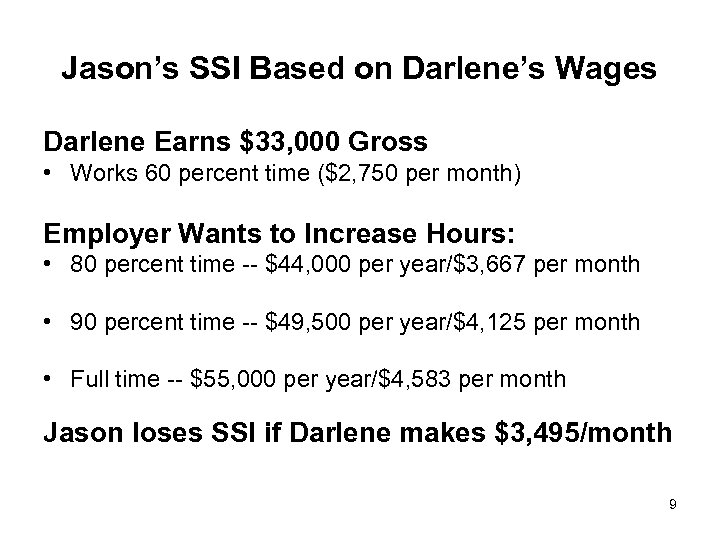 Jason’s SSI Based on Darlene’s Wages Darlene Earns $33, 000 Gross • Works 60 percent time ($2, 750 per month) Employer Wants to Increase Hours: • 80 percent time -- $44, 000 per year/$3, 667 per month • 90 percent time -- $49, 500 per year/$4, 125 per month • Full time -- $55, 000 per year/$4, 583 per month Jason loses SSI if Darlene makes $3, 495/month 9
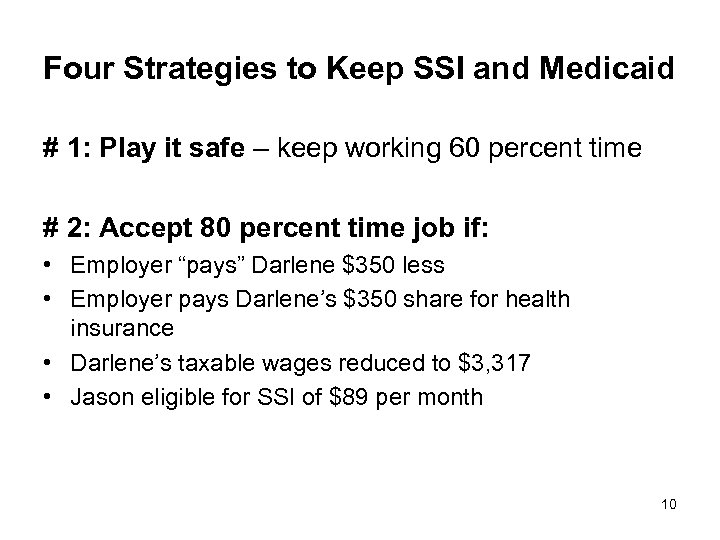 Four Strategies to Keep SSI and Medicaid # 1: Play it safe – keep working 60 percent time # 2: Accept 80 percent time job if: • Employer “pays” Darlene $350 less • Employer pays Darlene’s $350 share for health insurance • Darlene’s taxable wages reduced to $3, 317 • Jason eligible for SSI of $89 per month 10
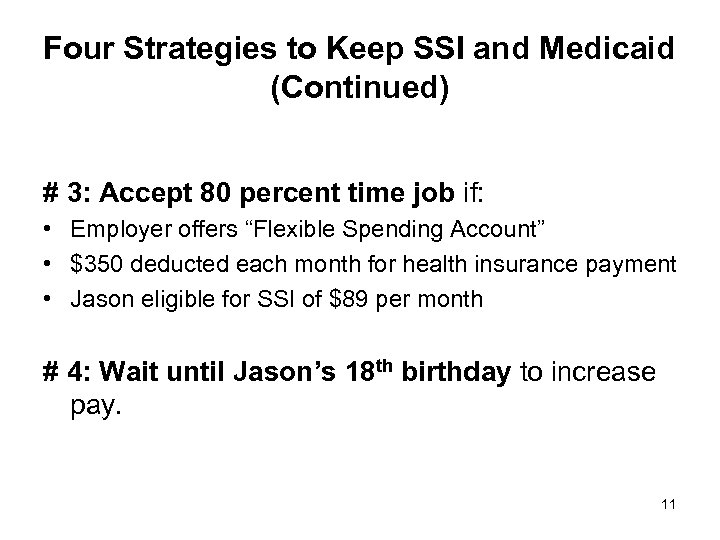 Four Strategies to Keep SSI and Medicaid (Continued) # 3: Accept 80 percent time job if: • Employer offers “Flexible Spending Account” • $350 deducted each month for health insurance payment • Jason eligible for SSI of $89 per month # 4: Wait until Jason’s 18 th birthday to increase pay. 11
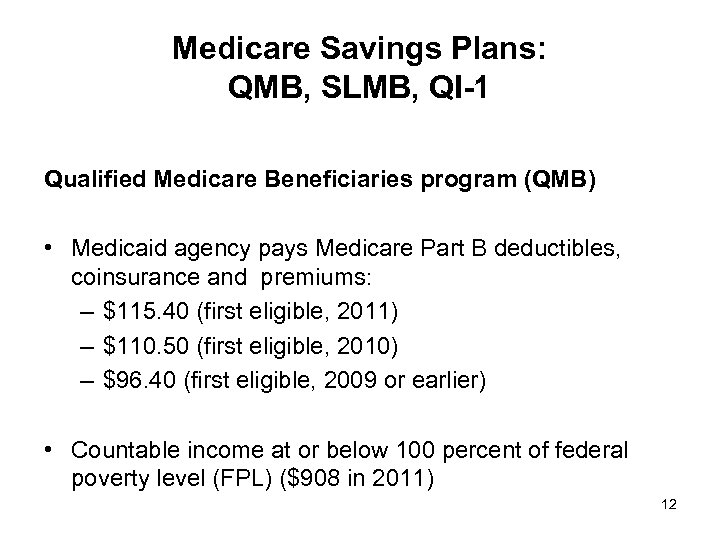 Medicare Savings Plans: QMB, SLMB, QI-1 Qualified Medicare Beneficiaries program (QMB) • Medicaid agency pays Medicare Part B deductibles, coinsurance and premiums: – $115. 40 (first eligible, 2011) – $110. 50 (first eligible, 2010) – $96. 40 (first eligible, 2009 or earlier) • Countable income at or below 100 percent of federal poverty level (FPL) ($908 in 2011) 12
 Medicare Savings Plans (Cont. ) Specified Low-Income Beneficiaries • Medicaid agency must pay Medicare Part B premiums only • Income between 100 and 120 percent of FPL (up to $1, 089 in 2011) 13
 Medicare Savings Programs (Cont. ) Qualified Individual Program (QI-1) • Medicaid agency pays for Part B premiums only • Income between 120 and 135 percent of FPL (up to $1, 226 in 2011) • QI-1 can be dependent on funds allocated year-by-year 14
 How QMB Helps Pay for AT If Medicare funds power wheelchair at approved rate of $8, 000 • Medicare pays 80 percent ($6, 400) • Individual must pay balance ($1, 600) • Medicaid would typically pay the $1, 600 If person not eligible for Medicaid or chooses not to pay a spend down: • Medicare pays the $6, 400 • QMB pays the $1, 600 15
 State Vocational Rehabilitation (VR) Agencies Financial Need Criteria – General Rule • VR agency may use financial need criteria for most services. • E. g. , college tuition, vehicles modifications, computers, and AT. Social Security, SSI Recipients Exempt from Needs Test • With any amount of SSI or SSDI, eligible for VR services at no cost. • Income/resources of parents, spouse do not count. 16
 VR Agencies and Financial Need Criteria – The Case of Ted Receives $1, 500 in Social Security Benefits • This is too much to qualify for SSI. • Too much to qualify for state’s Medicaid spend down Ted Automatically Meets the VR Agency’s Financial Need Criteria • VR agency can fund expensive AT, like van modifications, access ramps at home, or adapted computer equipment • Agency cannot make Ted pay toward cost of items. 17
 Alternative and Little Known Programs for Funding AT 18
 Alternative Financing Programs (AFPs) - A Source of Loans for AT An AFP can make a loan available by: • A revolving loan fund • A loan guarantee • An interest buy down 19
 Most Common Items Purchased with Loan Funds • • Vehicles modifications Computers, costs for computer access Mobility equipment, such as wheelchairs, scooters Equipment for daily living, like environmental control devices • Hearing aids, vision aids • Home modifications See www. resnaprojects. org/AFTAP for AFP information in 40 States. 20
 AFPs - Advocacy Tips The AFP loan: Excellent way to cover out-ofpocket costs related to AT purchase: • Amounts that exceed the payment limitations of private insurance • Medicare Part B 20 percent co-payment • Share of cost requirement charged by a state VR agency • AT-related costs exceeding amount available under SSI’s Plan for Achieving Self Support (PASS) • Amounts not otherwise covered by charity payments • Pending an appeal 21
 Federal Adoption Assistance Program Help for parents who adopt “Child with Special Needs” • Includes cash assistance and other special services Assistance through Automatic Medicaid: • If “child with special needs” criteria met and “adoption assistance agreement” in effect (i. e. , a federal adoption) • At state option, if child receives state or local adoption assistance 22
 Federal Adoption Assistance Program Additional Payments for AT, at State Option: • Covered through Minnesota’s adoption program: – Specialized communications equipment – Ramps – Accessible shower, elevated bathtubs and toilets – Blinking lights and tactile alarms as alternate warning systems – Lowered kitchen work surfaces – Disability-related modifications to a vehicle 23
 Funding Strategies That Do Not Involve a Program That Funds AT In a Conventional Sense 24
 Flexible Spending Account (FSA) Under Federal Tax Law Known as “flex plans, ” “cafeteria plans” or “ 125 plans” • Employee contribution deduction from pay, pre tax • Reduces taxable wages Types of expense covered • Uncovered medical: insurance premiums, co-payments, uncovered services, AT devices • Non-medical: child care, adoption fees, parking fees, public transportation costs 25
 Using Flexible Spending Account for AT - Back to Darlene & Jason Darlene Pays $350 Share of Insurance Premium • Taxable income reduced by $4, 200. Taxes reduced. • Reduced income for SSI eligibility. Jason keeps SSI. By Keeping SSI, Jason Also Keeps Medicaid • Medicaid pays for new wheelchair • Medicaid pays for new communication device 26
 Creative Structuring or Restructuring of Child Support to Obtain/Retain SSI and Medicaid Purpose of Strategy is Twofold: • Disability-related and other needs met through the child support without decreasing the SSI amount. • By obtaining or retaining eligibility for SSI, we ensure eligibility for Medicaid (in most states). Both support dollars and Medicaid can fund AT. 27
 Creative Structuring of Child Support - Back to Darlene and Jason Works 80 Percent Time, Earns $3, 667 Per Month • Wages reduced by $350 through FSA contribution. • Jason gets $89 SSI check plus Medicaid. Jason’s Dad to Pay $450 in Monthly Child Support • SSI program would count two thirds, $300. • Extra income makes Jason ineligible for SSI. • Jason will also lose Medicaid. 28
 Alternative Child Support Settlement for Jason Darlene’s Dilemma: No Adequate Transportation • Cannot afford van for travel with wheelchair. • Drives used car. – Two adults must lift Jason in and out of car. Instead of Cash, Dad Pays Directly to Vendors: • $400 to bank for loan on accessible van • $50 to car insurance company toward $150 monthly insurance 29
 How Creative Child Support Agreement Helps Jason Keeps Same Amount of SSI • Money paid to vendors not available for food or shelter • Not counted by SSI Jason Keeps Medicaid • Getting $1 or more in SSI keeps Medicaid in 39 states. • Medicaid funds power wheelchair, communication device. Darlene Get Van and Insurance • Child support arrangement makes it possible for Darlene to get a van with insurance to transport Jason. 30
 Thank you…. Ø Other materials available on each topic through National AT Advocacy Project. Contact Jim Sheldon (jsheldon@nls. org). Ø Check out National AT website (www. nls. org/natmain. htm) 31