 Скачать презентацию Non-Tariff Barriers in the NAMA Negotiations Is there
8dfacf0bdd55e64411a4a8ceaf7e1ab0.ppt
- Количество слайдов: 17



Non-Tariff Barriers in the NAMA Negotiations: Is there a Role for the Private Sector? Creck Buyonge CCES – Africa, Nairobi, Kenya Crowne Plaza Hotel, Nairobi (12 – 14 April 2010)
Summary n n Who is the Private Sector in the Context of the WTO NAMA NTB Negotiations? Nature of Interaction between the Private Sector & Government Agencies (on Trade Facilitation Issues) in Africa Specific Issues of Benefit to the Private Sector How the Private Sector can help in Implementation Process, TA & CB 2
By defining what we mean by “Private Sector” … … it becomes easier to map what the roles of various actors in the trade chain are, and what they can contribute in setting the agenda for the WTO NAMA negotiations on Non-Tariff Barriers, in the implementation process, technical assistance and capacity building
Who is the Private Sector? n n Customs often (narrowly) refer to Freight Forwarders & Customs Brokers as “Private Sector” BUT term could refer to different private sector interests at various stages of the International Trade Chain e. g. Importers, Exporters, manufacturers, Insurance Companies, Chambers of Commerce, Export/Import Agents, Banks, transporters, carriers, goods consolidators, shipping lines, inspection companies, warehouse keepers… 4
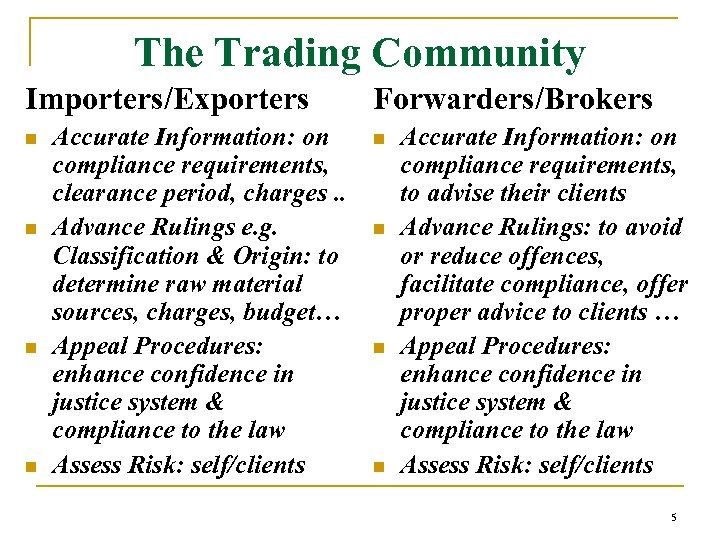
The Trading Community Importers/Exporters n n Accurate Information: on compliance requirements, clearance period, charges. . Advance Rulings e. g. Classification & Origin: to determine raw material sources, charges, budget… Appeal Procedures: enhance confidence in justice system & compliance to the law Assess Risk: self/clients Forwarders/Brokers n n Accurate Information: on compliance requirements, to advise their clients Advance Rulings: to avoid or reduce offences, facilitate compliance, offer proper advice to clients … Appeal Procedures: enhance confidence in justice system & compliance to the law Assess Risk: self/clients 5
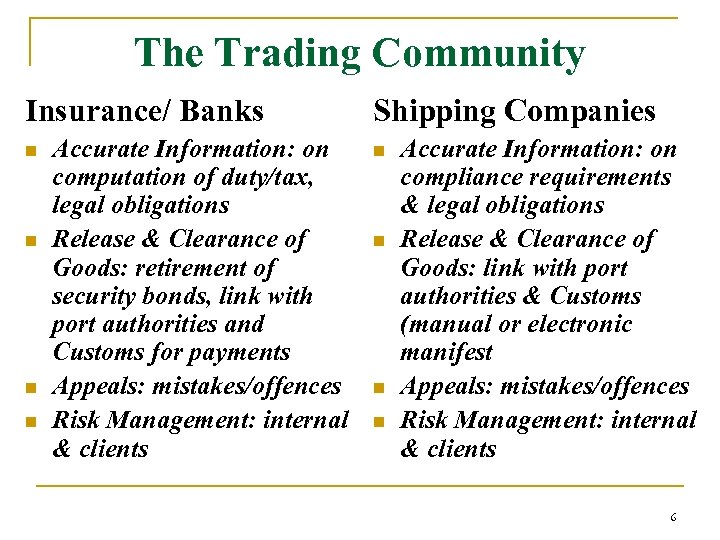
The Trading Community Insurance/ Banks n n Accurate Information: on computation of duty/tax, legal obligations Release & Clearance of Goods: retirement of security bonds, link with port authorities and Customs for payments Appeals: mistakes/offences Risk Management: internal & clients Shipping Companies n n Accurate Information: on compliance requirements & legal obligations Release & Clearance of Goods: link with port authorities & Customs (manual or electronic manifest Appeals: mistakes/offences Risk Management: internal & clients 6
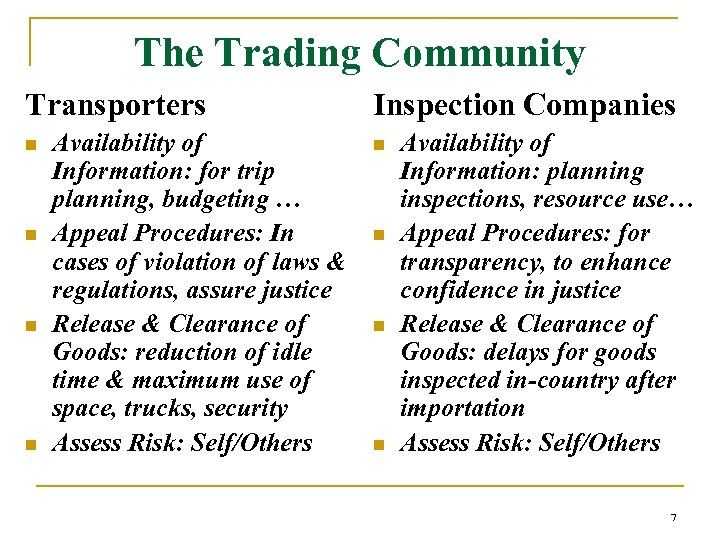
The Trading Community Transporters n n Availability of Information: for trip planning, budgeting … Appeal Procedures: In cases of violation of laws & regulations, assure justice Release & Clearance of Goods: reduction of idle time & maximum use of space, trucks, security Assess Risk: Self/Others Inspection Companies n n Availability of Information: planning inspections, resource use… Appeal Procedures: for transparency, to enhance confidence in justice Release & Clearance of Goods: delays for goods inspected in-country after importation Assess Risk: Self/Others 7
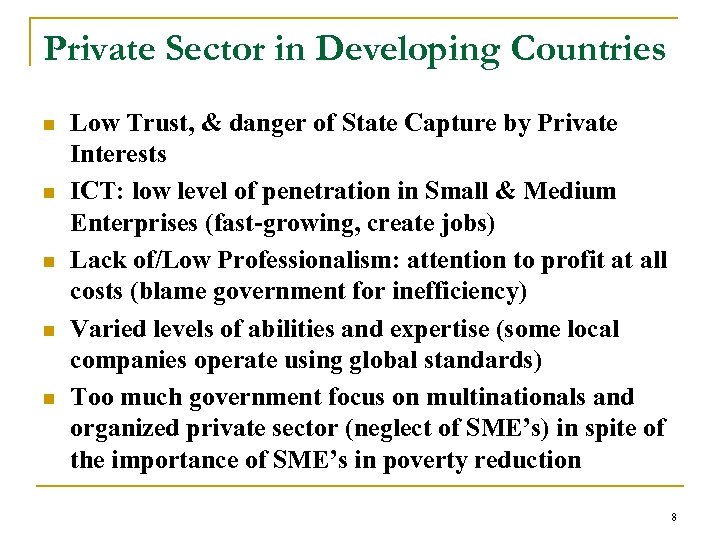
Private Sector in Developing Countries n n n Low Trust, & danger of State Capture by Private Interests ICT: low level of penetration in Small & Medium Enterprises (fast-growing, create jobs) Lack of/Low Professionalism: attention to profit at all costs (blame government for inefficiency) Varied levels of abilities and expertise (some local companies operate using global standards) Too much government focus on multinationals and organized private sector (neglect of SME’s) in spite of the importance of SME’s in poverty reduction 8
Private Sector Positive Developments n n Greater professionalism and better organization in the clearing & forwarding industry through Structured Training and Accreditation Frameworks, regional associations (e. g. in East Africa) Improved trust and collaboration between government and national private sector organizations (e. g. Private Sector Federations) and at regional level (various Regional Economic Communities) 9
Existing Partnerships: Examples n n Organization: Create strong private sector bodies that can control members, negotiate (clearing agents; shipping councils) ICT: Offer IT facilities & space to clearing agents to lodge documents at borders (esp. in remote areas) Simplified Documents for SME (e. g. ) Origin Cert. Diagnosis of Needs and Priorities: Involved in diagnosis of public sector needs (WCO/WTO), what about needs of the Private Sector? Those involved in Authorized Economic Operator pilots have reported benefits in improving their own processes. 10
WHAT TRADING COMMUNITYCAN DO n n Get organized or use existing organizations (e. g. through manufacturers’ associations, Shippers’ Councils, Chambers of Commerce …) to support facilitative measures Create and maintain links with international private sector organizations for experience sharing on the negotiations process Participate actively in national trade facilitation committees, and in efforts to simplify trade using available opportunities See the big picture: readiness to give and take 11
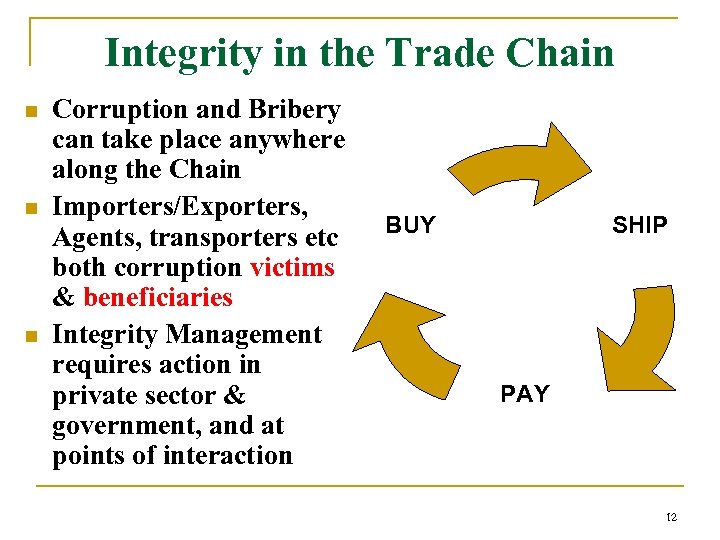
Integrity in the Trade Chain n Corruption and Bribery can take place anywhere along the Chain Importers/Exporters, Agents, transporters etc both corruption victims & beneficiaries Integrity Management requires action in private sector & government, and at points of interaction BUY SHIP PAY 12
Food for Thought n Simplification, Harmonization & Coordination potentially sabotages Corruption Networks, so it will be resisted by illegitimate traders n The Private Sector needs to recognize its specific roles in the International Trade Chain, and what actions and investments importers/exporters, banks, clearing agents, shipping agencies etc are required to facilitate international trade n Diagnostics & Assessments have NOT focused on private sector – because government agencies are seen as more prone to red tape (is this true? ) 13
Private Sector in Implementation n Diagnosis: Organized Private Sector have carried out own Corridor Surveys to determine impediments in the Trade Chain – can supplement Studies by Customs & Other Agencies n Business Process Review: Exactly what happens in the Trade Chain (including roles of private sector and government agencies) 14
Private Sector in Implementation n Sharing of Experience & Expertise: Especially where private sector have more experience e. g. ICT, Change Management … n Pilots e. g. ICT, Authorized Economic Operator n Investments e. g. ICT Support, Single Window n Issues Tracking: to facilitate improvements 15
Conclusion n n Elimination (or at least reduction) of Non-Tariff Barriers important for the Private Sector Continuous Engagement necessary within Private Sector, and between government agencies and the Private Sector Important to define various private sector interests and their role in the Trade Chain Recognize existing partnerships between Private Sector & Government 16

CONTACTS Creck Buyonge Adjunct Associate Professor (Revenue & Customs) Faculty of Law, University of Canberra Regional Manager, Centre for Customs & Excise Studies No. 9 NAS Apartments, Milimani Road P. O. Box 12435 – 00100 GPO Nairobi – KENYA Tel: +254 -20 -2099165 Fax: +254 -20 -3003637 Email: Creck. Buyonge@canberra. edu. au 17
Скачать презентацию Non-Tariff Barriers in the NAMA Negotiations Is there
8dfacf0bdd55e64411a4a8ceaf7e1ab0.ppt