


 Скачать презентацию Non-physician Clinicians in HIV Service Delivery Experiences From
80a0a239d7bf70a14b586f5c99949695.ppt
- Количество слайдов: 11
 Non-physician Clinicians in HIV Service Delivery: Experiences From 47 Sub-Saharan African Countries XVII International AIDS Conference Mexico City, Mexico August 4 th , 2008 Seble L. Frehywot MD, MHSA The George Washington University Washington, D. C.
 Content ¡ Overview of Non-physician Clinicians in Sub. Saharan Africa…ESR ¡ Non-physician Clinicians in HIV/AIDS Service delivery……country examples ¡ Needed Regulatory Elements in Non-Physician Clinician HIV/AIDS Service delivery ¡ Summary - Non-physician Clinicians Promise and Impediments for Scale-up 2
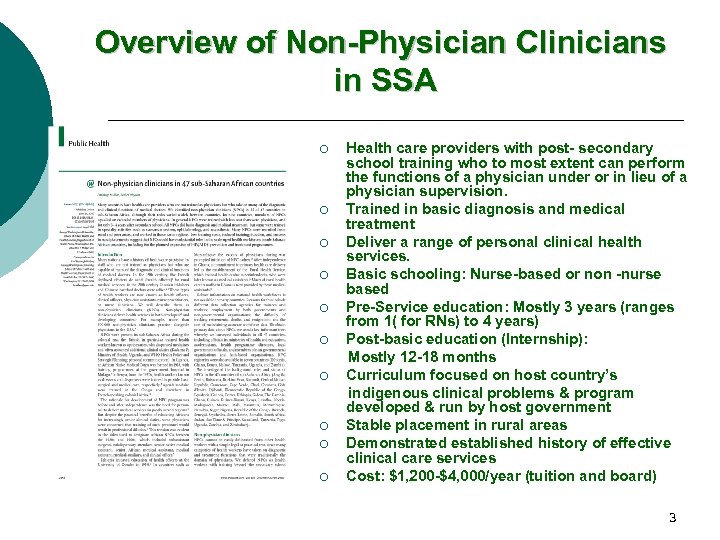 Overview of Non-Physician Clinicians in SSA ¡ ¡ ¡ ¡ ¡ Health care providers with post- secondary school training who to most extent can perform the functions of a physician under or in lieu of a physician supervision. Trained in basic diagnosis and medical treatment Deliver a range of personal clinical health services. Basic schooling: Nurse-based or non -nurse based Pre-Service education: Mostly 3 years (ranges from 1( for RNs) to 4 years) Post-basic education (Internship): Mostly 12 -18 months Curriculum focused on host country’s indigenous clinical problems & program developed & run by host government Stable placement in rural areas Demonstrated established history of effective clinical care services Cost: $1, 200 -$4, 000/year (tuition and board) 3
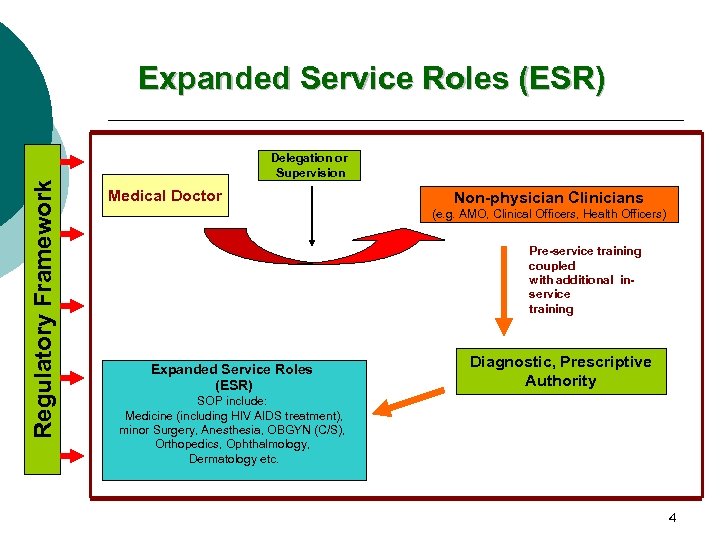 Regulatory Framework Expanded Service Roles (ESR) Delegation or Supervision Medical Doctor Non-physician Clinicians (e. g. AMO, Clinical Officers, Health Officers) Pre-service training coupled with additional inservice training Expanded Service Roles (ESR) Diagnostic, Prescriptive Authority SOP include: Medicine (including HIV AIDS treatment), minor Surgery, Anesthesia, OBGYN (C/S), Orthopedics, Ophthalmology, Dermatology etc. 4
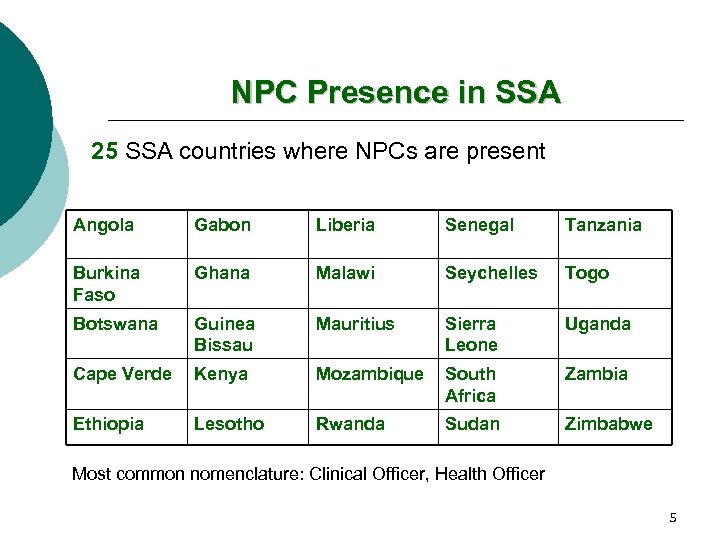 NPC Presence in SSA 25 SSA countries where NPCs are present Angola Gabon Liberia Senegal Tanzania Burkina Faso Ghana Malawi Seychelles Togo Botswana Guinea Bissau Mauritius Sierra Leone Uganda Cape Verde Kenya Mozambique South Africa Zambia Ethiopia Lesotho Rwanda Sudan Zimbabwe Most common nomenclature: Clinical Officer, Health Officer 5
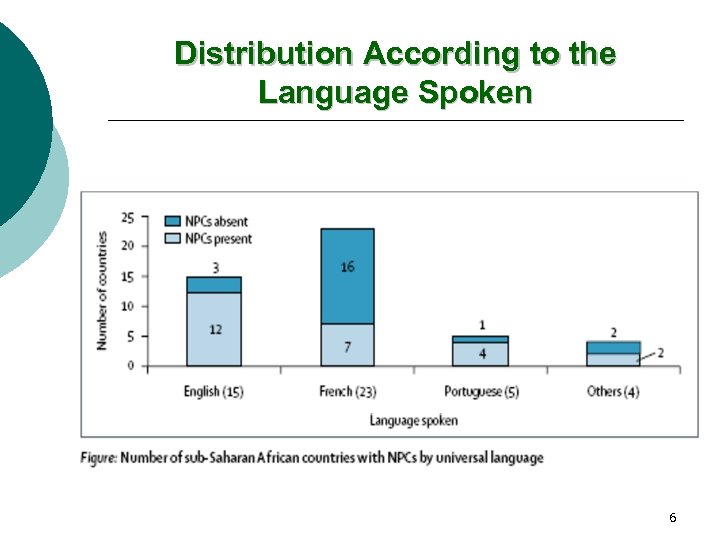 Distribution According to the Language Spoken 6
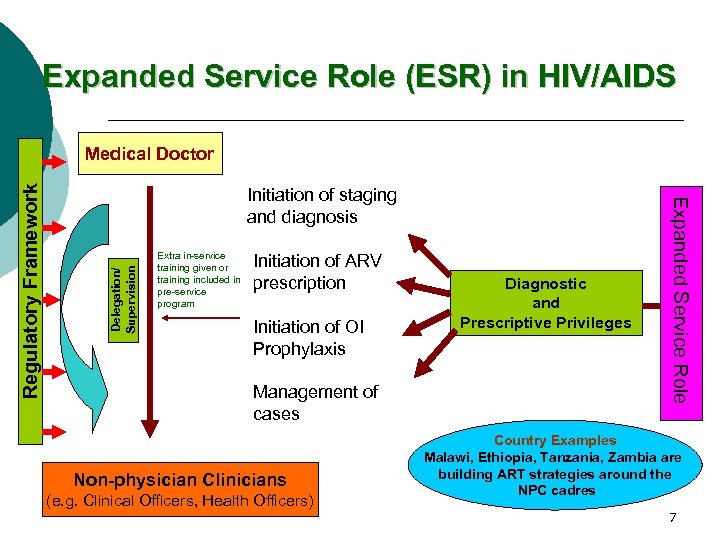 Expanded Service Role (ESR) in HIV/AIDS Delegation/ Supervision Initiation of staging and diagnosis Extra in-service training given or training included in pre-service program Initiation of ARV prescription Initiation of OI Prophylaxis Management of cases Non-physician Clinicians (e. g. Clinical Officers, Health Officers) Diagnostic and Prescriptive Privileges Expanded Service Role Regulatory Framework Medical Doctor Country Examples Malawi, Ethiopia, Tanzania, Zambia are building ART strategies around the NPC cadres 7
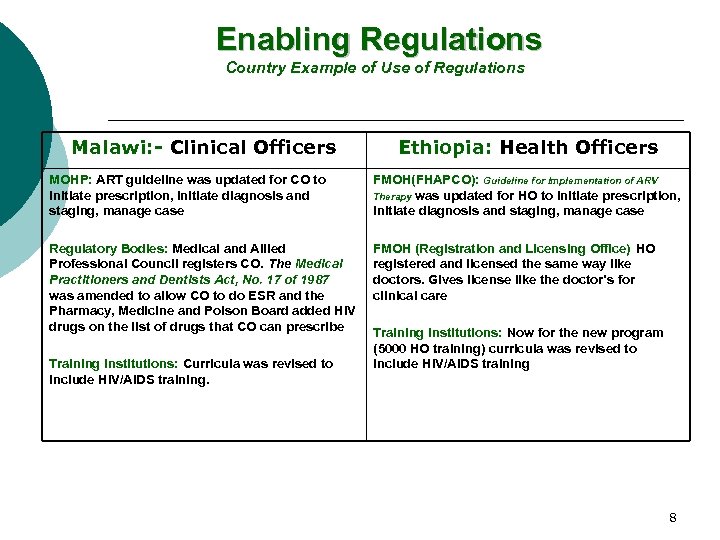 Enabling Regulations Country Example of Use of Regulations Malawi: - Clinical Officers Ethiopia: Health Officers MOHP: ART guideline was updated for CO to initiate prescription, initiate diagnosis and staging, manage case FMOH(FHAPCO): Guideline for Implementation of ARV Therapy was updated for HO to initiate prescription, initiate diagnosis and staging, manage case Regulatory Bodies: Medical and Allied Professional Council registers CO. The Medical Practitioners and Dentists Act, No. 17 of 1987 was amended to allow CO to do ESR and the Pharmacy, Medicine and Poison Board added HIV drugs on the list of drugs that CO can prescribe FMOH (Registration and Licensing Office) HO registered and licensed the same way like doctors. Gives license like the doctor’s for clinical care Training Institutions: Curricula was revised to include HIV/AIDS training. Training Institutions: Now for the new program (5000 HO training) curricula was revised to include HIV/AIDS training 8
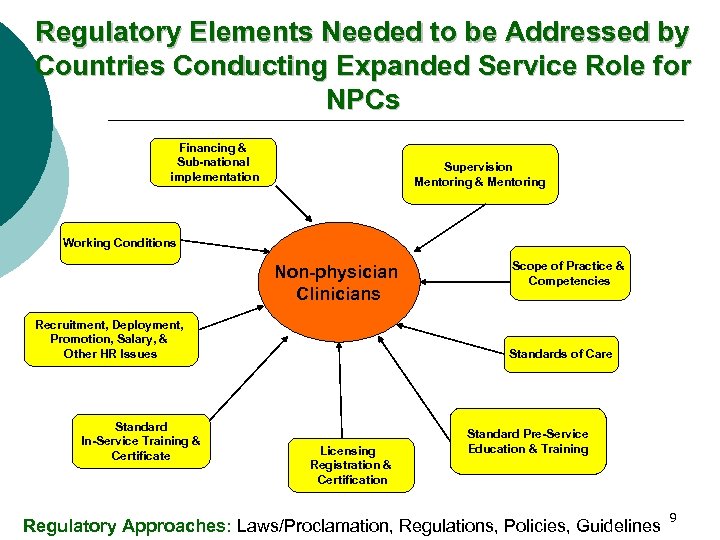 Regulatory Elements Needed to be Addressed by Countries Conducting Expanded Service Role for NPCs Financing & Sub-national implementation Supervision Mentoring & Mentoring Working Conditions Non-physician Clinicians Recruitment, Deployment, Promotion, Salary, & Other HR Issues Standard In-Service Training & Certificate Scope of Practice & Competencies Standards of Care Licensing Registration & Certification Standard Pre-Service Education & Training Regulatory Approaches: Laws/Proclamation, Regulations, Policies, Guidelines 9
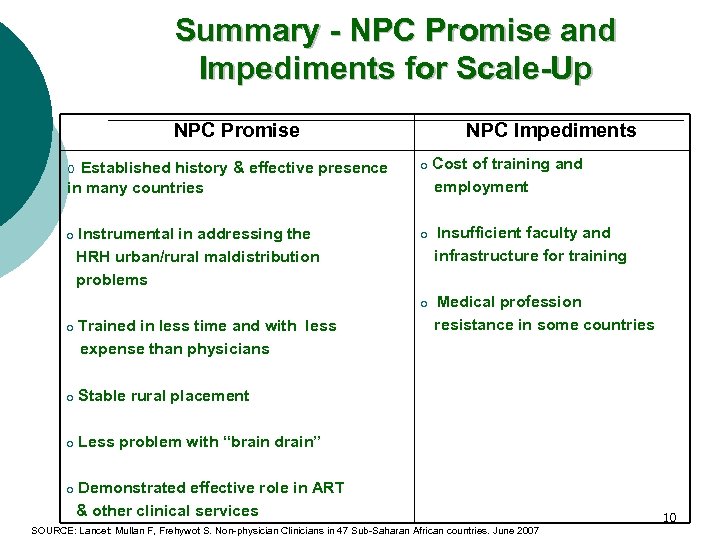 Summary - NPC Promise and Impediments for Scale-Up NPC Promise NPC Impediments o Cost of training and employment o Insufficient faculty and infrastructure for training o o Established history & effective presence Medical profession resistance in some countries in many countries o Instrumental in addressing the HRH urban/rural maldistribution problems o Trained in less time and with less expense than physicians o Stable rural placement o Less problem with “brain drain” o Demonstrated effective role in ART & other clinical services SOURCE: Lancet: Mullan F, Frehywot S. Non-physician Clinicians in 47 Sub-Saharan African countries. June 2007 10
 Thank You 11