 Скачать презентацию Non-pharmacological management of relapses Holly Wilkinson BSc Hons
c6a916ad46c0d6f5a2e3b5c915bc5419.ppt
- Количество слайдов: 1



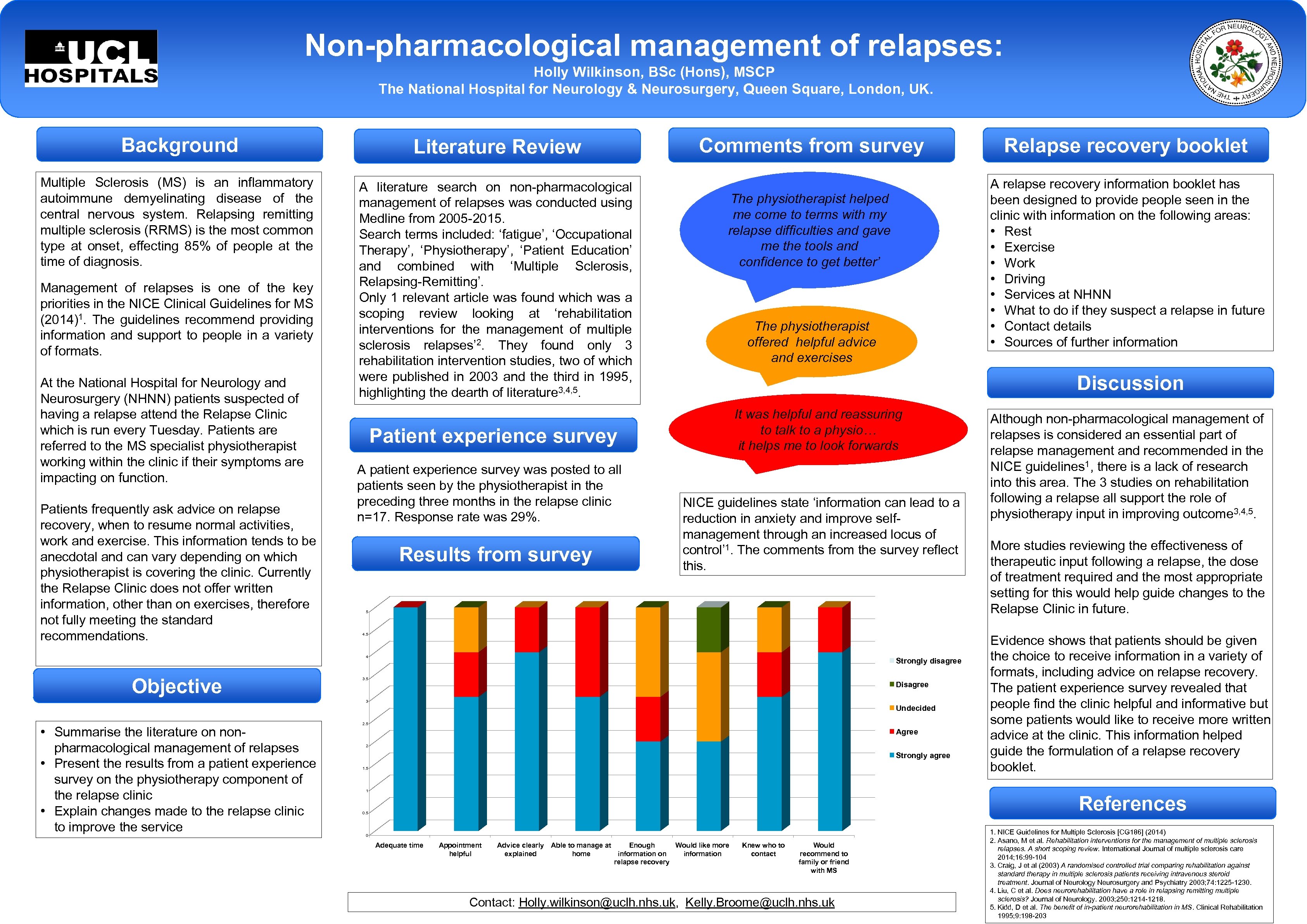
Non-pharmacological management of relapses: Holly Wilkinson, BSc (Hons), MSCP The National Hospital for Neurology & Neurosurgery, Queen Square, London, UK. Background Literature Review Multiple Sclerosis (MS) is an inflammatory autoimmune demyelinating disease of the central nervous system. Relapsing remitting multiple sclerosis (RRMS) is the most common type at onset, effecting 85% of people at the time of diagnosis. A literature search on non-pharmacological management of relapses was conducted using Medline from 2005 -2015. Search terms included: ‘fatigue’, ‘Occupational Therapy’, ‘Physiotherapy’, ‘Patient Education’ and combined with ‘Multiple Sclerosis, Relapsing-Remitting’. Only 1 relevant article was found which was a scoping review looking at ‘rehabilitation interventions for the management of multiple sclerosis relapses’ 2. They found only 3 rehabilitation intervention studies, two of which were published in 2003 and the third in 1995, highlighting the dearth of literature 3, 4, 5. Management of relapses is one of the key priorities in the NICE Clinical Guidelines for MS (2014)1. The guidelines recommend providing information and support to people in a variety of formats. At the National Hospital for Neurology and Neurosurgery (NHNN) patients suspected of having a relapse attend the Relapse Clinic which is run every Tuesday. Patients are referred to the MS specialist physiotherapist working within the clinic if their symptoms are impacting on function. Patients frequently ask advice on relapse recovery, when to resume normal activities, work and exercise. This information tends to be anecdotal and can vary depending on which physiotherapist is covering the clinic. Currently the Relapse Clinic does not offer written information, other than on exercises, therefore not fully meeting the standard recommendations. Comments from survey Results from survey The physiotherapist offered helpful advice and exercises Discussion It was helpful and reassuring to talk to a physio… it helps me to look forwards NICE guidelines state ‘information can lead to a reduction in anxiety and improve selfmanagement through an increased locus of control’ 1. The comments from the survey reflect this. 5 4 Objective A relapse recovery information booklet has been designed to provide people seen in the clinic with information on the following areas: • Rest • Exercise • Work • Driving • Services at NHNN • What to do if they suspect a relapse in future • Contact details • Sources of further information The physiotherapist helped me come to terms with my relapse difficulties and gave me the tools and confidence to get better’ Patient experience survey A patient experience survey was posted to all patients seen by the physiotherapist in the preceding three months in the relapse clinic n=17. Response rate was 29%. Strongly disagree 3. 5 Disagree 3 Undecided • Summarise the literature on nonpharmacological management of relapses • Present the results from a patient experience survey on the physiotherapy component of the relapse clinic • Explain changes made to the relapse clinic to improve the service Relapse recovery booklet 2. 5 Agree 2 Strongly agree 1. 5 1 Although non-pharmacological management of relapses is considered an essential part of relapse management and recommended in the NICE guidelines 1, there is a lack of research into this area. The 3 studies on rehabilitation following a relapse all support the role of physiotherapy input in improving outcome 3, 4, 5. More studies reviewing the effectiveness of therapeutic input following a relapse, the dose of treatment required and the most appropriate setting for this would help guide changes to the Relapse Clinic in future. Evidence shows that patients should be given the choice to receive information in a variety of formats, including advice on relapse recovery. The patient experience survey revealed that people find the clinic helpful and informative but some patients would like to receive more written advice at the clinic. This information helped guide the formulation of a relapse recovery booklet. References 0. 5 0 Adequate time Appointment helpful Advice clearly explained Able to manage at Enough Would like more home information on information relapse recovery Knew who to contact Would recommend to family or friend with MS Contact: Holly. wilkinson@uclh. nhs. uk, Kelly. Broome@uclh. nhs. uk 1. NICE Guidelines for Multiple Sclerosis [CG 186] (2014) 2. Asano, M et al. Rehabilitation interventions for the management of multiple sclerosis relapses. A short scoping review. International Journal of multiple sclerosis care 2014; 16: 99 -104 3. Craig, J et al (2003) A randomised controlled trial comparing rehabilitation against standard therapy in multiple sclerosis patients receiving intravenous steroid treatment. Journal of Neurology Neurosurgery and Psychiatry 2003; 74: 1225 -1230. 4. Liu, C et al. Does neurorehabilitation have a role in relapsing remitting multiple Printed by sclerosis? Journal of Neurology. 2003; 250: 1214 -1218. 5. Kidd, D et al. The benefit of in-patient neurorehabilitation in MS. Clinical Rehabilitation 1995; 9: 198 -203
Скачать презентацию Non-pharmacological management of relapses Holly Wilkinson BSc Hons
c6a916ad46c0d6f5a2e3b5c915bc5419.ppt