


 Скачать презентацию Non-Line of Sight Cannon Precision Strike Annual Review
a7da1de846ea9e7b181aa919b530e7eb.ppt
- Количество слайдов: 16
 Non-Line of Sight Cannon Precision Strike Annual Review 21 April 2004 Major Darby Mc. Nulty 1
 NLOS Cannon Agenda • • • NLOS Development Team FCS/UA Increment 1 NLOS Cannon - Family of Vehicles (Fo. V) & System of Systems (So. S) Commonality Across Fo. V FCS Requirements Flow (From System to Platform) NLOS Cannon CTD Efforts & Accomplishments SDD Efforts – NLOS Cannon Specs and Design Drivers SDD Trade Studies and Analyses (MGV & NLOS Cannon) Gun Caliber Efforts (155 mm versus 105 mm) Path Forward – MGV SRR and SFR Efforts • SRR Efforts – 17 Criterion • PIDs (Prime Item Development Specifications) • BTA (Best Technical Approach) 2
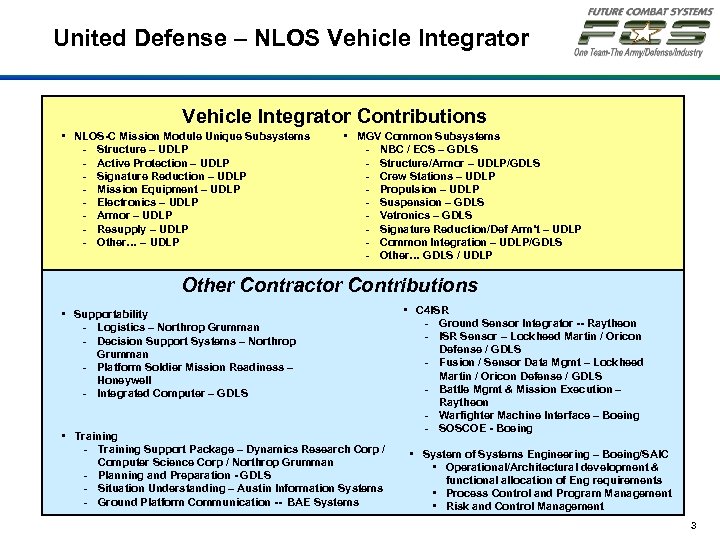 United Defense – NLOS Vehicle Integrator Contributions • NLOS-C Mission Module Unique Subsystems - Structure – UDLP - Active Protection – UDLP - Signature Reduction – UDLP - Mission Equipment – UDLP - Electronics – UDLP - Armor – UDLP - Resupply – UDLP - Other… – UDLP • MGV Common Subsystems - NBC / ECS – GDLS - Structure/Armor – UDLP/GDLS - Crew Stations – UDLP - Propulsion – UDLP - Suspension – GDLS - Vetronics – GDLS - Signature Reduction/Def Arm’t – UDLP - Common Integration – UDLP/GDLS - Other… GDLS / UDLP Other Contractor Contributions • Supportability - Logistics – Northrop Grumman - Decision Support Systems – Northrop Grumman - Platform Soldier Mission Readiness – Honeywell - Integrated Computer – GDLS • Training - Training Support Package – Dynamics Research Corp / Computer Science Corp / Northrop Grumman - Planning and Preparation - GDLS - Situation Understanding – Austin Information Systems - Ground Platform Communication -- BAE Systems • C 4 ISR - Ground Sensor Integrator -- Raytheon - ISR Sensor – Lockheed Martin / Oricon Defense / GDLS - Fusion / Sensor Data Mgmt – Lockheed Martin / Oricon Defense / GDLS - Battle Mgmt & Mission Execution – Raytheon - Warfighter Machine Interface – Boeing - SOSCOE - Boeing • System of Systems Engineering – Boeing/SAIC • Operational/Architectural development & functional allocation of Eng requirements • Process Control and Program Management • Risk and Control Management Supports FCS Tenet of Bringing Together Best of Industry 3
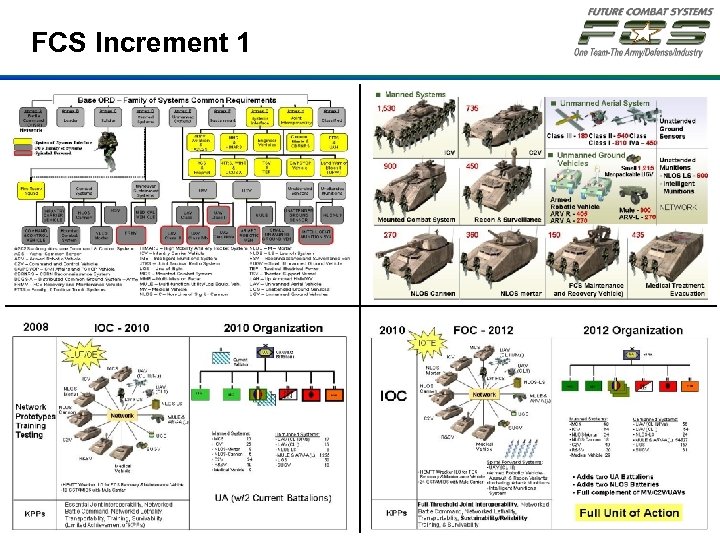 FCS Increment 1 4
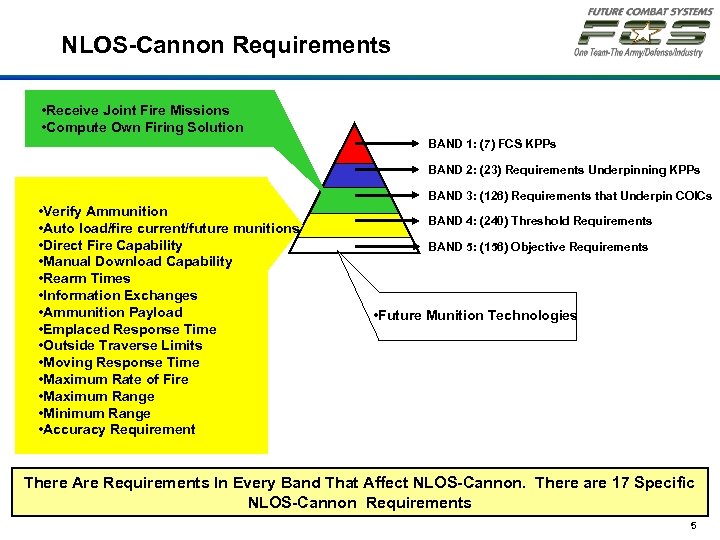 NLOS-Cannon Requirements • Receive Joint Fire Missions • Compute Own Firing Solution BAND 1: (7) FCS KPPs BAND 2: (23) Requirements Underpinning KPPs BAND 3: (126) Requirements that Underpin COICs • Verify Ammunition • Auto load/fire current/future munitions • Direct Fire Capability • Manual Download Capability • Rearm Times • Information Exchanges • Ammunition Payload • Emplaced Response Time • Outside Traverse Limits • Moving Response Time • Maximum Rate of Fire • Maximum Range • Minimum Range • Accuracy Requirement BAND 4: (240) Threshold Requirements BAND 5: (156) Objective Requirements • Future Munition Technologies There Are Requirements In Every Band That Affect NLOS-Cannon. There are 17 Specific NLOS-Cannon Requirements 5
 Summary • The NLOS-Cannon is one of the Future Combat System’s family of systems. • NLOS-Cannon has 147 PCD requirements to meet. Seventeen of these are cannon specific. • The Army has developed a FCS ORD structure placing FCS ORD requirements within a band structure. • FCS ORD bands facilitate the decision process allocating key requirements decisions to the appropriate level. • All NLOS-Cannon requirements decisions will be made based on a systems of system approach. 6
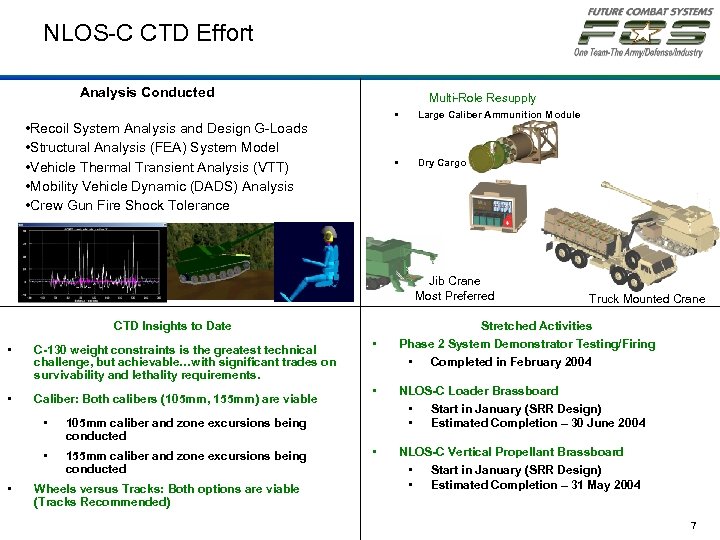 NLOS-C CTD Effort Analysis Conducted Multi-Role Resupply • • • Recoil System Analysis and Design G-Loads • Structural Analysis (FEA) System Model • Vehicle Thermal Transient Analysis (VTT) • Mobility Vehicle Dynamic (DADS) Analysis • Crew Gun Fire Shock Tolerance Large Caliber Ammunition Module Dry Cargo Module Jib Crane Most Preferred CTD Insights to Date • C-130 weight constraints is the greatest technical challenge, but achievable…with significant trades on survivability and lethality requirements. • Caliber: Both calibers (105 mm, 155 mm) are viable • • 155 mm caliber and zone excursions being conducted Stretched Activities • Phase 2 System Demonstrator Testing/Firing • Completed in February 2004 • NLOS-C Loader Brassboard • Start in January (SRR Design) • Estimated Completion – 30 June 2004 • NLOS-C Vertical Propellant Brassboard • Start in January (SRR Design) • Estimated Completion – 31 May 2004 105 mm caliber and zone excursions being conducted • Wheels versus Tracks: Both options are viable (Tracks Recommended) Truck Mounted Crane 7
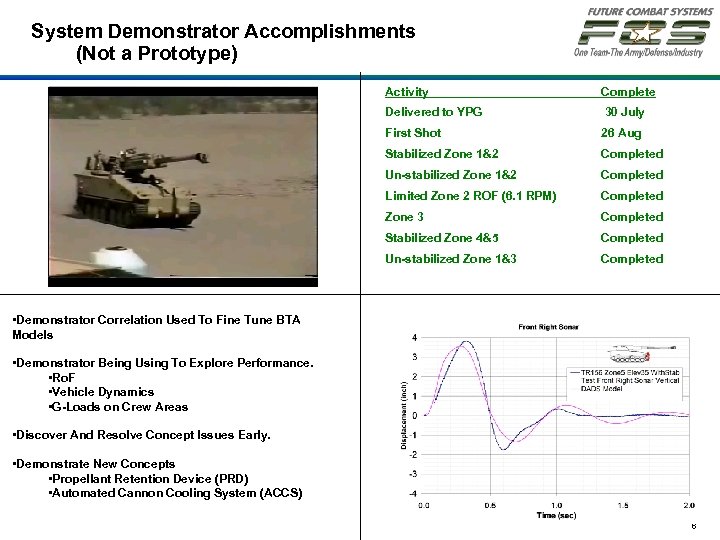 System Demonstrator Accomplishments (Not a Prototype) Activity Complete Delivered to YPG 30 July First Shot 26 Aug Stabilized Zone 1&2 Completed Un-stabilized Zone 1&2 Completed Limited Zone 2 ROF (6. 1 RPM) Completed Zone 3 Completed Stabilized Zone 4&5 Completed Un-stabilized Zone 1&3 Completed • Demonstrator Correlation Used To Fine Tune BTA Models • Demonstrator Being Using To Explore Performance. • Ro. F • Vehicle Dynamics • G-Loads on Crew Areas • Discover And Resolve Concept Issues Early. • Demonstrate New Concepts • Propellant Retention Device (PRD) • Automated Cannon Cooling System (ACCS) 8
 Summary • NLOS-C CTD Accomplishments. • • • NLOS-C System Demonstrator Completed and in Test Multi-role Resupply Concepts Developed Detailed Concepts Established (PRO-E Master Models) – Preliminary Concepts Of Projectile And Propellant Magazines And Shuttles, Gun Mount, Ammunition Loader/Rammer, Lower Mission Module, Turret Shell, Gun Pointing, And Ammo Upload Underway. – Basic Physical, Electrical And Software Architectures Defined – Weight And Space (Volume) Allocations And Estimates – Pit Stop Engineering Models Developed Significant Requirement Analysis Conducted Established Foundation for NLOS-C and MGV SDD (Prep for SRR and SFR) SDD Effort Underway. • • • Boeing/SAIC - Lead System Integrator United Defense Is The Variant Integrator For NLOS-Cannon FCS Manned Ground Vehicles (MGV) SRR & SFR Focus First Prototype Vehicles In Jun 07 FCS IOC In 2010 For Increment I (6 ea NLOS-C) 9
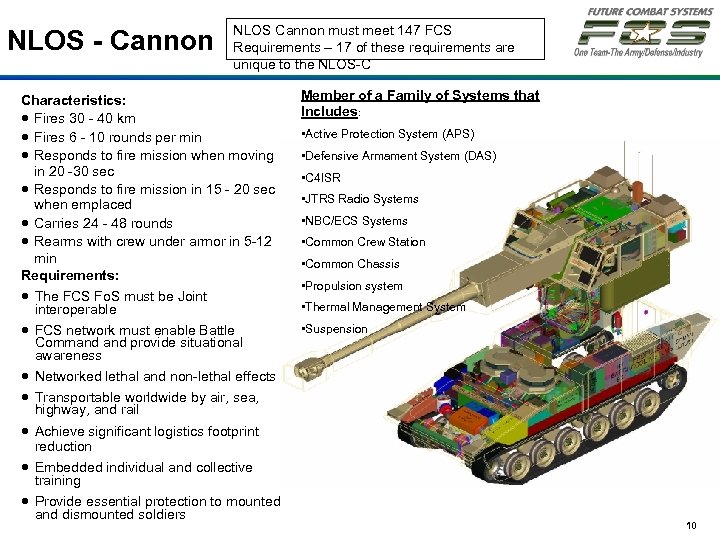 NLOS - Cannon NLOS Cannon must meet 147 FCS Requirements – 17 of these requirements are unique to the NLOS-C Characteristics: Fires 30 - 40 km Fires 6 - 10 rounds per min Responds to fire mission when moving in 20 -30 sec Responds to fire mission in 15 - 20 sec when emplaced Carries 24 - 48 rounds Rearms with crew under armor in 5 -12 min Requirements: The FCS Fo. S must be Joint interoperable FCS network must enable Battle Command provide situational awareness Networked lethal and non-lethal effects Transportable worldwide by air, sea, highway, and rail Achieve significant logistics footprint reduction Embedded individual and collective training Provide essential protection to mounted and dismounted soldiers Member of a Family of Systems that Includes: • Active Protection System (APS) • Defensive Armament System (DAS) • C 4 ISR • JTRS Radio Systems • NBC/ECS Systems • Common Crew Station • Common Chassis • Propulsion system • Thermal Management System • Suspension 10
 NLOS-Cannon “Top Ten” Design Drivers 1. 2. C 130 Transport – Establishes Weight And Volume Constraint ECC Weight (Flyweight) Definition – Establishes Required Weight Allocation For Ammo/Fuel (Projectiles On Board Weigh More Than Any Other Component) 3. Survivability – Requires Integral Medium Cannon And Heavy Machine Gun Armor 4. Mine Protection – Drives Armor Design And Interior Volume Availability 5. C 4 ISR – Drives Overall Vehicle Weight & Internal Volume 6. Reliability – Overall Design And Weight Impacts 7. Silent Watch – Drives Power Capacity And Battery Weight 8. Maximum Range- Drives Cannon Weight And Associated Structure. 9. Maximum and Sustained Rate Of Fire – Drives Structure/Subsystems Weight & Thermal Considerations 10. Automated Rearm Capability - Drives Overall Vehicle Weight & Internal Volume ECC Weight/C 130 Requirements Are “The Eye Of The Needle” For All MGVs 11
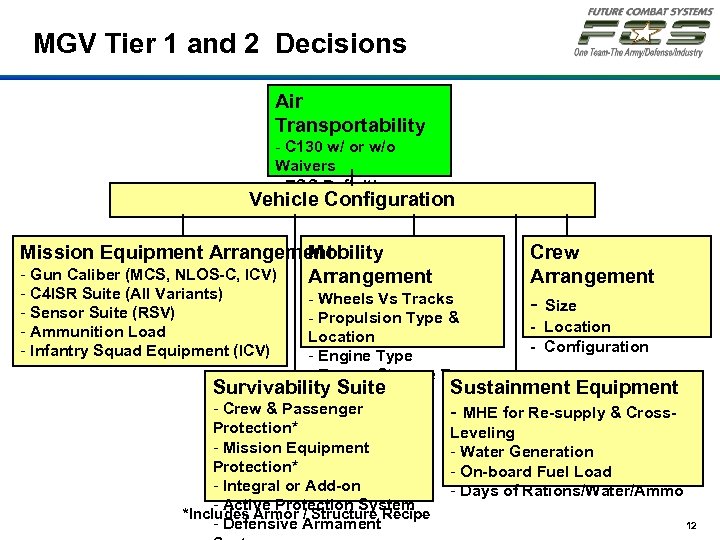 MGV Tier 1 and 2 Decisions Air Transportability - C 130 w/ or w/o Waivers - ECC Definition Vehicle Configuration - Design Weight Mission Equipment Arrangement Mobility - Gun Caliber (MCS, NLOS-C, ICV) Arrangement - C 4 ISR Suite (All Variants) - Sensor Suite (RSV) - Ammunition Load - Infantry Squad Equipment (ICV) Crew Arrangement - Wheels Vs Tracks - Propulsion Type & Location - Engine Type - Energy Storage Type Survivability Suite - Crew & Passenger Protection* - Mission Equipment Protection* - Integral or Add-on - Active Protection System *Includes Armor / Structure Recipe - Defensive Armament - Size - Location - Configuration Sustainment Equipment - MHE for Re-supply & Cross. Leveling - Water Generation - On-board Fuel Load - Days of Rations/Water/Ammo 12
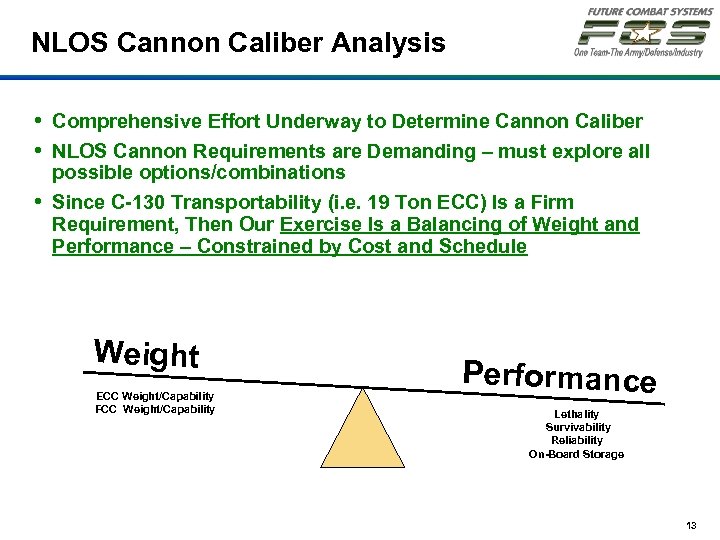 NLOS Cannon Caliber Analysis • Comprehensive Effort Underway to Determine Cannon Caliber • NLOS Cannon Requirements are Demanding – must explore all possible options/combinations • Since C-130 Transportability (i. e. 19 Ton ECC) Is a Firm Requirement, Then Our Exercise Is a Balancing of Weight and Performance – Constrained by Cost and Schedule Weight ECC Weight/Capability FCC Weight/Capability Performance Lethality Survivability Reliability On-Board Storage 13
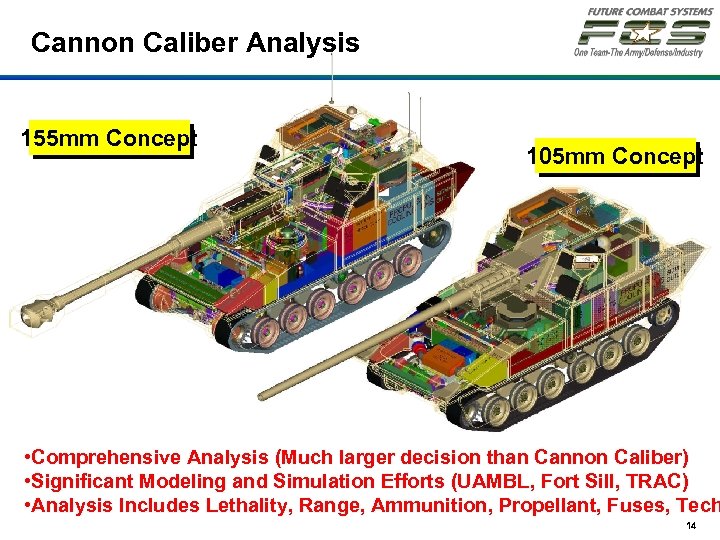 Cannon Caliber Analysis 155 mm Concept 105 mm Concept • Comprehensive Analysis (Much larger decision than Cannon Caliber) • Significant Modeling and Simulation Efforts (UAMBL, Fort Sill, TRAC) • Analysis Includes Lethality, Range, Ammunition, Propellant, Fuses, Tech 14
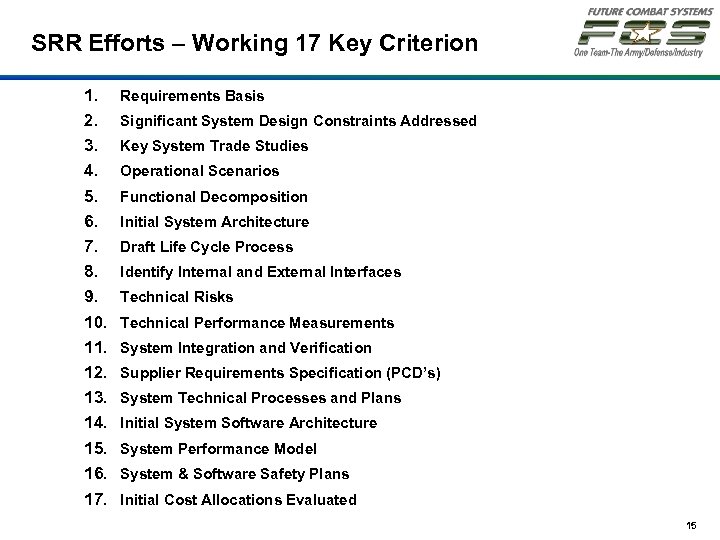 SRR Efforts – Working 17 Key Criterion 1. 2. 3. 4. 5. 6. 7. 8. 9. 10. 11. 12. 13. 14. 15. 16. Requirements Basis Significant System Design Constraints Addressed Key System Trade Studies Operational Scenarios Functional Decomposition Initial System Architecture Draft Life Cycle Process Identify Internal and External Interfaces Technical Risks Technical Performance Measurements System Integration and Verification Supplier Requirements Specification (PCD’s) System Technical Processes and Plans Initial System Software Architecture System Performance Model System & Software Safety Plans 17. Initial Cost Allocations Evaluated 15
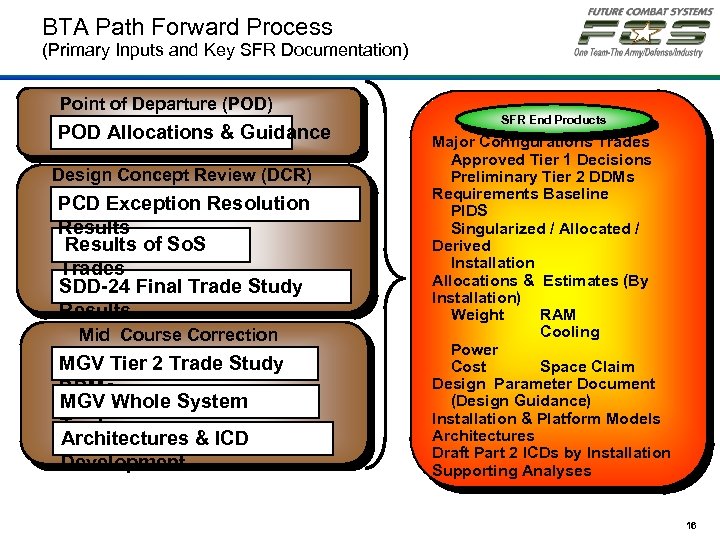 BTA Path Forward Process (Primary Inputs and Key SFR Documentation) Point of Departure (POD) POD Allocations & Guidance Design Concept Review (DCR) PCD Exception Resolution Results of So. S Trades SDD-24 Final Trade Study Results Mid Course Correction MGV Tier 2 Trade Study DDMs MGV Whole System Trades Architectures & ICD Development SFR End Products Major Configurations Trades Approved Tier 1 Decisions Preliminary Tier 2 DDMs Requirements Baseline PIDS Singularized / Allocated / Derived Installation Allocations & Estimates (By Installation) Weight RAM Cooling Power Cost Space Claim Design Parameter Document (Design Guidance) Installation & Platform Models Architectures Draft Part 2 ICDs by Installation Supporting Analyses 16