


 Скачать презентацию Non-Ferrous Founders Society Safety Health Training Program
977bd54d3f58aec9377b64e131398388.ppt
- Количество слайдов: 36
 Non-Ferrous Founders’ Society Safety & Health Training Program Hazard Communication/GHS Training Program Section 6: Haz. Com/GHS and the Aluminum Foundry © 2015 All Rights Reserved
 Haz. Com/GHS and the Aluminum Foundry n What are some of the hazards that exist in an Aluminum Foundry? n What are some common manufacturing process/materials in the Aluminum Foundry, and what hazards can these processes/materials present to the foundry worker? n What are some of the Personal Protective Equipment (PPE) items that workers should wear in an Aluminum Foundry?
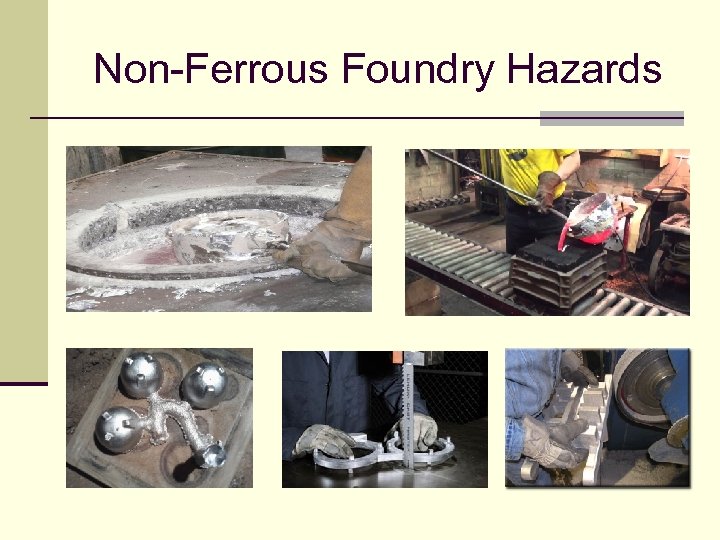 Non-Ferrous Foundry Hazards
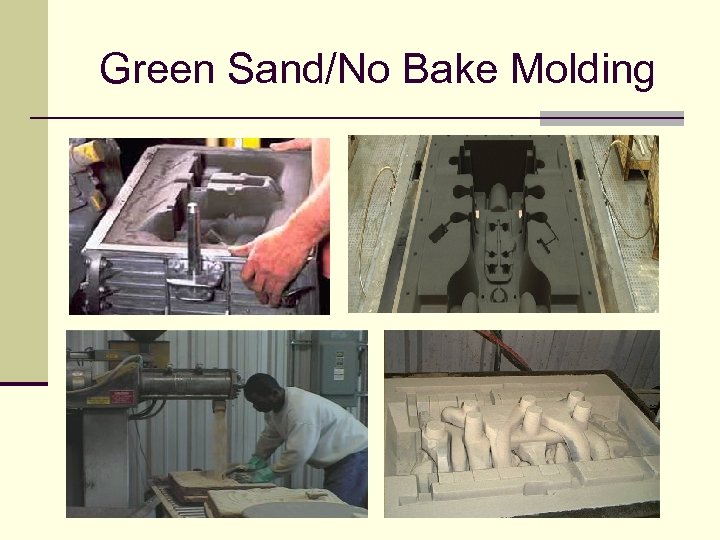 Green Sand/No Bake Molding
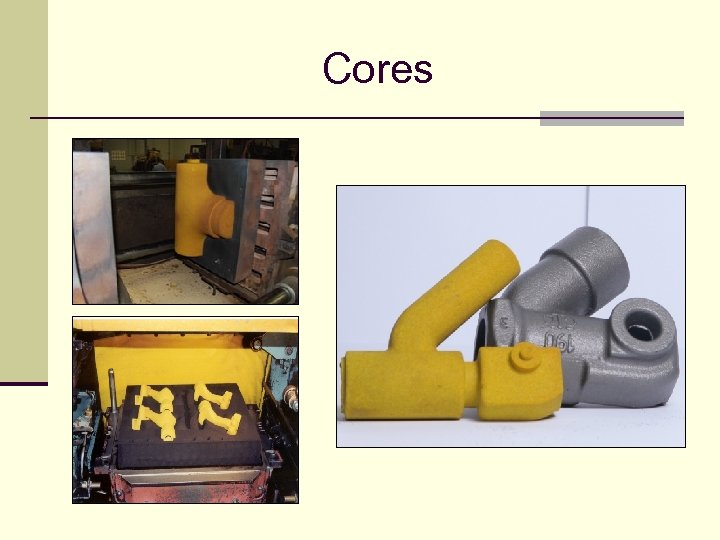 Cores
Cores
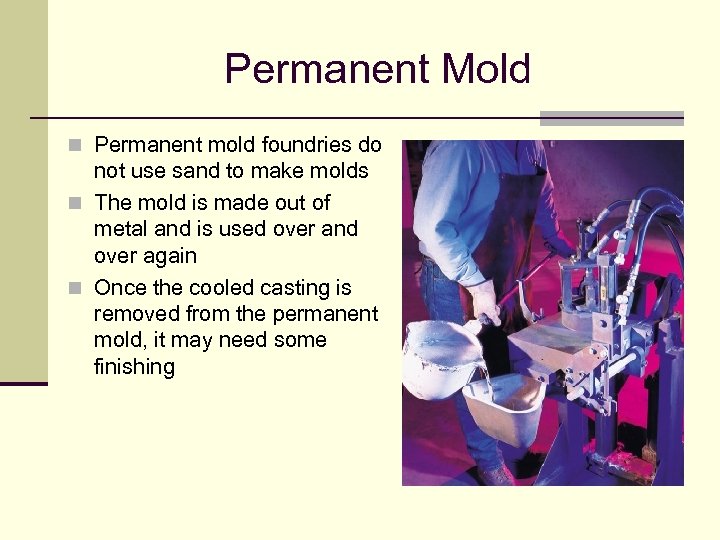 Permanent Mold n Permanent mold foundries do not use sand to make molds n The mold is made out of metal and is used over and over again n Once the cooled casting is removed from the permanent mold, it may need some finishing
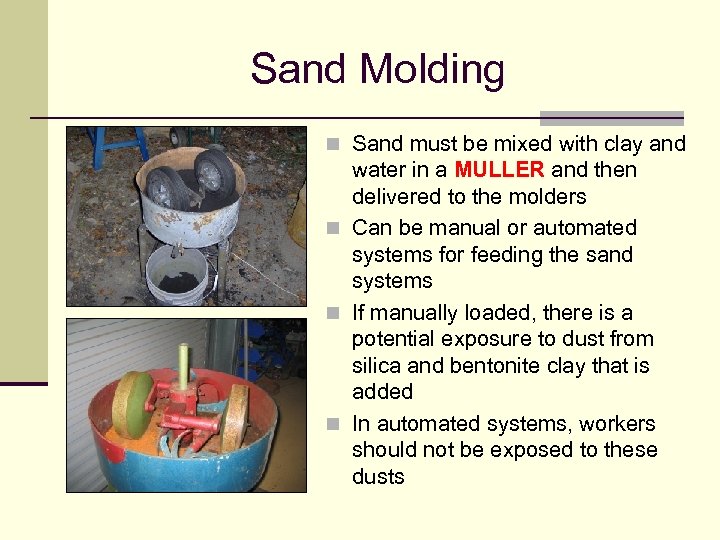 Sand Molding n Sand must be mixed with clay and water in a MULLER and then delivered to the molders n Can be manual or automated systems for feeding the sand systems n If manually loaded, there is a potential exposure to dust from silica and bentonite clay that is added n In automated systems, workers should not be exposed to these dusts
 Sand Molding n Once water is added to the system, the amount of dust should be quite low n However, workers who clean out these system can generate excessive dust
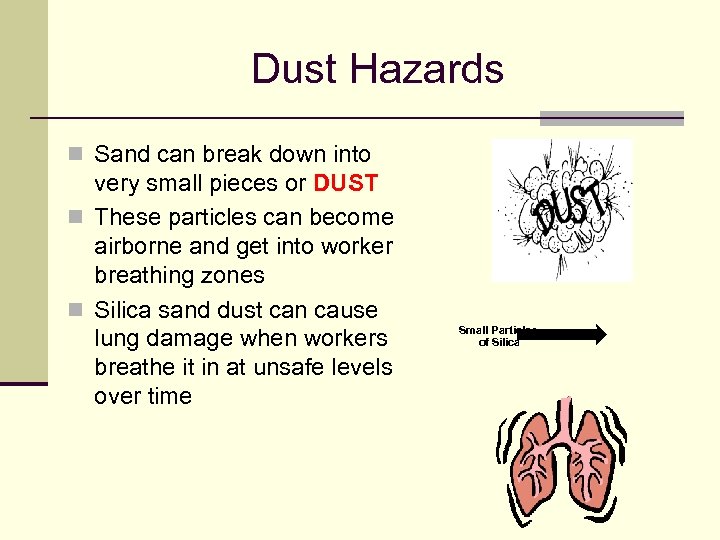 Dust Hazards n Sand can break down into very small pieces or DUST n These particles can become airborne and get into worker breathing zones n Silica sand dust can cause lung damage when workers breathe it in at unsafe levels over time Small Particles of Silica
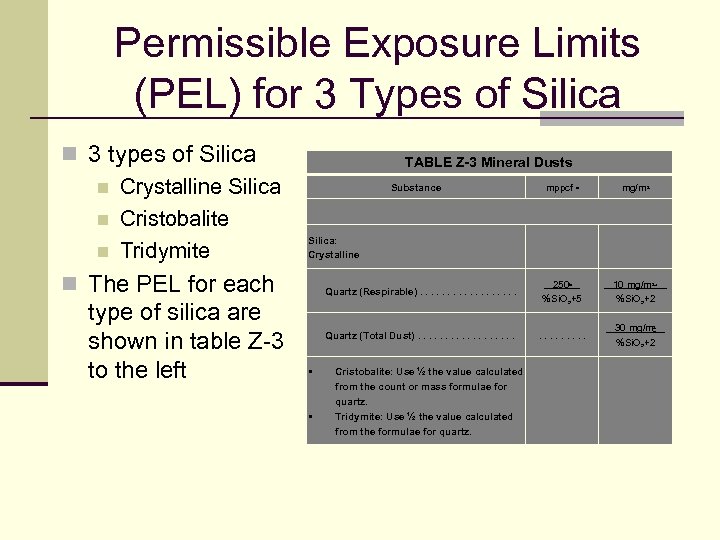 Permissible Exposure Limits (PEL) for 3 Types of Silica n 3 types of Silica n Crystalline Silica n Cristobalite n Tridymite Silica: Crystalline n The PEL for each Quartz (Respirable). . . . 250 b %Si. O 2+5 10 mg/m 3 e %Si. O 2+2 Quartz (Total Dust). . . . 30 mg/m 3 %Si. O 2+2 type of silica are shown in table Z-3 to the left TABLE Z-3 Mineral Dusts Substance mppcf a Cristobalite: Use ½ the value calculated from the count or mass formulae for quartz. Tridymite: Use ½ the value calculated from the formulae for quartz. mg/m 3
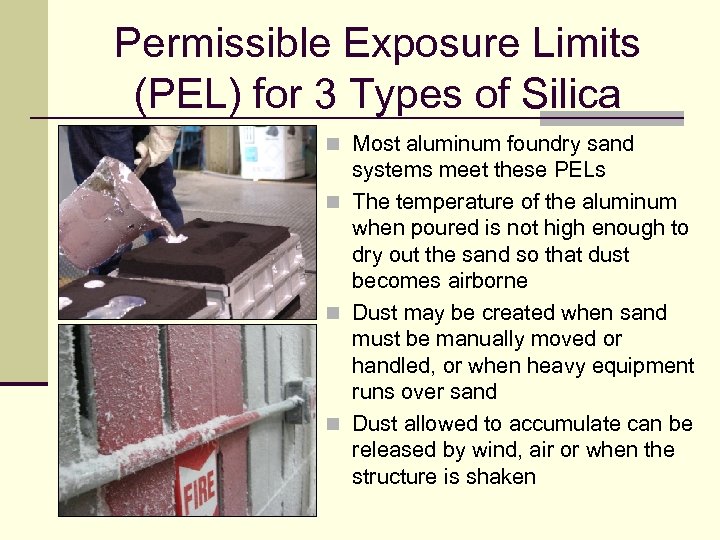 Permissible Exposure Limits (PEL) for 3 Types of Silica n Most aluminum foundry sand systems meet these PELs n The temperature of the aluminum when poured is not high enough to dry out the sand so that dust becomes airborne n Dust may be created when sand must be manually moved or handled, or when heavy equipment runs over sand n Dust allowed to accumulate can be released by wind, air or when the structure is shaken
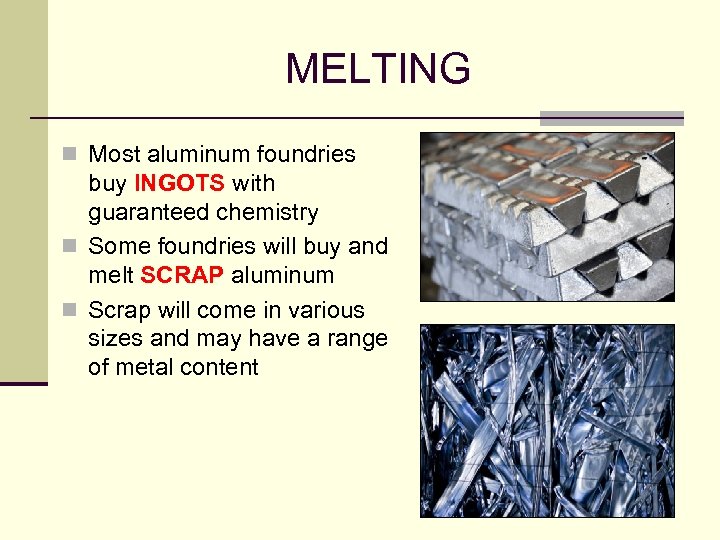 MELTING n Most aluminum foundries buy INGOTS with guaranteed chemistry n Some foundries will buy and melt SCRAP aluminum n Scrap will come in various sizes and may have a range of metal content
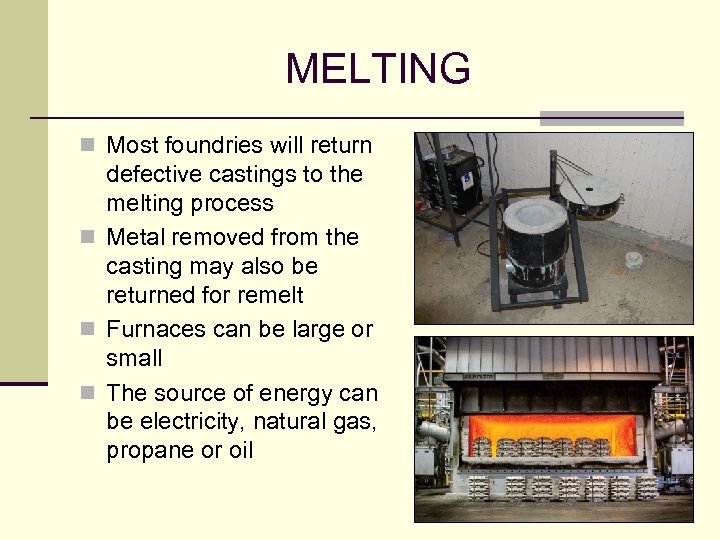 MELTING n Most foundries will return defective castings to the melting process n Metal removed from the casting may also be returned for remelt n Furnaces can be large or small n The source of energy can be electricity, natural gas, propane or oil
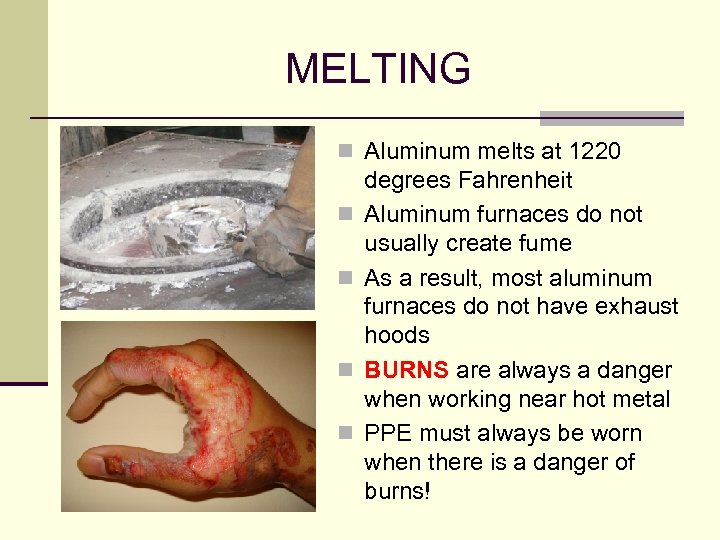 MELTING n Aluminum melts at 1220 n n degrees Fahrenheit Aluminum furnaces do not usually create fume As a result, most aluminum furnaces do not have exhaust hoods BURNS are always a danger when working near hot metal PPE must always be worn when there is a danger of burns!
 Personal Protective Equipment Recommended minimum basic clothing requirements for any employee working near the melting and pouring areas are: n 100% cotton socks and undergarments n 100% cotton or wool outer garments For employees in a hazardous zone (near a furnace or ladle containing molten metal) additional specific clothing and PPE is recommended based on the conditions, such as: n The temperatures, amount and type of molten metal in the furnace, ladle and/or mold n The level of the metal and area of the body that could be impacted by a splash, runout, spark, flame or hot surface n How close is the worker to molten metal and hot surfaces
 Personal Protective Equipment DO NOT LIST: • Do Not wear Nomex* because all molten metals tend to stick to the fabric • Do Not wear phosphorus treated cotton because molten Aluminum tends to stick to the fabric • Do Not wear polyester, nylon and other manmade materials that can melt and readily ignite • • • DO LIST: Do wear pants or leggings that cover the top of the boot to prevent molten metal/sparks from entering the boot Do wear spats or leggings that cover the lacings if laced boots are worn Do wear long pants, long sleeve shirts are recommended Do evaluate the need for spats, leggings and chaps for pouring operations Do wear clothing that does not trap molten metal/sparks Do wear any other PPE needed to protect body parts exposed to heat or metal
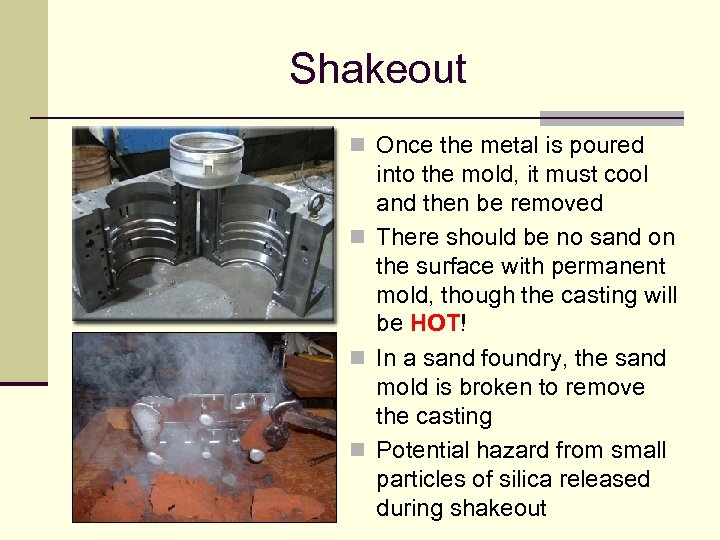 Shakeout n Once the metal is poured into the mold, it must cool and then be removed n There should be no sand on the surface with permanent mold, though the casting will be HOT! n In a sand foundry, the sand mold is broken to remove the casting n Potential hazard from small particles of silica released during shakeout
 Respirators n If workers are exposed to airborne silica above the PEL, n n engineering controls or other measures must be taken to reduce the amount of silica dust to a safe level Until these measures are put into place, or safe levels can not be achieved, RESPIRATORS must be worn by exposed workers Respirators are effective, if they are the RIGHT type of respirator and WORN and MAINTAINED properly If your company requires the use of respirators, a written program is needed along with training and fit testing Medical questionnaire must be completed for everyone in the program to be sure that the respirator can be safely worn
 Other Potential Airborne Hazards from Mold and Core Making n If molds or cores are made with CHEMICALLY BONDED SAND, the mixing and heating process can release gases and vapors that may be hazardous n The Safety Data Sheet (SDS) will list chemicals that may be a problem either as ingredients, as a result of mixing two ingredients, or as a result of pouring hot metal into the mold and breaking down the chemicals in the mold/core n One substance that may be released is ISOCYANATES
 ISOCYANATES n Some commonly used chemical binders used to hold sand n n n together contain ISOCYANATES are chemical compounds that react with other chemicals to make a new chemical with new characteristics In the foundry, we mix a RESIN and a CATALYST with sands to make a mold or core ISOCYANATES in some core making systems include Toluene Diisocyantes (TDI) or Methylene Biphenyl Isocyanate (MDI) If these chemicals are present in your foundry, they will be shown on the Safety Data Sheet (SDS) Workers exposed to these chemicals can develop ASTHMA
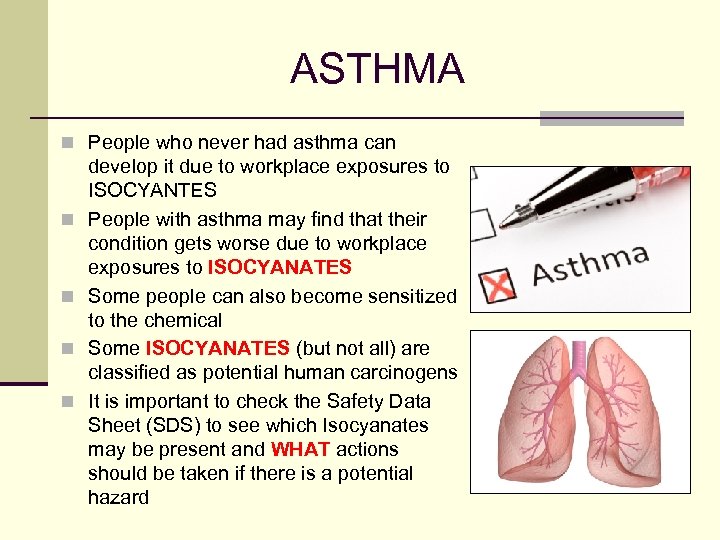 ASTHMA n People who never had asthma can n n develop it due to workplace exposures to ISOCYANTES People with asthma may find that their condition gets worse due to workplace exposures to ISOCYANATES Some people can also become sensitized to the chemical Some ISOCYANATES (but not all) are classified as potential human carcinogens It is important to check the Safety Data Sheet (SDS) to see which Isocyanates may be present and WHAT actions should be taken if there is a potential hazard
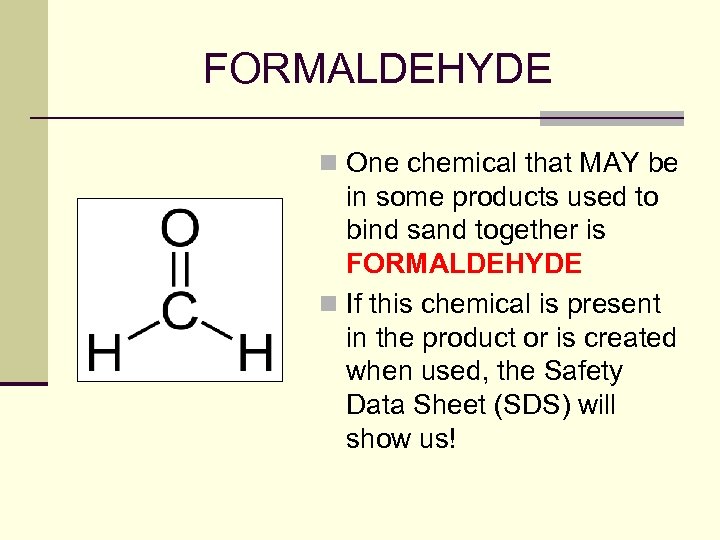 FORMALDEHYDE n One chemical that MAY be in some products used to bind sand together is FORMALDEHYDE n If this chemical is present in the product or is created when used, the Safety Data Sheet (SDS) will show us!
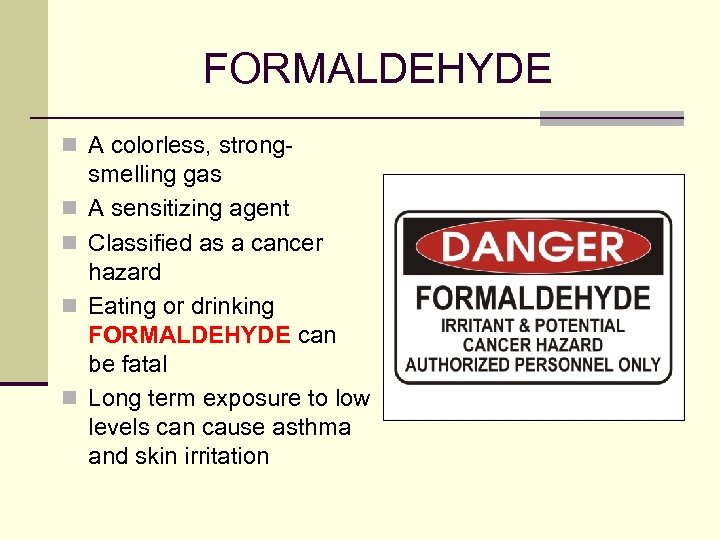 FORMALDEHYDE n A colorless, strongn n smelling gas A sensitizing agent Classified as a cancer hazard Eating or drinking FORMALDEHYDE can be fatal Long term exposure to low levels can cause asthma and skin irritation
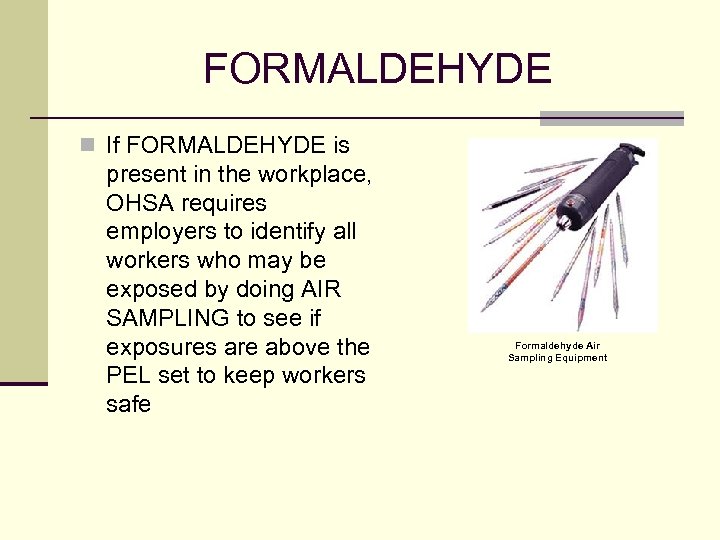 FORMALDEHYDE n If FORMALDEHYDE is present in the workplace, OHSA requires employers to identify all workers who may be exposed by doing AIR SAMPLING to see if exposures are above the PEL set to keep workers safe Formaldehyde Air Sampling Equipment
 FORMALDEHYDE n It tests show levels of FORMALDEHYDE are at or above the PEL, the company must use feasible engineering and work practice controls to reduce these levels n The PEL for FORMALDEHYDE is 0. 75 parts per million measured as an 8 -hour Time Weighted Average (TWA) n A second PEL in the form of a short-term exposure limit (STEL) of 2 parts per million which is the maximum exposure allowed during a 15 -minute period
 FORMALDEHYDE n All elements of a FORMALDEHYDE program must be in a written document kept up to date by the foundry n OSHA standard includes an ACTION LEVEL of 0. 5 parts per million (8 hour TWA). Tests at or above this level require more air sampling, along with training and medical surveillance of the affected workers n If control efforts cannot reduce exposure to acceptable levels, workers will be given respirators and other PPE needed, such as clothing, gloves, aprons, and chemical splash goggles
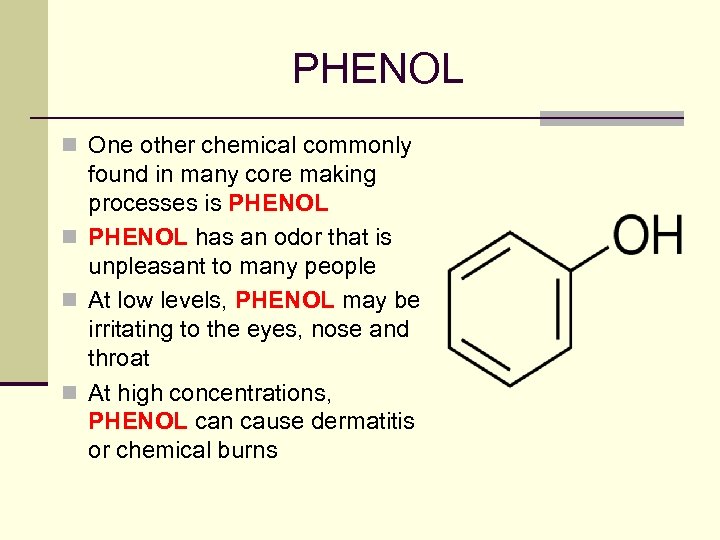 PHENOL n One other chemical commonly found in many core making processes is PHENOL n PHENOL has an odor that is unpleasant to many people n At low levels, PHENOL may be irritating to the eyes, nose and throat n At high concentrations, PHENOL can cause dermatitis or chemical burns
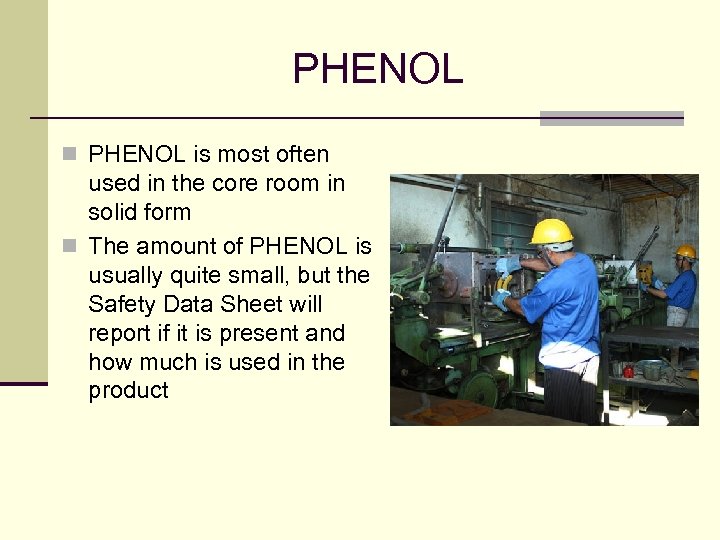 PHENOL n PHENOL is most often used in the core room in solid form n The amount of PHENOL is usually quite small, but the Safety Data Sheet will report if it is present and how much is used in the product
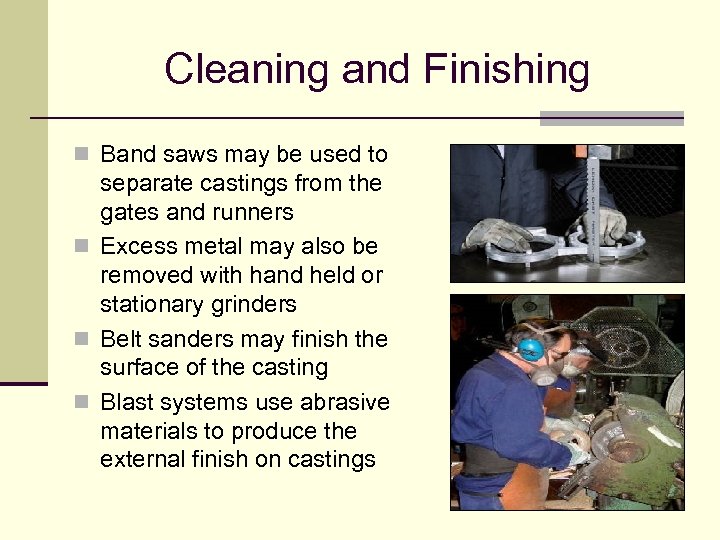 Cleaning and Finishing n Band saws may be used to separate castings from the gates and runners n Excess metal may also be removed with hand held or stationary grinders n Belt sanders may finish the surface of the casting n Blast systems use abrasive materials to produce the external finish on castings
 Cleaning and Finishing n If any silica sand remains on the casting, it could n n become airborne and present the same hazards as in sand system operations The finishing/grinding processes may also remove very small particles of aluminum from the casting If the particles are small enough, they can become airborne and be breathed by workers, causing metal fume fever Metal fume fever is a flu like illness that lasts for a day or two with headache, fever and chills Large amounts of aluminum dust breathed in over time can damage the lungs by scarring as well
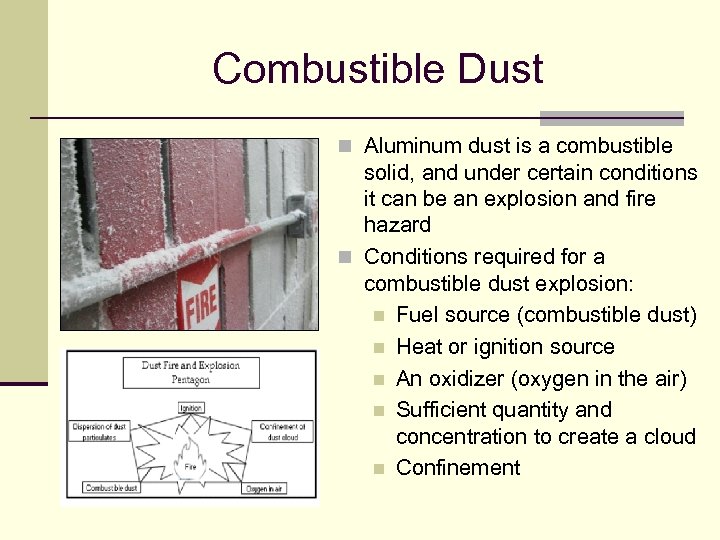 Combustible Dust n Aluminum dust is a combustible solid, and under certain conditions it can be an explosion and fire hazard n Conditions required for a combustible dust explosion: n Fuel source (combustible dust) n Heat or ignition source n An oxidizer (oxygen in the air) n Sufficient quantity and concentration to create a cloud n Confinement
 Combustible Dust n How do we prevent a dust explosion? n n Find out if there is a combustible dust in your plant (the SDS can help identify the products you use that can create a combustible dust) Engineering control are required to be sure that the hoods, ductwork and dust collectors themselves don’t become a hazard since they collect or concentrate the dust Control the sources of ignition in any area where there is a combustible dust hazard Have a good housekeeping program for floors and horizontal surfaces to keep dust accumulations to a minimum
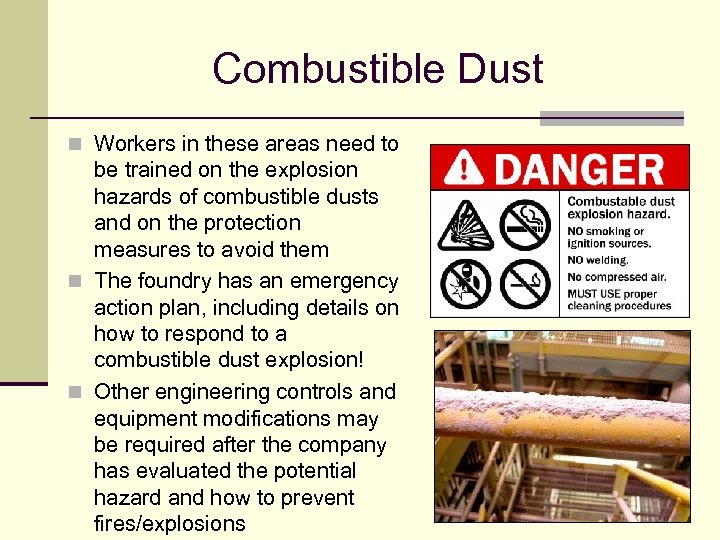 Combustible Dust n Workers in these areas need to be trained on the explosion hazards of combustible dusts and on the protection measures to avoid them n The foundry has an emergency action plan, including details on how to respond to a combustible dust explosion! n Other engineering controls and equipment modifications may be required after the company has evaluated the potential hazard and how to prevent fires/explosions
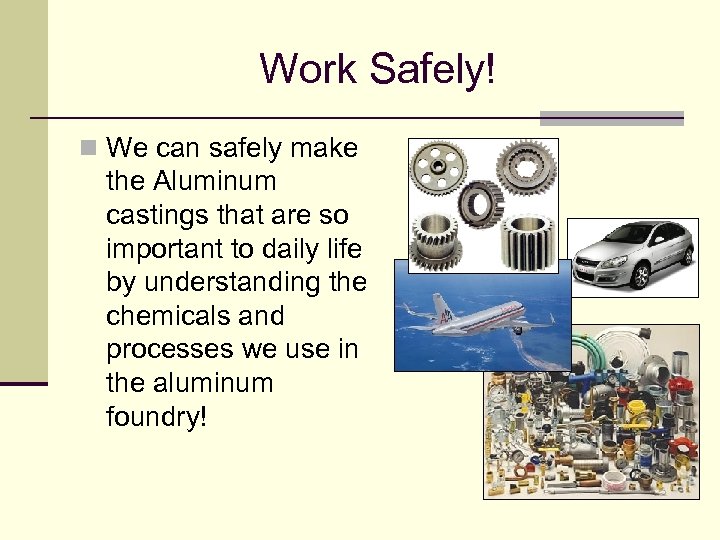 Work Safely! n We can safely make the Aluminum castings that are so important to daily life by understanding the chemicals and processes we use in the aluminum foundry!
 Acknowledgements n This material was produced under grant number SH-26318 -SH 4 from the Occupational Safety and Health Administration, U. S. Department of Labor. It does not necessarily reflect the views or policies of the U. S. Department of Labor, nor does mention of trade names, commercial products, or organizations imply endorsement by the U. S. Government
 Non-Ferrous Founders’ Society Safety & Health Training Program For further information about this or other training modules: Non-Ferrous Founders’ Society 1480 Renaissance Drive, Suite 310 Park Ridge, IL 60068 847/299 -0950 http: //www. nffs. org