 Скачать презентацию NOBODY S PERFECT PARENTING PROGRAM SAFETY MIND BODY
475d6ffaebc965e1c094309984f63f27.ppt
- Количество слайдов: 52



NOBODY’S PERFECT PARENTING PROGRAM
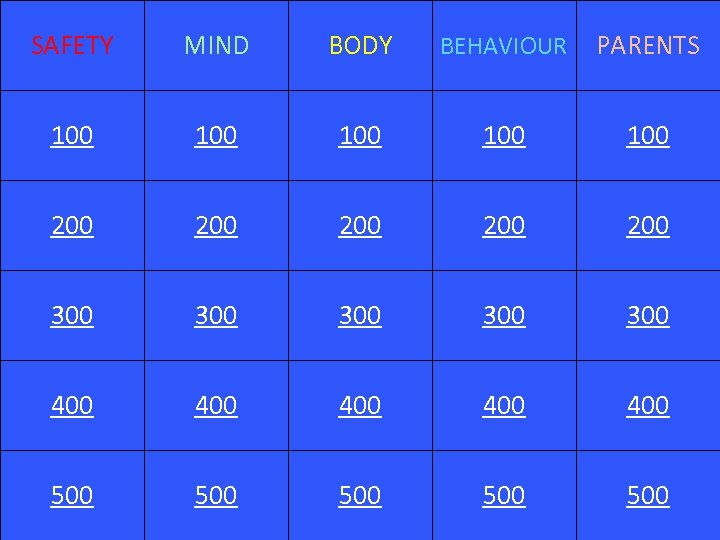
SAFETY MIND BODY BEHAVIOUR PARENTS 100 100 100 200 200 200 300 300 300 400 400 400 500 500 500
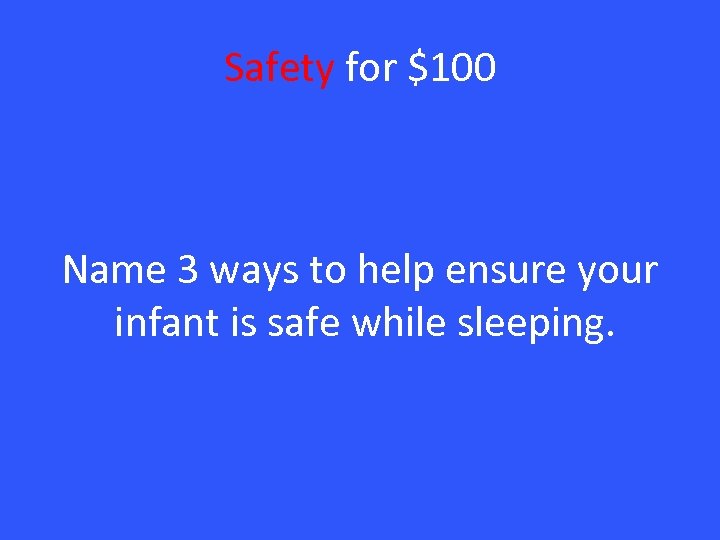
Safety for $100 Name 3 ways to help ensure your infant is safe while sleeping.
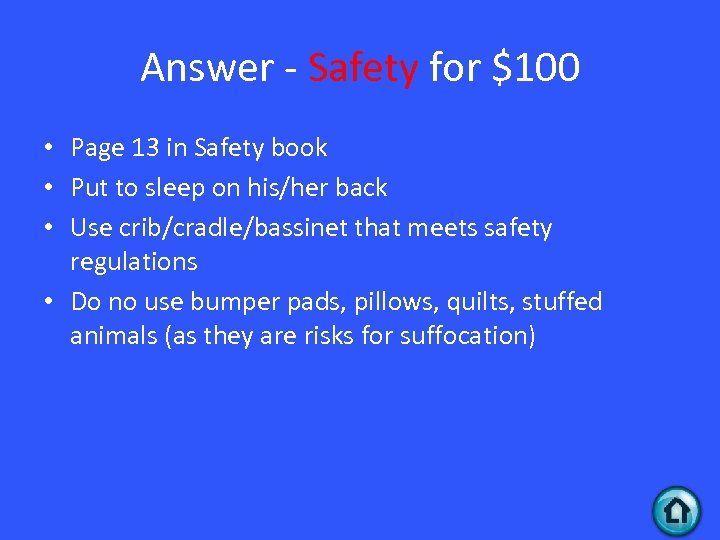
Answer - Safety for $100 • Page 13 in Safety book • Put to sleep on his/her back • Use crib/cradle/bassinet that meets safety regulations • Do no use bumper pads, pillows, quilts, stuffed animals (as they are risks for suffocation)
Safety for $200 When infants start to crawl and become mobile, what are three ways to help ensure their safety?
Answer - Safety for $200 • Pages 16 & 17 in Safety book • Use baby gates; make sure that the gates at the top of stairs are fastened with screws • Ensure all windows have stops or guards on them (i. e. , falling hazard) • Keep small toys or choking hazards out of reach of children • Make sure there are no cords (i. e. , from blinds) within child’s reach • Move crib to lowest position • Strap child in to high chairs and strollers
Safety for $300 What are 3 things to take into account regarding car seat safety?
Answer - Safety for $300 • Pages 34 – 38 in the Safety book • Proper installation in the back seat • Your child’s height and weight needs to match with the car seat • Car seat meets Transport Canada Safety Standards and is not expired or has not been in a crash • Ensure the child is strapped in properly
Safety for $400 What are 3 things you can do to protect children during winter weather?
Answer - Safety for $400 • Page 49 in the Safety book • Dress children in layers • Have as much clothing coverage as possible (hat, mitts, boots, neck warmer, coat and snow pants) • Keep children dry; replace wet clothing with dry • Keep children inside if it is too cold or high wind chill • Use helmet when skiing, sledding, snowboarding, skating
Safety for $500 What are 4 things you should have in a First Aid Kit?
Answer - Safety for $500 • • • Pages 50 – 53 in the Safety book List of emergency numbers Sterile gauze and tape Bandages Scissors Tweezers Ice bag or chemical ice pack Non-latex disposable gloves Thermometer Antibiotic cream
Mind for $100 What are 3 ways to help build a secure attachment between you and your baby?
Answer - Mind for $100 • Pages 8 and 9 in the Mind book • Respond to your baby when he/she cries • Comfort your baby when upset, frightened, sick, or hurt • Talk to and touch your baby in loving ways • Pay close attention to your baby • Play with your baby
Mind for $200 When a baby is around 6 – 12 months, what are some things you can do to help him/her learn, explore, and have fun?
Answer - Mind for $200 • Page 22 in the Mind book • Give your baby lots of chances for moving around and exploring in a safe environment • Give your baby lots to look at • Give your baby lots of positive things to listen to • Give your baby new experiences • Respect and respond to your baby’s feelings
Mind for $300 What are 3 things that your child is learning while he or she is playing?
Answer - Mind for $300 • Learning new skills (holding, throwing, building, knocking down, catching) • Learning about objects • Learning to get along with others • Learning to build confidence • Learning ways to express their feelings • Learning ways to understand their world
Mind for $400 What are 4 things that a child between 1 – 2 might be learning?
Answer - Mind for $400 • • • Page 27 in the Mind book Walking and running Feeding themselves Carrying things Playing with toys and drawing Talking and understanding simple words Knowing names for familiar people, animals, and objects Helping get dressed Letting out frustrations (tantrums, yelling, saying “No”) Giving love (hugs, smiles, laughter) Understanding routines
Mind for $500 Preschoolers (ages 3 – 5) are learning to understand their own feelings and other people’s feelings. What are 4 things caregivers can do to help them?
Answer - Mind for $500 • Pages 42 – 44 in the Mind book • Help them understand their feelings • Help them recognize other people’s feelings and to be fair • Give them chances to help and care for others • Listen closely • Give lots of opportunities for play, read books, sing songs • Help them out when they are sad or angry
Body for $100 What are 3 things that a pregnant woman can do to help her baby’s development before the baby is born?
Answer - Body for $100 • • • Page 7 in the Body book Be active Eat well Lower amount of stress Do not drink alcohol or do drugs Do not smoke
Body for $200 When children start to become interested and ready to start eating food, what are 3 things to consider when offering solid foods?
Answer - Body for $200 Pages 16 an 17 in Body book Start with pureed and iron rich foods Offer one food at a time Add one food at a time Continue breastfeeding or formula until child is 9 – 12 months • Ensure foods offered are not a choking hazard • Slowly add mashed or chopped foods as the child is showing signs that he or she is ready • • •
Body for $300 What are 2 health benefits of breastfeeding for babies?
Answer - Body for $300 • Page 14 in the Body book • It is the easiest food for your baby to digest and for its body to use • It protects your baby from disease and infection • It is free • It is ready whenever you need it • No waste or prep-work • Helps build attachment
Body for $400 What are 3 things you can do to help your child get enough activity each day?
Answer - Body for $400 • • • Page 11 in the Body book Make time every day for age-appropriate play Get outside when the weather permits Get involved in activities or sports Limit screen time Be an active role model for your children
Body for $500 What are 3 common things that should take place at a child’s regular check-up?
Answer - Body for $500 • Page 24 in the Body book • Healthcare provider checks your child’s growth, development, vision, and hearing • Healthcare provider asks you questions about your child • You ask questions you may have and address any concerns • Healthcare provider makes sure that immunizations are up to date
Behaviour for $100 What is attachment and why is it important?
Answer - Behaviour for $100 • Page 7 in the Behaviour book • Attachment is the deep emotional connection a baby forms with the first main people who take care of her/him • Attachment begins before birth and develops over time when you respond to your child’s needs in a warm, loving, and dependable way • A baby’s attachment to her parents influences how she thinks, learns, feels, and behaves for her whole life • Attachment teaches the child she can trust you to meet her needs
Behaviour for $200 What are 3 things you can help do to prevent temper tantrums?
Answer - Behaviour for $200 • Pages 70 – 71 in the Behaviour book • Try to figure out when and why tantrums are happening and address that reason (i. e. , if hungry, then offer food/drink) • Follow a daily routine • Give your child lots of time to be active and to play • Learn what helps to calm your child • Help your child understand share his/her feelings • Try to distract or change activities when tantrum first starts
Behaviour for $300 What are 3 reasons that your baby might be crying and 3 things you can do to help calm him down?
Answer - Behaviour for $300 • Pages 46 – 47 in the Behaviour book • Reasons for crying: hunger, fear, pain, loneliness, cold, colic, teething, too much noise/light/etc. • Things you can do to soothe baby: breastfeed, change diaper, hold your baby, walk with/rock her, talk/sing to him
Behaviour for $400 What are 2 negative effects that spanking can have on your child?
Answer - Behaviour for $400 • Page 24 in the Behaviour book • That it is okay to hit people when they do something that you do not like • That it is okay to hit someone that is little • That the person hitting is not safe; to fear them • To be afraid of adults • To make sure you don’t get caught in the future or to lie
Behaviour for $500 What are 4 things you can do (as a parent or caregiver) to address a child’s challenging behaviour?
Answer - Behaviour for $500 • Pages 16 – 28 of the Behaviour book • Have realistic expectations of your child • Try to understand your individual child and his/her developing stage • Be a good role model • Encourage and praise your child • Set realistic limits and family rules • Stick to routines • Help your child learn from his/her behaviour • Remain calm • Get support if you need it
Parents for $100 What are 3 strategies for getting more food for your money?
Answer - Parents for $100 • • Page 16 in the Parent book Plan meals before buying food Check grocery flyers for sales or coupons Shop with a list Avoid eating out Buy foods that are in season Buy and cook food as a group or use a community kitchen
Parents for $200 When choosing child care, what are some things to consider?
Answer - Parents for $200 • Page 52 in the Parent book • What do you know about and how do you feel about the child’s care provider? • Check references • Does the location work for you? • What is the cost? • What is the childcare environment like? • What services are provided?
Parents for $300 List 3 coping strategies to help you deal with stress.
Answer - Parents for $300 • Pages 29 – 31 in the Parent book • Find time for yourself and to do things you enjoy or find relaxing • Talk to someone you trust (friend, counsellor, support group, help line) • Exercise and eat healthy • Practice deep breathing • Get enough sleep • Avoid negative ways of coping (alcohol, drugs, smoking, etc. ) • Look for services or professionals in your community (doctor, counsellor, support group)
Parents for $400 What are 3 things you can do if you or someone you know is being abused?
Answer - Parents for $400 • • Page 58 in the Parent book Look for help, support, and guidance Talk to someone you can trust Look for resources in your community Join a support group See a counsellor Make a plan to help stay safe
Parents for $500 What are 4 services/support agencies to help parents cope with mental health concerns or addictive behaviours?
Answer - Parents for $500 • • • Pages 31 – 44 in the Parent book Help line Family services agency Mental health clinic Crisis centre Healthcare provider Counsellor Support group Elders or clergy Alcohol and drug abuse centres or support groups
Скачать презентацию NOBODY S PERFECT PARENTING PROGRAM SAFETY MIND BODY
475d6ffaebc965e1c094309984f63f27.ppt