 Скачать презентацию NOBEL PRIZE — 2012 Ryazan State University Natural
Nobel_prize_-_2012.ppt
- Количество слайдов: 10



NOBEL PRIZE - 2012 Ryazan State University Natural Faculty Biology Second-year student Anastasia Kotikova
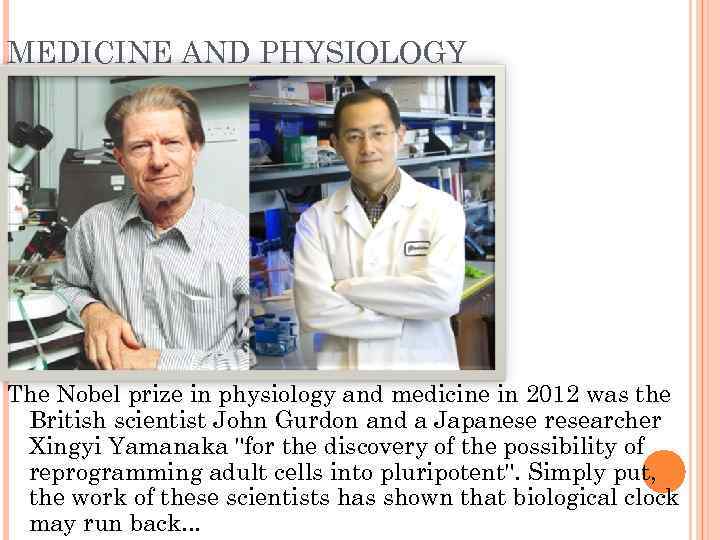
MEDICINE AND PHYSIOLOGY The Nobel prize in physiology and medicine in 2012 was the British scientist John Gurdon and a Japanese researcher Xingyi Yamanaka "for the discovery of the possibility of reprogramming adult cells into pluripotent". Simply put, the work of these scientists has shown that biological clock may run back. . .
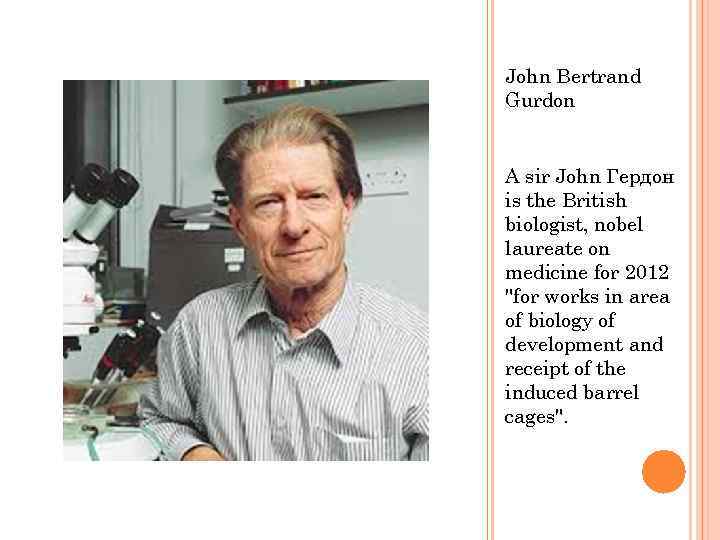
John Bertrand Gurdon A sir John Гердон is the British biologist, nobel laureate on medicine for 2012 "for works in area of biology of development and receipt of the induced barrel cages".
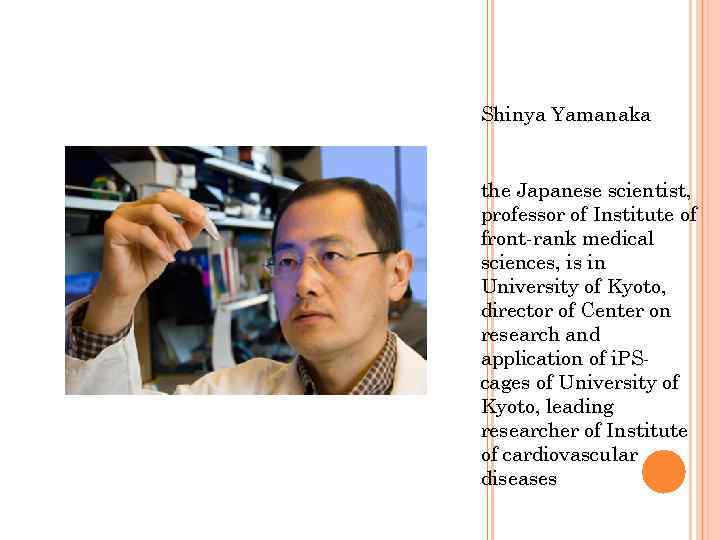
Shinya Yamanaka the Japanese scientist, professor of Institute of front-rank medical sciences, is in University of Kyoto, director of Center on research and application of i. PScages of University of Kyoto, leading researcher of Institute of cardiovascular diseases
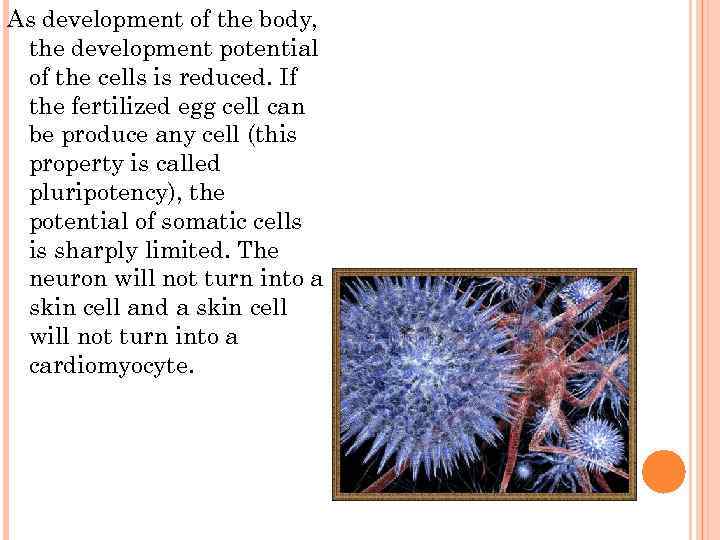
As development of the body, the development potential of the cells is reduced. If the fertilized egg cell can be produce any cell (this property is called pluripotency), the potential of somatic cells is sharply limited. The neuron will not turn into a skin cell and a skin cell will not turn into a cardiomyocyte.
The greatest potential among somatic cells possess is stem cells, but they give rise to a limited number of cell types (multipotential stem cells of an adult organism). It is a kind of "differentiated" aging at the cellular level. While aging is an irreversible process. The winners have shown that everything is wrong and everything is much more interesting.
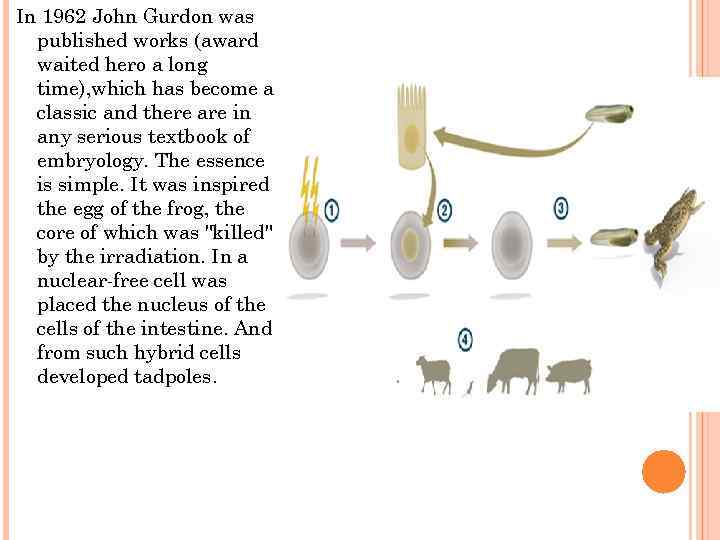
In 1962 John Gurdon was published works (award waited hero a long time), which has become a classic and there are in any serious textbook of embryology. The essence is simple. It was inspired the egg of the frog, the core of which was "killed" by the irradiation. In a nuclear-free cell was placed the nucleus of the cells of the intestine. And from such hybrid cells developed tadpoles.
This experiment, in particular, argued that the genome of somatic cells contain all the information that is in the egg, and therefore, the narrowing of the potentials of cells during development not associated with a degradation of genes. Consequently, the development can be reversed, by turning somatic cell into a pluripotent using such surgery at the cellular level. From this experiment, in particular, originate all work on the cloning of animals.
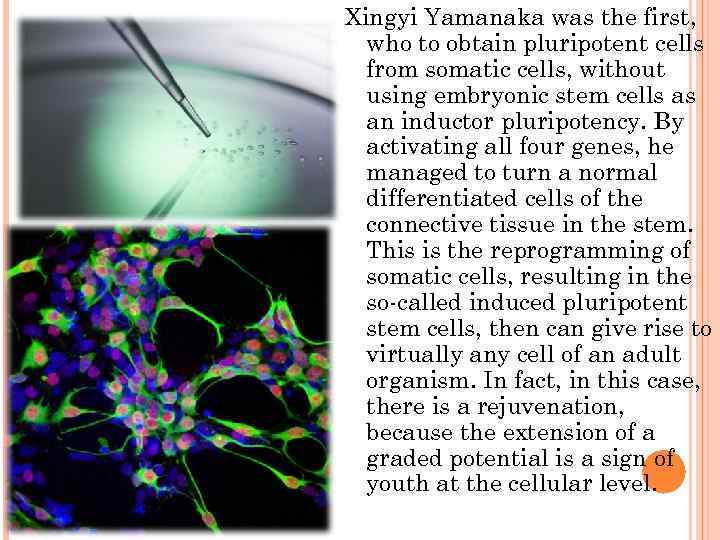
Xingyi Yamanaka was the first, who to obtain pluripotent cells from somatic cells, without using embryonic stem cells as an inductor pluripotency. By activating all four genes, he managed to turn a normal differentiated cells of the connective tissue in the stem. This is the reprogramming of somatic cells, resulting in the so-called induced pluripotent stem cells, then can give rise to virtually any cell of an adult organism. In fact, in this case, there is a rejuvenation, because the extension of a graded potential is a sign of youth at the cellular level.
The importance of these studies lies in the fact that this approach allows to refuse working with embryonic material. In the case of man, it is fraught with ethical problems. If you create pluripotent cells from somatic, such difficulties do not arise. The stem cells can be used to restore damaged by disease or aging of organs and tissues. Currently, many scientists expect that on the basis of these works they will be able to develop methods of obtaining stem cells needed for medicine. Perhaps that many incurable diseases at the present time will ever be defeated.
Скачать презентацию NOBEL PRIZE — 2012 Ryazan State University Natural
Nobel_prize_-_2012.ppt