


 Скачать презентацию NOAO Gemini Science Center NGSC Taft Armandroff for
ca37bd9e28731e388750078586614294.ppt
- Количество слайдов: 19
 NOAO Gemini Science Center (NGSC) Taft Armandroff for NOAO Users’ Committee October 2003
 Overview of NGSC Activities • NGSC User & Observing Proposal Support • NGSC Operations Support • NGSC Outreach to U. S. Astronomical Community • NGSC Instrumentation Activities • “Aspen” Next-Generation Gemini Instrumentation Process
 NGSC User Support • Call for U. S. Gemini proposals & their evaluation – Community education • • NOAO Newsletter, NGSC section U. S. Gemini Web information AAS Meetings Power. Point presentations at U. S. universities – Proposal technical review – Support TAC evaluation – Transmit ranked list to Gemini; interface via ITAC • Support of U. S. Gemini proposers & users – Help. Desk, e-mail & phone contact – Support & checking of U. S. Phase II submissions • 2003 B: GMOS, NIRI, & Phoenix (44 U. S. ) • Provide reduction packages for Gemini data – Collaboration with NOAO Data Products Program and Gemini
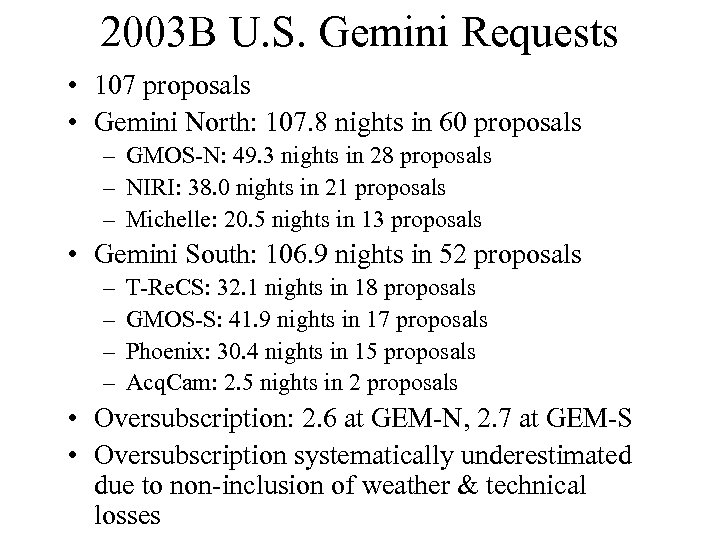 2003 B U. S. Gemini Requests • 107 proposals • Gemini North: 107. 8 nights in 60 proposals – GMOS-N: 49. 3 nights in 28 proposals – NIRI: 38. 0 nights in 21 proposals – Michelle: 20. 5 nights in 13 proposals • Gemini South: 106. 9 nights in 52 proposals – – T-Re. CS: 32. 1 nights in 18 proposals GMOS-S: 41. 9 nights in 17 proposals Phoenix: 30. 4 nights in 15 proposals Acq. Cam: 2. 5 nights in 2 proposals • Oversubscription: 2. 6 at GEM-N, 2. 7 at GEM-S • Oversubscription systematically underestimated due to non-inclusion of weather & technical losses
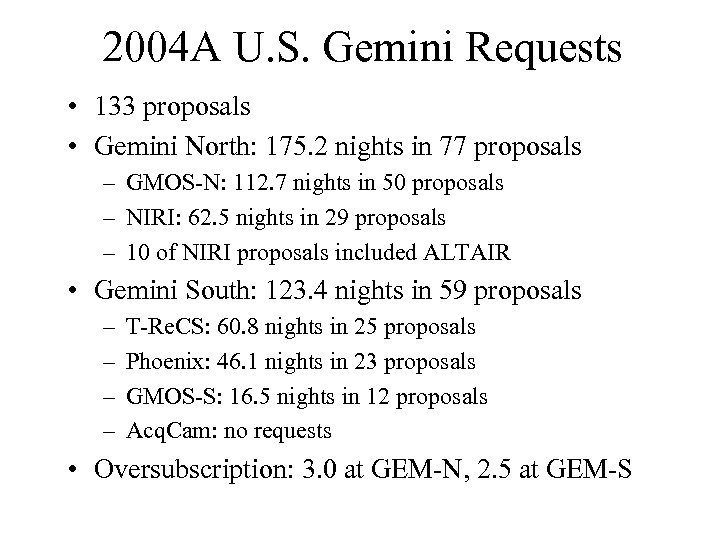 2004 A U. S. Gemini Requests • 133 proposals • Gemini North: 175. 2 nights in 77 proposals – GMOS-N: 112. 7 nights in 50 proposals – NIRI: 62. 5 nights in 29 proposals – 10 of NIRI proposals included ALTAIR • Gemini South: 123. 4 nights in 59 proposals – – T-Re. CS: 60. 8 nights in 25 proposals Phoenix: 46. 1 nights in 23 proposals GMOS-S: 16. 5 nights in 12 proposals Acq. Cam: no requests • Oversubscription: 3. 0 at GEM-N, 2. 5 at GEM-S
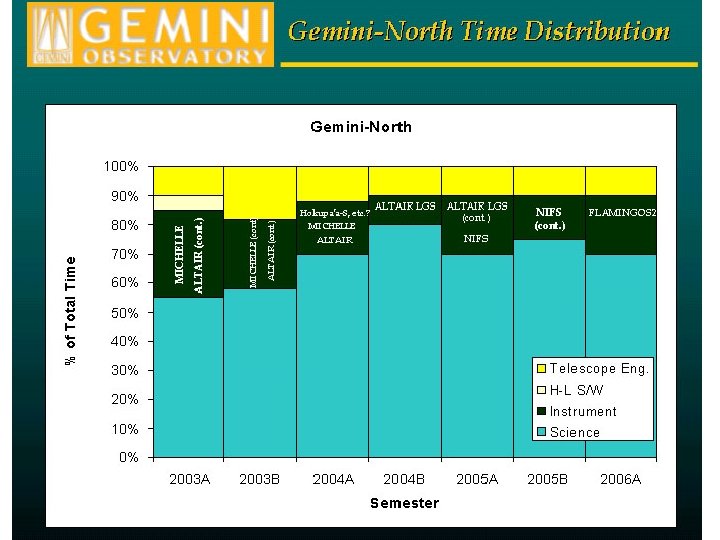
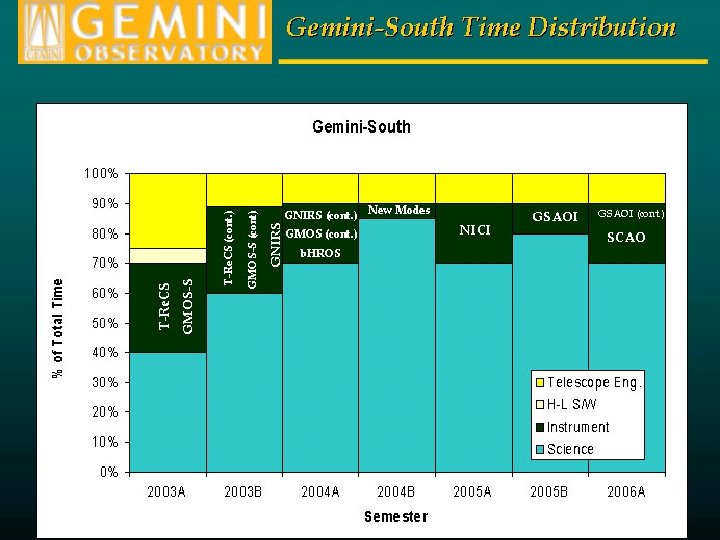
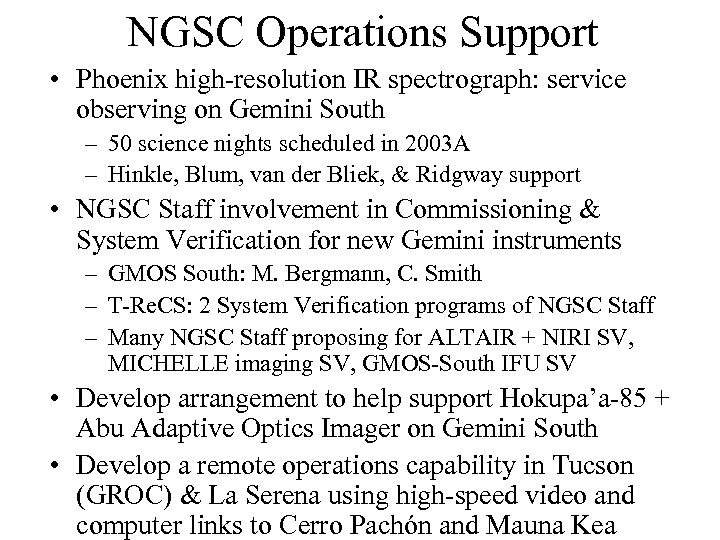 NGSC Operations Support • Phoenix high-resolution IR spectrograph: service observing on Gemini South – 50 science nights scheduled in 2003 A – Hinkle, Blum, van der Bliek, & Ridgway support • NGSC Staff involvement in Commissioning & System Verification for new Gemini instruments – GMOS South: M. Bergmann, C. Smith – T-Re. CS: 2 System Verification programs of NGSC Staff – Many NGSC Staff proposing for ALTAIR + NIRI SV, MICHELLE imaging SV, GMOS-South IFU SV • Develop arrangement to help support Hokupa’a-85 + Abu Adaptive Optics Imager on Gemini South • Develop a remote operations capability in Tucson (GROC) & La Serena using high-speed video and computer links to Cerro Pachón and Mauna Kea
 Community Outreach • Host special-topic science & analysis workshops – Future NGSC workshop ideas: • • mid-IR observing opportunities at Gemini Integral Field Unit (IFU) opportunities at Gemini Using IRAF to reduce your Gemini data GNIRS observing & calibration • NGSC at AAS meetings: booth at Seattle AAS (posters, brochures & Observing Tool demonstr. ) – do same at Atlanta AAS (January 2004) • • • NGSC presentations at U. S. institutions NGSC Webcast on Gemini 2004 A Proposals Postdoc program (2 general; 3 South American) Gemini Science Meeting in 2004 (NGSC Support) U. S. Gemini SAC is NGSC’s community-based advisory council
 NGSC Instrumentation Activities • Mission – instrument procurement in U. S. for Gemini telescopes – analogous function in other partner countries • Activities – NGSC let all the current U. S. instrument contracts – provide advice & liaison to the instrument teams – carry out management oversight • Co. DR, PDR, CDR, acceptance testing • Quarterly Reviews • release of payments only when specified milestone met – report progress to International Gemini; coordinate communications between the instrument team & Gemini
 U. S. Instrument Developments • T-Re. CS: mid-infrared imager and spectrograph for Gemini South (Florida) – Delivered to Gemini South 12 April 2003 – Followed by integration, acceptance testing, & commissioning – First light took place 2 June 2003 – TAC-approved science programs beginning execution! • GNIRS: workhorse infrared long-slit / IFU spectrograph for Gemini South (NOAO) – Pre-shipment acceptance test completed 15 October 2003 – GNIRS shipment to Gemini South imminent – Mounting GNIRS on Gemini South planned for December 2003 – GNIRS first light planned for January 2004
 U. S. Instrument Developments • NICI: dual-beam coronagraphic infrared imager for Gemini South (MKIR) – NASA funded – Procurement / fabrication phase ending; integration phase beginning – December 2004 delivery planned • Flamingos-2: multi-object IR spectrograph and imager (Florida) – Management Review in late January 2003 – NGSC assisting Florida personnel in project management techniques (Gaughan & Eklund) – Flamingos-2 contract approved and signed in early May – Critical Design Review took place in August – December 2005 delivery planned
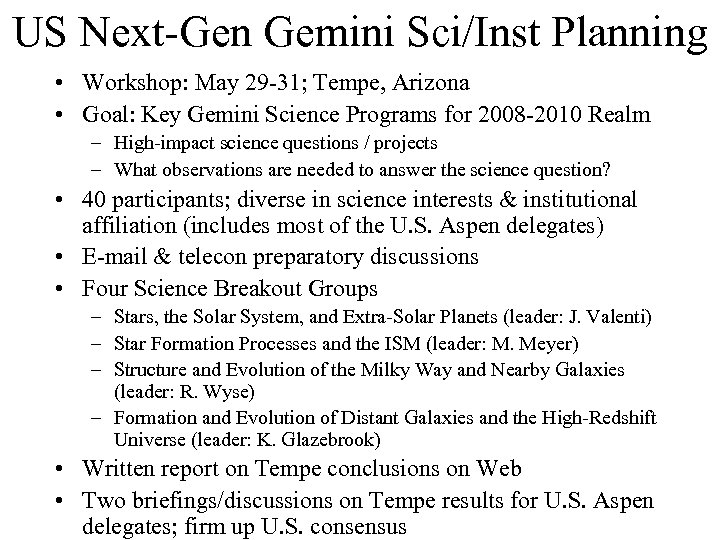 US Next-Gen Gemini Sci/Inst Planning • Workshop: May 29 -31; Tempe, Arizona • Goal: Key Gemini Science Programs for 2008 -2010 Realm – High-impact science questions / projects – What observations are needed to answer the science question? • 40 participants; diverse in science interests & institutional affiliation (includes most of the U. S. Aspen delegates) • E-mail & telecon preparatory discussions • Four Science Breakout Groups – Stars, the Solar System, and Extra-Solar Planets (leader: J. Valenti) – Star Formation Processes and the ISM (leader: M. Meyer) – Structure and Evolution of the Milky Way and Nearby Galaxies (leader: R. Wyse) – Formation and Evolution of Distant Galaxies and the High-Redshift Universe (leader: K. Glazebrook) • Written report on Tempe conclusions on Web • Two briefings/discussions on Tempe results for U. S. Aspen delegates; firm up U. S. consensus
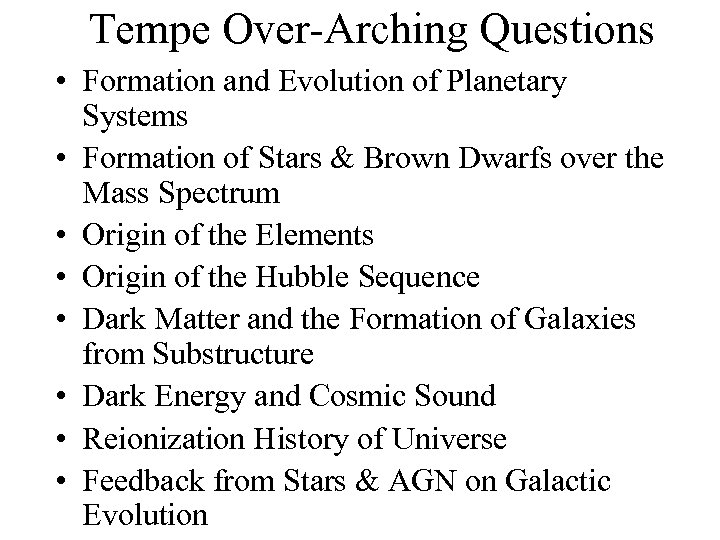 Tempe Over-Arching Questions • Formation and Evolution of Planetary Systems • Formation of Stars & Brown Dwarfs over the Mass Spectrum • Origin of the Elements • Origin of the Hubble Sequence • Dark Matter and the Formation of Galaxies from Substructure • Dark Energy and Cosmic Sound • Reionization History of Universe • Feedback from Stars & AGN on Galactic Evolution
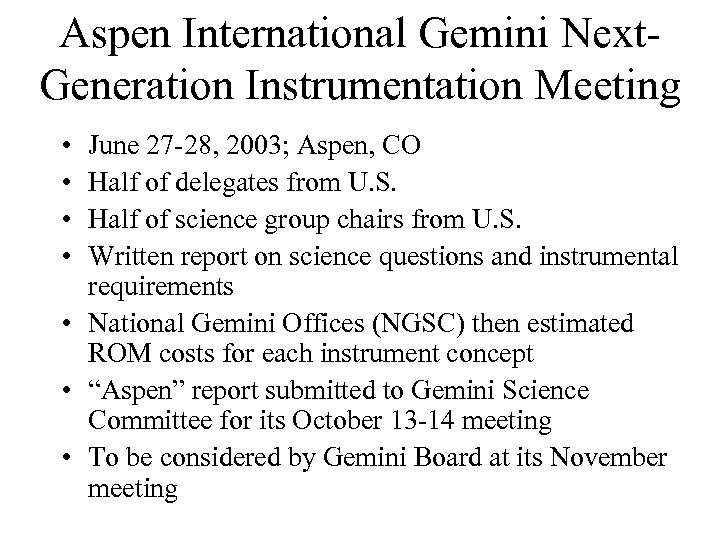 Aspen International Gemini Next. Generation Instrumentation Meeting • • June 27 -28, 2003; Aspen, CO Half of delegates from U. S. Half of science group chairs from U. S. Written report on science questions and instrumental requirements • National Gemini Offices (NGSC) then estimated ROM costs for each instrument concept • “Aspen” report submitted to Gemini Science Committee for its October 13 -14 meeting • To be considered by Gemini Board at its November meeting
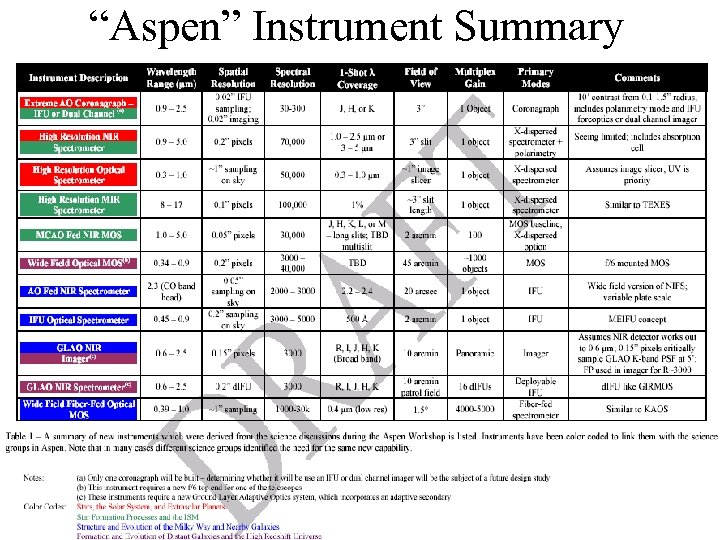 “Aspen” Instrument Summary
 Open NGSC/Gemini Issues • Are the science needs of U. S. community at large aperture being met by Gemini? Any issues impeding user science? • Do the “Aspen” instruments represent a bright scientific future for Gemini? • What are the near-term priorities for commissioning Gemini instruments? • What data reduction software is most needed for U. S. Gemini users? • Is there demand for both Queue and Classical observing with Gemini by our community? • The U. S. Gemini SAC has discussed all these questions.
 Begin Reserve Slides May be of use for specific committee questions
 Recent U. S. Gemini Papers • “Detection of Nine M 8. 0 -L 0. 5 Binaries: The Very Low Mass Binary Population and Its Implications for Brown Dwarf and Very Low Mass Star Formation, ” Close et al. , Ap. J, 2003 • “Resolved Mid-Infrared Emission in the Narrow. Line Region of NGC 4151, ” Radomski et al. , Ap. J, 2003 • “Mid-Infrared Imaging of the Protostellar Binary L 1448 N IRS 3(A, B), ” Ciardi et al. , Ap. J, 2003 • “Fluorine Abundances in the Large Magellanic Cloud and Omega Centauri: Evidence for Neutrino Nucleosynthesis? , ” Cunha et al. , AJ, 2003