


 Скачать презентацию NOAA s Satellite and Information Service The Nation s Civil
7435c994706ba92c302d7a87904c55ff.ppt
- Количество слайдов: 68
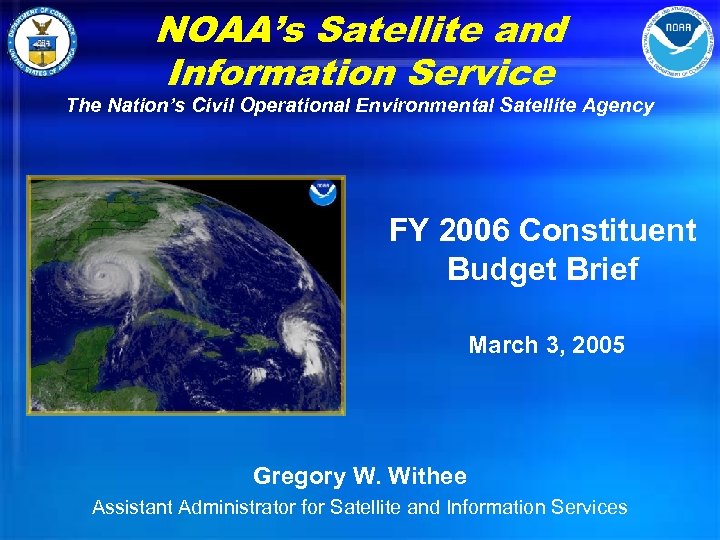 NOAA’s Satellite and Information Service The Nation’s Civil Operational Environmental Satellite Agency FY 2006 Constituent Budget Brief March 3, 2005 Gregory W. Withee Assistant Administrator for Satellite and Information Services
 Agenda • NOAA Budget Highlights • FY 2004 Accomplishments • FY 2005 Highlights • FY 2006 Budget Overview – – Environmental Satellite Services Data and Information Services Satellite Systems Other Systems and Construction Projects 2
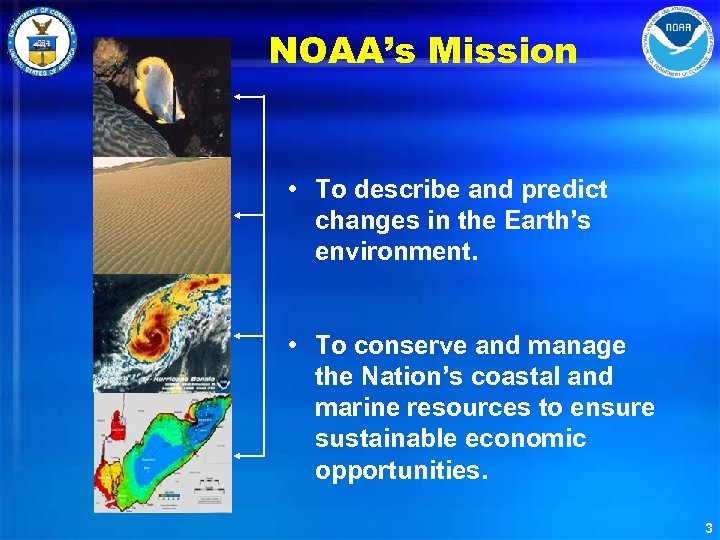 NOAA’s Mission • To describe and predict changes in the Earth’s environment. • To conserve and manage the Nation’s coastal and marine resources to ensure sustainable economic opportunities. 3
 FY 2004 Service Accomplishments • Provided Outstanding Service for Hurricane Season • Issued Operational Air Quality Forecasts in New England • Issued New Operational Climate Forecast Model • Rebuilt 4 Fisheries Stocks • Restored 5, 562 Acres of Coastal Habitat and Wetlands. • Charted Over 2, 070 Square Miles of Ocean • 220 American lives saved with Satellite Rescue System (SARSAT) 4
 FY 2004 Management Accomplishments • Issued Strategic Plan for an Global Earth Observing System • Began Critical Fisheries Survey Vessel Modernization • Issued 5 Year Research Plan and 20 -Year Research Vision for NOAA • Realigned Administrative Support Services • Began Grants On-Line. Improved Timely Grant Issuance by 12% • Earned Unqualified Audit Opinion for 6 th Year in a Row • Updated NOAA Strategic Plan and Improved Internal Planning 5
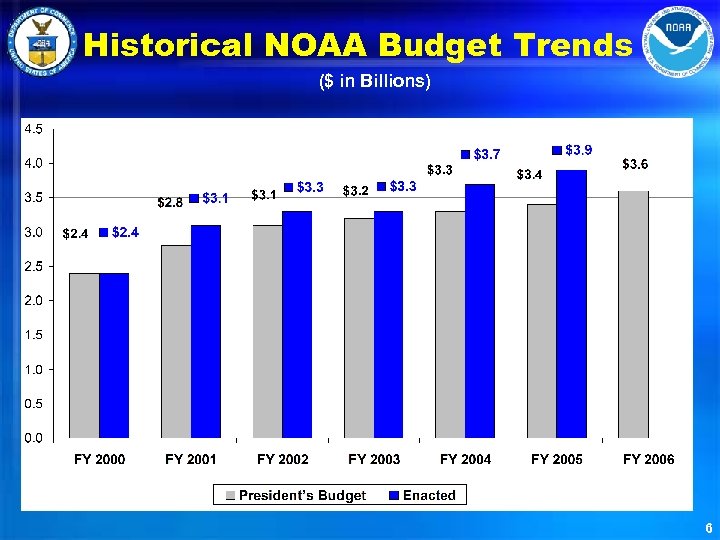 Historical NOAA Budget Trends ($ in Billions) 6
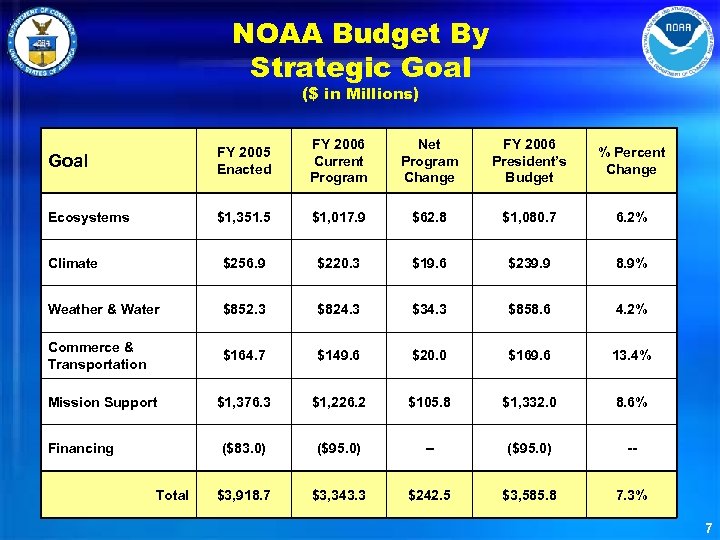 NOAA Budget By Strategic Goal ($ in Millions) Goal FY 2005 Enacted FY 2006 Current Program Net Program Change FY 2006 President’s Budget % Percent Change Ecosystems $1, 351. 5 $1, 017. 9 $62. 8 $1, 080. 7 6. 2% Climate $256. 9 $220. 3 $19. 6 $239. 9 8. 9% Weather & Water $852. 3 $824. 3 $34. 3 $858. 6 4. 2% Commerce & Transportation $164. 7 $149. 6 $20. 0 $169. 6 13. 4% $1, 376. 3 $1, 226. 2 $105. 8 $1, 332. 0 8. 6% ($83. 0) ($95. 0) -- $3, 918. 7 $3, 343. 3 $242. 5 $3, 585. 8 7. 3% Mission Support Financing Total 7
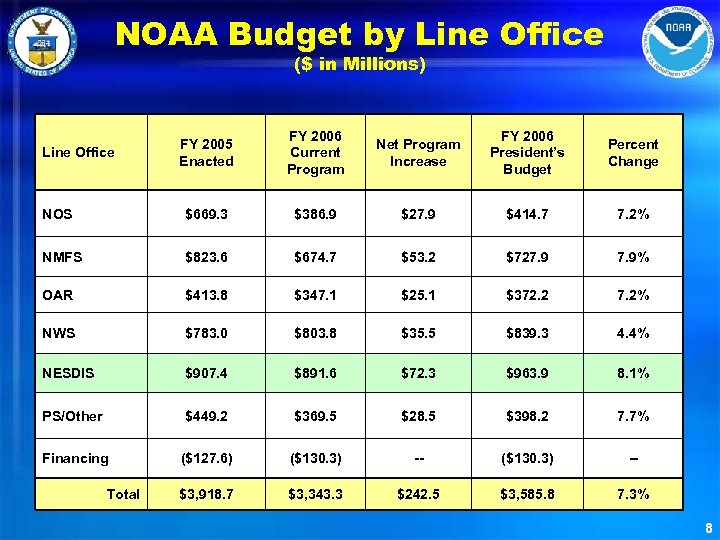 NOAA Budget by Line Office ($ in Millions) FY 2005 Enacted FY 2006 Current Program Net Program Increase FY 2006 President’s Budget Percent Change NOS $669. 3 $386. 9 $27. 9 $414. 7 7. 2% NMFS $823. 6 $674. 7 $53. 2 $727. 9% OAR $413. 8 $347. 1 $25. 1 $372. 2 7. 2% NWS $783. 0 $803. 8 $35. 5 $839. 3 4. 4% NESDIS $907. 4 $891. 6 $72. 3 $963. 9 8. 1% PS/Other $449. 2 $369. 5 $28. 5 $398. 2 7. 7% Financing ($127. 6) ($130. 3) -- $3, 918. 7 $3, 343. 3 $242. 5 $3, 585. 8 7. 3% Line Office Total 8
 NOAA Budget Priorities ($ in Millions) • Support People and Infrastructure 1) Contribute to a Global Earth Observing System 4) Invest in Ecosystems Management • Expand Climate Services & Observations • Improve Weather Forecasts and Warnings • Facilitate Intermodal Transportation • Support Facilities Maintenance & Construction 9
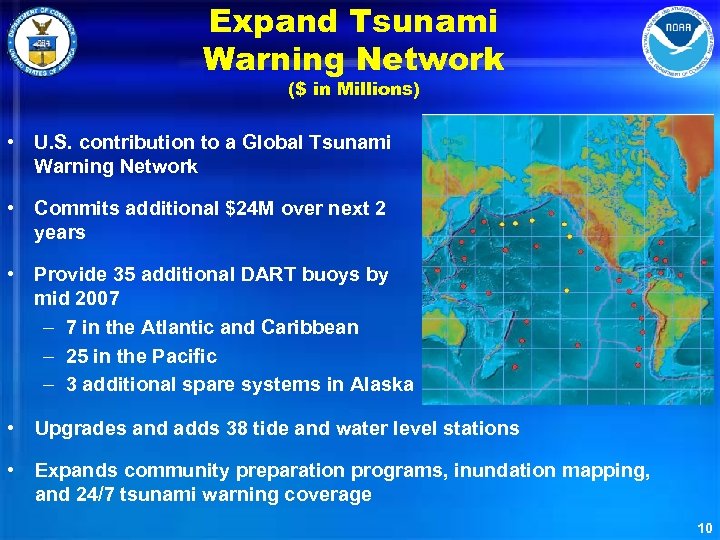 Expand Tsunami Warning Network ($ in Millions) • U. S. contribution to a Global Tsunami Warning Network • Commits additional $24 M over next 2 years • Provide 35 additional DART buoys by mid 2007 – 7 in the Atlantic and Caribbean – 25 in the Pacific – 3 additional spare systems in Alaska • Upgrades and adds 38 tide and water level stations • Expands community preparation programs, inundation mapping, and 24/7 tsunami warning coverage 10
 NOAA Satellite and Information Mission To provide timely access to global environmental data and information services from satellites and other sources in support of the larger NOAA mission. 11
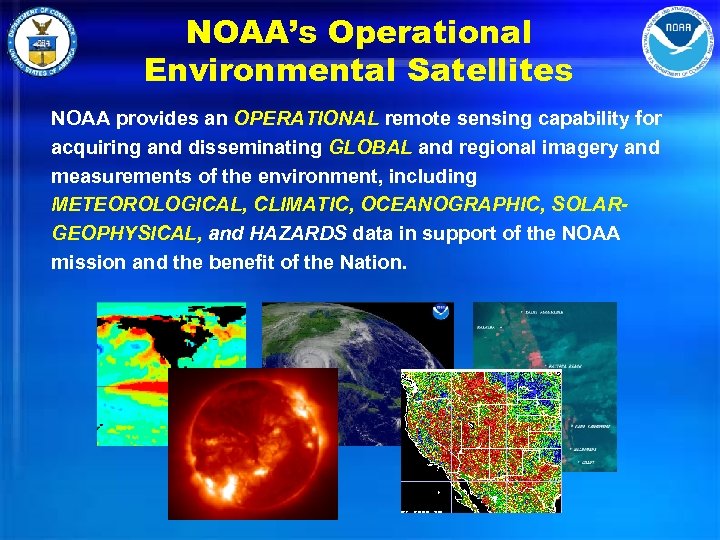 NOAA’s Operational Environmental Satellites NOAA provides an OPERATIONAL remote sensing capability for acquiring and disseminating GLOBAL and regional imagery and measurements of the environment, including METEOROLOGICAL, CLIMATIC, OCEANOGRAPHIC, SOLARGEOPHYSICAL, and HAZARDS data in support of the NOAA mission and the benefit of the Nation.
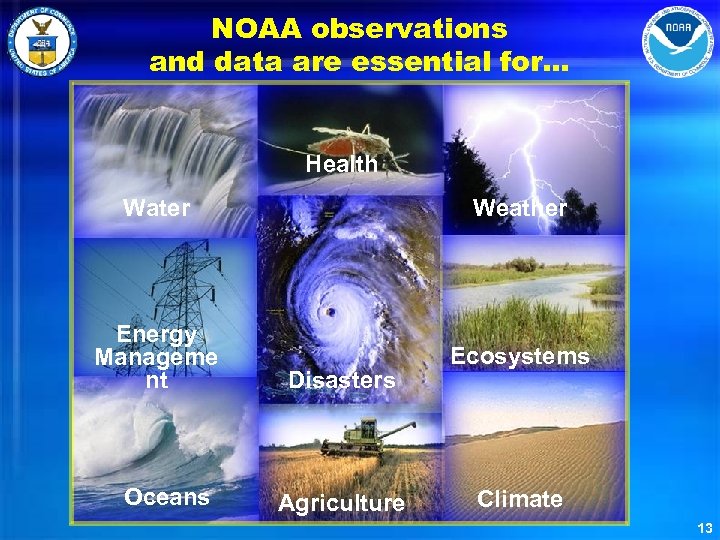 NOAA observations and data are essential for… Health Water Weather Energy Manageme nt Ecosystems Oceans Disasters Agriculture Climate 13
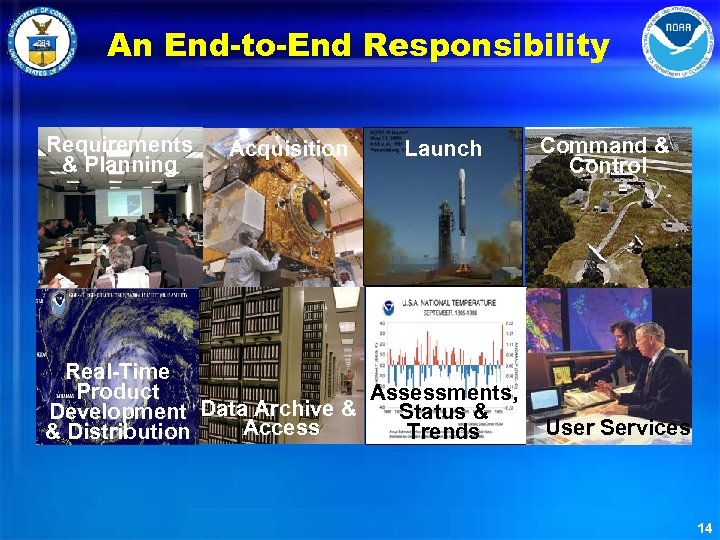 An End-to-End Responsibility Requirements & Planning Acquisition Launch Command & Control Real-Time Product Assessments, Development Data Archive & Status & User Services Access & Distribution Trends 14
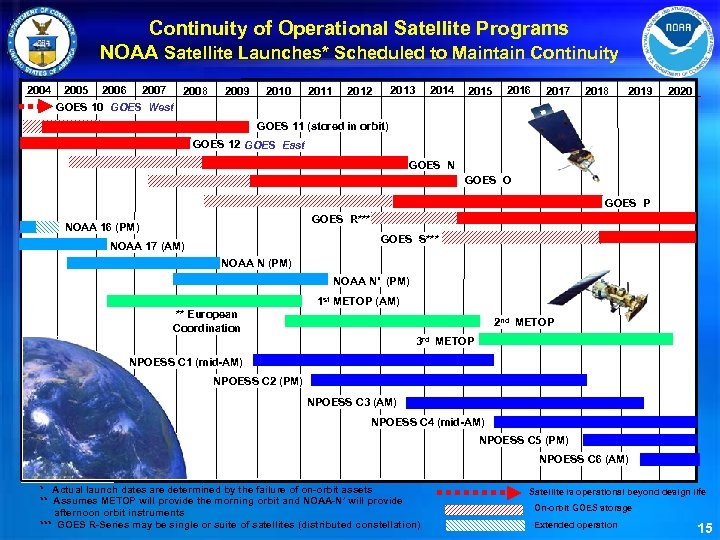 Continuity of Operational Satellite Programs NOAA Satellite Launches* Scheduled to Maintain Continuity 2004 2005 2006 2007 2008 2009 2010 2011 2012 2013 2014 2015 2016 2017 2018 2019 2020 GOES 10 GOES West GOES 11 (stored in orbit) GOES 12 GOES East GOES N GOES O GOES P GOES R*** NOAA 16 (PM) GOES S*** NOAA 17 (AM) NOAA N (PM) NOAA N’ (PM) 1 st METOP (AM) ** European Coordination 2 nd METOP 3 rd METOP NPOESS C 1 (mid-AM) NPOESS C 2 (PM) NPOESS C 3 (AM) NPOESS C 4 (mid-AM) NPOESS C 5 (PM) NPOESS C 6 (AM) * Actual launch dates are determined by the failure of on-orbit assets ** Assumes METOP will provide the morning orbit and NOAA-N’ will provide afternoon orbit instruments *** GOES R-Series may be single or suite of satellites (distributed constellation) Satellite is operational beyond design life On-orbit GOES storage Extended operation 15
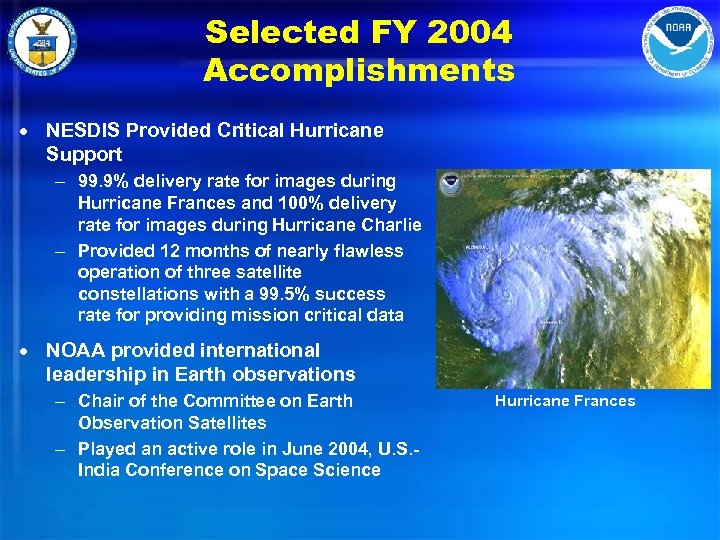 Selected FY 2004 Accomplishments · NESDIS Provided Critical Hurricane Support – 99. 9% delivery rate for images during Hurricane Frances and 100% delivery rate for images during Hurricane Charlie – Provided 12 months of nearly flawless operation of three satellite constellations with a 99. 5% success rate for providing mission critical data · NOAA provided international leadership in Earth observations – Chair of the Committee on Earth Observation Satellites – Played an active role in June 2004, U. S. India Conference on Space Science Hurricane Frances
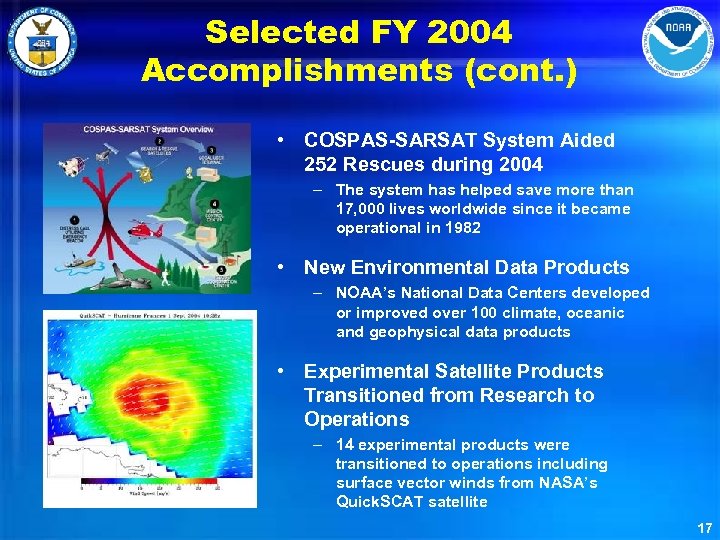 Selected FY 2004 Accomplishments (cont. ) • COSPAS-SARSAT System Aided 252 Rescues during 2004 – The system has helped save more than 17, 000 lives worldwide since it became operational in 1982 • New Environmental Data Products – NOAA’s National Data Centers developed or improved over 100 climate, oceanic and geophysical data products • Experimental Satellite Products Transitioned from Research to Operations – 14 experimental products were transitioned to operations including surface vector winds from NASA’s Quick. SCAT satellite 17
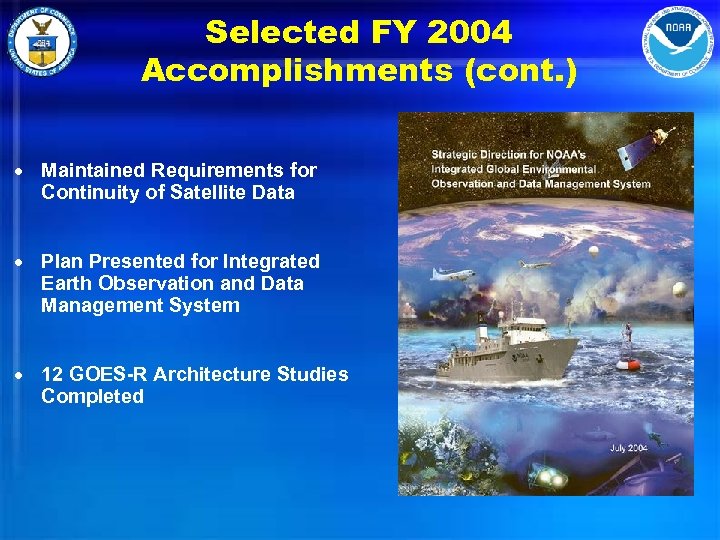 Selected FY 2004 Accomplishments (cont. ) · Maintained Requirements for Continuity of Satellite Data · Plan Presented for Integrated Earth Observation and Data Management System · 12 GOES-R Architecture Studies Completed
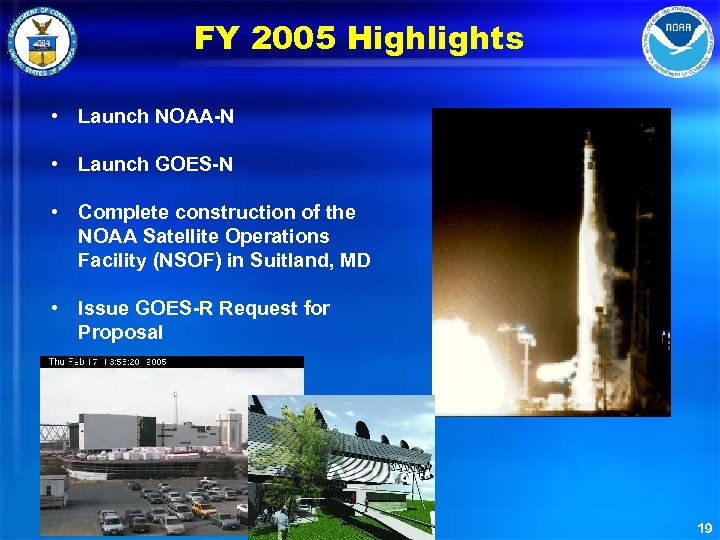 FY 2005 Highlights • Launch NOAA-N • Launch GOES-N • Complete construction of the NOAA Satellite Operations Facility (NSOF) in Suitland, MD • Issue GOES-R Request for Proposal 19
 FY 2006 Budget Overview • Requests $963. 9 million, which represents a $72. 3 M or 8. 1% requested increase over the FY 2006 current program • Maintains environmental satellite and information services budget • Supports NOAA strategy of integrated global observations and data management • Includes continued development of GOES-R, the National Polarorbiting Operational Environmental Satellite System (NPOESS), and the CLASS data archive and access system • Provides for NOAA operations of the Jason 2/OSTM mission • Funds first year operations of the new NOAA Satellite Operations Facility (NSOF) 20
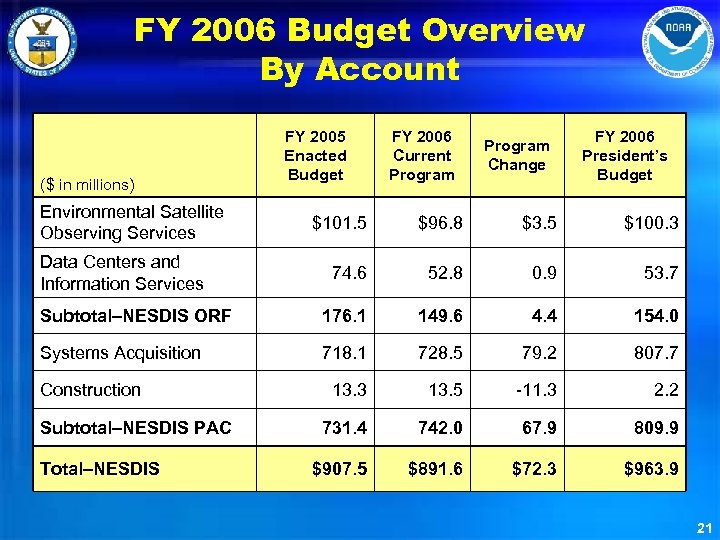 FY 2006 Budget Overview By Account ($ in millions) Environmental Satellite Observing Services FY 2005 Enacted Budget FY 2006 Current Program Change FY 2006 President’s Budget $101. 5 $96. 8 $3. 5 $100. 3 74. 6 52. 8 0. 9 53. 7 Subtotal–NESDIS ORF 176. 1 149. 6 4. 4 154. 0 Systems Acquisition 718. 1 728. 5 79. 2 807. 7 13. 3 13. 5 -11. 3 2. 2 731. 4 742. 0 67. 9 809. 9 $907. 5 $891. 6 $72. 3 $963. 9 Data Centers and Information Services Construction Subtotal–NESDIS PAC Total–NESDIS 21
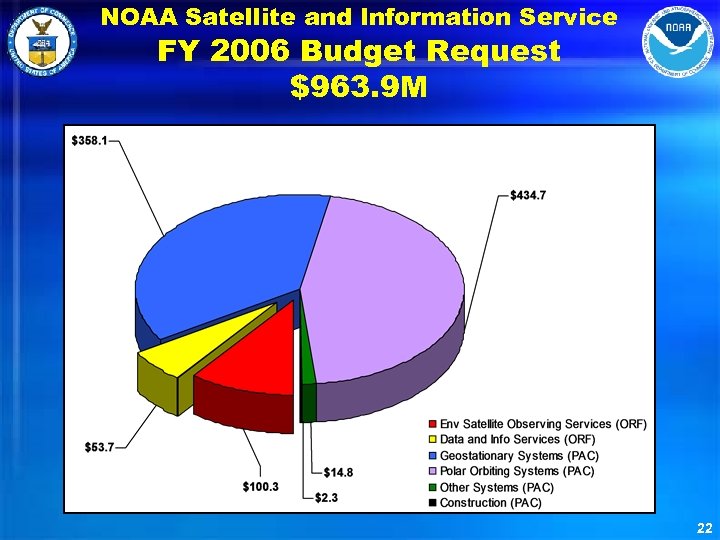 NOAA Satellite and Information Service FY 2006 Budget Request $963. 9 M 22
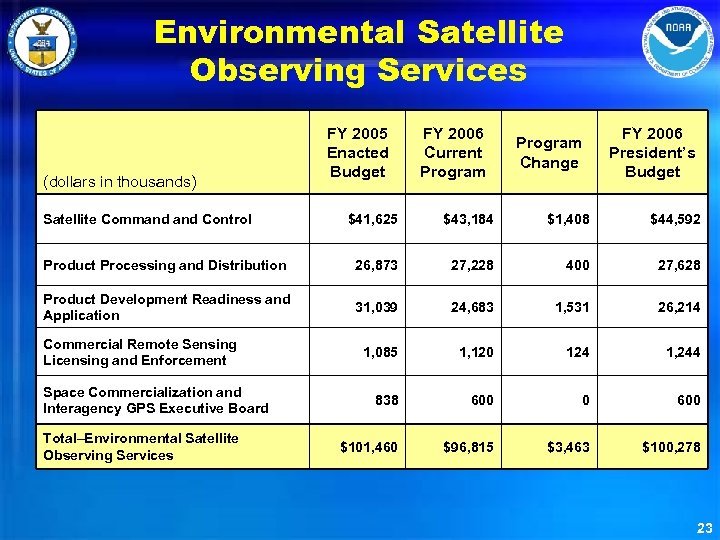 Environmental Satellite Observing Services (dollars in thousands) Satellite Command Control FY 2005 Enacted Budget FY 2006 Current Program FY 2006 President’s Budget Program Change $41, 625 $43, 184 $1, 408 $44, 592 Product Processing and Distribution 26, 873 27, 228 400 27, 628 Product Development Readiness and Application 31, 039 24, 683 1, 531 26, 214 1, 085 1, 120 124 1, 244 838 600 0 600 $101, 460 $96, 815 $3, 463 $100, 278 Commercial Remote Sensing Licensing and Enforcement Space Commercialization and Interagency GPS Executive Board Total–Environmental Satellite Observing Services 23
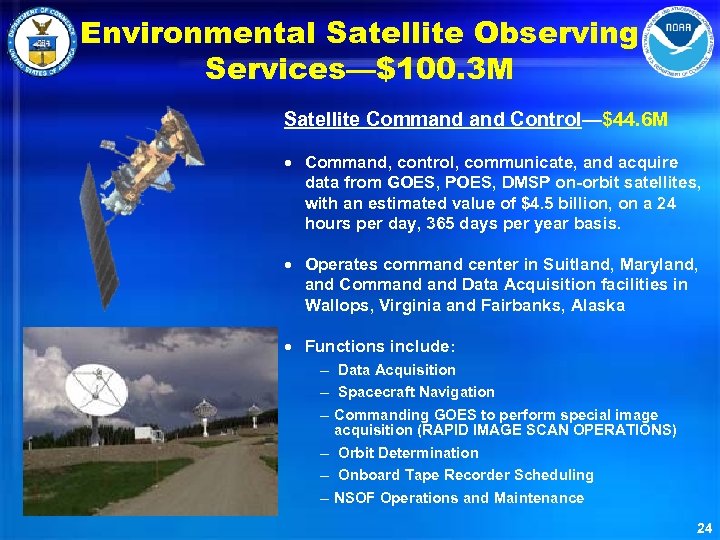 Environmental Satellite Observing Services—$100. 3 M Satellite Command Control—$44. 6 M · Command, control, communicate, and acquire data from GOES, POES, DMSP on-orbit satellites, with an estimated value of $4. 5 billion, on a 24 hours per day, 365 days per year basis. · Operates command center in Suitland, Maryland, and Command Data Acquisition facilities in Wallops, Virginia and Fairbanks, Alaska · Functions include: – Data Acquisition – Spacecraft Navigation – Commanding GOES to perform special image acquisition (RAPID IMAGE SCAN OPERATIONS) – Orbit Determination – Onboard Tape Recorder Scheduling – NSOF Operations and Maintenance 24
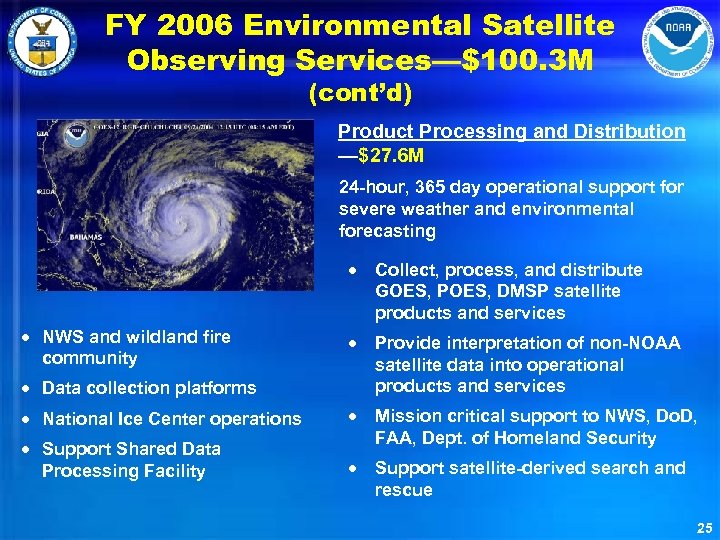 FY 2006 Environmental Satellite Observing Services—$100. 3 M (cont’d) Product Processing and Distribution —$27. 6 M 24 -hour, 365 day operational support for severe weather and environmental forecasting · Collect, process, and distribute GOES, POES, DMSP satellite products and services · Provide interpretation of non-NOAA satellite data into operational products and services · National Ice Center operations · · Support Shared Data Processing Facility Mission critical support to NWS, Do. D, FAA, Dept. of Homeland Security · Support satellite-derived search and rescue · NWS and wildland fire community · Data collection platforms 25
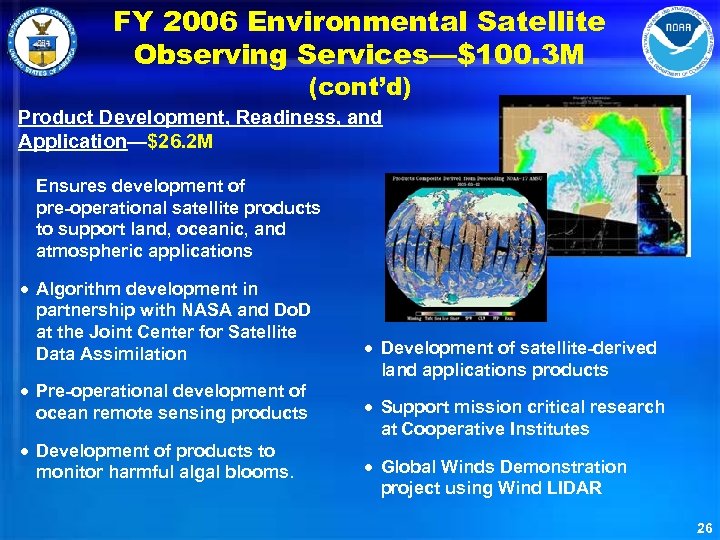 FY 2006 Environmental Satellite Observing Services—$100. 3 M (cont’d) Product Development, Readiness, and Application—$26. 2 M Ensures development of pre-operational satellite products to support land, oceanic, and atmospheric applications · Algorithm development in partnership with NASA and Do. D at the Joint Center for Satellite Data Assimilation · Pre-operational development of ocean remote sensing products · Development of products to monitor harmful algal blooms. · Development of satellite-derived land applications products · Support mission critical research at Cooperative Institutes · Global Winds Demonstration project using Wind LIDAR 26
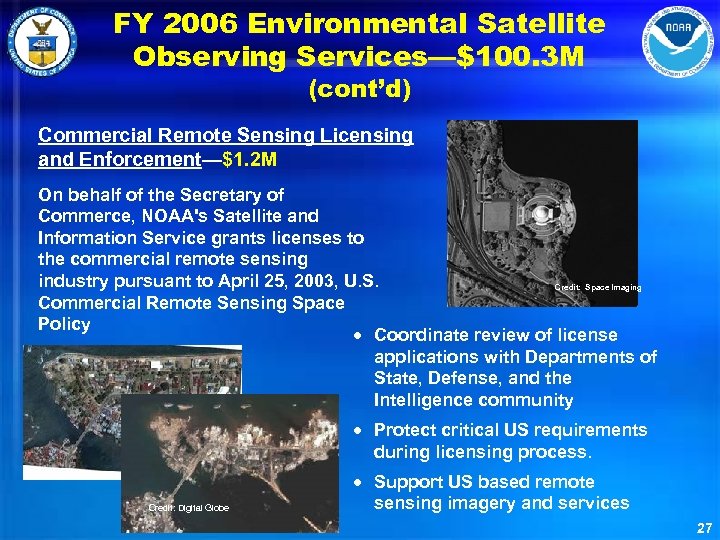 FY 2006 Environmental Satellite Observing Services—$100. 3 M (cont’d) Commercial Remote Sensing Licensing and Enforcement—$1. 2 M On behalf of the Secretary of Commerce, NOAA's Satellite and Information Service grants licenses to the commercial remote sensing industry pursuant to April 25, 2003, U. S. Credit: Space Imaging Commercial Remote Sensing Space Policy · Coordinate review of license applications with Departments of State, Defense, and the Intelligence community · Protect critical US requirements during licensing process. Credit: Digital Globe Credit: Digital Globe · Support US based remote sensing imagery and services 27
 FY 2006 Environmental Satellite Observing Services—$100. 3 M (cont’d) Space Commercialization—$0. 6 M Beginning in FY 2006, the NOAA Budget Request includes funding for the Office of Space Commercialization. These activities were previously performed by the Technology Administration. Activities include: · policy development, market analysis, and outreach/education with commercial space industry sectors Credit: Digital Globe · satellite navigation, satellite imaging, national space policy and other space-related issues 28
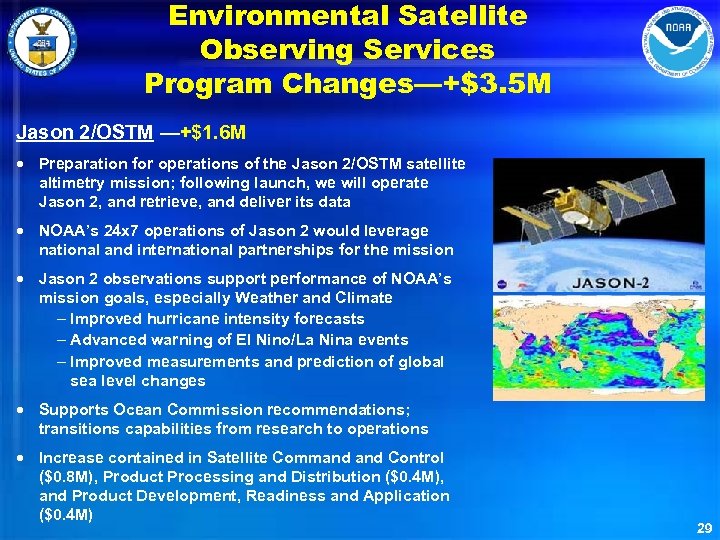 Environmental Satellite Observing Services Program Changes—+$3. 5 M Jason 2/OSTM —+$1. 6 M · Preparation for operations of the Jason 2/OSTM satellite altimetry mission; following launch, we will operate Jason 2, and retrieve, and deliver its data · NOAA’s 24 x 7 operations of Jason 2 would leverage national and international partnerships for the mission · Jason 2 observations support performance of NOAA’s mission goals, especially Weather and Climate – Improved hurricane intensity forecasts – Advanced warning of El Nino/La Nina events – Improved measurements and prediction of global sea level changes · Supports Ocean Commission recommendations; transitions capabilities from research to operations · Increase contained in Satellite Command Control ($0. 8 M), Product Processing and Distribution ($0. 4 M), and Product Development, Readiness and Application ($0. 4 M) 29
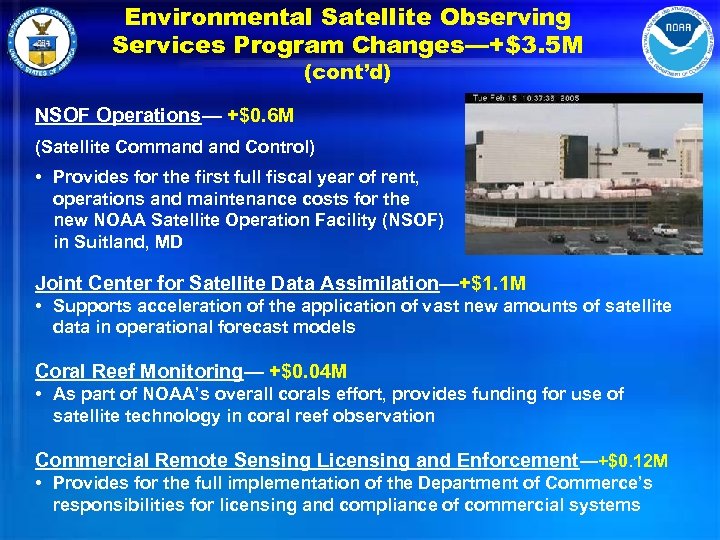 Environmental Satellite Observing Services Program Changes—+$3. 5 M (cont’d) NSOF Operations— +$0. 6 M (Satellite Command Control) • Provides for the first full fiscal year of rent, operations and maintenance costs for the new NOAA Satellite Operation Facility (NSOF) in Suitland, MD Joint Center for Satellite Data Assimilation—+$1. 1 M • Supports acceleration of the application of vast new amounts of satellite data in operational forecast models Coral Reef Monitoring— +$0. 04 M • As part of NOAA’s overall corals effort, provides funding for use of satellite technology in coral reef observation Commercial Remote Sensing Licensing and Enforcement—+$0. 12 M • Provides for the full implementation of the Department of Commerce’s responsibilities for licensing and compliance of commercial systems
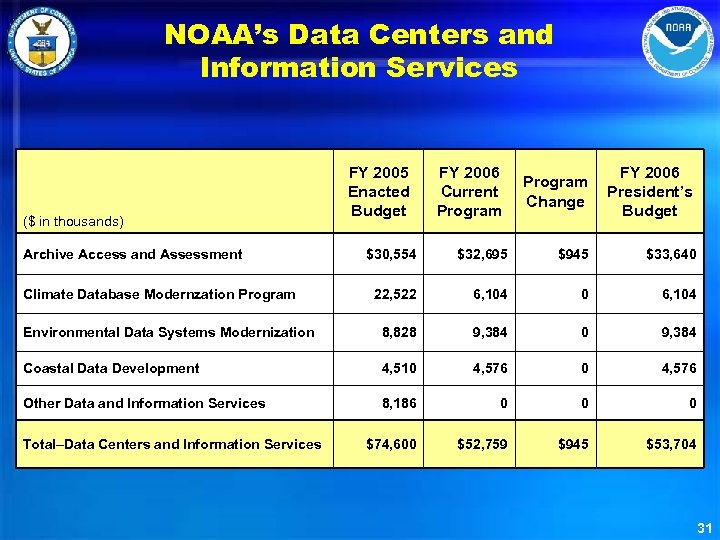 NOAA’s Data Centers and Information Services ($ in thousands) Archive Access and Assessment FY 2005 Enacted Budget FY 2006 Current Program Change FY 2006 President’s Budget $30, 554 $32, 695 $945 $33, 640 22, 522 6, 104 0 6, 104 Environmental Data Systems Modernization 8, 828 9, 384 0 9, 384 Coastal Data Development 4, 510 4, 576 Other Data and Information Services 8, 186 0 0 0 $74, 600 $52, 759 $945 $53, 704 Climate Database Modernzation Program Total–Data Centers and Information Services 31
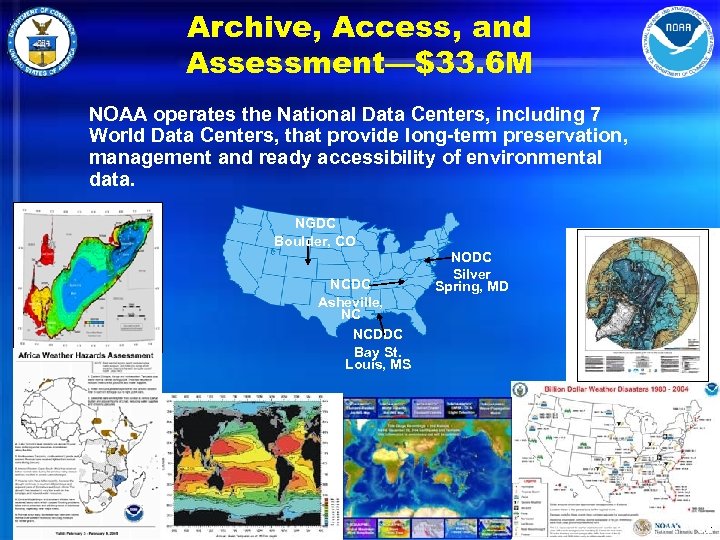 Archive, Access, and Assessment—$33. 6 M NOAA operates the National Data Centers, including 7 World Data Centers, that provide long-term preservation, management and ready accessibility of environmental data. NGDC Boulder, CO NCDC Asheville, NC NCDDC Bay St. Louis, MS NODC Silver Spring, MD 32
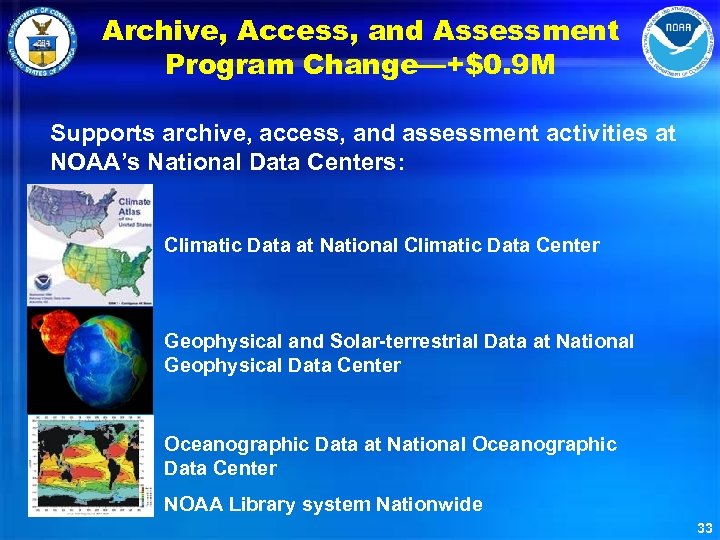 Archive, Access, and Assessment Program Change—+$0. 9 M Supports archive, access, and assessment activities at NOAA’s National Data Centers: Climatic Data at National Climatic Data Center Geophysical and Solar-terrestrial Data at National Geophysical Data Center Oceanographic Data at National Oceanographic Data Center NOAA Library system Nationwide 33
 FY 2006—Other Data and Information Activities $6. 1 M Climate Database Modernization · Rescues at-risk data from loss due to deteriorating media $9. 4 M Environmental Data Systems Modernization · Provides essential ongoing maintenance of systems modernization efforts · Supports Scientific Data Stewardship activities $4. 6 M Coastal Data Development · Improves on‑line access of data to the Nation’s coastal user community and GIS applications 34
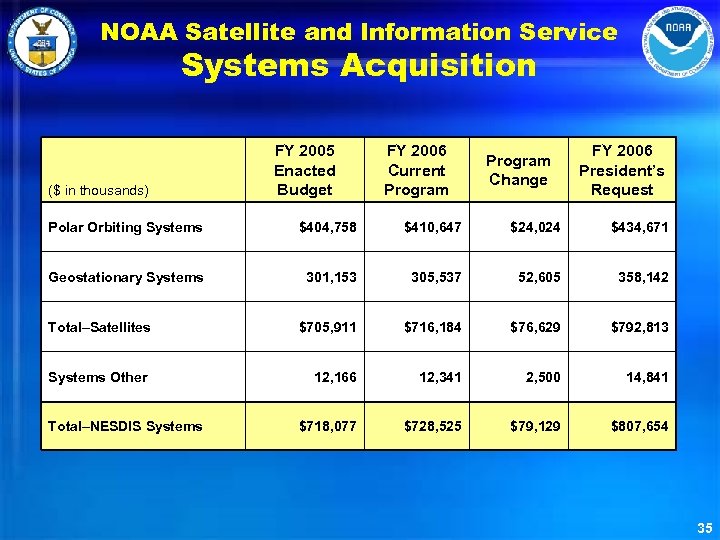 NOAA Satellite and Information Service Systems Acquisition ($ in thousands) FY 2005 Enacted Budget FY 2006 Current Program Change FY 2006 President’s Request Polar Orbiting Systems $404, 758 $410, 647 $24, 024 $434, 671 Geostationary Systems 301, 153 305, 537 52, 605 358, 142 Total–Satellites $705, 911 $716, 184 $76, 629 $792, 813 Systems Other 12, 166 12, 341 2, 500 14, 841 $718, 077 $728, 525 $79, 129 $807, 654 Total–NESDIS Systems 35
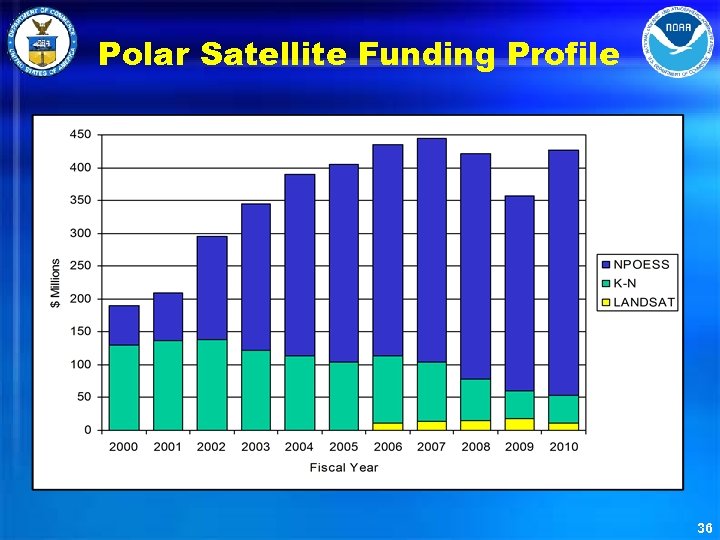 Polar Satellite Funding Profile 36
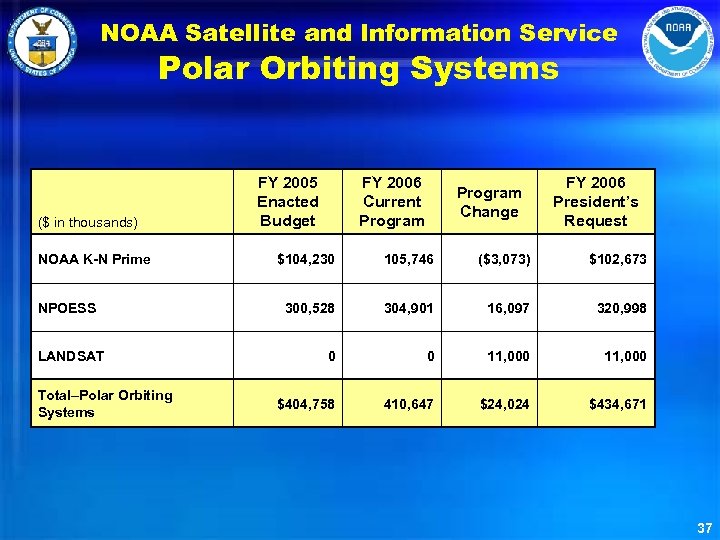 NOAA Satellite and Information Service Polar Orbiting Systems ($ in thousands) NOAA K-N Prime NPOESS LANDSAT Total–Polar Orbiting Systems FY 2005 Enacted Budget FY 2006 Current Program Change FY 2006 President’s Request $104, 230 105, 746 ($3, 073) $102, 673 300, 528 304, 901 16, 097 320, 998 0 0 11, 000 $404, 758 410, 647 $24, 024 $434, 671 37
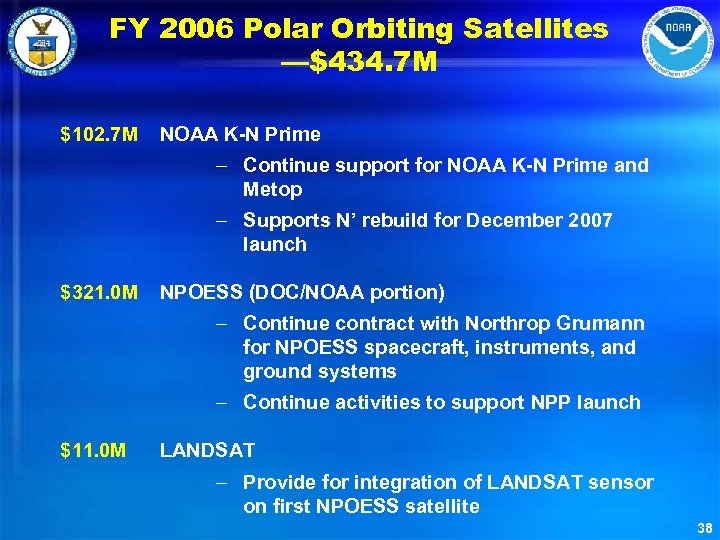 FY 2006 Polar Orbiting Satellites —$434. 7 M $102. 7 M NOAA K-N Prime – Continue support for NOAA K-N Prime and Metop – Supports N’ rebuild for December 2007 launch $321. 0 M NPOESS (DOC/NOAA portion) – Continue contract with Northrop Grumann for NPOESS spacecraft, instruments, and ground systems – Continue activities to support NPP launch $11. 0 M LANDSAT – Provide for integration of LANDSAT sensor on first NPOESS satellite 38
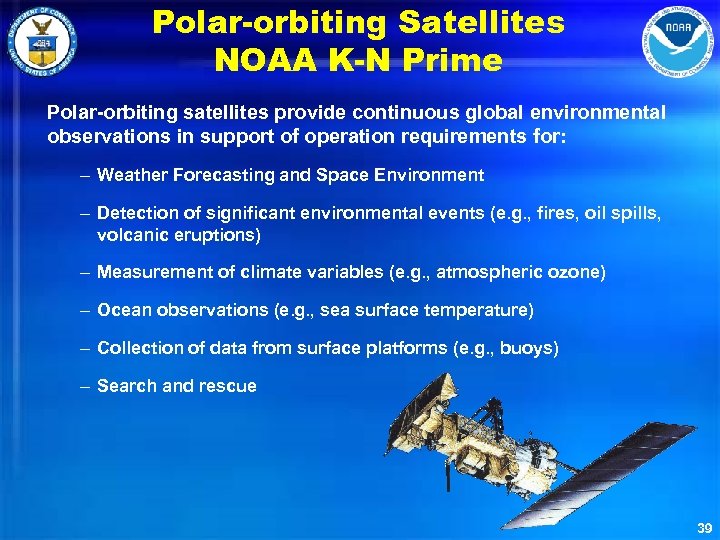 Polar-orbiting Satellites NOAA K-N Prime Polar-orbiting satellites provide continuous global environmental observations in support of operation requirements for: – Weather Forecasting and Space Environment – Detection of significant environmental events (e. g. , fires, oil spills, volcanic eruptions) – Measurement of climate variables (e. g. , atmospheric ozone) – Ocean observations (e. g. , sea surface temperature) – Collection of data from surface platforms (e. g. , buoys) – Search and rescue 39
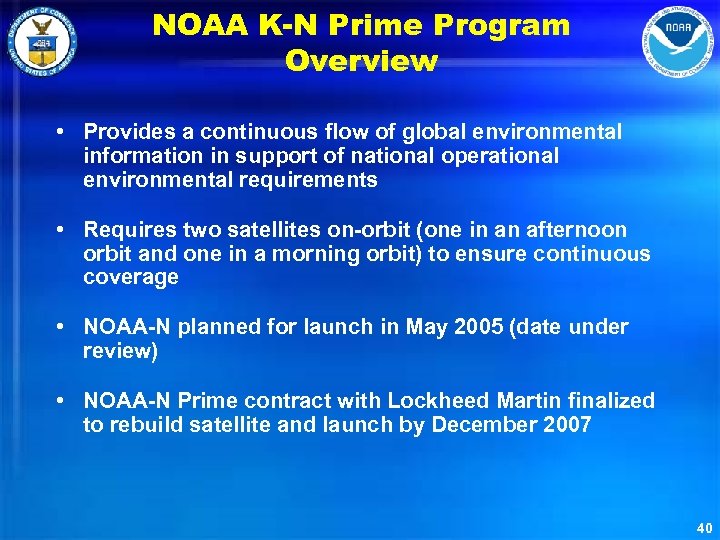 NOAA K-N Prime Program Overview • Provides a continuous flow of global environmental information in support of national operational environmental requirements • Requires two satellites on-orbit (one in an afternoon orbit and one in a morning orbit) to ensure continuous coverage • NOAA-N planned for launch in May 2005 (date under review) • NOAA-N Prime contract with Lockheed Martin finalized to rebuild satellite and launch by December 2007 40
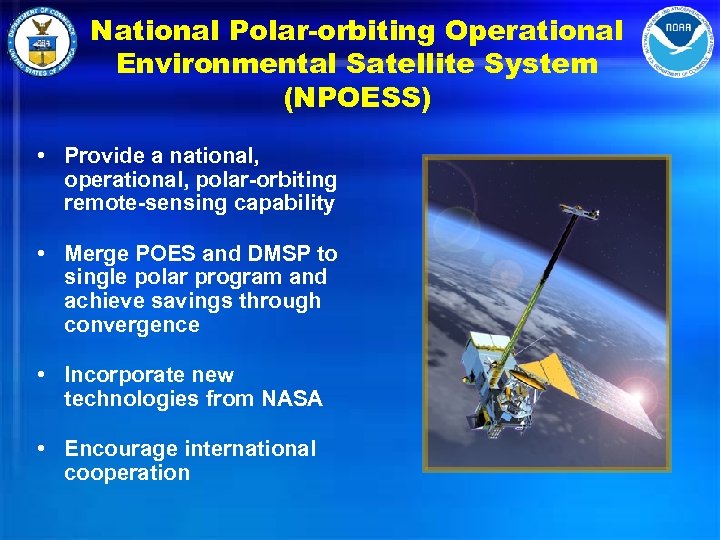 National Polar-orbiting Operational Environmental Satellite System (NPOESS) • Provide a national, operational, polar-orbiting remote-sensing capability • Merge POES and DMSP to single polar program and achieve savings through convergence • Incorporate new technologies from NASA • Encourage international cooperation
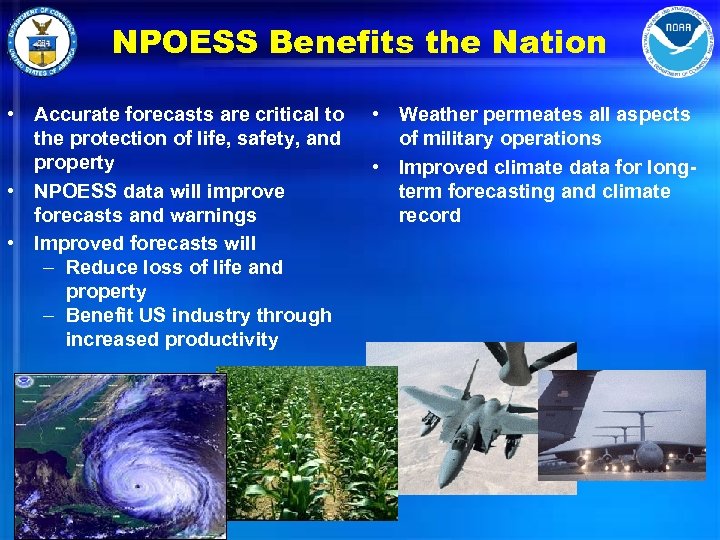 NPOESS Benefits the Nation • Accurate forecasts are critical to the protection of life, safety, and property • NPOESS data will improve forecasts and warnings • Improved forecasts will – Reduce loss of life and property – Benefit US industry through increased productivity • Weather permeates all aspects of military operations • Improved climate data for longterm forecasting and climate record
 NPOESS Program Change—+$16. 1 M • Continues development of NPP and NPOESS toward 2007 and 2010 launch dates, respectively • Provides funding for instruments, spacecraft, ground systems and program costs • NPP will provide critical risk reduction activities for NPOESS • NPOESS will meet the nation’s civil and military environmental information needs • Transitions select NASA sensors to operations 43
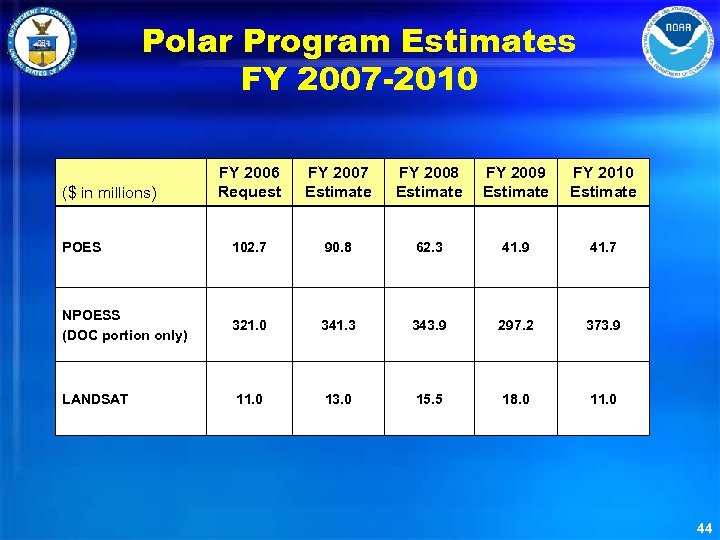 Polar Program Estimates FY 2007 -2010 FY 2006 Request FY 2007 Estimate FY 2008 Estimate FY 2009 Estimate FY 2010 Estimate POES 102. 7 90. 8 62. 3 41. 9 41. 7 NPOESS (DOC portion only) 321. 0 341. 3 343. 9 297. 2 373. 9 LANDSAT 11. 0 13. 0 15. 5 18. 0 11. 0 ($ in millions) 44
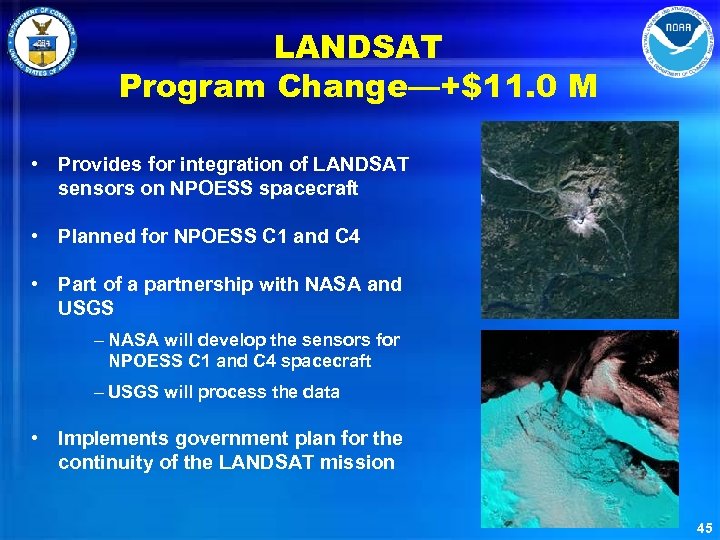 LANDSAT Program Change—+$11. 0 M • Provides for integration of LANDSAT sensors on NPOESS spacecraft • Planned for NPOESS C 1 and C 4 • Part of a partnership with NASA and USGS – NASA will develop the sensors for NPOESS C 1 and C 4 spacecraft – USGS will process the data • Implements government plan for the continuity of the LANDSAT mission 45
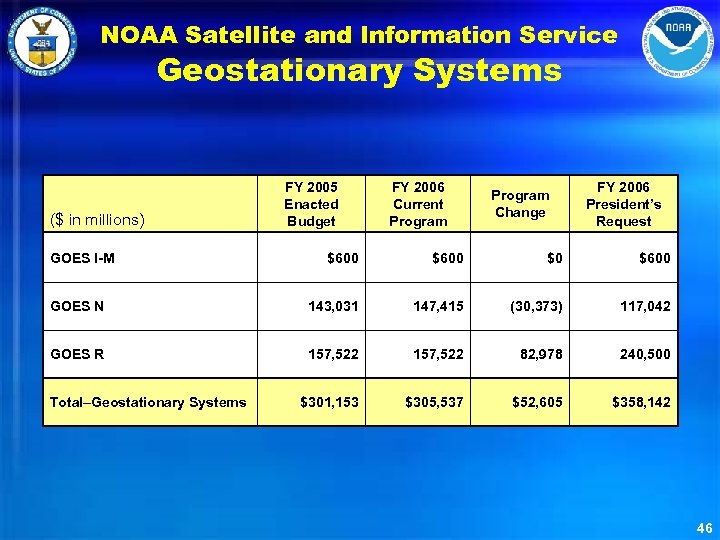 NOAA Satellite and Information Service Geostationary Systems ($ in millions) GOES I-M FY 2005 Enacted Budget FY 2006 Current Program Change FY 2006 President’s Request $600 $0 $600 GOES N 143, 031 147, 415 (30, 373) 117, 042 GOES R 157, 522 82, 978 240, 500 $301, 153 $305, 537 $52, 605 $358, 142 Total–Geostationary Systems 46
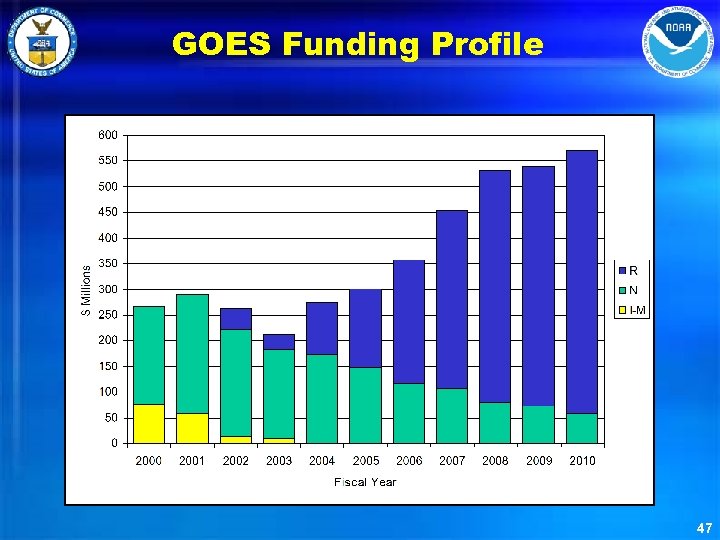 GOES Funding Profile 47
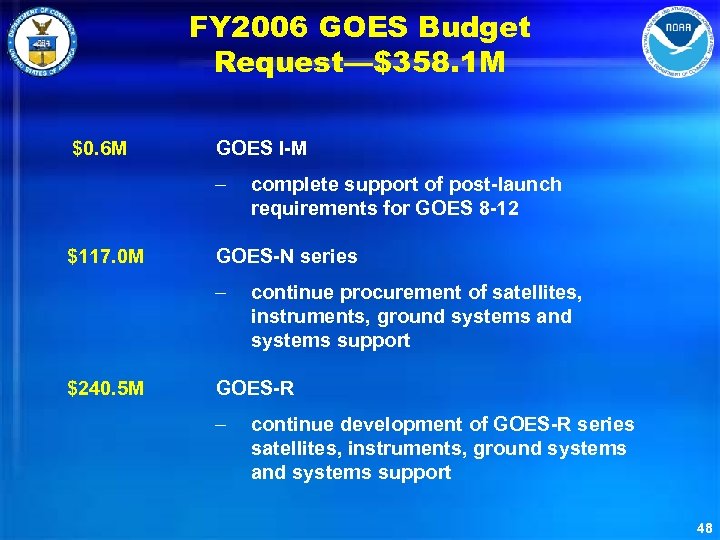 FY 2006 GOES Budget Request—$358. 1 M $0. 6 M GOES I-M – $117. 0 M GOES-N series – $240. 5 M complete support of post-launch requirements for GOES 8 -12 continue procurement of satellites, instruments, ground systems and systems support GOES-R – continue development of GOES-R series satellites, instruments, ground systems and systems support 48
 FY 2006 GOES N Series Request—$117. 0 M • Consists of 3 satellites (N, O, P) Planned Launch Dates – GOES-N May 2005 – GOES-O April 2007 – GOES-P October 2008 • Instruments: Imager, Sounder, and Solar XRay imager 49
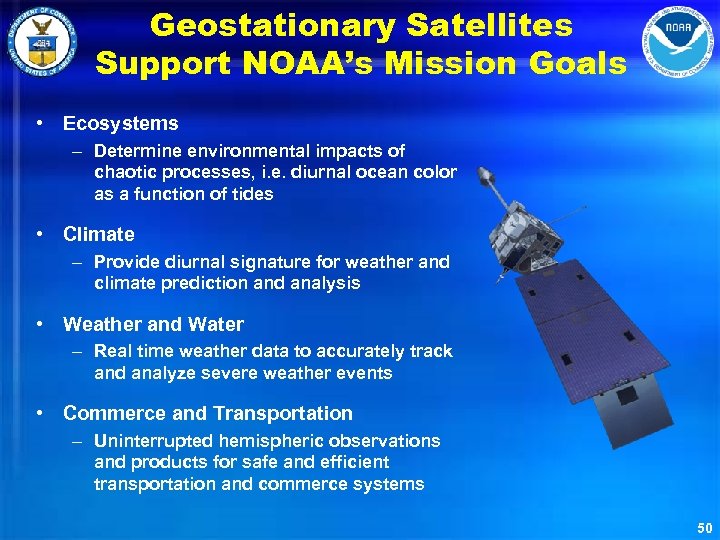 Geostationary Satellites Support NOAA’s Mission Goals • Ecosystems – Determine environmental impacts of chaotic processes, i. e. diurnal ocean color as a function of tides • Climate – Provide diurnal signature for weather and climate prediction and analysis • Weather and Water – Real time weather data to accurately track and analyze severe weather events • Commerce and Transportation – Uninterrupted hemispheric observations and products for safe and efficient transportation and commerce systems 50
 FY 2006 GOES-R Request— $240. 5 M • Continue development of the next generation Geostationary Operational Environmental Satellite (GOES-R) • Responds to national operational environmental requirements for higher spatial resolution, enhanced spectral information, improved coverage, and more rapid updates leading to better predictions • Responds to NOAA’s Strategic Plan for ecosystems management, climate variability, severe weather information, and safe transportation • Program is based on 2012 launch readiness requirement 51
 GOES-R Series Program Change—+$82. 9 M • Continues GOES-R development activities • Provides design/risk reduction of spacecraft and ground system, and development/production of the instruments • Meets the nation’s requirements for environmental data and provides for continuity of coverage • Provides 2012 launch readiness needed to backup the activation of GOES-P for operations • Implements technologies to improve mission goal applications; key enhancements will result in significant benefits to the Nation 52
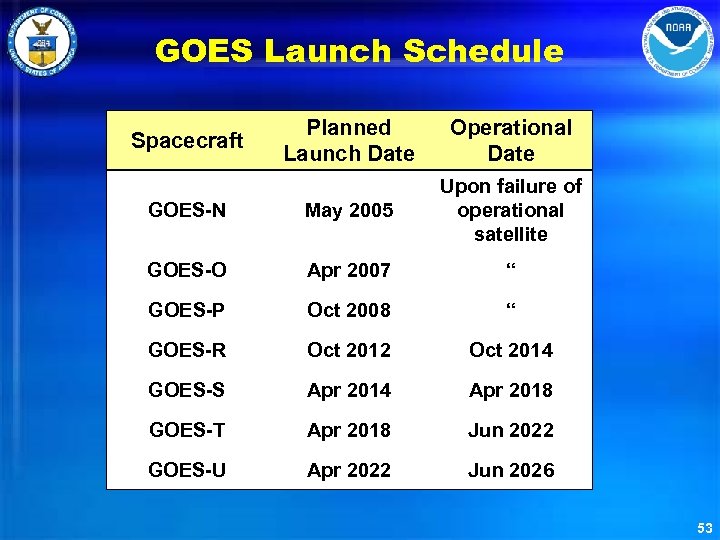 GOES Launch Schedule Planned Launch Date Operational Date GOES-N May 2005 Upon failure of operational satellite GOES-O Apr 2007 “ GOES-P Oct 2008 “ GOES-R Oct 2012 Oct 2014 GOES-S Apr 2014 Apr 2018 GOES-T Apr 2018 Jun 2022 GOES-U Apr 2022 Jun 2026 Spacecraft 53
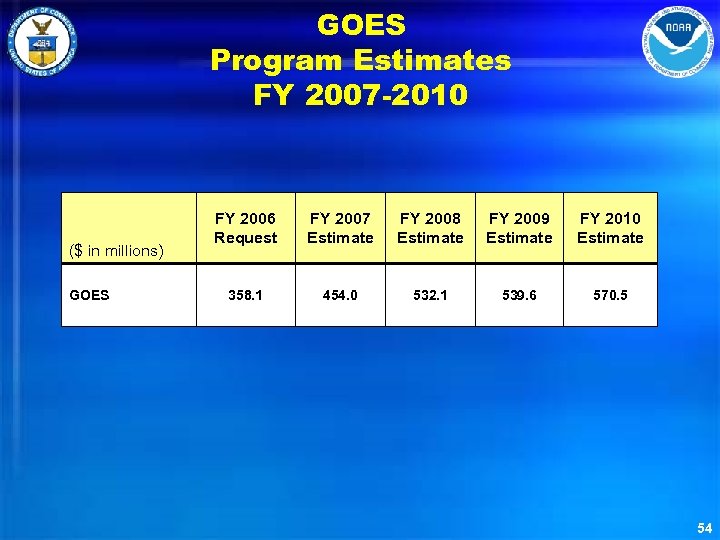 GOES Program Estimates FY 2007 -2010 ($ in millions) GOES FY 2006 Request FY 2007 Estimate FY 2008 Estimate FY 2009 Estimate FY 2010 Estimate 358. 1 454. 0 532. 1 539. 6 570. 5 54
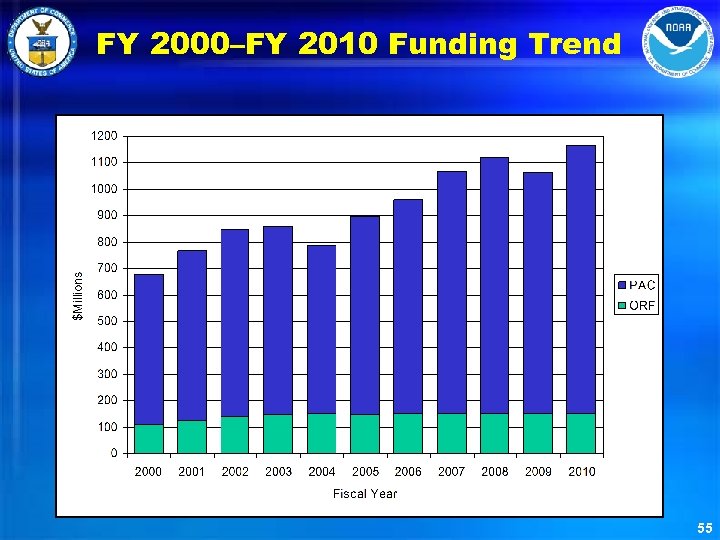 FY 2000–FY 2010 Funding Trend 55
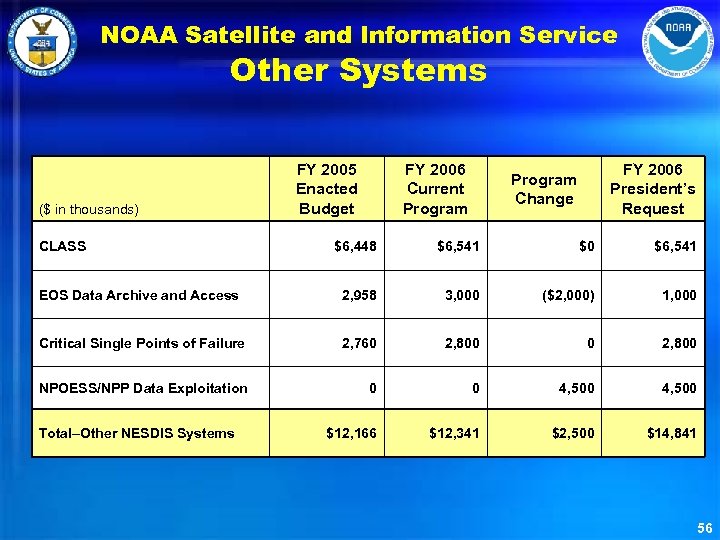 NOAA Satellite and Information Service Other Systems ($ in thousands) CLASS FY 2005 Enacted Budget FY 2006 Current Program FY 2006 President’s Request Program Change $6, 448 $6, 541 $0 $6, 541 EOS Data Archive and Access 2, 958 3, 000 ($2, 000) 1, 000 Critical Single Points of Failure 2, 760 2, 800 NPOESS/NPP Data Exploitation 0 0 4, 500 $12, 166 $12, 341 $2, 500 $14, 841 Total–Other NESDIS Systems 56
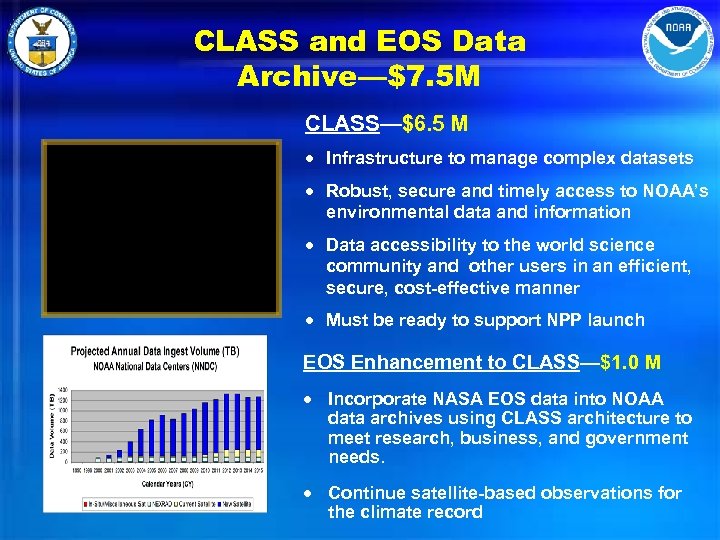 CLASS and EOS Data Archive—$7. 5 M CLASS—$6. 5 M · Infrastructure to manage complex datasets · Robust, secure and timely access to NOAA’s environmental data and information · Data accessibility to the world science community and other users in an efficient, secure, cost-effective manner · Must be ready to support NPP launch EOS Enhancement to CLASS—$1. 0 M · Incorporate NASA EOS data into NOAA data archives using CLASS architecture to meet research, business, and government needs. · Continue satellite-based observations for the climate record
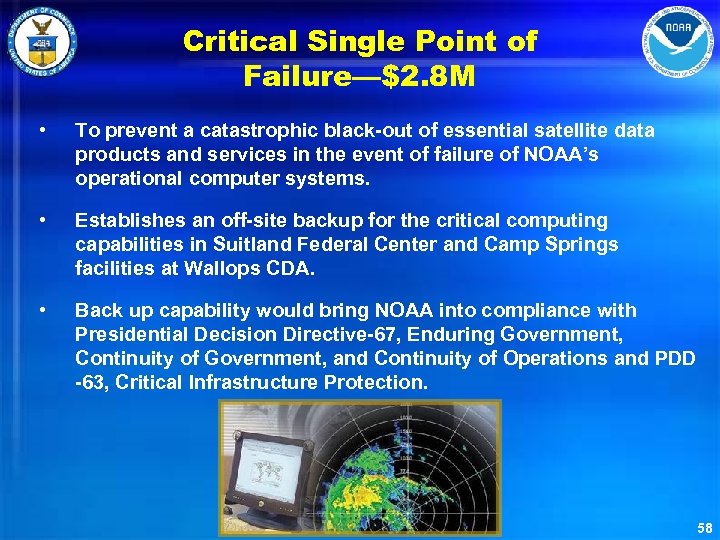 Critical Single Point of Failure—$2. 8 M • To prevent a catastrophic black-out of essential satellite data products and services in the event of failure of NOAA’s operational computer systems. • Establishes an off-site backup for the critical computing capabilities in Suitland Federal Center and Camp Springs facilities at Wallops CDA. • Back up capability would bring NOAA into compliance with Presidential Decision Directive-67, Enduring Government, Continuity of Government, and Continuity of Operations and PDD -63, Critical Infrastructure Protection. 58
 NPOESS/NPP Data Exploitation Program Change—+$4. 5 M • $4. 5 M requested for NPP (NPOESS Preparatory Program) and NPOESS product development and related infrastructure • Makes use of the substantial investment in NPOESS by starting use of the NPP data stream – NPP products will contribute toward risk reduction efforts for NPOESS by early evaluation of NPP products from instruments to be flown on NPOESS – Transitions R&D sensors into operational product development and dissemination • Will result in improvements in mission performance: gale warning accuracy, tropical storm track, winter storm warning lead time 59
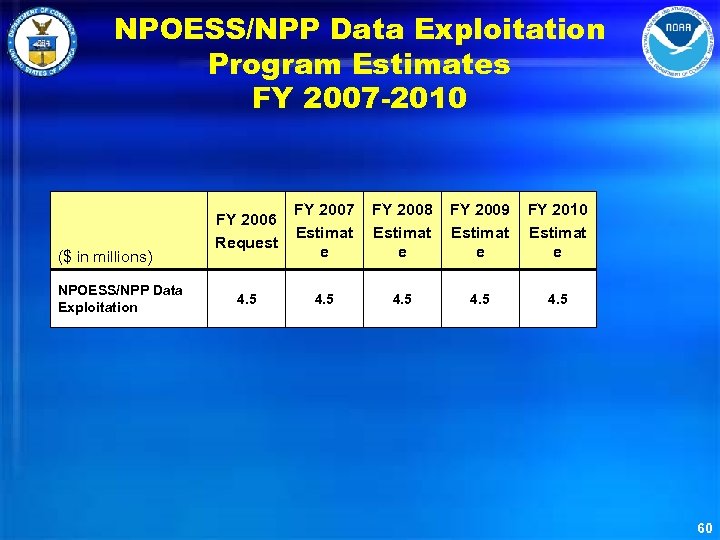 NPOESS/NPP Data Exploitation Program Estimates FY 2007 -2010 ($ in millions) NPOESS/NPP Data Exploitation FY 2006 Request FY 2007 Estimat e FY 2008 Estimat e FY 2009 Estimat e FY 2010 Estimat e 4. 5 4. 5 60
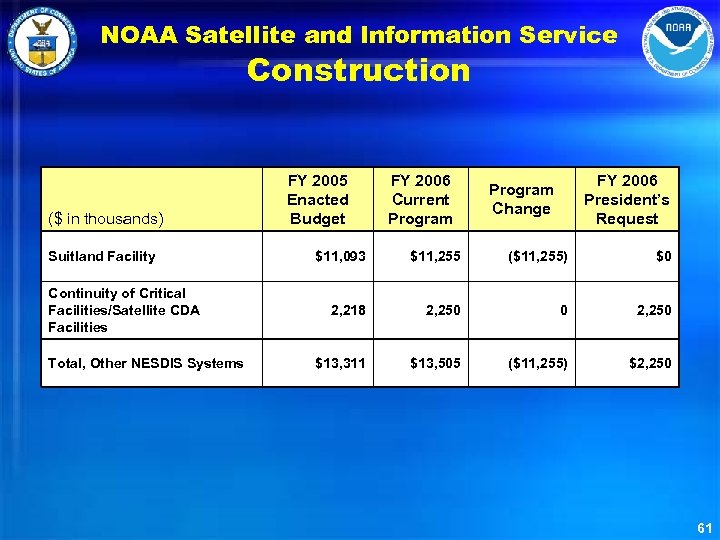 NOAA Satellite and Information Service Construction ($ in thousands) Suitland Facility Continuity of Critical Facilities/Satellite CDA Facilities Total, Other NESDIS Systems FY 2005 Enacted Budget FY 2006 Current Program FY 2006 President’s Request Program Change $11, 093 $11, 255 ($11, 255) $0 2, 218 2, 250 0 2, 250 $13, 311 $13, 505 ($11, 255) $2, 250 61
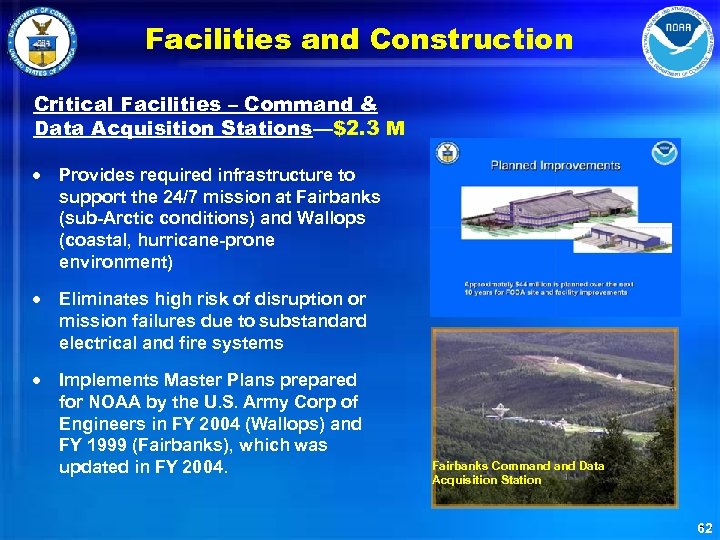 Facilities and Construction Critical Facilities – Command & Data Acquisition Stations—$2. 3 M · Provides required infrastructure to support the 24/7 mission at Fairbanks (sub-Arctic conditions) and Wallops (coastal, hurricane-prone environment) · Eliminates high risk of disruption or mission failures due to substandard electrical and fire systems · Implements Master Plans prepared for NOAA by the U. S. Army Corp of Engineers in FY 2004 (Wallops) and FY 1999 (Fairbanks), which was updated in FY 2004. Fairbanks Command Data Acquisition Station 62
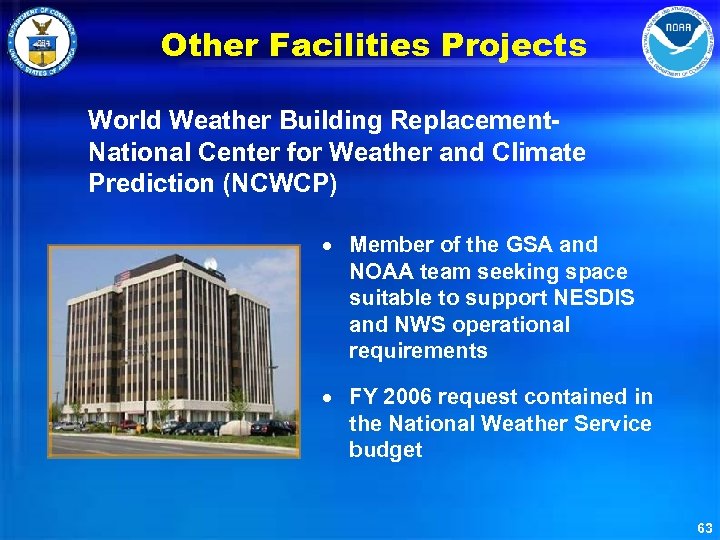 Other Facilities Projects World Weather Building Replacement- National Center for Weather and Climate Prediction (NCWCP) · Member of the GSA and NOAA team seeking space suitable to support NESDIS and NWS operational requirements · FY 2006 request contained in the National Weather Service budget 63
 FY 2006 Budget Summary • Overall, the FY 2006 request for NOAA Satellites and Information of $963. 9 M is a $72. 3 M or 8. 1% increase over the current program • The request: – Supports critical satellite operations and data and information services – Continues GOES-R and NPOESS systems development to meet future satellite requirements for observational coverage and capabilities – Continues data systems development for archive and access of observations data – Supports NOAA’s mission goals and strategic directions for FY 2006 and beyond 64
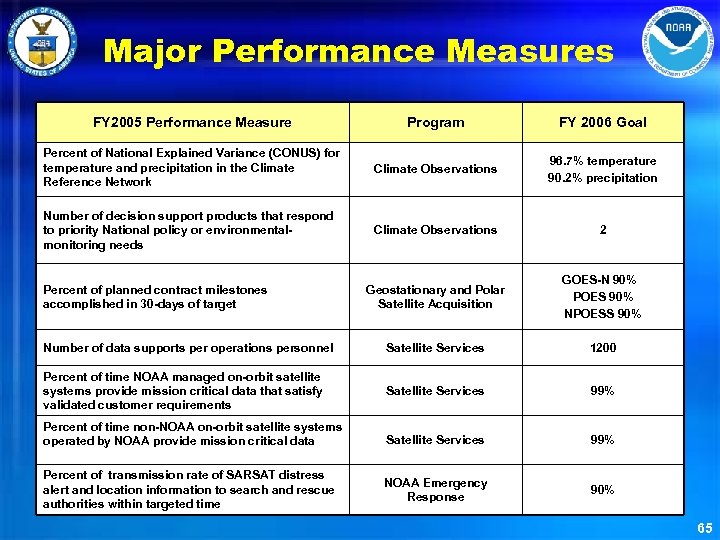 Major Performance Measures FY 2005 Performance Measure Program FY 2006 Goal Percent of National Explained Variance (CONUS) for temperature and precipitation in the Climate Reference Network Climate Observations 96. 7% temperature 90. 2% precipitation Number of decision support products that respond to priority National policy or environmentalmonitoring needs Climate Observations 2 Geostationary and Polar Satellite Acquisition GOES-N 90% POES 90% NPOESS 90% Number of data supports per operations personnel Satellite Services 1200 Percent of time NOAA managed on-orbit satellite systems provide mission critical data that satisfy validated customer requirements Satellite Services 99% NOAA Emergency Response 90% Percent of planned contract milestones accomplished in 30 -days of target Percent of time non-NOAA on-orbit satellite systems operated by NOAA provide mission critical data Percent of transmission rate of SARSAT distress alert and location information to search and rescue authorities within targeted time 65
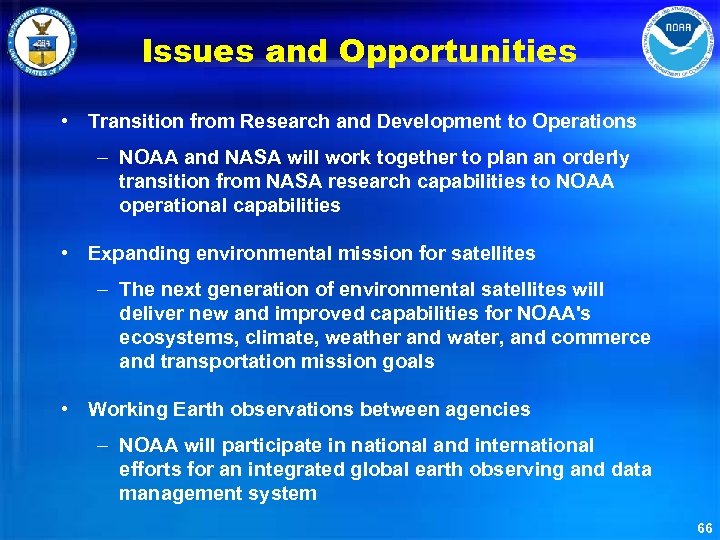 Issues and Opportunities • Transition from Research and Development to Operations – NOAA and NASA will work together to plan an orderly transition from NASA research capabilities to NOAA operational capabilities • Expanding environmental mission for satellites – The next generation of environmental satellites will deliver new and improved capabilities for NOAA's ecosystems, climate, weather and water, and commerce and transportation mission goals • Working Earth observations between agencies – NOAA will participate in national and international efforts for an integrated global earth observing and data management system 66
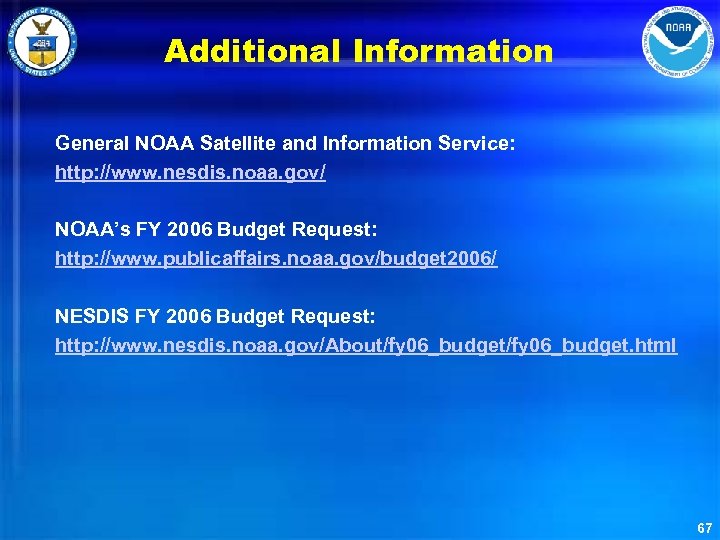 Additional Information General NOAA Satellite and Information Service: http: //www. nesdis. noaa. gov/ NOAA’s FY 2006 Budget Request: http: //www. publicaffairs. noaa. gov/budget 2006/ NESDIS FY 2006 Budget Request: http: //www. nesdis. noaa. gov/About/fy 06_budget. html 67
 68
68