 Скачать презентацию NOAA Environmental Software Infrastructure and Interoperability Program NE
c0ae6c00375eaa6fc740cdd2ce5b0a04.ppt
- Количество слайдов: 12



NOAA Environmental Software Infrastructure and Interoperability Program NE II Cecelia De. Luca Sylvia Murphy V. Balaji GO-ESSP August 13, 2009 Germany
Outline NE II • NESII Overview • NESII Associated Projects ◦ Earth System Curator ◦ Earth System Modeling Framework ◦ National Unified Operational Prediction Capability ◦ Do. D Battlespace Environments Institute ◦ NASA Modeling Analysis and Prediction Program ◦ Workflow Initiatives ◦ NOAA Global Interoperability Program
Overview of NESII NE II • New group at NOAA Earth System Research Laboratory in Boulder (as of Nov 1, 2009) • Group was formerly the Earth System Modeling Infrastructure section at the National Center for Atmospheric Research • Focuses on development of software infrastructure for Earth system modeling • Includes key portions of the Earth System Modeling Framework and Earth System Curator projects • Partners and customers are from research and operational centers, weather and climate, across NOAA, NSF, Do. D, NASA and other organizations
Outline NE II • NESII Overview • NESII Associated Projects ◦ Earth System Curator ◦ Earth System Modeling Framework ◦ National Unified Operational Prediction Capability ◦ Do. D Battlespace Environments Institute ◦ NASA Modeling Analysis and Prediction Program ◦ Workflow Initiatives ◦ NOAA Global Interoperability Program
Earth System Curator NE II Background • Collaborators include NCAR, GFDL, LLNL Program for Climate Model Diagnosis and Intercomparison, EU METAFOR project, University of Michigan, Georgia Tech, … • Curator project was sponsored by NSF from 2005 -2008, extended through 2010 with NASA funds, new funding from NSF (Curator Co. G) for 2010 -2014 Activities • Working with METAFOR, LLNL and others to implement user interfaces in the DOE Earth System Grid portal to connect CMIP 5 simulations to detailed model and experiment descriptions • Working with the ESMF team, the Naval Research Laboratory and others to encode metadata in applications, using COAMPS and CCSM as early examples
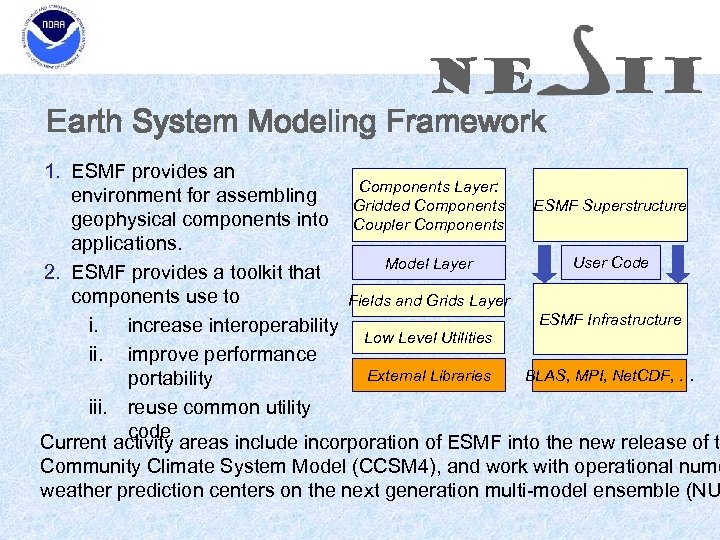
NE Earth System Modeling Framework II 1. ESMF provides an Components Layer: environment for assembling ESMF Superstructure Gridded Components geophysical components into Coupler Components applications. User Code Model Layer 2. ESMF provides a toolkit that components use to Fields and Grids Layer ESMF Infrastructure i. increase interoperability Low Level Utilities ii. improve performance External Libraries BLAS, MPI, Net. CDF, … portability iii. reuse common utility code Current activity areas include incorporation of ESMF into the new release of t Community Climate System Model (CCSM 4), and work with operational nume weather prediction centers on the next generation multi-model ensemble (NU
NE National Unified Operation Prediction Capability (NUOPC) II • Consortium of Air Force, Navy, and NOAA modelers who are developing a multi-model ensemble for numerical weather prediction • Interoperable components built on common standards and framework (ESMF) • Funded through National Weather Service and Department of Defense, runs from 2010 -2015, about $1. 5 M/yr for infrastructure maintenance and development • Still in final stages of negotiation
NE II Other application projects and programs • Battlespace Environments Institute (BEI) – large Do. D project with Army, Air Force and Navy (2005 -2011) ◦ Developing coupled models for operational and research purposes using ESMF ◦ Mostly regional models: coastal, wave and watershed modeling, some space weather modeling • NASA Modeling Analysis and Prediction Program (2005 -2010) ◦ Construction of the GEOS-5 atmospheric general circulation model and associated components ◦ Many (30+) ESMF components
Climate Model Workflows NE II • Project initiated by Ufuk Turuncoglu, visitor from Istanbul Technical University, 2008 -2009 • New award with NSF Tera. Grid funding, partner with NCAR VETS and Purdue University: 2 years, about $150 K per year • Create easy to use work environments for running complex models like CCSM 4 • Automatically document parameter changes and other aspects of model runs • Hide interactions with complicated computing technologies • Archive, reproduce and share experiments
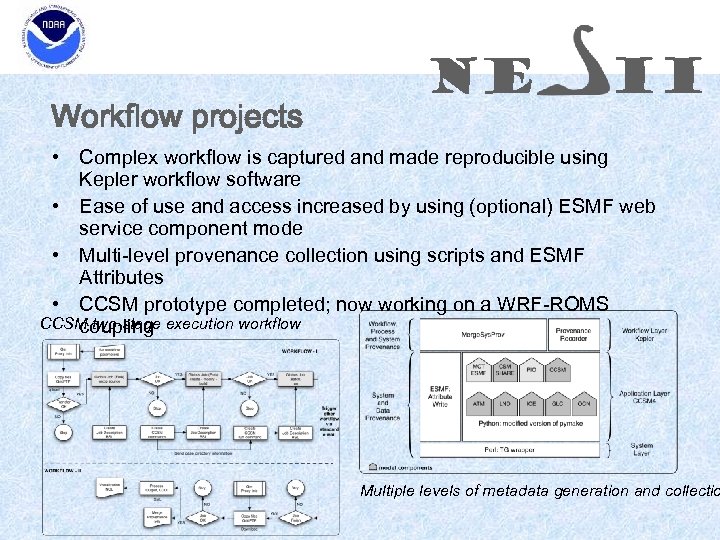
Workflow projects NE II • Complex workflow is captured and made reproducible using Kepler workflow software • Ease of use and access increased by using (optional) ESMF web service component mode • Multi-level provenance collection using scripts and ESMF Attributes • CCSM prototype completed; now working on a WRF-ROMS CCSM two-stage execution workflow coupling Multiple levels of metadata generation and collectio
NE NOAA Global Interoperability Program II Goals • Unified view of software infrastructure across functions (e. g. frameworks, data services, metadata), weather and climate domains, and agencies • Create new paths of interaction among research and operational groups • Advance strategies for model co-development and community evaluation of model elements • Improve accessibility and usability of federal modeling systems Specs • Focus on multi-model ensembles for climate research and prediction • Initiated FY 09 by NOAA ESRL, funded through NOAA Climate Program Office
Development progression NE II • Develop ESMF software and pools of interoperable components with standard interfaces • Optionally cap ESMF components with web service protocols and loose coupling interfaces (e. g. Open. MI) • Collaboratively develop and adapt metadata schemata to document component contents • Implement the schemata in ESMF utilities so models can store, read and write structured metadata • Build links between metadata outputs and data portals, so that model and simulation descriptions can be accessed via web interfaces • Integrate commodity governance into science gateways to support distributed development and analysis • Collectively create a variety of automated workflows using metadata, models, data services, and combinations of tight and loose coupling techniques
Скачать презентацию NOAA Environmental Software Infrastructure and Interoperability Program NE
c0ae6c00375eaa6fc740cdd2ce5b0a04.ppt