 Скачать презентацию No SQL Metadata Management October 20 th 2010
df9e20ffdd46b8539fe83f80a424ce59.ppt
- Количество слайдов: 104



No SQL Metadata Management October 20 th, 2010 Dan Mc. Creary President Dan Mc. Creary & Associates dan@danmccreary. com 1
Presentation Description Metadata, or data that describes data, is fundamentally different than data itself. The management of metadata is becoming a strategic area for many organizations and the topic of data governance is also becoming central to the data strategies for many organizations. This presentation will look at how the requirements of enterprise metadata management dictate that new schema-free web application architectures be better suited to the task of metadata management. These new “zero translation” architectures combine some of the best aspects of document management systems and traditional tabular data management but without the complexity of traditional multi-tier architectures. We will give examples of how these new XML-centric architectures are being used to solve metadata management challenges and how they empower non-programmers to build and maintain metadata registries. M D 2
Outline • Part 1 – – – Background on NO-SQL What is metadata? Enterprise Metadata Management (EMM) requirements Role of agility Why XRX systems are agile • Part 2 – – – M D Tour of a native XML system and a metadata registry XQuery, REST and XForms XML web services How empower Bas and other non-programmers How to start a pilot project Questions Copyright 2010 Dan Mc. Creary & Associates 3
After This Presentation Users Will Be Able To: • • • Define metadata and compare and contrast metadata management with data management Describe the high-level features of enterprise metadata management systems Differentiate between metadata repositories and metadata registries Understand the role of duplication in managed metadata environments Understand the role of ISO-Standards in metadata management Describe the major application architectures and the number of data translations used in each architecture Define "Zero translation" application architectures Define metadata agility and the metrics used to measure metadata agility Describe the XRX architecture and XML search Understand the role of native xml systems and the XQuery language Access resource for creating a pilot metadata registry project M D 4
Background for Dan Mc. Creary • Enterprise data architecture consultant based in Minneapolis • Strong interest in enterprise metadata management and semantic web • Builds metadata registries using ISO/IEC 11179 and US Federal XML standards (NIEM. gov) • Customers: Cri. MNet/BCA, MN Dept. of Education, MN Dept. of Revenue, Thrivent Financial, Patriot Data Systems, US Department of State, MN Historical Society, US Library of Congress, Mindware, Syntactica, Surescripts M D 5
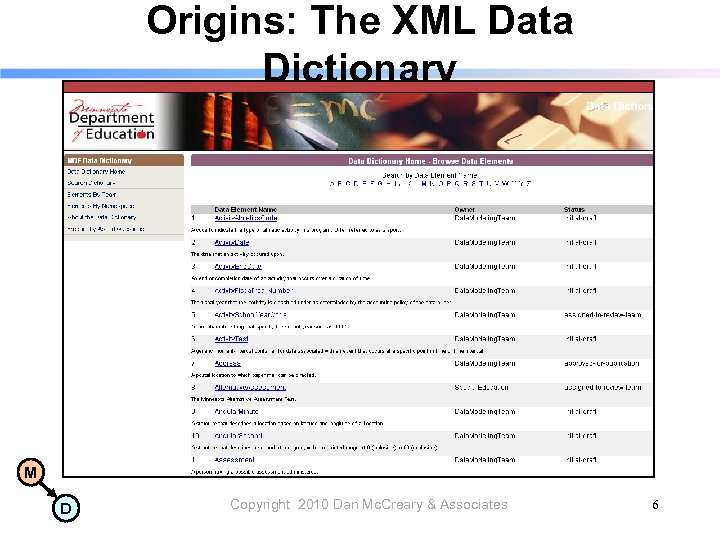
Origins: The XML Data Dictionary M D Copyright 2010 Dan Mc. Creary & Associates 6
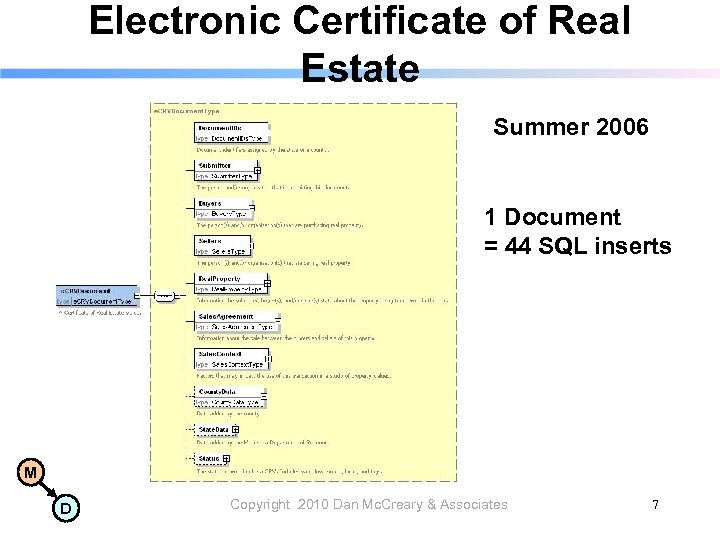
Electronic Certificate of Real Estate Summer 2006 1 Document = 44 SQL inserts M D Copyright 2010 Dan Mc. Creary & Associates 7
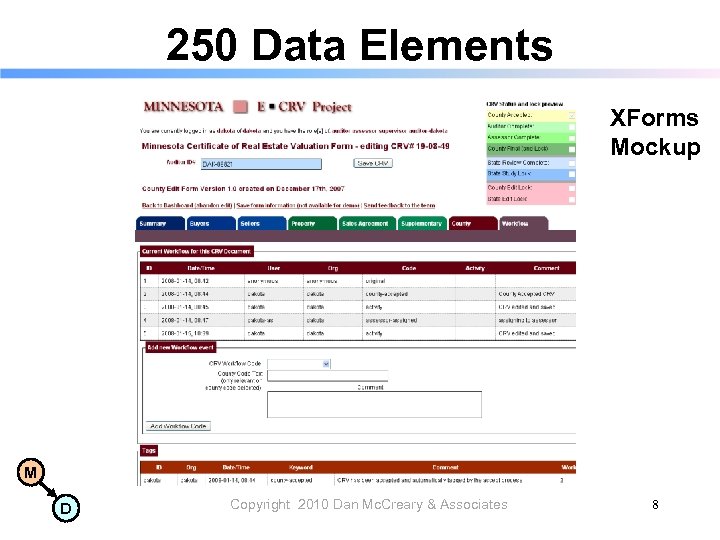
250 Data Elements XForms Mockup M D Copyright 2010 Dan Mc. Creary & Associates 8
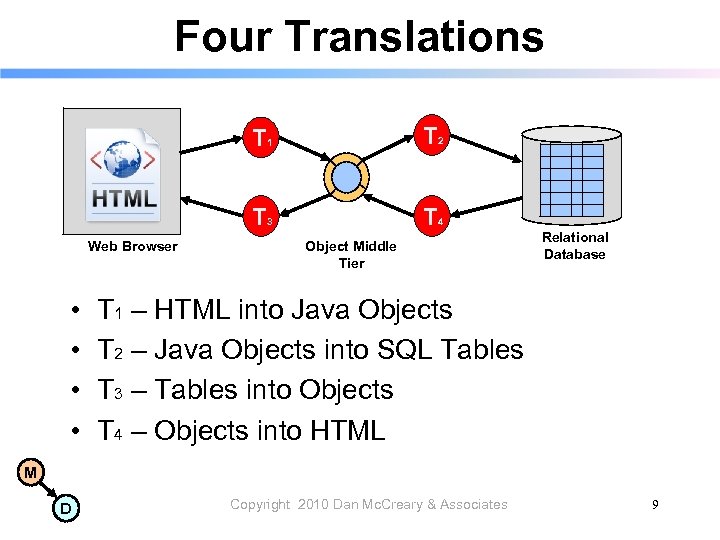
Four Translations T 1 T 3 Web Browser • • T 2 T 4 Object Middle Tier Relational Database T 1 – HTML into Java Objects T 2 – Java Objects into SQL Tables T 3 – Tables into Objects T 4 – Objects into HTML M D Copyright 2010 Dan Mc. Creary & Associates 9
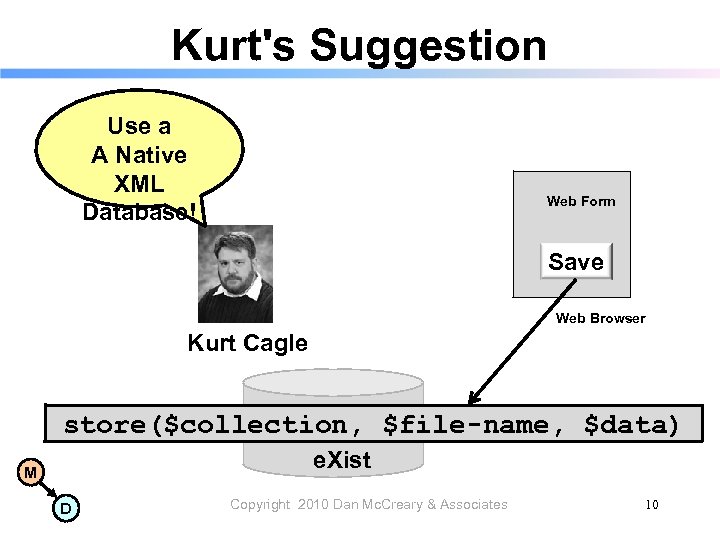
Kurt's Suggestion Use a A Native XML Database! Web Form Save Web Browser Kurt Cagle store($collection, $file-name, $data) e. Xist M D Copyright 2010 Dan Mc. Creary & Associates 10
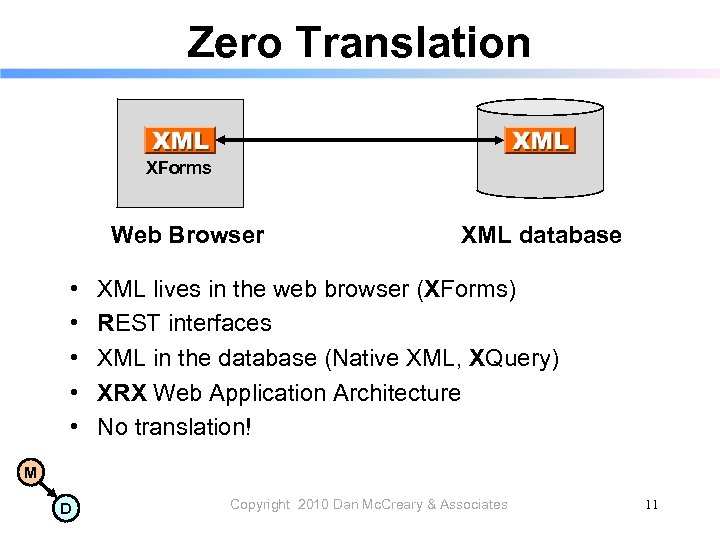
Zero Translation XForms Web Browser • • • XML database XML lives in the web browser (XForms) REST interfaces XML in the database (Native XML, XQuery) XRX Web Application Architecture No translation! M D Copyright 2010 Dan Mc. Creary & Associates 11
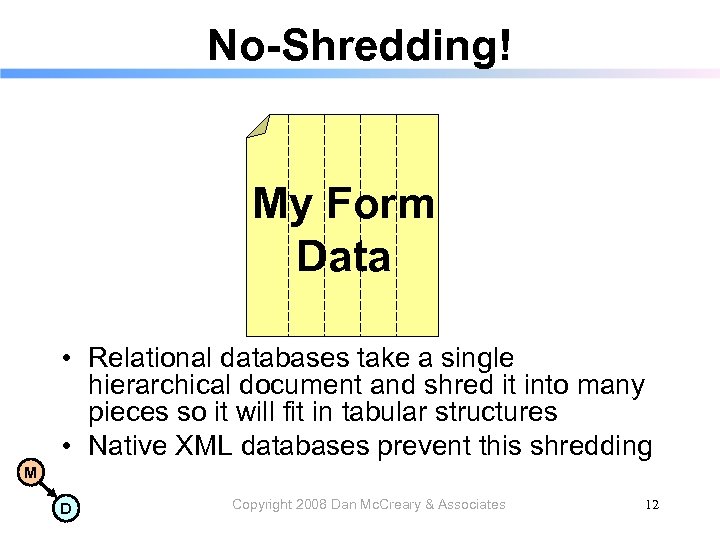
No-Shredding! My Form Data • Relational databases take a single hierarchical document and shred it into many pieces so it will fit in tabular structures • Native XML databases prevent this shredding M D Copyright 2008 Dan Mc. Creary & Associates 12
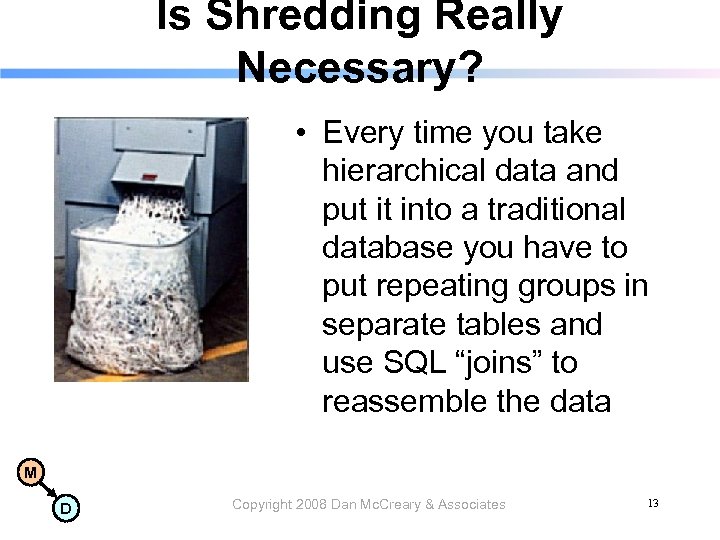
Is Shredding Really Necessary? • Every time you take hierarchical data and put it into a traditional database you have to put repeating groups in separate tables and use SQL “joins” to reassemble the data M D Copyright 2008 Dan Mc. Creary & Associates 13
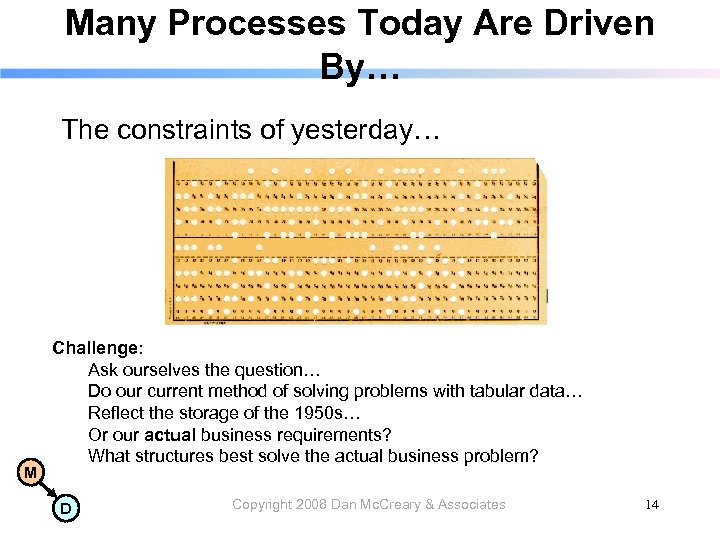
Many Processes Today Are Driven By… The constraints of yesterday… M Challenge: Ask ourselves the question… Do our current method of solving problems with tabular data… Reflect the storage of the 1950 s… Or our actual business requirements? What structures best solve the actual business problem? D Copyright 2008 Dan Mc. Creary & Associates 14
"Schema Free" • Systems that automatically determine how to index data as the data is loaded into the database • No a priori knowledge of data structure • No need for up-front logical data modeling – …but some modeling is still critical • Adding new data elements or changing data elements is not disruptive • Searching millions of records still has subsecond response time M D Copyright 2010 Dan Mc. Creary & Associates 15
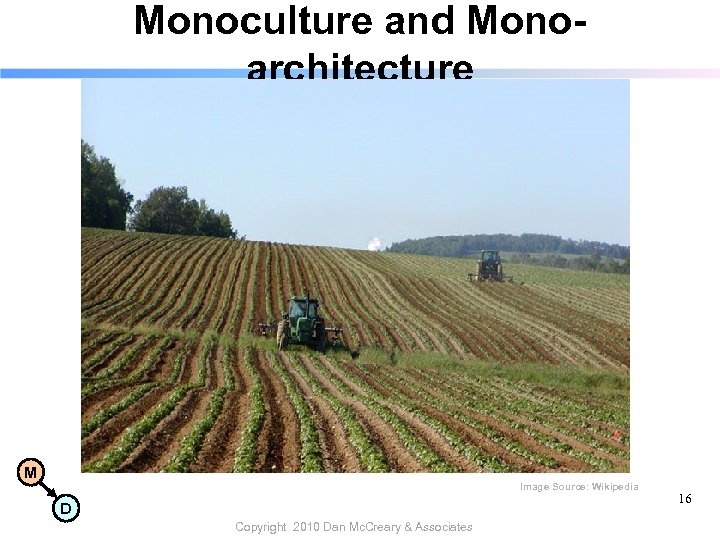
Monoculture and Monoarchitecture M Image Source: Wikipedia D Copyright 2010 Dan Mc. Creary & Associates 16
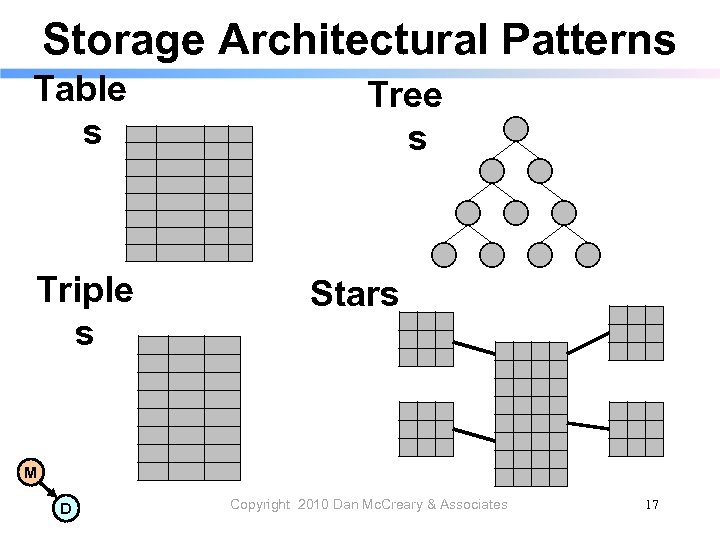
Storage Architectural Patterns Table s Triple s Tree s Stars M D Copyright 2010 Dan Mc. Creary & Associates 17
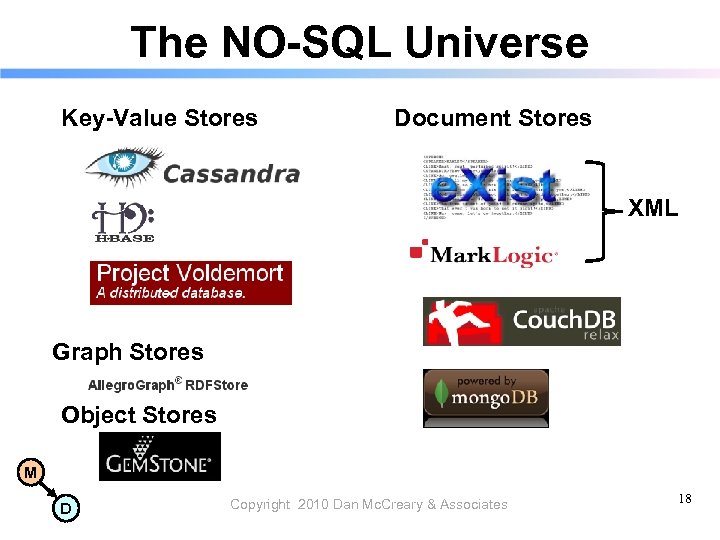
The NO-SQL Universe Key-Value Stores Document Stores XML Graph Stores Object Stores M D Copyright 2010 Dan Mc. Creary & Associates 18
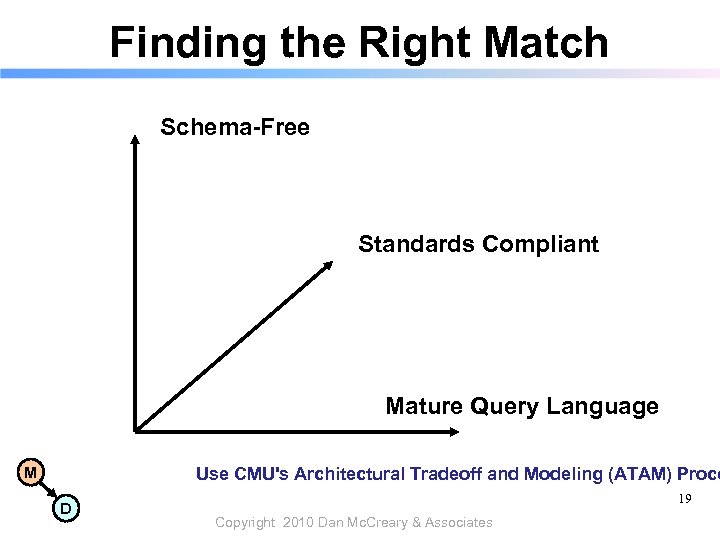
Finding the Right Match Schema-Free Standards Compliant Mature Query Language M Use CMU's Architectural Tradeoff and Modeling (ATAM) Proce D 19 Copyright 2010 Dan Mc. Creary & Associates
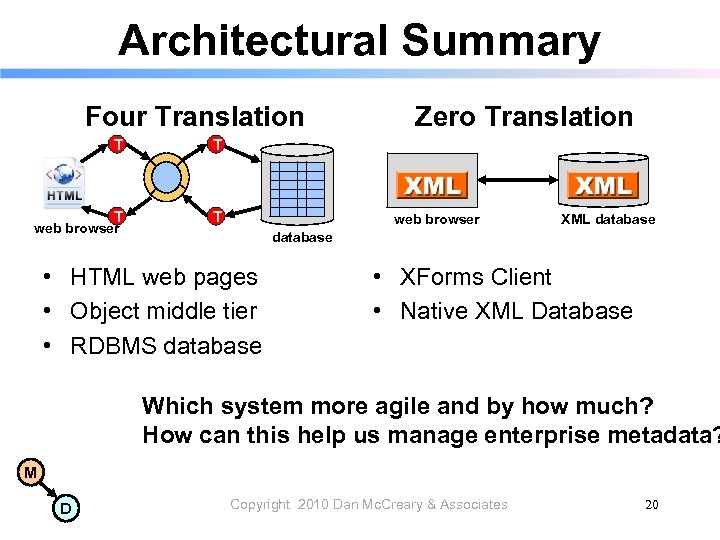
Architectural Summary Four Translation T T Zero Translation web browser XML database • HTML web pages • Object middle tier • RDBMS database • XForms Client • Native XML Database Which system more agile and by how much? How can this help us manage enterprise metadata? M D Copyright 2010 Dan Mc. Creary & Associates 20
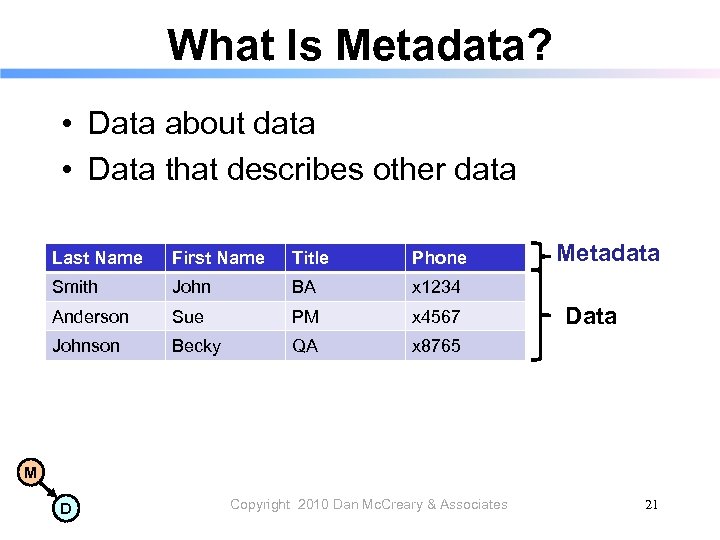
What Is Metadata? • Data about data • Data that describes other data Last Name First Name Title Phone Smith John BA x 1234 Anderson Sue PM x 4567 Johnson Becky QA Metadata x 8765 Data M D Copyright 2010 Dan Mc. Creary & Associates 21
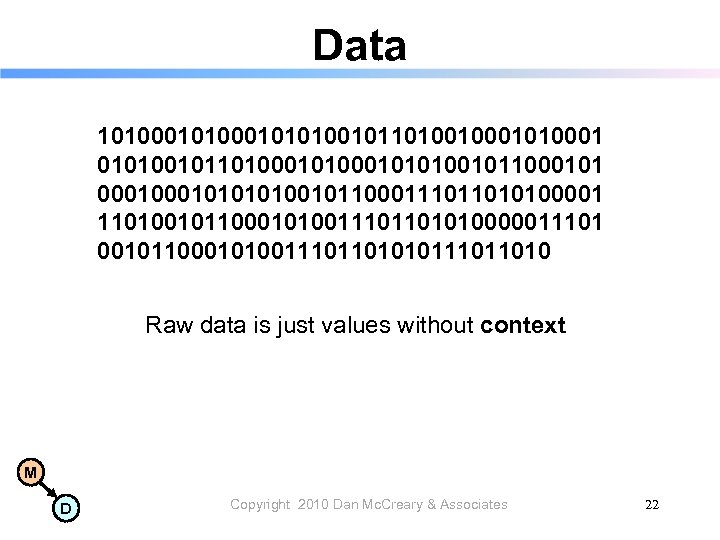
Data 1010001010100101101001010001 010100101101000101010010110001010101001011000111011010100001 11010010110001010011101101010000011101 001011000101001110110101011010 Raw data is just values without context M D Copyright 2010 Dan Mc. Creary & Associates 22
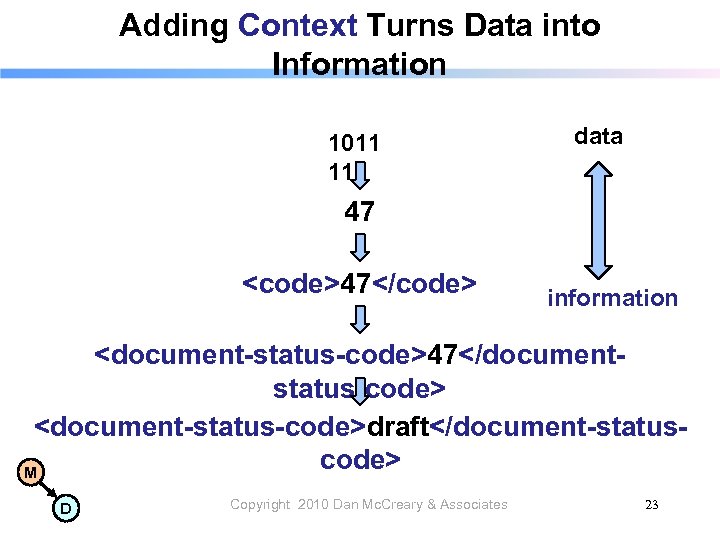
Adding Context Turns Data into Information 1011 11 data 47 <code>47</code> information <document-status-code>47</documentstatus-code> <document-status-code>draft</document-statuscode> M D Copyright 2010 Dan Mc. Creary & Associates 23
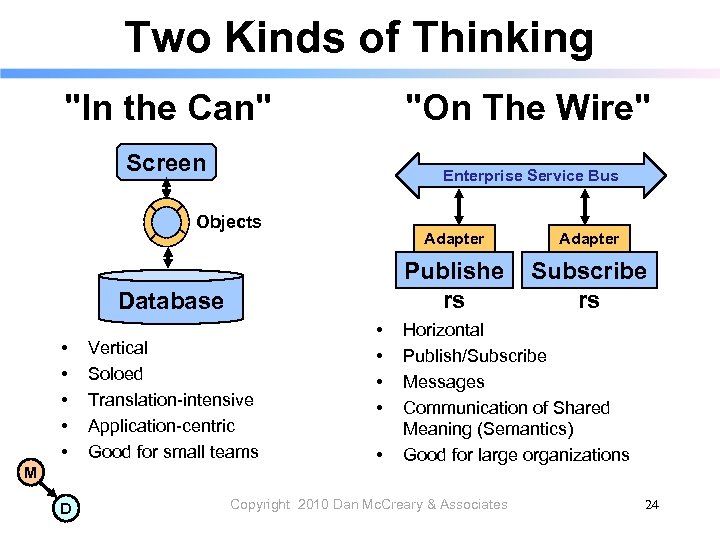
Two Kinds of Thinking "In the Can" "On The Wire" Screen Enterprise Service Bus Objects Adapter Publishe rs Database • • • M D Vertical Soloed Translation-intensive Application-centric Good for small teams • • • Adapter Subscribe rs Horizontal Publish/Subscribe Messages Communication of Shared Meaning (Semantics) Good for large organizations Copyright 2010 Dan Mc. Creary & Associates 24
Managed Metadata • The processes surrounding the creation and management of enterprise metadata and their definitions – ISO 11179: "Administered Items" – Traceability: • Who created data definitions and when and in what context for what purpose? M D Copyright 2010 Dan Mc. Creary & Associates 25
Repository vs. Registry Metadata Repository Metadata Registry • Were any metadata is stored • No focus on duplicate element elimination • No strict controls on removal of imprecise data elements • Function-specific data • Where carefully controlled metadata is stored • Focus on elimination of duplicate data elements • Focus on semantics • Subject area classification • Data stewardship • Follows ISO guidelines M D Copyright 2010 Dan Mc. Creary & Associates 26
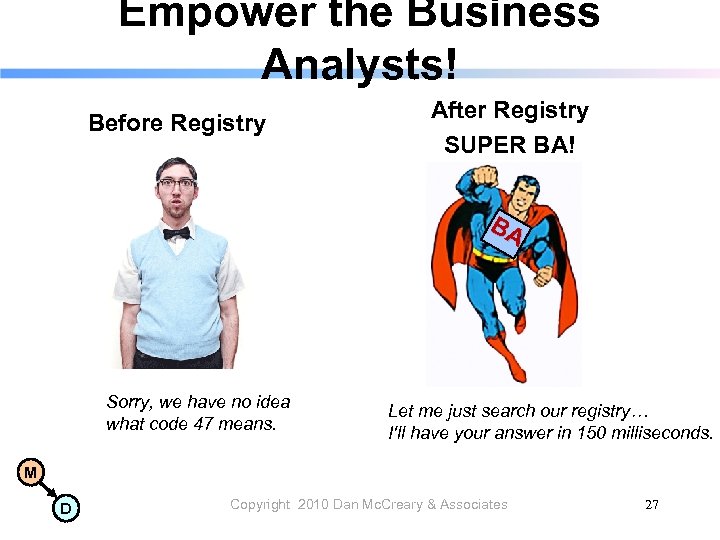
Empower the Business Analysts! Before Registry After Registry SUPER BA! BA Sorry, we have no idea what code 47 means. Let me just search our registry… I'll have your answer in 150 milliseconds. M D Copyright 2010 Dan Mc. Creary & Associates 27
EMM Requirements • EMM = Enterprise Metadata Management • Tools to create a "enterprise trust" in data element data definitions (Data Governance) • Tools to eliminate duplication of data elements • Powerful search • Metadata web services • Controls on who adds and updates definitions • Support for data stewardship M D Copyright 2010 Dan Mc. Creary & Associates 28
ISO/ICE 11179 Metadata Registry • Standards for managing enterprise semantics • Focus on the management of a "Library" of metadata based on subject headings (like the Dewey Decimal System) • Guidelines for creating precise data definitions • Guidelines for classification of data types M D Copyright 2010 Dan Mc. Creary & Associates 29
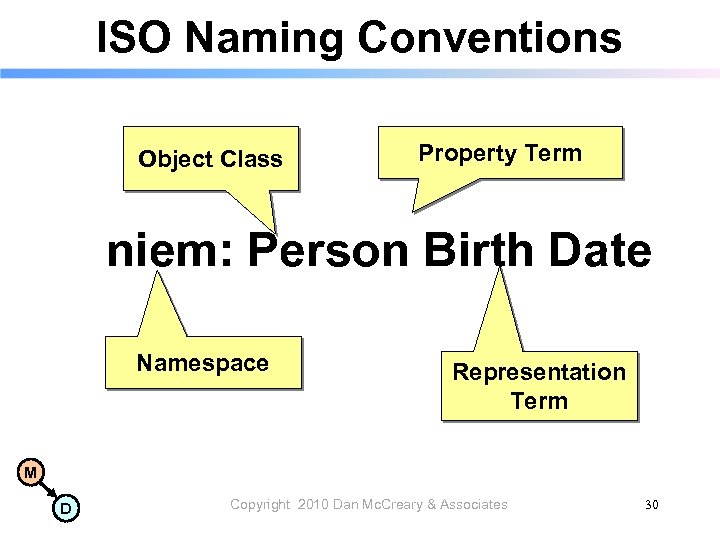
ISO Naming Conventions Object Class Property Term niem: Person Birth Date Namespace Representation Term M D Copyright 2010 Dan Mc. Creary & Associates 30
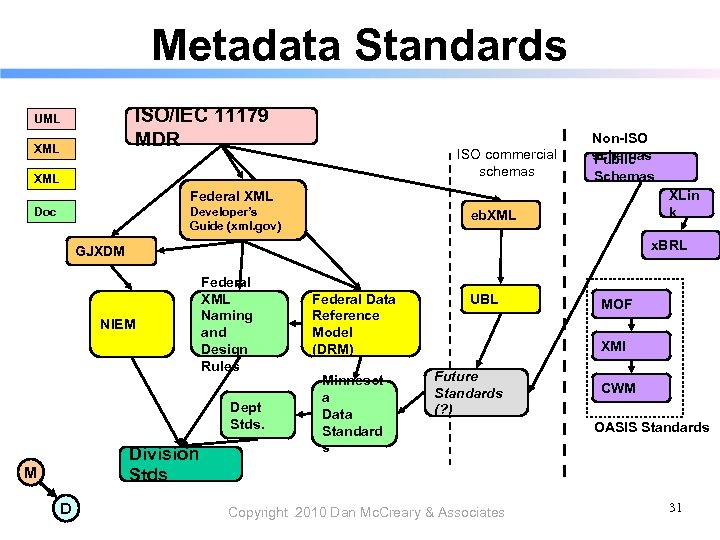
Metadata Standards ISO/IEC 11179 MDR UML XML ISO commercial schemas XML Non-ISO schemas Public Schemas XLin k Federal XML Developer’s Guide (xml. gov) Doc eb. XML x. BRL GJXDM NIEM Federal XML Naming and Design Rules Dept Stds. Division Stds M D Federal Data Reference Model (DRM) Minnesot a Data Standard s UBL MOF XMI Future Standards (? ) Copyright 2010 Dan Mc. Creary & Associates CWM OASIS Standards 31
Why is XRX More Agile? • • • Importing data Querying data Creating web services Exporting Publishing (not to be confused with "Agile Development") M D Copyright 2010 Dan Mc. Creary & Associates 32
A Happy Partnership XForms XQuery M D Copyright 2008 Dan Mc. Creary & Associates 33
XQuery • In 1998 Jonathan Robie and Joe Lapp (then the principal architect of Web. Methods) created a language called XQL • In 1998, two query languages, XQL and XML-QL got a lot of interest within the W 3 C and a working group for XML-based querying languages was formed • The working group selected around 90 use cases and compared the ability of seven advanced query languages to execute them • None of the seven were perfect. Each had some defects • The working we took the best part of each of the seven languages and created the XQuery standard M D 34
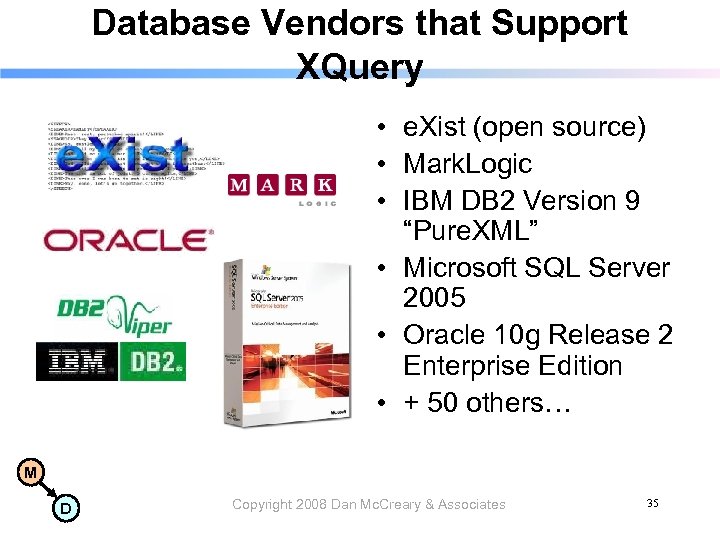
Database Vendors that Support XQuery • e. Xist (open source) • Mark. Logic • IBM DB 2 Version 9 “Pure. XML” • Microsoft SQL Server 2005 • Oracle 10 g Release 2 Enterprise Edition • + 50 others… M D Copyright 2008 Dan Mc. Creary & Associates 35
It is Easy to Import Data SQL 1. Analyze data for all parent child relationships and repeating groups 2. Design logical and physical ER diagrams 3. For each table create a Data Definition File using a data definition language (DDL) 4. Create indexes using DDL 5. Create one table for each set of repeating set of data 6. Run DDL on database creating tables using the appropriate data types 7. Create indexes 8. Create Insert statements 9. Create separate insert statements for each repeating group 10. Run Insert statements on primary structures in database 11. Use primary keys of the first data inserts as foreign keys of dependant M data structures D XQuery 1. Drag XML files into folder 36
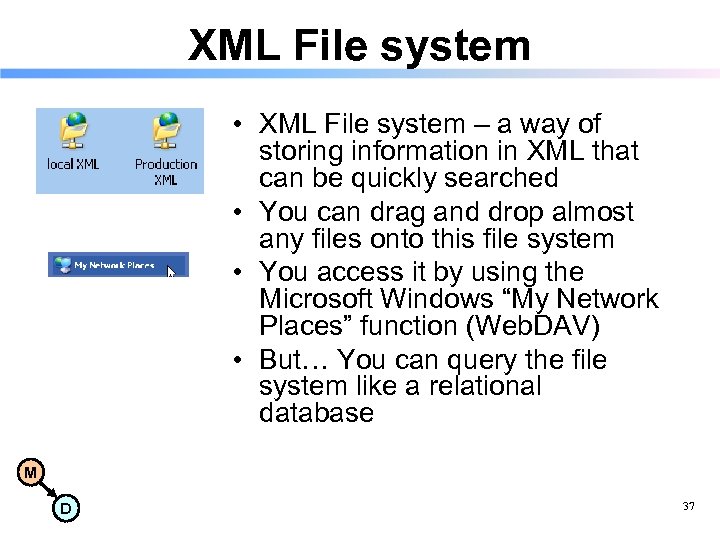
XML File system • XML File system – a way of storing information in XML that can be quickly searched • You can drag and drop almost any files onto this file system • You access it by using the Microsoft Windows “My Network Places” function (Web. DAV) • But… You can query the file system like a relational database M D 37
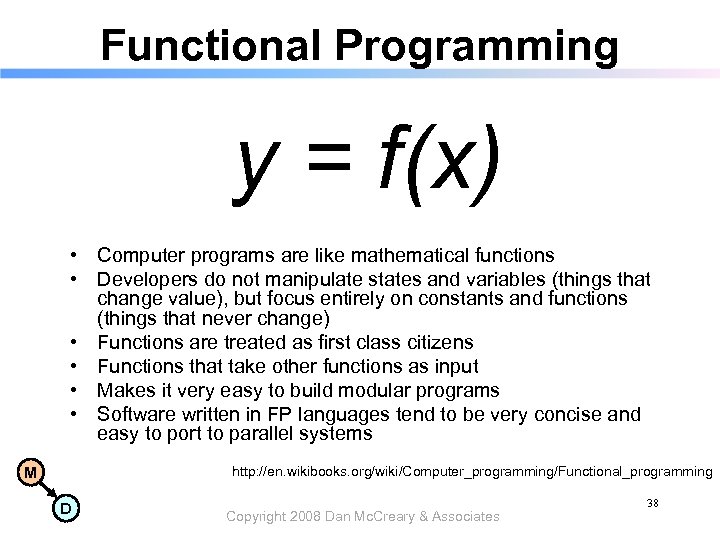
Functional Programming y = f(x) • Computer programs are like mathematical functions • Developers do not manipulate states and variables (things that change value), but focus entirely on constants and functions (things that never change) • Functions are treated as first class citizens • Functions that take other functions as input • Makes it very easy to build modular programs • Software written in FP languages tend to be very concise and easy to port to parallel systems http: //en. wikibooks. org/wiki/Computer_programming/Functional_programming M D Copyright 2008 Dan Mc. Creary & Associates 38
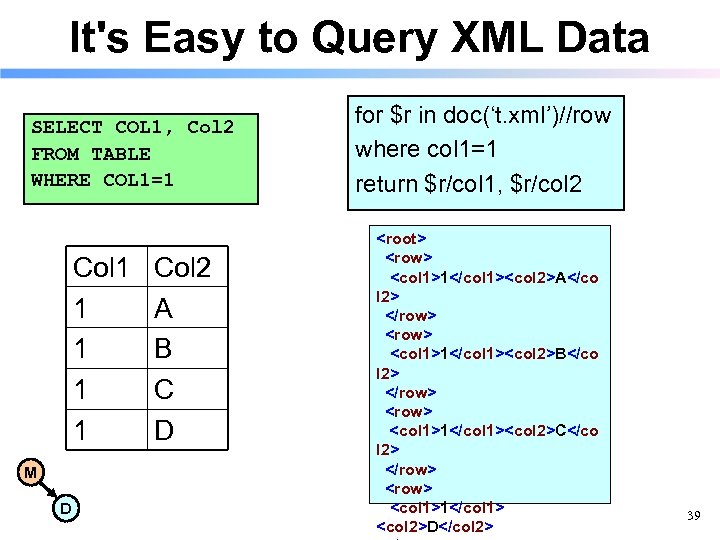
It's Easy to Query XML Data SELECT COL 1, Col 2 FROM TABLE WHERE COL 1=1 Col 1 1 1 M D Col 2 A B C D for $r in doc(‘t. xml’)//row where col 1=1 return $r/col 1, $r/col 2 <root> <row> <col 1>1</col 1><col 2>A</co l 2> </row> <col 1>1</col 1><col 2>B</co l 2> </row> <col 1>1</col 1><col 2>C</co l 2> </row> <col 1>1</col 1> <col 2>D</col 2> 39
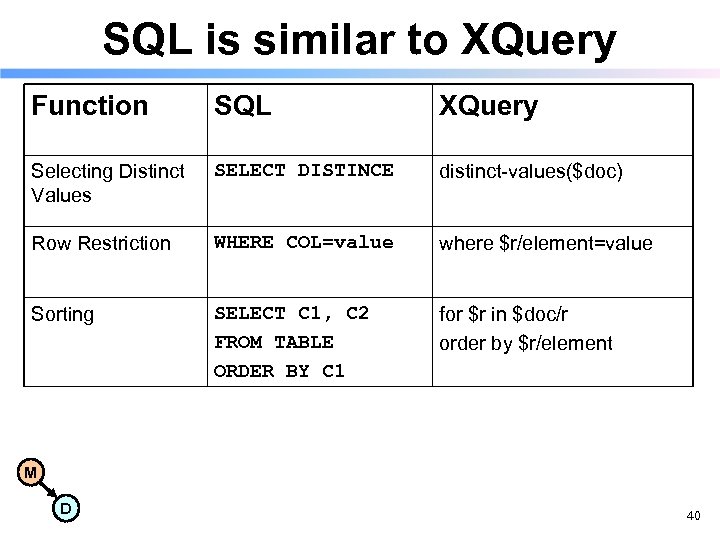
SQL is similar to XQuery Function SQL XQuery Selecting Distinct Values SELECT DISTINCE distinct-values($doc) Row Restriction WHERE COL=value where $r/element=value Sorting SELECT C 1, C 2 FROM TABLE ORDER BY C 1 for $r in $doc/r order by $r/element M D 40
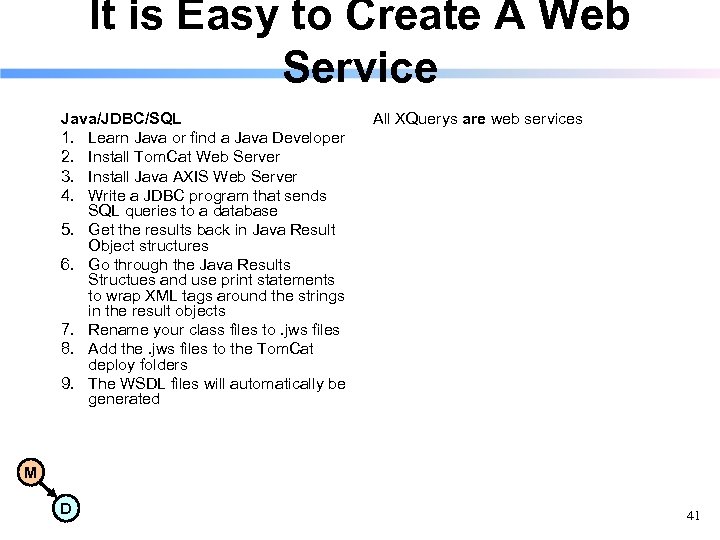
It is Easy to Create A Web Service Java/JDBC/SQL 1. Learn Java or find a Java Developer 2. Install Tom. Cat Web Server 3. Install Java AXIS Web Server 4. Write a JDBC program that sends SQL queries to a database 5. Get the results back in Java Result Object structures 6. Go through the Java Results Structues and use print statements to wrap XML tags around the strings in the result objects 7. Rename your class files to. jws files 8. Add the. jws files to the Tom. Cat deploy folders 9. The WSDL files will automatically be generated All XQuerys are web services M D 41
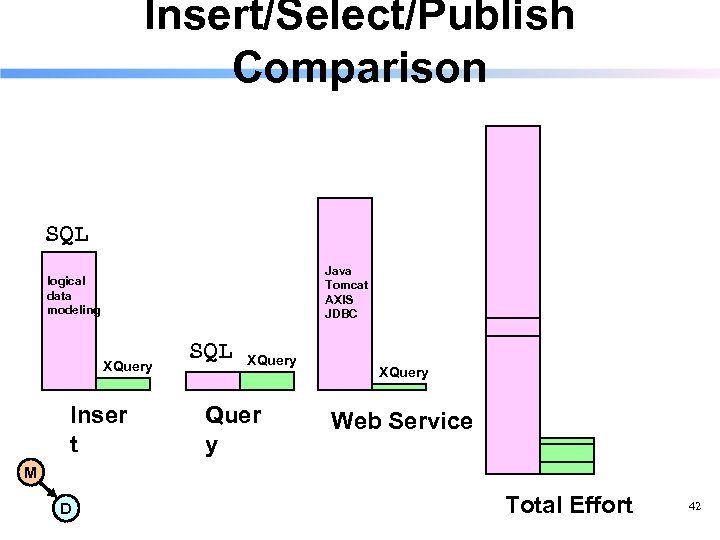
Insert/Select/Publish Comparison SQL Java Tomcat AXIS JDBC logical data modeling XQuery Inser t SQL XQuery Quer y XQuery Web Service M D Total Effort 42
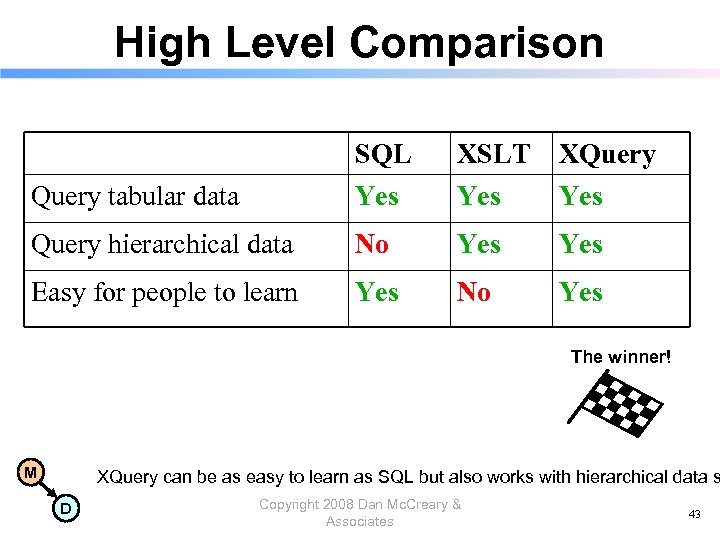
High Level Comparison Query tabular data SQL Yes XSLT Yes XQuery Yes Query hierarchical data No Yes Easy for people to learn Yes No Yes The winner! M XQuery can be as easy to learn as SQL but also works with hierarchical data s D Copyright 2008 Dan Mc. Creary & Associates 43
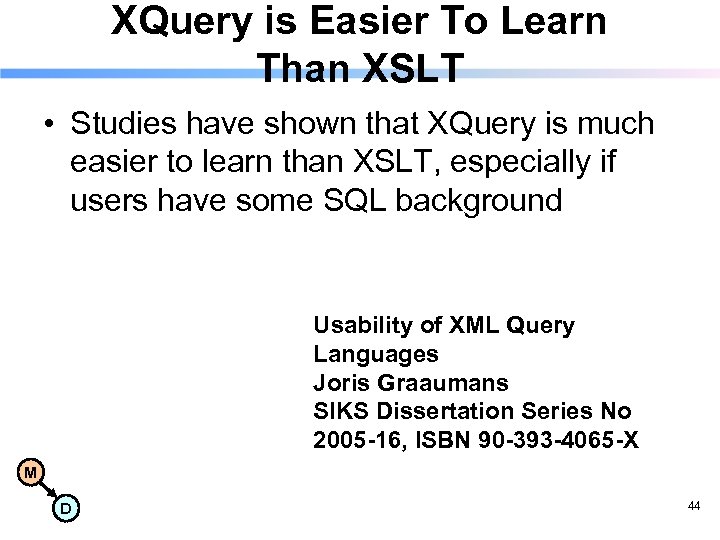
XQuery is Easier To Learn Than XSLT • Studies have shown that XQuery is much easier to learn than XSLT, especially if users have some SQL background Usability of XML Query Languages Joris Graaumans SIKS Dissertation Series No 2005 -16, ISBN 90 -393 -4065 -X M D 44
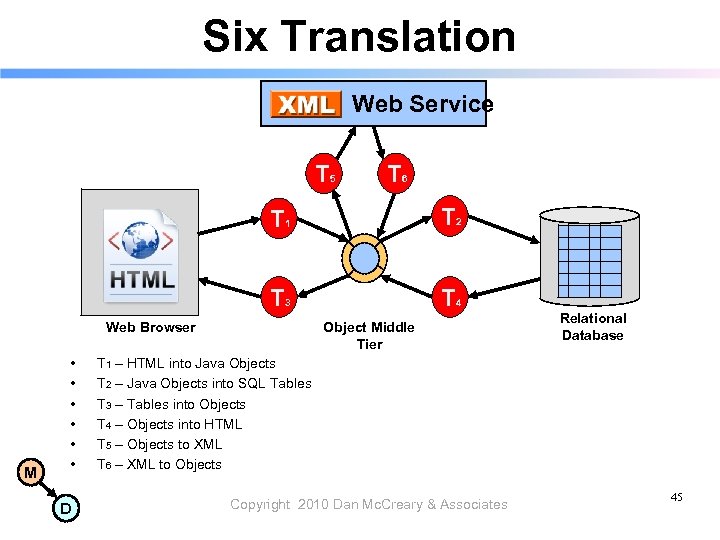
Six Translation Web Service T 5 T 6 T 1 T 2 T 3 T 4 Web Browser M • • • D Object Middle Tier Relational Database T 1 – HTML into Java Objects T 2 – Java Objects into SQL Tables T 3 – Tables into Objects T 4 – Objects into HTML T 5 – Objects to XML T 6 – XML to Objects Copyright 2010 Dan Mc. Creary & Associates 45
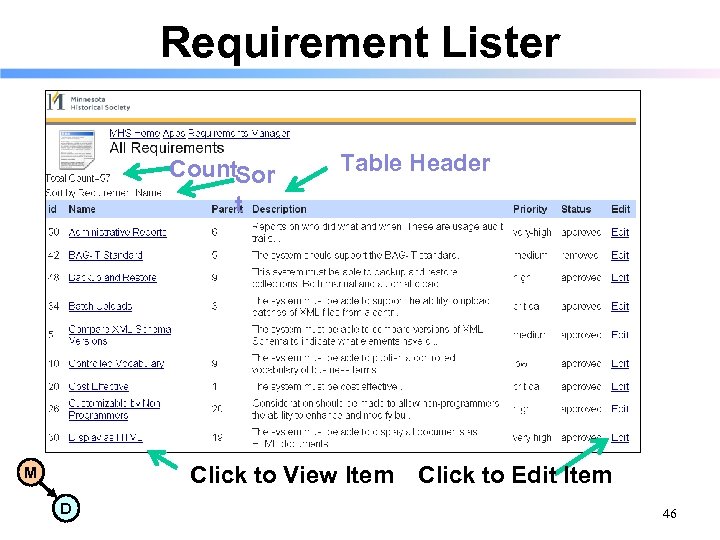
Requirement Lister Count. Sor t Table Header Click to View Item M D Click to Edit Item 46
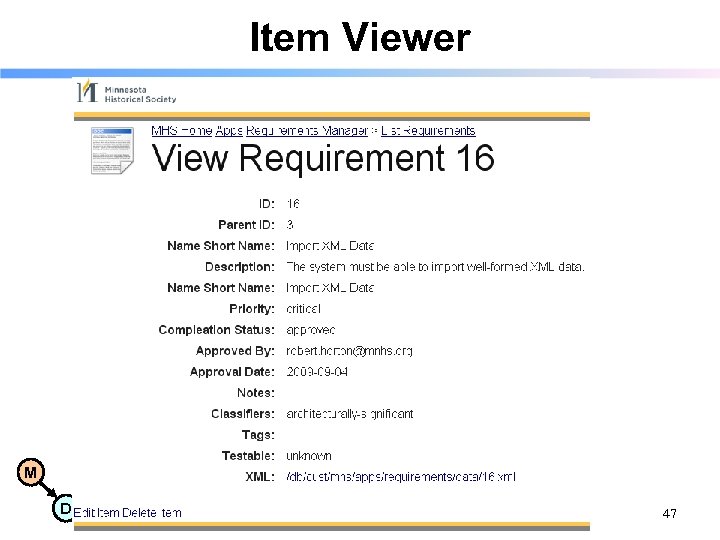
Item Viewer M D 47
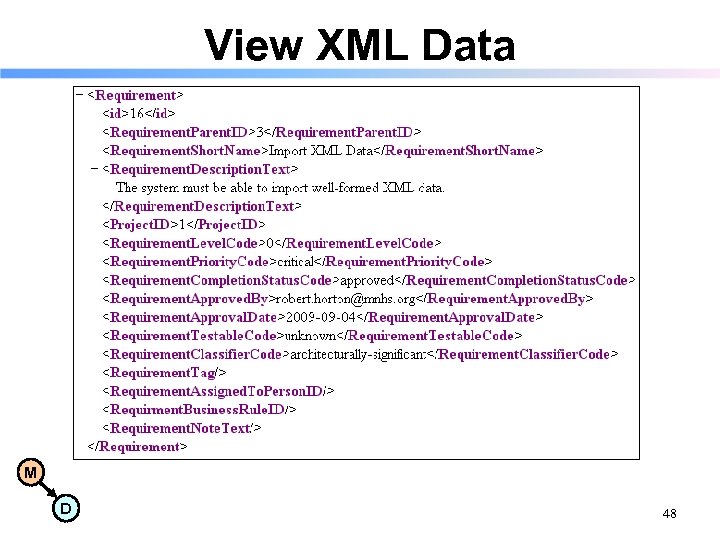
View XML Data M D 48
XForms • W 3 C Standard for web-forms processing • Allows web-forms to load and save complex XML data with many repeating sub-structures • Works very well with REST-type interfaces • Bundled with XML databases (e. Xist and Mark. Logic) • Large library of sample applications M D 49
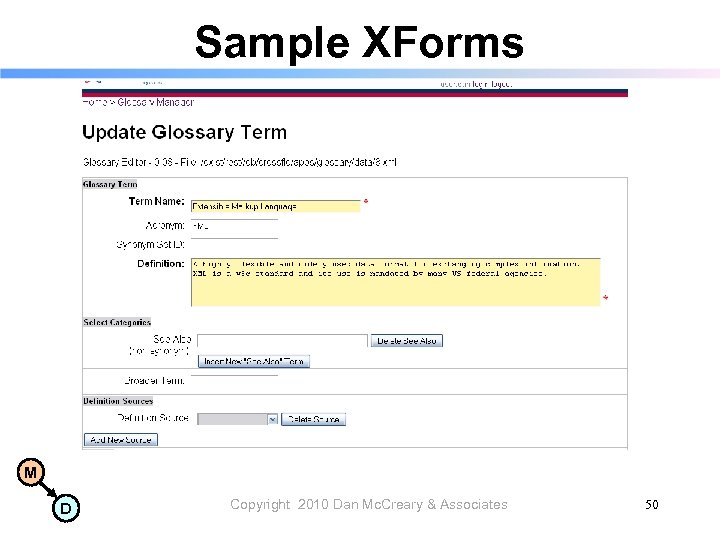
Sample XForms M D Copyright 2010 Dan Mc. Creary & Associates 50
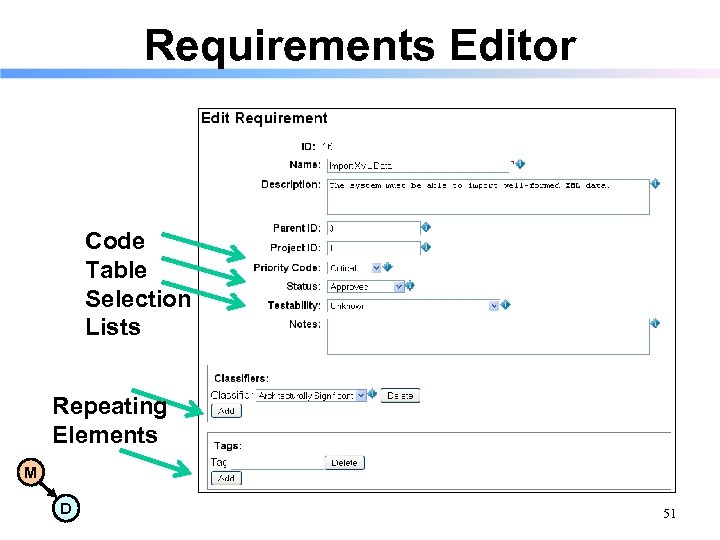
Requirements Editor Code Table Selection Lists Repeating Elements M D 51
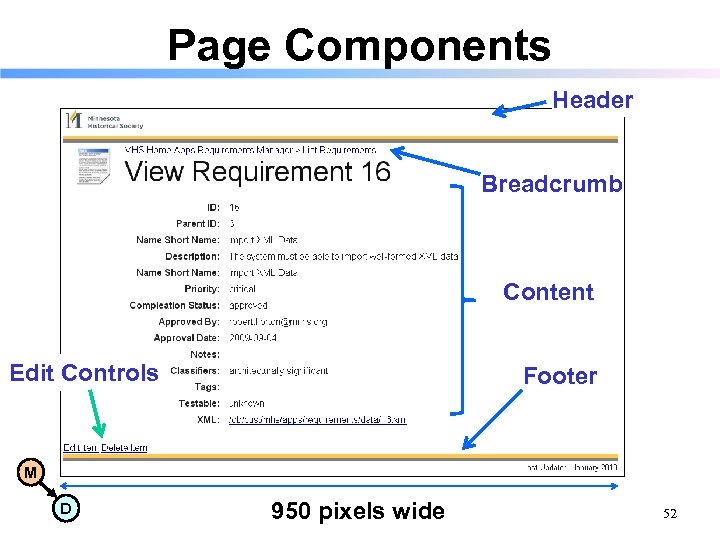
Page Components Header Breadcrumb Content Edit Controls Footer M D 950 pixels wide 52
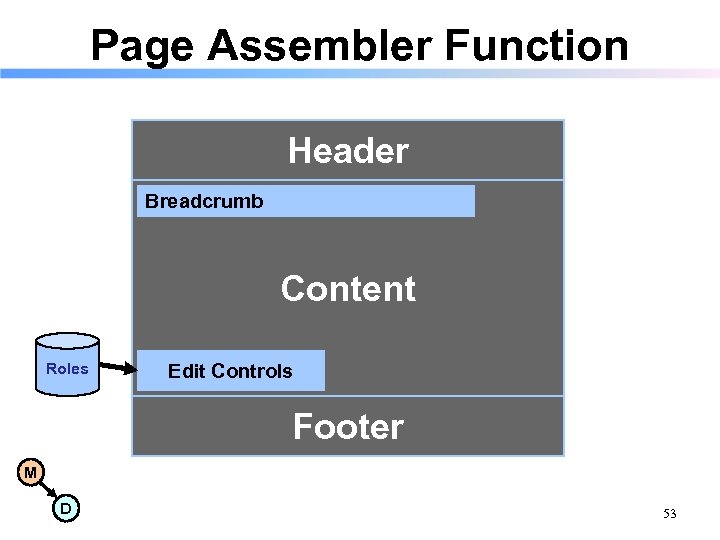
Page Assembler Function Header Breadcrumb Content Roles Edit Controls Footer M D 53
Style Module • Each non-content region of the page is generated by a server-side XQuery function • Users can change a single function and the entire site will be updated • Functions are dynamic and can take into account the page function M D 54
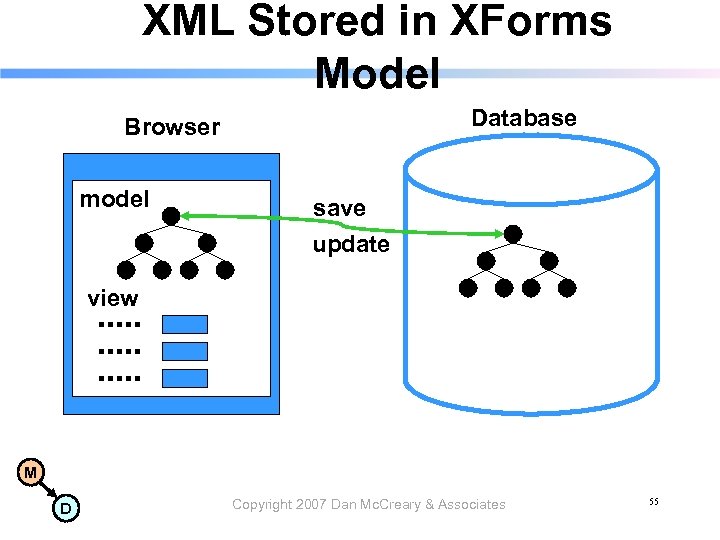
XML Stored in XForms Model Database Browser model save update view M D Copyright 2007 Dan Mc. Creary & Associates 55
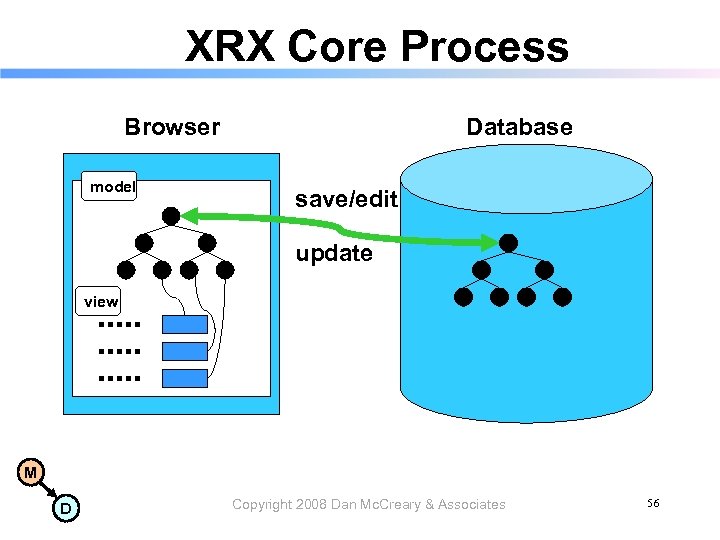
XRX Core Process Browser model Database save/edit update view M D Copyright 2008 Dan Mc. Creary & Associates 56
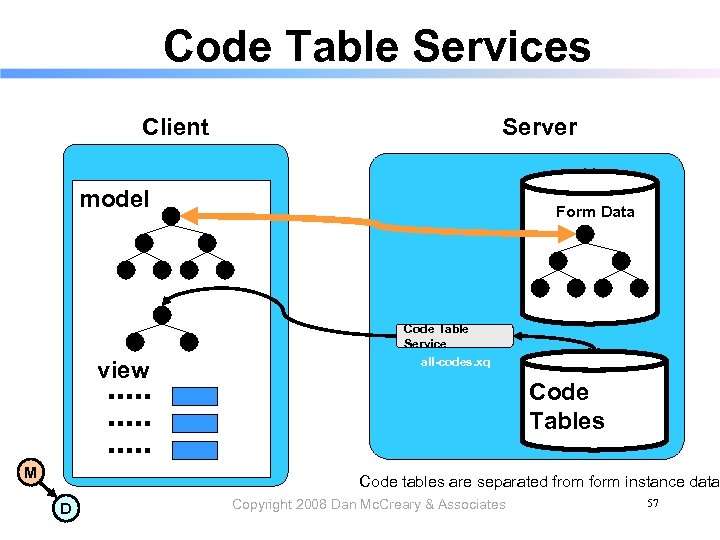
Code Table Services Client Server model Form Data Code Table Service view M all-codes. xq Code Tables Code tables are separated from form instance data D Copyright 2008 Dan Mc. Creary & Associates 57
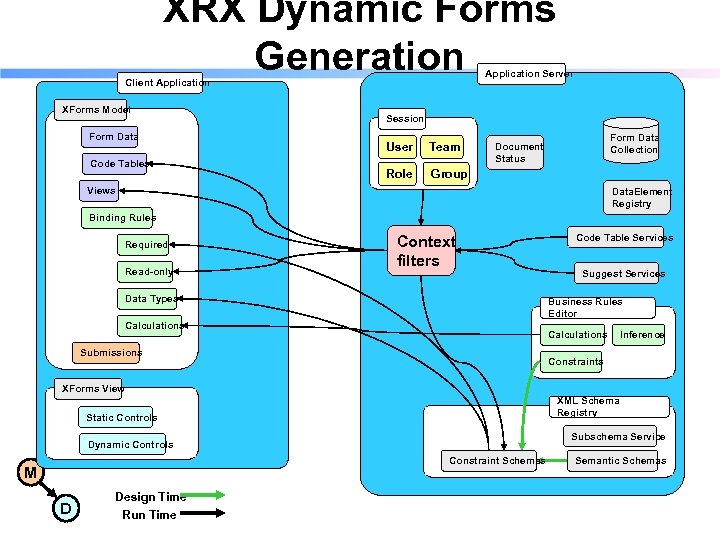
XRX Dynamic Forms Generation Application Server Client Application XForms Model Form Data Code Tables Session User Team Role Form Data Collection Group Document Status Views Data. Element Registry Binding Rules Required Read-only Context filters Data Types Code Table Services Suggest Services Business Rules Editor Calculations Submissions Inference Constraints XForms View XML Schema Registry Static Controls Subschema Service Dynamic Controls Constraint Schemas M D Design Time Run Time Semantic Schemas
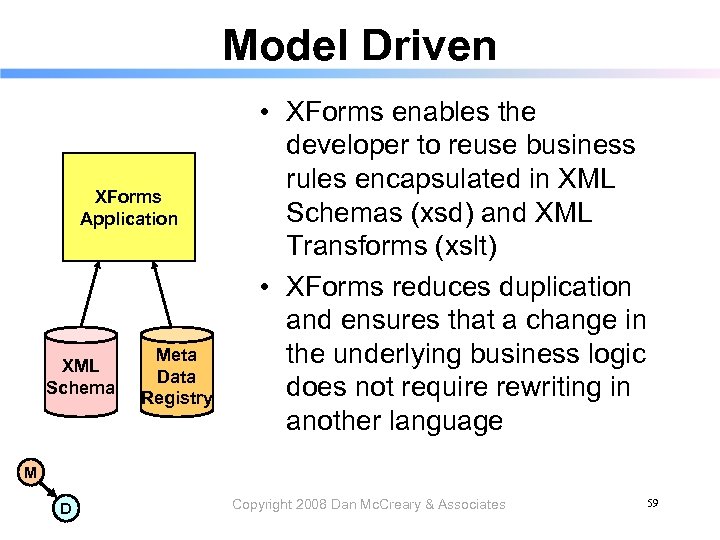
Model Driven XForms Application XML Schema Meta Data Registry • XForms enables the developer to reuse business rules encapsulated in XML Schemas (xsd) and XML Transforms (xslt) • XForms reduces duplication and ensures that a change in the underlying business logic does not require rewriting in another language M D Copyright 2008 Dan Mc. Creary & Associates 59
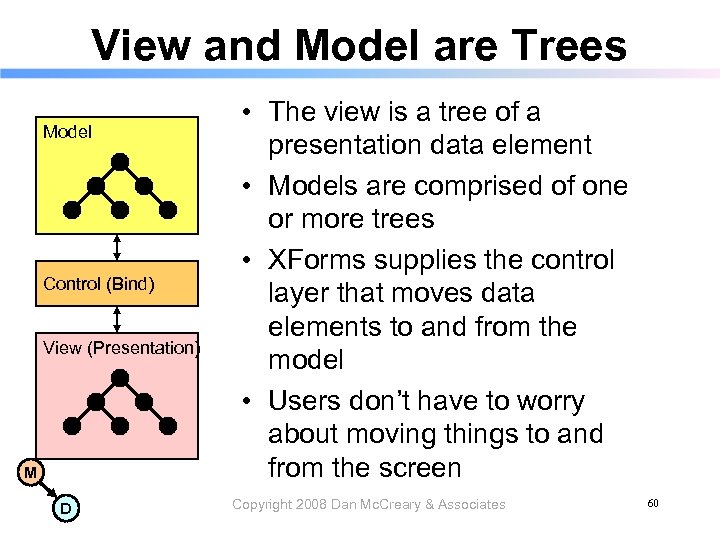
View and Model are Trees Model Control (Bind) View (Presentation) M D • The view is a tree of a presentation data element • Models are comprised of one or more trees • XForms supplies the control layer that moves data elements to and from the model • Users don’t have to worry about moving things to and from the screen Copyright 2008 Dan Mc. Creary & Associates 60
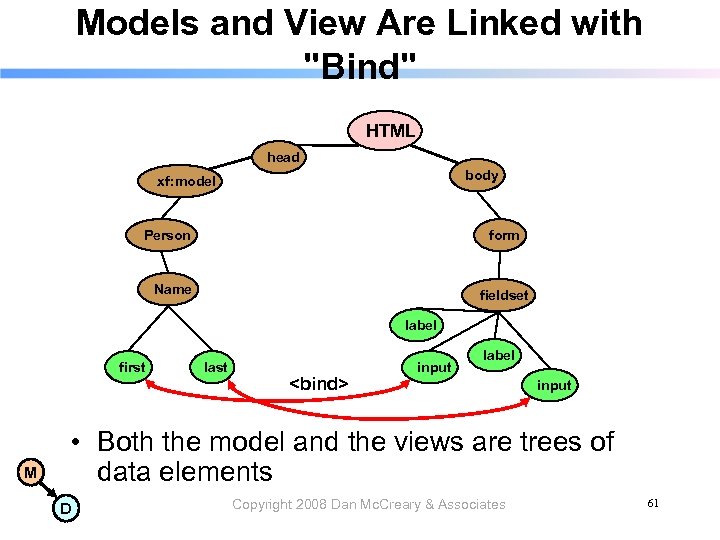
Models and View Are Linked with "Bind" HTML head body xf: model Person form Name fieldset label first M last <bind> input label input • Both the model and the views are trees of data elements D Copyright 2008 Dan Mc. Creary & Associates 61
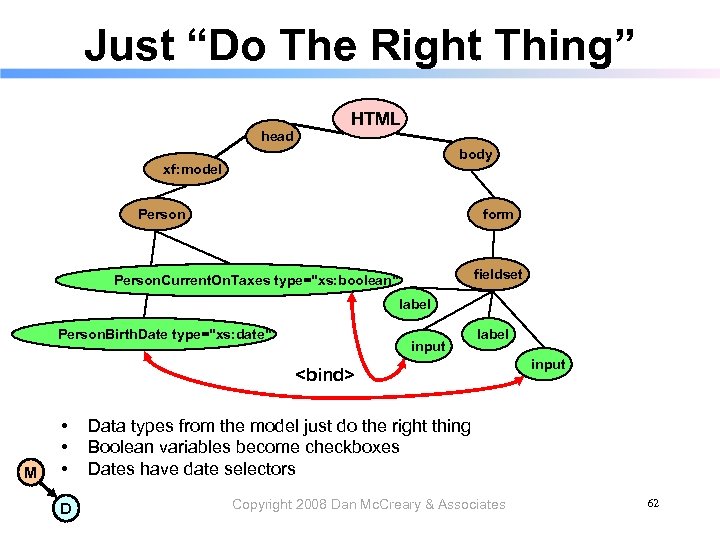
Just “Do The Right Thing” head HTML body xf: model Person form fieldset Person. Current. On. Taxes type="xs: boolean" label Person. Birth. Date type="xs: date" input label <bind> M • • • D input Data types from the model just do the right thing Boolean variables become checkboxes Dates have date selectors Copyright 2008 Dan Mc. Creary & Associates 62
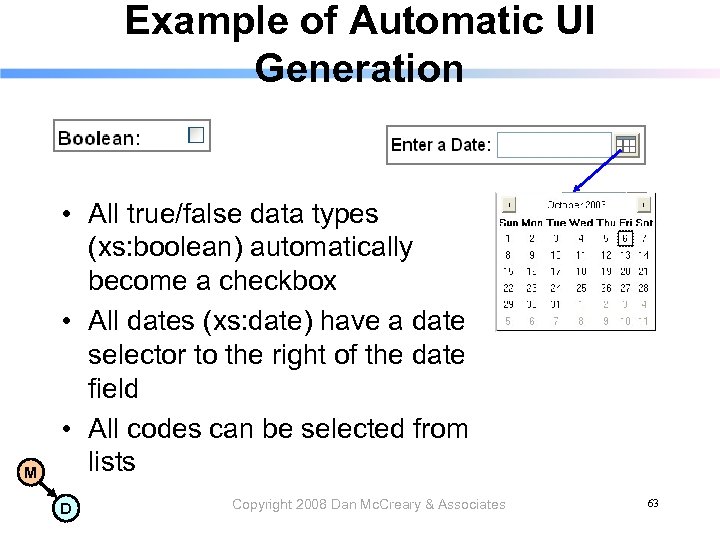
Example of Automatic UI Generation M • All true/false data types (xs: boolean) automatically become a checkbox • All dates (xs: date) have a date selector to the right of the date field • All codes can be selected from lists D Copyright 2008 Dan Mc. Creary & Associates 63
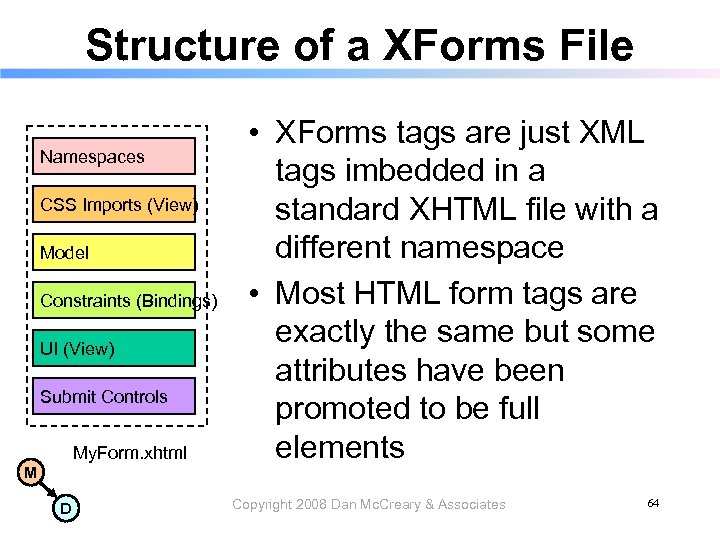
Structure of a XForms File Namespaces CSS Imports (View) Model Constraints (Bindings) UI (View) Submit Controls My. Form. xhtml M D • XForms tags are just XML tags imbedded in a standard XHTML file with a different namespace • Most HTML form tags are exactly the same but some attributes have been promoted to be full elements Copyright 2008 Dan Mc. Creary & Associates 64
REST • REpresentation State Transfer • Create applications based on well designed URLs • Take advantage of web caching • Migrate toward Resource-Oriented Computing (ROC) • REST evangelists: RESTifarians M D Copyright 2008 Dan Mc. Creary & Associates 65
Five RESTFull Friends 1. In-resident memory cache in your browser 2. You local hard drive cache 3. Your local enterprise cache 4. The cache on the web server farm 5. The cache on the database Please make sure to check with your RESTfull friends BEFORE you bother the database. M D Copyright 2008 Dan Mc. Creary & Associates 66
Shallow REST vs. Deep REST • You can start taking advantage of Re. ST buy just doing well thought-out URL design • To take advantage of deep Re. ST you must consider the subtleties of the HTTP protocol – GET vs POST vs PUT – DELETE M D Copyright 2008 Dan Mc. Creary & Associates 67
Benefits of REST • • Provides improved response time Reduced server load Improves server scalability Requires less client-side software Depends less on vendor dependencies Promotes discovery Provides better long-term compatibility Better and evolvability D Copyright 2008 Dan Mc. Creary & Associates M 68
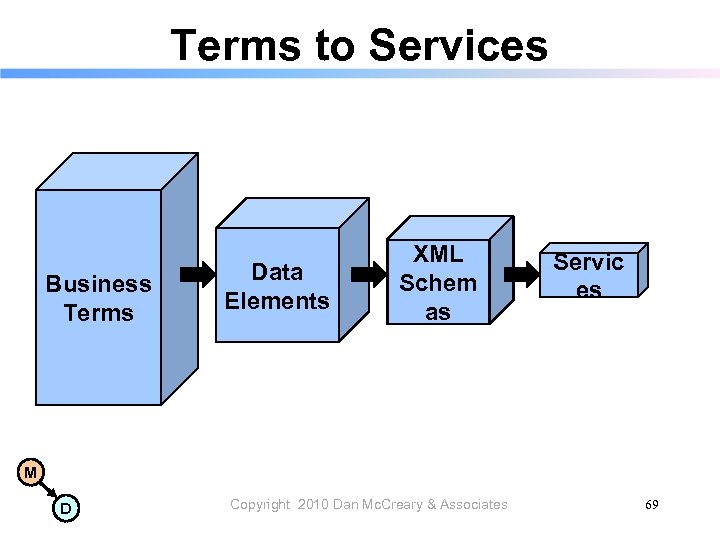
Terms to Services Business Terms Data Elements XML Schem as Servic es M D Copyright 2010 Dan Mc. Creary & Associates 69
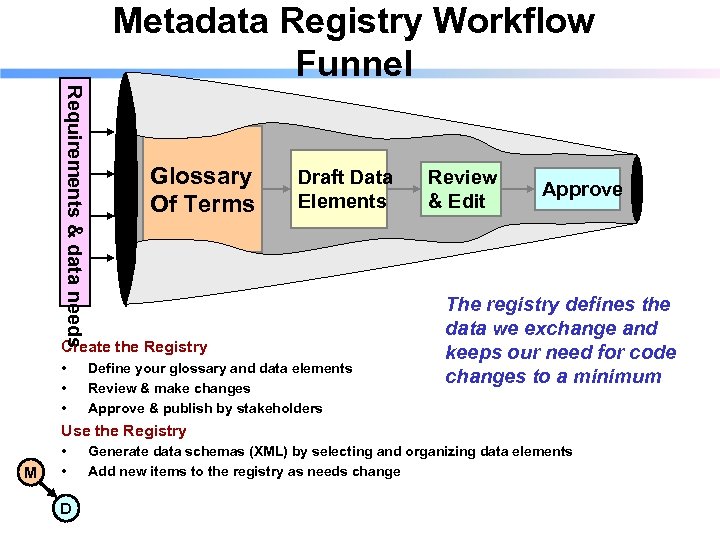
Metadata Registry Workflow Funnel Requirements & data needs Glossary Of Terms Draft Data Elements Create the Registry • • • Define your glossary and data elements Review & make changes Approve & publish by stakeholders Review & Edit Approve The registry defines the data we exchange and keeps our need for code changes to a minimum Use the Registry M • • D Generate data schemas (XML) by selecting and organizing data elements Add new items to the registry as needs change
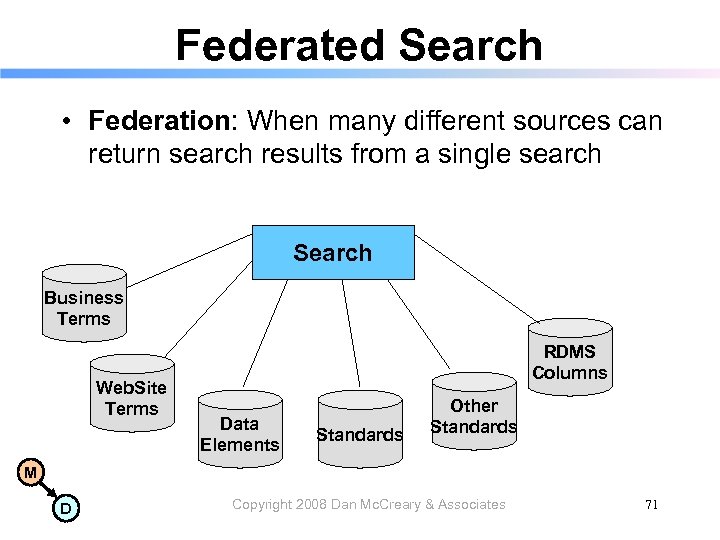
Federated Search • Federation: When many different sources can return search results from a single search Search Business Terms Web. Site Terms RDMS Columns Data Elements Standards Other Standards M D Copyright 2008 Dan Mc. Creary & Associates 71
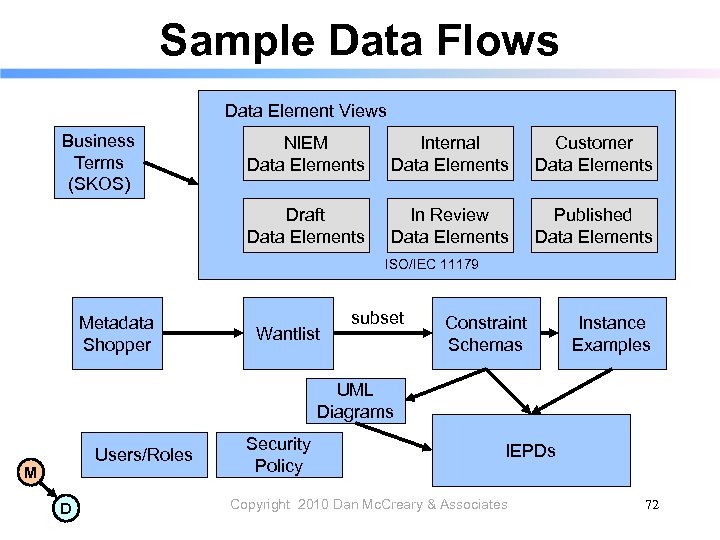
Sample Data Flows Data Element Views Business Terms (SKOS) NIEM Data Elements Internal Data Elements Customer Data Elements Draft Data Elements In Review Data Elements Published Data Elements ISO/IEC 11179 Metadata Shopper Wantlist subset Constraint Schemas Instance Examples UML Diagrams Users/Roles M D Security Policy IEPDs 72 Copyright 2010 Dan Mc. Creary & Associates 72
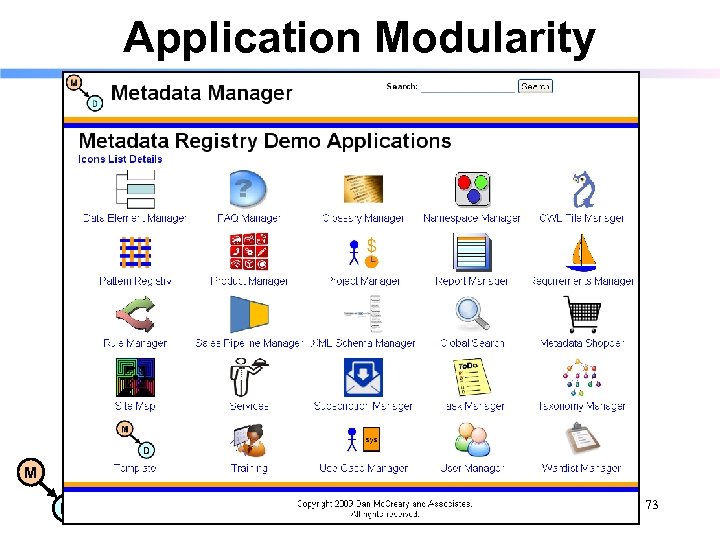
Application Modularity M D Copyright 2010 Dan Mc. Creary & Associates 73
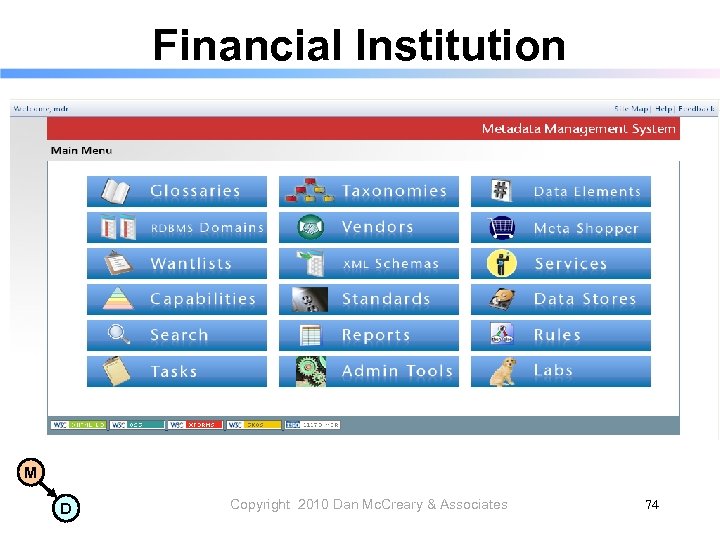
Financial Institution M D Copyright 2010 Dan Mc. Creary & Associates 74
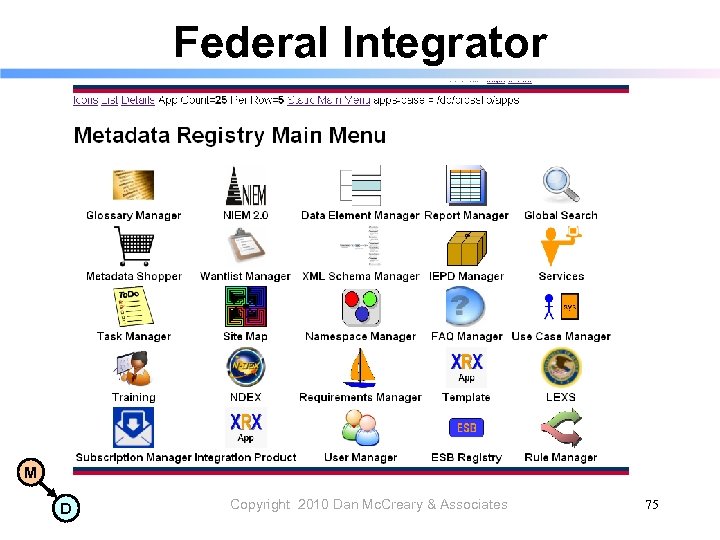
Federal Integrator M D Copyright 2010 Dan Mc. Creary & Associates 75
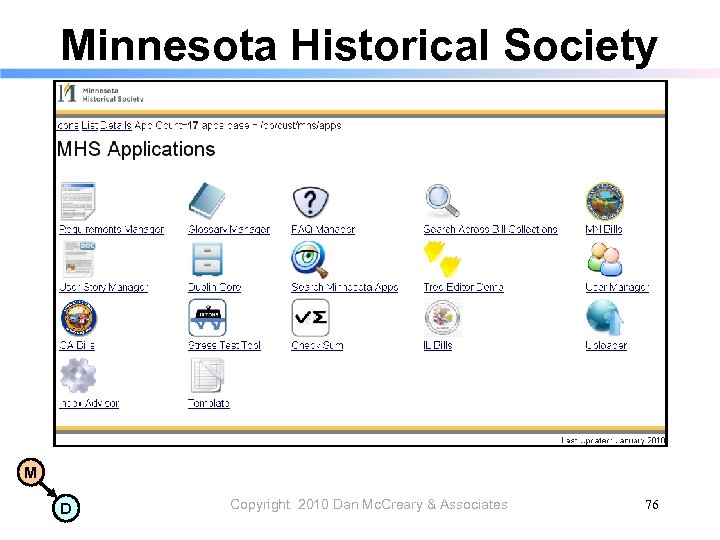
Minnesota Historical Society M D Copyright 2010 Dan Mc. Creary & Associates 76
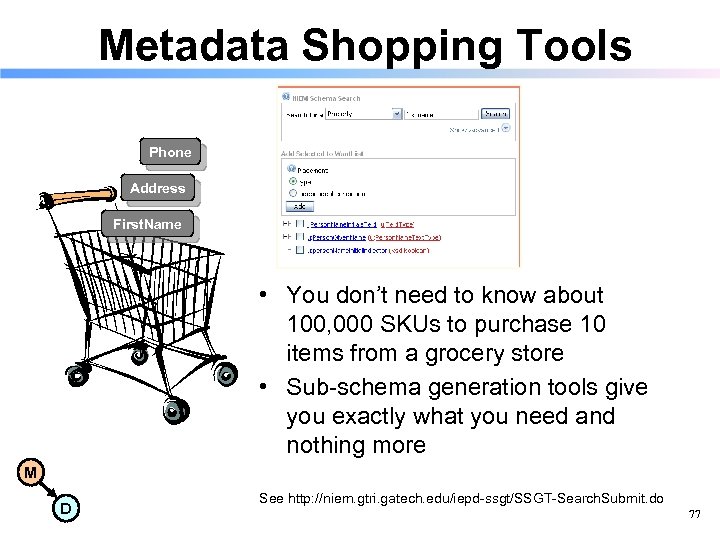
Metadata Shopping Tools Phone Address First. Name • You don’t need to know about 100, 000 SKUs to purchase 10 items from a grocery store • Sub-schema generation tools give you exactly what you need and nothing more M D See http: //niem. gtri. gatech. edu/iepd-ssgt/SSGT-Search. Submit. do 77
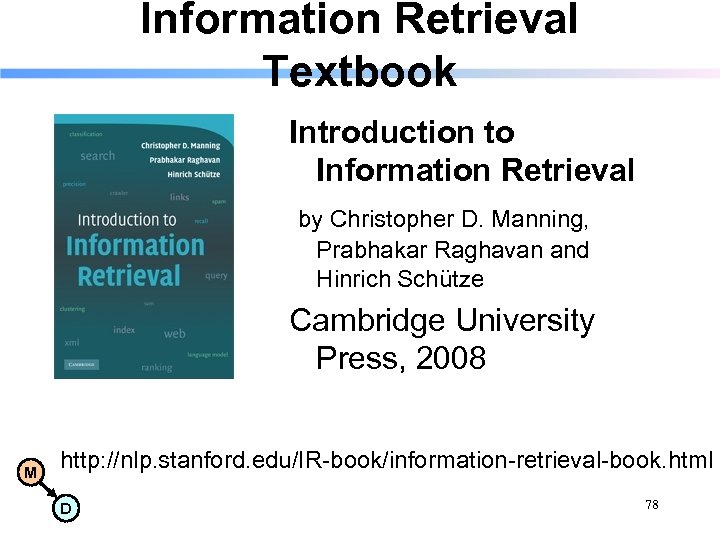
Information Retrieval Textbook Introduction to Information Retrieval by Christopher D. Manning, Prabhakar Raghavan and Hinrich Schütze Cambridge University Press, 2008 M http: //nlp. stanford. edu/IR-book/information-retrieval-book. html D 78
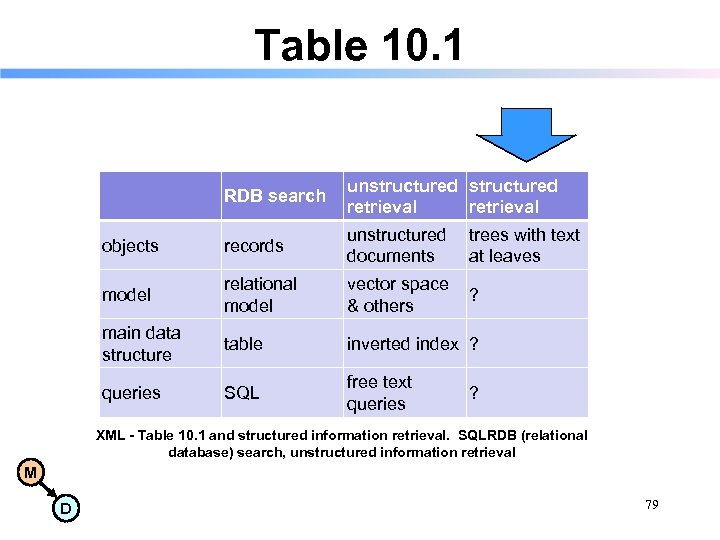
Table 10. 1 RDB search unstructured retrieval objects records unstructured trees with text documents at leaves model relational model vector space ? & others main data structure table inverted index ? queries SQL free text queries ? XML - Table 10. 1 and structured information retrieval. SQLRDB (relational database) search, unstructured information retrieval M D 79
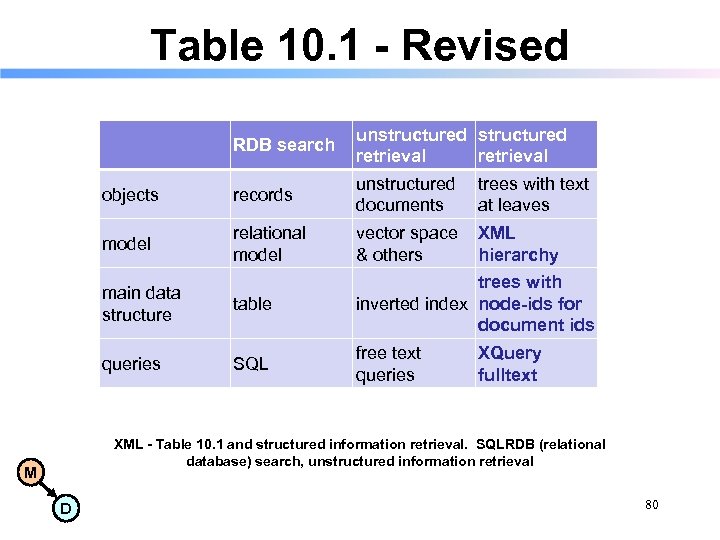
Table 10. 1 - Revised RDB search unstructured retrieval objects records unstructured trees with text documents at leaves model relational model vector space XML & others hierarchy main data structure table trees with inverted index node-ids for document ids queries SQL free text queries XQuery fulltext XML - Table 10. 1 and structured information retrieval. SQLRDB (relational database) search, unstructured information retrieval M D 80
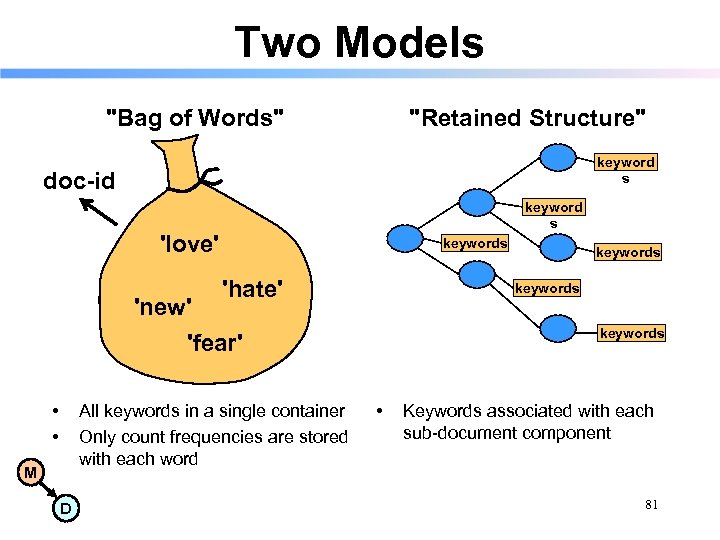
Two Models "Bag of Words" "Retained Structure" keyword s doc-id keyword s 'love' keywords 'hate' keywords 'new' 'fear' • • All keywords in a single container Only count frequencies are stored with each word M D keywords • Keywords associated with each sub-document component 81
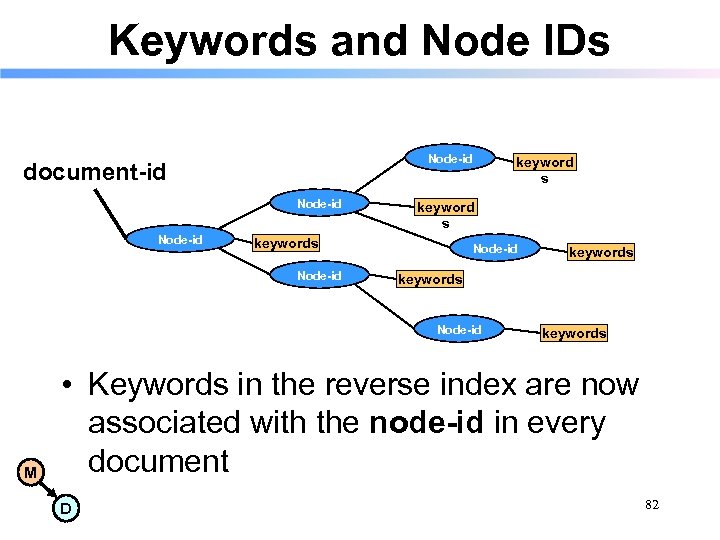
Keywords and Node IDs Node-id document-id Node-id keyword s keywords Node-id keywords Node-id M keywords • Keywords in the reverse index are now associated with the node-id in every document D 82
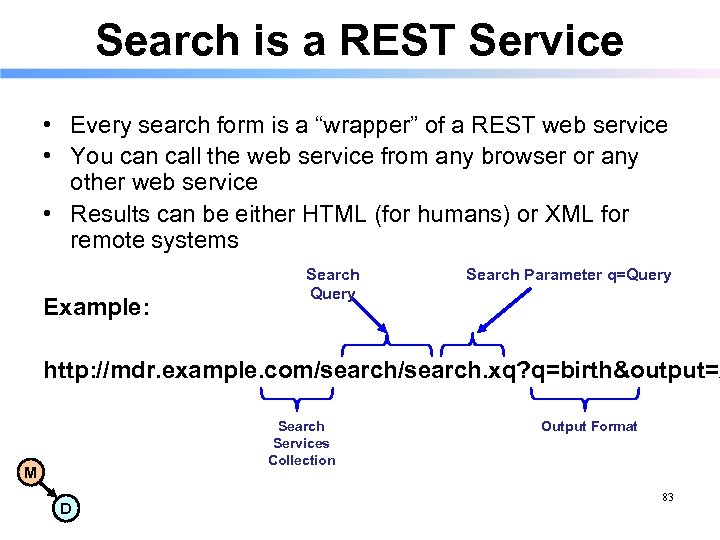
Search is a REST Service • Every search form is a “wrapper” of a REST web service • You can call the web service from any browser or any other web service • Results can be either HTML (for humans) or XML for remote systems Example: Search Query Search Parameter q=Query http: //mdr. example. com/search. xq? q=birth&output=x Search Services Collection M D Output Format 83
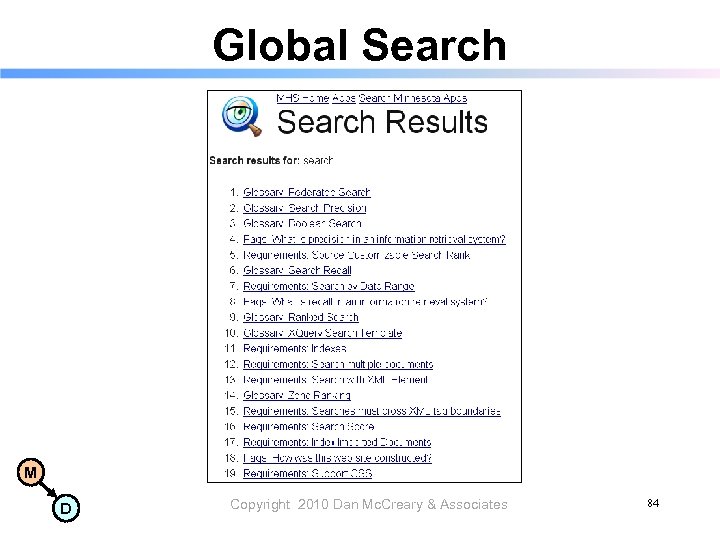
Global Search M D Copyright 2010 Dan Mc. Creary & Associates 84
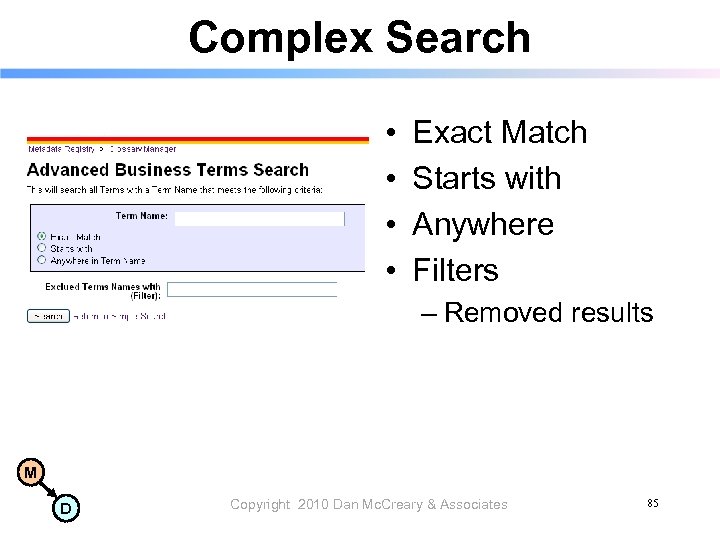
Complex Search • • Exact Match Starts with Anywhere Filters – Removed results M D Copyright 2010 Dan Mc. Creary & Associates 85
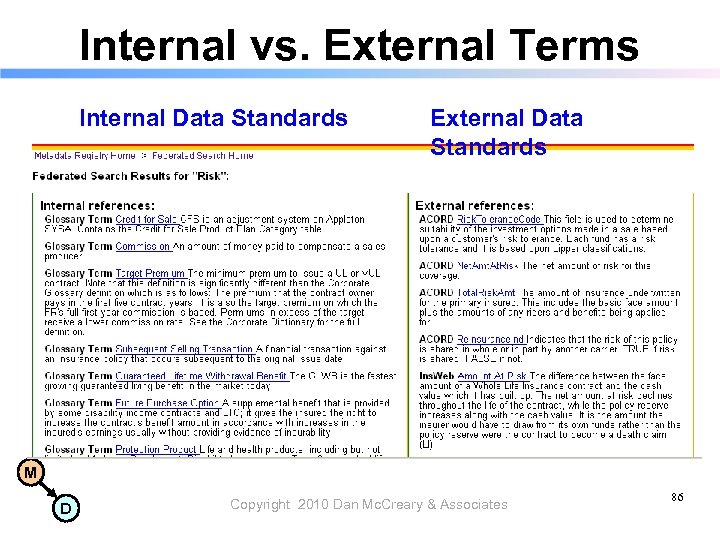
Internal vs. External Terms Internal Data Standards External Data Standards M D Copyright 2010 Dan Mc. Creary & Associates 86
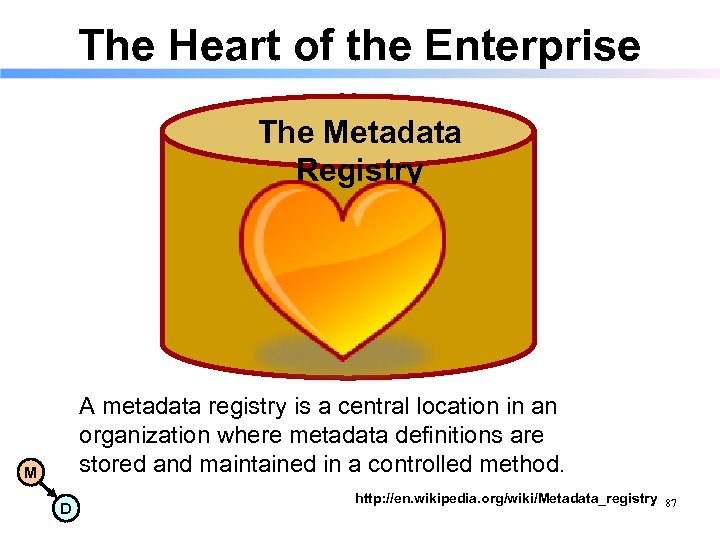
The Heart of the Enterprise The Metadata Registry A metadata registry is a central location in an organization where metadata definitions are stored and maintained in a controlled method. M D http: //en. wikipedia. org/wiki/Metadata_registry 87
Dan's Promise to Every BA • If you are… – somewhat familiar with HTML and SQL – willing to "know your data" – willing to spend around 40 hours in training – able to use open source software • Then… – You can build and maintain your own metadata registry M D Copyright 2010 Dan Mc. Creary & Associates 88
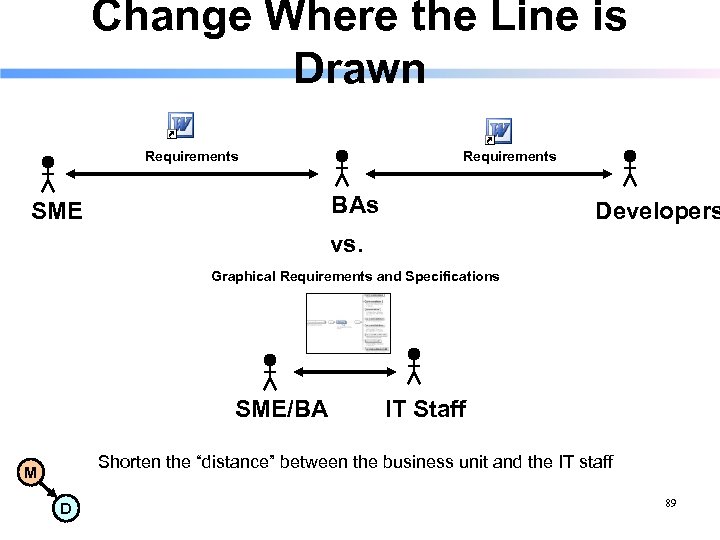
Change Where the Line is Drawn Requirements BAs SME Developers vs. Graphical Requirements and Specifications SME/BA IT Staff Shorten the “distance” between the business unit and the IT staff M D 89
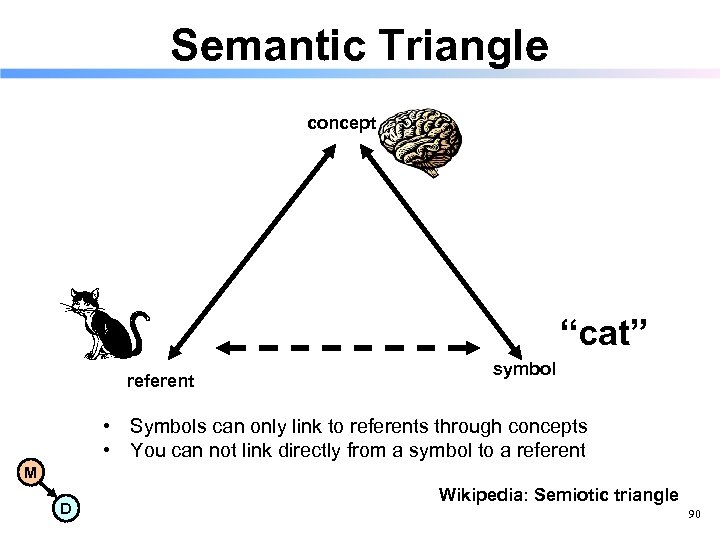
Semantic Triangle concept “cat” referent symbol • Symbols can only link to referents through concepts • You can not link directly from a symbol to a referent M D Wikipedia: Semiotic triangle 90
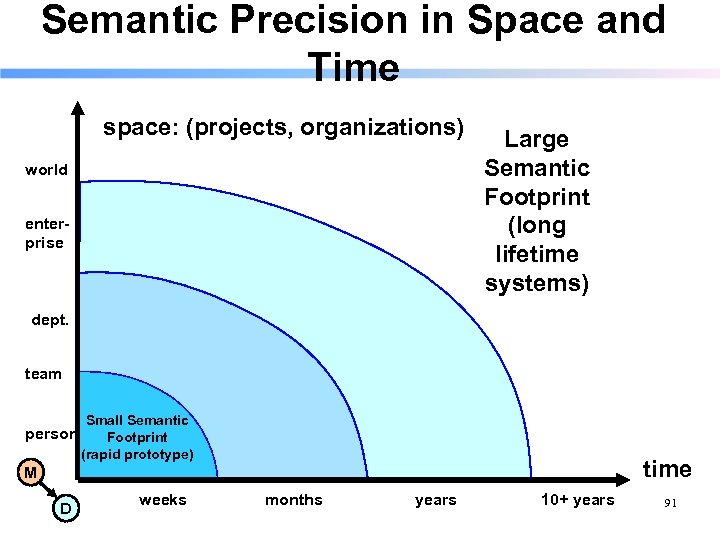
Semantic Precision in Space and Time space: (projects, organizations) world enterprise Large Semantic Footprint (long lifetime systems) dept. team person Small Semantic Footprint (rapid prototype) time M D weeks months years 10+ years 91
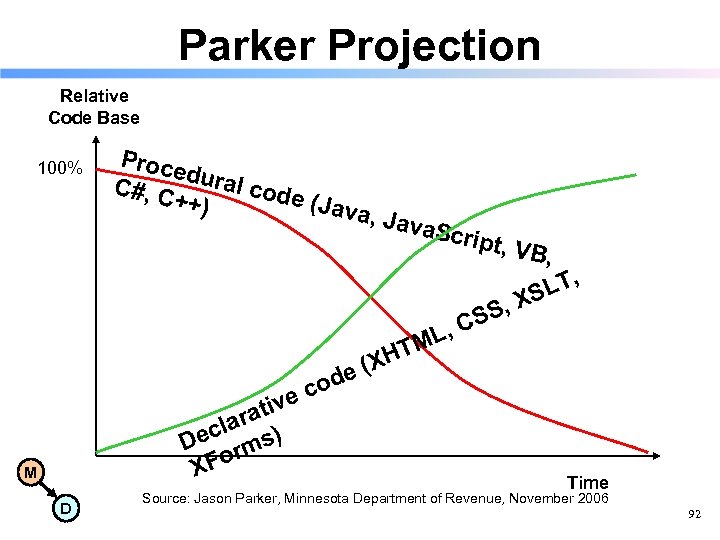
Parker Projection Relative Code Base 100% Proce d C#, C ural code ++) (Jav a, Java Scrip L, C TM (XH t, VB , T, SL S, X S ode c tive lara ) Dec rms XFo M D Time Source: Jason Parker, Minnesota Department of Revenue, November 2006 92
Incoming! Has this web thing gone away yet? L M X web M D Copyright 2008 Dan Mc. Creary & Associates 93
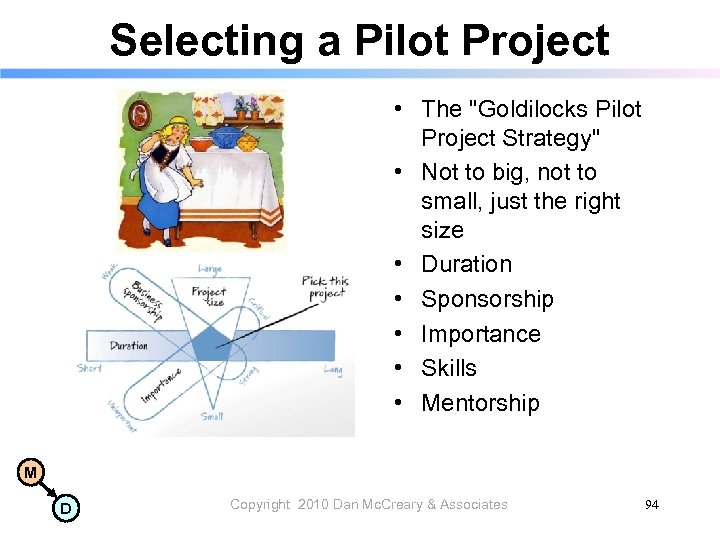
Selecting a Pilot Project • The "Goldilocks Pilot Project Strategy" • Not to big, not to small, just the right size • Duration • Sponsorship • Importance • Skills • Mentorship M D Copyright 2010 Dan Mc. Creary & Associates 94
Find A Community… e. Xist Meeting Prague March 12 th, 2010 M D 95
Challenges • Minimal local talent with XQuery • XForms performance issues for large forms (over 100 fields per form) – User smaller forms • Role-based access control at the collection level M D Copyright 2010 Dan Mc. Creary & Associates 96
Words of Caution • Only use "latest stable" releases – Currently e. Xist 1. 4 • Backup your system • Put critical transactions in at least two places (transaction logs) • Avoid long-running transactions • Use locking to avoid missing updates M D Copyright 2010 Dan Mc. Creary & Associates 97
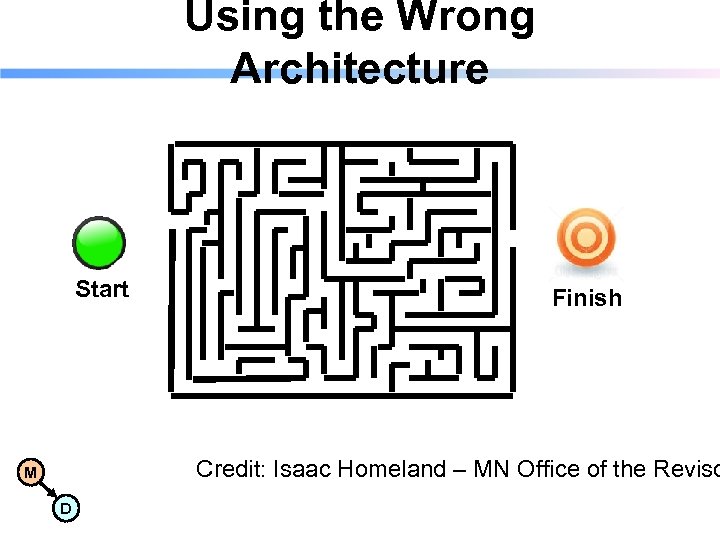
Using the Wrong Architecture Start Finish Credit: Isaac Homeland – MN Office of the Reviso M D
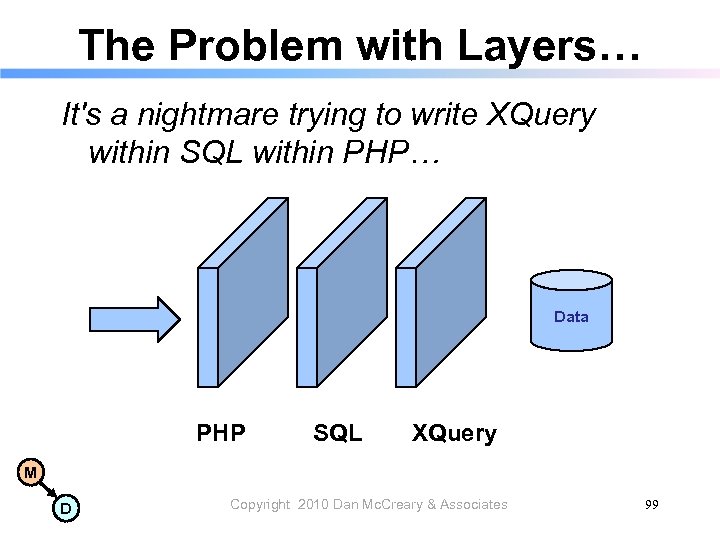
The Problem with Layers… It's a nightmare trying to write XQuery within SQL within PHP… Data PHP SQL XQuery M D Copyright 2010 Dan Mc. Creary & Associates 99
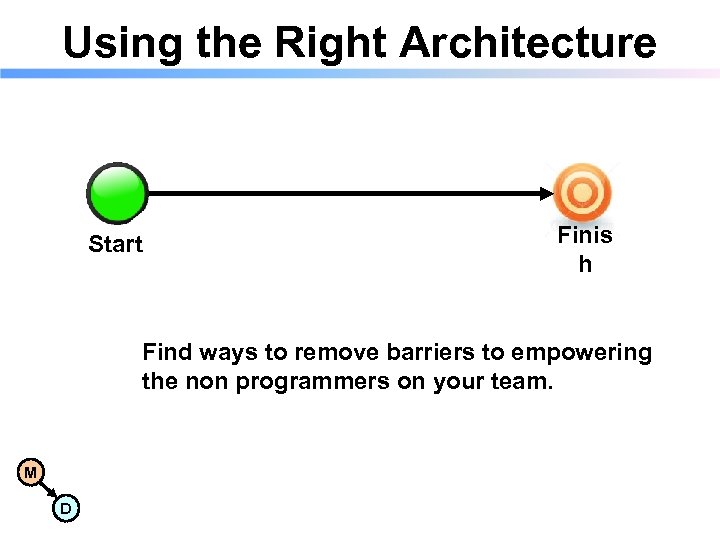
Using the Right Architecture Start Finis h Find ways to remove barriers to empowering the non programmers on your team. M D
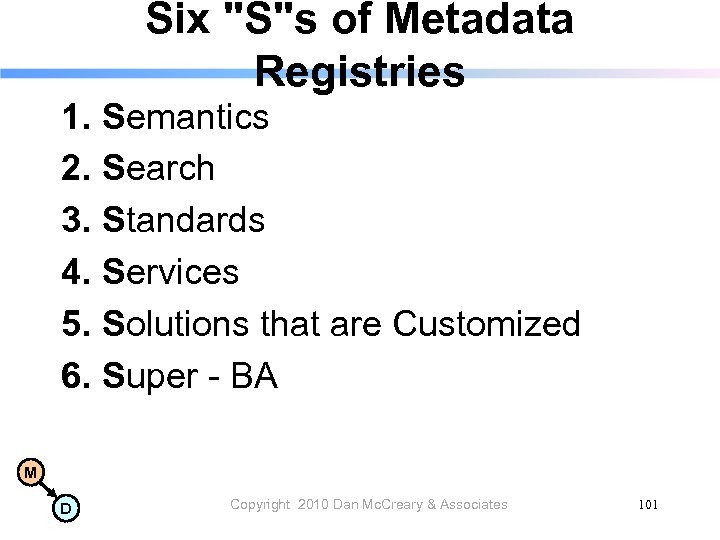
Six "S"s of Metadata Registries 1. Semantics 2. Search 3. Standards 4. Services 5. Solutions that are Customized 6. Super - BA M D Copyright 2010 Dan Mc. Creary & Associates 101
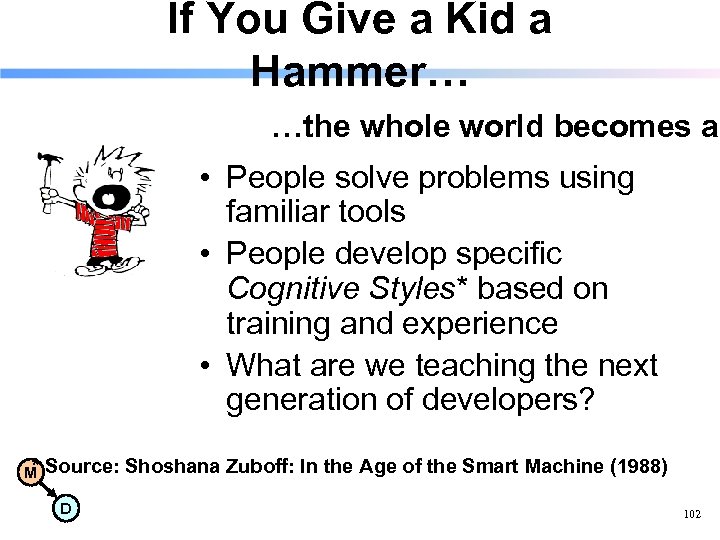
If You Give a Kid a Hammer… …the whole world becomes a • People solve problems using familiar tools • People develop specific Cognitive Styles* based on training and experience • What are we teaching the next generation of developers? * Source: Shoshana Zuboff: In the Age of the Smart Machine (1988) M D 102
References XForms XQuery XRX A Beginner's Guide to XRX Send e-mail to dan@danmccreary. com for extended list of "getting started" resources. M D 103
Questions? Dan Mc. Creary President Dan Mc. Creary & Associates dan@danmccreary. com (952) 931 -9198 M D 104
Скачать презентацию No SQL Metadata Management October 20 th 2010
df9e20ffdd46b8539fe83f80a424ce59.ppt