


 Скачать презентацию No singing in this presentation Data Management on
3ada240d90df098f82f92afa70436b83.ppt
- Количество слайдов: 24
 No singing in this presentation Data Management on the Fusion Computational Pipeline, “End-to-end solutions” Presentation to Sci. DAC 2005 meeting 6/29/05 Scott A. Klasky PPPL M. Beck (UTK) , V. Bhat (PPPL), E. Feibush(PPPL) B. Ludäscher (UCD) , M. Parashar (Rutgers), A. Shoshani (LBL) D. Silver (Rutgers), M. Vouk (NCS) GPS Sci. DAC CEMM Sci. DAC Batchelor
 Outline of Talk • The Fusion Simulation Project (FSP). • Computer Science enabling technologies. • The Scientific Investigation Process. • Technologies necessary for leadership class computing, such as the FSP. – – – Adaptive Workflow Technology Data streaming Collaborative code monitoring Integrated Data Analysis and Visualization Environment. Ubiquitous and Transparent Data Sharing.
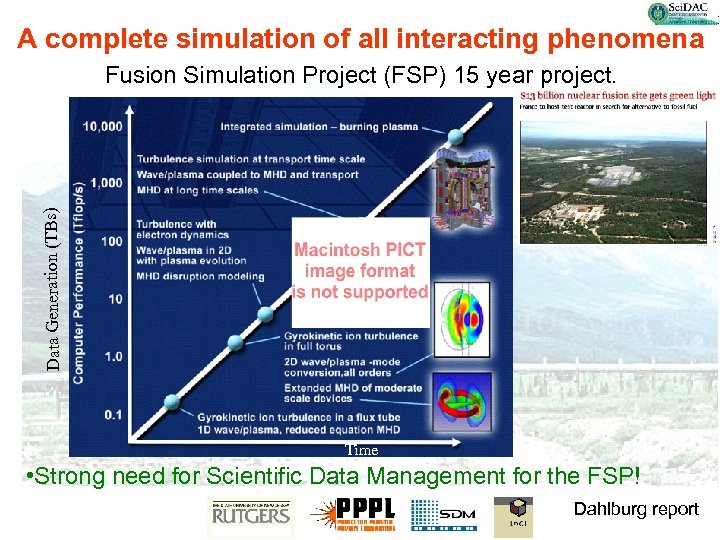 A complete simulation of all interacting phenomena Data Generation (TBs) Fusion Simulation Project (FSP) 15 year project. Time • Strong need for Scientific Data Management for the FSP! Dahlburg report
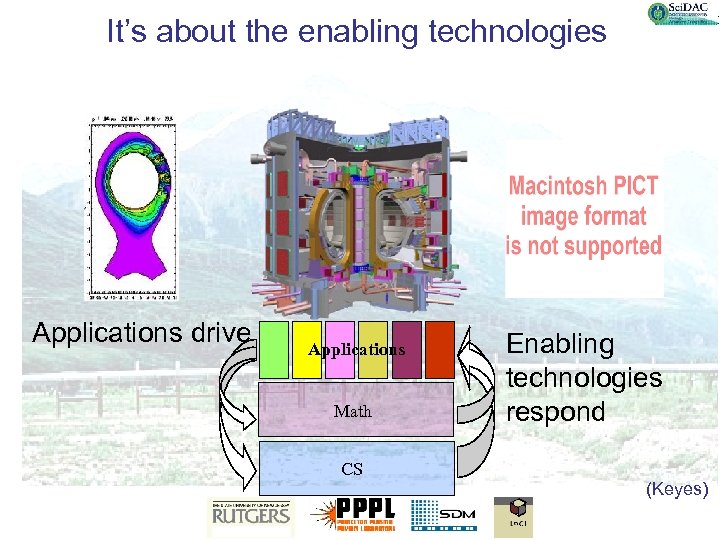 It’s about the enabling technologies Applications drive Applications Math Enabling technologies respond CS (Keyes)
 FSP has computer science/DM requirements • Coupling multiple codes/data – In-core and network-based • Analysis and visualization – Feature extraction, data juxtaposition for V&V • Dynamic monitoring and control – Parameter modification, snapshot generation, … • Data sharing among collaborators – Transparent and efficient data access • These requirements are shared with many other simulations across the DOE community.
 Six data technologies Fundamental to supporting the data management requirements for scientific applications • From the report from the DOE Office of Science Data-Management Workshops (March – May 2004) (R. Mount) – – – – • http: //www-user. slac. stanford. edu/rmount/dm-workshop-04/Final-report. pdf Workflow, data transformation Metadata, data description, logical organization Efficient access and queries, data integration Distributed data management, data movement, networks Storage and caching Data analysis, visualization, and integrated environments A path-finding FSP should develop and demonstrate these components
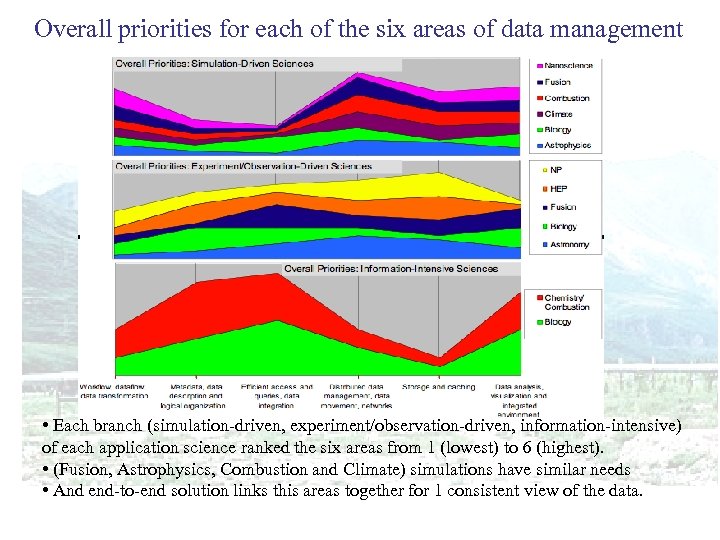 Overall priorities for each of the six areas of data management • Each branch (simulation-driven, experiment/observation-driven, information-intensive) of each application science ranked the six areas from 1 (lowest) to 6 (highest). • (Fusion, Astrophysics, Combustion and Climate) simulations have similar needs • And end-to-end solution links this areas together for 1 consistent view of the data.
 OFES has a clear need for advanced SDM • Current OFES Data management technologies work well for current experiments, but do not scale well for large data. • The time is ripe for OFES to join in collaborative efforts with other DOE data management researchers and design a system, which will be scaleable to a FSP and ultimately to the needs of ITER.
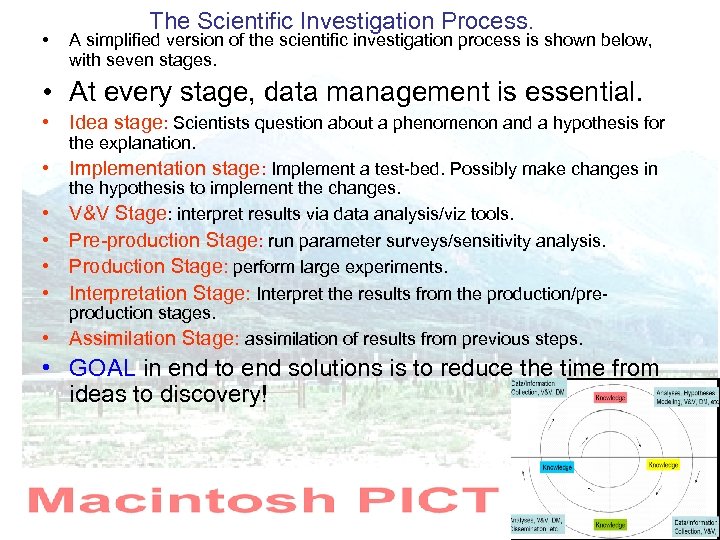 • The Scientific Investigation Process. A simplified version of the scientific investigation process is shown below, with seven stages. • At every stage, data management is essential. • Idea stage: Scientists question about a phenomenon and a hypothesis for the explanation. • Implementation stage: Implement a test-bed. Possibly make changes in • • • the hypothesis to implement the changes. V&V Stage: interpret results via data analysis/viz tools. Pre-production Stage: run parameter surveys/sensitivity analysis. Production Stage: perform large experiments. Interpretation Stage: Interpret the results from the production/preproduction stages. Assimilation Stage: assimilation of results from previous steps. • GOAL in end to end solutions is to reduce the time from ideas to discovery!
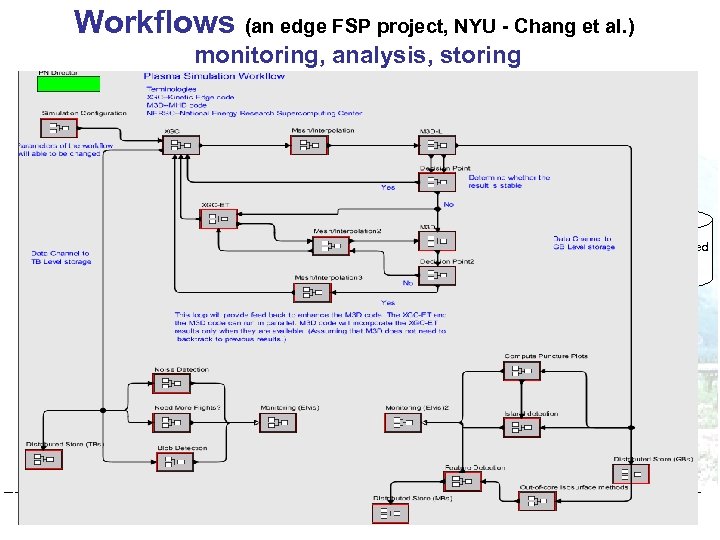 Workflows (an edge FSP project, NYU - Chang et al. ) monitoring, analysis, storing Start (L-H) XGC-ET Mesh/Interpolation Yes No XGC-ET M 3 D-L (Linear stability) Stable? Mesh/Interpolation M 3 D t Stable? Distributed Store No Mesh/Interpolation TBs Yes Compute Puncture Plots Noise Detection Portal (Elvis) Island detection Need More Flights? Blob Detection B healed? Distributed Store MBs I D A V E Feature Detection Out-of-core Isosurface methods Distributed Store GBs
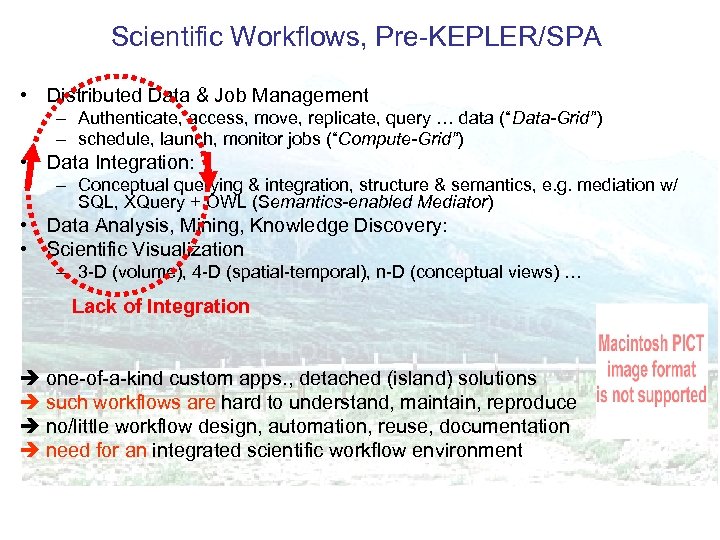 Scientific Workflows, Pre-KEPLER/SPA • Distributed Data & Job Management – Authenticate, access, move, replicate, query … data (“Data-Grid”) – schedule, launch, monitor jobs (“Compute-Grid”) • Data Integration: – Conceptual querying & integration, structure & semantics, e. g. mediation w/ SQL, XQuery + OWL (Semantics-enabled Mediator) • Data Analysis, Mining, Knowledge Discovery: • Scientific Visualization – 3 -D (volume), 4 -D (spatial-temporal), n-D (conceptual views) … Lack of Integration è one-of-a-kind custom apps. , detached (island) solutions è such workflows are hard to understand, maintain, reproduce è no/little workflow design, automation, reuse, documentation è need for an integrated scientific workflow environment
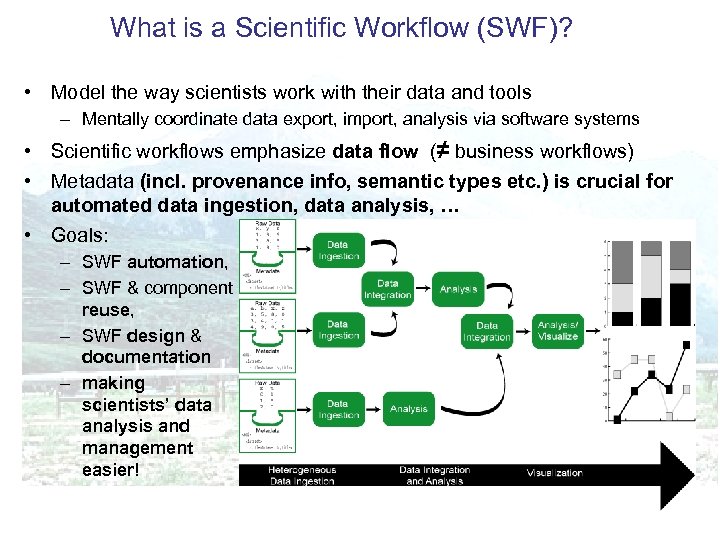 What is a Scientific Workflow (SWF)? • Model the way scientists work with their data and tools – Mentally coordinate data export, import, analysis via software systems • Scientific workflows emphasize data flow (≠ business workflows) • Metadata (incl. provenance info, semantic types etc. ) is crucial for automated data ingestion, data analysis, … • Goals: – SWF automation, – SWF & component reuse, – SWF design & documentation – making scientists’ data analysis and management easier!
 Interactive and Autonomic Control of Workflows/ Simulations • Scale, complexity and dynamism of the FSP requires simulations to be accessed, monitored and controlled during execution. • Development and deployment of applications that can be externally monitored and interactively or autonomically controlled. – Enable interactive and autonomic (policies driven) control of simulation elements, interactions and workflows. – A control network to enable elements to be accessed and managed externally. • Support runtime monitoring, dynamic data injection and simulation workflow control. • Support efficient and scalable implementations of monitoring, interactive and autonomic control and rule execution.
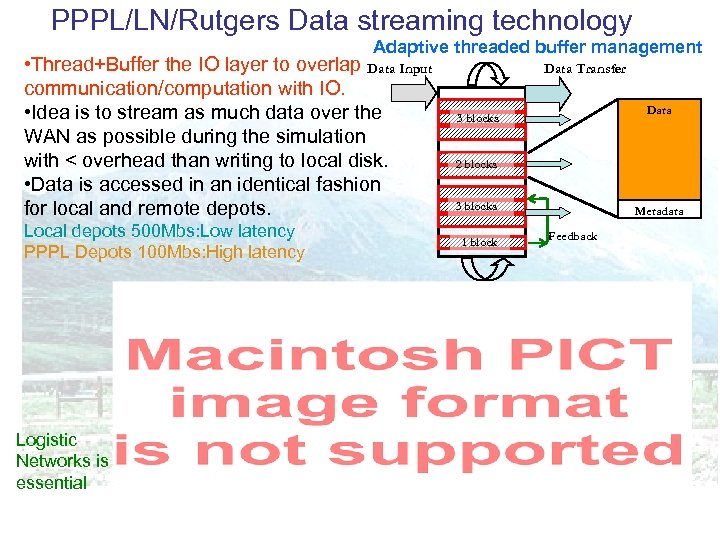 PPPL/LN/Rutgers Data streaming technology Adaptive threaded buffer management • Thread+Buffer the IO layer to overlap Data Input communication/computation with IO. • Idea is to stream as much data over the WAN as possible during the simulation with < overhead than writing to local disk. • Data is accessed in an identical fashion for local and remote depots. Local depots 500 Mbs: Low latency PPPL Depots 100 Mbs: High latency Logistic Networks is essential Data Transfer Data 3 blocks 2 blocks 3 blocks 1 block Metadata Feedback
 Network Adaptability Latency Aware Network Aware Self Adjusting Buffer.
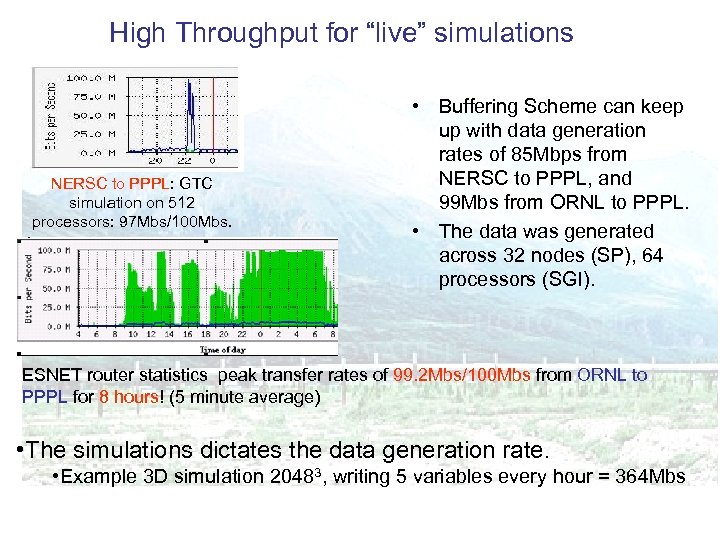 High Throughput for “live” simulations NERSC to PPPL: GTC simulation on 512 processors: 97 Mbs/100 Mbs. • Buffering Scheme can keep up with data generation rates of 85 Mbps from NERSC to PPPL, and 99 Mbs from ORNL to PPPL. • The data was generated across 32 nodes (SP), 64 processors (SGI). ESNET router statistics peak transfer rates of 99. 2 Mbs/100 Mbs from ORNL to PPPL for 8 hours! (5 minute average) • The simulations dictates the data generation rate. • Example 3 D simulation 20483, writing 5 variables every hour = 364 Mbs
 % overhead Low Overhead • Overhead is defined as – Difference between Time taken with I/O scheme and time taken with no I/O of resulting data from simulations during its lifetime. • Data generation – 1. 5 Mbs/node * 64 nodes = 96 Mbs (now) – 8 Mbs/node * 64 nodes = 520 Mbs (GTC future)
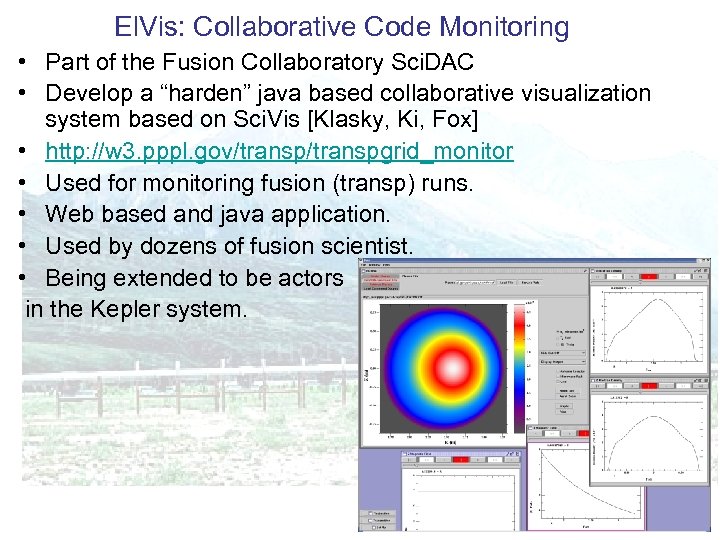 El. Vis: Collaborative Code Monitoring • Part of the Fusion Collaboratory Sci. DAC • Develop a “harden” java based collaborative visualization system based on Sci. Vis [Klasky, Ki, Fox] • http: //w 3. pppl. gov/transpgrid_monitor • Used for monitoring fusion (transp) runs. • Web based and java application. • Used by dozens of fusion scientist. • Being extended to be actors in the Kepler system.
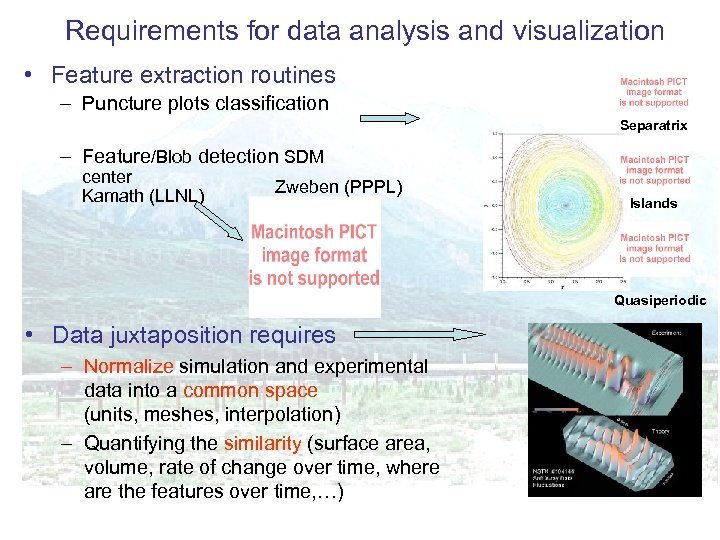 Requirements for data analysis and visualization • Feature extraction routines – Puncture plots classification Separatrix – Feature/Blob detection SDM center Kamath (LLNL) Zweben (PPPL) Islands Quasiperiodic • Data juxtaposition requires – Normalize simulation and experimental data into a common space (units, meshes, interpolation) – Quantifying the similarity (surface area, volume, rate of change over time, where are the features over time, …)
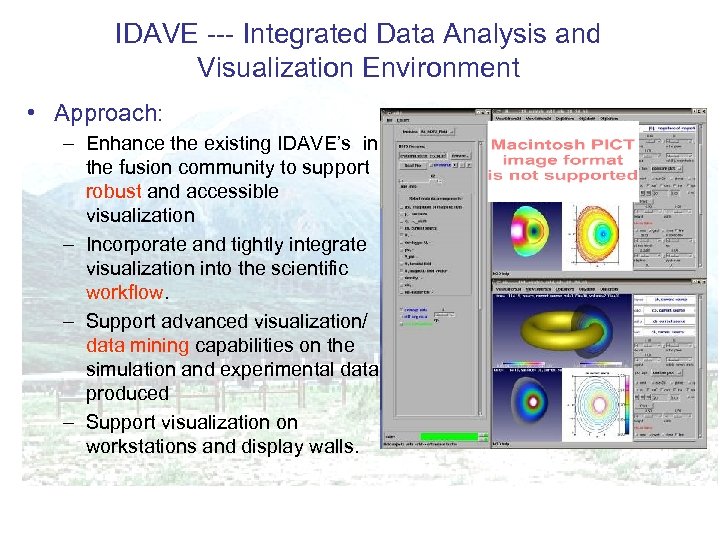 IDAVE --- Integrated Data Analysis and Visualization Environment • Approach: – Enhance the existing IDAVE’s in the fusion community to support robust and accessible visualization – Incorporate and tightly integrate visualization into the scientific workflow. – Support advanced visualization/ data mining capabilities on the simulation and experimental data produced – Support visualization on workstations and display walls.
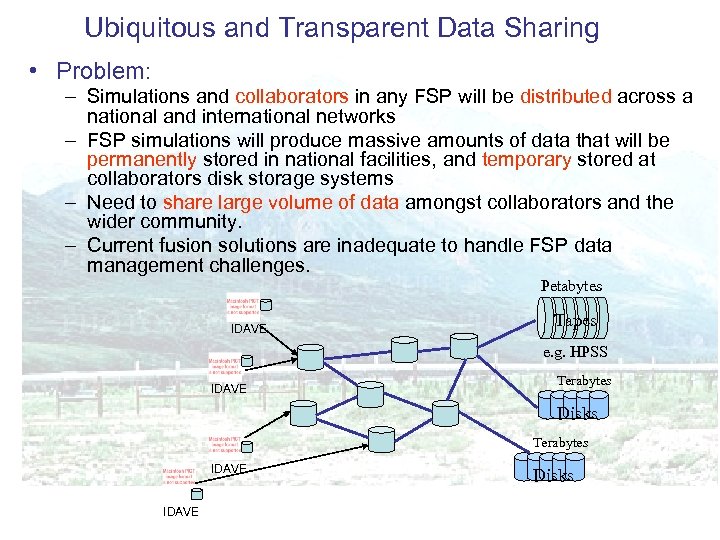 Ubiquitous and Transparent Data Sharing • Problem: – Simulations and collaborators in any FSP will be distributed across a national and international networks – FSP simulations will produce massive amounts of data that will be permanently stored in national facilities, and temporary stored at collaborators disk storage systems – Need to share large volume of data amongst collaborators and the wider community. – Current fusion solutions are inadequate to handle FSP data management challenges. Petabytes IDAVE Tapes e. g. HPSS IDAVE Terabytes Disks Terabytes IDAVE Disks
 Ubiquitous and Transparent Data Sharing • What technology is required – Metadata system • To map user concepts to datasets and files • e. g. find {ITER, shot_1174, Var=P(2 D), Time=0 -10} • e. g. Yields: /iter/shot 1174/mhd – Logical to physical data (files) mapping • e. g. lors: //www. pppl. gov/fsp/shot 1174. xml • Support for multiple replicas based on access patterns – Technology to manage temporary space • Lifetime, garbage collection – Technology for fast access • Parallel streams, large transfer windows, data streaming – Robustness • If mass store unavailable, replicas can be used • Technology to recover from transient failure
 Ubiquitous and Transparent Data Sharing • Approach – Need logistical versions of standard libraries and tools (Net. CDF, HDF 5) for moving and accessing data across the network – Speed of transfer and control of placement are vital to performance and fault tolerance – Data staging, scheduling and tracking based on common SDM tools and policies – Global namespace and placement policies to enable community collaboration around distributed postprocessing, visualization tasks • Use: – Logistical Networking: distributed depot system, maps logical to physical, parallel access, file staging – Storage Resource Management (SRM): Disk & Tape Mgmt Systems, manage space, lifetime, garbage collection, – No dependence on a single system: SRM is a middleware standard for multiple storage systems
 Summary • The scientific investigation process in the FSP will be limited without a strong data management -visualization approach highlighted in the 2004 DOE Data Management report. • Many DOE projects would benefit from End-to. End solutions. • Need to couple DOE/NSF computer science research with hardened solutions for applications. • 2004 Data Management Workshop: need $32 M/year of new funding!