 Скачать презентацию NNC Comments on the DSWD Omnibus Guidelines on
9832fa45a734e4cf964c8a127288e258.ppt
- Количество слайдов: 28



NNC Comments on the DSWD Omnibus Guidelines on Supplementary Feeding Program Writeshop on the Finalization of the DSWD Guidelines on Supplementary Feeding • Cebu City • 4 -8 May 2015
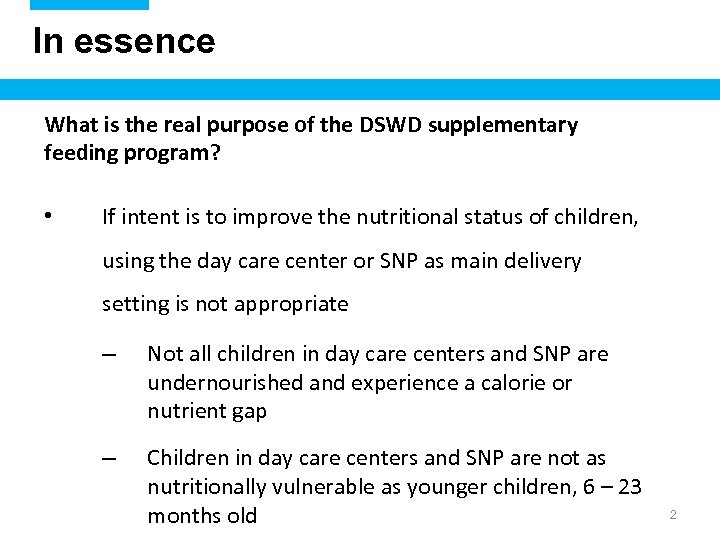
In essence What is the real purpose of the DSWD supplementary feeding program? • If intent is to improve the nutritional status of children, using the day care center or SNP as main delivery setting is not appropriate – Not all children in day care centers and SNP are undernourished and experience a calorie or nutrient gap – Children in day care centers and SNP are not as nutritionally vulnerable as younger children, 6 – 23 months old 2
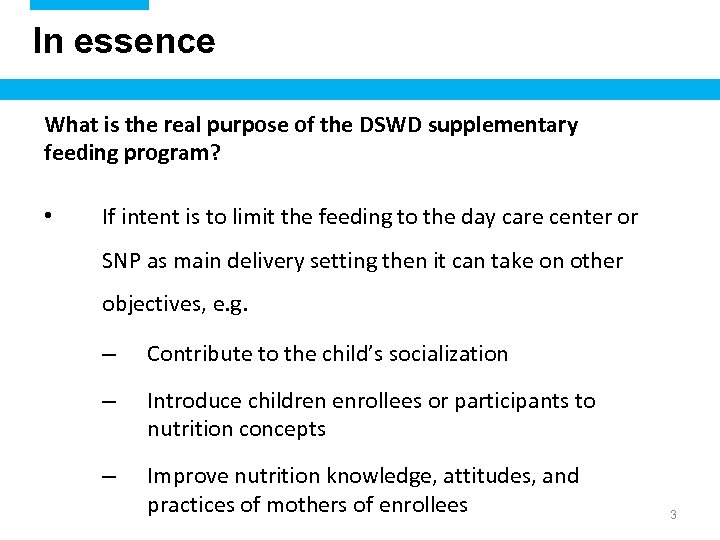
In essence What is the real purpose of the DSWD supplementary feeding program? • If intent is to limit the feeding to the day care center or SNP as main delivery setting then it can take on other objectives, e. g. – Contribute to the child’s socialization – Introduce children enrollees or participants to nutrition concepts – Improve nutrition knowledge, attitudes, and practices of mothers of enrollees 3
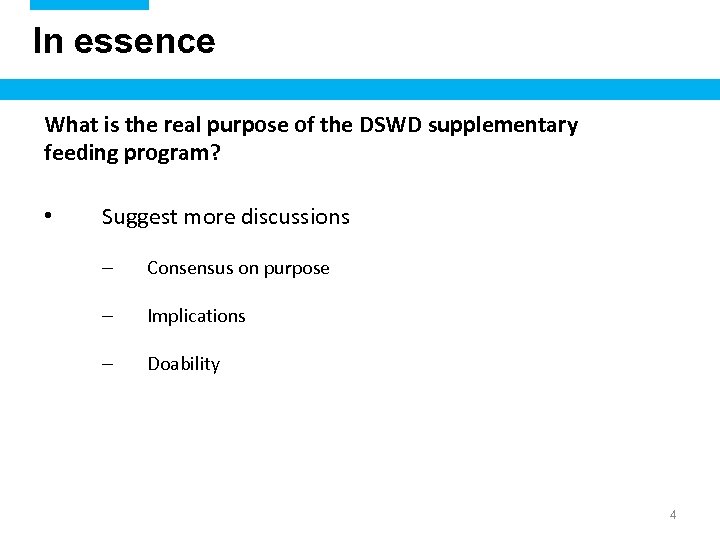
In essence What is the real purpose of the DSWD supplementary feeding program? • Suggest more discussions – Consensus on purpose – Implications – Doability 4

SPECIFIC COMMENTS 3/15/2018
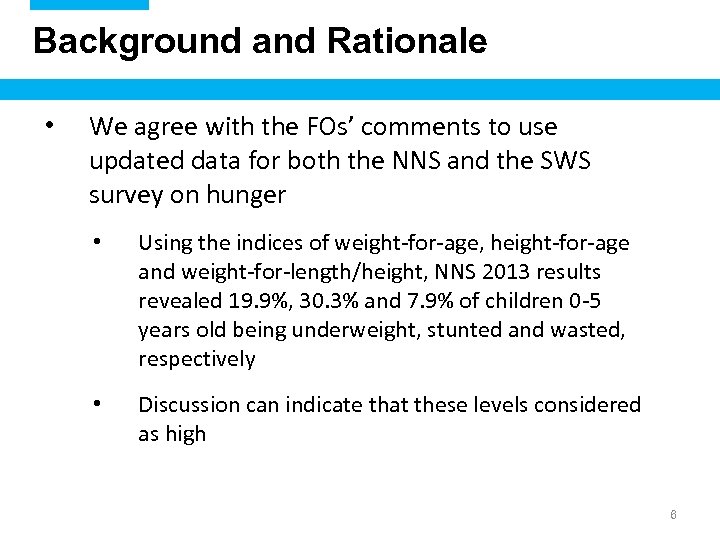
Background and Rationale • We agree with the FOs’ comments to use updated data for both the NNS and the SWS survey on hunger • Using the indices of weight-for-age, height-for-age and weight-for-length/height, NNS 2013 results revealed 19. 9%, 30. 3% and 7. 9% of children 0 -5 years old being underweight, stunted and wasted, respectively • Discussion can indicate that these levels considered as high 6
Background and Rationale • The rationale can also state the presence of gap in energy and nutrient intake of the targeted age group to strengthen the need to supplement. • Since NNS 2013 data on individual intake is not yet available, data of 2008 NNS can be used • SFP also serves as a “safety net” to food insecure households and has the ability to meet the gap (MLAV comment. Can be removed, because if we are talking about food insecure households, safety net should apply to hh) 7
Background and Rationale • If possible, include data on the nutritional status of children enrolled in day care centers to establish that a considerable percentage of enrolled children are underweight-for-age 8
Legal Bases • Agree with FO VI comments to include Early Years Act • Can include the Zero Hunger Challenge • (MLAV: Please verify if Zero Hunger Challenge can be put on level as the other international instruments; I think not) 9
Description • We agree with the FOs’ comment that the word “children” encompasses a wide age range, thus, better to indicate specific age group 10
Objective • Agree with comment of NCR FO that “objective” should indicate objective of the guidelines, e. g. To provide guidance for the provision of augmentation support for feeding program for children in LGU-managed DCC/SNP • The objectives of the supplementary feeding can be a section under implementation 11
Scope and Coverage • Need to specify the scope and coverage of the guidelines 12
Definition of Terms • Include definition of underweight-for-age, stunting and wasting, highlighting their differences 13
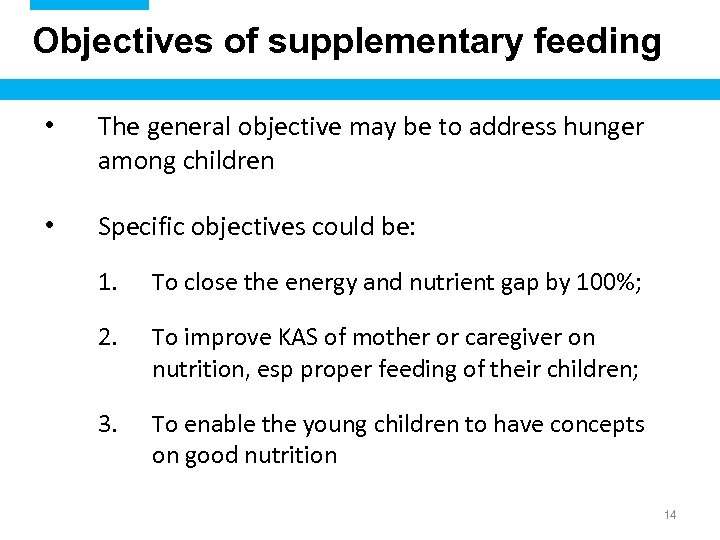
Objectives of supplementary feeding • The general objective may be to address hunger among children • Specific objectives could be: 1. To close the energy and nutrient gap by 100%; 2. To improve KAS of mother or caregiver on nutrition, esp proper feeding of their children; 3. To enable the young children to have concepts on good nutrition 14
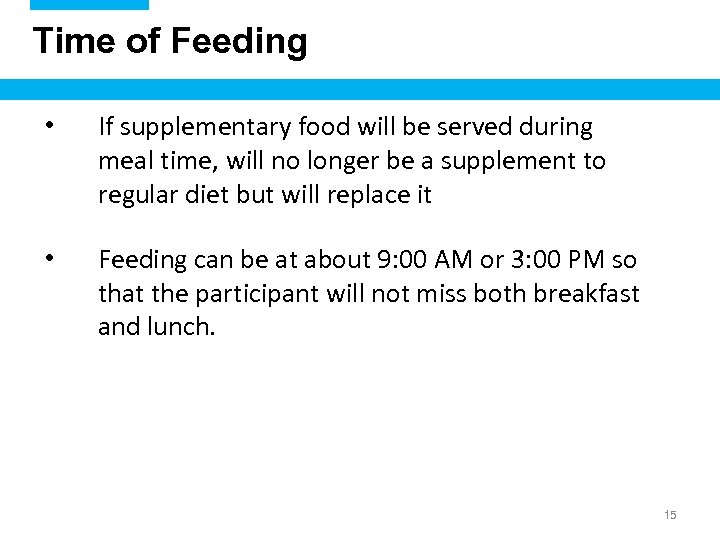
Time of Feeding • If supplementary food will be served during meal time, will no longer be a supplement to regular diet but will replace it • Feeding can be at about 9: 00 AM or 3: 00 PM so that the participant will not miss both breakfast and lunch. 15
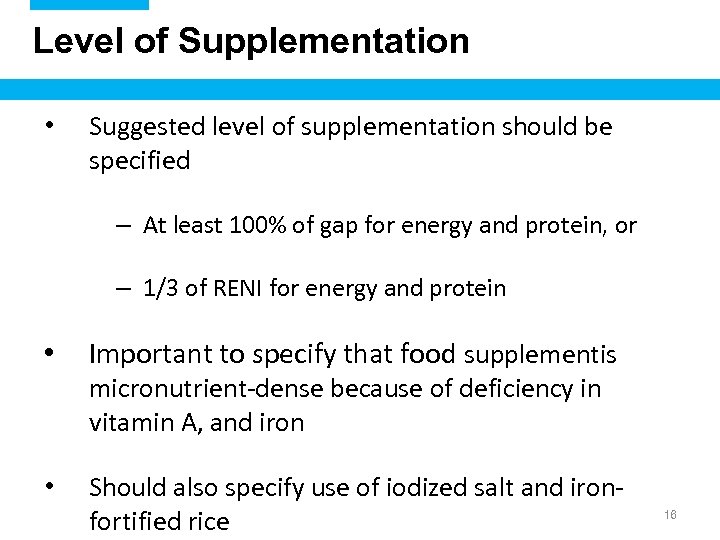
Level of Supplementation • Suggested level of supplementation should be specified – At least 100% of gap for energy and protein, or – 1/3 of RENI for energy and protein • Important to specify that food supplementis micronutrient-dense because of deficiency in vitamin A, and iron • Should also specify use of iodized salt and ironfortified rice 16
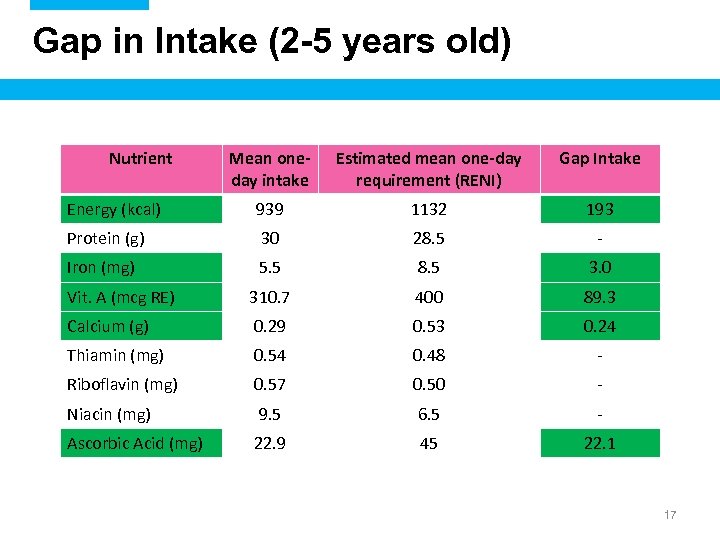
Gap in Intake (2 -5 years old) Nutrient Mean oneday intake Estimated mean one-day requirement (RENI) Gap Intake Energy (kcal) 939 1132 193 Protein (g) 30 28. 5 - Iron (mg) 5. 5 8. 5 3. 0 Vit. A (mcg RE) 310. 7 400 89. 3 Calcium (g) 0. 29 0. 53 0. 24 Thiamin (mg) 0. 54 0. 48 - Riboflavin (mg) 0. 57 0. 50 - Niacin (mg) 9. 5 6. 5 - Ascorbic Acid (mg) 22. 9 45 22. 1 17
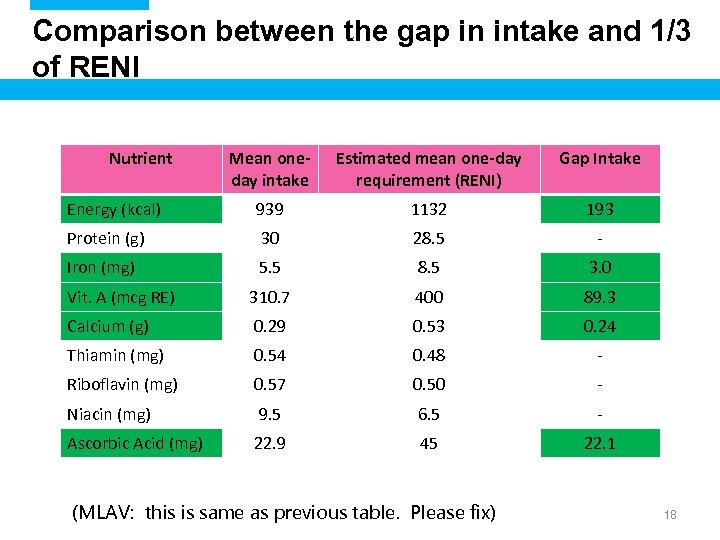
Comparison between the gap in intake and 1/3 of RENI Nutrient Mean oneday intake Estimated mean one-day requirement (RENI) Gap Intake Energy (kcal) 939 1132 193 Protein (g) 30 28. 5 - Iron (mg) 5. 5 8. 5 3. 0 Vit. A (mcg RE) 310. 7 400 89. 3 Calcium (g) 0. 29 0. 53 0. 24 Thiamin (mg) 0. 54 0. 48 - Riboflavin (mg) 0. 57 0. 50 - Niacin (mg) 9. 5 6. 5 - Ascorbic Acid (mg) 22. 9 45 22. 1 (MLAV: this is same as previous table. Please fix) 18
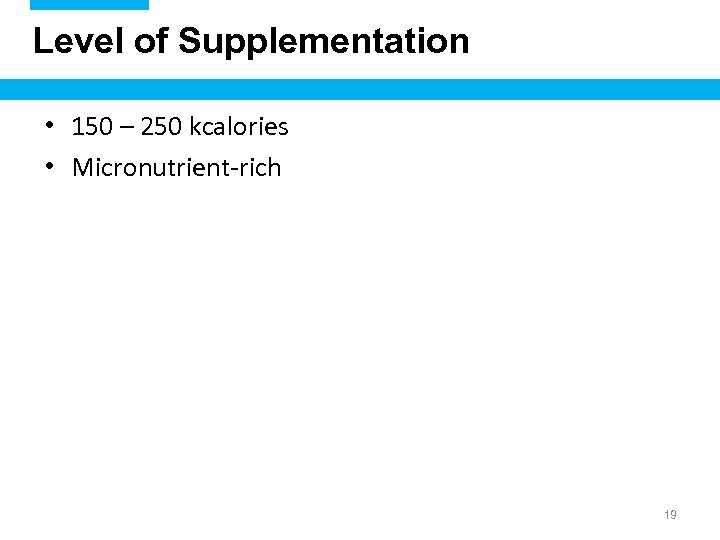
Level of Supplementation • 150 – 250 kcalories • Micronutrient-rich 19
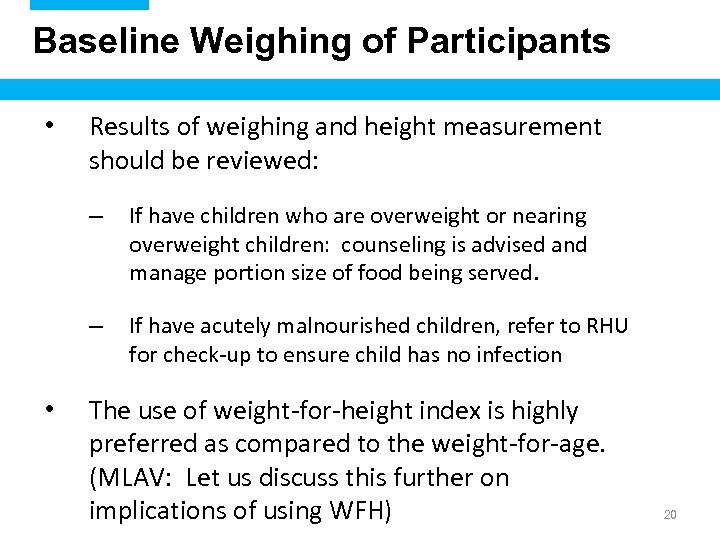
Baseline Weighing of Participants • Results of weighing and height measurement should be reviewed: – – • If have children who are overweight or nearing overweight children: counseling is advised and manage portion size of food being served. If have acutely malnourished children, refer to RHU for check-up to ensure child has no infection The use of weight-for-height index is highly preferred as compared to the weight-for-age. (MLAV: Let us discuss this further on implications of using WFH) 20
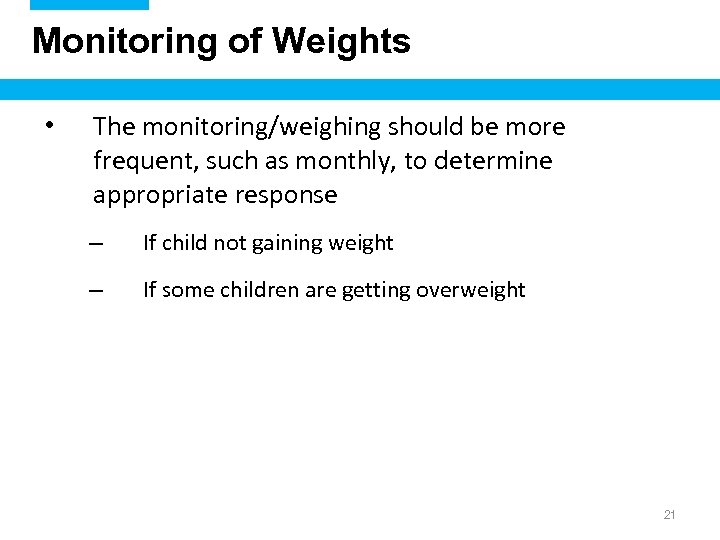
Monitoring of Weights • The monitoring/weighing should be more frequent, such as monthly, to determine appropriate response – If child not gaining weight – If some children are getting overweight 21
Implementing Procedures/ Scheme • Unless the program is available for all DCC, the identification of priority target areas may also be included, such as: 1. Areas with highest subsistence incidence; 2. Areas with highest poverty incidence; 3. Regions with the highest proportion of food insecure households or children 22
Implementing Procedures/ Scheme • SFP can contribute to the improvement of the current nutritional situation of the target beneficiary, but does not by itself represent a single solution to the primary health and nutritional problems. There is a need to complement with various interventions for a more effective and sustainable results. 23
Complementary Activities • The following complementary activities are suggested: • Growth Monitoring • Deworming • Immunization • Micronutrient supplementation • Nutrition education and diet counseling to parents • Water, Sanitation, and Hygiene 24
Sustainability • Social components such as gardening (DCC could have gardens too and children can be taught on how to care for plants), as well as livelihood and income-generating activities, may be added to the supplementary feeding program for sustainability. • These activities may help overcome food insecurity when economic factors such as lack of money to buy food is the fundamental cause for the inadequacy in food intake. 25
Some Clarifications • How often do the day care worker accomplish the daily intake form? • Who is in-charge of doing the orientation? • How is the orientation being done? 26
Documentation/ Reporting • The documentation may include several events that are worthy of recognition or any unusual and remarkable characteristics of the program during implementation such as: 1. Program accomplishments 2. Good practices or lessons learned 3. Issues encountered and actions taken 4. Recommendations for policy or program adjustment 27

Thank You Kingsoft Office Make Presentation much more fun
Скачать презентацию NNC Comments on the DSWD Omnibus Guidelines on
9832fa45a734e4cf964c8a127288e258.ppt