 Скачать презентацию NMP ST 8 Dependable Multiprocessor DM Dr John
43d868d29e77ca31206a8ff94a83b1c4.ppt
- Количество слайдов: 18



NMP ST 8 Dependable Multiprocessor (DM) Dr. John R. Samson, Jr. Honeywell Defense & Space Systems 13350 U. S. Highway 19 North Clearwater, Florida 33764 (727) 539 - 2449 john. r. samson@honeywell. com High Performance Embedded Computing Workshop (HPEC) 18 – 20 September 2007
Outline • Introduction - Dependable Multiprocessor * technology - overview - hardware architecture - software architecture • Current Status & Future Plans • TRL 6 Technology Validation • TRL 7 Flight Experiment • Summary & Conclusion * formerly known as the Environmentally-Adaptive Fault-Tolerant Computer (EAFTC); The Dependable Multiprocessor effort is funded under NASA NMP ST 8 contract NMO-710209. This presentation has not been published elsewhere, and is hereby offered for exclusive publication except that Honeywell reserves the right to reproduce the material in whole or in part for its own use and where Honeywell is so obligated by contract, for whatever use is required thereunder. 2
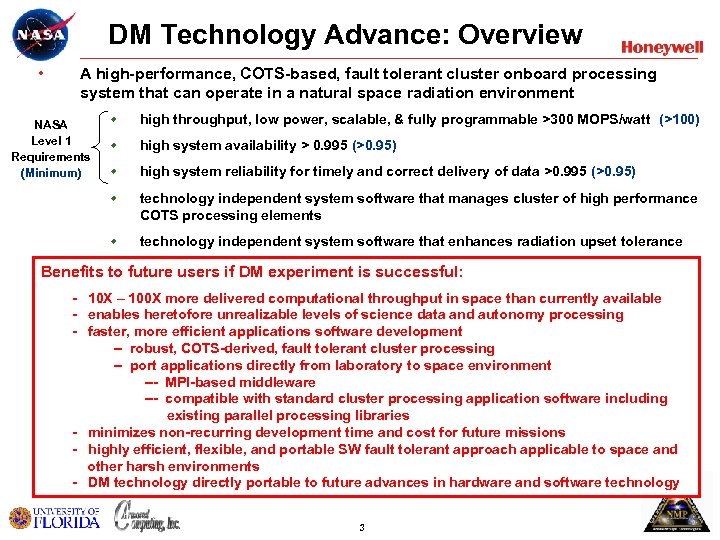
DM Technology Advance: Overview • A high-performance, COTS-based, fault tolerant cluster onboard processing system that can operate in a natural space radiation environment w high throughput, low power, scalable, & fully programmable >300 MOPS/watt (>100) w high system availability > 0. 995 (>0. 95) w high system reliability for timely and correct delivery of data >0. 995 (>0. 95) w technology independent system software that manages cluster of high performance COTS processing elements w NASA Level 1 Requirements (Minimum) technology independent system software that enhances radiation upset tolerance Benefits to future users if DM experiment is successful: - 10 X – 100 X more delivered computational throughput in space than currently available - enables heretofore unrealizable levels of science data and autonomy processing - faster, more efficient applications software development -- robust, COTS-derived, fault tolerant cluster processing -- port applications directly from laboratory to space environment --- MPI-based middleware --- compatible with standard cluster processing application software including existing parallel processing libraries - minimizes non-recurring development time and cost for future missions - highly efficient, flexible, and portable SW fault tolerant approach applicable to space and other harsh environments - DM technology directly portable to future advances in hardware and software technology 3
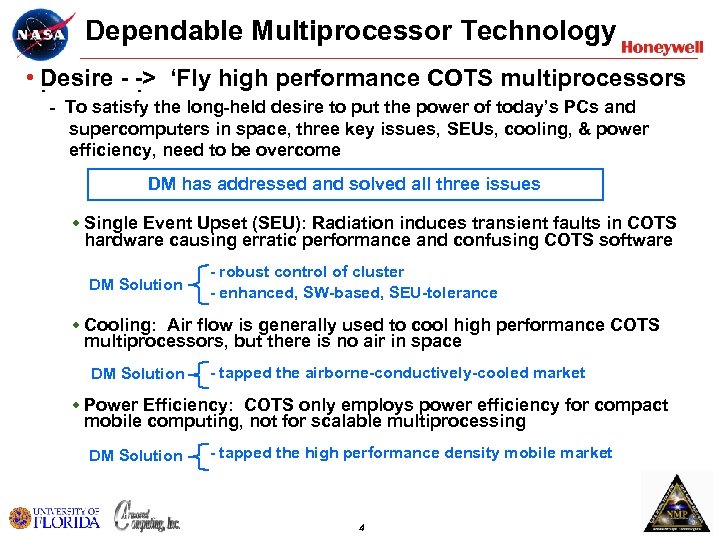
Dependable Multiprocessor Technology • Desire - -> ‘Fly high performance COTS multiprocessors in To satisfy the long-held desire to put the power of today’s PCs and - space’ supercomputers in space, three key issues, SEUs, cooling, & power efficiency, need to be overcome DM has addressed and solved all three issues w Single Event Upset (SEU): Radiation induces transient faults in COTS hardware causing erratic performance and confusing COTS software DM Solution - robust control of cluster - enhanced, SW-based, SEU-tolerance w Cooling: Air flow is generally used to cool high performance COTS multiprocessors, but there is no air in space DM Solution - tapped the airborne-conductively-cooled market w Power Efficiency: COTS only employs power efficiency for compact mobile computing, not for scalable multiprocessing DM Solution - tapped the high performance density mobile market 4
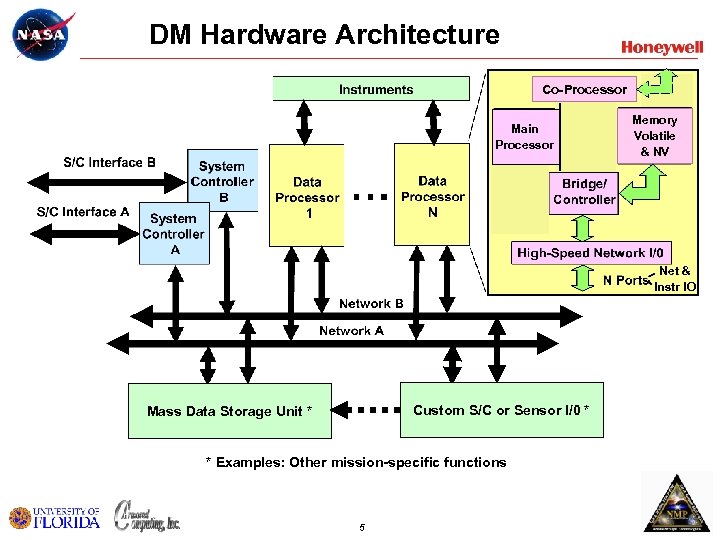
DM Hardware Architecture Co-Processor Main Processor Memory Volatile & NV Net & Instr IO Custom S/C or Sensor I/0 * Mass Data Storage Unit * * Examples: Other mission-specific functions 5
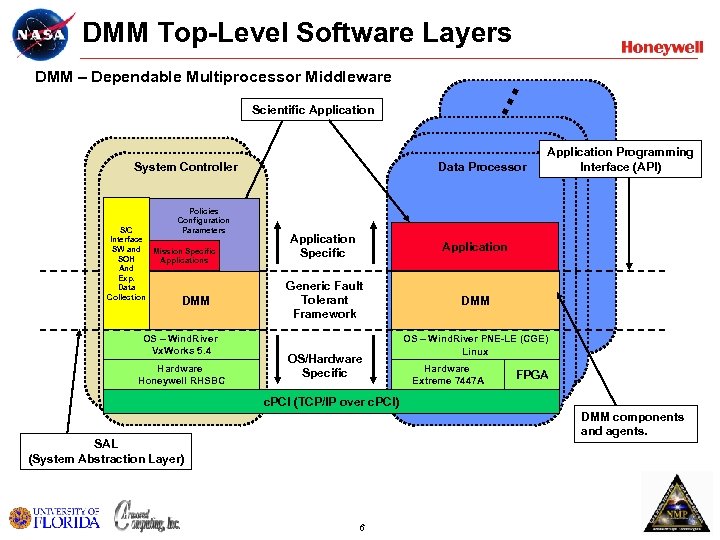
DMM Top-Level Software Layers Scientific Application System Controller Policies Configuration Parameters S/C Interface SW and Mission Specific SOH Applications And Exp. Data Collection DMM OS – Wind. River Vx. Works 5. 4 Hardware Honeywell RHSBC . . . DMM – Dependable Multiprocessor Middleware Data Processor Application Specific Application Generic Fault Tolerant Framework Application Programming Interface (API) DMM OS/Hardware Specific OS – Wind. River PNE-LE (CGE) Linux Hardware Extreme 7447 A FPGA c. PCI (TCP/IP over c. PCI) DMM components and agents. SAL (System Abstraction Layer) 6
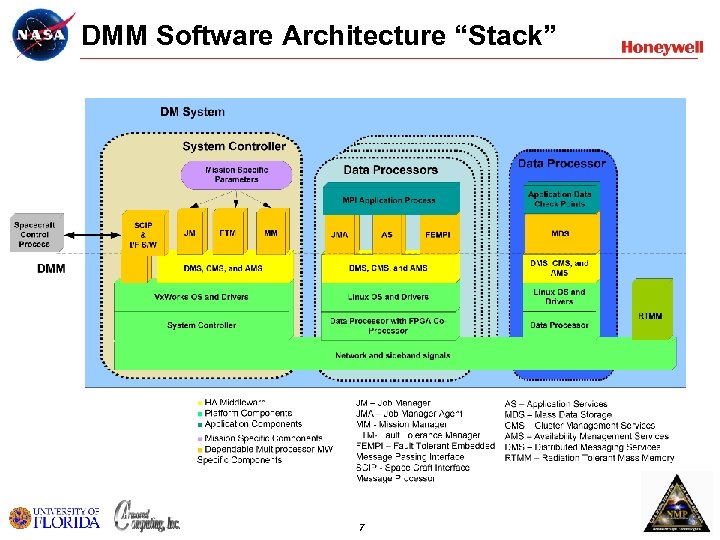
DMM Software Architecture “Stack” 7
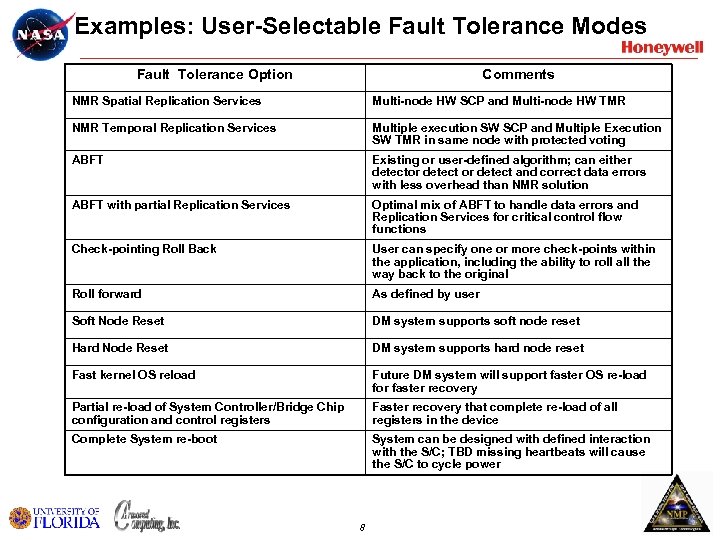
Examples: User-Selectable Fault Tolerance Modes Fault Tolerance Option Comments NMR Spatial Replication Services Multi-node HW SCP and Multi-node HW TMR NMR Temporal Replication Services Multiple execution SW SCP and Multiple Execution SW TMR in same node with protected voting ABFT Existing or user-defined algorithm; can either detector detect and correct data errors with less overhead than NMR solution ABFT with partial Replication Services Optimal mix of ABFT to handle data errors and Replication Services for critical control flow functions Check-pointing Roll Back User can specify one or more check-points within the application, including the ability to roll all the way back to the original Roll forward As defined by user Soft Node Reset DM system supports soft node reset Hard Node Reset DM system supports hard node reset Fast kernel OS reload Future DM system will support faster OS re-load for faster recovery Partial re-load of System Controller/Bridge Chip configuration and control registers Faster recovery that complete re-load of all registers in the device Complete System re-boot System can be designed with defined interaction with the S/C; TBD missing heartbeats will cause the S/C to cycle power 8
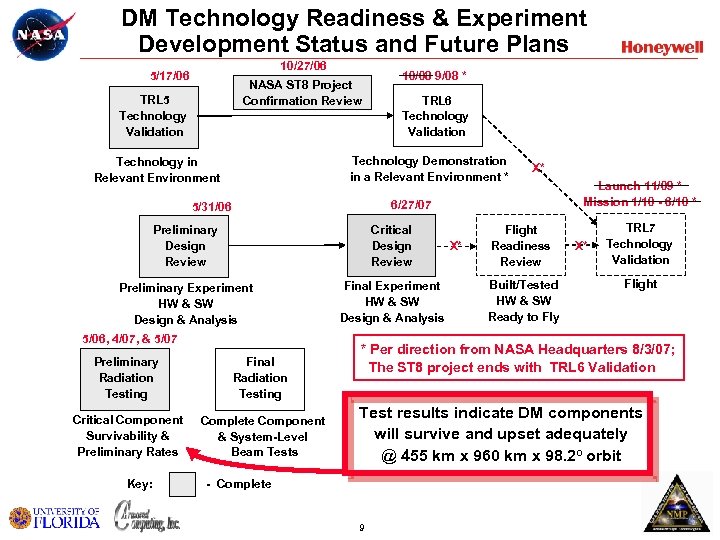
DM Technology Readiness & Experiment Development Status and Future Plans 10/27/06 5/17/06 NASA ST 8 Project Confirmation Review TRL 5 Technology Validation 10/08 9/08 * TRL 6 Technology Validation Technology Demonstration in a Relevant Environment * Technology in Relevant Environment 6/27/07 5/31/06 Preliminary Design Review Critical Design Review Preliminary Experiment HW & SW Design & Analysis Final Experiment HW & SW Design & Analysis 5/06, 4/07, & 5/07 Preliminary Radiation Testing Final Radiation Testing Critical Component Survivability & Preliminary Rates Complete Component & System-Level Beam Tests Key: X* X* Flight Readiness Review Built/Tested HW & SW Ready to Fly Launch 11/09 * Mission 1/10 - 6/10 * X* TRL 7 Technology Validation Flight * Per direction from NASA Headquarters 8/3/07; The ST 8 project ends with TRL 6 Validation Test results indicate DM components will survive and upset adequately @ 455 km x 960 km x 98. 2 o orbit - Complete 9
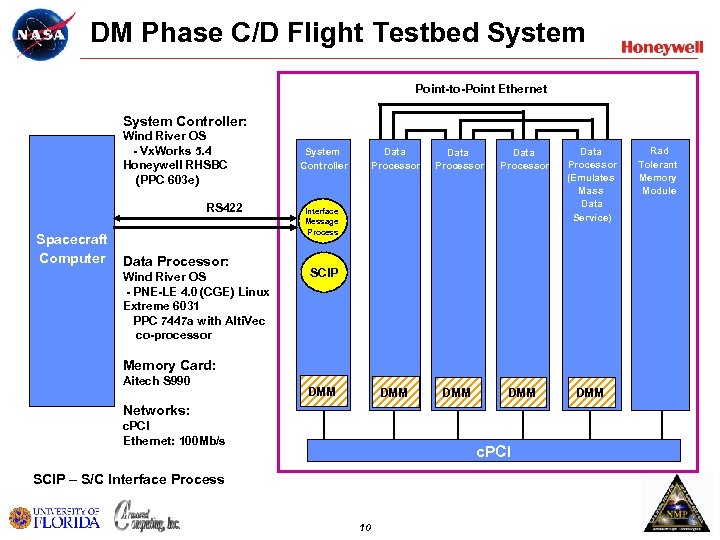
DM Phase C/D Flight Testbed System Point-to-Point Ethernet System Controller: Wind River OS - Vx. Works 5. 4 Honeywell RHSBC (PPC 603 e) RS 422 Spacecraft Computer Data Processor: Wind River OS - PNE-LE 4. 0 (CGE) Linux Extreme 6031 PPC 7447 a with Alti. Vec co-processor Data Processor (Emulates Mass Data Service) DMM System Controller DMM DMM Interface Message Process SCIP Memory Card: Aitech S 990 DMM Networks: c. PCI Ethernet: 100 Mb/s c. PCI SCIP – S/C Interface Process 10 Rad Tolerant Memory Module
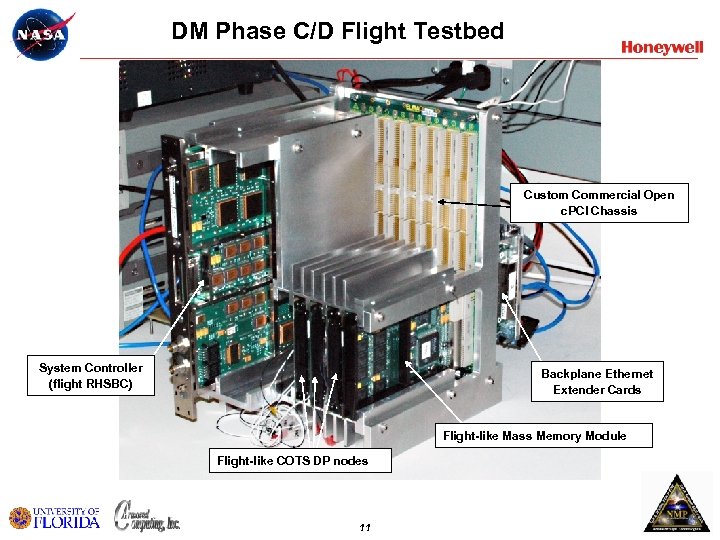
DM Phase C/D Flight Testbed Custom Commercial Open c. PCI Chassis System Controller (flight RHSBC) Backplane Ethernet Extender Cards Flight-like Mass Memory Module Flight-like COTS DP nodes 11
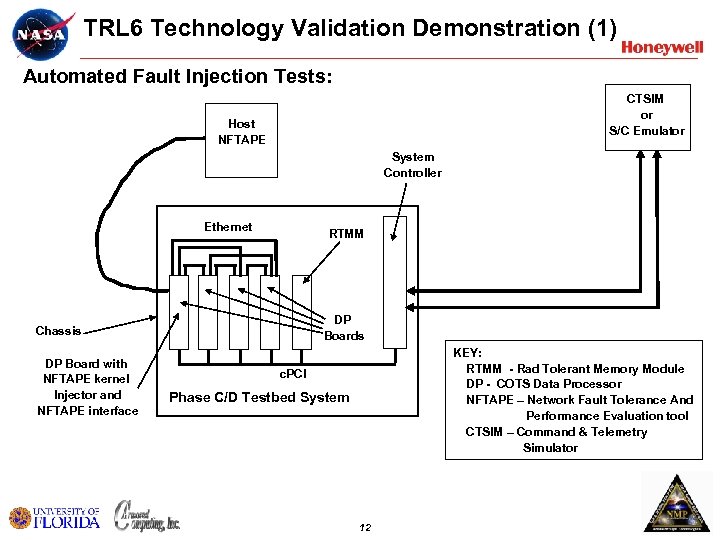
TRL 6 Technology Validation Demonstration (1) Automated Fault Injection Tests: CTSIM or S/C Emulator Host NFTAPE System Controller Ethernet RTMM DP Boards Chassis DP Board with NFTAPE kernel Injector and NFTAPE interface KEY: RTMM - Rad Tolerant Memory Module DP - COTS Data Processor NFTAPE – Network Fault Tolerance And Performance Evaluation tool CTSIM – Command & Telemetry Simulator c. PCI Phase C/D Testbed System 12
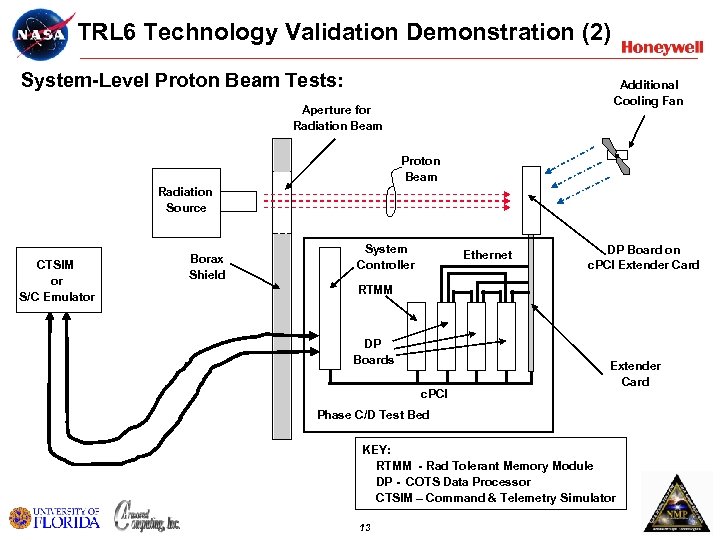
TRL 6 Technology Validation Demonstration (2) System-Level Proton Beam Tests: Additional Cooling Fan Aperture for Radiation Beam . Proton Beam Radiation Source CTSIM or S/C Emulator Borax Shield System Controller Ethernet DP Board on c. PCI Extender Card RTMM DP Boards c. PCI Extender Card Phase C/D Test Bed KEY: RTMM - Rad Tolerant Memory Module DP - COTS Data Processor CTSIM – Command & Telemetry Simulator 13
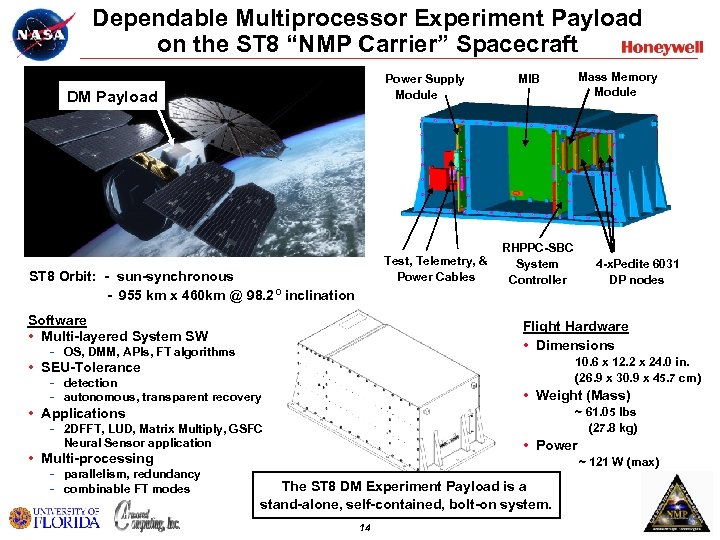
Dependable Multiprocessor Experiment Payload on the ST 8 “NMP Carrier” Spacecraft Power Supply Module DM Payload Test, Telemetry, & Power Cables ST 8 Orbit: - sun-synchronous - 955 km x 460 km @ 98. 2 o inclination Software • Multi-layered System SW RHPPC-SBC System Controller 4 -x. Pedite 6031 DP nodes Flight Hardware • Dimensions - OS, DMM, APIs, FT algorithms 10. 6 x 12. 2 x 24. 0 in. (26. 9 x 30. 9 x 45. 7 cm) • SEU-Tolerance - detection - autonomous, transparent recovery • Applications - 2 DFFT, LUD, Matrix Multiply, GSFC • Weight (Mass) ~ 61. 05 lbs (27. 8 kg) Neural Sensor application • Multi-processing - parallelism, redundancy - combinable FT modes Mass Memory Module MIB • Power ~ 121 W (max) The ST 8 DM Experiment Payload is a stand-alone, self-contained, bolt-on system. 14
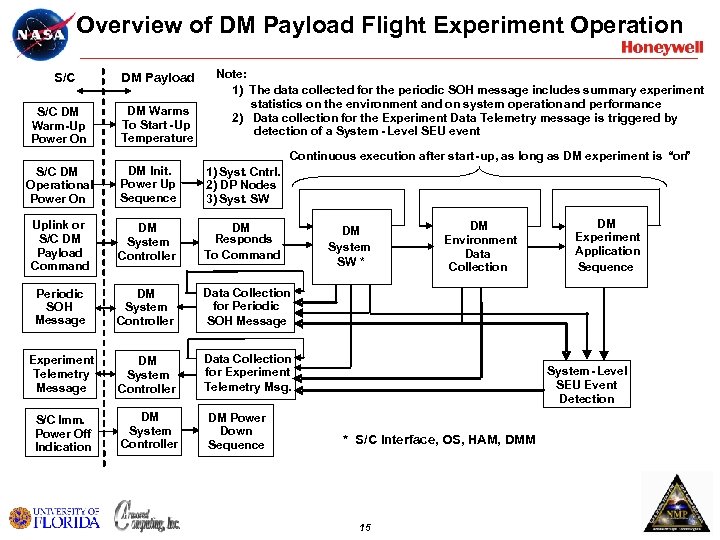
Overview of DM Payload Flight Experiment Operation S/C DM Warm-Up Power On DM Payload DM Warms To Start - Up Temperature Note: 1) The data collected for the periodic SOH message includes summary experiment statistics on the environment and on system operation and performance 2) Data collection for the Experiment Data Telemetry message is triggered by detection of a System - Level SEU event Continuous execution after start-up, as long as DM experiment is “on” S/C DM Operational Power On DM Init. Power Up Sequence 1) Syst. Cntrl. 2) DP Nodes 3) Syst. SW Uplink or S/C DM Payload Command DM System Controller DM Responds To Command Periodic SOH Message DM System Controller Data Collection for Periodic SOH Message Experiment Telemetry Message DM System Controller Data Collection for Experiment Telemetry Msg. S/C Imm. Power Off Indication DM System Controller DM Power Down Sequence DM System SW * DM Environment Data Collection DM Experiment Application Sequence System - Level SEU Event Detection * S/C Interface, OS, HAM, DMM 15
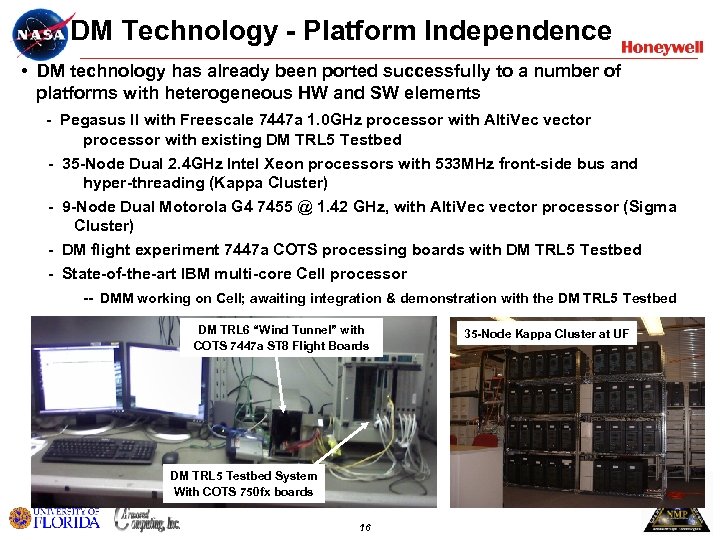
DM Technology - Platform Independence • DM technology has already been ported successfully to a number of platforms with heterogeneous HW and SW elements - Pegasus II with Freescale 7447 a 1. 0 GHz processor with Alti. Vec vector processor with existing DM TRL 5 Testbed - 35 -Node Dual 2. 4 GHz Intel Xeon processors with 533 MHz front-side bus and hyper-threading (Kappa Cluster) - 9 -Node Dual Motorola G 4 7455 @ 1. 42 GHz, with Alti. Vec vector processor (Sigma Cluster) - DM flight experiment 7447 a COTS processing boards with DM TRL 5 Testbed - State-of-the-art IBM multi-core Cell processor -- DMM working on Cell; awaiting integration & demonstration with the DM TRL 5 Testbed DM TRL 6 “Wind Tunnel” with COTS 7447 a ST 8 Flight Boards DM TRL 5 Testbed System With COTS 750 fx boards 16 35 -Node Kappa Cluster at UF
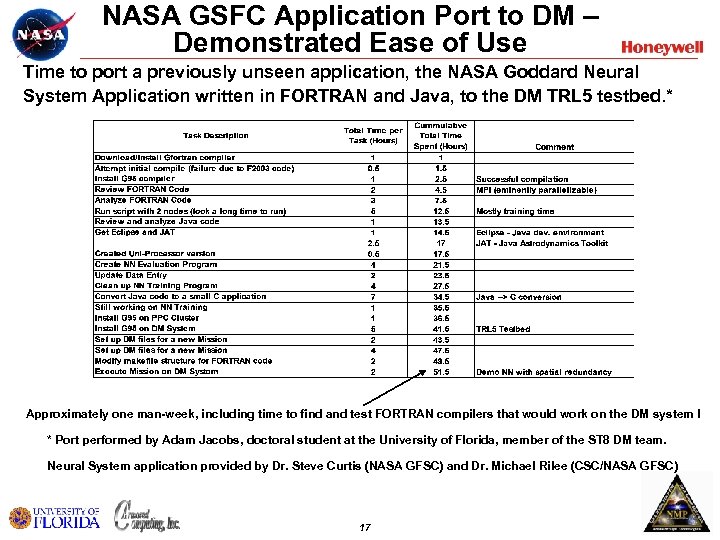
NASA GSFC Application Port to DM – Demonstrated Ease of Use Time to port a previously unseen application, the NASA Goddard Neural System Application written in FORTRAN and Java, to the DM TRL 5 testbed. * Approximately one man-week, including time to find and test FORTRAN compilers that would work on the DM system ! * Port performed by Adam Jacobs, doctoral student at the University of Florida, member of the ST 8 DM team. Neural System application provided by Dr. Steve Curtis (NASA GFSC) and Dr. Michael Rilee (CSC/NASA GFSC) 17
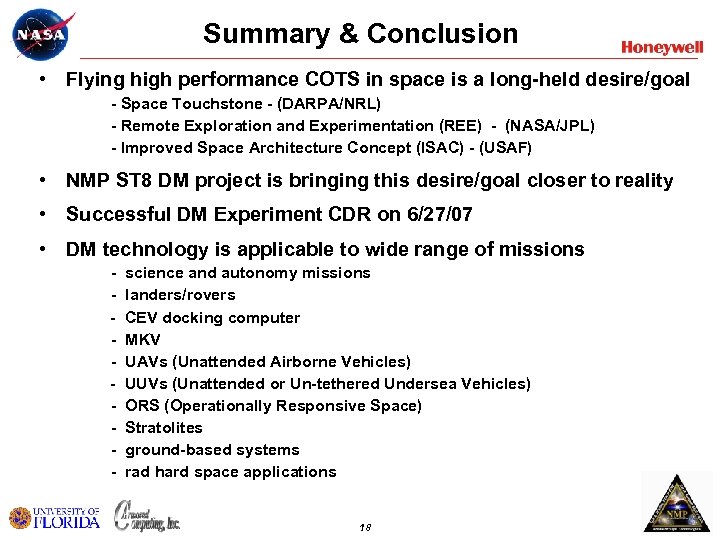
Summary & Conclusion • Flying high performance COTS in space is a long-held desire/goal - Space Touchstone - (DARPA/NRL) - Remote Exploration and Experimentation (REE) - (NASA/JPL) - Improved Space Architecture Concept (ISAC) - (USAF) • NMP ST 8 DM project is bringing this desire/goal closer to reality • Successful DM Experiment CDR on 6/27/07 • DM technology is applicable to wide range of missions - science and autonomy missions landers/rovers CEV docking computer MKV UAVs (Unattended Airborne Vehicles) UUVs (Unattended or Un-tethered Undersea Vehicles) ORS (Operationally Responsive Space) Stratolites ground-based systems rad hard space applications 18
Скачать презентацию NMP ST 8 Dependable Multiprocessor DM Dr John
43d868d29e77ca31206a8ff94a83b1c4.ppt