


 Скачать презентацию NLCTA and ESA Next Linear Collider Test Accelerator
67619e874fcec086f90c7a9c6b822c2b.ppt
- Количество слайдов: 20
 NLCTA and ESA (Next Linear Collider Test Accelerator and End Station A) Carsten Hast Test Facilities Department Head SLAC DOE HEP Review July 7 – 9, 2008 SLAC DOE HEP Review July 7 - 9, 2008
 ARD Test Facilities Department * After this winter’s financial turmoil and reorganization ARD founded a new Test Facilities Department – Helps to develop and test near-term solutions for accelerator systems including RF structures and power sources as well as beam optical, diagnostic and collimation systems. – Operates and supports the large test facilities at SLAC • • • NLCTA in ESB L-Band X-Band RF test facilities in ESB End Station A FACET (2009) Hardware and personnel contributions to ATF/ATF 2 program at KEK Support for LCLS hard- and software development * Personnel (2008) – Five engineering physicists, two technicians SLAC DOE HEP Review July 7 - 9, 2008 2
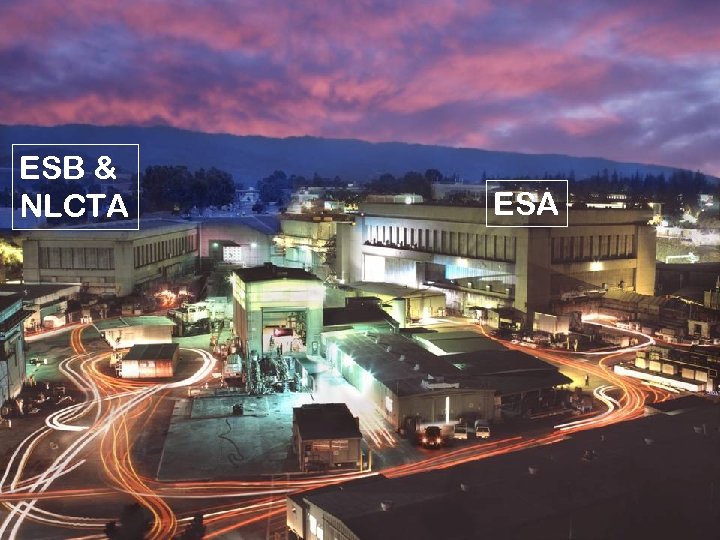 ESB & NLCTA ESA
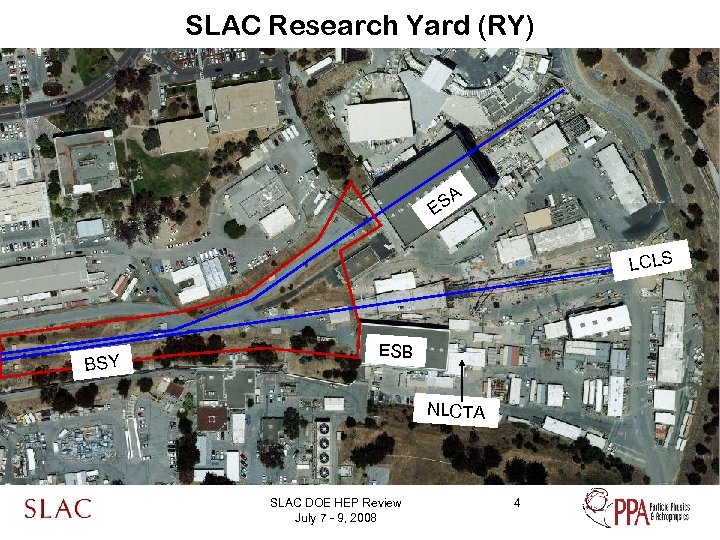 SLAC Research Yard (RY) SA E LCLS BSY ESB NLCTA SLAC DOE HEP Review July 7 - 9, 2008 4
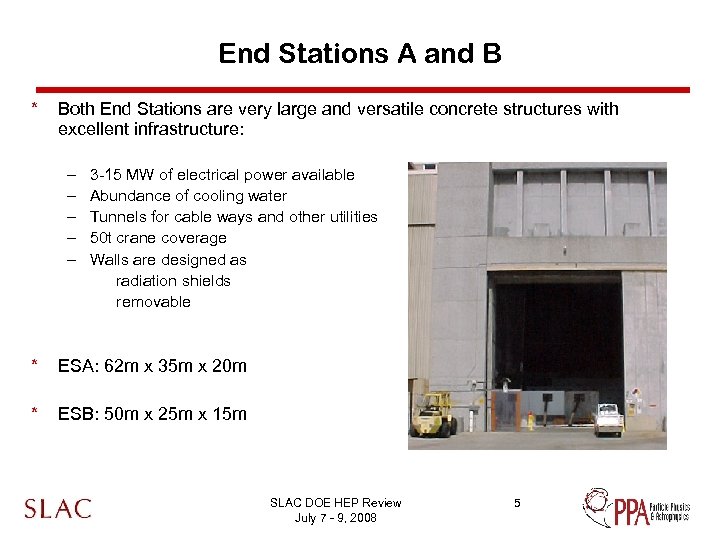 End Stations A and B * Both End Stations are very large and versatile concrete structures with excellent infrastructure: – – – 3 -15 MW of electrical power available Abundance of cooling water Tunnels for cable ways and other utilities 50 t crane coverage Walls are designed as radiation shields removable * ESA: 62 m x 35 m x 20 m * ESB: 50 m x 25 m x 15 m SLAC DOE HEP Review July 7 - 9, 2008 5
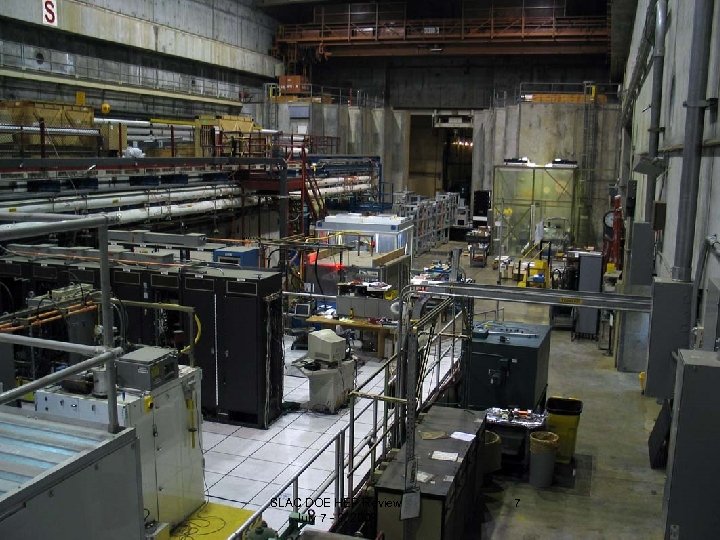
 End Station B (ESB) * NLCTA Next Linear Collider Test Accelerator – small X-Band test accelerator (11 m) – achieved peak energy of 350 Me. V – Shielding designed for 1. 2 Ge. V * E-163 Laser Acceleration – Using 60 Me. V NLCTA beam into the experimental hall – Class 4 laser room * L-Band SNS modulator for RF tests of couplers, RF distribution systems outside of beam enclosure and cavities inside of NLCTA * 4 X-Band RF structures for equipment testing – 3 with 300 MW power – 1 with 150 MW power * Building new L-Band test stand with Marx-modulator and klystron for life testing of both (operational this fall) SLAC DOE HEP Review July 7 - 9, 2008 6
 SLAC DOE HEP Review July 7 - 9, 2008 7
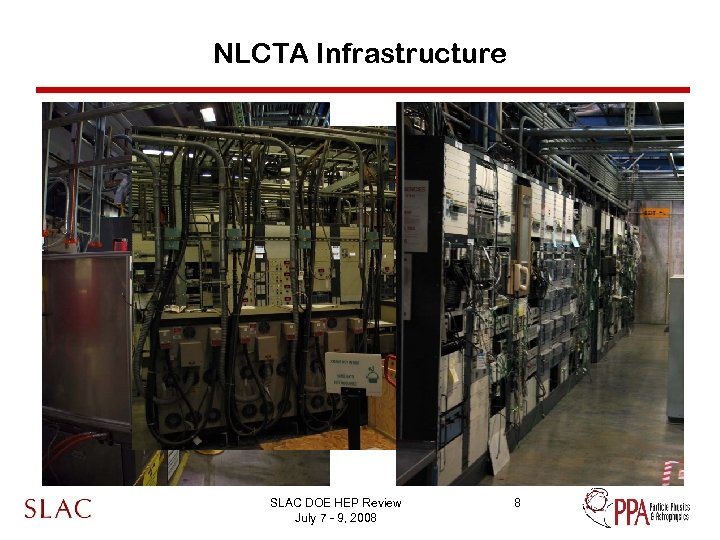 NLCTA Infrastructure SLAC DOE HEP Review July 7 - 9, 2008 8
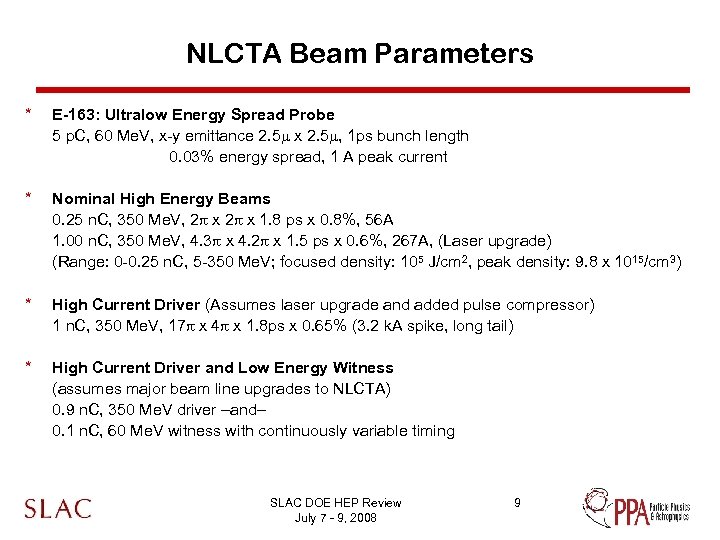 NLCTA Beam Parameters * E-163: Ultralow Energy Spread Probe 5 p. C, 60 Me. V, x-y emittance 2. 5 m x 2. 5 m, 1 ps bunch length 0. 03% energy spread, 1 A peak current * Nominal High Energy Beams 0. 25 n. C, 350 Me. V, 2 p x 1. 8 ps x 0. 8%, 56 A 1. 00 n. C, 350 Me. V, 4. 3 p x 4. 2 p x 1. 5 ps x 0. 6%, 267 A, (Laser upgrade) (Range: 0 -0. 25 n. C, 5 -350 Me. V; focused density: 105 J/cm 2, peak density: 9. 8 x 10¹⁵/cm 3) * High Current Driver (Assumes laser upgrade and added pulse compressor) 1 n. C, 350 Me. V, 17 p x 4 p x 1. 8 ps x 0. 65% (3. 2 k. A spike, long tail) * High Current Driver and Low Energy Witness (assumes major beam line upgrades to NLCTA) 0. 9 n. C, 350 Me. V driver –and– 0. 1 n. C, 60 Me. V witness with continuously variable timing SLAC DOE HEP Review July 7 - 9, 2008 9
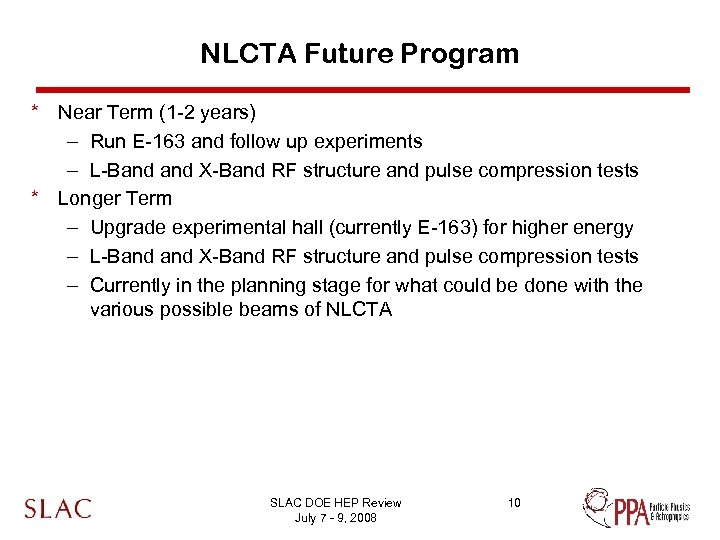 NLCTA Future Program * Near Term (1 -2 years) – Run E-163 and follow up experiments – L-Band X-Band RF structure and pulse compression tests * Longer Term – Upgrade experimental hall (currently E-163) for higher energy – L-Band X-Band RF structure and pulse compression tests – Currently in the planning stage for what could be done with the various possible beams of NLCTA SLAC DOE HEP Review July 7 - 9, 2008 10
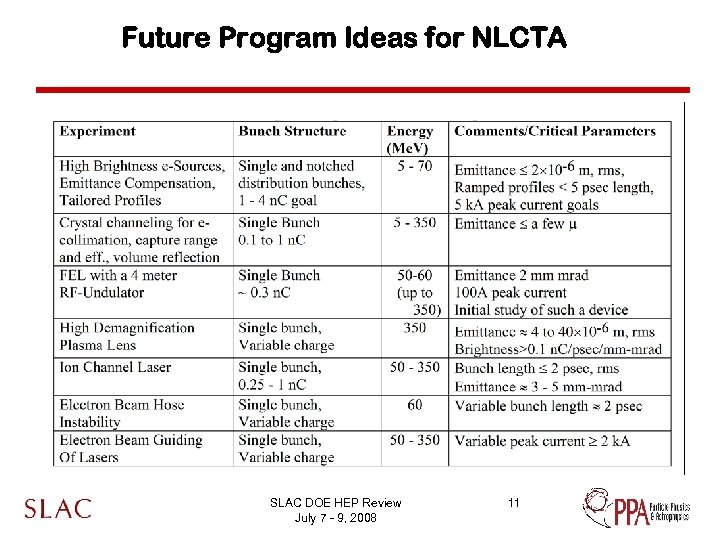 Future Program Ideas for NLCTA SLAC DOE HEP Review July 7 - 9, 2008 11
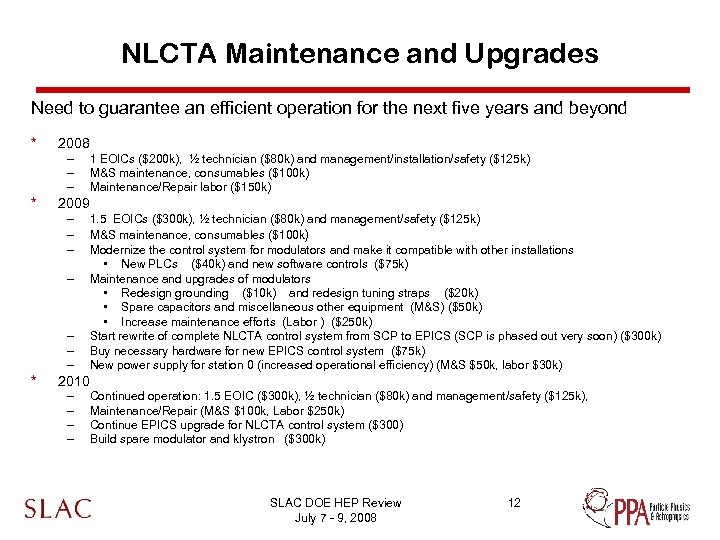 NLCTA Maintenance and Upgrades Need to guarantee an efficient operation for the next five years and beyond * 2008 – – – * 2009 – – – – * 1 EOICs ($200 k), ½ technician ($80 k) and management/installation/safety ($125 k) M&S maintenance, consumables ($100 k) Maintenance/Repair labor ($150 k) 1. 5 EOICs ($300 k), ½ technician ($80 k) and management/safety ($125 k) M&S maintenance, consumables ($100 k) Modernize the control system for modulators and make it compatible with other installations • New PLCs ($40 k) and new software controls ($75 k) Maintenance and upgrades of modulators • Redesign grounding ($10 k) and redesign tuning straps ($20 k) • Spare capacitors and miscellaneous other equipment (M&S) ($50 k) • Increase maintenance efforts (Labor ) ($250 k) Start rewrite of complete NLCTA control system from SCP to EPICS (SCP is phased out very soon) ($300 k) Buy necessary hardware for new EPICS control system ($75 k) New power supply for station 0 (increased operational efficiency) (M&S $50 k, labor $30 k) 2010 – – Continued operation: 1. 5 EOIC ($300 k), ½ technician ($80 k) and management/safety ($125 k), Maintenance/Repair (M&S $100 k, Labor $250 k) Continue EPICS upgrade for NLCTA control system ($300) Build spare modulator and klystron ($300 k) SLAC DOE HEP Review July 7 - 9, 2008 12
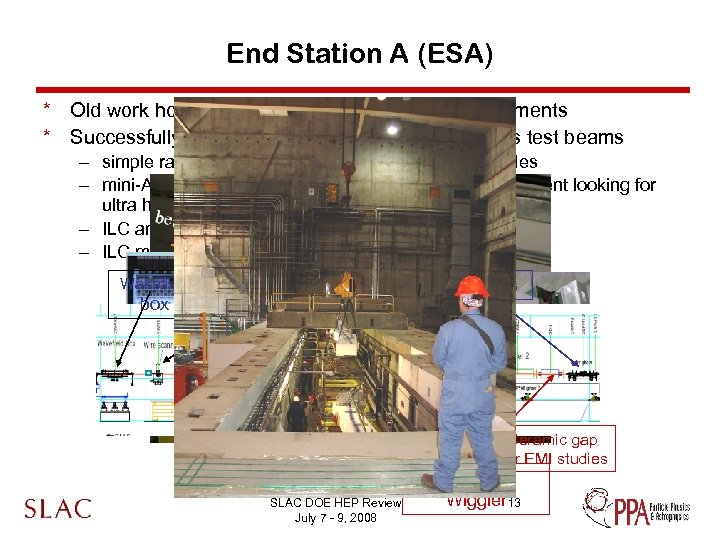 End Station A (ESA) * Old work horse for deep inelastic scattering experiments * Successfully used during the past years for various test beams – simple radiation experiments to verify simulation codes – mini-Antarctica for calibrating ANITA, a balloon experiment looking for ultra high energy (UHE) neutrinos – ILC and Super-B detector development – ILC machine detector interface Wakefield box Wire Scanners “IP BPMs” T-488 rf BPMs 18 feet T-487: long. bunch profile SLAC DOE HEP Review July 7 - 9, 2008 Ceramic gap for EMI studies Dipoles + Wiggler 13
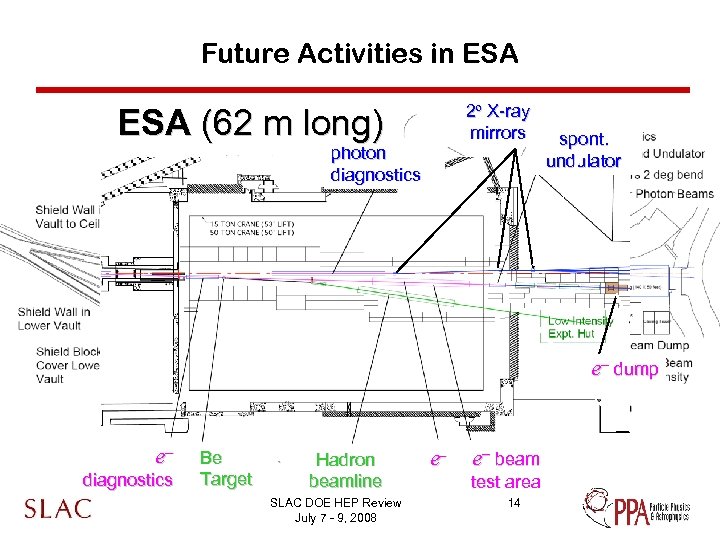 Future Activities in ESA 2º X-ray mirrors ESA (62 m long) photon diagnostics spont. undulator e- dump ediagnostics Be Target Hadron beamline SLAC DOE HEP Review July 7 - 9, 2008 e- e- beam test area 14
 ESA: LCLS-Undulator 2 and Test Beams * A ~10 Ge. V undulator solution fits as an x-ray source and provides the opportunity for HEP Test Beams * Test beam program will use primary and secondary beams much in the same fashion and for similar purposes as in the past years – Primary beam • Beam instrumentation and accelerator physics studies, e. g. ILC • Particle astrophysics detectors and techniques • Materials damage studies with thin and thick targets, with a range of bunch lengths • Radiation exposure and beam dump tests: Activation, residual dose rates and materials damage – Secondary beam (single electrons and hadrons) • Detector R&D for HEP detectors like Super-B, LHC-detector upgrade, ILCSi. D development SLAC DOE HEP Review July 7 - 9, 2008 15
 Phased approach to Future ESA Test Beams * LCLS-U 2 might start 2014 * Phase 1: 2009(? )-2012 – Modernize the ESA PPS system design and implementation would probably cost about $500 k, but needs additional study – Need upgraded kickers – Would seek agreement from SLAC management and BES for a defined fraction of LCLS beam pulses, e. g. , 1% of 120 Hz – Possibility of beam halo in the linac as a completely parasitic source for secondary beam * Phase 2: 2014 onwards? – 100% of spent beam will be available for test beams * Linac task force working towards recommendation for a coordinated development plan, with the aim that this will be adopted by SLAC management SLAC DOE HEP Review July 7 - 9, 2008 16
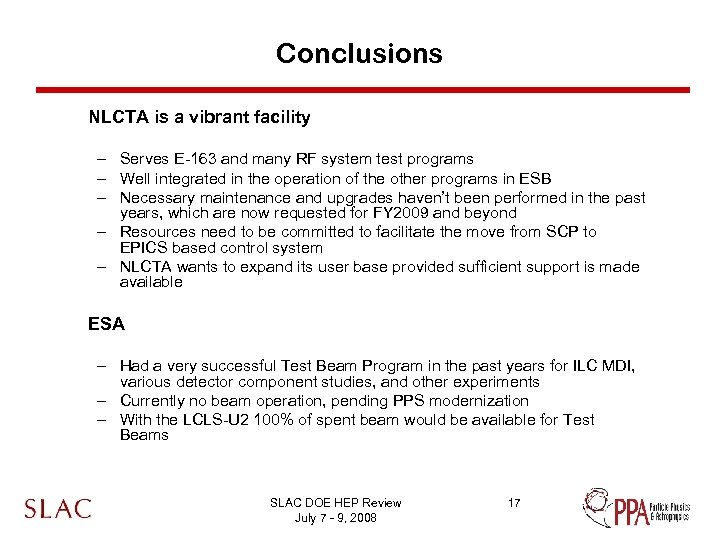 Conclusions NLCTA is a vibrant facility – Serves E-163 and many RF system test programs – Well integrated in the operation of the other programs in ESB – Necessary maintenance and upgrades haven’t been performed in the past years, which are now requested for FY 2009 and beyond – Resources need to be committed to facilitate the move from SCP to EPICS based control system – NLCTA wants to expand its user base provided sufficient support is made available ESA – Had a very successful Test Beam Program in the past years for ILC MDI, various detector component studies, and other experiments – Currently no beam operation, pending PPS modernization – With the LCLS-U 2 100% of spent beam would be available for Test Beams SLAC DOE HEP Review July 7 - 9, 2008 17
 ESA Additional
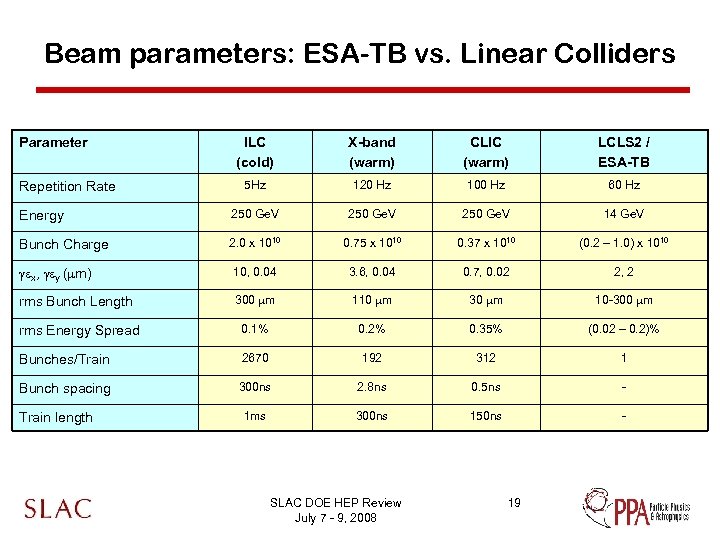 Beam parameters: ESA-TB vs. Linear Colliders Parameter ILC (cold) X-band (warm) CLIC (warm) LCLS 2 / ESA-TB 5 Hz 120 Hz 100 Hz 60 Hz Energy 250 Ge. V 14 Ge. V Bunch Charge 2. 0 x 1010 0. 75 x 1010 0. 37 x 1010 (0. 2 – 1. 0) x 1010 gex, gey (mm) 10, 0. 04 3. 6, 0. 04 0. 7, 0. 02 2, 2 rms Bunch Length 300 mm 110 mm 30 mm 10 -300 mm rms Energy Spread 0. 1% 0. 2% 0. 35% (0. 02 – 0. 2)% Bunches/Train 2670 192 312 1 Bunch spacing 300 ns 2. 8 ns 0. 5 ns - 1 ms 300 ns 150 ns - Repetition Rate Train length SLAC DOE HEP Review July 7 - 9, 2008 19
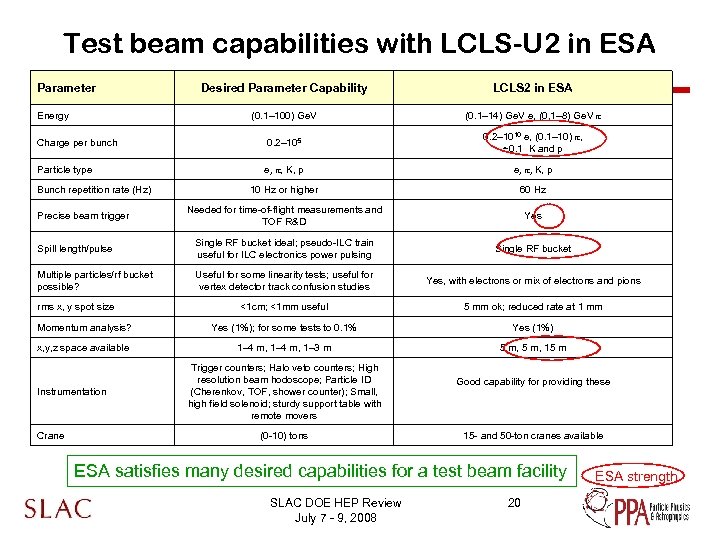 Test beam capabilities with LCLS-U 2 in ESA Parameter Desired Parameter Capability LCLS 2 in ESA (0. 1– 100) Ge. V (0. 1– 14) Ge. V e, (0. 1– 8) Ge. V p Charge per bunch 0. 2– 105 0. 2– 1010 e, (0. 1– 10) p, ~0. 1 K and p Particle type e, p, K, p 10 Hz or higher 60 Hz Needed for time-of-flight measurements and TOF R&D Yes Spill length/pulse Single RF bucket ideal; pseudo-ILC train useful for ILC electronics power pulsing Single RF bucket Multiple particles/rf bucket possible? Useful for some linearity tests; useful for vertex detector track confusion studies Yes, with electrons or mix of electrons and pions <1 cm; <1 mm useful 5 mm ok; reduced rate at 1 mm Momentum analysis? Yes (1%); for some tests to 0. 1% Yes (1%) x, y, z space available 1– 4 m, 1– 3 m 5 m, 15 m Energy Bunch repetition rate (Hz) Precise beam trigger rms x, y spot size Instrumentation Crane Trigger counters; Halo veto counters; High resolution beam hodoscope; Particle ID (Cherenkov, TOF, shower counter); Small, high field solenoid; sturdy support table with remote movers (0 -10) tons Good capability for providing these 15 - and 50 -ton cranes available ESA satisfies many desired capabilities for a test beam facility SLAC DOE HEP Review July 7 - 9, 2008 20 ESA strength