


 Скачать презентацию NLC — The Next Linear Collider Project The
ddec44374ed44dcd5c6f06cc26ab9551.ppt
- Количество слайдов: 27
 NLC - The Next Linear Collider Project The Photon Collider at NLC Jeff Gronberg/LLNL Fermilab Line Drive March 15, 2001 This work was performed under the auspices of the U. S. Department of Energy by the University of California, Lawrence Livermore National Laboratory under Contract No. W-7405 - Eng-48.
 NLC - The Next Linear Collider Project Outline • Review the basic principles behind photon production through Compton back-scattering. • Discuss the engineering required to actually realize a photon collider. – Lasers – Optics – Interaction Region design Basic components exist (laser, optics, IR design) Complete engineering design for Snowmass
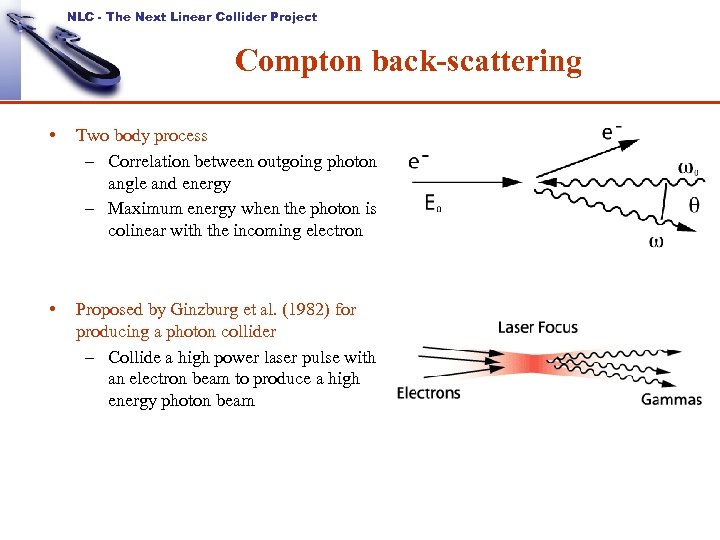 NLC - The Next Linear Collider Project Compton back-scattering • Two body process – Correlation between outgoing photon angle and energy – Maximum energy when the photon is colinear with the incoming electron • Proposed by Ginzburg et al. (1982) for producing a photon collider – Collide a high power laser pulse with an electron beam to produce a high energy photon beam
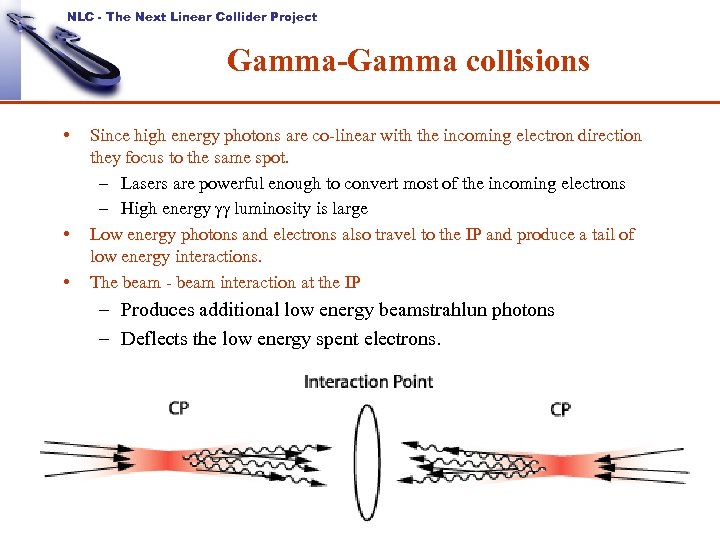 NLC - The Next Linear Collider Project Gamma-Gamma collisions • • • Since high energy photons are co-linear with the incoming electron direction they focus to the same spot. – Lasers are powerful enough to convert most of the incoming electrons – High energy gg luminosity is large Low energy photons and electrons also travel to the IP and produce a tail of low energy interactions. The beam - beam interaction at the IP – Produces additional low energy beamstrahlun photons – Deflects the low energy spent electrons.
 NLC - The Next Linear Collider Project Full Team in Place • • Lasers: – Jim Early – John Crane Optics • – Steve Boege – Lynn Seppala • – Scott Lerner • Mechanical Engineering – Ken Skulina • Knut Skarpas VIII • Leif Erikson • Accelerator Engineering – David Asner • Pantaleo Raimondi • Andrei Seryi • Tor Raubenheimer Physics – Jeff Gronberg – David Asner – Solomon Obolu – Shri Gopalakrishna • Tohru Takahashi • NWU - FNAL Project Management – Karl van Bibber – Jeff Gronberg
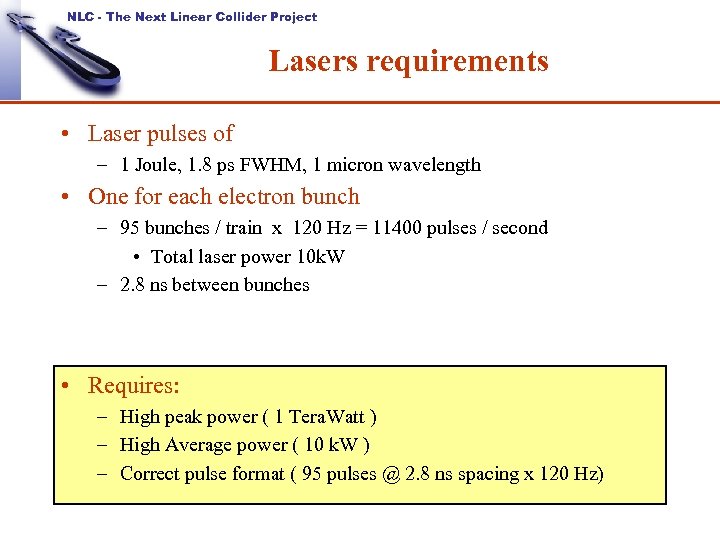 NLC - The Next Linear Collider Project Lasers requirements • Laser pulses of – 1 Joule, 1. 8 ps FWHM, 1 micron wavelength • One for each electron bunch – 95 bunches / train x 120 Hz = 11400 pulses / second • Total laser power 10 k. W – 2. 8 ns between bunches • Requires: – High peak power ( 1 Tera. Watt ) – High Average power ( 10 k. W ) – Correct pulse format ( 95 pulses @ 2. 8 ns spacing x 120 Hz)
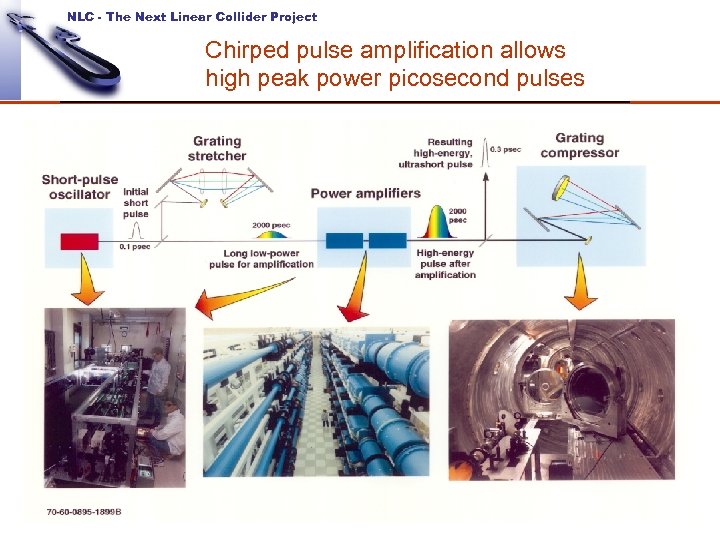 NLC - The Next Linear Collider Project Chirped pulse amplification allows high peak power picosecond pulses
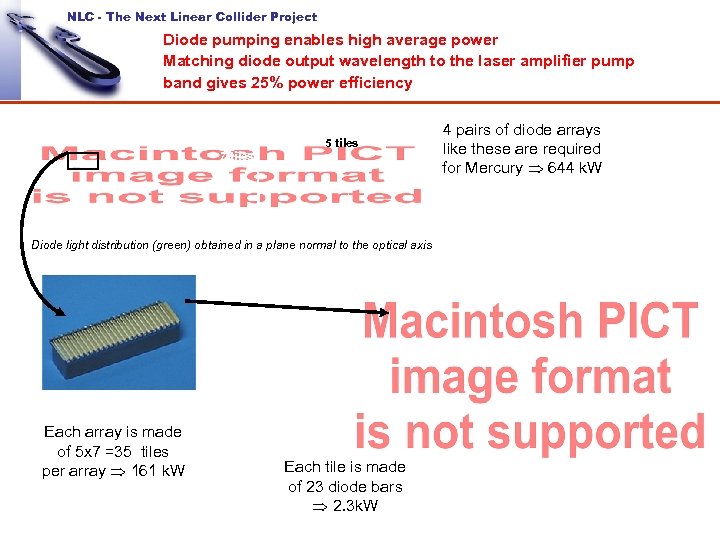 NLC - The Next Linear Collider Project Diode pumping enables high average power Matching diode output wavelength to the laser amplifier pump band gives 25% power efficiency 7 tiles 5 tiles Diode light distribution (green) obtained in a plane normal to the optical axis Each array is made of 5 x 7 =35 tiles per array 161 k. W Each tile is made of 23 diode bars 2. 3 k. W 4 pairs of diode arrays like these are required for Mercury 644 k. W
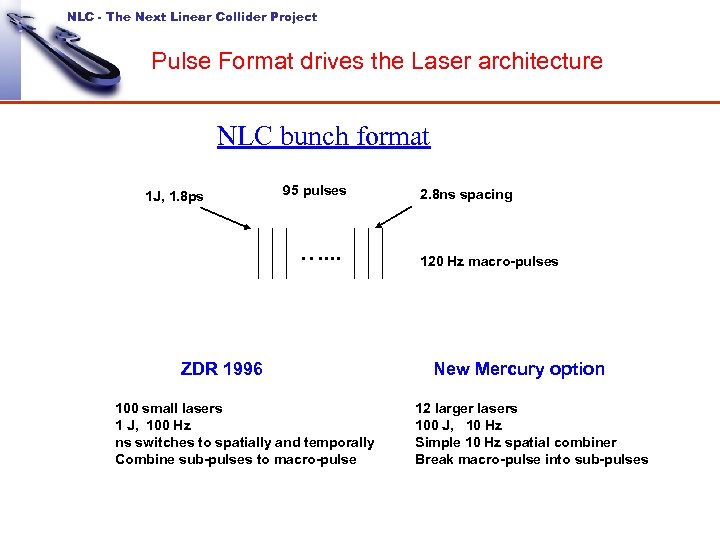 NLC - The Next Linear Collider Project Pulse Format drives the Laser architecture NLC bunch format 1 J, 1. 8 ps 95 pulses …. . . ZDR 1996 100 small lasers 1 J, 100 Hz ns switches to spatially and temporally Combine sub-pulses to macro-pulse 2. 8 ns spacing 120 Hz macro-pulses New Mercury option 12 larger lasers 100 J, 10 Hz Simple 10 Hz spatial combiner Break macro-pulse into sub-pulses
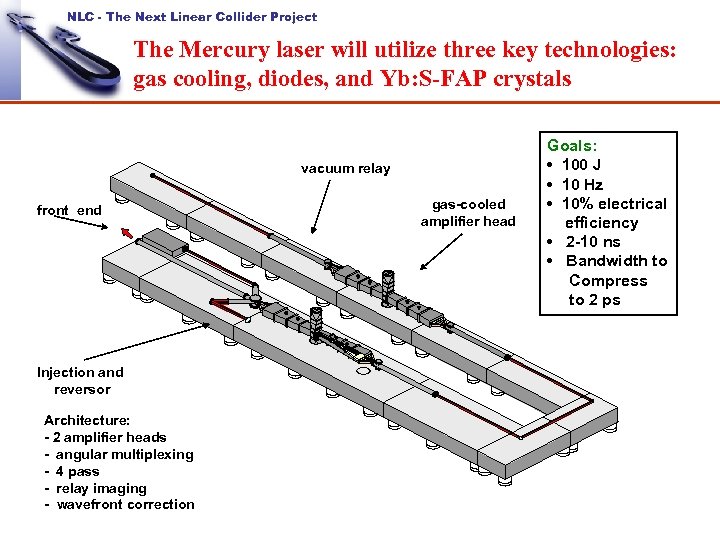 NLC - The Next Linear Collider Project The Mercury laser will utilize three key technologies: gas cooling, diodes, and Yb: S-FAP crystals vacuum relay front end Injection and reversor Architecture: - 2 amplifier heads - angular multiplexing - 4 pass - relay imaging - wavefront correction gas-cooled amplifier head Goals: • 100 J • 10 Hz • 10% electrical efficiency • 2 -10 ns • Bandwidth to Compress to 2 ps
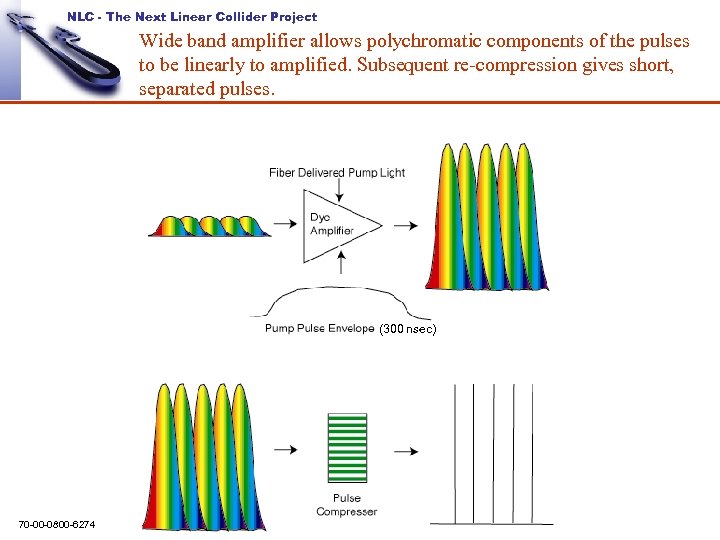 NLC - The Next Linear Collider Project Wide band amplifier allows polychromatic components of the pulses to be linearly to amplified. Subsequent re-compression gives short, separated pulses. (300 nsec) 70 -00 -0800 -6274
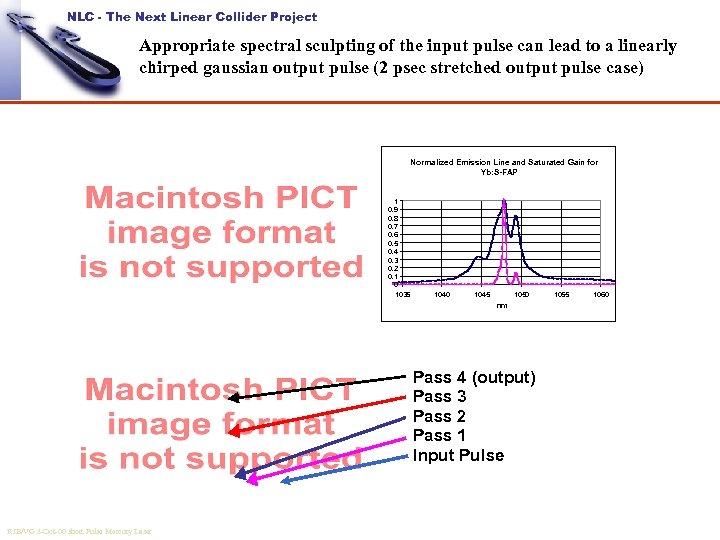 NLC - The Next Linear Collider Project Appropriate spectral sculpting of the input pulse can lead to a linearly chirped gaussian output pulse (2 psec stretched output pulse case) Normalized Emission Line and Saturated Gain for Yb: S-FAP 1 0. 9 0. 8 0. 7 0. 6 0. 5 0. 4 0. 3 0. 2 0. 1 0 1035 1040 1045 1050 nm Pass 4 (output) Pass 3 Pass 2 Pass 1 Input Pulse RJB/VG 3 -Oct-00 short Pulse Mercury Laser 1055 1060
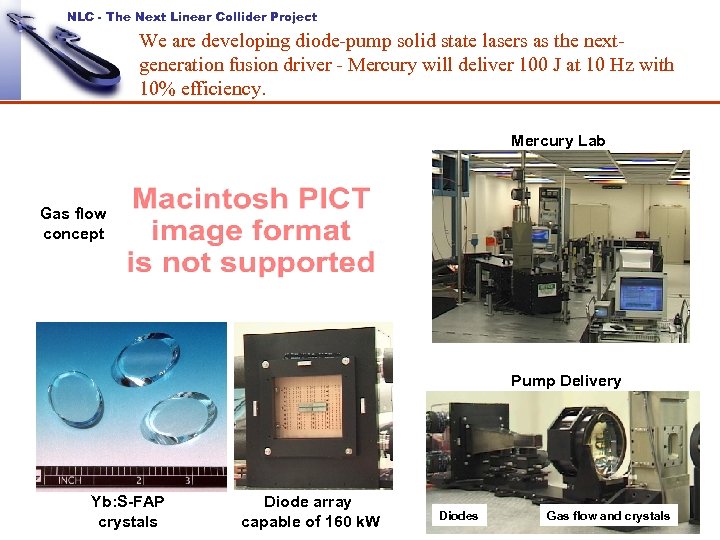 NLC - The Next Linear Collider Project We are developing diode-pump solid state lasers as the nextgeneration fusion driver - Mercury will deliver 100 J at 10 Hz with 10% efficiency. Mercury Lab Gas flow concept Pump Delivery Yb: S-FAP crystals Diode array capable of 160 k. W Diodes Gas flow and crystals
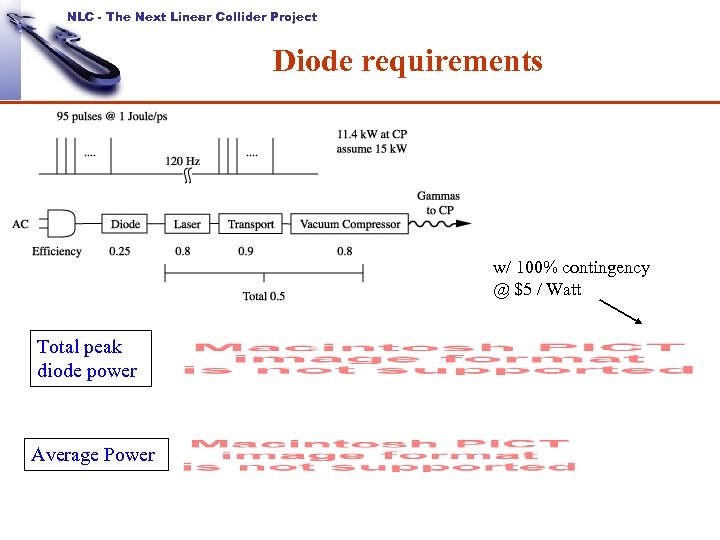 NLC - The Next Linear Collider Project Diode requirements w/ 100% contingency @ $5 / Watt Total peak diode power Average Power
 NLC - The Next Linear Collider Project Optics and IR • • Optics requirements – Keep accumulated wave-front aberrations small – Prevent damage to optics from high power pulses • All regimes; ps, 300 ns, continuous – Prevent accumulation of non-linear phase aberration • Vacuum transport lines • Reflective optics - transmissive optics only where necessary IR/Optics integration – Optics must be mounted in the IR – All hardware required to accomplish this must not: • Interfere with the accelerator • Degrade the performance of the detector • Generate backgrounds
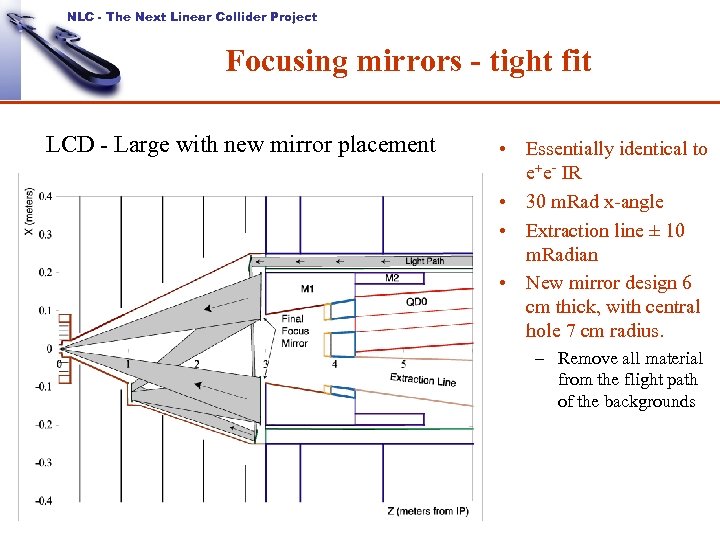 NLC - The Next Linear Collider Project Focusing mirrors - tight fit LCD - Large with new mirror placement • Essentially identical to e+e- IR • 30 m. Rad x-angle • Extraction line ± 10 m. Radian • New mirror design 6 cm thick, with central hole 7 cm radius. – Remove all material from the flight path of the backgrounds
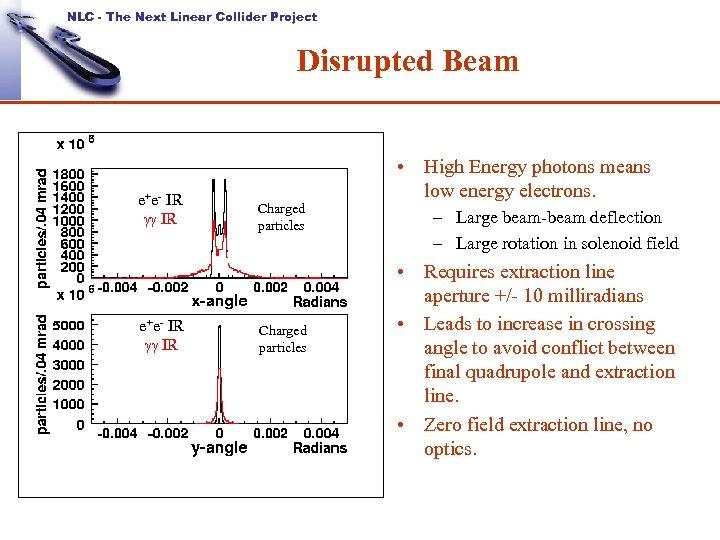 NLC - The Next Linear Collider Project Disrupted Beam e+e- IR gg IR Charged particles • High Energy photons means low energy electrons. – Large beam-beam deflection – Large rotation in solenoid field • Requires extraction line aperture +/- 10 milliradians • Leads to increase in crossing angle to avoid conflict between final quadrupole and extraction line. • Zero field extraction line, no optics.
 NLC - The Next Linear Collider Project IR Background changes from e+e • Increased disruption of beam, Larger extraction line – 10 milliradians extraction line • Crossing angle increased to 30 milliradians to avoid conflict with incoming quad. Should be reduced to minimum when final design of quad is known. – First two layers of SVX now have line of sight to the beam dump • Fluence of neutrons 1011 /cm 2/year • Need rad hard SVX • Higher rate of gg qq, minijets – Still to be evaluated
 NLC - The Next Linear Collider Project Tesla bunch structure t. B ns NB f Hz TESLA-500 337 2820 5 NLC-500 H 2. 8/1. 4 95/190 120 sz mm N 1010 300 2. 0 110 1. 5/0. 75 Tesla bunch structure is very different Major impact on Laser Architecture • 1 millisecond is the laser amplifier upper state lifetime – Tesla must produce 30 times as many pulses on that timescale • Since most laser power goes unused they are investigating – Multipass optical cavities – Ring lasers • No baseline design in TDR
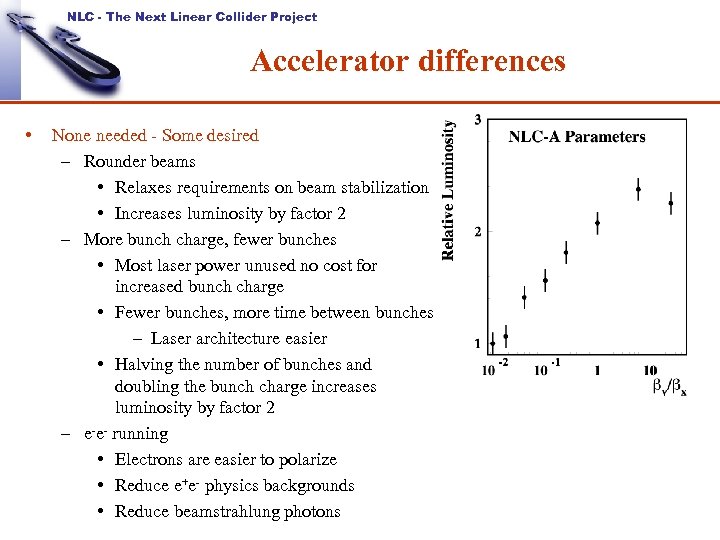 NLC - The Next Linear Collider Project Accelerator differences • None needed - Some desired – Rounder beams • Relaxes requirements on beam stabilization • Increases luminosity by factor 2 – More bunch charge, fewer bunches • Most laser power unused no cost for increased bunch charge • Fewer bunches, more time between bunches – Laser architecture easier • Halving the number of bunches and doubling the bunch charge increases luminosity by factor 2 – e-e- running • Electrons are easier to polarize • Reduce e+e- physics backgrounds • Reduce beamstrahlung photons
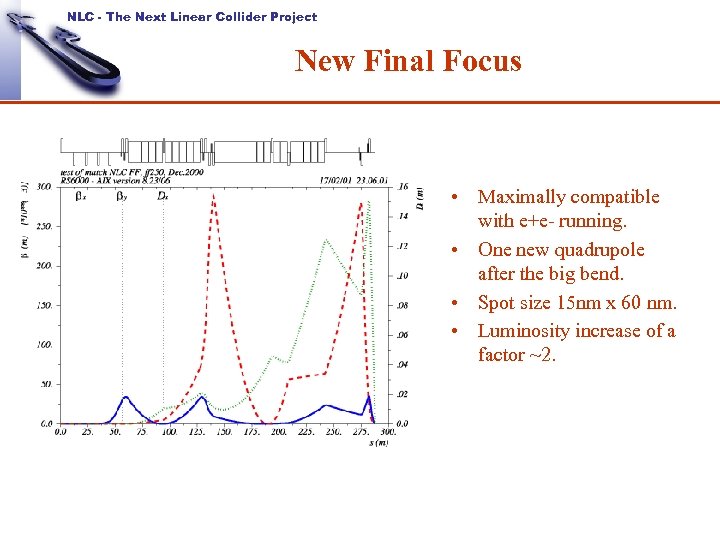 NLC - The Next Linear Collider Project New Final Focus • Maximally compatible with e+e- running. • One new quadrupole after the big bend. • Spot size 15 nm x 60 nm. • Luminosity increase of a factor ~2.
 NLC - The Next Linear Collider Project Increase bunch charge • Lasers prefer bunch spacing of 2. 8 ns – Current 190 bunch 1. 4 ns machine parameter sets are not optimal • Tor Raubenheimer provides optimized machine parameters for gg – 95 bunches, 2. 8 ns spacing – All other parameters as per NLC-A – Twice the bunch charge In the high energy peak the gg luminosity is now ~4 times higher than for the standard machine parameters
 NLC - The Next Linear Collider Project e-e- running • Easy (sort of) – Changeover requires rotating all quads in one arm of the linac • Order 1 month required – Polarized electron production needed in the positron injection complex with positron target bypass • The base e-e- luminosity is down a factor of 3 from the e+eluminosity. The beam attraction become repulsion. – Beam-beam interaction has no effect of high energy gg peak – Improved polarization increases luminosity in the high energy gg peak – Most ee backgrounds reduced by a factor 3
 NLC - The Next Linear Collider Project Machine Optimization • Basic design of photon collider exists. • Detailed choices about machine configuration must be driven by physics analyses. – How important is electron polarization? – Must the low energy tail be suppressed? – Is it important to do Higgs runs on peak or can we take advantage of higher luminosity in the tail while running at max energy for SUSY / new physics searchs.
 NLC - The Next Linear Collider Project Ongoing Physics efforts • For new machine parameters and round beams – ~1000 Higgs / year • Evaluating Higgs @ – 120, 140, 160 Ge. V/c mass – bb, WW, ZZ modes • UC Davis students evaluating – gg chargino pairs – eg Lightest SUSY partner • Groundswell of interest in gg • NWU and FNAL physicists have organized an international workshop on gamma-gamma interactions @ FNAL, March 14 -17. – http: //diablo. phys. nwu. edu/ggws/ • gg parallel session @ JHU LC meeting next week – http: //hep. pha. jhu. edu/~morris/lcw
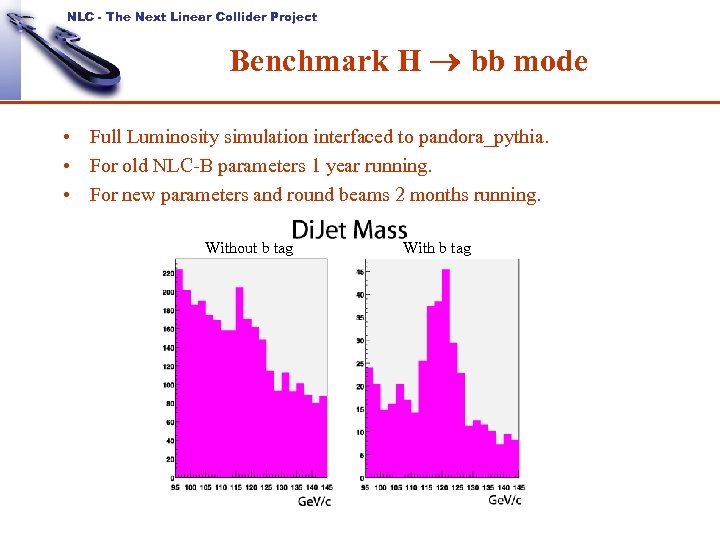 NLC - The Next Linear Collider Project Benchmark H bb mode • Full Luminosity simulation interfaced to pandora_pythia. • For old NLC-B parameters 1 year running. • For new parameters and round beams 2 months running. Without b tag With b tag
 NLC - The Next Linear Collider Project Conclusion • Livermore is proceeding with a complete engineering design of a photon collider for Snowmass • No show stoppers have been found for either the laser technology, optics or the IR integration All enabling technologies exist Task is mainly engineering now