


 Скачать презентацию Nixon s Domestic Policy Nixon in Person
10ec858f2e703e4fa12faafbd281307e.ppt
- Количество слайдов: 30
 Nixon’s Domestic Policy
 Nixon in Person • Unlike most politicians, Richard Nixon was a reserved and remote man • Many respected him for his experience and political strategies • He had few close friends, and often people thought he was cold and even had a mean side with his enemies • Nixon avoided his Cabinet and used his White House staff to help develop policies
 Domestic Policy • Restoring law and order was one of them most important aspects of Nixon’s domestic policy • Inflation – Inflation had doubled between 1965 and 1968 – Nixon began deficit spending or spending more money in a year than the government receives in revenues – He also proposed a 90 -day freeze on wage, prices, and rents
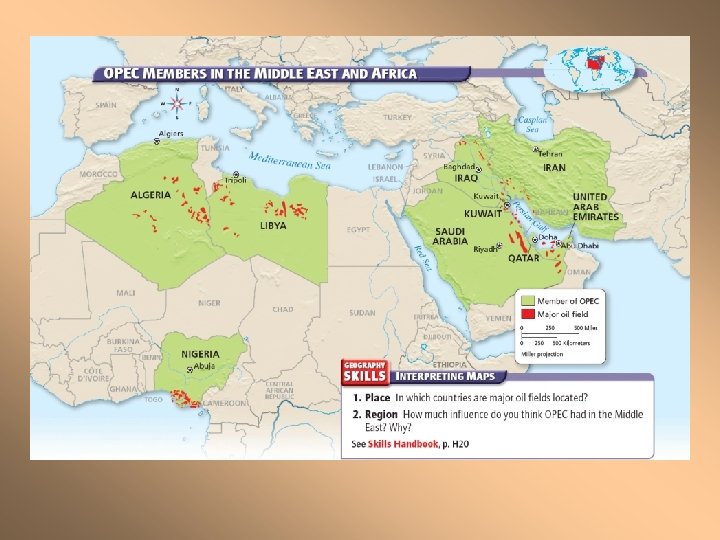
 Domestic Policy • Oil Crisis – The nation’s growing population and economy used more energy every year – Coal had environmental concerns – Americans depended on cheap oil for about 1/3 of energy needs – After the U. S. backed Israel, Arab members of OPEC imposed an embargo or ban on shipping oil to the U. S. – Oil prices skyrocketed – The result was a recession
 Domestic Policy • Social Programs – Nixon hoped to cut spending by shutting down some of the Great Society programs – Nixon called for a new partnership between the federal government and the state governments know as the New Federalism – States would assume greater responsibility for the well-being of their own citizens
 The “Southern Strategy” • Nixon believed he had little to gain by supporting advances in civil rights • “There are those who want instant integration and those who want segregation forever, I believe that we need to have a middle course between those two extremes. ” • Southern strategy was to win over white southern Democrats • Nixon repeatedly opposed acts to help African Americans
 The First Moon Landing • On July 20, 1969, Neil Armstrong descended from the Eagle lunar landing craft and set foot on the moon’s surface • Television viewers around the world witnessed this triumph of the Apollo program • The astronauts of Apollo 11 were welcomed back as heroes
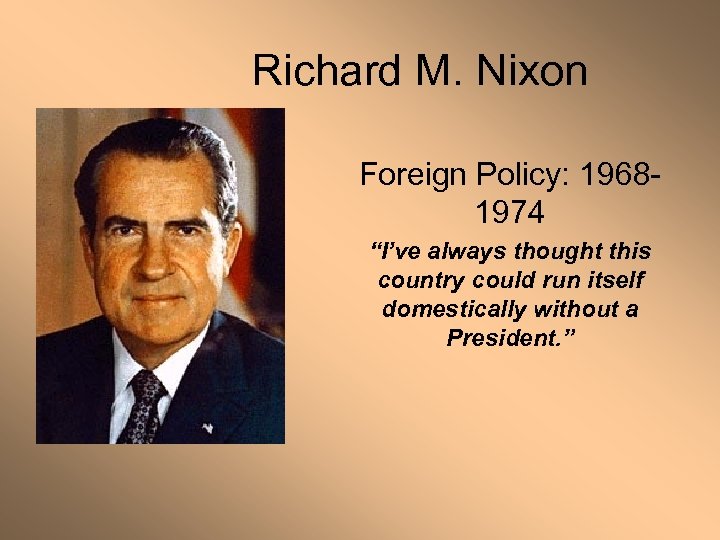 Richard M. Nixon Foreign Policy: 19681974 “I’ve always thought this country could run itself domestically without a President. ”
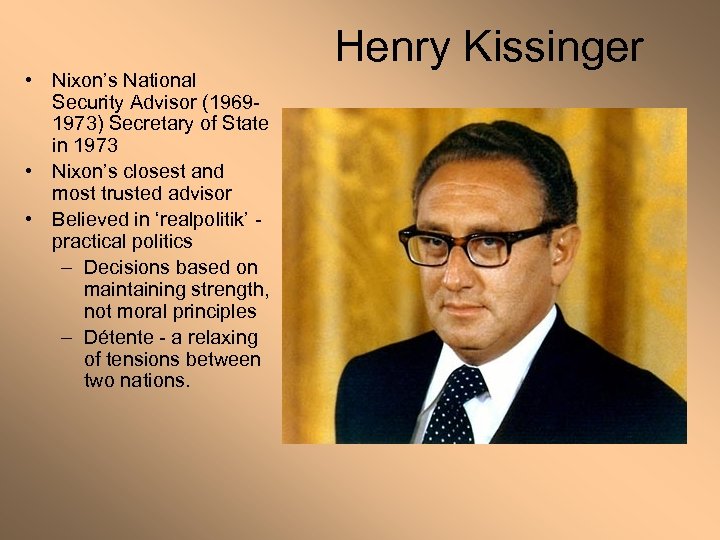 • Nixon’s National Security Advisor (19691973) Secretary of State in 1973 • Nixon’s closest and most trusted advisor • Believed in ‘realpolitik’ practical politics – Decisions based on maintaining strength, not moral principles – Détente - a relaxing of tensions between two nations. Henry Kissinger
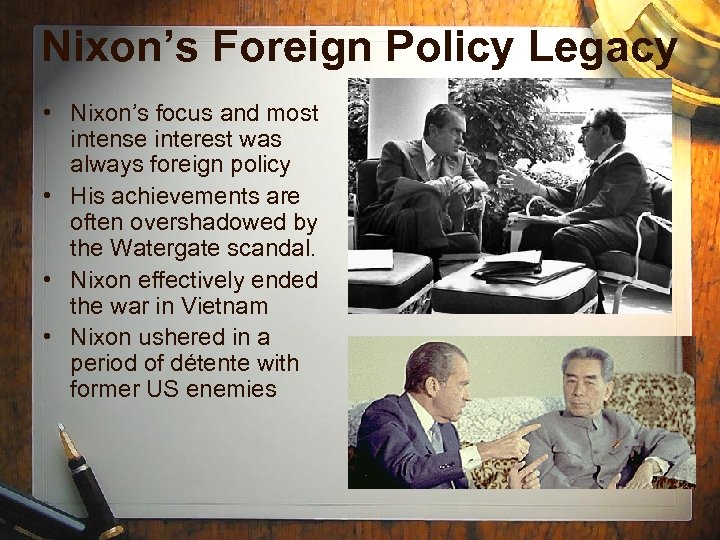
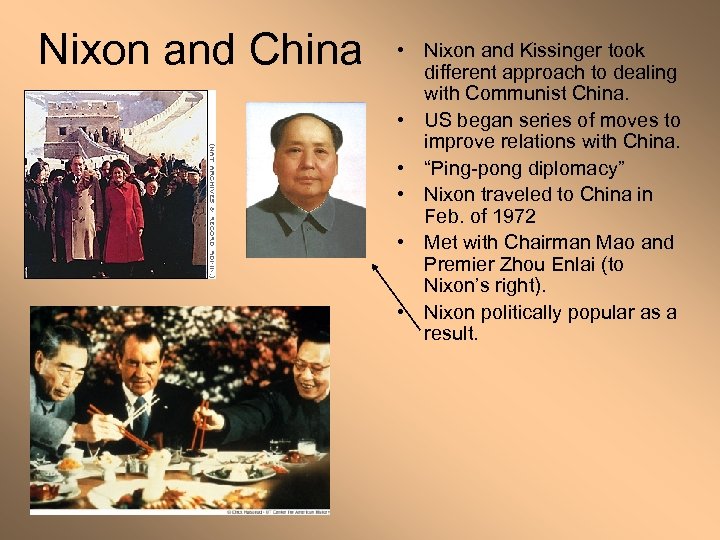 Nixon and China • Nixon and Kissinger took different approach to dealing with Communist China. • US began series of moves to improve relations with China. • “Ping-pong diplomacy” • Nixon traveled to China in Feb. of 1972 • Met with Chairman Mao and Premier Zhou Enlai (to Nixon’s right). • Nixon politically popular as a result.
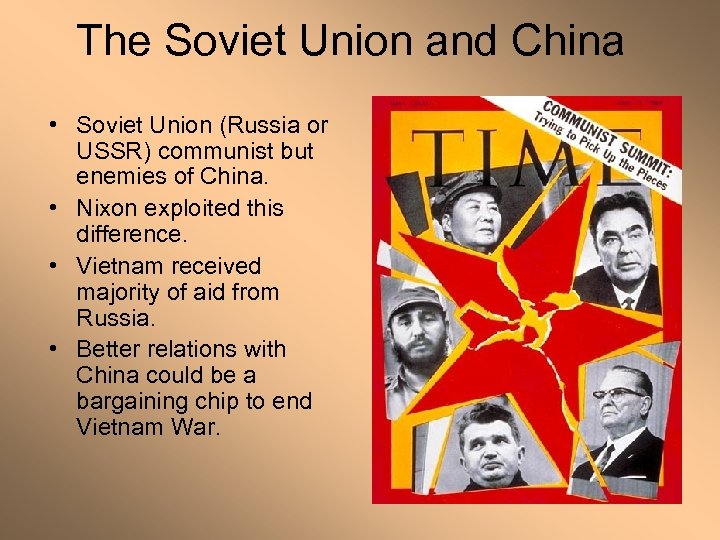 The Soviet Union and China • Soviet Union (Russia or USSR) communist but enemies of China. • Nixon exploited this difference. • Vietnam received majority of aid from Russia. • Better relations with China could be a bargaining chip to end Vietnam War.
 Nixon, the USSR, and China
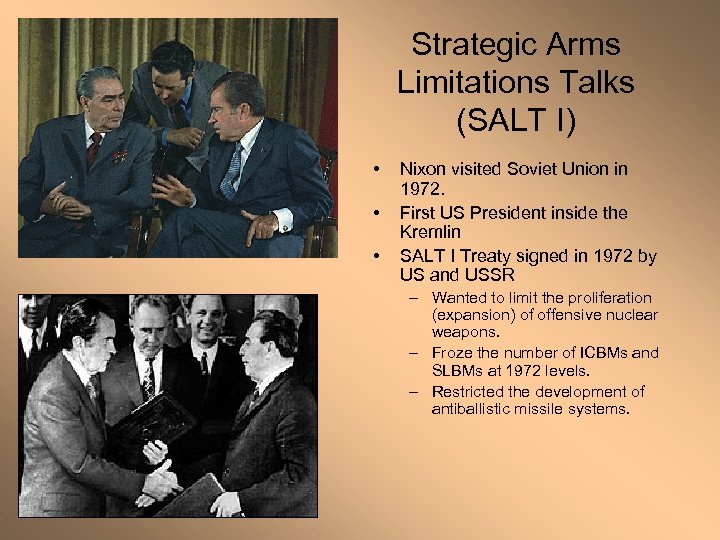 Strategic Arms Limitations Talks (SALT I) • • • Nixon visited Soviet Union in 1972. First US President inside the Kremlin SALT I Treaty signed in 1972 by US and USSR – Wanted to limit the proliferation (expansion) of offensive nuclear weapons. – Froze the number of ICBMs and SLBMs at 1972 levels. – Restricted the development of antiballistic missile systems.
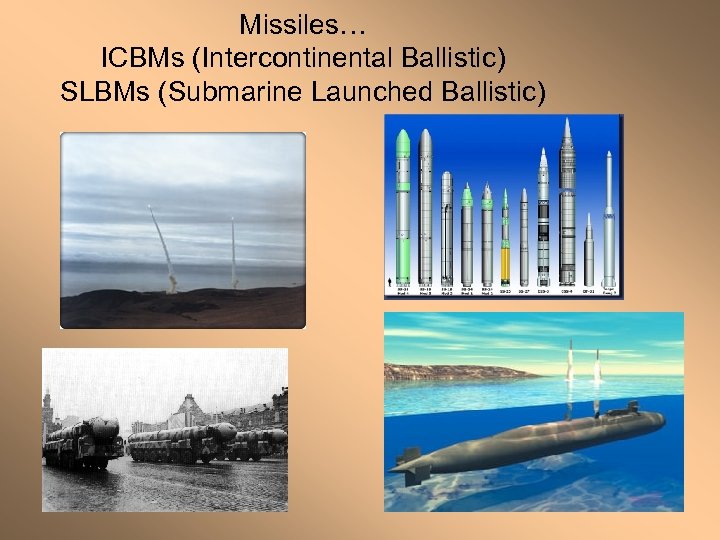 Missiles… ICBMs (Intercontinental Ballistic) SLBMs (Submarine Launched Ballistic)
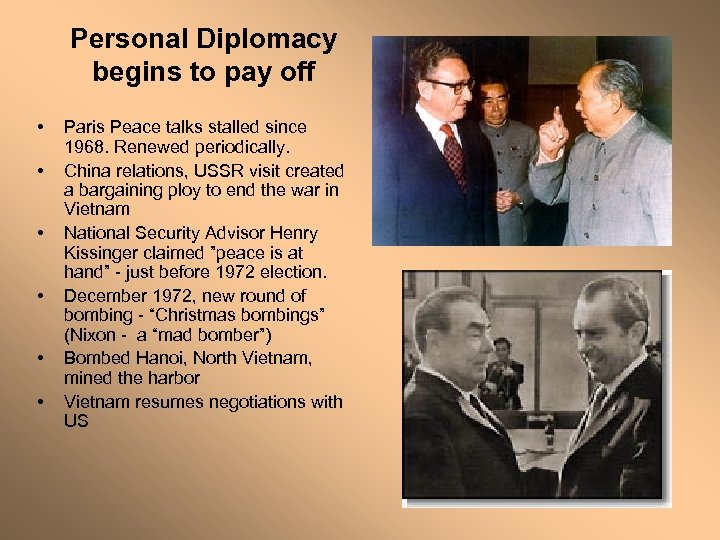 Personal Diplomacy begins to pay off • • • Paris Peace talks stalled since 1968. Renewed periodically. China relations, USSR visit created a bargaining ploy to end the war in Vietnam National Security Advisor Henry Kissinger claimed ”peace is at hand” - just before 1972 election. December 1972, new round of bombing - “Christmas bombings” (Nixon - a “mad bomber”) Bombed Hanoi, North Vietnam, mined the harbor Vietnam resumes negotiations with US
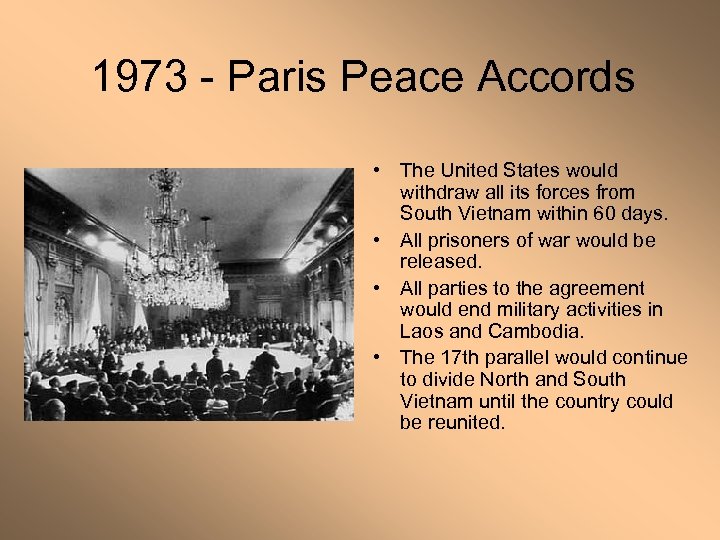 1973 - Paris Peace Accords • The United States would withdraw all its forces from South Vietnam within 60 days. • All prisoners of war would be released. • All parties to the agreement would end military activities in Laos and Cambodia. • The 17 th parallel would continue to divide North and South Vietnam until the country could be reunited.
 Paris Peace Accords: Vietnam
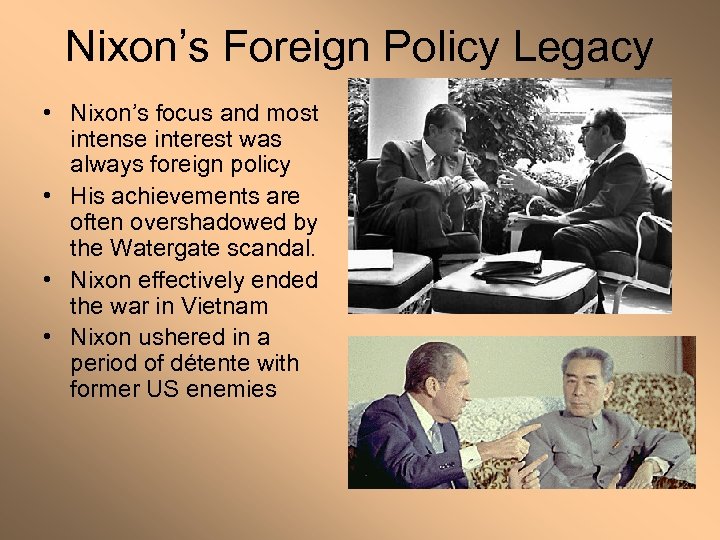 Nixon’s Foreign Policy Legacy • Nixon’s focus and most intense interest was always foreign policy • His achievements are often overshadowed by the Watergate scandal. • Nixon effectively ended the war in Vietnam • Nixon ushered in a period of détente with former US enemies
 ARAB-ISRAELI RELATIONS
 Arab-Israeli Tensions • Since Israel’s declaration of independence in 1948, Arab nations had engaged in wars with the Jewish state, and none had opened up diplomatic relations with Israel by the 1970 s. – The Arabs, especially Palestinians, considered Israeli territory rightfully theirs. – The Muslim (and Jewish) holy city of Jerusalem was located within Israel’s borders. – United States was Israel’s steadfast ally from the beginning.
 The Six-Day War (1967) • Israel won a stunning victory against the Arabs in the Six-Day War of 1967. • Expanded the nation’s borders to include: – – the Golan Heights the West Bank the Gaza Strip the Sinai Peninsula. • Israel assumed the Arabs would not dare to attack them again so soon. • Arabs were as determined as ever to reclaim their territory and eliminate the Jewish state.
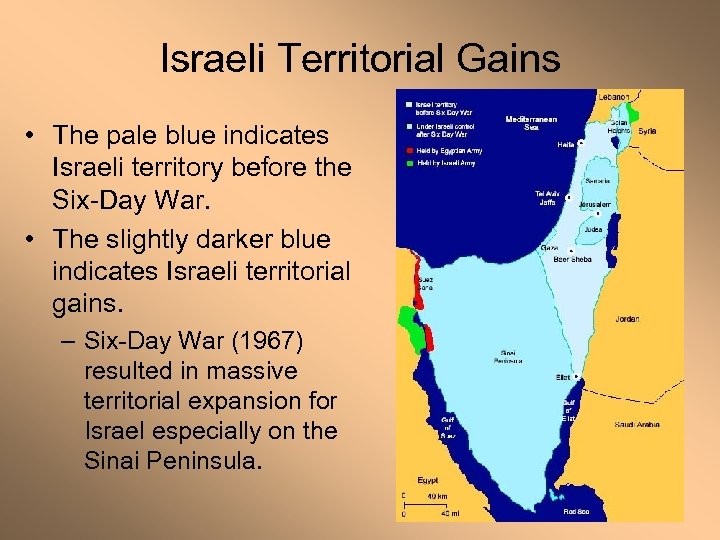 Israeli Territorial Gains • The pale blue indicates Israeli territory before the Six-Day War. • The slightly darker blue indicates Israeli territorial gains. – Six-Day War (1967) resulted in massive territorial expansion for Israel especially on the Sinai Peninsula.
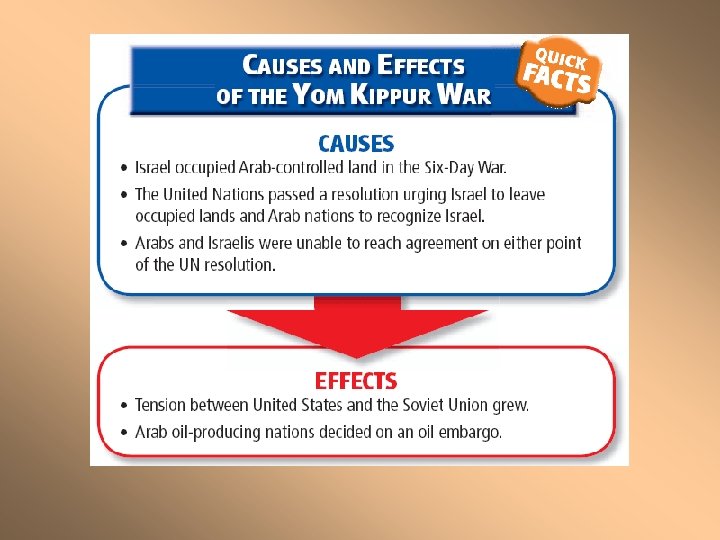
 The Yom Kippur War (1973) • October 6, 1973, the Arab nations of Egypt and Syria launched a surprise attack against Israel. – The Arabs chose the date with a very specific reason in mind: it coincided with Yom Kippur, Judaism’s holiest holiday. • The Arabs correctly assumed that Israel would be most vulnerable on this day. • Indeed, for the first two days of the war, the Israelis could not stop their enemies’ advance. • The war lasted a mere 20 days with intense fighting and thousands killed.
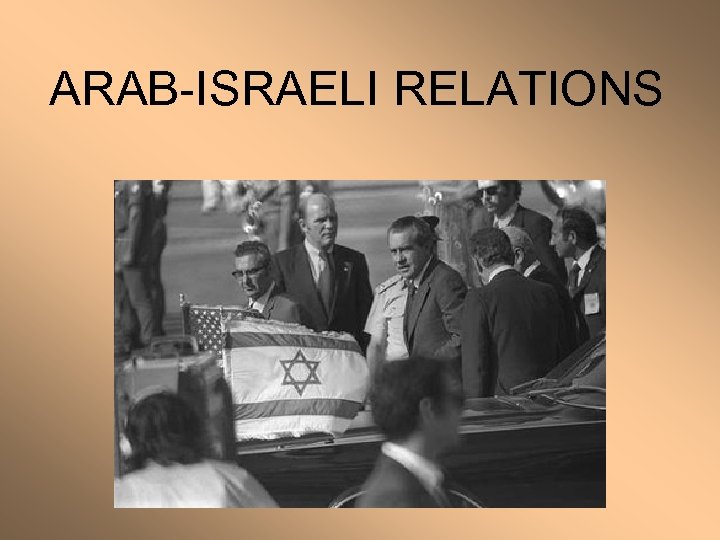
 American Involvement • America actively supported Israel, both politically and militarily, from the beginning. • Nixon personally ordered that American arms be airlifted to Israel. • The conflict resembled a proxy (Cold War) war, since it pitted America-friendly Israel vs. Egypt and Syria, long under Soviet influence.
 The Oil Crisis • In response to highly effective American involvement in the war, Arab nations declared on October 19 that they would not sell oil to the U. S. , because of its expressed support for Israel. – They later cut exports to the Netherlands and other nations backing Israel. • Within a few months, the price of a barrel of oil quadrupled! – This marked the first time Arab nations would use oil as a political and economic weapon.
 Effects of the War • No territorial concessions were made; each side claimed victory for itself. • Egypt drifted away from the Soviet Union and towards America, largely because of Kissinger’s developing relationship with Egyptian President Anwar Sadat. – Israel remained America’s close ally; likewise, Syria retained its alignment with the U. S. S. R. – As a result of the diplomatic shift, Egypt became more willing to negotiate with Israel. • In 1978, the Camp David Accords would make Egypt the first Arab nation to formally recognize the Jewish state. • The oil embargo had a devastating impact on the U. S. economy.
 Did Nixon Succeed in the Middle East? • In keeping with the Nixon Doctrine, he stood by an American ally, providing aid and supplies, but not manpower, for a successful defense. • With Kissinger’s aid, he also reduced the Soviet sphere of influence, of which Egypt was no longer a part by war’s end.
 Nixon’s Foreign Policy Legacy • Nixon’s focus and most intense interest was always foreign policy • His achievements are often overshadowed by the Watergate scandal. • Nixon effectively ended the war in Vietnam • Nixon ushered in a period of détente with former US enemies