 Скачать презентацию Nitrous Oxide Focus Group launch event Friday February
fccfd8dbf1a48d651b05ba37090e96b1.ppt
- Количество слайдов: 29



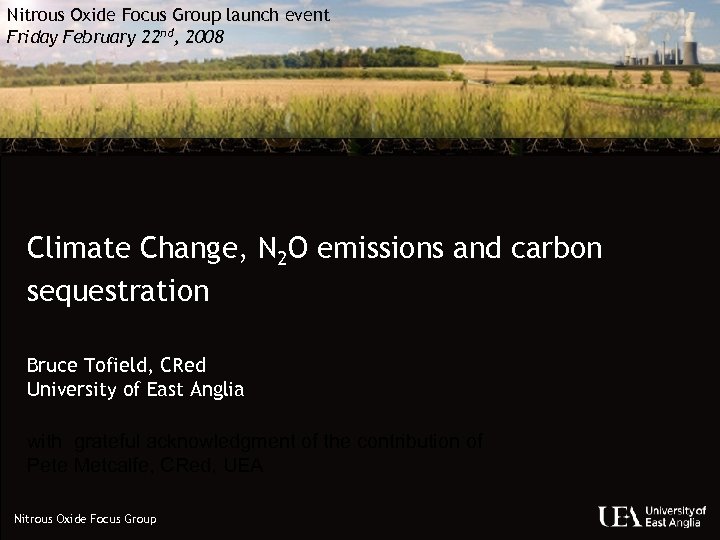
Nitrous Oxide Focus Group launch event Friday February 22 nd, 2008 Climate Change, N 2 O emissions and carbon sequestration Bruce Tofield, CRed University of East Anglia Nitrous Oxide Focus Group
CRed is a catalyst to stimulate new thinking and action that might not otherwise happen.
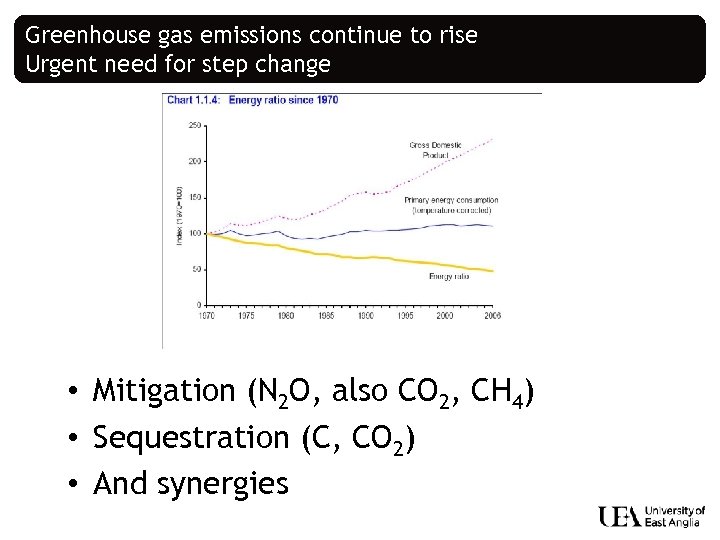
Greenhouse gas emissions continue to rise Urgent need for step change • Mitigation (N 2 O, also CO 2, CH 4) • Sequestration (C, CO 2) • And synergies
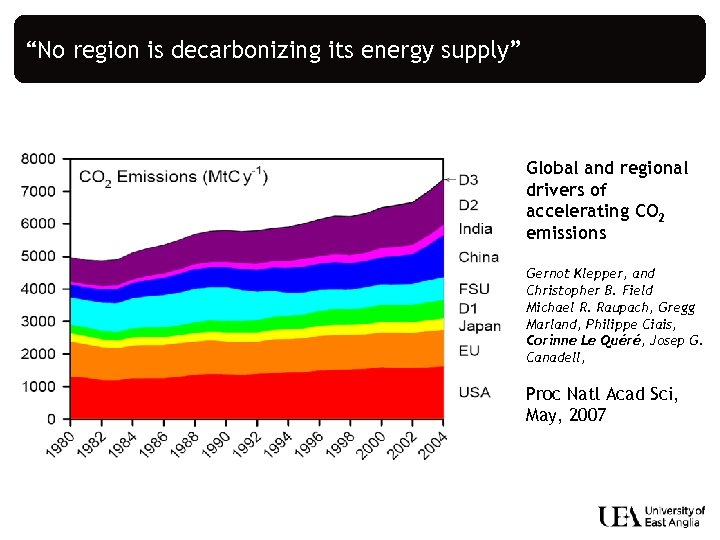
“No region is decarbonizing its energy supply” Global and regional drivers of accelerating CO 2 emissions Gernot Klepper, and Christopher B. Field Michael R. Raupach, Gregg Marland, Philippe Ciais, Corinne Le Quéré, Josep G. Canadell, Proc Natl Acad Sci, May, 2007
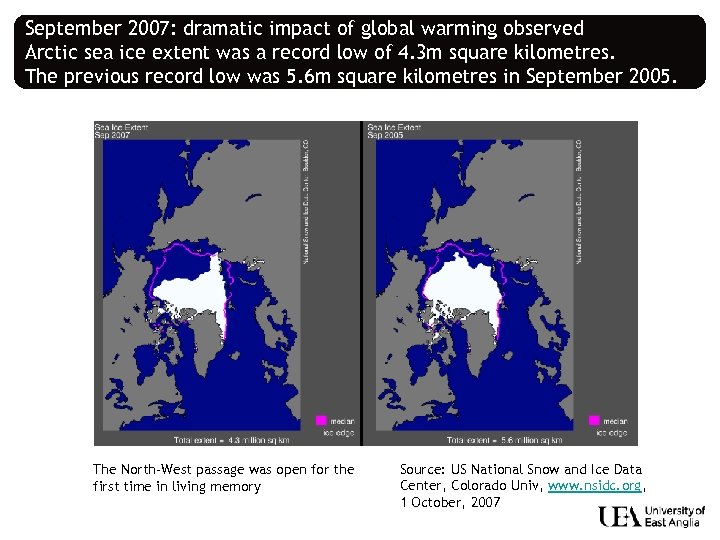
September 2007: dramatic impact of global warming observed Arctic sea ice extent was a record low of 4. 3 m square kilometres. The previous record low was 5. 6 m square kilometres in September 2005. The North-West passage was open for the first time in living memory Source: US National Snow and Ice Data Center, Colorado Univ, www. nsidc. org, 1 October, 2007
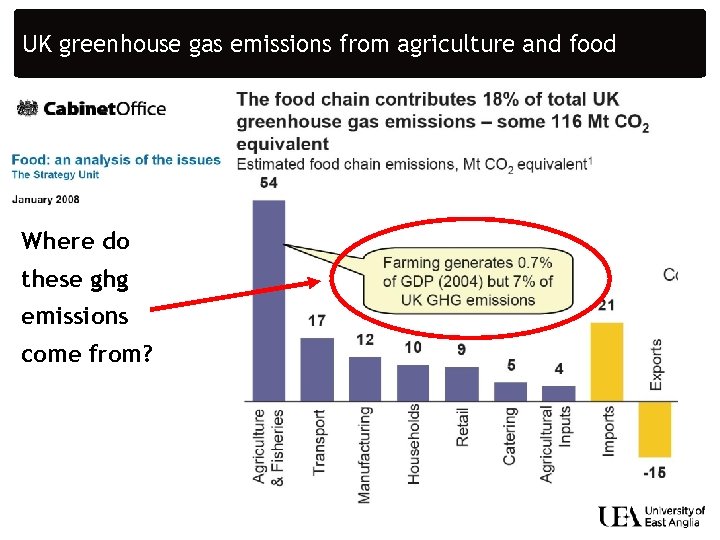
UK greenhouse gas emissions from agriculture and food Where do these ghg emissions come from?
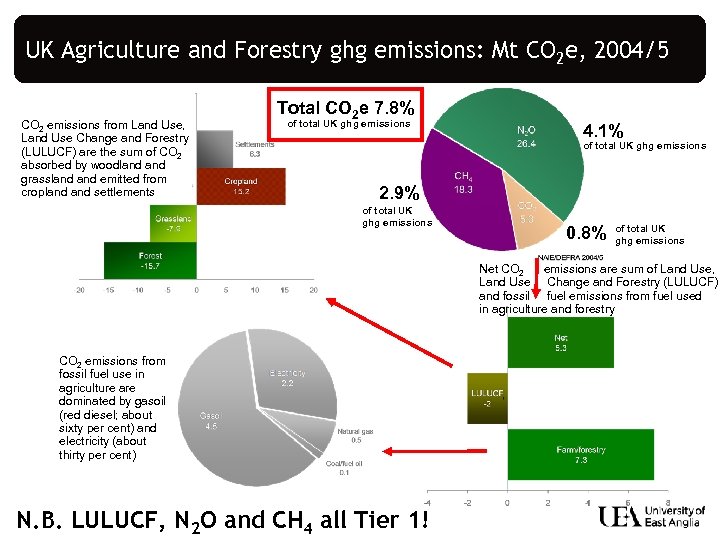
Mt CO 2 e UK Agriculture and Forestry ghg emissions: Mt CO 2 e, 2004/5 Mt CO 2 e CO 2 emissions from Land Use, Land Use Change and Forestry (LULUCF) are the sum of CO 2 absorbed by woodland grassland emitted from cropland settlements Total CO 2 e 7. 8% of total UK ghg emissions 4. 1% of total UK ghg emissions 2. 9% of total UK ghg emissions 0. 8% of total UK ghg emissions Net CO 2 emissions are sum of Land Use, Land Use Change and Forestry (LULUCF) and fossil fuel emissions from fuel used in agriculture and forestry CO 2 emissions from fossil fuel use in agriculture are dominated by gasoil (red diesel; about sixty per cent) and electricity (about thirty per cent) N. B. LULUCF, N 2 O and CH 4 all Tier 1!
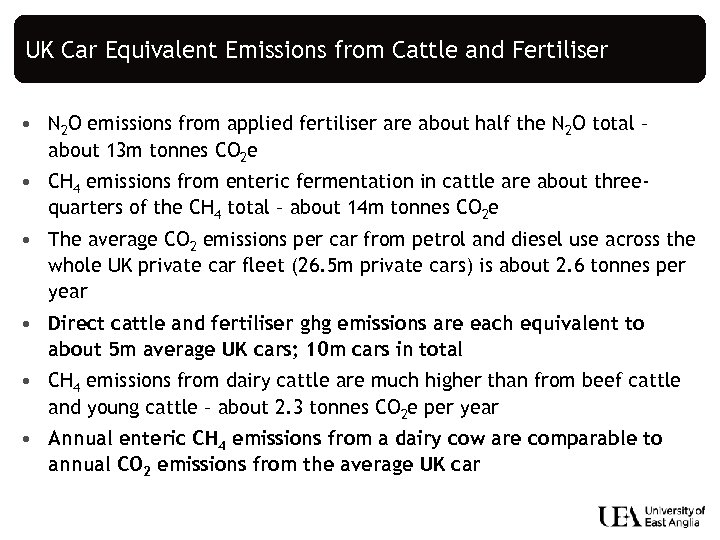
UK Car Equivalent Emissions from Cattle and Fertiliser • N 2 O emissions from applied fertiliser are about half the N 2 O total – about 13 m tonnes CO 2 e • CH 4 emissions from enteric fermentation in cattle are about threequarters of the CH 4 total – about 14 m tonnes CO 2 e • The average CO 2 emissions per car from petrol and diesel use across the whole UK private car fleet (26. 5 m private cars) is about 2. 6 tonnes per year • Direct cattle and fertiliser ghg emissions are each equivalent to about 5 m average UK cars; 10 m cars in total • CH 4 emissions from dairy cattle are much higher than from beef cattle and young cattle – about 2. 3 tonnes CO 2 e per year • Annual enteric CH 4 emissions from a dairy cow are comparable to annual CO 2 emissions from the average UK car
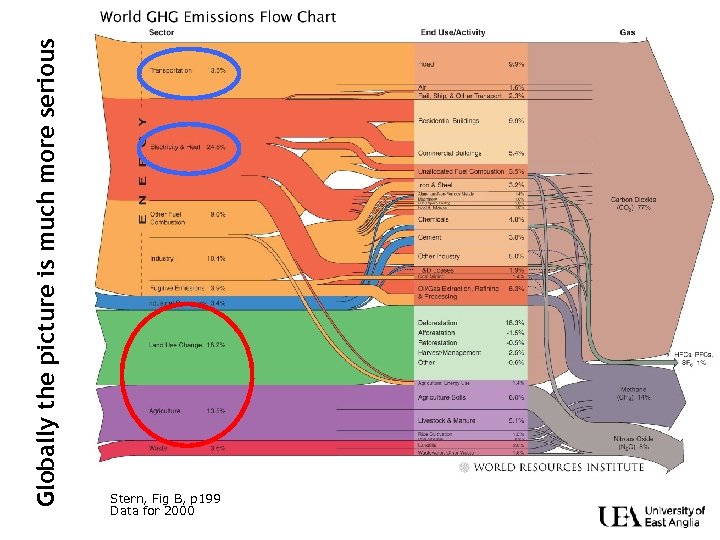
Globally the picture is much more serious Stern, Fig B, p 199 Data for 2000
Globally the picture from agriculture is much more serious • Deforestation alone bigger than transport – and still growing • Deforestation intimately linked to agriculture • Land use change and agriculture thirty per cent of global ghg emissions and still growing • Bigger than electricity and heat • N 2 O alone is six per cent of global ghg emissions • Over twice transport emissions
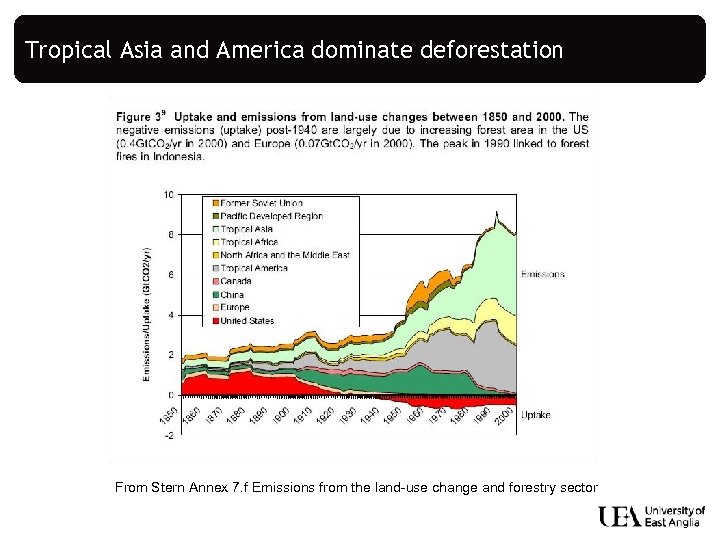
Tropical Asia and America dominate deforestation From Stern Annex 7. f Emissions from the land-use change and forestry sector
Emissions from agriculture and land use change will only increase without radical change in practice Global demand for food is expected to double within the coming 50 years, and global demand for transportation fuels is expected to increase even more rapidly. There is a great need for renewable energy supplies that do not cause significant environmental harm and do not compete with food supply. Environmental, economic, and energetic costs and benefits of biodiesel and ethanol biofuels Jason Hill, Erik Nelson, David Tilman, Stephen Polasky, and Douglas Tiffany PNAS: 103, 11206 -11210, 2006
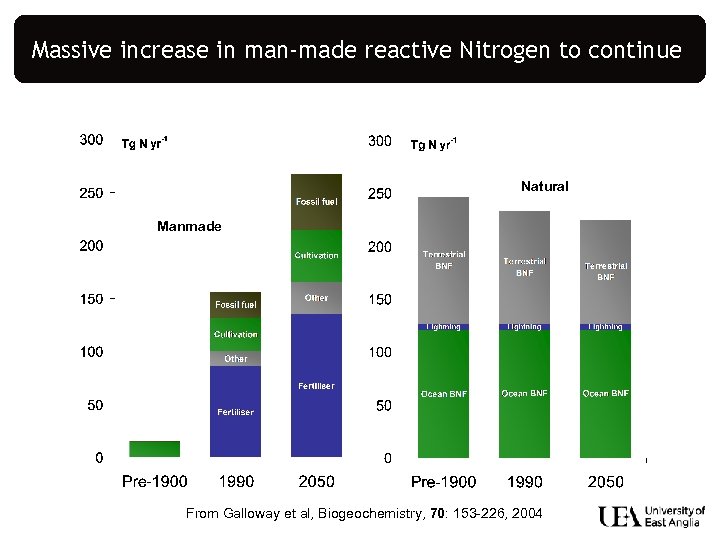
Massive increase in man-made reactive Nitrogen to continue Natural Manmade From Galloway et al, Biogeochemistry, 70: 153 -226, 2004
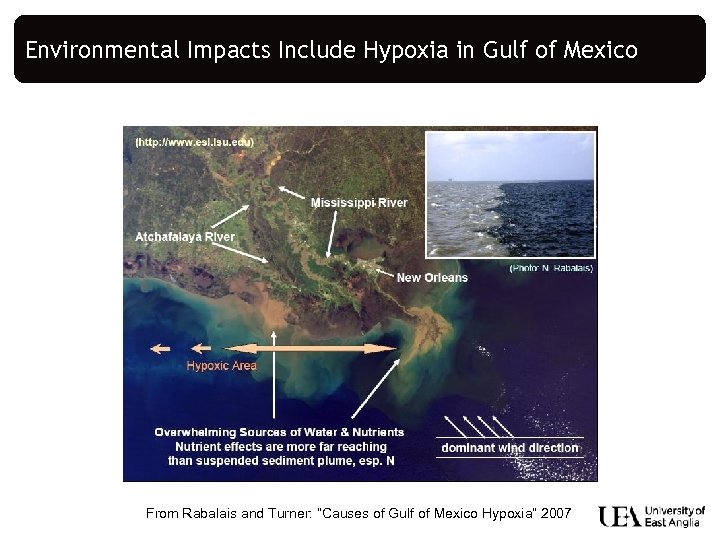
Environmental Impacts Include Hypoxia in Gulf of Mexico From Rabalais and Turner: “Causes of Gulf of Mexico Hypoxia” 2007
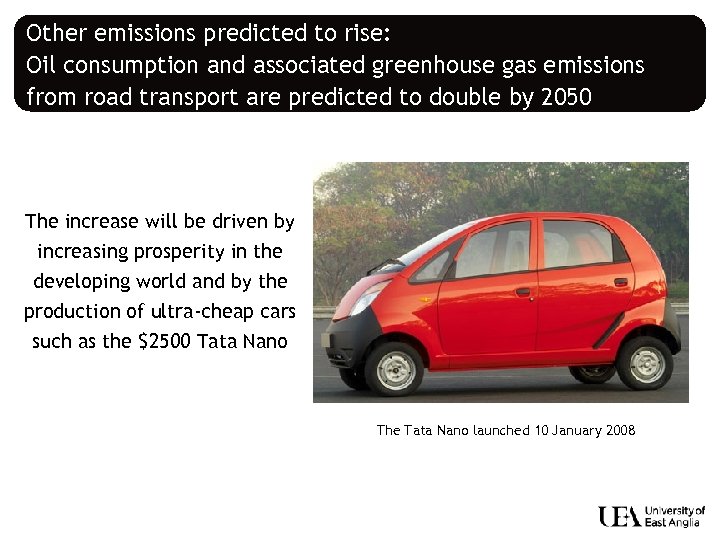
Other emissions predicted to rise: Oil consumption and associated greenhouse gas emissions from road transport are predicted to double by 2050 The increase will be driven by increasing prosperity in the developing world and by the production of ultra-cheap cars such as the $2500 Tata Nano The Tata Nano launched 10 January 2008
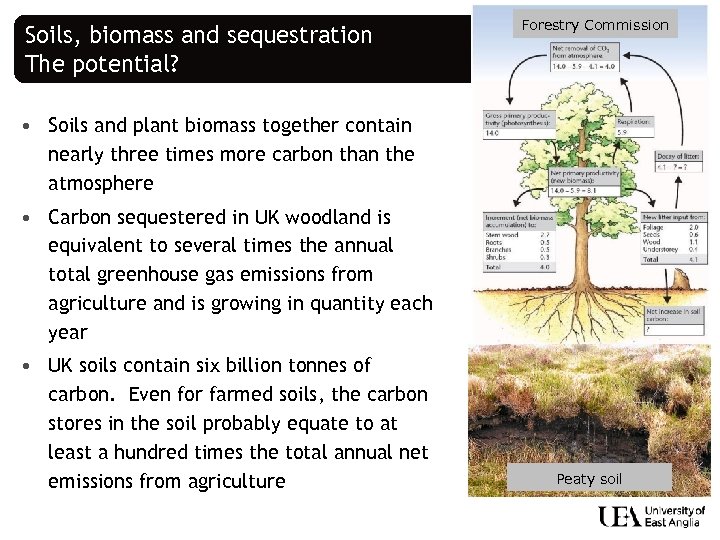
Soils, biomass and sequestration The potential? Forestry Commission • Soils and plant biomass together contain nearly three times more carbon than the atmosphere • Carbon sequestered in UK woodland is equivalent to several times the annual total greenhouse gas emissions from agriculture and is growing in quantity each year • UK soils contain six billion tonnes of carbon. Even for farmed soils, the carbon stores in the soil probably equate to at least a hundred times the total annual net emissions from agriculture Peaty soil
How can we reduce emissions from agriculture by developing practices to encourage carbon sequestration in soils? • What needs to change today? • Biofuel production is creating massive carbon debt • What new sequestration methods can be developed? • What impact will increased carbon sequestration have on N 2 O emissions?
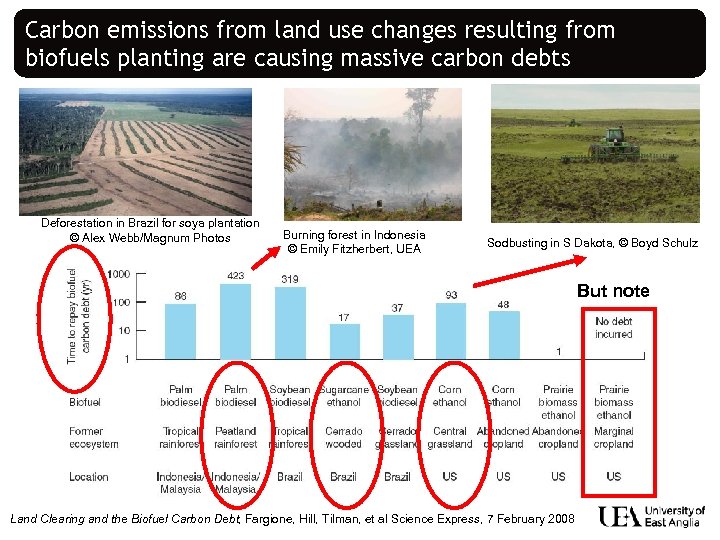
Carbon emissions from land use changes resulting from biofuels planting are causing massive carbon debts Deforestation in Brazil for soya plantation © Alex Webb/Magnum Photos Burning forest in Indonesia © Emily Fitzherbert, UEA Sodbusting in S Dakota, © Boyd Schulz But note Land Clearing and the Biofuel Carbon Debt, Fargione, Hill, Tilman, et al Science Express, 7 February 2008
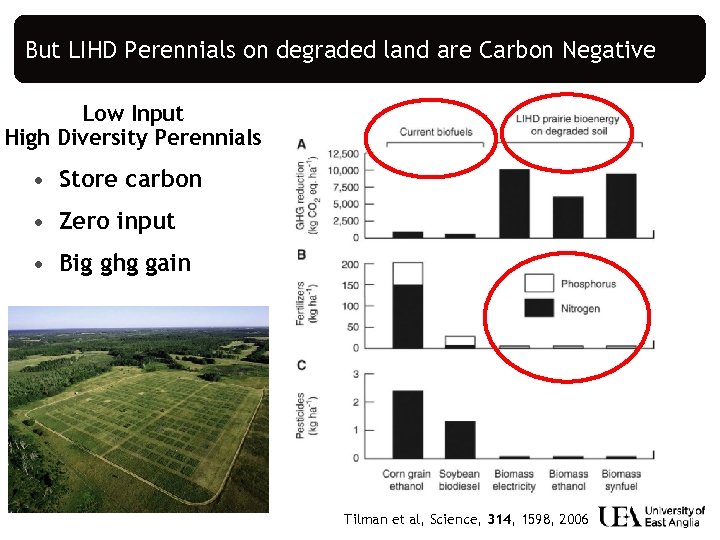
But LIHD Perennials on degraded land are Carbon Negative Low Input High Diversity Perennials • Store carbon • Zero input • Big ghg gain Tilman et al, Science, 314, 1598, 2006
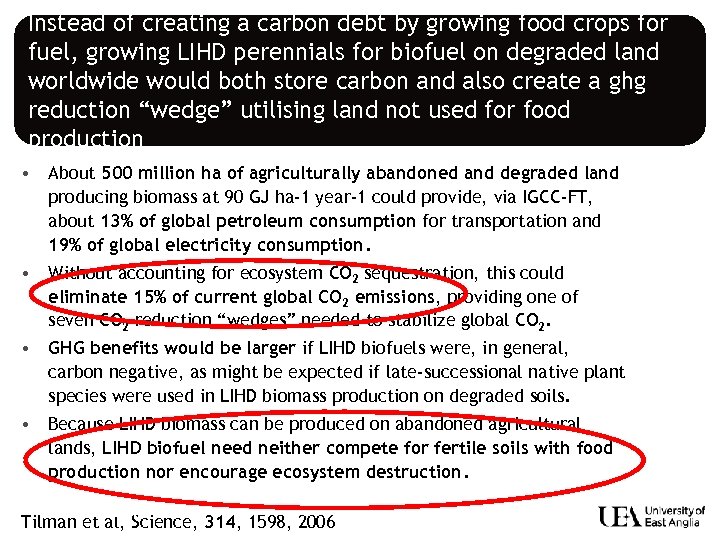
Instead of creating a carbon debt by growing food crops for fuel, growing LIHD perennials for biofuel on degraded land worldwide would both store carbon and also create a ghg reduction “wedge” utilising land not used for food production • About 500 million ha of agriculturally abandoned and degraded land producing biomass at 90 GJ ha-1 year-1 could provide, via IGCC-FT, about 13% of global petroleum consumption for transportation and 19% of global electricity consumption. • Without accounting for ecosystem CO 2 sequestration, this could eliminate 15% of current global CO 2 emissions, providing one of seven CO 2 reduction “wedges” needed to stabilize global CO 2. • GHG benefits would be larger if LIHD biofuels were, in general, carbon negative, as might be expected if late-successional native plant species were used in LIHD biomass production on degraded soils. • Because LIHD biomass can be produced on abandoned agricultural lands, LIHD biofuel need neither compete for fertile soils with food production nor encourage ecosystem destruction. WITHOUT N INPUT Tilman et al, Science, 314, 1598, 2006
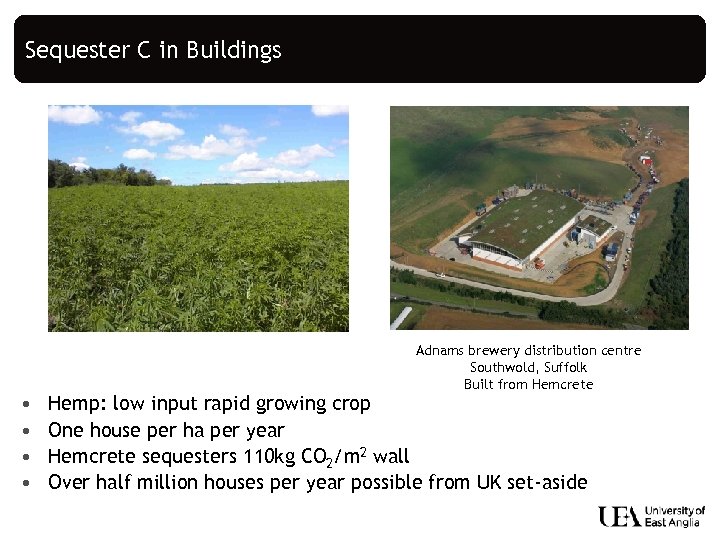
Sequester C in Buildings • • Adnams brewery distribution centre Southwold, Suffolk Built from Hemcrete Hemp: low input rapid growing crop One house per ha per year Hemcrete sequesters 110 kg CO 2/m 2 wall Over half million houses per year possible from UK set-aside
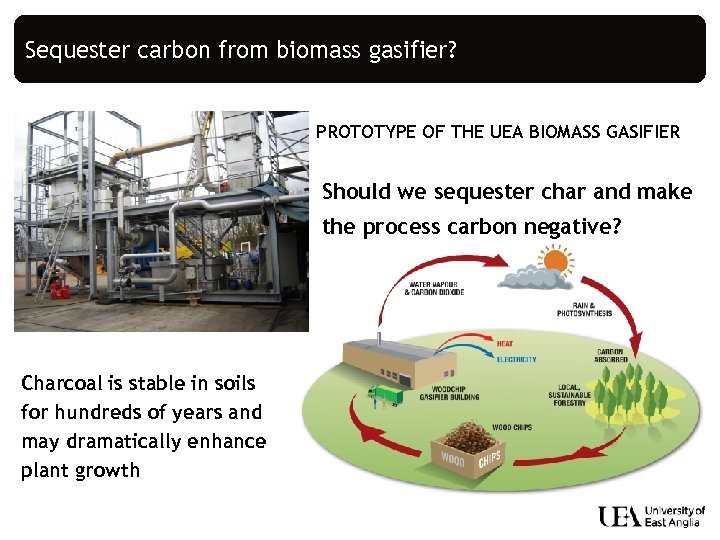
Sequester carbon from biomass gasifier? PROTOTYPE OF THE UEA BIOMASS GASIFIER Should we sequester char and make the process carbon negative? Charcoal is stable in soils for hundreds of years and may dramatically enhance plant growth
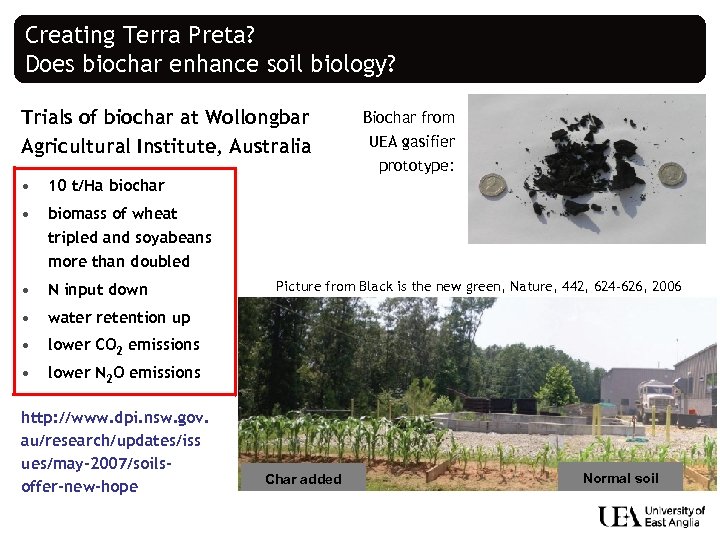
Creating Terra Preta? Does biochar enhance soil biology? Trials of biochar at Wollongbar Agricultural Institute, Australia • prototype: 10 t/Ha biochar • Biochar from UEA gasifier biomass of wheat tripled and soyabeans more than doubled • N input down • water retention up • lower CO 2 emissions • Picture from Black is the new green, Nature, 442, 624 -626, 2006 lower N 2 O emissions http: //www. dpi. nsw. gov. au/research/updates/iss ues/may-2007/soilsoffer-new-hope Char added Normal soil
We need to gain new understanding and gain it fast • What is the sequestration potential for biochar? • What kinds of char will work best? • What soils can be most usefully treated? • What plants can best utilise the benefits? • What is the impact on N 2 O emissions? • How much can inputs such as fertiliser be reduced? • Will treatment work in temperate and tropical climates?
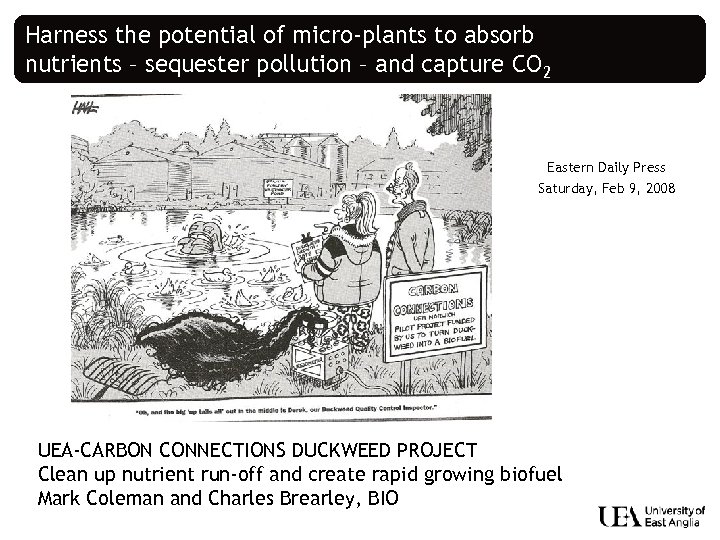
Harness the potential of micro-plants to absorb nutrients – sequester pollution – and capture CO 2 Eastern Daily Press Saturday, Feb 9, 2008 UEA-CARBON CONNECTIONS DUCKWEED PROJECT Clean up nutrient run-off and create rapid growing biofuel Mark Coleman and Charles Brearley, BIO
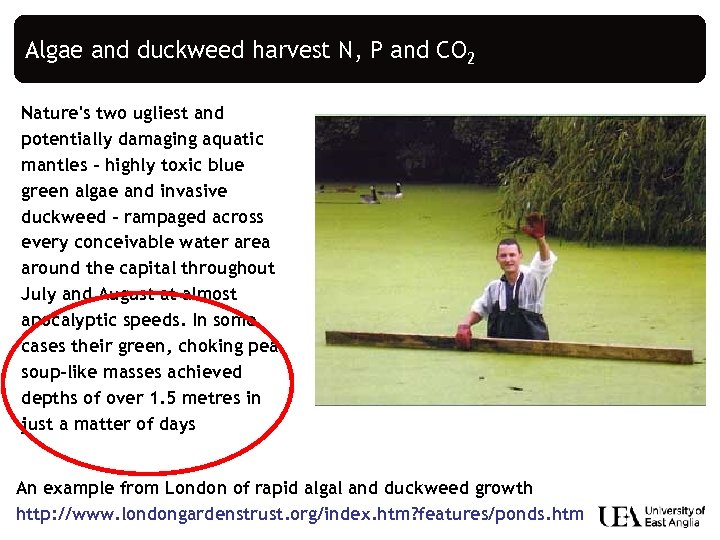
Algae and duckweed harvest N, P and CO 2 Nature's two ugliest and potentially damaging aquatic mantles - highly toxic blue green algae and invasive duckweed - rampaged across every conceivable water area around the capital throughout July and August at almost apocalyptic speeds. In some cases their green, choking pea soup-like masses achieved depths of over 1. 5 metres in just a matter of days An example from London of rapid algal and duckweed growth http: //www. londongardenstrust. org/index. htm? features/ponds. htm
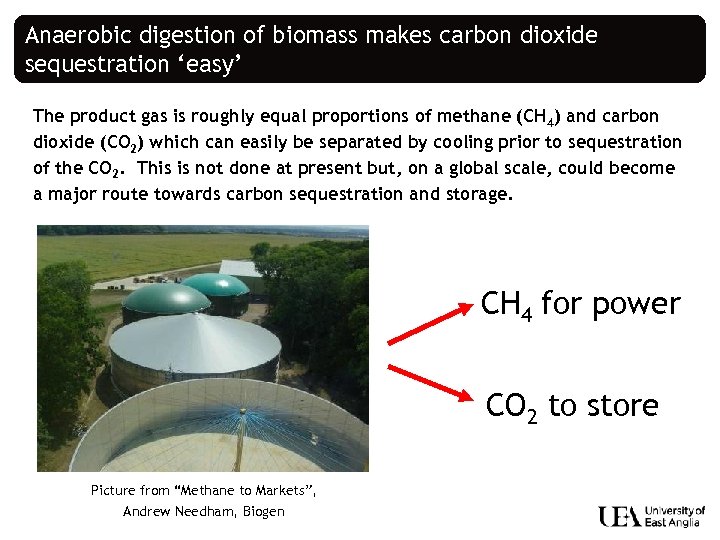
Anaerobic digestion of biomass makes carbon dioxide sequestration ‘easy’ The product gas is roughly equal proportions of methane (CH 4) and carbon dioxide (CO 2) which can easily be separated by cooling prior to sequestration of the CO 2. This is not done at present but, on a global scale, could become a major route towards carbon sequestration and storage. CH 4 for power CO 2 to store Picture from “Methane to Markets”, Andrew Needham, Biogen
There are major options to reduce emissions and sequester carbon through changes in agricultural practice • But they require big changes to current practice • The economics aren’t established • If we don’t make them happen emissions will continue to rise and rise fast • What are the impacts on N 2 O emissions of these new practices? • There is a great deal to learn and little time to do it in • Can this focus group can lead the way?
Nitrous Oxide Focus Group launch event Friday February 22 nd, 2008 Climate Change, N 2 O emissions and carbon sequestration Bruce Tofield, CRed University of East Anglia with grateful acknowledgment of the contribution of Pete Metcalfe, CRed, UEA Nitrous Oxide Focus Group
Скачать презентацию Nitrous Oxide Focus Group launch event Friday February
fccfd8dbf1a48d651b05ba37090e96b1.ppt