 Скачать презентацию NIST LBIR Capabilities for Absolute Radiometric Calibrations Dr
5521dc7d06a0860ae77a9e89b8b2fa95.ppt
- Количество слайдов: 28



NIST LBIR Capabilities for Absolute Radiometric Calibrations Dr. Raju Datla NIST Optical Technology Division Gaithersburg, MD 20899 PIs: Dr. Adriaan Carter & Dr. Timothy Jung 3/19/2018 1
Outline • Absolute Cryogenic radiometer (ACR) - Absolute Standard for LBIR Measurements – Blackbody Calibrations • MDXR – LBIR Transfer Standard Radiometer – Capabilities and Possibilities • BIB Trap detectors • Summary 3/19/2018 2
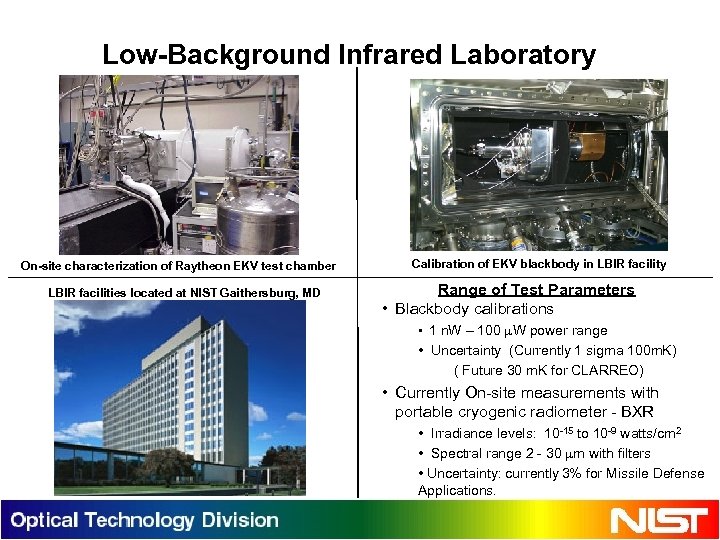
Low-Background Infrared Laboratory On-site characterization of Raytheon EKV test chamber LBIR facilities located at NIST Gaithersburg, MD Calibration of EKV blackbody in LBIR facility Range of Test Parameters • Blackbody calibrations • 1 n. W – 100 W power range • Uncertainty (Currently 1 sigma 100 m. K) ( Future 30 m. K for CLARREO) • Currently On-site measurements with portable cryogenic radiometer - BXR 3/19/2018 • Irradiance levels: 10 -15 to 10 -9 watts/cm 2 • Spectral range 2 - 30 m with filters • Uncertainty: currently 3% for Missile Defense Applications. 3
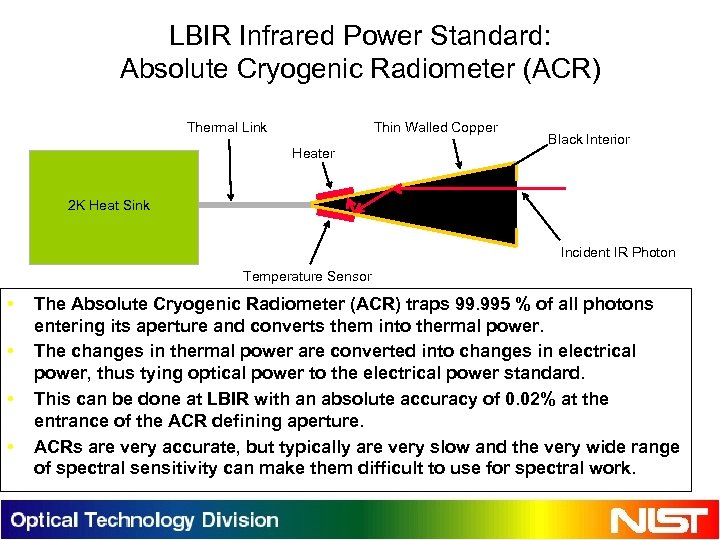
LBIR Infrared Power Standard: Absolute Cryogenic Radiometer (ACR) Thermal Link Thin Walled Copper Heater Black Interior 2 K Heat Sink Incident IR Photon Temperature Sensor • • The Absolute Cryogenic Radiometer (ACR) traps 99. 995 % of all photons entering its aperture and converts them into thermal power. The changes in thermal power are converted into changes in electrical power, thus tying optical power to the electrical power standard. This can be done at LBIR with an absolute accuracy of 0. 02% at the entrance of the ACR defining aperture. ACRs are very accurate, but typically are very slow and the very wide range of spectral sensitivity can make them difficult to use for spectral work. 3/19/2018 4
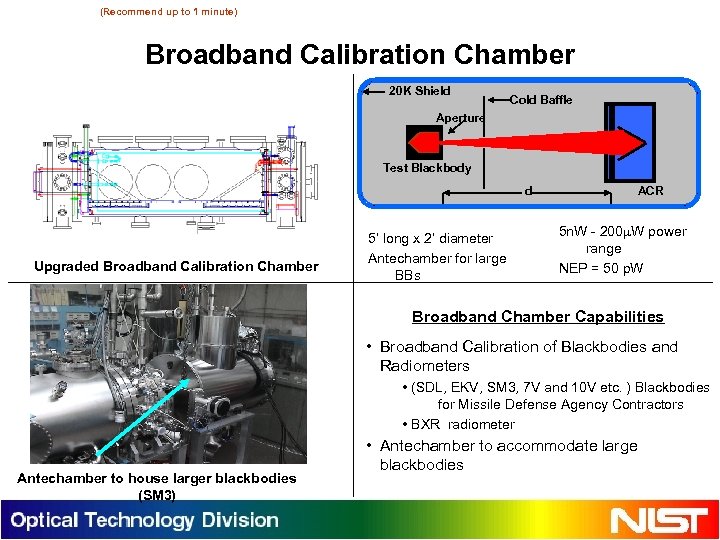
(Recommend up to 1 minute) Broadband Calibration Chamber 20 K Shield Cold Baffle Aperture Test Blackbody d Upgraded Broadband Calibration Chamber 5’ long x 2’ diameter Antechamber for large BBs ACR 5 n. W - 200 W power range NEP = 50 p. W Broadband Chamber Capabilities • Broadband Calibration of Blackbodies and Radiometers • (SDL, EKV, SM 3, 7 V and 10 V etc. ) Blackbodies for Missile Defense Agency Contractors • BXR radiometer Antechamber to house larger blackbodies (SM 3) 3/19/2018 • Antechamber to accommodate large blackbodies 5
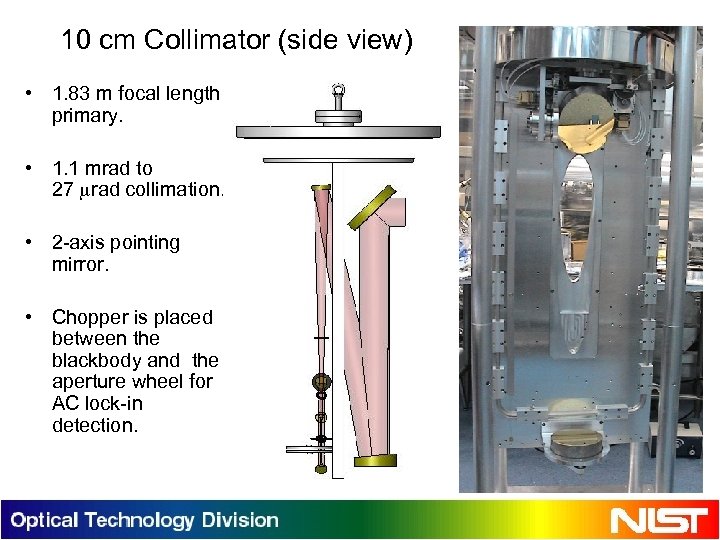
10 cm Collimator (side view) • 1. 83 m focal length primary. • 1. 1 mrad to 27 rad collimation. • 2 -axis pointing mirror. • Chopper is placed between the blackbody and the aperture wheel for AC lock-in detection. 3/19/2018 6
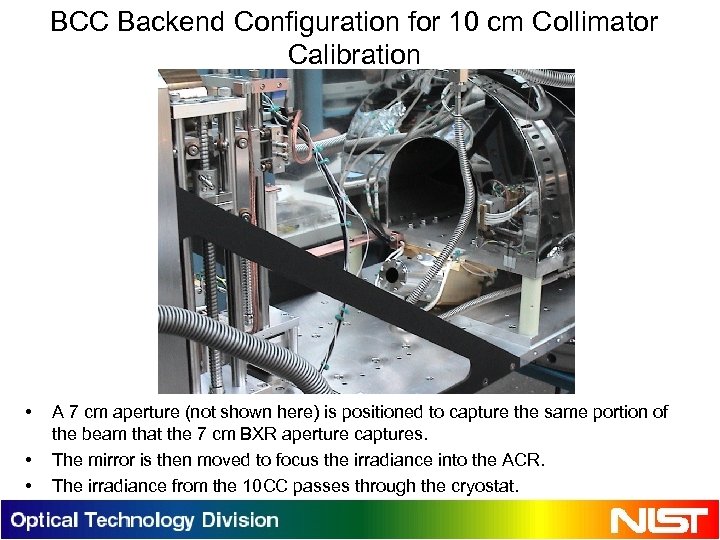
BCC Backend Configuration for 10 cm Collimator Calibration • • • A 7 cm aperture (not shown here) is positioned to capture the same portion of the beam that the 7 cm BXR aperture captures. The mirror is then moved to focus the irradiance into the ACR. The irradiance from the 10 CC passes through the cryostat. 3/19/2018 7
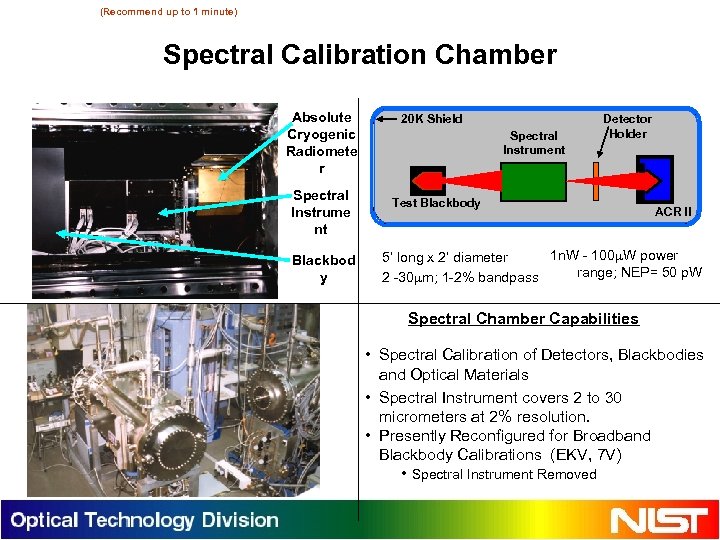
(Recommend up to 1 minute) Spectral Calibration Chamber Absolute Cryogenic Radiomete r Spectral Instrume nt Blackbod y 20 K Shield Spectral Instrument Detector Holder Test Blackbody ACR II 1 n. W - 100 W power 5’ long x 2’ diameter range; NEP= 50 p. W 2 -30 m; 1 -2% bandpass Spectral Chamber Capabilities • Spectral Calibration of Detectors, Blackbodies and Optical Materials • Spectral Instrument covers 2 to 30 micrometers at 2% resolution. • Presently Reconfigured for Broadband Blackbody Calibrations (EKV, 7 V) • Spectral Instrument Removed Space Sensor Test Facility 3/19/2018 8
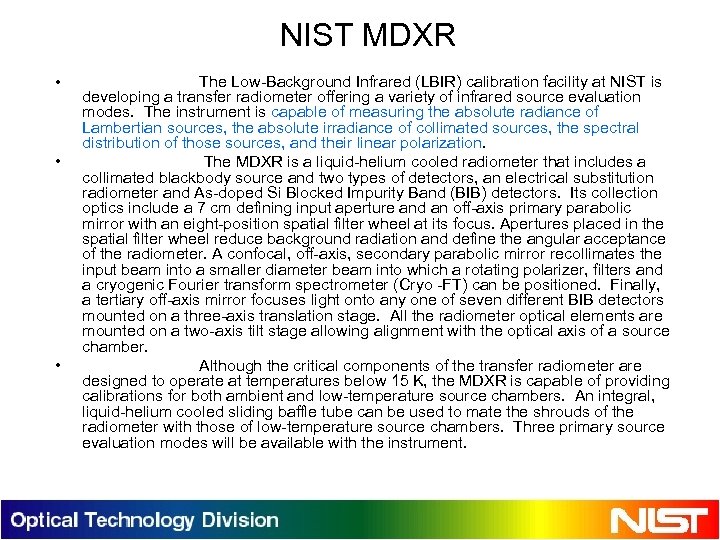
NIST MDXR • • • The Low-Background Infrared (LBIR) calibration facility at NIST is developing a transfer radiometer offering a variety of infrared source evaluation modes. The instrument is capable of measuring the absolute radiance of Lambertian sources, the absolute irradiance of collimated sources, the spectral distribution of those sources, and their linear polarization. The MDXR is a liquid-helium cooled radiometer that includes a collimated blackbody source and two types of detectors, an electrical substitution radiometer and As-doped Si Blocked Impurity Band (BIB) detectors. Its collection optics include a 7 cm defining input aperture and an off-axis primary parabolic mirror with an eight-position spatial filter wheel at its focus. Apertures placed in the spatial filter wheel reduce background radiation and define the angular acceptance of the radiometer. A confocal, off-axis, secondary parabolic mirror recollimates the input beam into a smaller diameter beam into which a rotating polarizer, filters and a cryogenic Fourier transform spectrometer (Cryo -FT) can be positioned. Finally, a tertiary off-axis mirror focuses light onto any one of seven different BIB detectors mounted on a three-axis translation stage. All the radiometer optical elements are mounted on a two-axis tilt stage allowing alignment with the optical axis of a source chamber. Although the critical components of the transfer radiometer are designed to operate at temperatures below 15 K, the MDXR is capable of providing calibrations for both ambient and low-temperature source chambers. An integral, liquid-helium cooled sliding baffle tube can be used to mate the shrouds of the radiometer with those of low-temperature source chambers. Three primary source evaluation modes will be available with the instrument. 3/19/2018 9
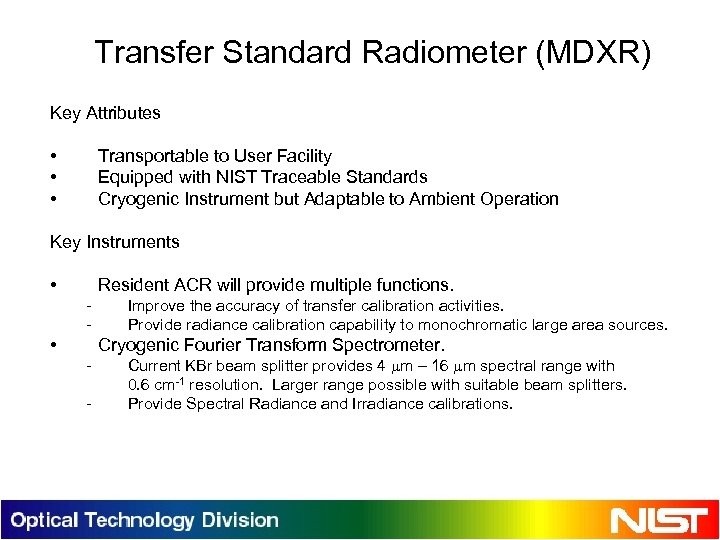
Transfer Standard Radiometer (MDXR) Key Attributes • • • Transportable to User Facility Equipped with NIST Traceable Standards Cryogenic Instrument but Adaptable to Ambient Operation Key Instruments • Resident ACR will provide multiple functions. - • Improve the accuracy of transfer calibration activities. Provide radiance calibration capability to monochromatic large area sources. Cryogenic Fourier Transform Spectrometer. - 3/19/2018 Current KBr beam splitter provides 4 m – 16 m spectral range with 0. 6 cm-1 resolution. Larger range possible with suitable beam splitters. Provide Spectral Radiance and Irradiance calibrations. 10
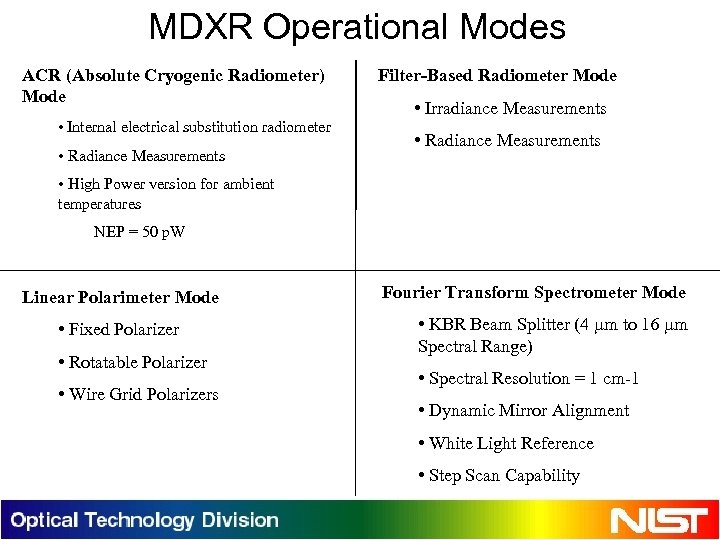
MDXR Operational Modes ACR (Absolute Cryogenic Radiometer) Mode • Internal electrical substitution radiometer • Radiance Measurements Filter-Based Radiometer Mode • Irradiance Measurements • Radiance Measurements • High Power version for ambient temperatures NEP = 50 p. W Linear Polarimeter Mode • Fixed Polarizer • Rotatable Polarizer • Wire Grid Polarizers Fourier Transform Spectrometer Mode • KBR Beam Splitter (4 m to 16 m Spectral Range) • Spectral Resolution = 1 cm-1 • Dynamic Mirror Alignment • White Light Reference • Step Scan Capability 3/19/2018 11
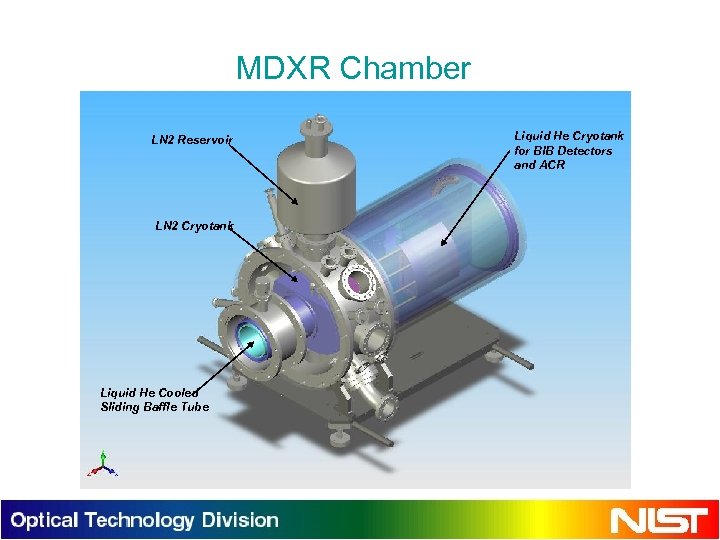
MDXR Chamber LN 2 Reservoir Liquid He Cryotank for BIB Detectors and ACR LN 2 Cryotank Liquid He Cooled Sliding Baffle Tube 3/19/2018 12
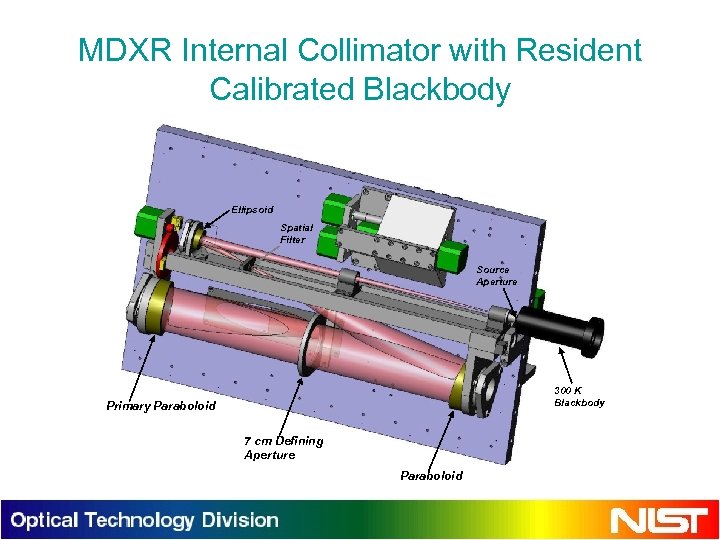
MDXR Internal Collimator with Resident Calibrated Blackbody Ellipsoid Spatial Filter Source Aperture 300 K Blackbody Primary Paraboloid 7 cm Defining Aperture Paraboloid 3/19/2018 13
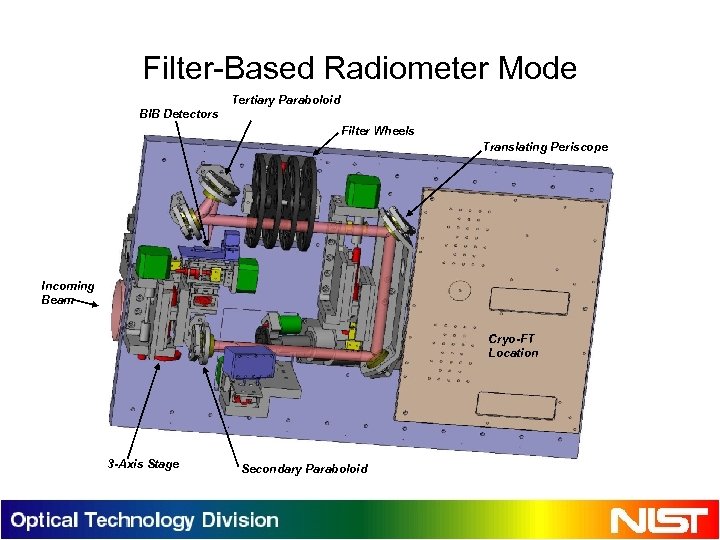
Filter-Based Radiometer Mode Tertiary Paraboloid BIB Detectors Filter Wheels Translating Periscope Incoming Beam Cryo-FT Location 3 -Axis Stage 3/19/2018 Secondary Paraboloid 14

MDXR Calibration Chain NIST High-Accuracy Cryogenic Radiometer (POWR) Using Calibrated Si Trap Detector Intercomparison NIST LBIR Absolute Cryogenic Radiometer (ACR) Using 7 cm Defining Aperture And Parabolic Mirror NIST 10 cm Collimator (10 CC) Using Absolute Filter, Mirror, and Aperture Measurements Water Bath BB NIST Transfer Radiometer (MDXR) MDXR ACR III Using NIST Diffraction Modeling User Facility - Radiance and Irradiance Calibrations 3/19/2018 15
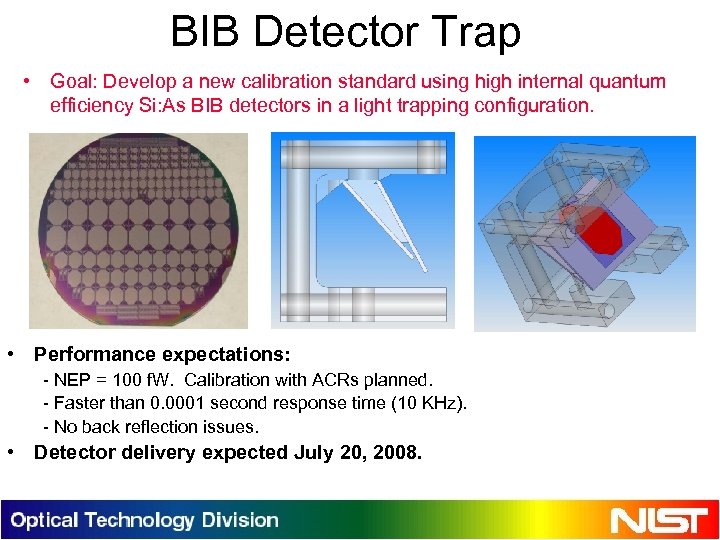
BIB Detector Trap • Goal: Develop a new calibration standard using high internal quantum efficiency Si: As BIB detectors in a light trapping configuration. • Performance expectations: - NEP = 100 f. W. Calibration with ACRs planned. - Faster than 0. 0001 second response time (10 KHz). - No back reflection issues. • Detector delivery expected July 20, 2008. 3/19/2018 16
Summary • LBIR ACRs provide radiance temperature measurements for blackbodies having emissivity close to unity. Current uncertainty for ambient BB – (1σ) 100 m. K, Future (1σ) 30 m. K. • Transportable transfer radiometer (MDXR) on horizon – Radiance and irradiance calibrations with spectral possibilities. • Highly sensitive, linear and flat response BIB trap detectors that cover the range 2 to 30 m will be delivered to NIST this summer. NEP = 100 f. W. 3/19/2018 17
Backup Slides 3/19/2018 18
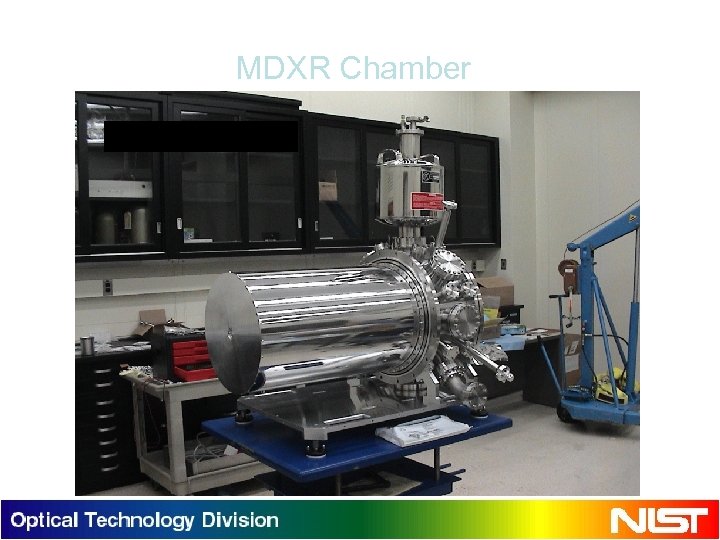
MDXR Chamber Outer titanium chamber removed to reveal liquid nitrogen cryoshroud 3/19/2018 19
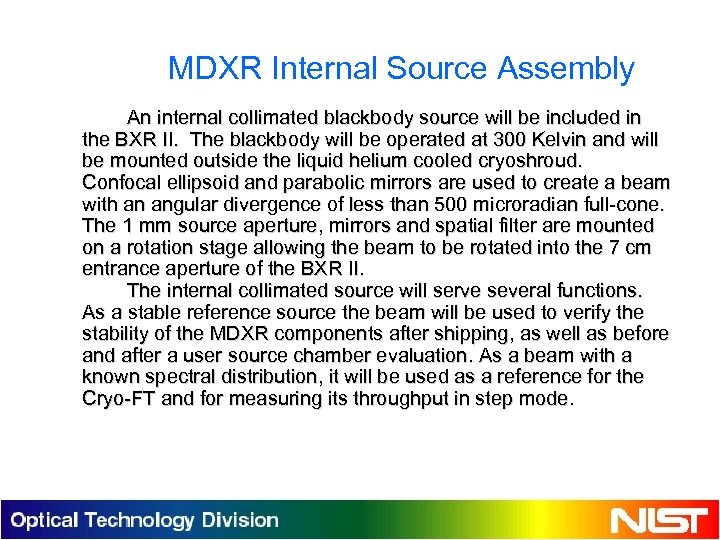
MDXR Internal Source Assembly An internal collimated blackbody source will be included in the BXR II. The blackbody will be operated at 300 Kelvin and will be mounted outside the liquid helium cooled cryoshroud. Confocal ellipsoid and parabolic mirrors are used to create a beam with an angular divergence of less than 500 microradian full-cone. The 1 mm source aperture, mirrors and spatial filter are mounted on a rotation stage allowing the beam to be rotated into the 7 cm entrance aperture of the BXR II. The internal collimated source will serve several functions. As a stable reference source the beam will be used to verify the stability of the MDXR components after shipping, as well as before and after a user source chamber evaluation. As a beam with a known spectral distribution, it will be used as a reference for the Cryo-FT and for measuring its throughput in step mode. 3/19/2018 20
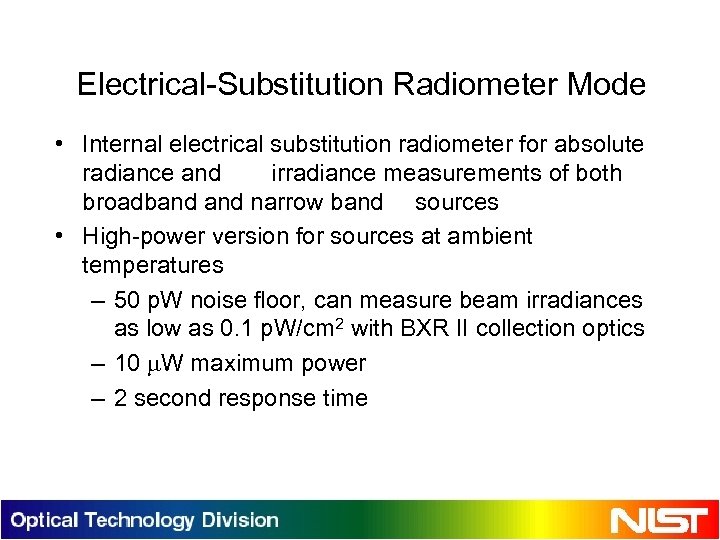
Electrical-Substitution Radiometer Mode • Internal electrical substitution radiometer for absolute radiance and irradiance measurements of both broadband narrow band sources • High-power version for sources at ambient temperatures – 50 p. W noise floor, can measure beam irradiances as low as 0. 1 p. W/cm 2 with BXR II collection optics – 10 W maximum power – 2 second response time 3/19/2018 21
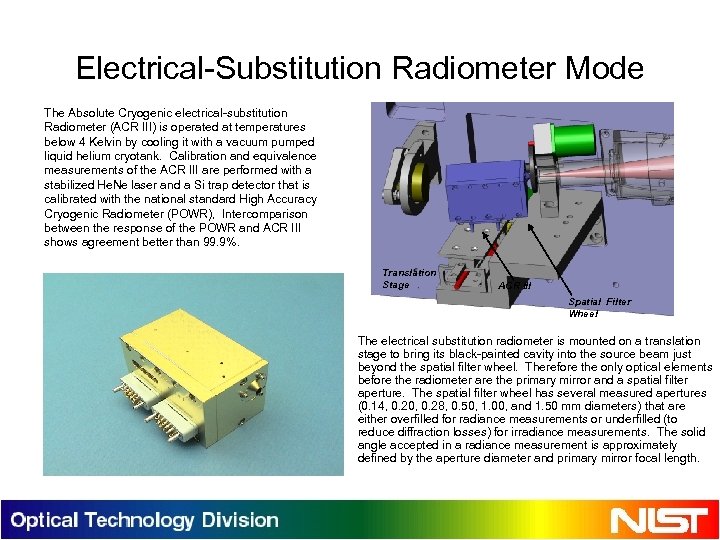
Electrical-Substitution Radiometer Mode The Absolute Cryogenic electrical-substitution Radiometer (ACR III) is operated at temperatures below 4 Kelvin by cooling it with a vacuum pumped liquid helium cryotank. Calibration and equivalence measurements of the ACR III are performed with a stabilized He. Ne laser and a Si trap detector that is calibrated with the national standard High Accuracy Cryogenic Radiometer (POWR), Intercomparison between the response of the POWR and ACR III shows agreement better than 99. 9%. Translation Stage ACR III Spatial Filter Wheel • 3/19/2018 The electrical substitution radiometer is mounted on a translation stage to bring its black-painted cavity into the source beam just beyond the spatial filter wheel. Therefore the only optical elements before the radiometer are the primary mirror and a spatial filter aperture. The spatial filter wheel has several measured apertures (0. 14, 0. 20, 0. 28, 0. 50, 1. 00, and 1. 50 mm diameters) that are either overfilled for radiance measurements or underfilled (to reduce diffraction losses) for irradiance measurements. The solid angle accepted in a radiance measurement is approximately defined by the aperture diameter and primary mirror focal length. 22
Filter-Based Radiometer Mode • • As-doped Si BIB detectors and they configured in a trap versin are the primary detectors Irradiance measurements – Required user source collimation O 1 mrad full cone – Measures collimated beams with irradiance levels between 10 -15 W/cm 2 and 10 -9 W/cm 2 {BIBs NEP=100 femto watts) – MDXR is calibrated for these measurements using a calibrated collimator, the NIST 10 cm Collimator (10 CC) • Radiance measurements – Can use 0. 14, 0. 20, and 0. 28 mm diameter spatial filter apertures corresponding to 0. 38, 0. 54 and 0. 76 mrad full cone acceptance angles – MDXR is calibrated for these measurements using a calibrated, large area blackbody source, the NIST LBIR Waterbath blackbody 3/19/2018 23
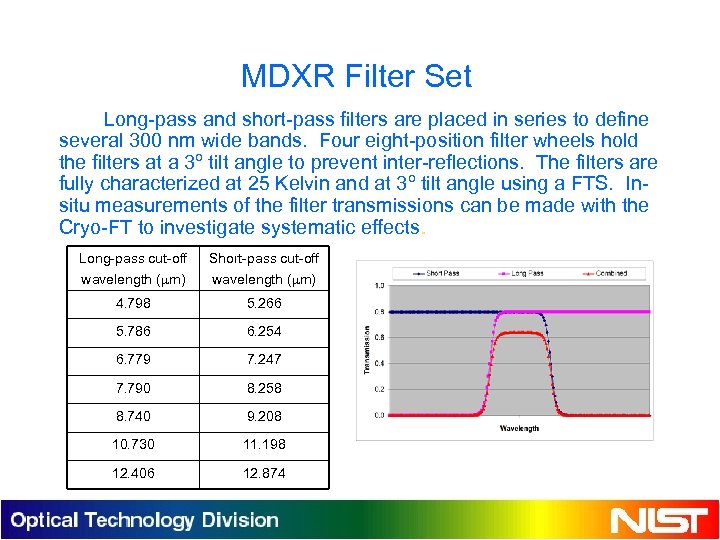
MDXR Filter Set Long-pass and short-pass filters are placed in series to define several 300 nm wide bands. Four eight-position filter wheels hold the filters at a 3 o tilt angle to prevent inter-reflections. The filters are fully characterized at 25 Kelvin and at 3 o tilt angle using a FTS. Insitu measurements of the filter transmissions can be made with the Cryo-FT to investigate systematic effects. Long-pass cut-off wavelength ( m) Short-pass cut-off wavelength ( m) 4. 798 5. 266 5. 786 6. 254 6. 779 7. 247 7. 790 8. 258 8. 740 9. 208 10. 730 11. 198 12. 406 12. 874 3/19/2018 24
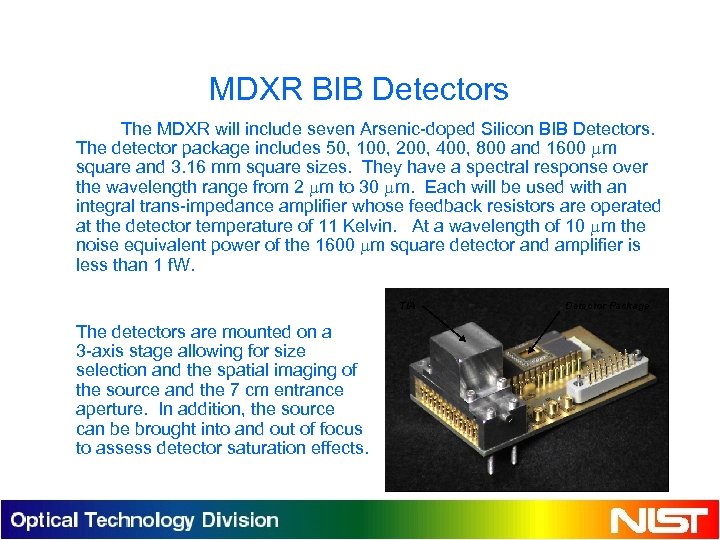
MDXR BIB Detectors The MDXR will include seven Arsenic-doped Silicon BIB Detectors. The detector package includes 50, 100, 200, 400, 800 and 1600 m square and 3. 16 mm square sizes. They have a spectral response over the wavelength range from 2 m to 30 m. Each will be used with an integral trans-impedance amplifier whose feedback resistors are operated at the detector temperature of 11 Kelvin. At a wavelength of 10 m the noise equivalent power of the 1600 m square detector and amplifier is less than 1 f. W. TIA Detector Package The detectors are mounted on a 3 -axis stage allowing for size selection and the spatial imaging of the source and the 7 cm entrance aperture. In addition, the source can be brought into and out of focus to assess detector saturation effects. 3/19/2018 25
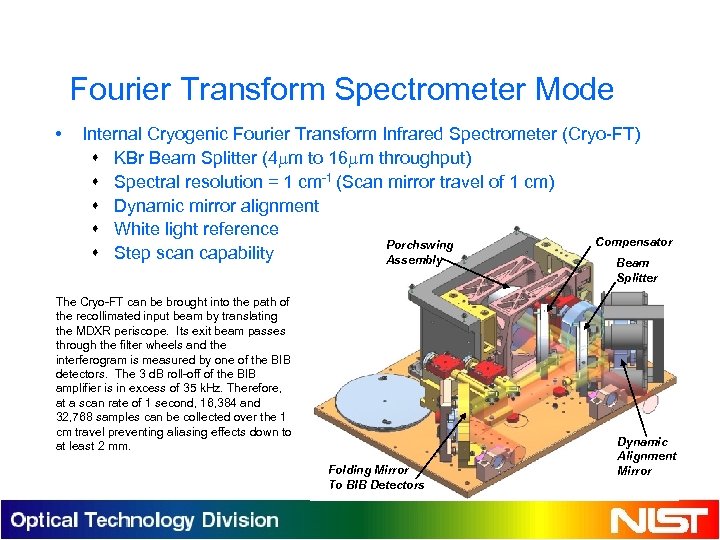
Fourier Transform Spectrometer Mode • Internal Cryogenic Fourier Transform Infrared Spectrometer (Cryo-FT) s KBr Beam Splitter (4 m to 16 m throughput) s Spectral resolution = 1 cm-1 (Scan mirror travel of 1 cm) s Dynamic mirror alignment s White light reference Compensator Porchswing s Step scan capability Assembly Beam Splitter The Cryo-FT can be brought into the path of the recollimated input beam by translating the MDXR periscope. Its exit beam passes through the filter wheels and the interferogram is measured by one of the BIB detectors. The 3 d. B roll-off of the BIB amplifier is in excess of 35 k. Hz. Therefore, at a scan rate of 1 second, 16, 384 and 32, 768 samples can be collected over the 1 cm travel preventing aliasing effects down to at least 2 mm. Folding Mirror To BIB Detectors 3/19/2018 Dynamic Alignment Mirror 26
Linear Polarimeter Mode • Rotatable polarizer placed after Mersenne telescope • Fixed polarizer placed in filter wheel to define laboratory orientation • Wire Grid Polarizers on Zn. Se substrates s Contrast ratios of 135 at 5 m and 140 at 10 m • Linear Polarization can be measured through the complete filter set 3/19/2018 27
MDXR Status • Modeling Completed (2005) • Capabilities will become available in three phases corresponding to the three primary source evaluation modes s Electrical-substitution radiometer mode (Summer 2008) s Filter-based radiometer mode (Fall 2008) s Fourier transform radiometer mode (Winter 2008) 3/19/2018 28
Скачать презентацию NIST LBIR Capabilities for Absolute Radiometric Calibrations Dr
5521dc7d06a0860ae77a9e89b8b2fa95.ppt