

“NIS PMD SHYMKENT” Economics grade 12 “The Monetary




 Скачать презентацию “NIS PMD SHYMKENT” Economics grade 12 “The Monetary
40902-functions_of_money.ppt
- Количество слайдов: 33
“NIS PMD SHYMKENT” Economics grade 12
“The Monetary System”
Contents Definition of Money… Kinds Of Money Functions Of Money The Demand For Money Four Money Supply definitions Determination of Rate of Interest
What is Money????
“Money is a good that acts as a medium of exchange in transactions, it is said that money act as a unit of account, a store of value and medium of exchange”
Properties Of Money Liquidity Scarcity Portability Uniformity
Kinds Of Money Commodity money Convertible paper money Inconvertible money Bank deposits Electronic money
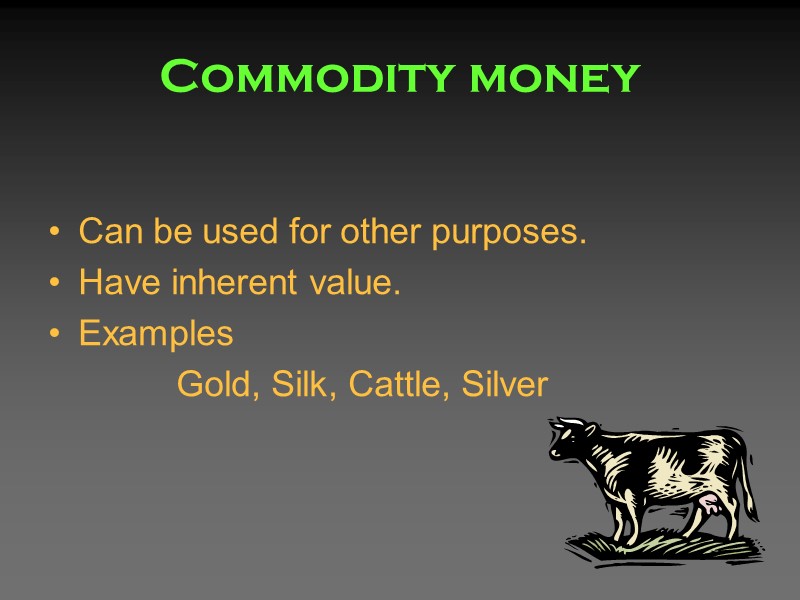
Commodity money Can be used for other purposes. Have inherent value. Examples Gold, Silk, Cattle, Silver
Convertible Paper Money The paper money that can be convertible into gold and silver. Examples are Gold and Silver certificates…
Inconvertible Paper Money The paper money that can’t be converted into Gold and Silver. Also called as Legal Tender Money. Examples are Notes and Coins issued by government.
Bank Deposits In current society most of the money used is Bank deposits… Examples of Bank Deposits are Demand deposits Savings deposits Time deposits Negotiable certificates of deposit
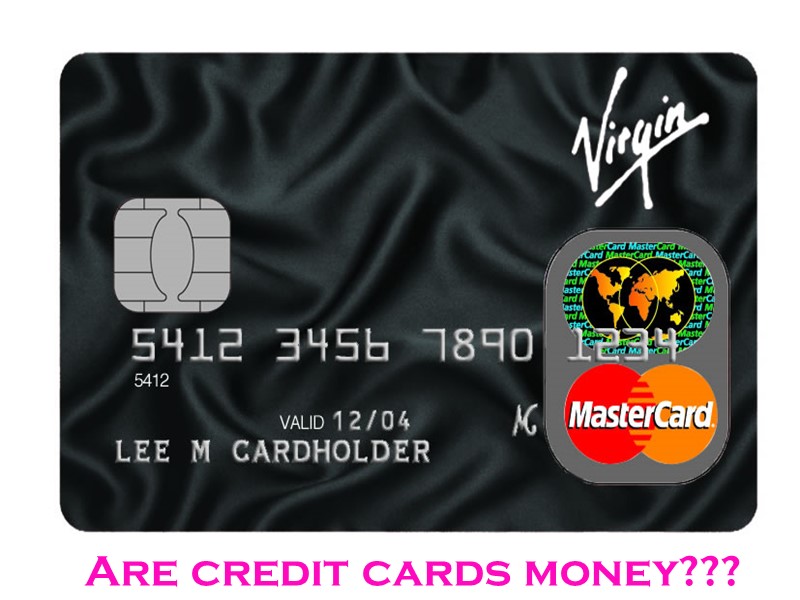
Electronic Money The money stored in certain electronic cash cards. Transactions are made electronically. Examples are Credit Card, Debit card, Charge card etc…
Functions of Money
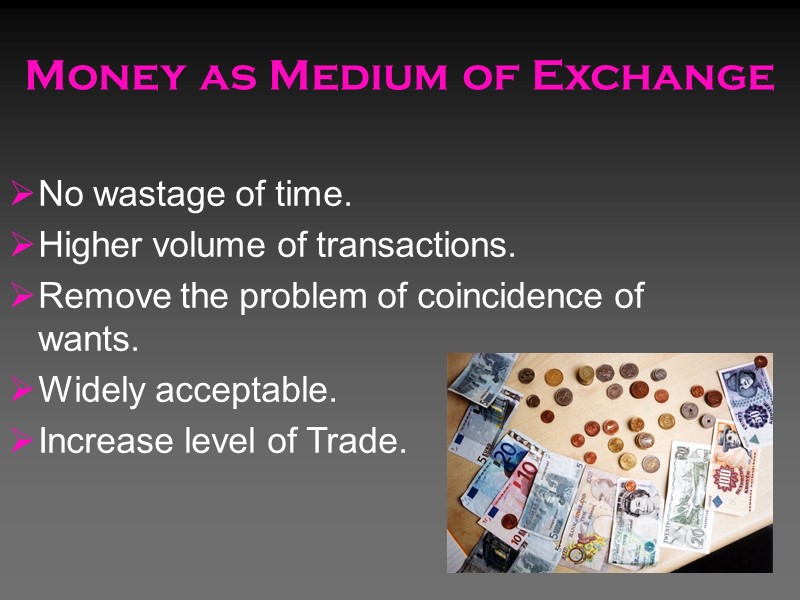
Money as Medium of Exchange No wastage of time. Higher volume of transactions. Remove the problem of coincidence of wants. Widely acceptable. Increase level of Trade.
Money as a unit of Account Provide a common measurement for the relative value of goods. The monitory unit may have different name in different countries.
Money as a store of Value Ability of money to store value over the time. Durability factor enables to convert your income into future purchases. Completely liquid. However inflation can destroy this function.
Are credit cards money???
Why people hold money???
Three motives of holding money!!! Transactions Demand Precautionary Demand Speculative Demand
Transactions Demand Stock of money to pay everyday expenses. Quick and easy purchases are main push to hold money. The holder has to suffer “cost of holding”, namely interest rate you forego.
Precautionary Motives The stock of money for uncertain expenses. People who don’t want to go for loans have great interest to hold money. Opportunity cost incurs of the interest forego.
Speculative Motives Holding of money due to the expected rise in interest rates. People use to convert their money into interest bearing instruments such as bonds, stocks and other non-money financial assets. People hold more when interest rate is low and hold less when interest rate is high.
INTEREST The major factor to determine the stock of money held by people is the INTEREST!!!
Money Supply Definitions
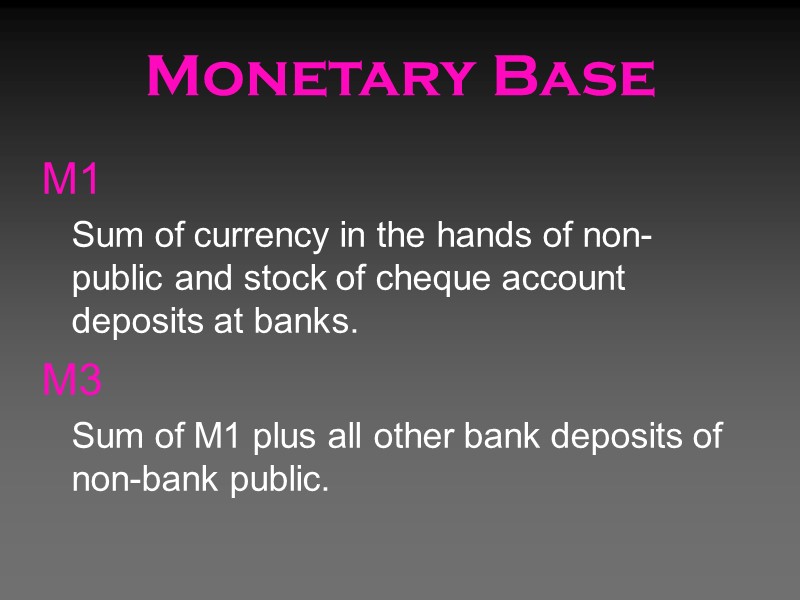
Monetary Base M1 Sum of currency in the hands of non-public and stock of cheque account deposits at banks. M3 Sum of M1 plus all other bank deposits of non-bank public.
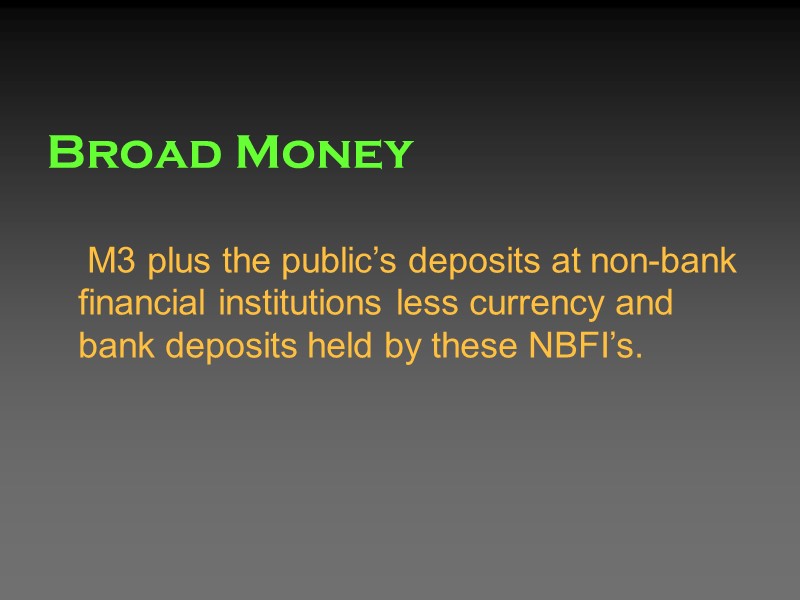
Broad Money M3 plus the public’s deposits at non-bank financial institutions less currency and bank deposits held by these NBFI’s.
Currency Includes coins and paper money. It constitute 20% of the M1 money supply. Its purpose is to make small purchases.
Cheque Account Deposits The total of cheque accounts balances in banks convertible to currency on demand by writing a cheque without advance notice. Saving Deposits Inteset bearing accounts in banks drawnable by issuing pass book.
Determination of Interest Rate
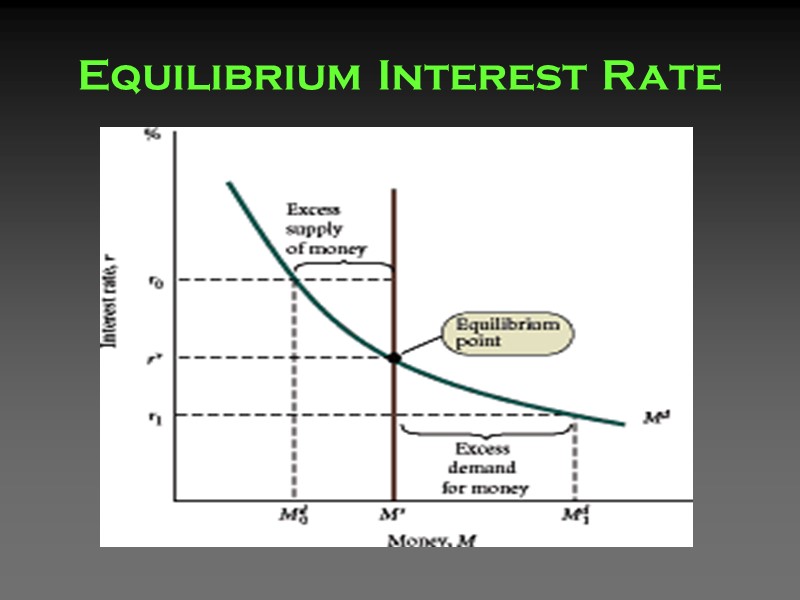
Equilibrium Interest Rate
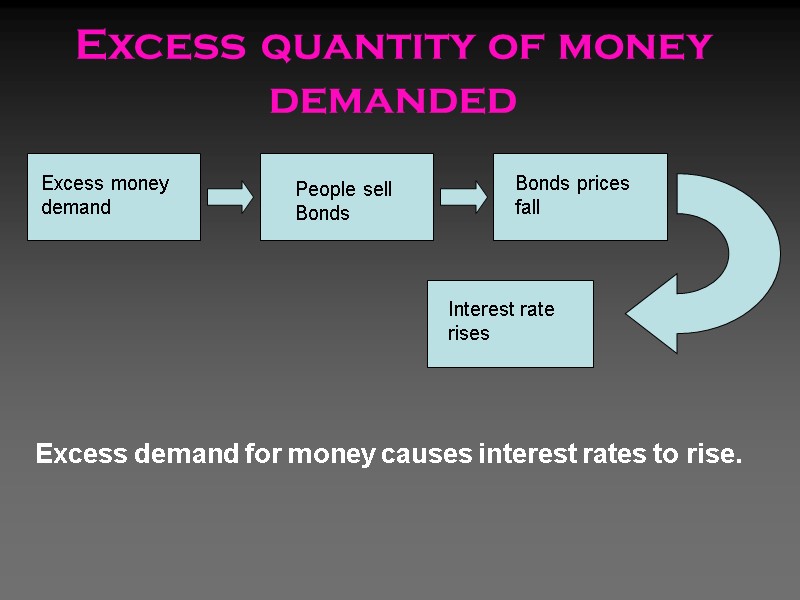
Excess quantity of money demanded Excess money demand Interest rate rises People sell Bonds Bonds prices fall Excess demand for money causes interest rates to rise.
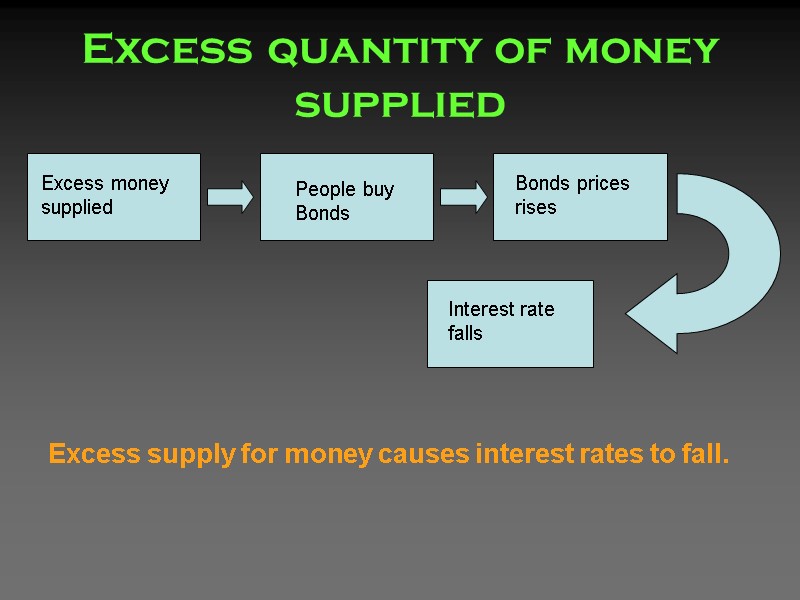
Excess quantity of money supplied Excess money supplied Interest rate falls People buy Bonds Bonds prices rises Excess supply for money causes interest rates to fall.
Thanks a lottt!!!