 Скачать презентацию NIRT Self-Assembled Nanohydrogels for Differential Cell Adhesion and
1857c9350c69c52ce895adb380bd3171.ppt
- Количество слайдов: 1



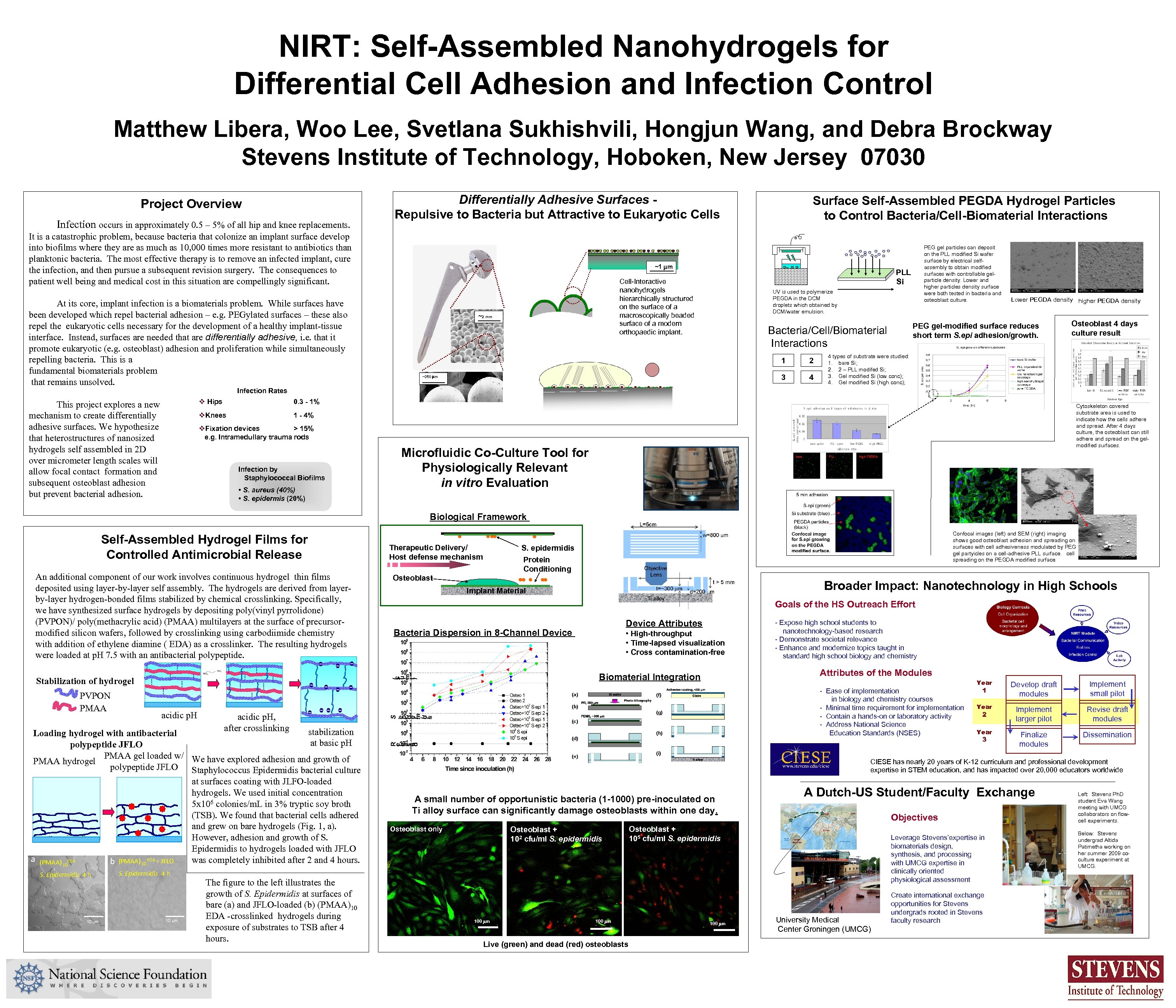
NIRT: Self-Assembled Nanohydrogels for Differential Cell Adhesion and Infection Control Matthew Libera, Woo Lee, Svetlana Sukhishvili, Hongjun Wang, and Debra Brockway Stevens Institute of Technology, Hoboken, New Jersey 07030 Project Overview Infection occurs in approximately 0. 5 – 5% of all hip and knee replacements. Differentially Adhesive Surfaces Repulsive to Bacteria but Attractive to Eukaryotic Cells It is a catastrophic problem, because bacteria that colonize an implant surface develop into biofilms where they are as much as 10, 000 times more resistant to antibiotics than planktonic bacteria. The most effective therapy is to remove an infected implant, cure the infection, and then pursue a subsequent revision surgery. The consequences to patient well being and medical cost in this situation are compellingly significant. At its core, implant infection is a biomaterials problem. While surfaces have been developed which repel bacterial adhesion – e. g. PEGylated surfaces – these also repel the eukaryotic cells necessary for the development of a healthy implant-tissue interface. Instead, surfaces are needed that are differentially adhesive, i. e. that it promote eukaryotic (e. g. osteoblast) adhesion and proliferation while simultaneously repelling bacteria. This is a fundamental biomaterials problem that remains unsolved. Surface Self-Assembled PEGDA Hydrogel Particles to Control Bacteria/Cell-Biomaterial Interactions ~1 m PLL Si Cell-Interactive nanohydrogels hierarchically structured on the surface of a macroscopically beaded surface of a modern orthopaedic implant. ~2 mm PEG gel particles can deposit on the PLL modified Si wafer surface by electrical selfassembly to obtain modified surfaces with controllable gelparticle density. Lower and higher particles density surface were both tested in bacteria and osteoblast culture. UV is used to polymerize PEGDA in the DCM droplets which obtained by DCM/water emulsion. PEG gel-modified surface reduces short term S. epi adhesion/growth. Bacteria/Cell/Biomaterial Interactions 1 3 ~350 m 2 4 Lower PEGDA density higher PEGDA density Osteoblast 4 days culture result 4 types of substrate were studied: 1. bare Si; 2. 2 – PLL modifed Si; 3. Gel modified Si (low conc); 4. Gel modified Si (high conc); Infection Rates v Hips 0. 3 - 1% v. Knees This project explores a new mechanism to create differentially adhesive surfaces. We hypothesize that heterostructures of nanosized hydrogels self assembled in 2 D over micrometer length scales will allow focal contact formation and subsequent osteoblast adhesion but prevent bacterial adhesion. 1 - 4% Cytoskeleton covered substrate area is used to indicate how the cells adhere and spread. After 4 days culture, the osteoblast can still adhere and spread on the gelmodified surfaces. v. Fixation devices > 15% e. g. Intramedullary trauma rods Infection by Staphylococcal Biofilms • S. aureus (40%) • S. epidermis (20%) Microfluidic Co-Culture Tool for Physiologically Relevant in vitro Evaluation bare PLL high PEGDA Biological Framework Self-Assembled Hydrogel Films for Controlled Antimicrobial Release An additional component of our work involves continuous hydrogel thin films deposited using layer-by-layer self assembly. The hydrogels are derived from layerby-layer hydrogen-bonded films stabilized by chemical crosslinking. Specifically, we have synthesized surface hydrogels by depositing poly(vinyl pyrrolidone) (PVPON)/ poly(methacrylic acid) (PMAA) multilayers at the surface of precursormodified silicon wafers, followed by crosslinking using carbodiimide chemistry with addition of ethylene diamine ( EDA) as a crosslinker. The resulting hydrogels were loaded at p. H 7. 5 with an antibacterial polypeptide. Therapeutic Delivery/ Host defense mechanism S. epidermidis Protein Conditioning Osteoblast Broader Impact: Nanotechnology in High Schools Implant Material Goals of the HS Outreach Effort 10 μm • High-throughput • Time-lapsed visualization • Cross contamination-free (a) - Ease of implementation in biology and chemistry courses - Minimal time requirement for implementation - Contain a hands-on or laboratory activity - Address National Science Education Standards (NSES) (f) (b) acidic p. H S. Epidermidis 4 h 10 μm (g) acidic p. H, after crosslinking The figure to the left illustrates the growth of S. Epidermidis at surfaces of bare (a) and JFLO-loaded (b) (PMAA)10 EDA -crosslinked hydrogels during exposure of substrates to TSB after 4 hours. (c) (h) (d) Develop draft modules Implement small pilot Year 2 Implement larger pilot Revise draft modules Year 3 Finalize modules Dissemination CIESE has nearly 20 years of K-12 curriculum and professional development expertise in STEM education, and has impacted over 20, 000 educators worldwide A small number of opportunistic bacteria (1 -1000) pre-inoculated on Ti alloy surface can significantly damage osteoblasts within one day. Osteoblast + 102 cfu/ml S. epidermidis 100 m Year 1 (i) (e) Osteoblast only - Expose high school students to nanotechnology-based research - Demonstrate societal relevance - Enhance and modernize topics taught in standard high school biology and chemistry Attributes of the Modules Biomaterial Integration stabilization Loading hydrogel with antibacterial at basic p. H polypeptide JFLO PMAA gel loaded w/ We have explored adhesion and growth of PMAA hydrogel polypeptide JFLO Staphylococcus Epidermidis bacterial culture at surfaces coating with JLFO-loaded hydrogels. We used initial concentration 5 x 10⁶ colonies/m. L in 3% tryptic soy broth (TSB). We found that bacterial cells adhered and grew on bare hydrogels (Fig. 1, a). However, adhesion and growth of S. Epidermidis to hydrogels loaded with JFLO a (PMAA) 10 EDA was completely inhibited after 2 and 4 hours. b (PMAA) 10 EDA + JFLO S. Epidermidis 4 h Device Attributes Bacteria Dispersion in 8 -Channel Device Stabilization of hydrogel PVPON PMAA Confocal images (left) and SEM (right) imaging shows good osteoblast adhesion and spreading on surfaces with cell adhesiveness modulated by PEG gel partyicles on a cell-adhesive PLL surface. cell spreading on the PEGDA modified surface. 100 m Live (green) and dead (red) osteoblasts A Dutch-US Student/Faculty Exchange Objectives Osteoblast + 105 cfu/ml S. epidermidis 100 m Leverage Stevens’expertise in biomaterials design, synthesis, and processing with UMCG expertise in clinically oriented physiological assessment University Medical Center Groningen (UMCG) Create international exchange opportunities for Stevens undergrads rooted in Stevens faculty research Left: Stevens Ph. D student Eva Wang meeting with UMCG collaborators on flowcell experiments. Below: Stevens undergrad Altida Patimetha working on her summer 2009 coculture experiment at UMCG.
Скачать презентацию NIRT Self-Assembled Nanohydrogels for Differential Cell Adhesion and
1857c9350c69c52ce895adb380bd3171.ppt