Скачать презентацию NIKOLA VAPTSAROV NAVAL ACADEMY MARITIME ENGINEERING EDUCATION IN
07019015d8f4af011b20dc3ce3412ada.ppt
- Количество слайдов: 47
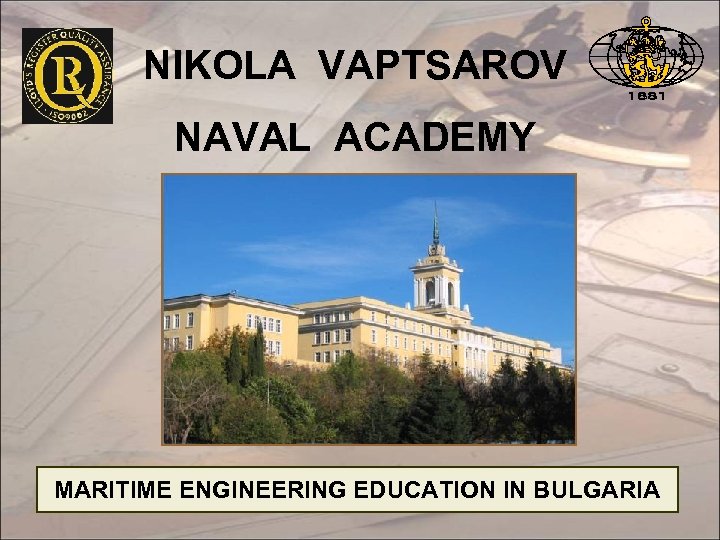 NIKOLA VAPTSAROV NAVAL ACADEMY MARITIME ENGINEERING EDUCATION IN BULGARIA
 OUR MISSION STATEMENT To develop highly qualified leaders for the Bulgarian Navy and the maritime industry; to prepare them for the challenges of the transforming Navy and the rapidly changing sector of the global maritime economy
 MAIN OBJECTIVES ü Higher military and civilian education for the future naval officers ü Doctor’s, Master’s and Bachelor’s degrees for the merchant marine ü Postgraduate training for military and maritime personnel ü Research and Development for the Bulgarian Navy and the maritime industry OTHER OBJECTIVES Technical training and enhancing the qualification of NCOs and sailors
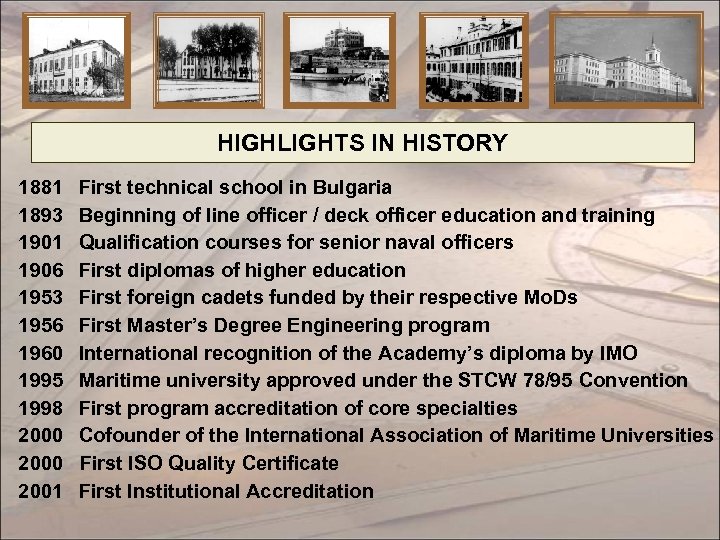 HIGHLIGHTS IN HISTORY 1881 1893 1901 1906 1953 1956 1960 1995 1998 2000 2001 First technical school in Bulgaria Beginning of line officer / deck officer education and training Qualification courses for senior naval officers First diplomas of higher education First foreign cadets funded by their respective Mo. Ds First Master’s Degree Engineering program International recognition of the Academy’s diploma by IMO Maritime university approved under the STCW 78/95 Convention First program accreditation of core specialties Cofounder of the International Association of Maritime Universities First ISO Quality Certificate First Institutional Accreditation
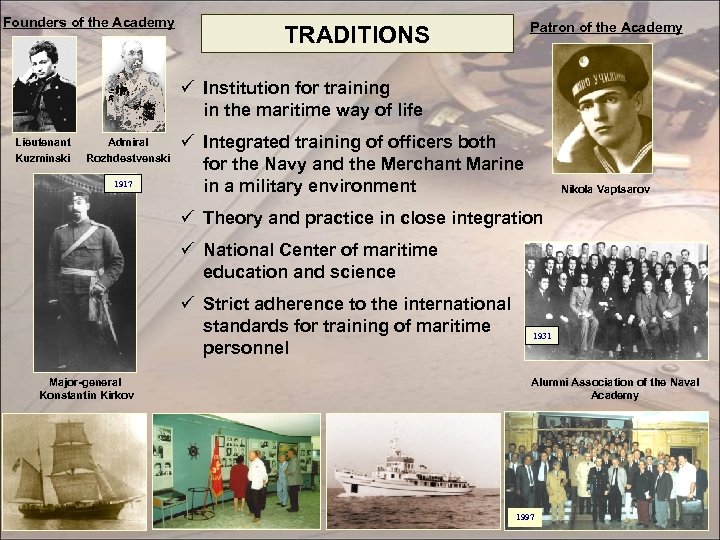 Founders of the Academy Patron of the Academy TRADITIONS ü Institution for training in the maritime way of life Lieutenant Kuzminski Admiral Rozhdestvenski 1917 ü Integrated training of officers both for the Navy and the Merchant Marine in a military environment Nikola Vaptsarov ü Theory and practice in close integration ü National Center of maritime education and science ü Strict adherence to the international standards for training of maritime personnel Major-general Konstantin Kirkov 1931 Alumni Association of the Naval Academy 1997
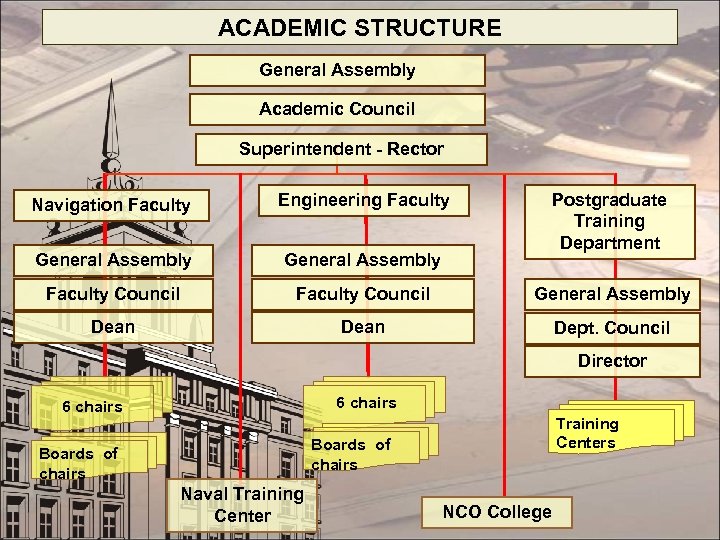 ACADEMIC STRUCTURE General Assembly Academic Council Superintendent - Rector Postgraduate Training Department Navigation Faculty Engineering Faculty General Assembly Faculty Council General Assembly Dean Dept. Council Director 6 chairs Training Centers Boards of chairs Naval Training Center NCO College
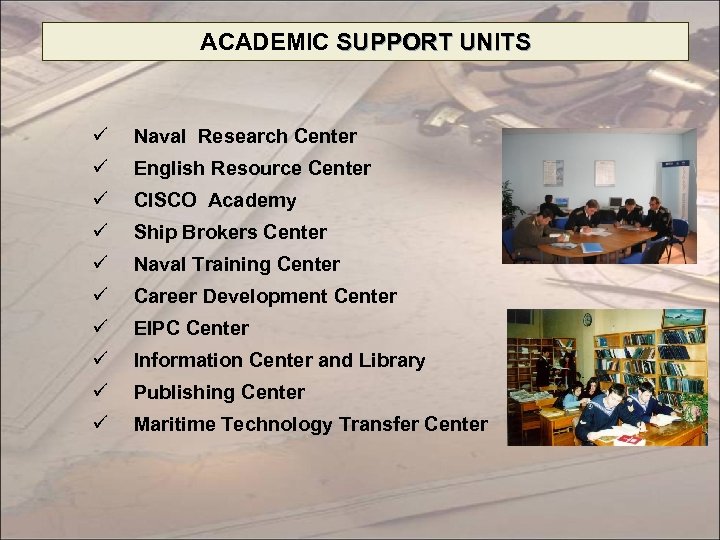 ACADEMIC SUPPORT UNITS ü Naval Research Center ü English Resource Center ü CISCO Academy ü Ship Brokers Center ü Naval Training Center ü Career Development Center ü EIPC Center ü Information Center and Library ü Publishing Center ü Maritime Technology Transfer Center
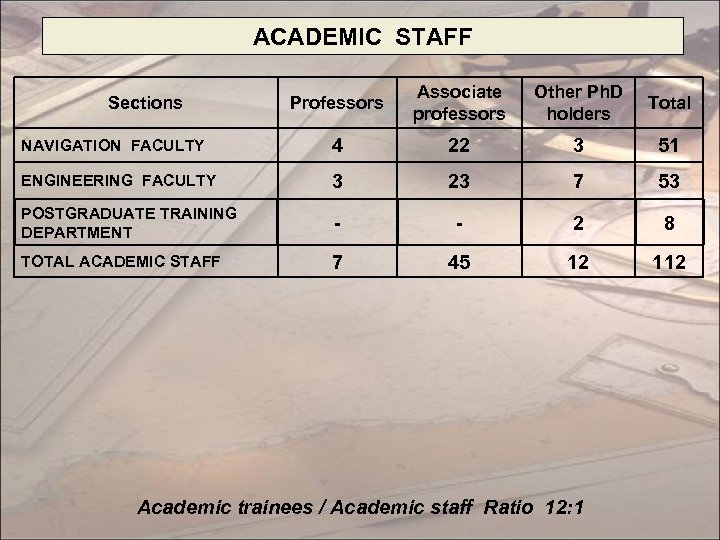 ACADEMIC STAFF Professors Associate professors Other Ph. D holders Total NAVIGATION FACULTY 4 22 3 51 ENGINEERING FACULTY 3 23 7 53 POSTGRADUATE TRAINING DEPARTMENT - - 2 8 TOTAL ACADEMIC STAFF 7 45 12 112 Sections Academic trainees / Academic staff Ratio 12: 1
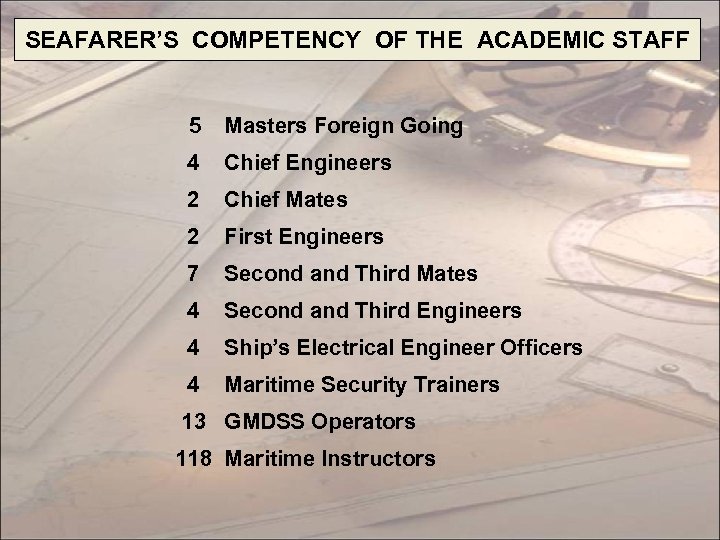 SEAFARER’S COMPETENCY OF THE ACADEMIC STAFF 5 Masters Foreign Going 4 Chief Engineers 2 Chief Mates 2 First Engineers 7 Second and Third Mates 4 Second and Third Engineers 4 Ship’s Electrical Engineer Officers 4 Maritime Security Trainers 13 GMDSS Operators 118 Maritime Instructors
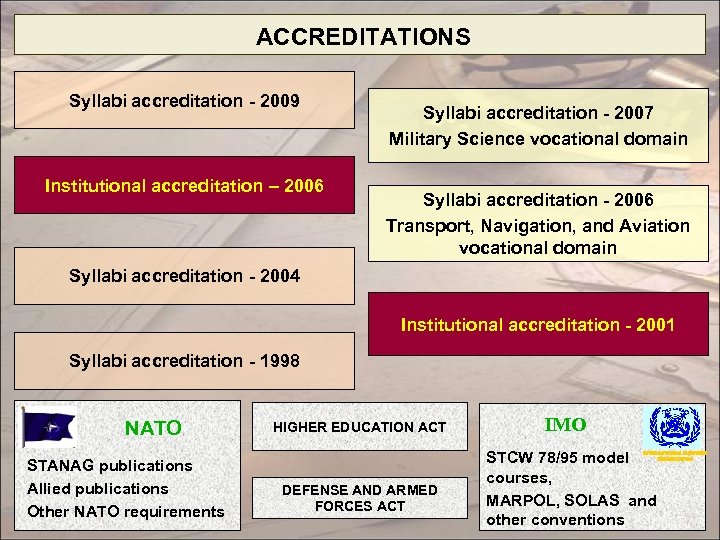 ACCREDITATIONS Syllabi accreditation - 2009 Institutional accreditation – 2006 Syllabi accreditation - 2007 Military Science vocational domain Syllabi accreditation - 2006 Transport, Navigation, and Aviation vocational domain Syllabi accreditation - 2004 Institutional accreditation - 2001 Syllabi accreditation - 1998 NATO STANAG publications Allied publications Other NATO requirements HIGHER EDUCATION ACT DEFENSE AND ARMED FORCES ACT IMO STCW 78/95 model courses, MARPOL, SOLAS and other conventions
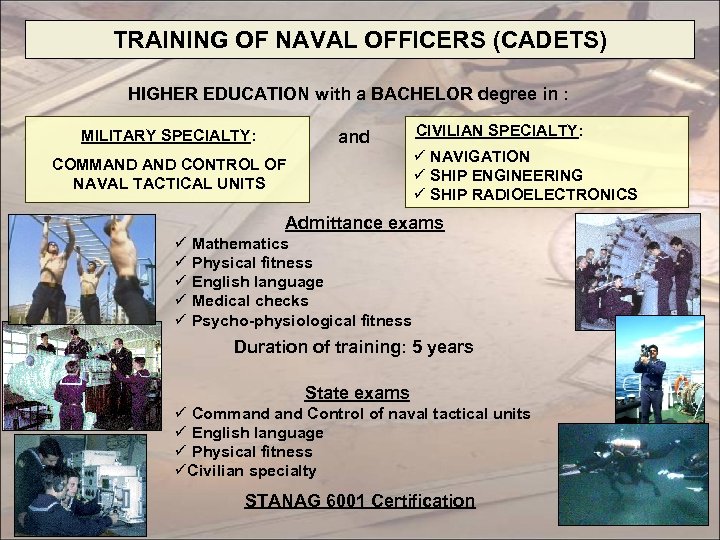 TRAINING OF NAVAL OFFICERS (CADETS) HIGHER EDUCATION with a BACHELOR degree in : and MILITARY SPECIALTY: CIVILIAN SPECIALTY: ü NAVIGATION ü SHIP ENGINEERING ü SHIP RADIOELECTRONICS COMMAND CONTROL OF NAVAL TACTICAL UNITS Admittance exams ü Mathematics ü Physical fitness ü English language ü Medical checks ü Psycho-physiological fitness Duration of training: 5 years State exams ü Command Control of naval tactical units ü English language ü Physical fitness üCivilian specialty STANAG 6001 Certification
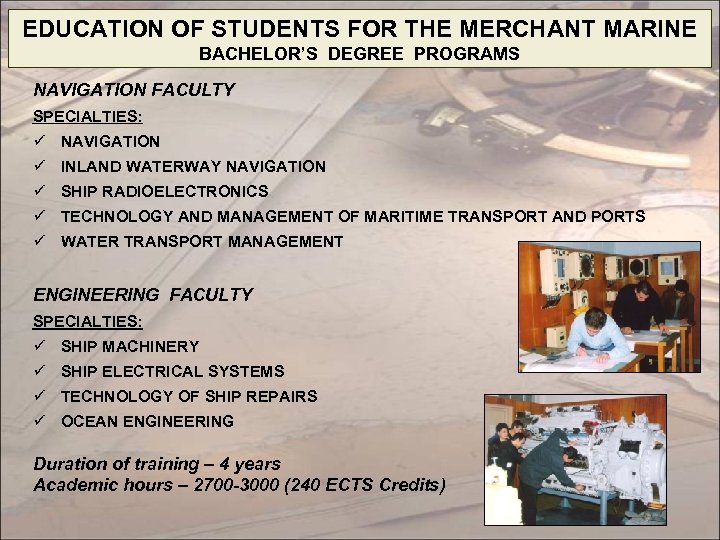 EDUCATION OF STUDENTS FOR THE MERCHANT MARINE BACHELOR’S DEGREE PROGRAMS NAVIGATION FACULTY SPECIALTIES: ü NAVIGATION ü INLAND WATERWAY NAVIGATION ü SHIP RADIOELECTRONICS ü TECHNOLOGY AND MANAGEMENT OF MARITIME TRANSPORT AND PORTS ü WATER TRANSPORT MANAGEMENT ENGINEERING FACULTY SPECIALTIES: ü SHIP MACHINERY ü SHIP ELECTRICAL SYSTEMS ü TECHNOLOGY OF SHIP REPAIRS ü OCEAN ENGINEERING Duration of training – 4 years Academic hours – 2700 -3000 (240 ECTS Credits)
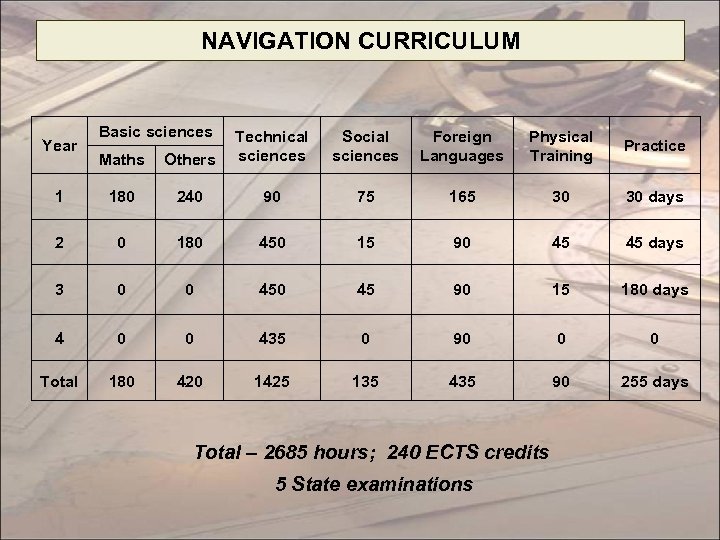 NAVIGATION CURRICULUM Basic sciences Maths Others Technical sciences 1 180 240 90 75 165 30 30 days 2 0 180 450 15 90 45 45 days 3 0 0 45 90 15 180 days 4 0 0 435 0 90 0 0 Total 180 420 1425 135 435 90 255 days Year Social sciences Foreign Languages Physical Training Practice Total – 2685 hours; 240 ECTS credits 5 State examinations
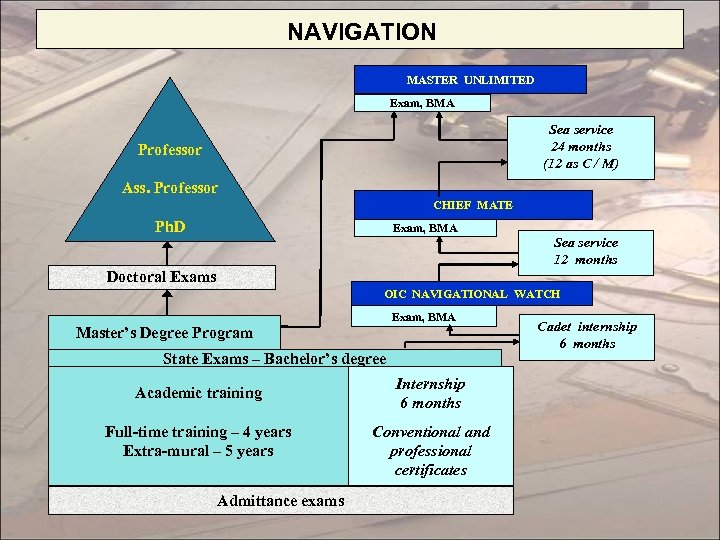 NAVIGATION MASTER UNLIMITED Exam, BMA Sea service 24 months (12 as C / M) Professor Ass. Professor CHIEF MATE Ph. D Exam, BMA Sea service 12 months Doctoral Exams OIC NAVIGATIONAL WATCH Exam, BMA Master’s Degree Program State Exams – Bachelor’s degree Academic training Full-time training – 4 years Extra-mural – 5 years Admittance exams Internship 6 months Conventional and professional certificates Cadet internship 6 months
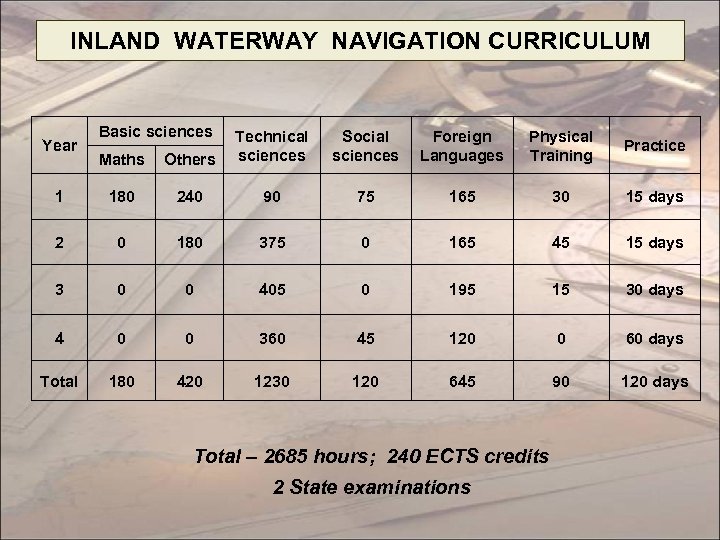 INLAND WATERWAY NAVIGATION CURRICULUM Basic sciences Maths Others Technical sciences 1 180 240 90 75 165 30 15 days 2 0 180 375 0 165 45 15 days 3 0 0 405 0 195 15 30 days 4 0 0 360 45 120 0 60 days Total 180 420 1230 120 645 90 120 days Year Social sciences Foreign Languages Physical Training Practice Total – 2685 hours; 240 ECTS credits 2 State examinations
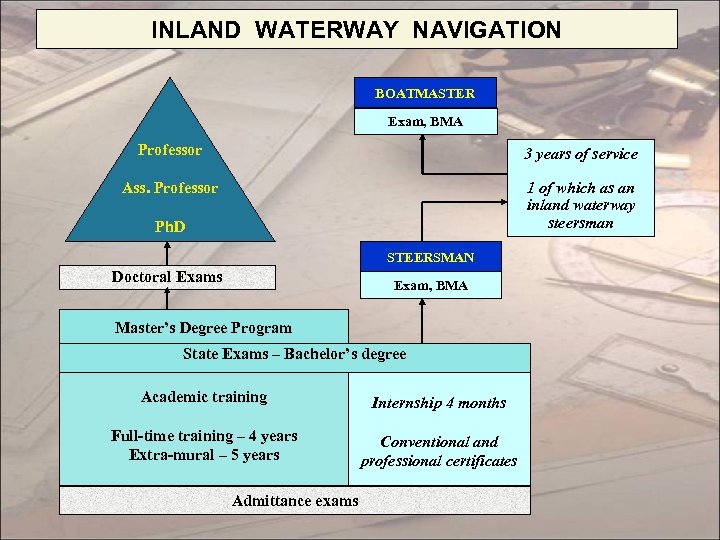 INLAND WATERWAY NAVIGATION BOATMASTER Exam, BMA Professor 3 years of service Ass. Professor 1 of which as an inland waterway steersman Ph. D STEERSMAN Doctoral Exams Exam, BMA Master’s Degree Program State Exams – Bachelor’s degree Academic training Internship 4 months Full-time training – 4 years Extra-mural – 5 years Conventional and professional certificates Admittance exams
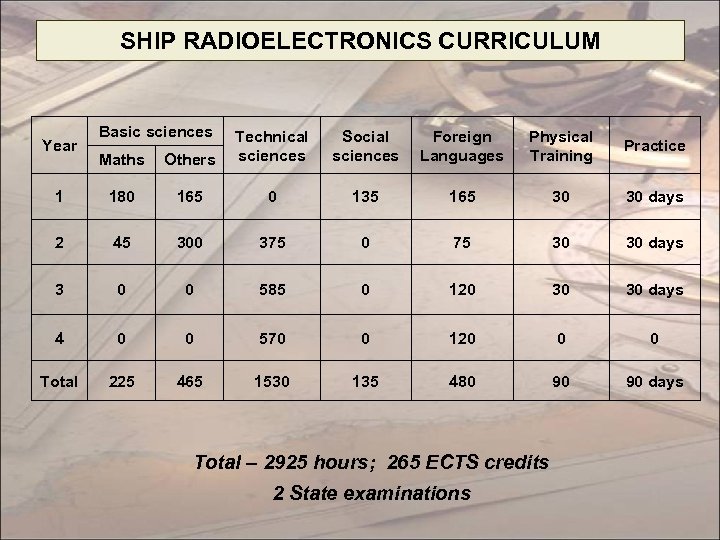 SHIP RADIOELECTRONICS CURRICULUM Basic sciences Maths Others Technical sciences 1 180 165 0 135 165 30 30 days 2 45 300 375 0 75 30 30 days 3 0 0 585 0 120 30 30 days 4 0 0 570 0 120 0 0 Total 225 465 1530 135 480 90 90 days Year Social sciences Foreign Languages Physical Training Practice Total – 2925 hours; 265 ECTS credits 2 State examinations
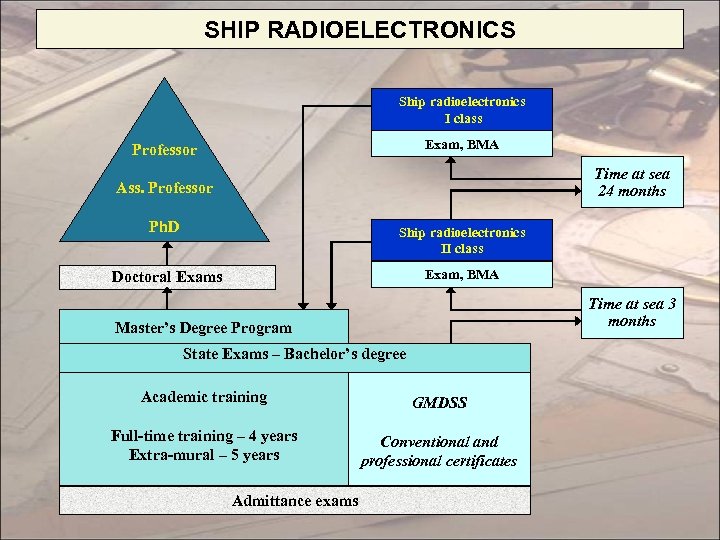 SHIP RADIOELECTRONICS Ship radioelectronics І class Exam, BMA Professor Time at sea 24 months Ass. Professor Ph. D Ship radioelectronics II class Doctoral Exams Exam, BMA Time at sea 3 months Master’s Degree Program State Exams – Bachelor’s degree Academic training GMDSS Full-time training – 4 years Extra-mural – 5 years Conventional and professional certificates Admittance exams
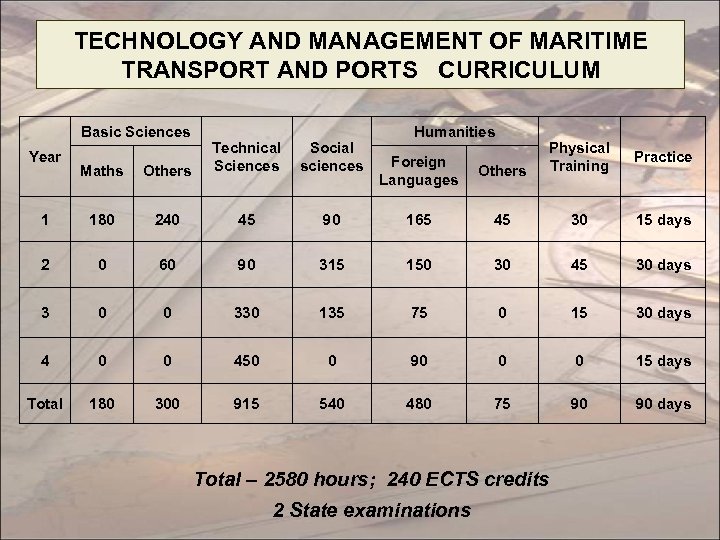 TECHNOLOGY AND MANAGEMENT OF MARITIME TRANSPORT AND PORTS CURRICULUM Basic Sciences Maths Others Technical Sciences 1 180 240 45 90 165 45 30 15 days 2 0 60 90 315 150 30 45 30 days 3 0 0 330 135 75 0 15 30 days 4 0 0 450 0 90 0 0 15 days Total 180 300 915 540 480 75 90 90 days Year Social sciences Humanities Foreign Languages Others Physical Training Practice Total – 2580 hours; 240 ECTS credits 2 State examinations
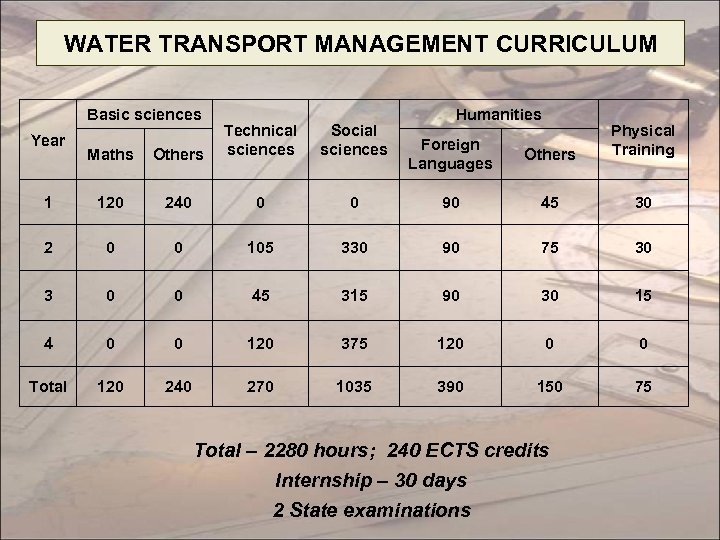 WATER TRANSPORT MANAGEMENT CURRICULUM Basic sciences Maths Others Technical sciences 1 120 240 0 2 0 0 3 0 4 Total Year Social sciences Humanities Foreign Languages Others Physical Training 0 90 45 30 105 330 90 75 30 0 45 315 90 30 15 0 0 120 375 120 0 0 120 240 270 1035 390 150 75 Total – 2280 hours; 240 ECTS credits Internship – 30 days 2 State examinations
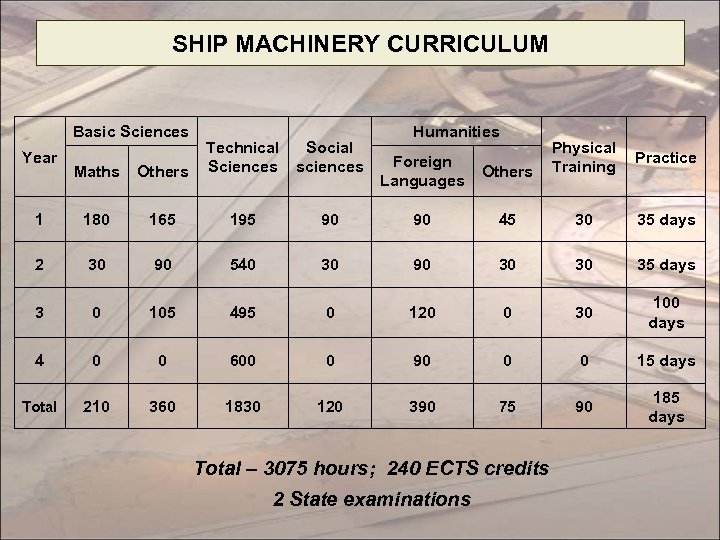 SHIP MACHINERY CURRICULUM Basic Sciences Maths Others Technical Sciences 1 180 165 195 90 90 45 30 35 days 2 30 90 540 30 90 30 30 35 days 3 0 105 495 0 120 0 30 100 days 4 0 0 600 0 90 0 0 15 days Total 210 360 1830 120 390 75 90 185 days Year Social sciences Humanities Foreign Languages Others Physical Training Practice Total – 3075 hours; 240 ECTS credits 2 State examinations
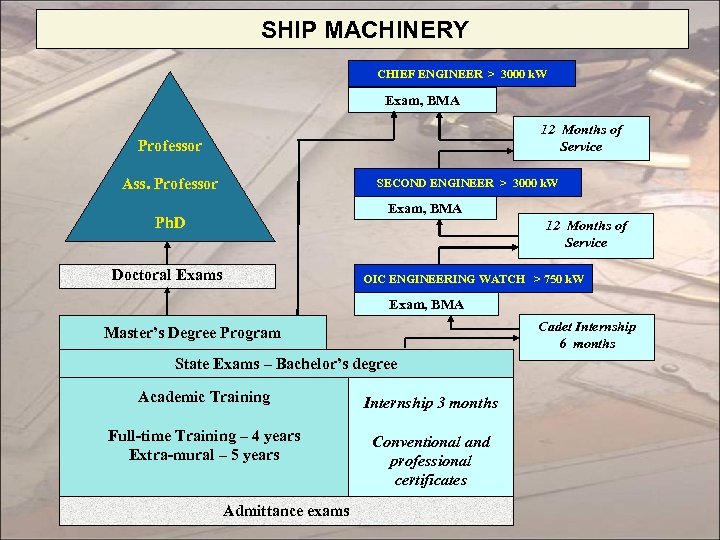 SHIP MACHINERY CHIEF ENGINEER > 3000 k. W Exam, BMA 12 Months of Service Professor Ass. Professor SECOND ENGINEER > 3000 k. W Exam, BMA Ph. D 12 Months of Service Doctoral Exams OIC ENGINEERING WATCH > 750 k. W Exam, BMA Cadet Internship 6 months Master’s Degree Program State Exams – Bachelor’s degree Academic Training Internship 3 months Full-time Training – 4 years Extra-mural – 5 years Conventional and professional certificates Admittance exams
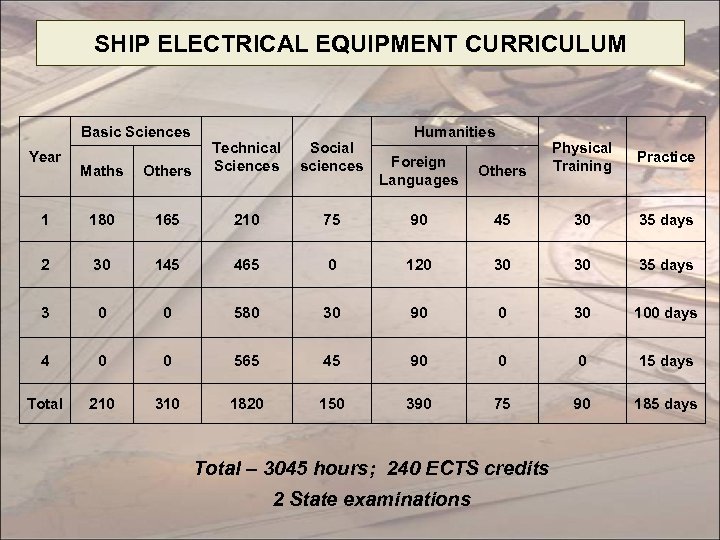 SHIP ELECTRICAL EQUIPMENT CURRICULUM Basic Sciences Maths Others Technical Sciences 1 180 165 210 75 90 45 30 35 days 2 30 145 465 0 120 30 30 35 days 3 0 0 580 30 90 0 30 100 days 4 0 0 565 45 90 0 0 15 days Total 210 310 1820 150 390 75 90 185 days Year Social sciences Humanities Foreign Languages Others Physical Training Practice Total – 3045 hours; 240 ECTS credits 2 State examinations
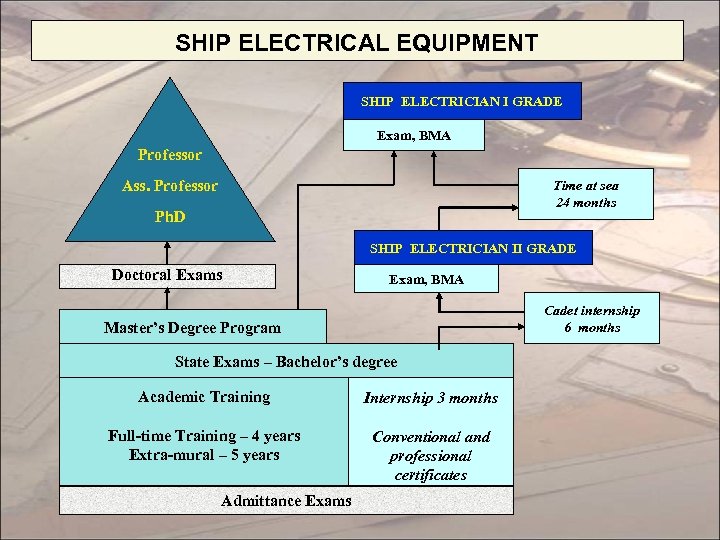 SHIP ELECTRICAL EQUIPMENT SHIP ELECTRICIAN I GRADE Exam, BMA Professor Ass. Professor Time at sea 24 months Ph. D SHIP ELECTRICIAN II GRADE Doctoral Exams Exam, BMA Cadet internship 6 months Master’s Degree Program State Exams – Bachelor’s degree Academic Training Internship 3 months Full-time Training – 4 years Extra-mural – 5 years Conventional and professional certificates Admittance Exams
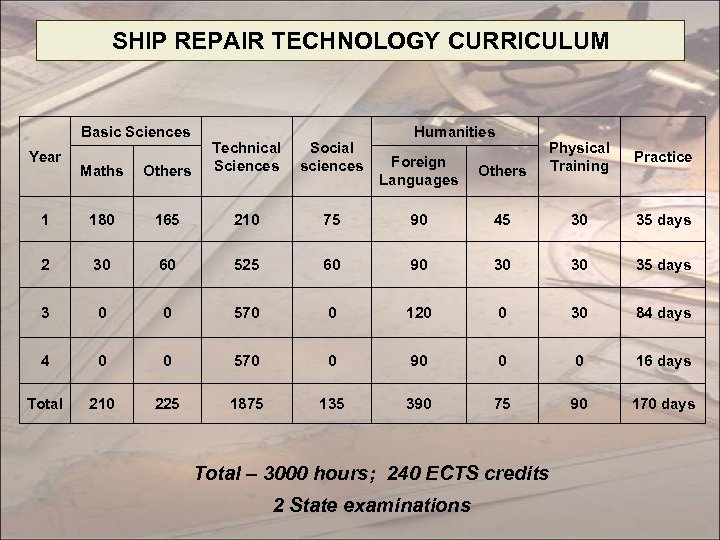 SHIP REPAIR TECHNOLOGY CURRICULUM Basic Sciences Maths Others Technical Sciences 1 180 165 210 75 90 45 30 35 days 2 30 60 525 60 90 30 30 35 days 3 0 0 570 0 120 0 30 84 days 4 0 0 570 0 90 0 0 16 days Total 210 225 1875 135 390 75 90 170 days Year Social sciences Humanities Foreign Languages Others Physical Training Practice Total – 3000 hours; 240 ECTS credits 2 State examinations
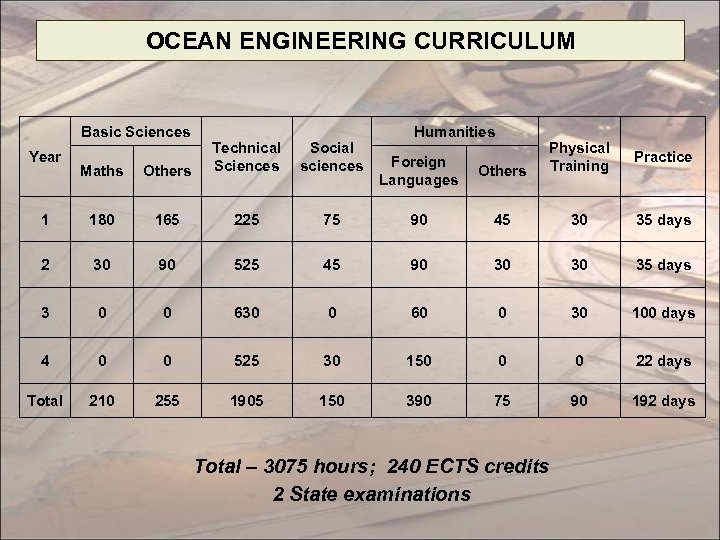 OCEAN ENGINEERING CURRICULUM Basic Sciences Maths Others Technical Sciences 1 180 165 225 75 90 45 30 35 days 2 30 90 525 45 90 30 30 35 days 3 0 0 630 0 60 0 30 100 days 4 0 0 525 30 150 0 0 22 days Total 210 255 1905 150 390 75 90 192 days Year Social sciences Humanities Foreign Languages Others Physical Training Practice Total – 3075 hours; 240 ECTS credits 2 State examinations
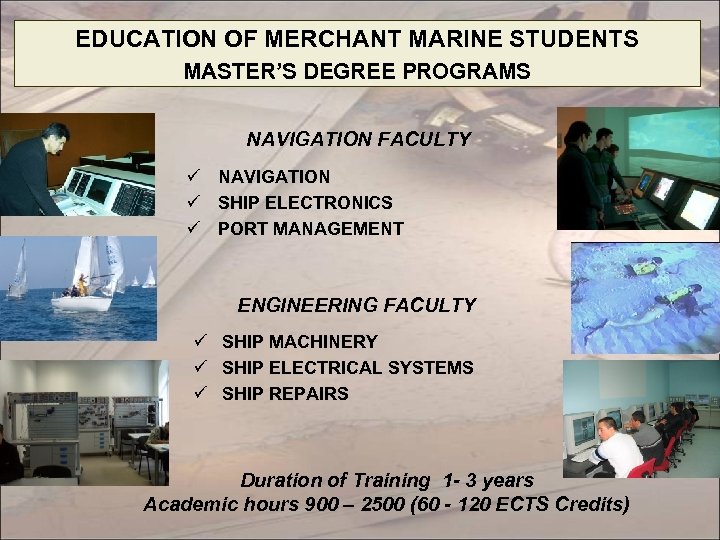 EDUCATION OF MERCHANT MARINE STUDENTS MASTER’S DEGREE PROGRAMS NAVIGATION FACULTY ü NAVIGATION ü SHIP ELECTRONICS ü PORT MANAGEMENT ENGINEERING FACULTY ü SHIP MACHINERY ü SHIP ELECTRICAL SYSTEMS ü SHIP REPAIRS Duration of Training 1 - 3 years Academic hours 900 – 2500 (60 - 120 ECTS Credits)
 DOCTORAL DEGREE PROGRAMS SCIENTIFIC SPECIALTIES ü 02. 14. 12 Ship Operation and Navigation ü 02. 14 Operation of Water Transport, Seaports and River ports ü 02. 07. 03 Radiolocation and Radionavigation ü 02. 07. 20 Communications Systems and Networks ü 02. 03. 05 Ship Power Plants and Machinery ü 02. 03. 04 Technology and Organization of Shipbuilding and Ship Repairing ü 02. 04. 15 Ship Power Supply and Electrical Systems ü 05. 12. 01 Organization and Management of the Armed Forces ü 05. 06. 11 Military Psychology
 POSTGRADUATE TRAINING MERCHANT MARINERS ü Licensed ship broker and agent training ü Conventional certificate training ü Training for a higher degree of maritime qualification ü Bridge team/resource management courses ü Engine team/resource management courses ü GMDSS operator training ü RADAR / ARPA training ü Security officers training ü Safety officers training ü English Language training ü Diver training
 DISTANCE LEARNING CENTER ü A structure within the Postgraduate Training Department ü Courses offered to military and civilian students ü Courses currently available / in development: – English – Information Technologies – Physics – Mathematics – Economics ü Supplementary materials available in all disciplines ü Active participation in Mo. D projects in the area of English language teaching / learning
 QUALITY MANAGEMENT SYSTEM 2000 - Lloyd’s Register’s ISO 9002: 1994 Certificate 2003 - Lloyd’s Register’s ISO 9001: 2000 Certificate 2009 - Lloyd’s Register’s ISO 9001: 2008 Certificate QUALITY POLICY Attaining and maintaining the high quality of tertiary maritime education towards meeting the aims and objectives of Nikola Vaptsarov Naval Academy based on the age-old traditions of the Academy by: identifying and meeting national and international standards; establishing controlled environment for implementing the international standards related to naval and maritime personnel education and training
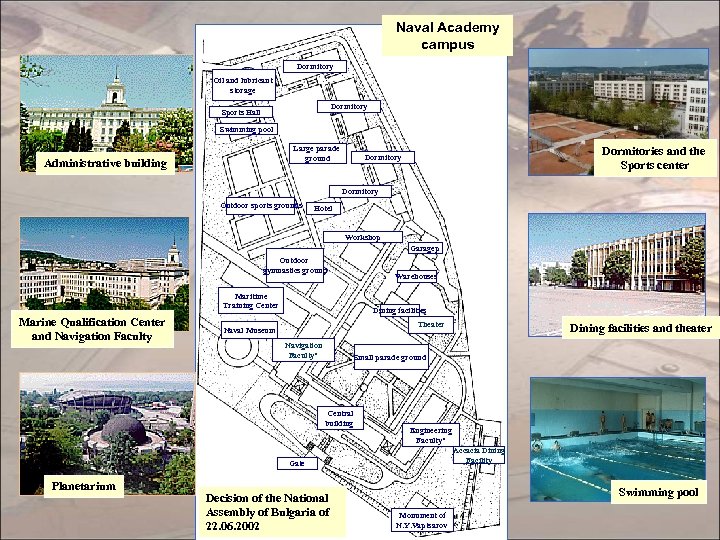 Naval Academy campus Dormitory Oil and lubricant storage Dormitory Sports Hall Swimming pool Large parade ground Administrative building Dormitories and the Sports center Dormitory Outdoor sports grounds Hotel Workshop Garageр Outdoor gymnastics ground Maritime Training Center Marine Qualification Center and Navigation Faculty Warehouses Dining facilities Theater Naval Museum Navigation Faculty” Small parade ground Central building Engineering Faculty” Accacia Dining Facility Gate Planetarium Dining facilities and theater Decision of the National Assembly of Bulgaria of 22. 06. 2002 Swimming pool Monument of N. Y. Vaptsarov
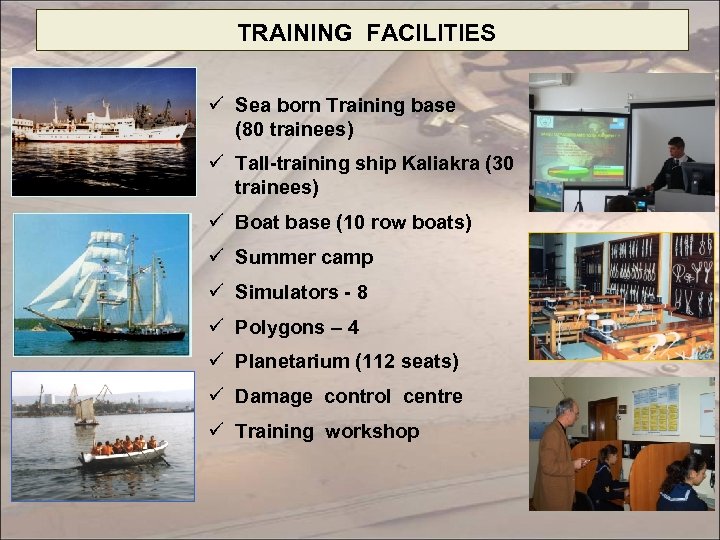 TRAINING FACILITIES ü Sea born Training base (80 trainees) ü Tall-training ship Kaliakra (30 trainees) ü Boat base (10 row boats) ü Summer camp ü Simulators - 8 ü Polygons – 4 ü Planetarium (112 seats) ü Damage control centre ü Training workshop
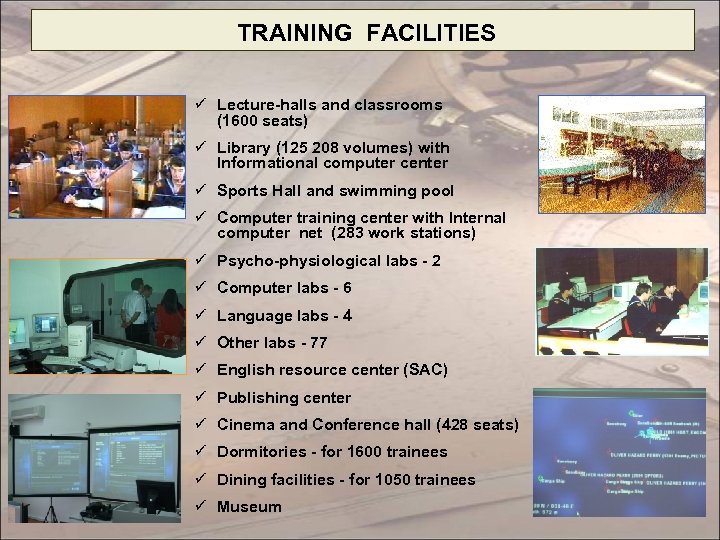 TRAINING FACILITIES ü Lecture-halls and classrooms (1600 seats) ü Library (125 208 volumes) with Informational computer center ü Sports Hall and swimming pool ü Computer training center with Internal computer net (283 work stations) ü Psycho-physiological labs - 2 ü Computer labs - 6 ü Language labs - 4 ü Other labs - 77 ü English resource center (SAC) ü Publishing center ü Cinema and Conference hall (428 seats) ü Dormitories - for 1600 trainees ü Dining facilities - for 1050 trainees ü Museum
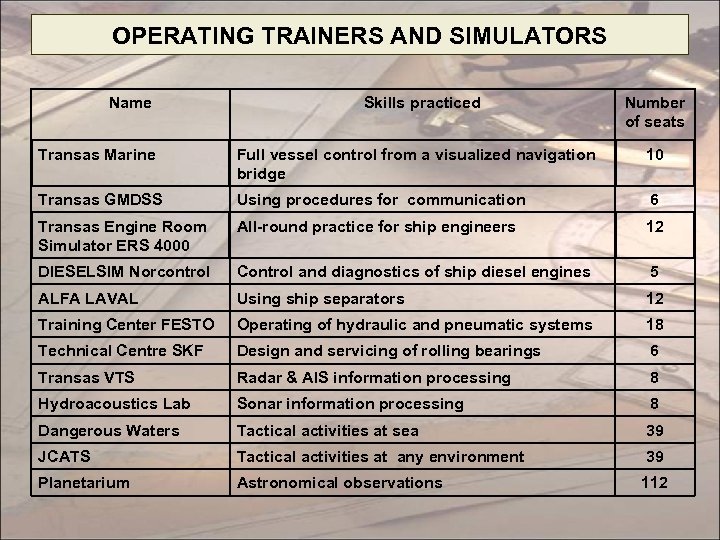 OPERATING TRAINERS AND SIMULATORS Name Skills practiced Number of seats Transas Marine Full vessel control from a visualized navigation bridge 10 Transas GMDSS Using procedures for communication 6 Transas Engine Room Simulator ERS 4000 All-round practice for ship engineers 12 DIESELSIM Norcontrol Control and diagnostics of ship diesel engines 5 ALFA LAVAL Using ship separators 12 Training Center FESTO Operating of hydraulic and pneumatic systems 18 Technical Centre SKF Design and servicing of rolling bearings 6 Transas VTS Radar & AIS information processing 8 Hydroacoustics Lab Sonar information processing 8 Dangerous Waters Tactical activities at sea 39 JCATS Tactical activities at any environment 39 Planetarium Astronomical observations 112
 RESEARCH AND DEVELOPMENT ACTIVITIES STRATEGIC GOAL To establish a centre of fundamental and applied science research in the area of naval science and marine technologies providing education and scientific support to the Navy and maritime industry MAIN AREAS ü ü ü Marine technologies Naval science, weaponry and equipment Maritime safety and security Navigation Maritime education and qualification activities
 INTERNATIONAL CONTACTS MEMBERSHIP IN ü The International Association of Maritime Universities (IAMU) ü The International Maritime Lecturers Association (IMLA) ü The Consortium of Military Academies and Defense Studies Institutes ü The World Maritime University, Malmö, Sweden ü Cisco Networking Academy ü Microsoft Academy
 INTERNATIONAL CONTACTS WITH NAVAL ACADEMIES ü Naval Academy “Mircea cel Batran”, Constantsa, Romania ü Turkish Naval Academy , Tuzla, Istanbul ü Hellenic Naval Academy, Piareus, Greece ü Academia Navale Livorno, Italy ü US Naval Academy, Annapolis, Maryland ü Spanish Naval Academy, Marin, Pontevedra ü Naval Academy at Murwik, Flensburg, Germany ü Ecole Navale, Brest, France ü Britannia Royal Naval College, Dartmouth, Devon ü Sevastopol Naval Institute, Sevastopol, Ukraine
 INTERNATIONAL CONTACTS WITH MARITIME ACADEMIES AND UNIVERSITIES ü ü ü Institute of Chartered Shipbrokers, London, UK Constantsa Maritime University, Romania Istanbul Technical University, Turkey Piri Reis Maritime University, Istanbul, Turkey Main Maritime Academy, USA California Maritime Academy, USA Gdynia Maritime University, Poland Odessa National Maritime Academy, Ukraine Admiral Makarov State Maritime Academy, Russia St. Petersburg State University of Water Transport, Russia Odessa State University of Water Transport, Ukraine Batumi State Maritime Academy, Georgia
 INTERNATIONAL CONTACTS ERASMUS PROGRAM ü Standard and Extended Erasmus Charter (2007, 2008) ü Teaching Staff Mobility Agreement with Constanta Maritime University. Mobility in the period 2007 – 2010: § 24 professors from the Naval Academy, Varna § 22 professors from the Maritime University, Constanta ü Students Mobility Agreement with “Stargate Ship Management” and “Ahrenkiel Ship Management” for 45 practice mobilities in 2009 – 2010 ü Participation in the Military Erasmus Program: § 2 cadets in Spanish Naval Academy, Marin, Pontevedra – 2 week seminar § practice on board US and Italian combat ships
 INTERNATIONAL CONTACTS ERASMUS PROGRAMS IN PREPARATION Bilateral Agreements for Academic Exchange for 2011 – 2013: ü Constanta Naval Academy, Romania ü Istanbul Technical University, Turkey, Maritime Faculty ü University of Applied Sciences, FHS – Vienna, Austria, Department of Intelligent Transport Systems ü Military University of Brno, Czech Republic All programs are signed and pending at Erasmus Office
 BUSINESS CONTACTS ü TRANSAS Group, UK ü Zodiac Maritime Agencies Ltd, UK ü Royal Caribbean International ü Thenamaris, Greece ü Multraship Towage & Salvage, The Netherlands ü Premiere Group Ltd, Norway ü Marine Consult, Germany ü K-Line, Japan ü Stamco Ship Management Co Ltd, Greece ü Union Shipping and Trade Co Ltd, Greece ü Keppel Fels Baltech Ltd, Singapore ü Star Gate Ltd ü Kuwait Oil Tanker Company ü Promar Ltd, Germany ü EURONAV, France ü Odyssey Management Consultancy, Dubai, UAE ü Cosmos Shipping
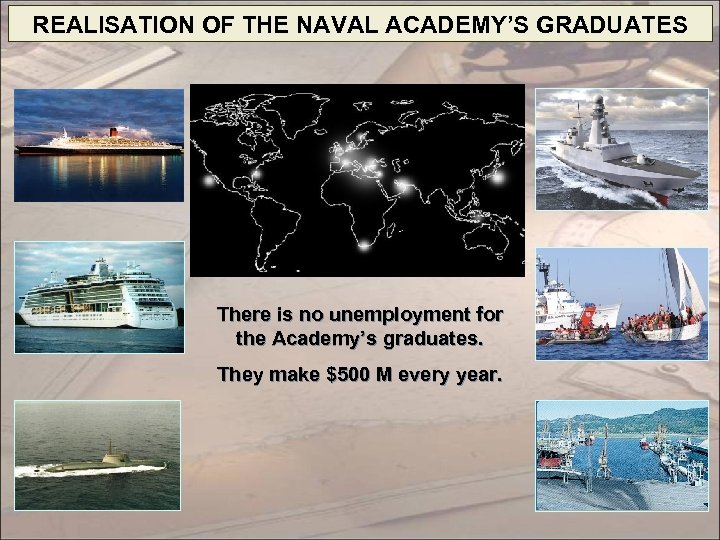 REALISATION OF THE NAVAL ACADEMY’S GRADUATES There is no unemployment for the Academy’s graduates. They make $500 M every year.
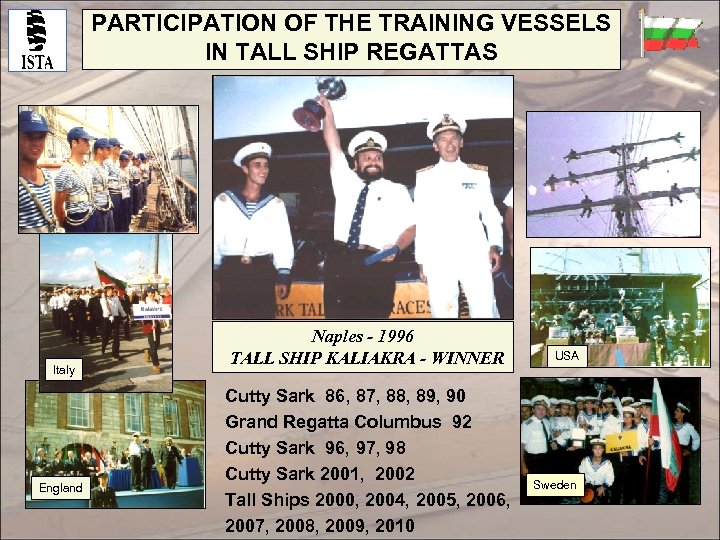 PARTICIPATION OF THE TRAINING VESSELS IN TALL SHIP REGATTAS Italy England Naples - 1996 TALL SHIP KALIAKRA - WINNER Cutty Sark 86, 87, 88, 89, 90 Grand Regatta Columbus 92 Cutty Sark 96, 97, 98 Cutty Sark 2001, 2002 Tall Ships 2000, 2004, 2005, 2006, 2007, 2008, 2009, 2010 USA Sweden
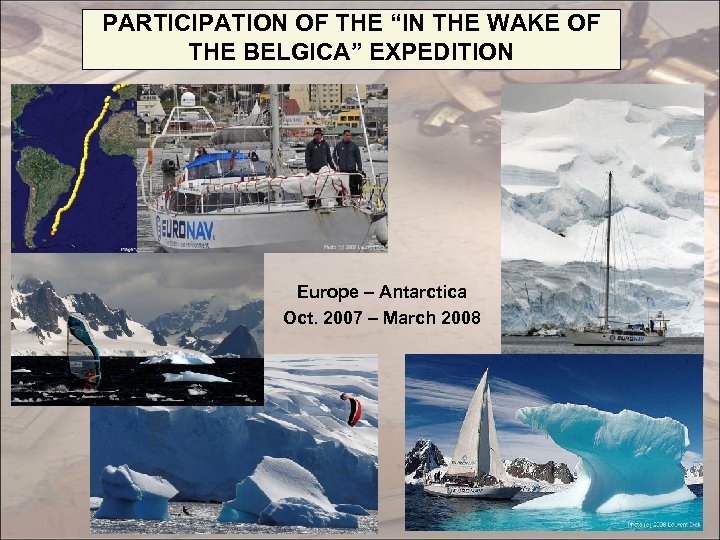 PARTICIPATION OF THE “IN THE WAKE OF THE BELGICA” EXPEDITION Europe – Antarctica Oct. 2007 – March 2008
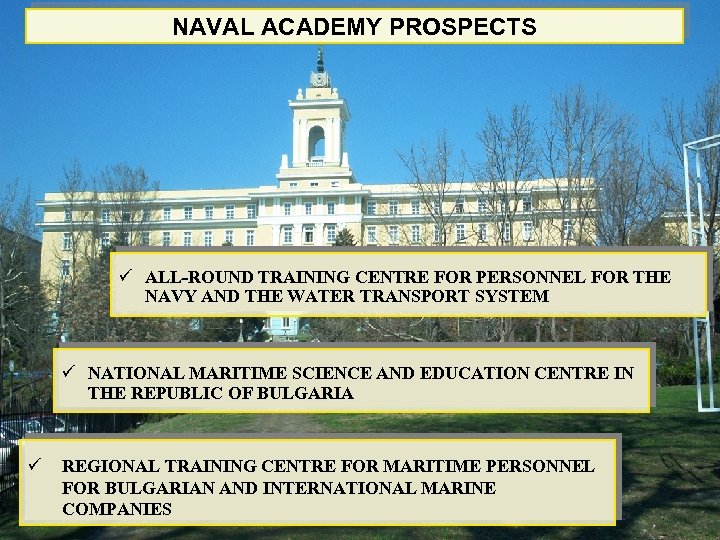 NAVAL ACADEMY PROSPECTS ü ALL-ROUND TRAINING CENTRE FOR PERSONNEL FOR THE NAVY AND THE WATER TRANSPORT SYSTEM ü NATIONAL MARITIME SCIENCE AND EDUCATION CENTRE IN THE REPUBLIC OF BULGARIA ü REGIONAL TRAINING CENTRE FOR MARITIME PERSONNEL FOR BULGARIAN AND INTERNATIONAL MARINE COMPANIES