


 Скачать презентацию NIH s Enterprise Approach to Measuring Customer Satisfaction Presented
c227a3c8309cdcc3fa099705154663a8.ppt
- Количество слайдов: 46
 NIH's Enterprise Approach to Measuring Customer Satisfaction Presented at ACSI User Group Meeting March 20, 2007 Sue Feldman, National Cancer Institute Cindy Love, National Library of Medicine
 Copyright Published as Multimedia Appendix 4 in: Wood FB, Siegel ER, Feldman S, Love CB, Rodrigues D, Malamud M, Lagana M, Crafts J Web Evaluation at the US National Institutes of Health: Use of the American Customer Satisfaction Index Online Customer Survey J Med Internet Res 2008; 10(1): e 4
 ACSI Trans-NIH Evaluation ACSI Trans-NIH Leadership Team National Library of Medicine Elliot Siegel Fred Wood Cindy Love National Cancer Institute Sue Feldman National Heart, Lung, and Blood Institute Mark Malamud NIH Office of Communications and Public Liaison Dennis Rodrigues NIH Center for Information Technology Marie Lagana Evaluation Contractor Westat Jennifer Crafts
 ACSI Trans-NIH Evaluation Fore. See Results Larry Freed Joel Van. Haaften Errol Hau Rick Jacobson Federal Consulting Group Ron Oberbillig
 Transforming Health and Medicine Through Discovery National Institutes of Health
 NIH Mission Uncover new knowledge that leads to better health for everyone by: § Supporting peer-reviewed scientific research at universities, medical schools, hospitals, and research institutions throughout United States and overseas § Conducting research in its own laboratories § Training research investigators § Developing and disseminating credible health information based on scientific discovery
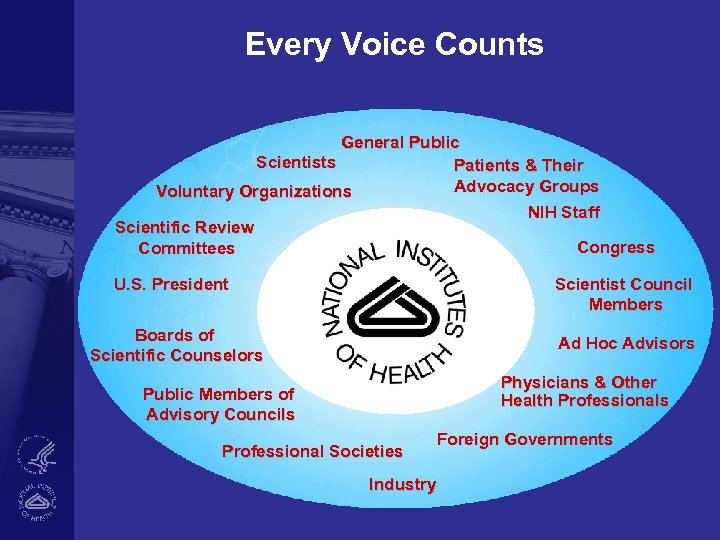 Every Voice Counts General Public Scientists Patients & Their Advocacy Groups Voluntary Organizations NIH Staff Scientific Review Congress Committees U. S. President Scientist Council Members Boards of Scientific Counselors Ad Hoc Advisors Physicians & Other Health Professionals Public Members of Advisory Councils Professional Societies Industry Foreign Governments
 Overview • Why the National Institutes of Health (NIH) Decided to Take an Enterprise Approach to Measuring Customer Satisfaction • Project Background • Evaluation Results – How NIH Web Sites Have Used the ACSI – What NIH Learned
 Why the NIH Decided to Take an Enterprise Approach to Measuring Customer Satisfaction • To strengthen each participating organization’s Web evaluation capability • To share Web evaluation learning and experience with the ACSI across NIH
 Why the NIH Decided to Take an Enterprise Approach to Measuring Customer Satisfaction • To evaluate the use of the ACSI as a Web evaluation tool for NIH Web sites – – Usefulness in evaluating individual NIH Web sites When and how the ACSI would be most useful How sites might benefit Whether ACSI could be integrated into the redesign cycles of the various different Web sites at NIH
 Project Background • Fall of 2003, NLM and NCI had both implemented the ACSI on a number of Web sites • May 2004, NLM and NCI shared their experiences at trans-NIH Web Authors Group (WAG) meeting • WAG members polled for indication of interest in participating in Trans-NIH ACSI project • Team of co-principal investigators assembled and NIH Evaluation Set-Aside funds were applied for
 Project Background • October 2004, NIH Evaluation Branch funded effort – Initially funded for 18 months – In 2005, supplemental funding extended the project for 6 months • The project was managed by a trans-NIH ACSI Leadership Team, made up of the co-principal investigators • Evaluation was conducted by Westat
 Project Background • Participation by 18 NIH institutes and centers and 13 offices of the Office of the NIH Director • 60 initial licenses • 55 licenses active into 2006 • 42 Web sites collected enough surveys to generate ACSI scores
 Project Background • The Web sites included: – – Organization home pages and/or portals Sites supporting access to and use of research data Sites for dissemination of medical information Sites for transacting extramural business such as grant applications – Sites promoting access to clinical trials – Intranet sites – Niche sites • Audiences included patients, family/friends of patients, health professionals, scientist/researchers, educators, administrators, librarian/information professionals, journalist/reporters, students, government employees, and other general public.
 Evaluation Questions • Through the offer of an ACSI license, were teams encouraged to use an online customer satisfaction survey? • What was the value of using the ACSI? • Did broad ACSI use provide additional enterprisewide benefits? • Did the evaluation provide any additional understanding about how NIH sites are used?
 Evaluation Methodology • Data collected from October 2004 to May 2006 included: – – Review of Related Data from NIH Web site teams Surveys of NIH Web site teams Interviews with NIH Web site teams Observations of meetings
 Evaluation Results • How NIH Web Sites Have Used the ACSI • What NIH Learned
 How NIH Web Sites Have Used the ACSI Teams used the ACSI as: • A ready-to-use customer satisfaction metric that provided preapproved Office of Management and Budget (OMB) clearance • A tool for incorporating custom questions in order to identify specific site issues and problems • A source of information about audience demographics • A source for planning any follow-up work involving additional evaluation methods • An archive of data for future use and analysis
 How NIH Web Sites Have Used the ACSI • To benchmark against other government and industry sites • To gain insights about and opportunities for improving Web presence through site-specific feedback • To respond more quickly and effectively to everevolving Web • To determine impact of proposed Web site changes • To evaluate whether programs are performing significantly better or worse over evaluation period
 What NIH Learned • ACSI Use for Individual Web Site Teams • ACSI Trans-NIH Activities
 ACSI Use for Individual Web Site Teams • Web Site Team Rating of Key Start-up Activities • Overall Satisfaction With Use of ACSI to Evaluate Site • Usefulness of Custom Questions and ACSI Scores • Site Teams Use of ACSI Data • Barriers to Making Changes to Site
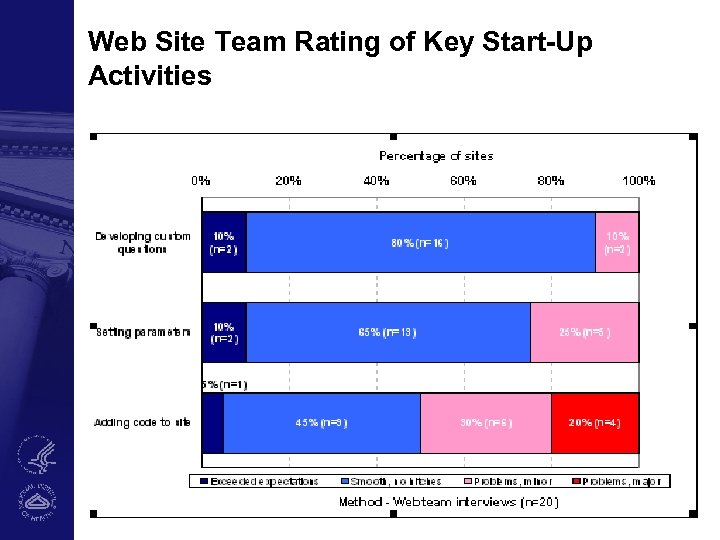 Web Site Team Rating of Key Start-Up Activities
 Overall Satisfaction With Use of ACSI to Evaluate Site
 Usefulness of Custom Questions and ACSI Scores
 Site Teams Use of ACSI Data
 Types of Site Improvements Planned Using ACSI Data
 Teams’ Plans to Use ACSI Data for Next Redesign
 Barriers to Making Changes to Site
 What NIH Learned: Considerations for Use of ACSI • Successful implementation of ACSI methodology requires – Buy-in from staff and management – Resources (staff time, license time) • Commitment to evaluation and customer satisfaction takes time – To get familiar w/ reports and methodology – To identify priorities for what to work on, revise • Understanding of how to take full advantage of custom questions and segmentation • Coordination of license with site maintenance/revision cycle – When will you benefit most from customer satisfaction data?
 What NIH Learned: NIH Site Characteristics and the ACSI • Associated with successful use: – – – Timing license period with redesign cycle Committed resources Supportive management Adequate traffic volume Public site No-niche site • Associated with issues/difficulties: – – – – Intranet Low traffic volume Manual page coding required Skeptical attitude within organization Lack of support from staff or management Fit of Web site team and SRA Niche or specialty Web sites
 What NIH Learned: ACSI Use for Individual Web Site Teams • The majority of Web site teams were able to implement the ACSI and receive results for their sites • Issues surfaced in cases where: – Adding code to Web site pages was a labor-intensive process – Internal staff or management were skeptical about the ACSI methodology – ACSI data accumulated slowly (e. g. , for intranet sites or sites with low traffic volume)
 What NIH Learned: ACSI Use for Individual Web Site Teams • Across all sites, teams derived the most value from their custom question and segmentation data rather than from their ACSI model data – Data provided valuable insight about audience profiles and visit characteristics – Teams took advantage of having a continuous feedback source for identifying site problems and audience information needs – Teams used their custom question data to plan a variety of types of site improvements to address areas identified as important for improving customer satisfaction
 What NIH Learned: ACSI Use for Individual Web Site Teams • Timing of the license was a key factor in perceived value of the ACSI – Teams that were actively involved in updating or redesigning their sites used the custom questions and segmentation analyses to address needs. • These teams tended to have their resources ready to act on results and implement site changes – Teams that did not currently have the staff time to devote to reviewing results indicated that they were saving their qualitative data for use in planning their next redesign
 What NIH Learned: ACSI Use for Individual Web Site Teams • Longevity was a key factor in making optimal use of the ACSI for Web site evaluation – Teams that used the ACSI the longest tended to be satisfied with and find value in its use, especially for planning site changes and comparing versions of the site before and after revisions – Teams for sites with relatively later license term start dates and/or slow rates of collecting ACSI surveys tended to be dissatisfied with the ACSI because they did not have sufficient time or opportunity to receive and/or act on ACSI results
 What NIH Learned: ACSI Use for Individual Web Site Teams • Web site teams expressed some dissatisfaction with the process of using the ACSI in cases where: – There was turnover of the Satisfaction Research Analysts (SRAs) assigned from Fore. See – Teams perceived that ACSI Satisfaction Scores did not truly reflect site quality (e. g. , sites for which visitors look for content that does not fit within the site mission) – Staff time constraints were a barrier to attending to or acting on the perceived large volume of ACSI data • Some of these teams would prefer to use an online survey on a more intermittent basis
 Web Sites That Were Less Successful in Using the ACSI • Timely Collection of 300 Completed ACSI Surveys • Timing of License Period With Web Site Development/Redesign Schedule • Fit of Web Site Team and SRA • “Niche” or Specialty Web Sites • Lack of Support From Staff or Management
 ACSI Trans-NIH Activities • Increased interest in Web evaluation and customer satisfaction measurement • Promoted user-centered design • Encouraged collaboration across NIH • Secured permission for NIH Web sites to use persistent cookies in conjunction with ACSI
 ACSI Trans-NIH Activities • Provided sharing of lessons learned and experiences across NIH – – Shared case studies Shared value of custom questions Encouraged use of different types of custom questions Demonstrated use of custom questions to investigate timely topics – Discussed opportunities for improving NIH Web presence
 ACSI Trans-NIH Activities • Enabled benchmarking of performance against other agencies, departments, organizations – Where NIH fits with Fore. See trends and insights – Areas of relative strengths and weaknesses • By aggregating similar custom questions across sites – Provided better understanding of user needs for health information and user motivations for seeking and using information – Provided deeper insights into roles and demographics of users and better understanding of why they came to Web site and what they did with information found
 ACSI Trans-NIH Activities • NIH-wide meetings – Highlighted contributions and challenges of ACSI – Provided forum to share lessons learned and identify future directions and opportunities – Contributed to increasing awareness and understanding of Web evaluation at NIH • Network of NIH Web site professionals – Provided informal mentoring by experienced/knowledgeable Web site team members and teams
 Conclusions • ACSI is a useful methodology for Web evaluation – Online user surveys can provide helpful information about and better understanding of web site users, and contribute to a user-centered approach to web site design. – The ACSI provides additional value added because of its rigorous and proven methodology, standardized questions, benchmarking, optional custom questions, and good pricevalue ratio. • Overall, NIH sites derived benefit from use
 Conclusions • This project enhanced the NIH leadership position re web evaluation -- The Trans-NIH project was the first “Enterprise-Wide” ACSI application, and the largest enterprise web evaluation project to date in the US Government. -- NIH web sites performed well overall against other US Govt and private sector benchmarks, and as a result NIH received significant positive media coverage.
 Conclusions • Most NIH sites were only beginning to integrate ACSI into their respective redesign cycles • The ACSI is not for all web sites, and requires sufficient site traffic and customer base, plus adequate management and financial support. • Use of the ACSI can help assure that Web sites and the information available from them are the best that they can be.
 Conclusions • Thanks to the NIH staff and others who contributed to the success of the ACSI project and a special thanks to Cindy Love for collaborating with me on this presentation.
 Sue Feldman feldmans@mail. nih. gov 301 -496 -7420 Cindy Love Cindy_love@nlm. nih. gov 301 -496 -5306
 Questions?