 Скачать презентацию NIH Electronic Submission Overview Megan Columbus NIH Program
4208860b849479748aa351a738e8e8e6.ppt
- Количество слайдов: 36



NIH Electronic Submission Overview Megan Columbus NIH Program Manager, Electronic Receipt of Grant Applications January 11, 2006
Today’s Goals n To provide a comprehensive understanding of the electronic submission process and the new SF 424 Research & Related (R&R) application. n To introduce participants to available resources that can be used to enhance applicant knowledge and spread that knowledge within their organizations. l Train-the-trainer 2
NIH’s Electronic Receipt Goal By the end of May 2007, NIH plans to: 1. Require electronic submission through Grants. gov for all NIH grant applications 2. Transition from the PHS 398 application form to SF 424 family of forms data set SF 424 Research and Research-Related (SF 424 (R&R)) SF 424 Discretionary (of limited use for NIH) Announced in the NIH Guide, Aug. 19, 2005: http: //grants. nih. gov/grants/guide/notice-files/NOT-OD-05 -067. html 3
Why transition to electronic receipt? n It benefits our applicant community, creates efficiencies, and will ultimately make our jobs easier! l Eliminates the burden of paper-based data collection l Resulting efficiencies may allow NIH to shorten the cycle from application receipt to award n AREA grants – An early win! l Electronic submission creates a comprehensive repository of data that can be mined by knowledge management and other tools l Electronic validations improve data quality l Savings of >200, 000 pieces of paper/year (estimated) and countless hours of human effort l Reductions of scanning, printing, and data-entry costs l Grant image is consistent, clear and in color 4
Why transition to SF 424 (R&R)? n SF 424 (R&R) is the government-wide data set for research grant applications l Applicants can use standard forms regardless of the program or agency to which they are applying l Reduces administrative burden on the Federal grants community 5
Why transition? n Public Law (PL) 106 -107 l Federal Financial Assistance Management Improvement Act of 1999 n n Improve the effectiveness and performance of Federal financial assistance programs Simplify Federal financial assistance application and reporting requirements Improve the delivery of services to the public President’s Management Agenda (2002) l “Agencies to allow applicants for Federal Grants to apply for, and ultimately manage, grant funds online through a common web site, simplifying grants management and eliminating redundancies. . . ” 6
Why now? n It’s been a long time coming. It’s time. n OMB has set the following FY 2006 Goal for Agencies: Post 75% of Funding Opportunities in Grants. gov “Find” on “Apply” n The PHS 398 OMB clearance expires in September, 2007 7
This is a huge transition for all of us! n The simultaneous transition to electronic application submission and a new set of application forms is a huge initiative for NIH with an aggressive time table n It involves: l l l Many funding mechanisms Tens of thousands of applications ranging widely in size and complexity Numerous communications from NIH staff and applicant organizations regarding the new submission process and application form set 8
Multiple Systems Working Together n Grants. gov – the Federal government’s single on-line portal to find apply for Federal grant funding. l n Used by all 26 Federal grant-making agencies. e. RA Commons – the NIH electronic Research Administration system that allows applicants/grantees to electronically receive and transmit application and award information. l Used by NIH and other HHS components. Important! Each system has its own registration requirements and validation process. 9
Registration Requirements n Both Grants. gov and e. RA Commons registration is required for electronic submission. n These are separate processes that can be done simultaneously. n All registrations must be completed prior to application submission. n Failure to complete the required registrations prior to application submission may result in delay of review assignment and funding consideration. It is critical for institutions to begin these registrations at least 2 -4 weeks before applications are due! 10
Registration Requirements – Grants. gov n Applicant organizations must complete one-time only registration n Principal Investigators do not need to register with Grants. gov n Good for electronic submission to all Federal agencies n Detailed instructions at: http: //grants. gov/Get. Started n Grants. gov registration requires institutions to: l l n Obtain a Data Universal Numbering System (DUNS) number Register in Central Contractor Registry (CCR) * New organizations should allow extra time for this step Registration not required to find funding opportunity or download application package, only to submit completed application It is critical for institutions to begin this registration process at least 2 -4 weeks before applications are due! 11
Registration Requirements – e. RA Commons n Applicant institutions must complete one-time only registration. n Principal Investigators (PIs) must work through their institutions to register. l l n The PI must hold a PI account and be affiliated with the applicant organization. PIs currently registered only for Internet Assisted Review (IAR) must work through their institutions for full e. RA Commons registration. PI and Signing Official (SO) need separate accounts in e. RA Commons since both need to verify the application. It is critical for institutions to begin this registration process at least 2 -4 weeks before applications are due! 12
Registration Requirements – e. RA Commons n Organizations must include a DUNS number in their institutional profile that matches the DUNS number on the submitted application. n NIH will consider starting the e. RA Commons registration process at least two weeks in advance of the submission date a “good faith” effort to prepare for electronic submission. Applicants that make a “good faith” effort to register, will not be penalized for any NIH-caused registration processing delay. n See http: //era. nih. gov/Electronic. Receipt/preparing. htm for additional information. It is critical for institutions to begin this registration process at least 2 -4 weeks before applications are due! 13
Submission Methods Applicant organization can submit applications to NIH through Grants. gov in one of two ways: 1. Direct submission - using Pure. Edge Viewer 2. System-to-system – using (XML) data stream to communicate with Grants. gov n n Can be created by institution OR Institution can establish an agreement with a commercial Service Provider http: //era. nih. gov/Electronic. Receipt/sp. htm 14
Software Requirements n Pure. Edge viewer downloaded (free) from Grants. gov site at http: //www. grants. gov/Download. Viewer n PDF generation software l n Grants. gov lists some available tools and software http: //www. grants. gov/assets/PDFConversion. pdf. MAC users will need to use PC emulation software or download free CITRIX client application to take advantage of the CITRIX service offered by Grants. gov in partnership with NIH. http: //www. grants. gov/Mac. Support l Pure. Edge has committed to providing a platform independent viewer by November 2006. 15
Using standard forms to apply through Grants. gov is a very different model n The application form and instructions will now be part of a package that NIH posts on Grants. gov along with each funding opportunity announcement (FOA). n Applicants will download the application package for the specific funding opportunity announcement from within Grants. gov. n This specific application package MUST be used to apply for the accompanying solicitation. l Some fields of application are pre-filled from announcement 16
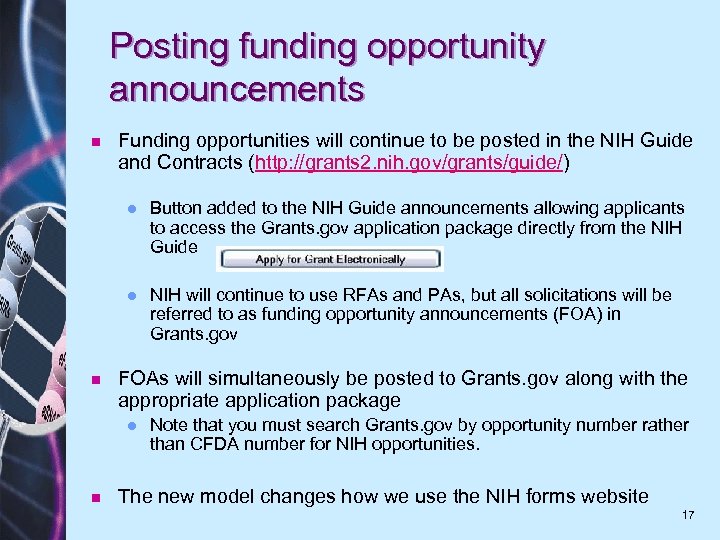
Posting funding opportunity announcements n Funding opportunities will continue to be posted in the NIH Guide and Contracts (http: //grants 2. nih. gov/grants/guide/) l l n Button added to the NIH Guide announcements allowing applicants to access the Grants. gov application package directly from the NIH Guide NIH will continue to use RFAs and PAs, but all solicitations will be referred to as funding opportunity announcements (FOA) in Grants. gov FOAs will simultaneously be posted to Grants. gov along with the appropriate application package l n Note that you must search Grants. gov by opportunity number rather than CFDA number for NIH opportunities. The new model changes how we use the NIH forms website 17
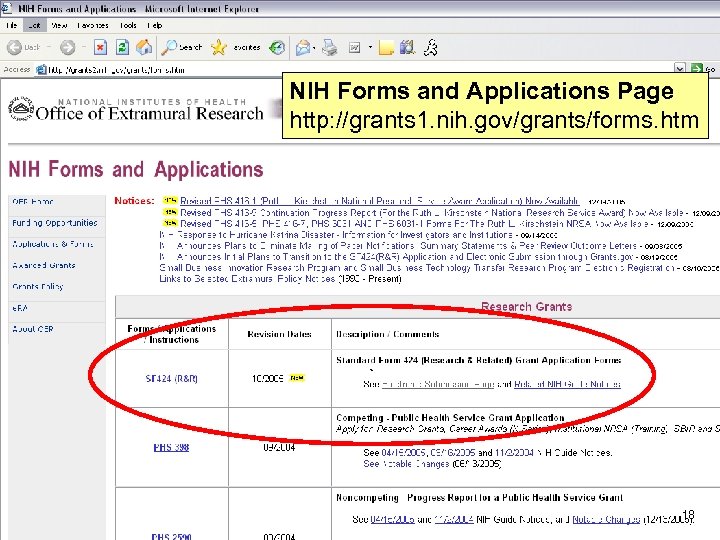
NIH Forms and Applications Page http: //grants 1. nih. gov/grants/forms. htm ` 18
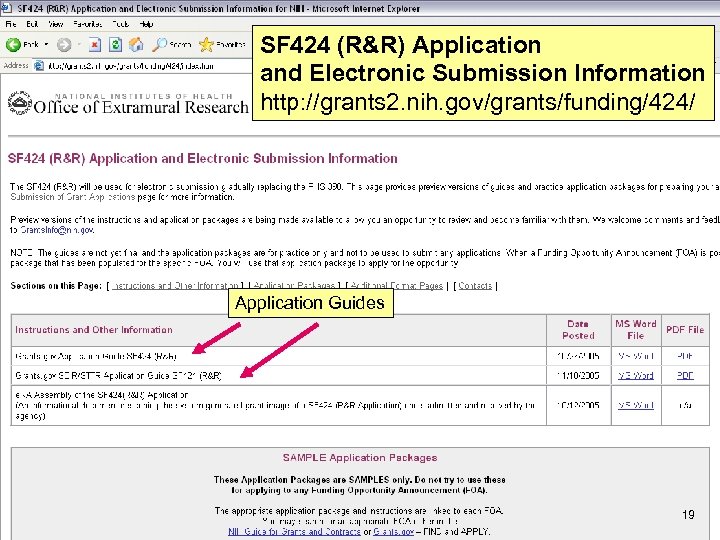
SF 424 (R&R) Application and Electronic Submission Information http: //grants 2. nih. gov/grants/funding/424/ Application Guides 19
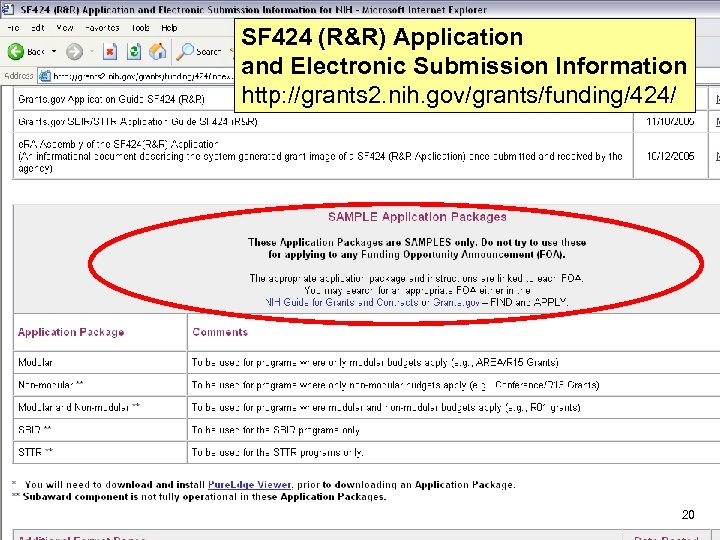
SF 424 (R&R) Application and Electronic Submission Information http: //grants 2. nih. gov/grants/funding/424/ 20
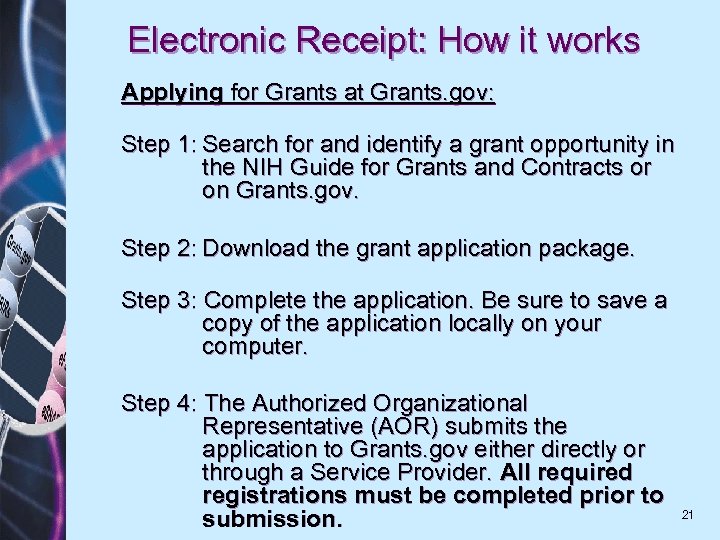
Electronic Receipt: How it works Applying for Grants at Grants. gov: Step 1: Search for and identify a grant opportunity in the NIH Guide for Grants and Contracts or on Grants. gov. Step 2: Download the grant application package. Step 3: Complete the application. Be sure to save a copy of the application locally on your computer. Step 4: The Authorized Organizational Representative (AOR) submits the application to Grants. gov either directly or through a Service Provider. All required registrations must be completed prior to submission. 21
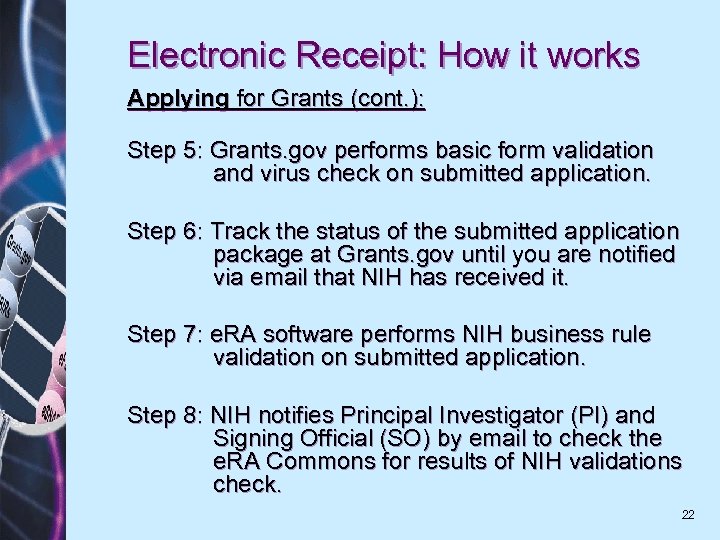
Electronic Receipt: How it works Applying for Grants (cont. ): Step 5: Grants. gov performs basic form validation and virus check on submitted application. Step 6: Track the status of the submitted application package at Grants. gov until you are notified via email that NIH has received it. Step 7: e. RA software performs NIH business rule validation on submitted application. Step 8: NIH notifies Principal Investigator (PI) and Signing Official (SO) by email to check the e. RA Commons for results of NIH validations check. 22
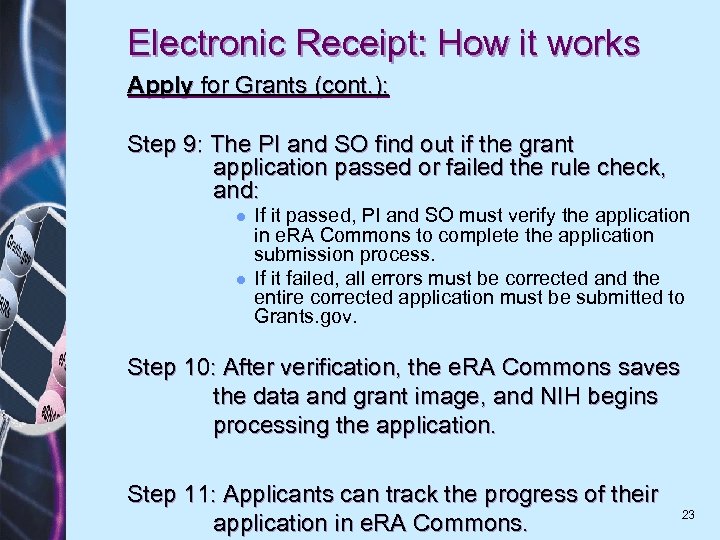
Electronic Receipt: How it works Apply for Grants (cont. ): Step 9: The PI and SO find out if the grant application passed or failed the rule check, and: l l If it passed, PI and SO must verify the application in e. RA Commons to complete the application submission process. If it failed, all errors must be corrected and the entire corrected application must be submitted to Grants. gov. Step 10: After verification, the e. RA Commons saves the data and grant image, and NIH begins processing the application. Step 11: Applicants can track the progress of their application in e. RA Commons. 23
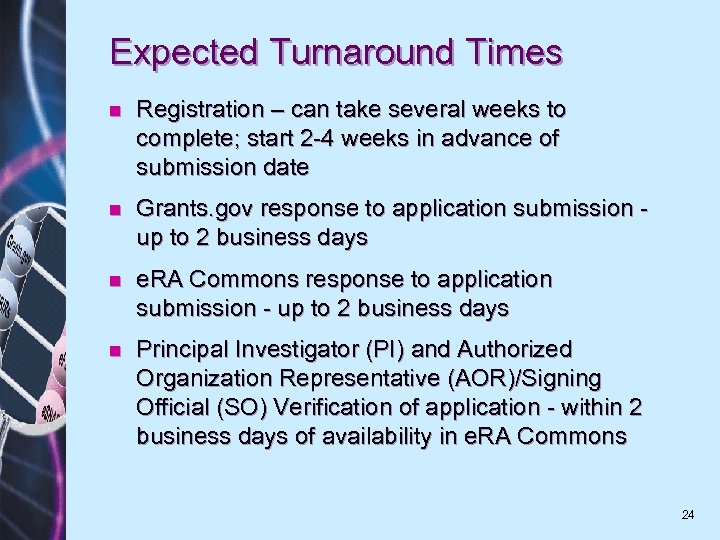
Expected Turnaround Times n Registration – can take several weeks to complete; start 2 -4 weeks in advance of submission date n Grants. gov response to application submission up to 2 business days n e. RA Commons response to application submission - up to 2 business days n Principal Investigator (PI) and Authorized Organization Representative (AOR)/Signing Official (SO) Verification of application - within 2 business days of availability in e. RA Commons 24
NIH’s Transition Strategy n NIH will transition by individual research program/funding mechanism n ALL applications in response to these announcements for transitioned mechanisms will require electronic submission through Grants. gov on the SF 424 family of forms n Mechanisms not yet transitioned will continue to require paper PHS 398 submission n NIH will announce plans to transition mechanisms in NIH Guide for Grants and Contracts 25
Important Announcement Dates n Funding Opportunity Announcements will be posted in Grants. gov “Apply”, generally 2 months before the submission date. l Release Date – the date an application is posted. Posting announcement allows downloading of application package and the ability to start working on the application. l Opening Date - the first date the completed application can be submitted to Grants. gov. 26
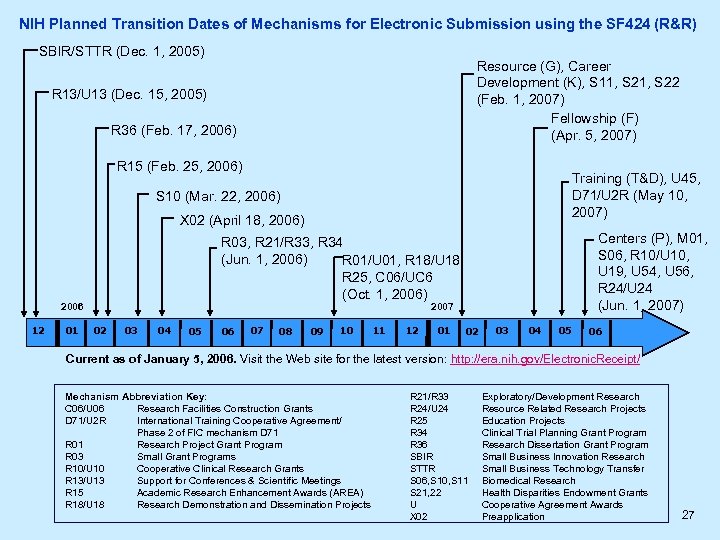
NIH Planned Transition Dates of Mechanisms for Electronic Submission using the SF 424 (R&R) SBIR/STTR (Dec. 1, 2005) Resource (G), Career Development (K), S 11, S 22 (Feb. 1, 2007) Fellowship (F) (Apr. 5, 2007) R 13/U 13 (Dec. 15, 2005) R 36 (Feb. 17, 2006) R 15 (Feb. 25, 2006) Training (T&D), U 45, D 71/U 2 R (May 10, 2007) S 10 (Mar. 22, 2006) X 02 (April 18, 2006) 2006 12 01 Centers (P), M 01, S 06, R 10/U 10, U 19, U 54, U 56, R 24/U 24 (Jun. 1, 2007) R 03, R 21/R 33, R 34 (Jun. 1, 2006) R 01/U 01, R 18/U 18, R 25, C 06/UC 6 (Oct. 1, 2006) 2007 02 03 04 05 06 07 08 09 10 11 12 01 02 03 04 05 06 Current as of January 5, 2006. Visit the Web site for the latest version: http: //era. nih. gov/Electronic. Receipt/ Mechanism Abbreviation Key: C 06/U 06 Research Facilities Construction Grants D 71/U 2 R International Training Cooperative Agreement/ Phase 2 of FIC mechanism D 71 R 01 Research Project Grant Program R 03 Small Grant Programs R 10/U 10 Cooperative Clinical Research Grants R 13/U 13 Support for Conferences & Scientific Meetings R 15 Academic Research Enhancement Awards (AREA) R 18/U 18 Research Demonstration and Dissemination Projects R 21/R 33 R 24/U 24 R 25 R 34 R 36 SBIR STTR S 06, S 10, S 11 S 21, 22 U X 02 Exploratory/Development Research Resource Related Research Projects Education Projects Clinical Trial Planning Grant Program Research Dissertation Grant Program Small Business Innovation Research Small Business Technology Transfer Biomedical Research Health Disparities Endowment Grants Cooperative Agreement Awards Preapplication 27
Completed Transitions n Small business (SBIR/STTR) l l n Transitioned on December 1, 2005 submission date Over 1800 applications received Conference grants (R 13) l l Transitioned on December 15, 2005 submission date Over 150 applications received 28
Advice from Experience n Read and follow all application instructions! l Failure to follow instructions has resulted in applicants having to submit corrected applications. n There application fields not marked as mandatory on the federal-wide form but that are required by NIH l Important! For example, the credential field of the R&R Senior/Key Person Profile component MUST contain the PI’s assigned e. RA Commons User ID for NIH to process the application submission 29
Advice from Experience n Register now to be prepared n Allow time for corrections n See it through to verification in e. RA Commons to complete the application process n When seeking support, be prepared to provide identifying information for your application and organization n Network with colleagues at other institutions to strategize ways to implement the change to NIH e -submission at your organization 30
Next Steps for NIH n We are analyzing all available data from completed submission rounds to identify areas for improvement. Some examples of things we will be working on: l l l n We are looking for opportunities to streamline the process l l n Help desk staffing Educating NIH staff Revising text in application guide for clarity and to provide additional guidance Reviewing business rules enforced by the system Outreach to the applicant community Re-evaluation of verification process Registration Comments and feedback are welcome! http: //era. nih. gov/Electronic. Receipt/feedback. htm 31
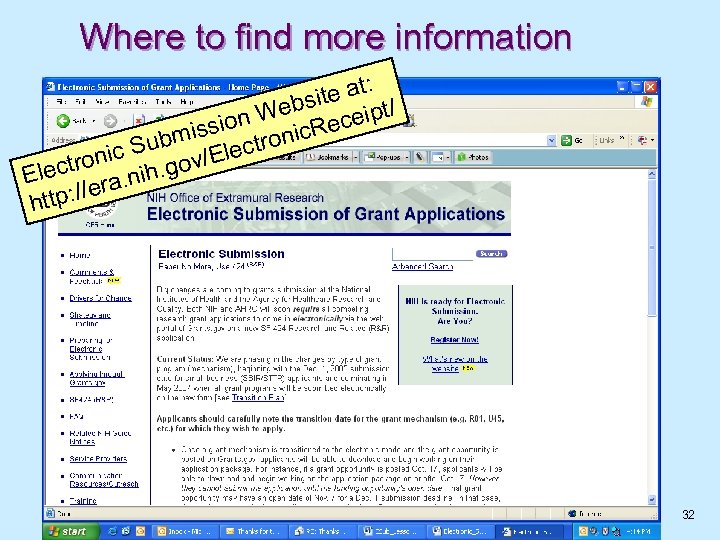
Where to find more information : ite at t/ s Web eceip n issio ronic. R Subm /Elect ic ctron nih. gov Ele /era. / http: 32
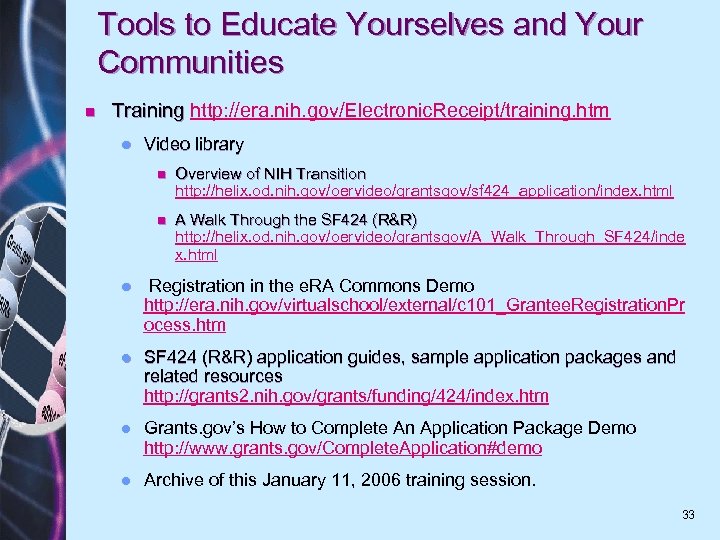
Tools to Educate Yourselves and Your Communities n Training http: //era. nih. gov/Electronic. Receipt/training. htm l Video library n Overview of NIH Transition http: //helix. od. nih. gov/oervideo/grantsgov/sf 424_application/index. html n A Walk Through the SF 424 (R&R) http: //helix. od. nih. gov/oervideo/grantsgov/A_Walk_Through_SF 424/inde x. html l Registration in the e. RA Commons Demo http: //era. nih. gov/virtualschool/external/c 101_Grantee. Registration. Pr ocess. htm l SF 424 (R&R) application guides, sample application packages and related resources http: //grants 2. nih. gov/grants/funding/424/index. htm l Grants. gov’s How to Complete An Application Package Demo http: //www. grants. gov/Complete. Application#demo l Archive of this January 11, 2006 training session. 33
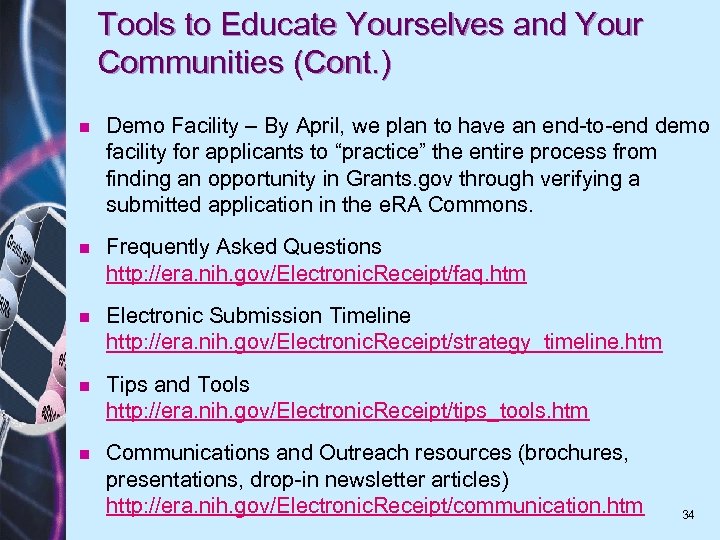
Tools to Educate Yourselves and Your Communities (Cont. ) n Demo Facility – By April, we plan to have an end-to-end demo facility for applicants to “practice” the entire process from finding an opportunity in Grants. gov through verifying a submitted application in the e. RA Commons. n Frequently Asked Questions http: //era. nih. gov/Electronic. Receipt/faq. htm n Electronic Submission Timeline http: //era. nih. gov/Electronic. Receipt/strategy_timeline. htm n Tips and Tools http: //era. nih. gov/Electronic. Receipt/tips_tools. htm n Communications and Outreach resources (brochures, presentations, drop-in newsletter articles) http: //era. nih. gov/Electronic. Receipt/communication. htm 34
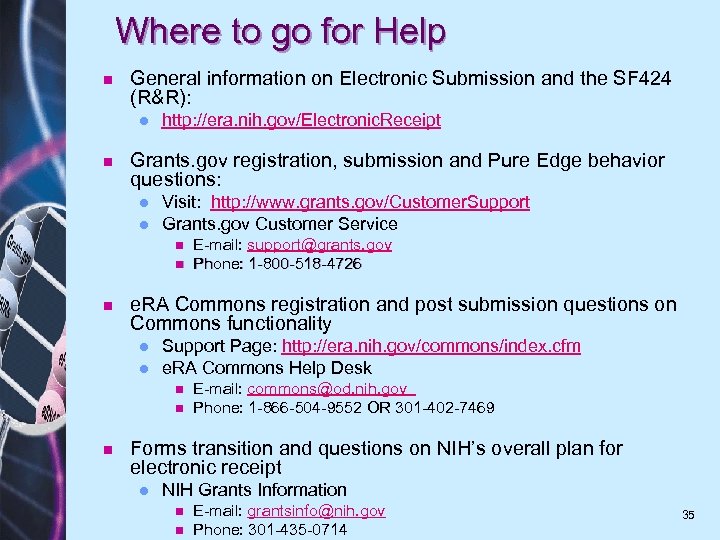
Where to go for Help n General information on Electronic Submission and the SF 424 (R&R): l n http: //era. nih. gov/Electronic. Receipt Grants. gov registration, submission and Pure Edge behavior questions: l l Visit: http: //www. grants. gov/Customer. Support Grants. gov Customer Service n n n e. RA Commons registration and post submission questions on Commons functionality l l Support Page: http: //era. nih. gov/commons/index. cfm e. RA Commons Help Desk n n n E-mail: support@grants. gov Phone: 1 -800 -518 -4726 E-mail: commons@od. nih. gov Phone: 1 -866 -504 -9552 OR 301 -402 -7469 Forms transition and questions on NIH’s overall plan for electronic receipt l NIH Grants Information n n E-mail: grantsinfo@nih. gov Phone: 301 -435 -0714 35

Get informed! Spread the word! __________ Thank you! 36
Скачать презентацию NIH Electronic Submission Overview Megan Columbus NIH Program
4208860b849479748aa351a738e8e8e6.ppt