



 NIGERIA
 Is situated in…
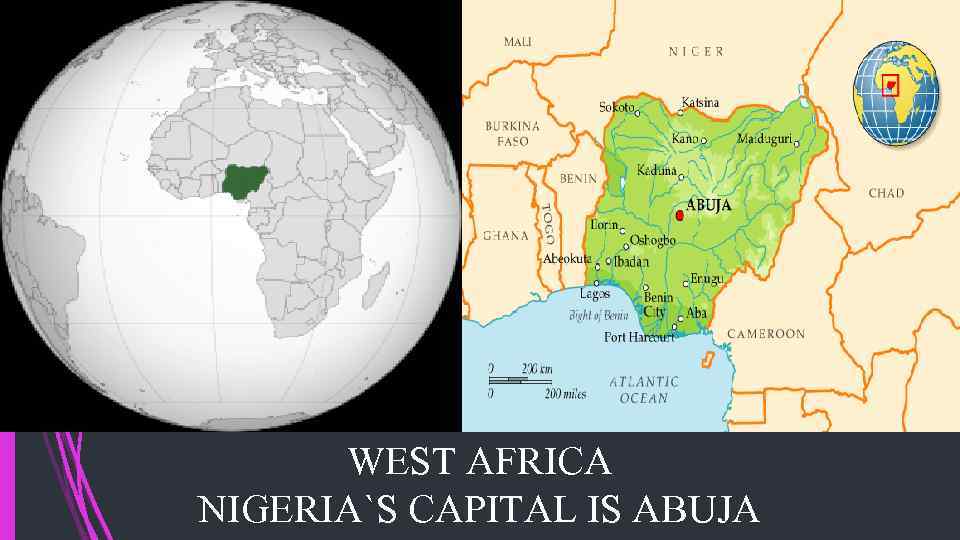 WEST AFRICA NIGERIA`S CAPITAL IS ABUJA
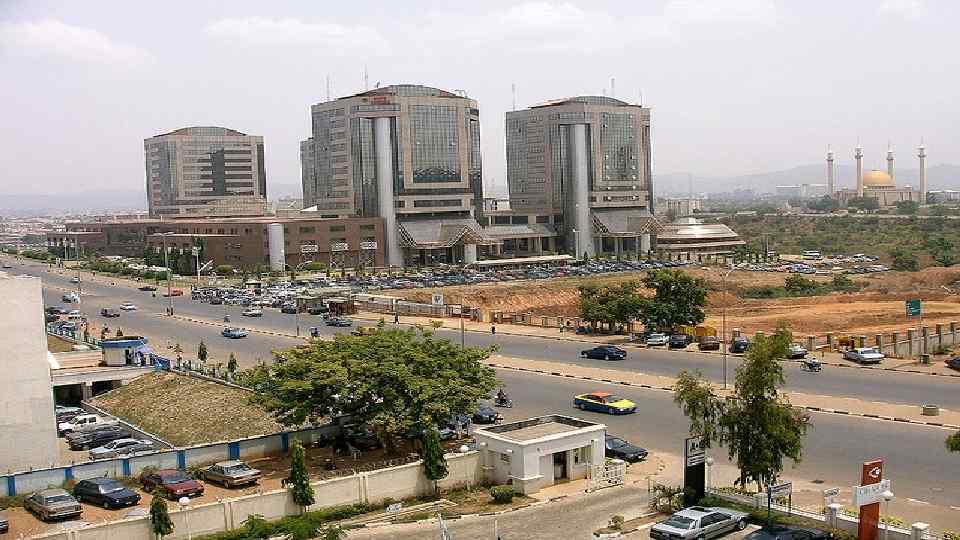
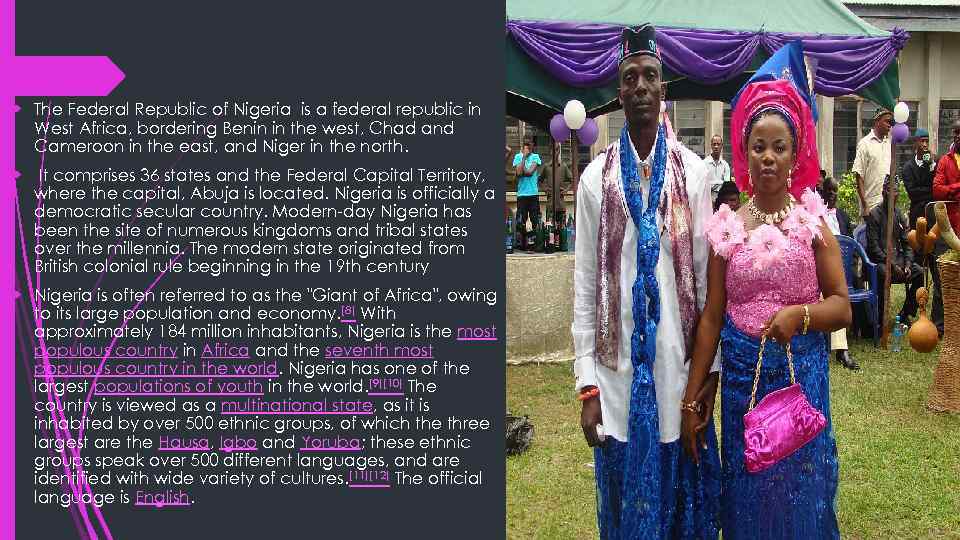 The Federal Republic of Nigeria is a federal republic in West Africa, bordering Benin in the west, Chad and Cameroon in the east, and Niger in the north. It comprises 36 states and the Federal Capital Territory, where the capital, Abuja is located. Nigeria is officially a democratic secular country. Modern-day Nigeria has been the site of numerous kingdoms and tribal states over the millennia. The modern state originated from British colonial rule beginning in the 19 th century Nigeria is often referred to as the "Giant of Africa", owing to its large population and economy. [8] With approximately 184 million inhabitants, Nigeria is the most populous country in Africa and the seventh most populous country in the world. Nigeria has one of the largest populations of youth in the world. [9][10] The country is viewed as a multinational state, as it is inhabited by over 500 ethnic groups, of which the three largest are the Hausa, Igbo and Yoruba; these ethnic groups speak over 500 different languages, and are identified with wide variety of cultures. [11][12] The official language is English.
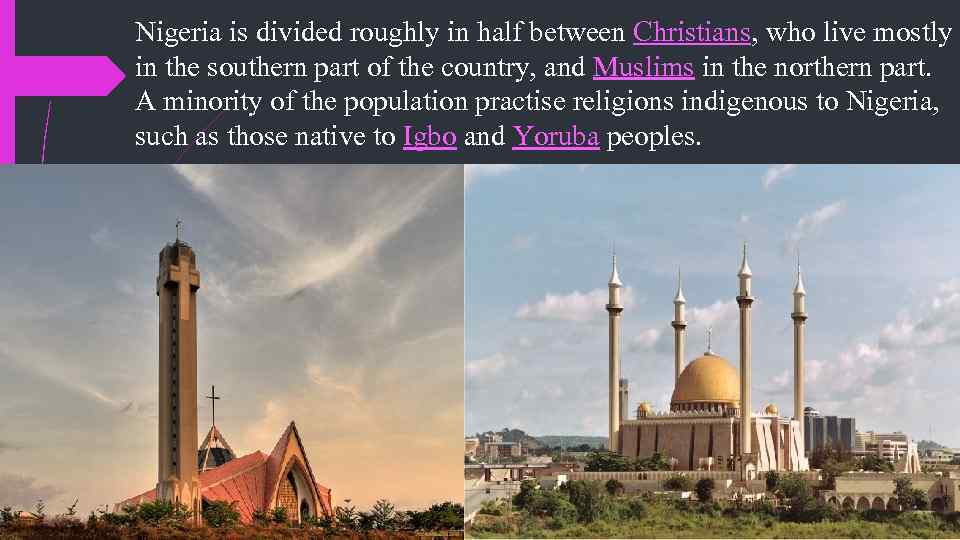 Nigeria is divided roughly in half between Christians, who live mostly in the southern part of the country, and Muslims in the northern part. A minority of the population practise religions indigenous to Nigeria, such as those native to Igbo and Yoruba peoples.
 As of 2015, Nigeria is the world's 20 th largest economy, worth more than $500 billion and $1 trillion in terms of nominal GDP and purchasing power parity respectively. It overtook South Africa to become Africa's largest economy in 2014. [13][14] The 2013 debt-to-GDP ratio was 11 percent. [15] Nigeria is considered to be an emerging market by the World Bank; [16] it has been identified as a regional power on the African continent, [17][18][19] a middle power in international affairs, [20][21][22][23] and has also been identified as an emerging global power. [24][25][26] Nigeria is a member of the MINT group of countries, which are widely seen as the globe's next "BRIC-like" economies. It is also listed among the "Next Eleven" economies set to become among the biggest in the world. Nigeria is a founding member of the African Union and a member of many other international organizations, including the United Nations, the Commonwealth of Nations and OPEC.
![Nigeria is a federal republic modelled after the United States, [75] with executive](https://present5.com/presentation/254201687_442900412/image-8.jpg "Nigeria is a federal republic modelled after the United States, [75] with executive") Nigeria is a federal republic modelled after the United States, [75] with executive power exercised by the President. It is influenced by the Westminster System model[citation needed] in the composition and management of the upper and lower houses of the bicameral legislature. The president presides as both head of state and head of the federal government; the leader is elected by popular vote to a maximum of two 4 -year terms. [76] In the March 28, 2015 presidential election, General Muhammadu Buhari emerged victorious to become the President of the Federal Republic of Nigeria, defeating then incumbent Dr Goodluck Jonathan.
Nigeria is a federal republic modelled after the United States, [75] with executive power exercised by the President. It is influenced by the Westminster System model[citation needed] in the composition and management of the upper and lower houses of the bicameral legislature. The president presides as both head of state and head of the federal government; the leader is elected by popular vote to a maximum of two 4 -year terms. [76] In the March 28, 2015 presidential election, General Muhammadu Buhari emerged victorious to become the President of the Federal Republic of Nigeria, defeating then incumbent Dr Goodluck Jonathan.
 There are three distinct systems of law in Nigeria: Common law, derived from its British colonial past, and a development of its own after independence; Customary law, derived from indigenous traditional norms and practice, including the dispute resolution meetings of pre-colonial Yorubaland secret societies and the Ẹ kpẹ and Ọ kọ ńkọ of Igboland Ibibioland; Sharia law, used only in the predominantly Muslim northern states of the country. It is an Islamic legal system that had been used long before the colonial administration. In late 1999, Zamfara emphasised its use, with eleven other northern states following suit. These states are Kano, Katsina, Niger, Bauchi, Borno, Kaduna, Gombe, Sokoto, Jigawa, Yobe, and Kebbi. The country has a judicial branch, the highest court of which is the Supreme Court of Nigeria.
 The main problems Despite its vast government revenue from the mining of petroleum, Nigeria is faced by a number of societal issues, owing primarily to a history of inefficiency in its governance.
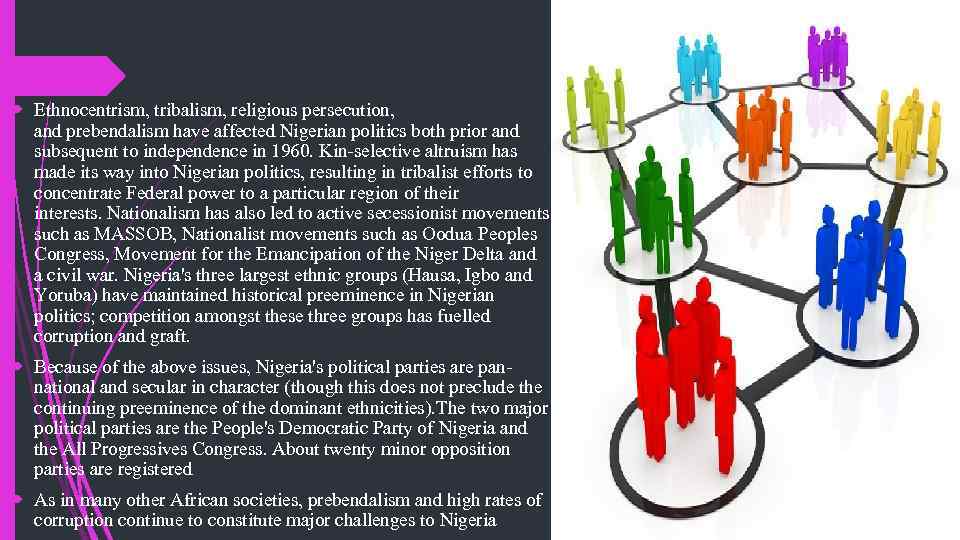 Ethnocentrism, tribalism, religious persecution, and prebendalism have affected Nigerian politics both prior and subsequent to independence in 1960. Kin-selective altruism has made its way into Nigerian politics, resulting in tribalist efforts to concentrate Federal power to a particular region of their interests. Nationalism has also led to active secessionist movements such as MASSOB, Nationalist movements such as Oodua Peoples Congress, Movement for the Emancipation of the Niger Delta and a civil war. Nigeria's three largest ethnic groups (Hausa, Igbo and Yoruba) have maintained historical preeminence in Nigerian politics; competition amongst these three groups has fuelled corruption and graft. Because of the above issues, Nigeria's political parties are pannational and secular in character (though this does not preclude the continuing preeminence of the dominant ethnicities). The two major political parties are the People's Democratic Party of Nigeria and the All Progressives Congress. About twenty minor opposition parties are registered As in many other African societies, prebendalism and high rates of corruption continue to constitute major challenges to Nigeria
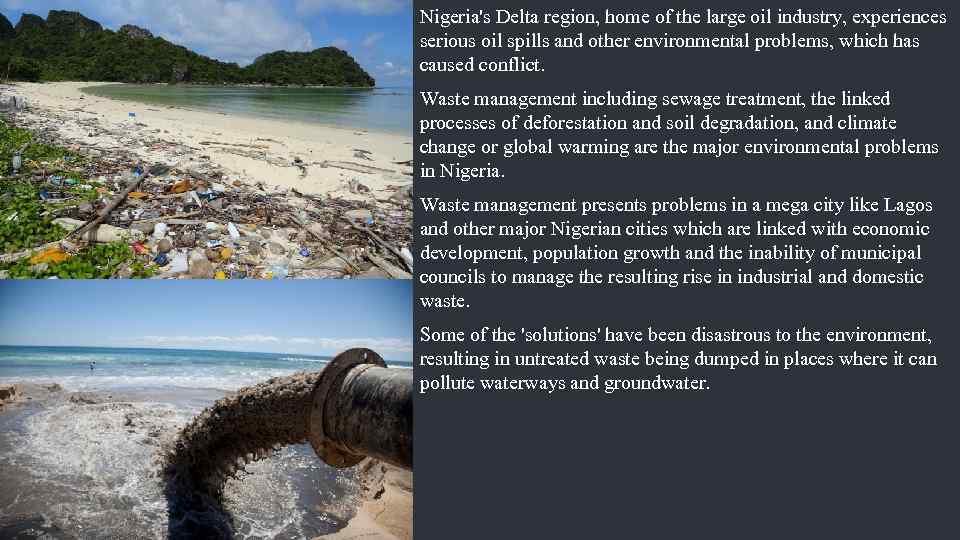 Nigeria's Delta region, home of the large oil industry, experiences serious oil spills and other environmental problems, which has caused conflict. Waste management including sewage treatment, the linked processes of deforestation and soil degradation, and climate change or global warming are the major environmental problems in Nigeria. Waste management presents problems in a mega city like Lagos and other major Nigerian cities which are linked with economic development, population growth and the inability of municipal councils to manage the resulting rise in industrial and domestic waste. Some of the 'solutions' have been disastrous to the environment, resulting in untreated waste being dumped in places where it can pollute waterways and groundwater.
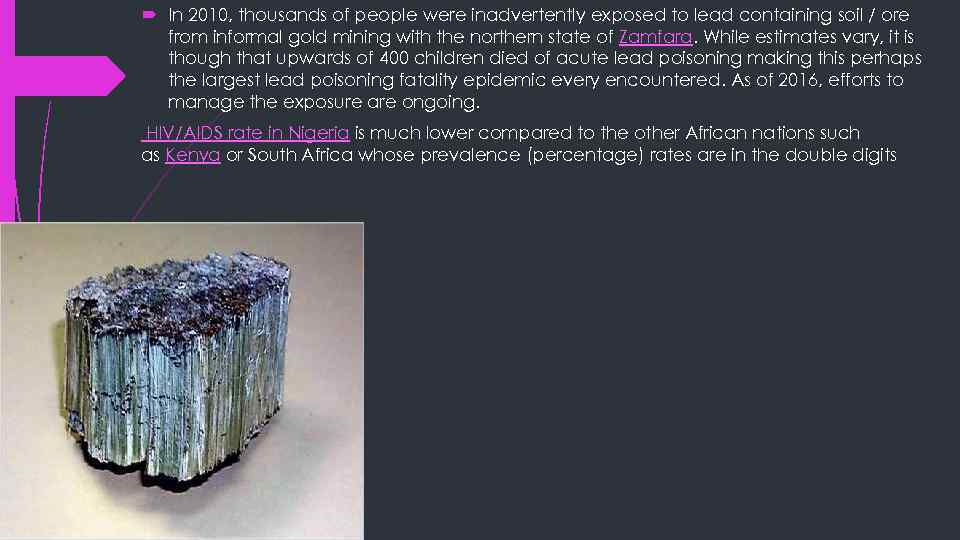 In 2010, thousands of people were inadvertently exposed to lead containing soil / ore from informal gold mining with the northern state of Zamfara. While estimates vary, it is though that upwards of 400 children died of acute lead poisoning making this perhaps the largest lead poisoning fatality epidemic every encountered. As of 2016, efforts to manage the exposure are ongoing. HIV/AIDS rate in Nigeria is much lower compared to the other African nations such as Kenya or South Africa whose prevalence (percentage) rates are in the double digits
 Nigeria is home to a substantial network of organised crime, active especially in drug trafficking. Nigerian criminal groups are heavily involved in drug trafficking, shipping heroin from Asian countries to Europe and America; and cocaine from South America to Europe and South Africa. [186] The various Nigerian Confraternities or "campus cults" are active in both organised crime and in political violence as well as providing a network of corruption within Nigeria. Internationally, Nigeria is infamous for a form of bank fraud dubbed 419, a type of advance fee fraud (named after Section 419 of the Nigerian Penal Code) along with the "Nigerian scam", a form of confidence trick practised by individuals and criminal syndicates. [189] These scams involve a complicit Nigerian bank (the laws being set up loosely to allow it) and a scammer who claims to have money he needs to obtain from that bank. Nigeria has also been pervaded by political corruption. In 2015, Nigerian President Muhammadu Buhari stated that corrupt officials have stolen $150 billion from Nigeria in the last 10 years. There is also some major piracy in Nigeria, with attacks directed at all types of vessels.
![Nigeria's human rights record remains poor; [205] according to the US Department of](https://present5.com/presentation/254201687_442900412/image-15.jpg "Nigeria's human rights record remains poor; [205] according to the US Department of") Nigeria's human rights record remains poor; [205] according to the US Department of State, [205] the most significant human rights problems are: use of excessive force by security forces; impunity for abuses by security forces; arbitrary arrests; prolonged pretrial detention; judicial corruption and executive influence on the judiciary; rape, torture and other cruel, inhuman or degrading treatment of prisoners, detainees and suspects; harsh and life‑threatening prison and detention centre conditions; human trafficking for the purpose of prostitution and forced labour; societal violence and vigilante killings; child labour, child abuse and child sexual exploitation; domestic violence; discrimination based on ethnicity, region and religion. Under the Shari'a penal code that applies to Muslims in twelve northern states, offences such as alcohol consumption, homosexuality, infidelity and theft carry harsh sentences, including amputation, lashing, stoning and long prison terms. Under a law signed in early 2014, same-sex couples who marry face up to 14 years each in prison. Witnesses or anyone who helps gay couples marry will be sentenced to 10 years behind bars.
Nigeria's human rights record remains poor; [205] according to the US Department of State, [205] the most significant human rights problems are: use of excessive force by security forces; impunity for abuses by security forces; arbitrary arrests; prolonged pretrial detention; judicial corruption and executive influence on the judiciary; rape, torture and other cruel, inhuman or degrading treatment of prisoners, detainees and suspects; harsh and life‑threatening prison and detention centre conditions; human trafficking for the purpose of prostitution and forced labour; societal violence and vigilante killings; child labour, child abuse and child sexual exploitation; domestic violence; discrimination based on ethnicity, region and religion. Under the Shari'a penal code that applies to Muslims in twelve northern states, offences such as alcohol consumption, homosexuality, infidelity and theft carry harsh sentences, including amputation, lashing, stoning and long prison terms. Under a law signed in early 2014, same-sex couples who marry face up to 14 years each in prison. Witnesses or anyone who helps gay couples marry will be sentenced to 10 years behind bars.
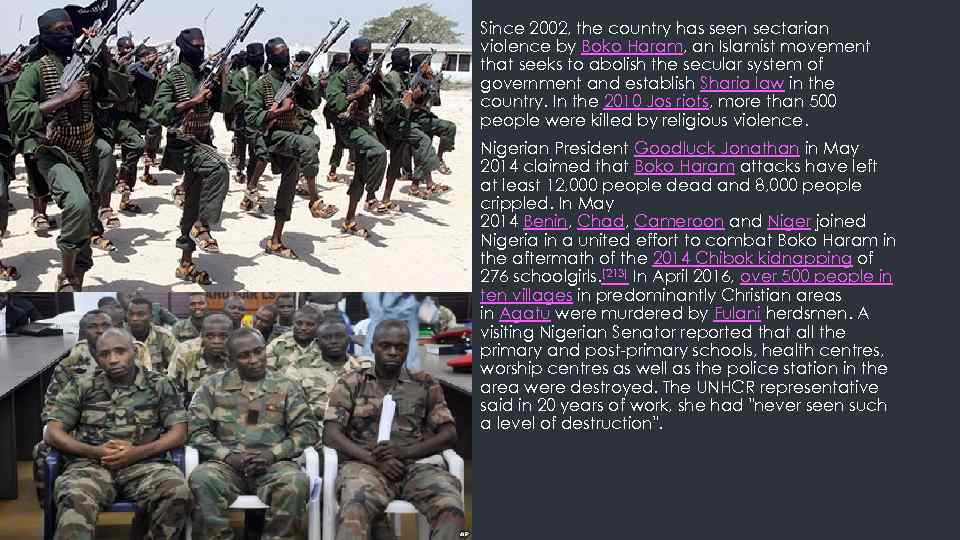 Since 2002, the country has seen sectarian violence by Boko Haram, an Islamist movement that seeks to abolish the secular system of government and establish Sharia law in the country. In the 2010 Jos riots, more than 500 people were killed by religious violence. Nigerian President Goodluck Jonathan in May 2014 claimed that Boko Haram attacks have left at least 12, 000 people dead and 8, 000 people crippled. In May 2014 Benin, Chad, Cameroon and Niger joined Nigeria in a united effort to combat Boko Haram in the aftermath of the 2014 Chibok kidnapping of 276 schoolgirls. [213] In April 2016, over 500 people in ten villages in predominantly Christian areas in Agatu were murdered by Fulani herdsmen. A visiting Nigerian Senator reported that all the primary and post-primary schools, health centres, worship centres as well as the police station in the area were destroyed. The UNHCR representative said in 20 years of work, she had "never seen such a level of destruction".
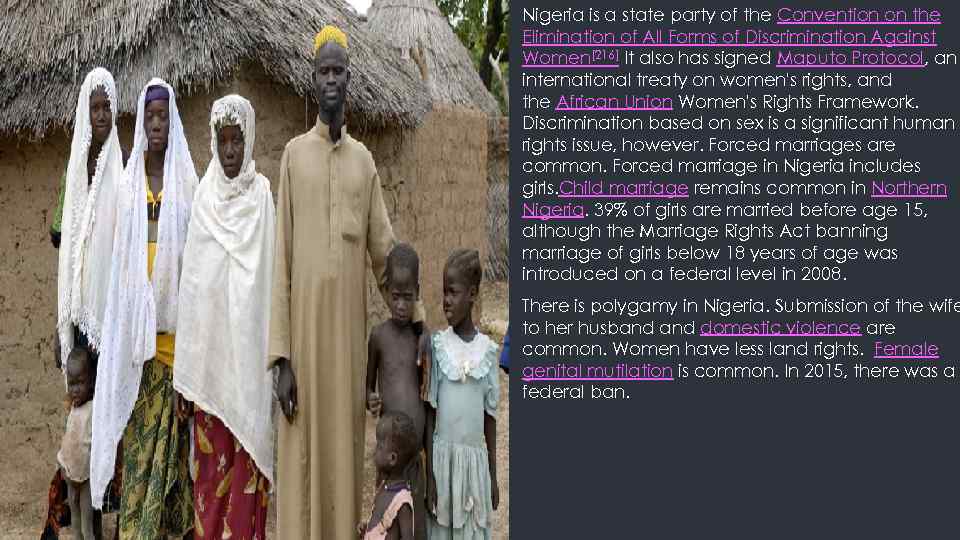 Nigeria is a state party of the Convention on the Elimination of All Forms of Discrimination Against Women[216] It also has signed Maputo Protocol, an international treaty on women's rights, and the African Union Women's Rights Framework. Discrimination based on sex is a significant human rights issue, however. Forced marriages are common. Forced marriage in Nigeria includes girls. Child marriage remains common in Northern Nigeria. 39% of girls are married before age 15, although the Marriage Rights Act banning marriage of girls below 18 years of age was introduced on a federal level in 2008. There is polygamy in Nigeria. Submission of the wife to her husband domestic violence are common. Women have less land rights. Female genital mutilation is common. In 2015, there was a federal ban.
 THANK YOU FOR YOUR ATTENTION!!!