 Скачать презентацию NGOs in Complex Emergencies Objectives To
946e6081abba0515709f3aaae4b71fca.ppt
- Количество слайдов: 21



NGOs in Complex Emergencies
Objectives • To understand the complexity of the ‘NGO community’ • To understand the principles and characteristics of NGOs • Identify coordination mechanisms of NGOs
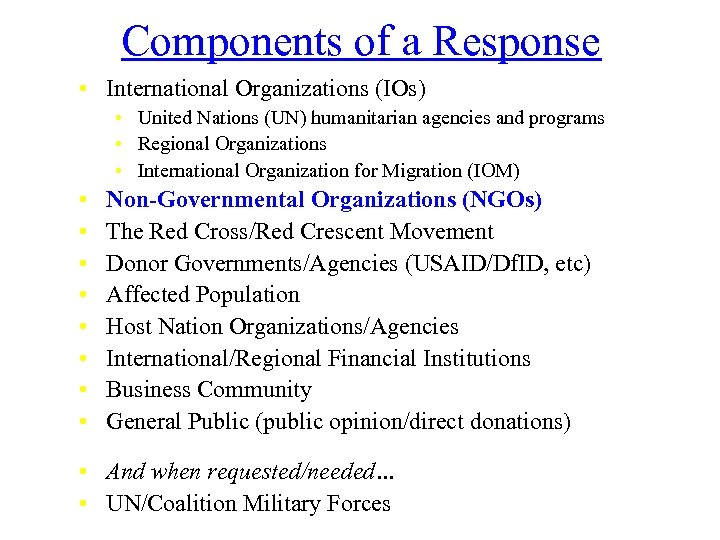
Components of a Response • International Organizations (IOs) • United Nations (UN) humanitarian agencies and programs • Regional Organizations • International Organization for Migration (IOM) • • Non-Governmental Organizations (NGOs) The Red Cross/Red Crescent Movement Donor Governments/Agencies (USAID/Df. ID, etc) Affected Population Host Nation Organizations/Agencies International/Regional Financial Institutions Business Community General Public (public opinion/direct donations) • And when requested/needed… • UN/Coalition Military Forces
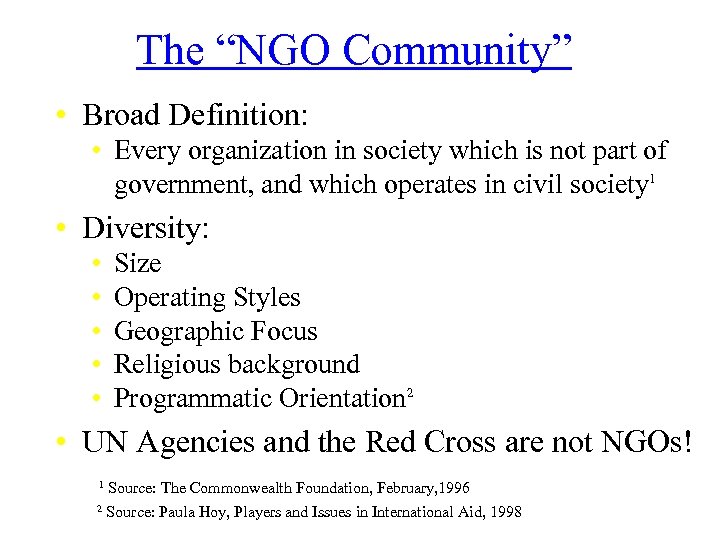
The “NGO Community” • Broad Definition: • Every organization in society which is not part of government, and which operates in civil society 1 • Diversity: • • • Size Operating Styles Geographic Focus Religious background Programmatic Orientation 2 • UN Agencies and the Red Cross are not NGOs! Source: The Commonwealth Foundation, February, 1996 2 Source: Paula Hoy, Players and Issues in International Aid, 1998 1
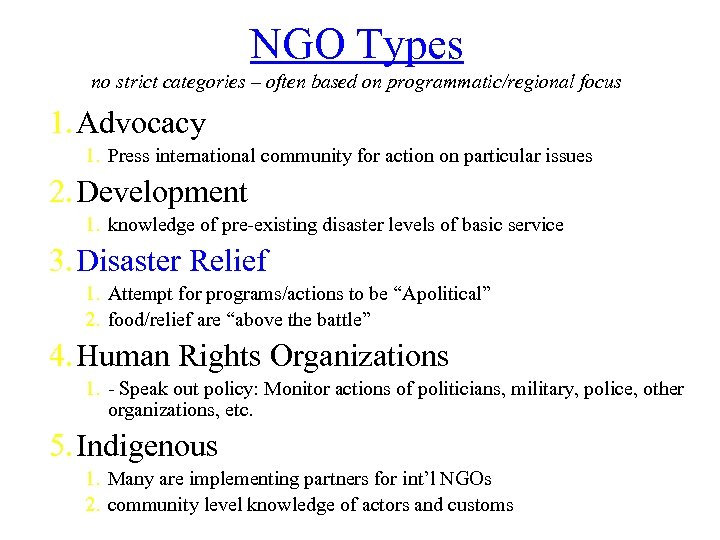
NGO Types no strict categories – often based on programmatic/regional focus 1. Advocacy 1. Press international community for action on particular issues 2. Development 1. knowledge of pre-existing disaster levels of basic service 3. Disaster Relief 1. Attempt for programs/actions to be “Apolitical” 2. food/relief are “above the battle” 4. Human Rights Organizations 1. - Speak out policy: Monitor actions of politicians, military, police, other organizations, etc. 5. Indigenous 1. Many are implementing partners for int’l NGOs 2. community level knowledge of actors and customs
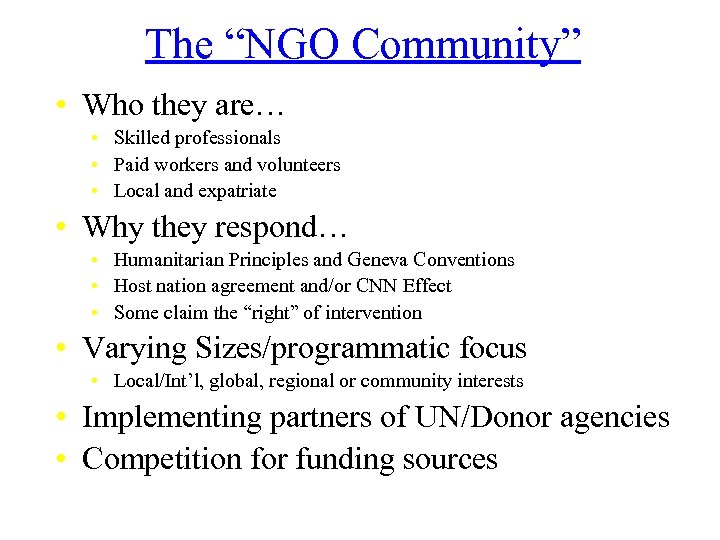
The “NGO Community” • Who they are… • Skilled professionals • Paid workers and volunteers • Local and expatriate • Why they respond… • Humanitarian Principles and Geneva Conventions • Host nation agreement and/or CNN Effect • Some claim the “right” of intervention • Varying Sizes/programmatic focus • Local/Int’l, global, regional or community interests • Implementing partners of UN/Donor agencies • Competition for funding sources
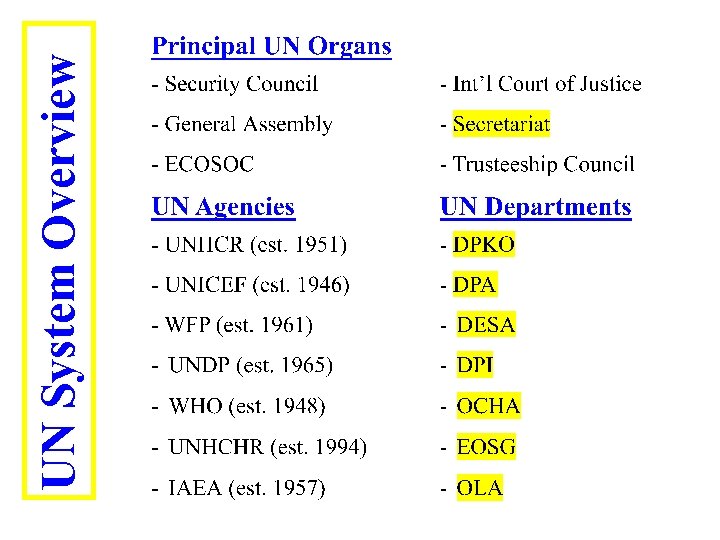
UN System Overview
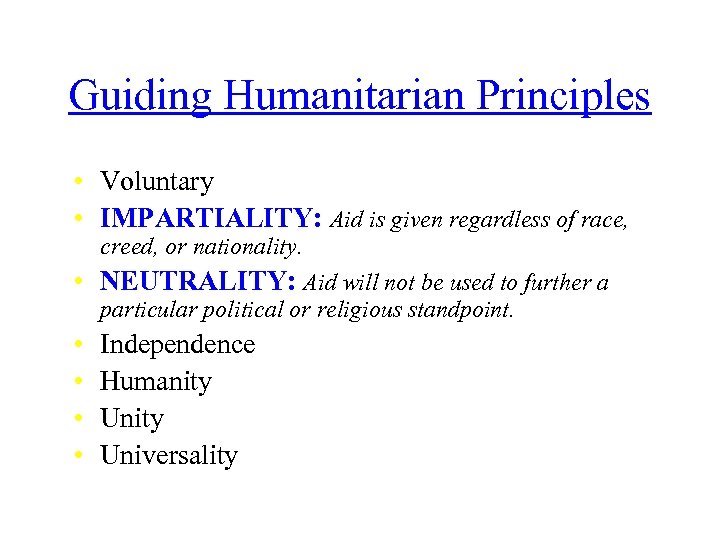
Guiding Humanitarian Principles • Voluntary • IMPARTIALITY: Aid is given regardless of race, creed, or nationality. • NEUTRALITY: Aid will not be used to further a particular political or religious standpoint. • • Independence Humanity Universality
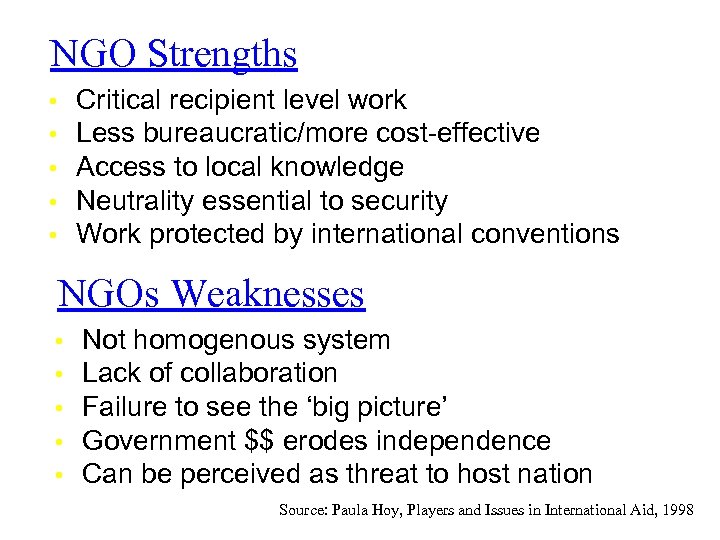
NGO Strengths Critical recipient level work Less bureaucratic/more cost-effective Access to local knowledge Neutrality essential to security Work protected by international conventions • • • NGOs Weaknesses • • • Not homogenous system Lack of collaboration Failure to see the ‘big picture’ Government $$ erodes independence Can be perceived as threat to host nation Source: Paula Hoy, Players and Issues in International Aid, 1998
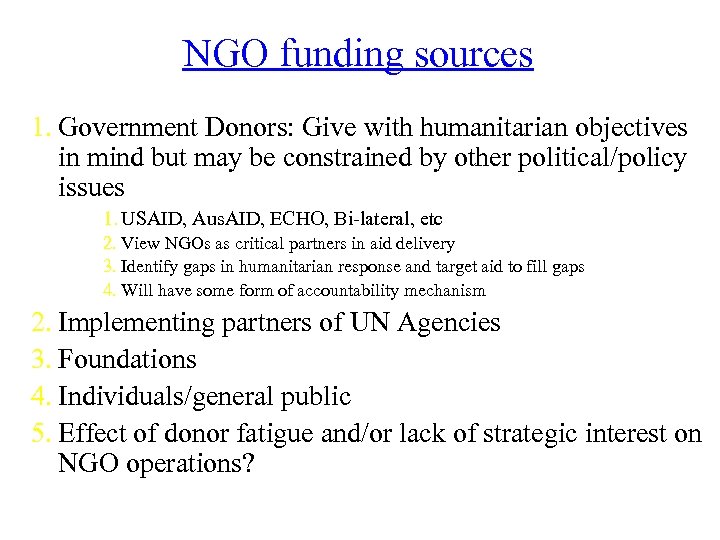
NGO funding sources 1. Government Donors: Give with humanitarian objectives in mind but may be constrained by other political/policy issues 1. USAID, Aus. AID, ECHO, Bi-lateral, etc 2. View NGOs as critical partners in aid delivery 3. Identify gaps in humanitarian response and target aid to fill gaps 4. Will have some form of accountability mechanism 2. Implementing partners of UN Agencies 3. Foundations 4. Individuals/general public 5. Effect of donor fatigue and/or lack of strategic interest on NGO operations?
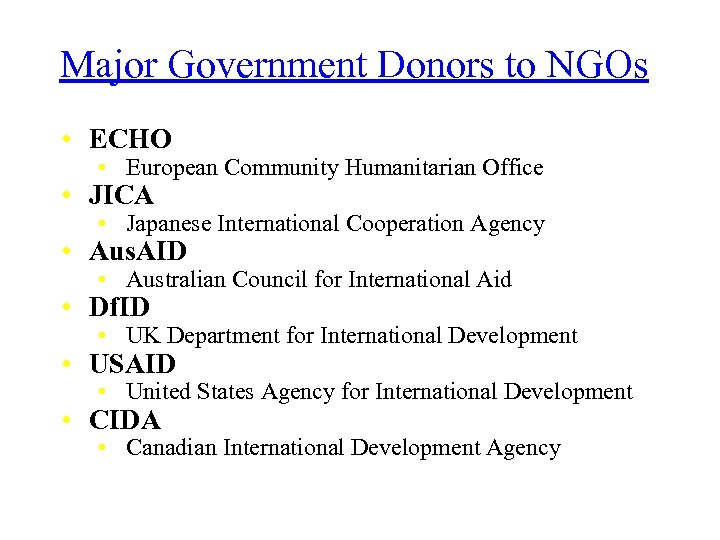
Major Government Donors to NGOs • ECHO • European Community Humanitarian Office • JICA • Japanese International Cooperation Agency • Aus. AID • Australian Council for International Aid • Df. ID • UK Department for International Development • USAID • United States Agency for International Development • CIDA • Canadian International Development Agency
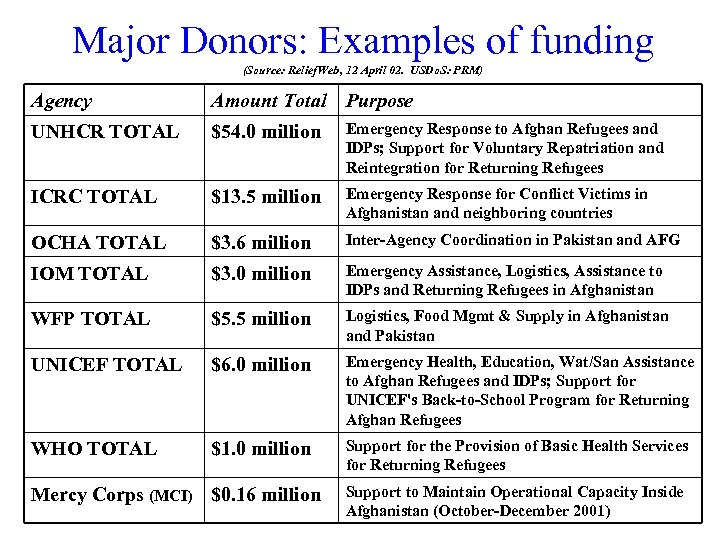
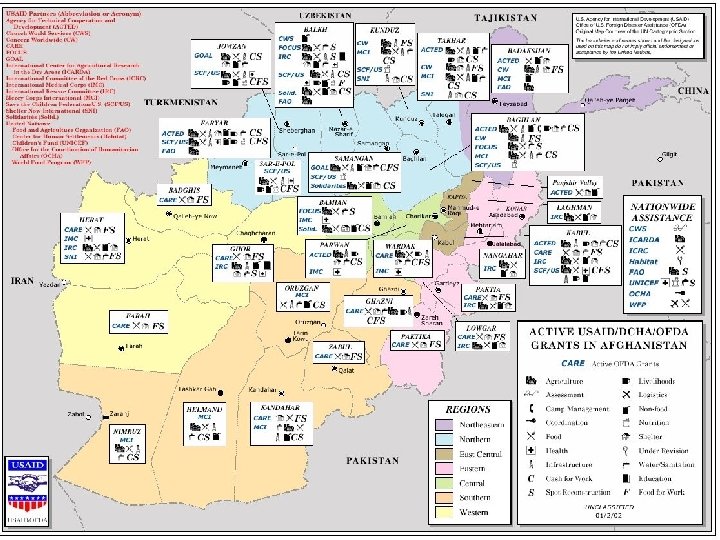
Major Donors: Examples of funding (Source: Relief. Web, 12 April 02. USDo. S: PRM) Agency Amount Total Purpose UNHCR TOTAL $54. 0 million Emergency Response to Afghan Refugees and IDPs; Support for Voluntary Repatriation and Reintegration for Returning Refugees ICRC TOTAL $13. 5 million Emergency Response for Conflict Victims in Afghanistan and neighboring countries OCHA TOTAL $3. 6 million Inter-Agency Coordination in Pakistan and AFG IOM TOTAL $3. 0 million Emergency Assistance, Logistics, Assistance to IDPs and Returning Refugees in Afghanistan WFP TOTAL $5. 5 million Logistics, Food Mgmt & Supply in Afghanistan and Pakistan UNICEF TOTAL $6. 0 million Emergency Health, Education, Wat/San Assistance to Afghan Refugees and IDPs; Support for UNICEF's Back-to-School Program for Returning Afghan Refugees WHO TOTAL $1. 0 million Support for the Provision of Basic Health Services for Returning Refugees Mercy Corps (MCI) $0. 16 million Support to Maintain Operational Capacity Inside Afghanistan (October-December 2001)
Efforts to improve accountability • Sphere Project: Minimum Standards in Disaster Response: • • • water supply and sanitation nutrition food aid shelter and site planning health services • ICRC/NGO Code of Conduct • 130 organizations have signed • Donor demands for increased accountability • What is “acceptable loss”
Tanzania 1997 Fancy doing “something useful? ” Spend three months living and working in rural Africa on health-related village projects. No skills needed. If you’re 18 -28, find out how by calling HEALTH PROJECTS ABROAD on 01629 640053
NGO Training • Red. R • Security Management Workshops • Transport Access in Emergencies • Site Selection and Planning • People in Aid • World Vision Security Training • Individual organization training/recruitment policies • i. e. OXFAM GB: Knowledge/experience with Sphere Standards
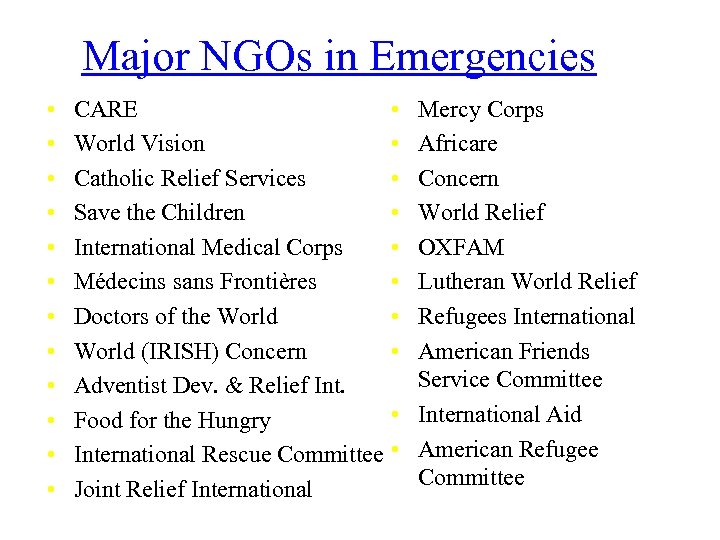
Major NGOs in Emergencies • • • CARE World Vision Catholic Relief Services Save the Children International Medical Corps Médecins sans Frontières Doctors of the World (IRISH) Concern Adventist Dev. & Relief Int. Food for the Hungry International Rescue Committee Joint Relief International • • Mercy Corps Africare Concern World Relief OXFAM Lutheran World Relief Refugees International American Friends Service Committee • International Aid • American Refugee Committee
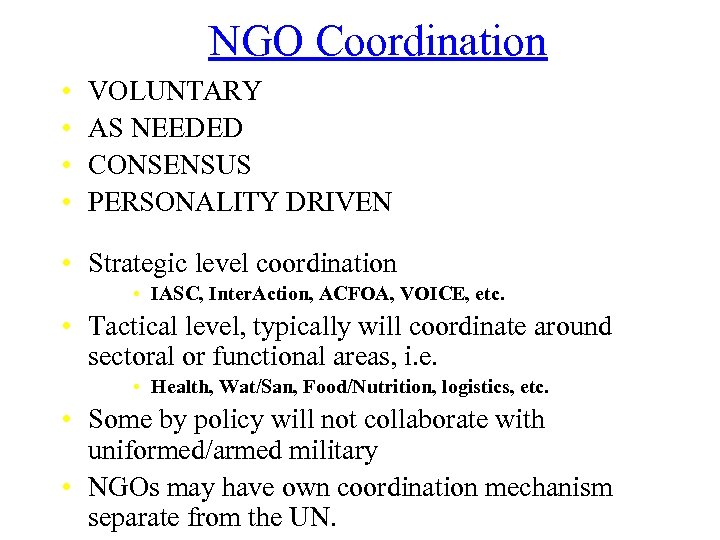
NGO Coordination • • VOLUNTARY AS NEEDED CONSENSUS PERSONALITY DRIVEN • Strategic level coordination • IASC, Inter. Action, ACFOA, VOICE, etc. • Tactical level, typically will coordinate around sectoral or functional areas, i. e. • Health, Wat/San, Food/Nutrition, logistics, etc. • Some by policy will not collaborate with uniformed/armed military • NGOs may have own coordination mechanism separate from the UN.
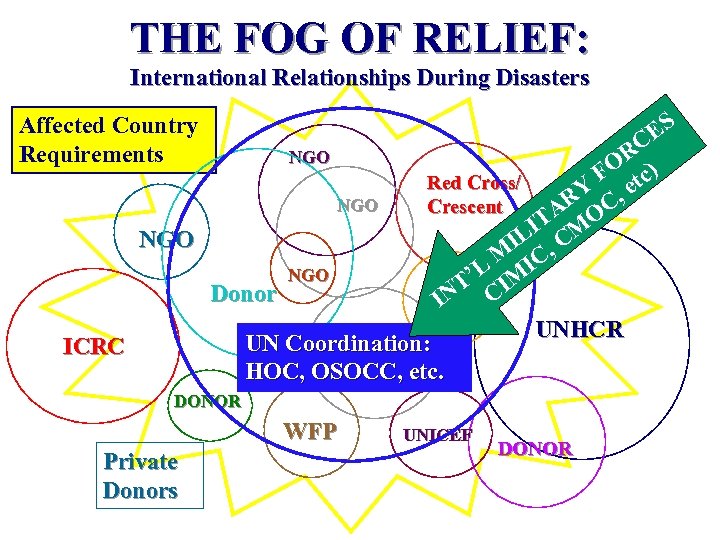
THE FOG OF RELIEF: International Relationships During Disasters Affected Country Requirements ES C OR c) F t Red Cross/ e RY C, NGO Crescent TA MO LI C NGO I M IC, L NGO T’ CIM Donor IN NGO UNHCR UN Coordination: ICRC NGO HOC, OSOCC, etc. NGO DONOR WFP Private Donors UNICEF DONOR
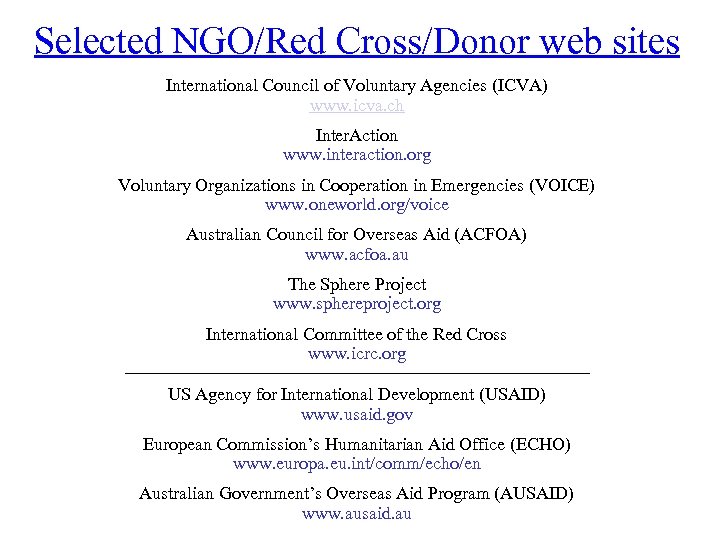
Selected NGO/Red Cross/Donor web sites International Council of Voluntary Agencies (ICVA) www. icva. ch Inter. Action www. interaction. org Voluntary Organizations in Cooperation in Emergencies (VOICE) www. oneworld. org/voice Australian Council for Overseas Aid (ACFOA) www. acfoa. au The Sphere Project www. sphereproject. org International Committee of the Red Cross www. icrc. org _______________________________________________ US Agency for International Development (USAID) www. usaid. gov European Commission’s Humanitarian Aid Office (ECHO) www. europa. eu. int/comm/echo/en Australian Government’s Overseas Aid Program (AUSAID) www. ausaid. au
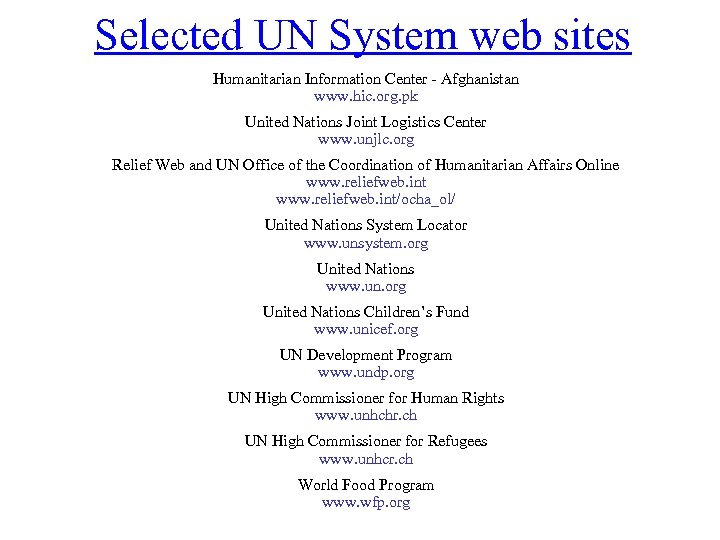
Selected UN System web sites Humanitarian Information Center - Afghanistan www. hic. org. pk United Nations Joint Logistics Center www. unjlc. org Relief Web and UN Office of the Coordination of Humanitarian Affairs Online www. reliefweb. int/ocha_ol/ United Nations System Locator www. unsystem. org United Nations www. un. org United Nations Children’s Fund www. unicef. org UN Development Program www. undp. org UN High Commissioner for Human Rights www. unhchr. ch UN High Commissioner for Refugees www. unhcr. ch World Food Program www. wfp. org
Скачать презентацию NGOs in Complex Emergencies Objectives To
946e6081abba0515709f3aaae4b71fca.ppt