


 Скачать презентацию Next Steps Post-Kyoto U S Options The EU
5abcd8082e6a930385c84d9b200b5af8.ppt
- Количество слайдов: 13
 Next Steps Post-Kyoto: U. S. Options The EU Experience Sustainable Energy Institute Washington D. C, March 30, 2005 Robert Donkers, Environment Counselor at the Delegation of the European Commission to the US European Commission
 European Framework: European Climate Change Programme (ECCP) l l Involves key stakeholders Objective: Cost effective ways to meet EU -8% Kyoto objective l l Total reduction potential of 578 - 696 Mt CO 2 eq. /year = twice Kyoto ‘-8%’ identified (including strong support for emissions trading) EU measures for 276 -316 Mt CO 2 eq. /year currently “in implementation” … but need for monitoring of effectiveness and review European Commission
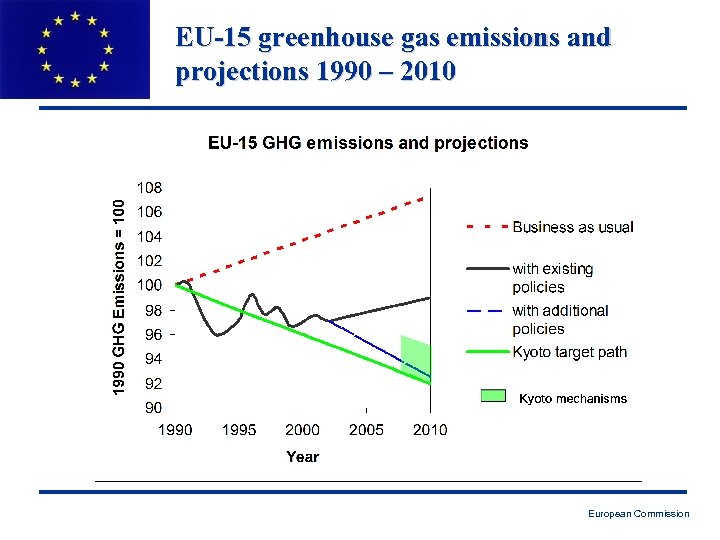 EU-15 greenhouse gas emissions and projections 1990 – 2010 European Commission
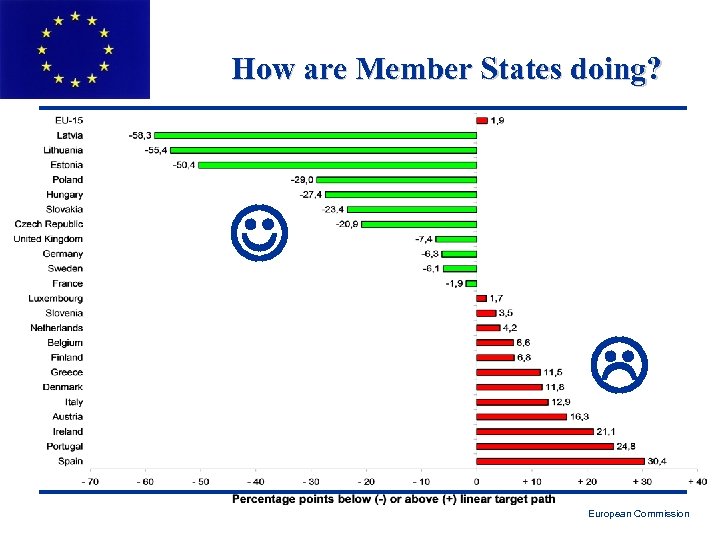 How are Member States doing? European Commission
 EU emissions trading scheme 1 (EU ETS) l l l New market based instrument: CO 2 emissions covered by allowances First “trial period” 2005 – 2007, limited to CO 2 emissions from large, energy intensive users (12, 000 installations) Each Member States allocated allowances to companies – Commission to approve each NAP Companies can trade surplus allowances or buy extra allowances on the market Companies may use credits from GHG emission reduction projects (CDM and JI) undertaken in developing and developed countries Sanctions for non-respect (€ 40 per tonne) Market price for CO 2 – companies decide on the most cost. European Commission effective emission reduction strategies
 EU emissions trading scheme 2 (EU ETS) Experience to date: l l l January 2005: 2. 5 m tonnes CO 2 traded at average Euro 6 -7 February 2005: 4 m tonnes CO 2 traded at average Euro 7 March 2005: still running, but on Tuesday March 22 alone 2 m tonnes CO 2 traded at Euro 16. 45 !!! Careful Conclusion: ‘Appetite’ is increasing and the market is becoming of age European Commission
 What else is needed to implement EU climate change policy? Extend emissions trading to other installations and GHG gases l Bring in transport (in particular aviation) l Investment in R&D and new technologies l Changes in behaviour (energy saving etc) l Urgent & significant increase of renewable energy l European Commission
 March 2005 Communication of the European Commission l l Depending on the risks we are willing to accept, global emissions will have to peak between 2015 and 2025 (Re) engage our partners: build a broad coalition among developed and developing countries m EU leadership m Advantages of participation m Disadvantages of non-participation Build on Kyoto framework Is there a one size fits all? A mix of mitigation and adaptation policies A mix of targets, timetables, technologies, and policies “Action on climate change post-2102” European Commission (http: //europa. eu. int/comm/environment/climat/future_action. htm)
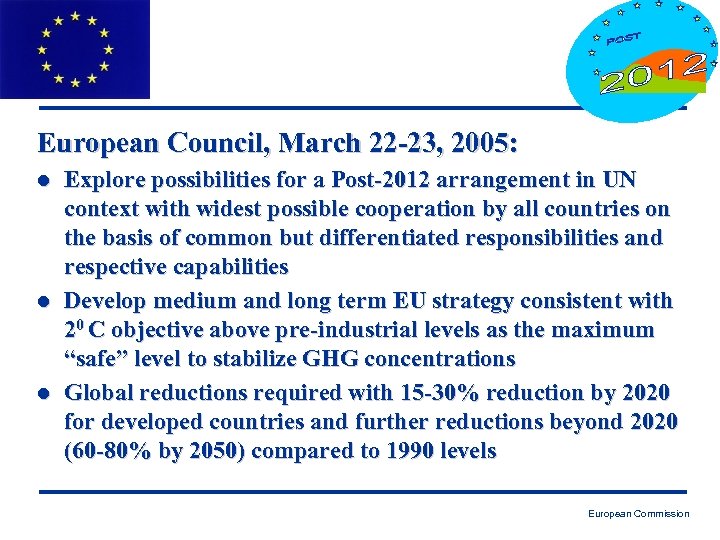 European Council, March 22 -23, 2005: l l l Explore possibilities for a Post-2012 arrangement in UN context with widest possible cooperation by all countries on the basis of common but differentiated responsibilities and respective capabilities Develop medium and long term EU strategy consistent with 20 C objective above pre-industrial levels as the maximum “safe” level to stabilize GHG concentrations Global reductions required with 15 -30% reduction by 2020 for developed countries and further reductions beyond 2020 (60 -80% by 2050) compared to 1990 levels European Commission
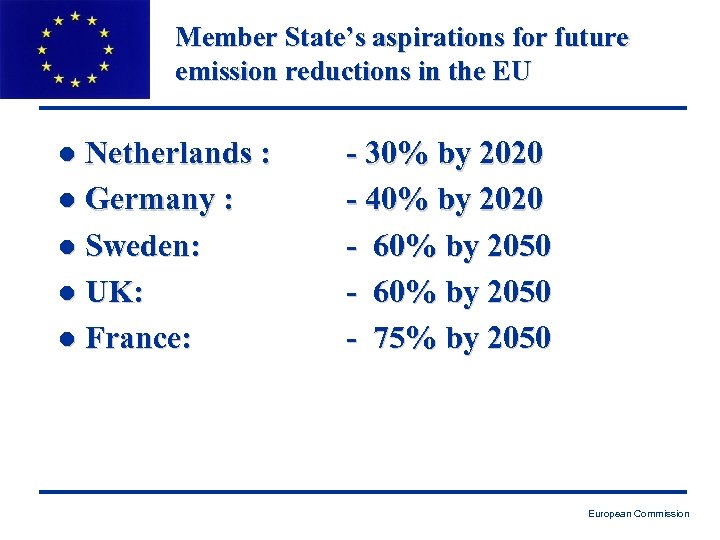 Member State’s aspirations for future emission reductions in the EU Netherlands : l Germany : l Sweden: l UK: l France: l - 30% by 2020 - 40% by 2020 - 60% by 2050 - 75% by 2050 European Commission
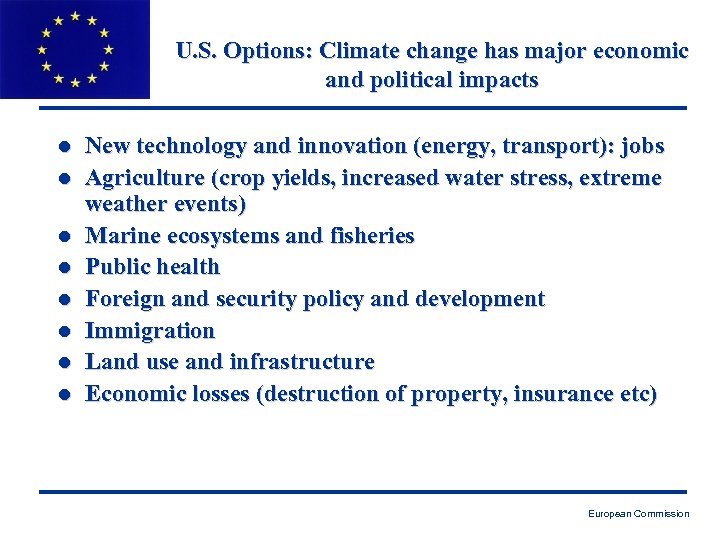 U. S. Options: Climate change has major economic and political impacts l l l l New technology and innovation (energy, transport): jobs Agriculture (crop yields, increased water stress, extreme weather events) Marine ecosystems and fisheries Public health Foreign and security policy and development Immigration Land use and infrastructure Economic losses (destruction of property, insurance etc) European Commission
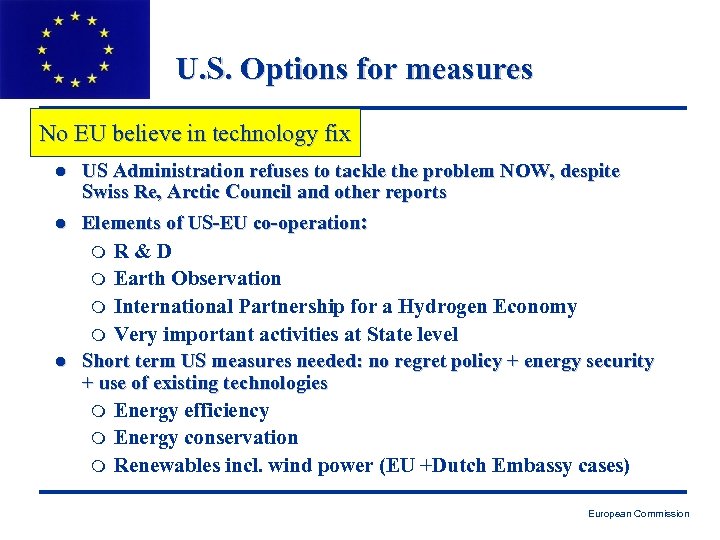 U. S. Options for measures No EU believe in technology fix l US Administration refuses to tackle the problem NOW, despite Swiss Re, Arctic Council and other reports l Elements of US-EU co-operation: l R&D m Earth Observation m International Partnership for a Hydrogen Economy m Very important activities at State level Short term US measures needed: no regret policy + energy security + use of existing technologies m Energy efficiency m Energy conservation m Renewables incl. wind power (EU +Dutch Embassy cases) m European Commission
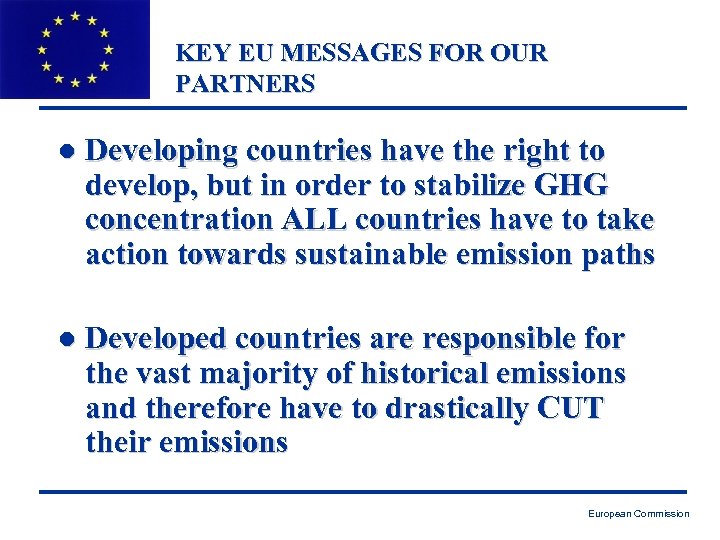 KEY EU MESSAGES FOR OUR PARTNERS l Developing countries have the right to develop, but in order to stabilize GHG concentration ALL countries have to take action towards sustainable emission paths l Developed countries are responsible for the vast majority of historical emissions and therefore have to drastically CUT their emissions European Commission