 Скачать презентацию Next Generation NRN Architectures Axel Clauberg clauberg cisco com
b7a3edb0d559b9ba8033114d75cd8a3e.ppt
- Количество слайдов: 24



Next Generation NRN Architectures Axel Clauberg, clauberg@cisco. com Sr. Manager, Consulting Engineering Cisco Systems EMEA AC_2004 © 2004 Cisco Systems, Inc. All rights reserved. 1
Agenda Requirements A look over the fence IP approach Transport approach Conclusions AC_2004 © 2004 Cisco Systems, Inc. All rights reserved. 2
Requirements AC_2004 © 2004, Cisco Systems, Inc. All rights reserved. 3
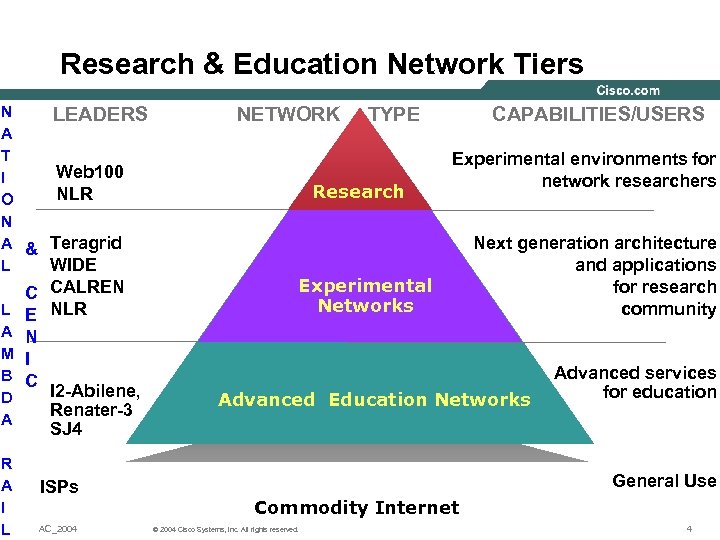
Research & Education Network Tiers N LEADERS A T Web 100 I NLR O N A & Teragrid L WIDE L A M B D A R A I L C CALREN E NLR N I C I 2 -Abilene, Renater-3 SJ 4 ISPs AC_2004 NETWORK TYPE Research CAPABILITIES/USERS Experimental environments for network researchers Experimental Networks Next generation architecture and applications for research community Advanced Education Networks Advanced services for education General Use Commodity Internet © 2004 Cisco Systems, Inc. All rights reserved. 4
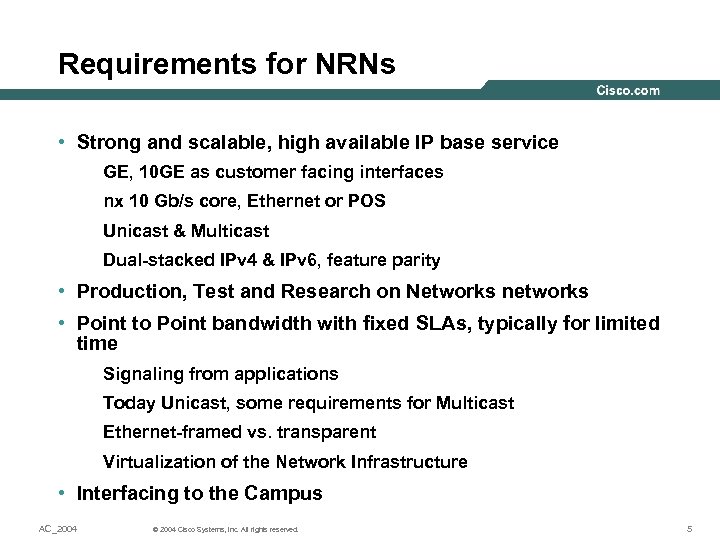
Requirements for NRNs • Strong and scalable, high available IP base service GE, 10 GE as customer facing interfaces nx 10 Gb/s core, Ethernet or POS Unicast & Multicast Dual-stacked IPv 4 & IPv 6, feature parity • Production, Test and Research on Networks networks • Point to Point bandwidth with fixed SLAs, typically for limited time Signaling from applications Today Unicast, some requirements for Multicast Ethernet-framed vs. transparent Virtualization of the Network Infrastructure • Interfacing to the Campus AC_2004 © 2004 Cisco Systems, Inc. All rights reserved. 5
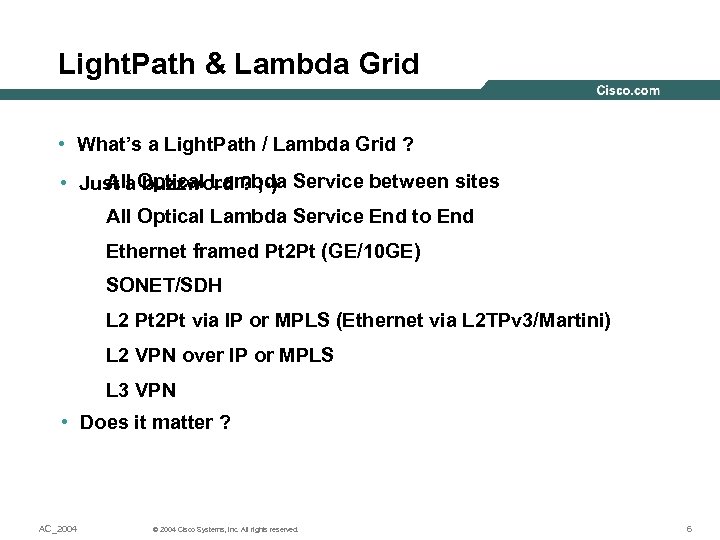
Light. Path & Lambda Grid • What’s a Light. Path / Lambda Grid ? All buzzword ? ; -) • Just a Optical Lambda Service between sites All Optical Lambda Service End to End Ethernet framed Pt 2 Pt (GE/10 GE) SONET/SDH L 2 Pt 2 Pt via IP or MPLS (Ethernet via L 2 TPv 3/Martini) L 2 VPN over IP or MPLS L 3 VPN • Does it matter ? AC_2004 © 2004 Cisco Systems, Inc. All rights reserved. 6
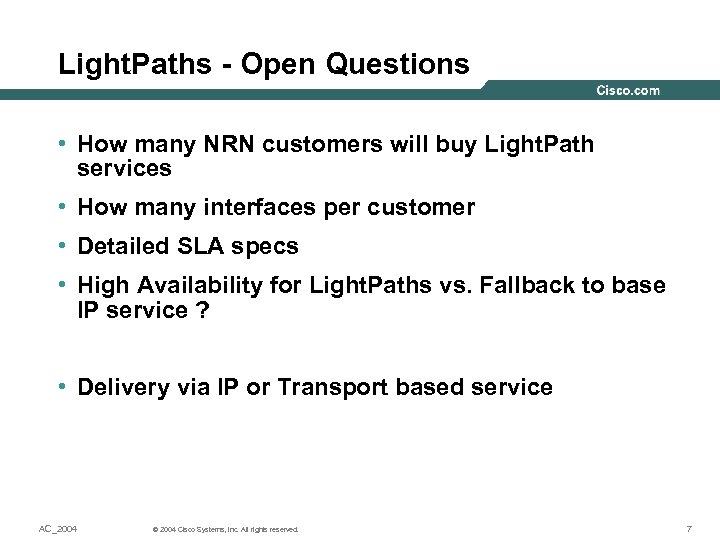
Light. Paths - Open Questions • How many NRN customers will buy Light. Path services • How many interfaces per customer • Detailed SLA specs • High Availability for Light. Paths vs. Fallback to base IP service ? • Delivery via IP or Transport based service AC_2004 © 2004 Cisco Systems, Inc. All rights reserved. 7

A look over the fence AC_2004 © 2004, Cisco Systems, Inc. All rights reserved. 8
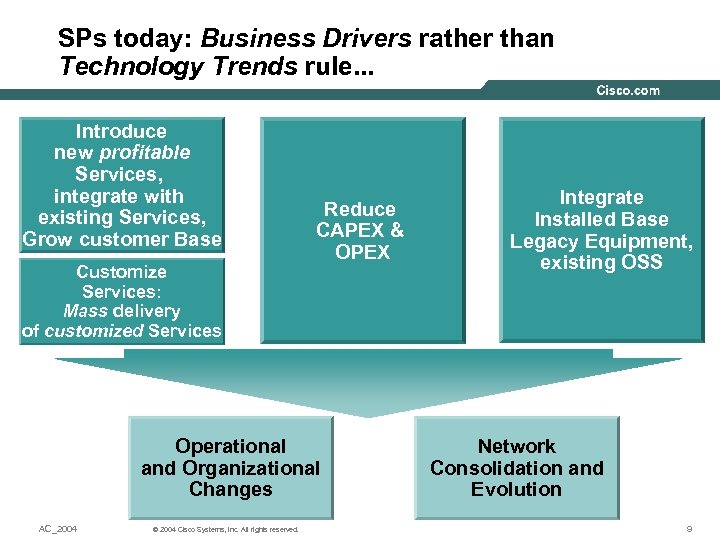
SPs today: Business Drivers rather than Technology Trends rule. . . Introduce new profitable Services, integrate with existing Services, Grow customer Base Customize Services: Mass delivery of customized Services Reduce CAPEX & OPEX Operational and Organizational Changes AC_2004 © 2004 Cisco Systems, Inc. All rights reserved. Integrate Installed Base Legacy Equipment, existing OSS Network Consolidation and Evolution 9
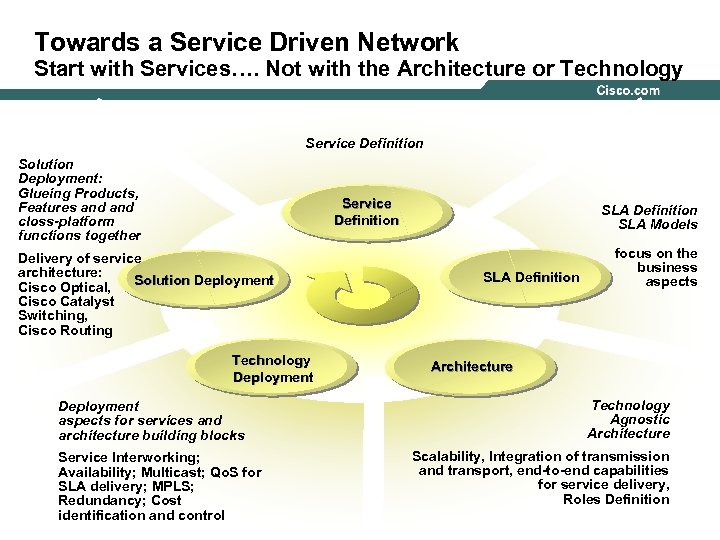
Towards a Service Driven Network Start with Services…. Not with the Architecture or Technology Service Definition Solution Deployment: Glueing Products, Features and closs-platform functions together Service Definition Delivery of service architecture: Solution Deployment Cisco Optical, Cisco Catalyst Switching, Cisco Routing Technology Deployment aspects for services and architecture building blocks Service Interworking; Availability; Multicast; Qo. S for SLA delivery; MPLS; Redundancy; Cost identification and control AC_2004 © 2004 Cisco Systems, Inc. All rights reserved. SLA Definition SLA Models SLA Definition focus on the business aspects Architecture Technology Agnostic Architecture Scalability, Integration of transmission and transport, end-to-end capabilities for service delivery, Roles Definition 10
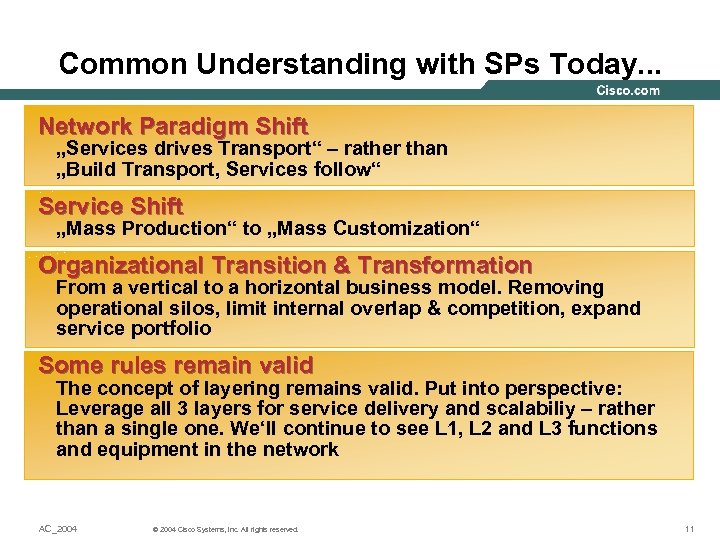
Common Understanding with SPs Today. . . Network Paradigm Shift „Services drives Transport“ – rather than „Build Transport, Services follow“ Service Shift „Mass Production“ to „Mass Customization“ Organizational Transition & Transformation From a vertical to a horizontal business model. Removing operational silos, limit internal overlap & competition, expand service portfolio Some rules remain valid The concept of layering remains valid. Put into perspective: Leverage all 3 layers for service delivery and scalabiliy – rather than a single one. We‘ll continue to see L 1, L 2 and L 3 functions and equipment in the network AC_2004 © 2004 Cisco Systems, Inc. All rights reserved. 11
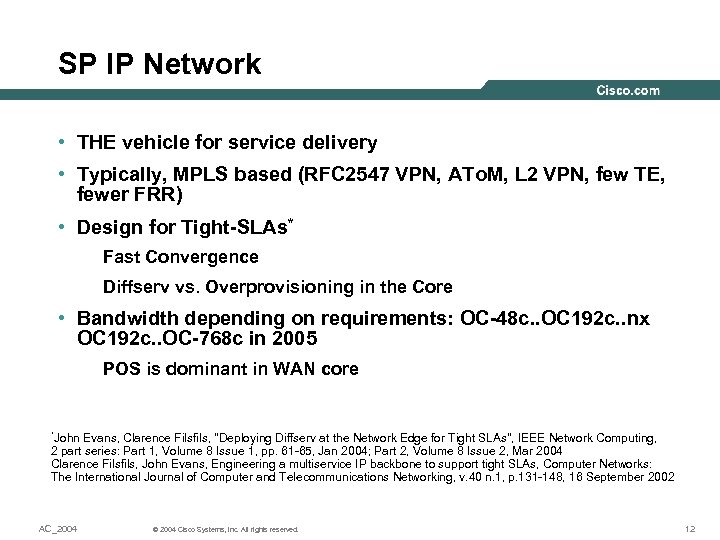
SP IP Network • THE vehicle for service delivery • Typically, MPLS based (RFC 2547 VPN, ATo. M, L 2 VPN, few TE, fewer FRR) • Design for Tight-SLAs* Fast Convergence Diffserv vs. Overprovisioning in the Core • Bandwidth depending on requirements: OC-48 c. . OC 192 c. . nx OC 192 c. . OC-768 c in 2005 POS is dominant in WAN core *John Evans, Clarence Filsfils, "Deploying Diffserv at the Network Edge for Tight SLAs", IEEE Network Computing, 2 part series: Part 1, Volume 8 Issue 1, pp. 61 -65, Jan 2004; Part 2, Volume 8 Issue 2, Mar 2004 Clarence Filsfils, John Evans, Engineering a multiservice IP backbone to support tight SLAs, Computer Networks: The International Journal of Computer and Telecommunications Networking, v. 40 n. 1, p. 131 -148, 16 September 2002 AC_2004 © 2004 Cisco Systems, Inc. All rights reserved. 12
IP Approach AC_2004 © 2004, Cisco Systems, Inc. All rights reserved. 13
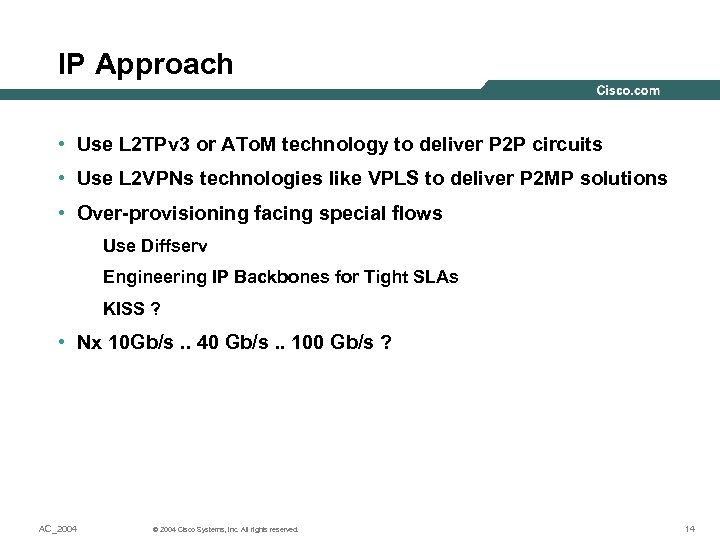
IP Approach • Use L 2 TPv 3 or ATo. M technology to deliver P 2 P circuits • Use L 2 VPNs technologies like VPLS to deliver P 2 MP solutions • Over-provisioning facing special flows Use Diffserv Engineering IP Backbones for Tight SLAs KISS ? • Nx 10 Gb/s. . 40 Gb/s. . 100 Gb/s ? AC_2004 © 2004 Cisco Systems, Inc. All rights reserved. 14
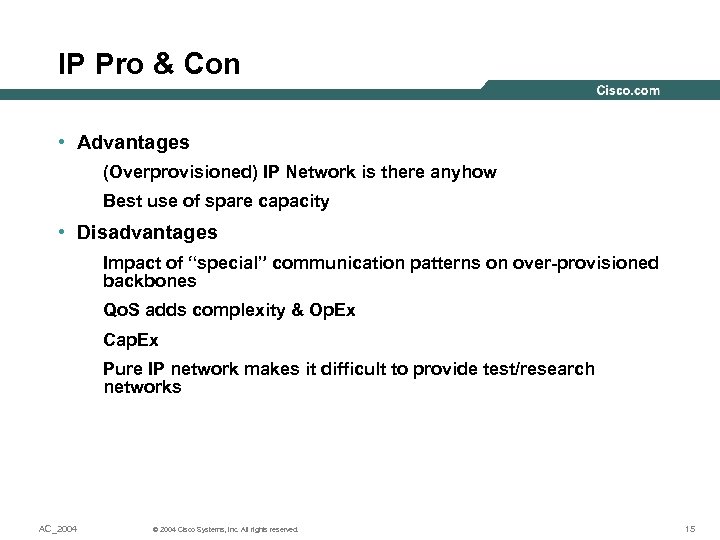
IP Pro & Con • Advantages (Overprovisioned) IP Network is there anyhow Best use of spare capacity • Disadvantages Impact of “special” communication patterns on over-provisioned backbones Qo. S adds complexity & Op. Ex Cap. Ex Pure IP network makes it difficult to provide test/research networks AC_2004 © 2004 Cisco Systems, Inc. All rights reserved. 15
Transport based AC_2004 © 2004, Cisco Systems, Inc. All rights reserved. 16
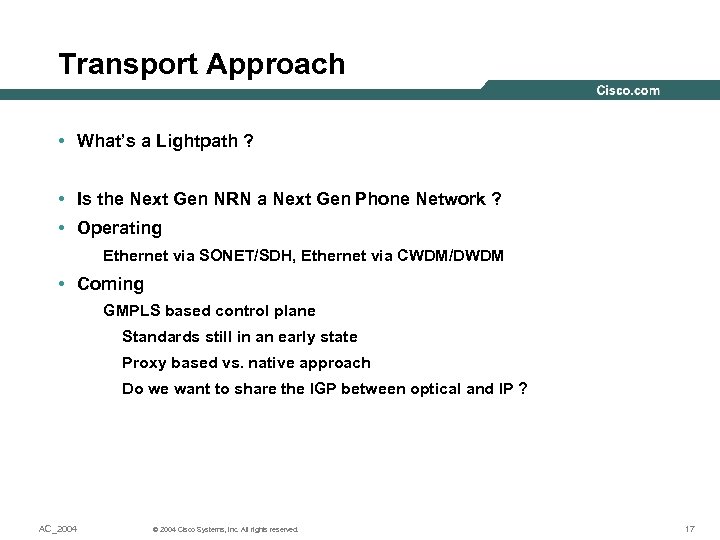
Transport Approach • What’s a Lightpath ? • Is the Next Gen NRN a Next Gen Phone Network ? • Operating Ethernet via SONET/SDH, Ethernet via CWDM/DWDM • Coming GMPLS based control plane Standards still in an early state Proxy based vs. native approach Do we want to share the IGP between optical and IP ? AC_2004 © 2004 Cisco Systems, Inc. All rights reserved. 17
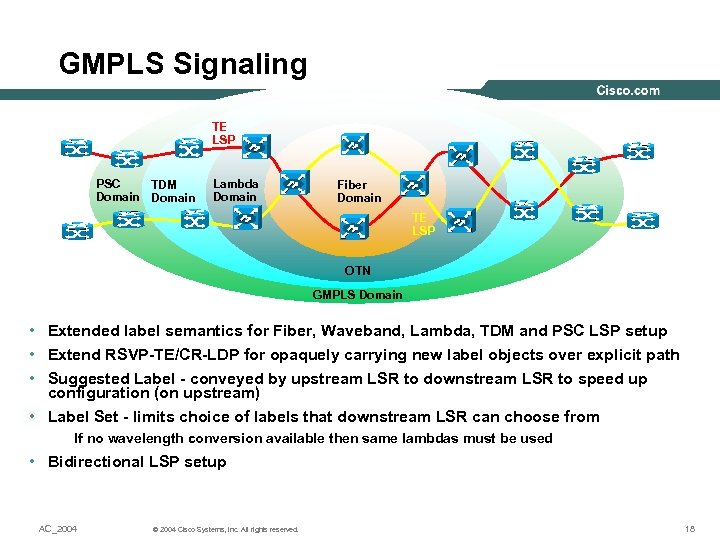
GMPLS Signaling TE LSP PSC TDM Domain Lambda Domain Fiber Domain TE LSP OTN GMPLS Domain • Extended label semantics for Fiber, Waveband, Lambda, TDM and PSC LSP setup • Extend RSVP-TE/CR-LDP for opaquely carrying new label objects over explicit path • Suggested Label - conveyed by upstream LSR to downstream LSR to speed up configuration (on upstream) • Label Set - limits choice of labels that downstream LSR can choose from If no wavelength conversion available then same lambdas must be used • Bidirectional LSP setup AC_2004 © 2004 Cisco Systems, Inc. All rights reserved. 18
Transport Pro & Con • Advantages Fixed SLAs Simple, well established technology Easy to provision test/research networks For NRNs with Dark Fibre: combination of CWDM, DWDM & TDM • Disadvantages Provisioning Control Plane proprietary - GMPLS just coming to market Multi-Domain provisioning Capacity planning Over-provisioning is expensive No Multicast For NRNs without Dark Fibre access: TDM over multiple lambdas is only alternative AC_2004 © 2004 Cisco Systems, Inc. All rights reserved. 19
Conclusions AC_2004 © 2004, Cisco Systems, Inc. All rights reserved. 20
Conclusions I • If a NRN has a chance to acquire dark fibre for a reasonable price & conditions, go for it. now! • Most NRNs will by hybrid (Transport/IP) • A scalable dual-stack IPv 4/IPv 6 IP base service will always be needed • Some NRNs will bring perfect service for Grid apps purely based on the IP network • There are some benefits for looking at services and SLAs, first, before nailing down architectures AC_2004 © 2004 Cisco Systems, Inc. All rights reserved. 21
Conclusions II • Don’t do full investment for what you will need in 5 years now… but let’s not get caught in a trap, investment protection is more than a marketing term… • Underlying transport networks should use a standards based IP based Control Plane, e. g. GMPLS • GMPLS is still far from being complete Many details in Standards missing, Inter-Domain, Deployment expertise • Other work areas GMPLS Bandwidth Broker Integration, Completion of the AAA Integration Virtualization of the Network Infrastructure • Vendors are willing to talk long term strategy and share Carrier experiences… AC_2004 © 2004 Cisco Systems, Inc. All rights reserved. 22

Q and A AC_2004 © 2004, Cisco Systems, Inc. All rights reserved. 23
AC_2004 © 2004, Cisco Systems, Inc. All rights reserved. 24
Скачать презентацию Next Generation NRN Architectures Axel Clauberg clauberg cisco com
b7a3edb0d559b9ba8033114d75cd8a3e.ppt