 Скачать презентацию Next Generation Lighting Webinar November 30 2010 Next
18d5764a5ae126403336618c53cce504.ppt
- Количество слайдов: 30



Next Generation Lighting Webinar November 30, 2010 Next Generation Lighting Webinar
About Sample clients Next Generation Lighting Webinar
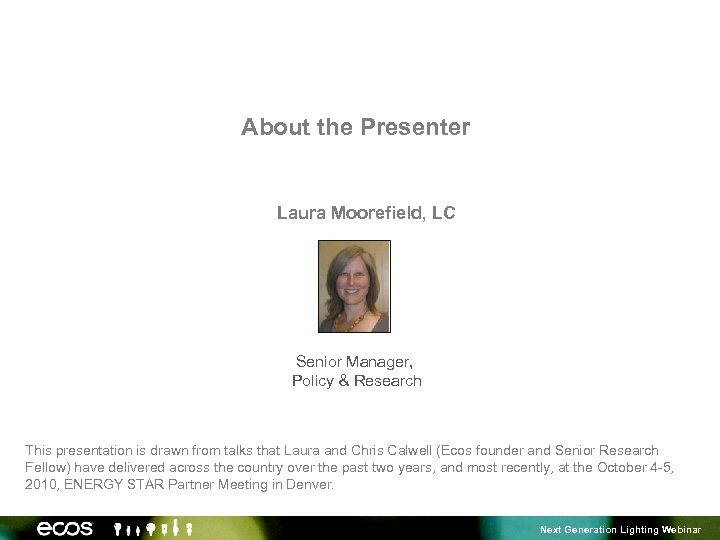
About the Presenter Laura Moorefield, LC Senior Manager, Policy & Research This presentation is drawn from talks that Laura and Chris Calwell (Ecos founder and Senior Research Fellow) have delivered across the country over the past two years, and most recently, at the October 4 -5, 2010, ENERGY STAR Partner Meeting in Denver. Next Generation Lighting Webinar
Key Topics Addressed • How will new federal laws affect the residential lighting market? • How will the mix of lighting technologies change in the near term? • How should utilities shift their focus to achieve the greatest net energy savings cost-effectively? The main take-away Utilities can continue to run cost-effective residential lighting programs before and after the new federal laws take effect. Next Generation Lighting Webinar
Utility CFL Programs Have Made Tremendous Strides • • Utilities have paid rebates on hundreds of millions of CFLs nationwide since the early 1990 s, saving billions of k. Wh At least 109 U. S. utilities are currently running lighting programs, with a total budget of more than $252 million. More than 90% of consumers are now aware of CFLs About 70% of national households now contain at least one CFLs have achieved a national socket share of about 16% and represent about 20 -25% of screw-based general service bulb unit sales Roughly 3, 000 qualifying general service CFL models listed on the ENERGY STAR website CFLs have become far smaller, more widely available, and more affordable – now commonly available in many types of stores for $2 to $5 apiece without utility rebates Next Generation Lighting Webinar
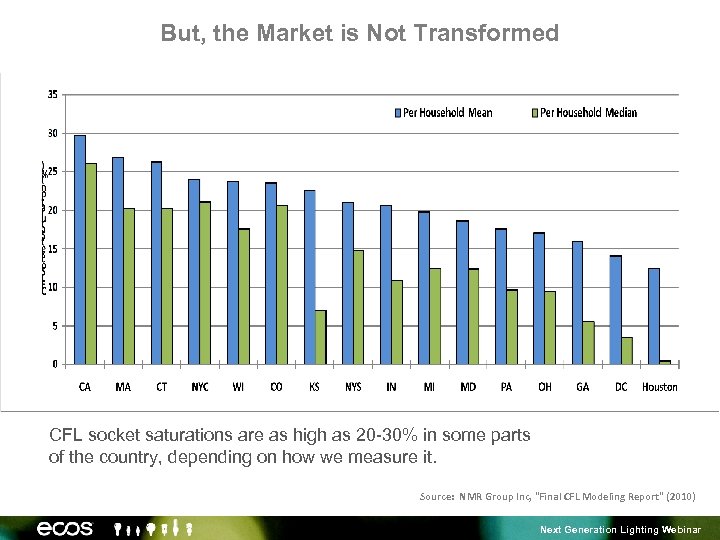
But, the Market is Not Transformed CFL socket saturations are as high as 20 -30% in some parts of the country, depending on how we measure it. Source: NMR Group Inc, "Final CFL Modeling Report" (2010) Next Generation Lighting Webinar
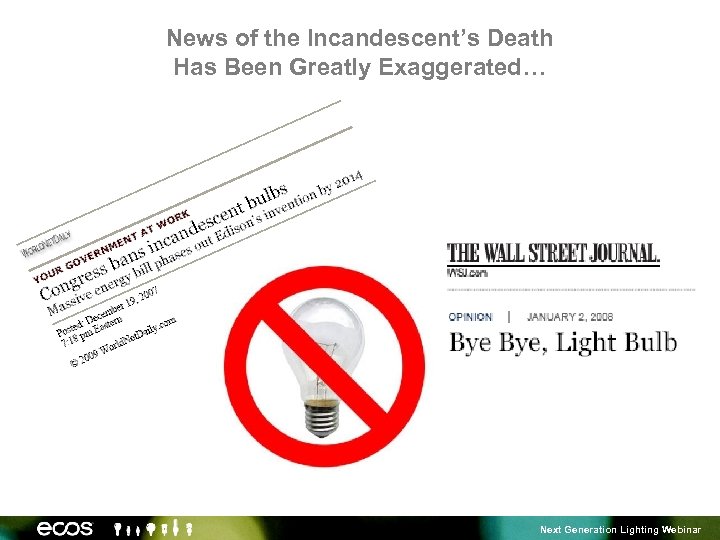
News of the Incandescent’s Death Has Been Greatly Exaggerated… Next Generation Lighting Webinar
What Will EISA Really Do? • EISA does not ban incandescent technology; it sets minimum efficiency requirements for lamps. Many halogen incandescent lamps are available today that pass EISA. • Phases in Tier 1 efficiency requirements for 40 – 100 W general purpose (household) lamps starting in 2012 • Provides weaker requirements for modified spectrum lamps • Exempts 5 lamp types unless sales increase substantially: - 3 -way lamps - Rough service lamps - Shatter proof lamps - Vibration service lamps - 2, 601 – 3, 000 lumen lamps • Includes provisions for a tougher Tier 2 in 2020 • Requires review and update of current FTC lamp labeling • Allows Nevada & California to enact EISA one year early, or to keep existing state standards in place Next Generation Lighting Webinar
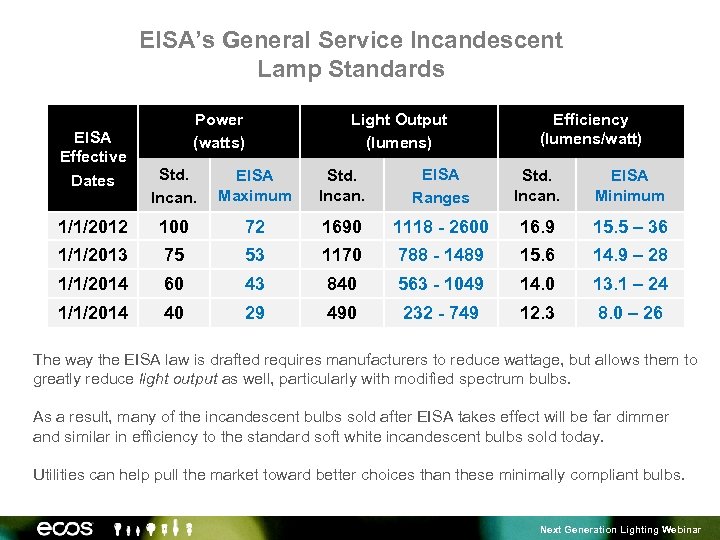
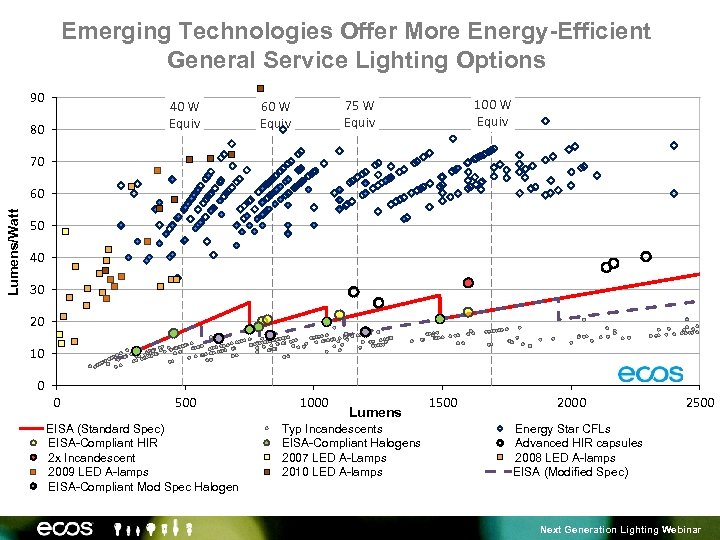
EISA’s General Service Incandescent Lamp Standards EISA Effective Dates Power (watts) Light Output (lumens) Efficiency (lumens/watt) Std. Incan. EISA Maximum Std. Incan. EISA Ranges Std. Incan. EISA Minimum 1/1/2012 100 72 1690 1118 - 2600 16. 9 15. 5 – 36 1/1/2013 75 53 1170 788 - 1489 15. 6 14. 9 – 28 1/1/2014 60 43 840 563 - 1049 14. 0 13. 1 – 24 1/1/2014 40 29 490 232 - 749 12. 3 8. 0 – 26 The way the EISA law is drafted requires manufacturers to reduce wattage, but allows them to greatly reduce light output as well, particularly with modified spectrum bulbs. As a result, many of the incandescent bulbs sold after EISA takes effect will be far dimmer and similar in efficiency to the standard soft white incandescent bulbs sold today. Utilities can help pull the market toward better choices than these minimally compliant bulbs. Next Generation Lighting Webinar
Emerging Technologies Offer More Energy-Efficient General Service Lighting Options 90 40 W Equiv 80 100 W Equiv 75 W Equiv 60 W Equiv 70 Lumens/Watt 60 50 40 30 20 10 0 0 500 EISA (Standard Spec) EISA-Compliant HIR 2 x Incandescent 2009 LED A-lamps EISA-Compliant Mod Spec Halogen 1000 Lumens Typ Incandescents EISA-Compliant Halogens 2007 LED A-Lamps 2010 LED A-lamps 1500 2000 2500 Energy Star CFLs Advanced HIR capsules 2008 LED A-lamps EISA (Modified Spec) Next Generation Lighting Webinar
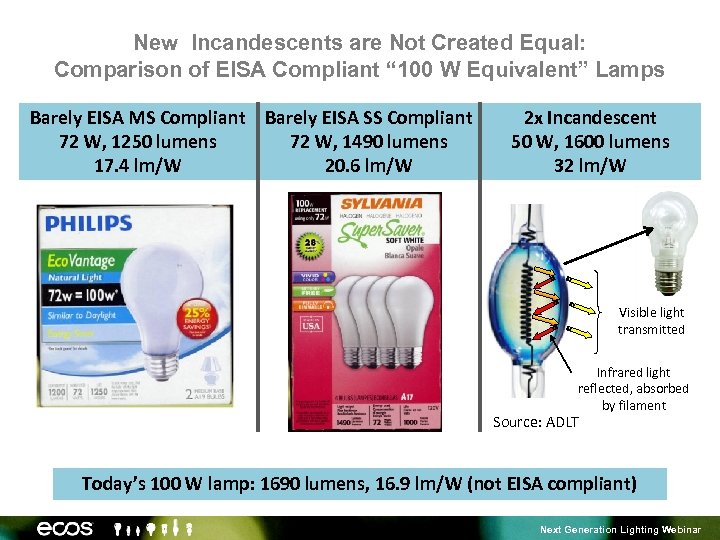
New Incandescents are Not Created Equal: Comparison of EISA Compliant “ 100 W Equivalent” Lamps Barely EISA MS Compliant Barely EISA SS Compliant 72 W, 1250 lumens 72 W, 1490 lumens 17. 4 lm/W 20. 6 lm/W 2 x Incandescent 50 W, 1600 lumens 32 lm/W Visible light transmitted Infrared light reflected, absorbed by filament Source: ADLT Today’s 100 W lamp: 1690 lumens, 16. 9 lm/W (not EISA compliant) Next Generation Lighting Webinar
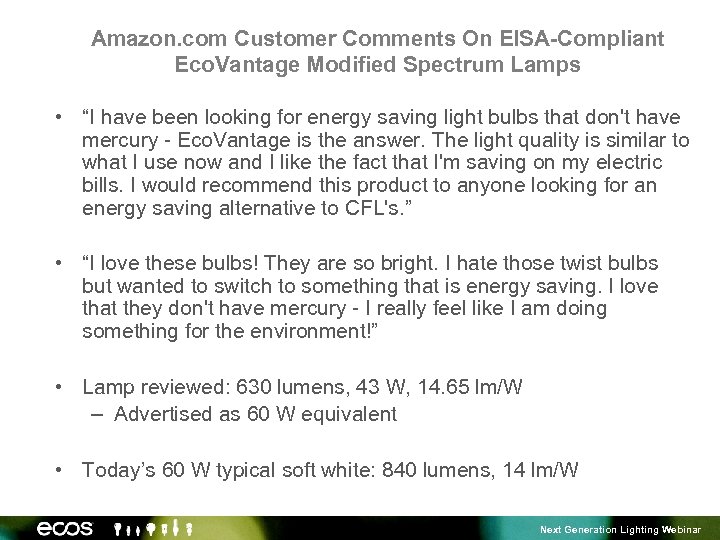
Amazon. com Customer Comments On EISA-Compliant Eco. Vantage Modified Spectrum Lamps • “I have been looking for energy saving light bulbs that don't have mercury - Eco. Vantage is the answer. The light quality is similar to what I use now and I like the fact that I'm saving on my electric bills. I would recommend this product to anyone looking for an energy saving alternative to CFL's. ” • “I love these bulbs! They are so bright. I hate those twist bulbs but wanted to switch to something that is energy saving. I love that they don't have mercury - I really feel like I am doing something for the environment!” • Lamp reviewed: 630 lumens, 43 W, 14. 65 lm/W – Advertised as 60 W equivalent • Today’s 60 W typical soft white: 840 lumens, 14 lm/W Next Generation Lighting Webinar
EISA Shifts the Baseline and Presents New Program Challenges • • • For a long time, the “story” has been very simple: CFLs good. Incandescents bad. Now the consumer education story is more complicated, but also more honest: there is no one right lighting technology for every application. We need a portfolio of options for different applications and customer needs. Implications: – Net savings from each rebated product will be smaller, but incremental costs will go down – Is a shift to specialty CFLs a move in the right direction? – Residential lighting programs will still cost less than generating electricity – Net to gross ratios for CFLs vary enormously today and may get worse. Next Generation Lighting Webinar
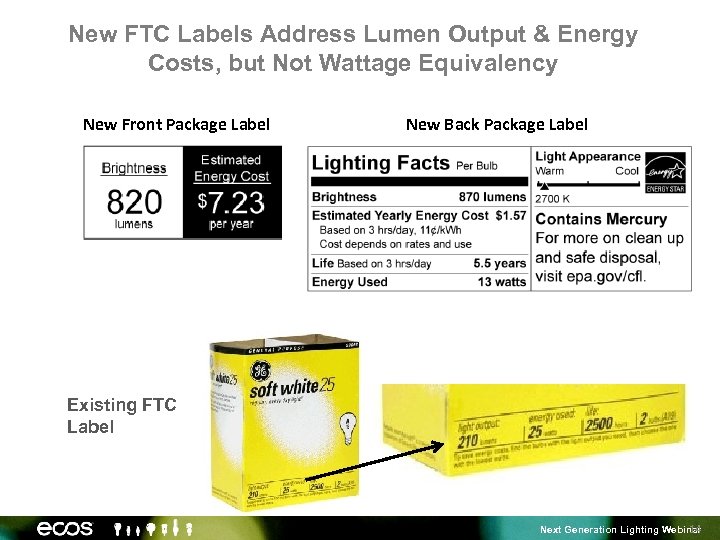
New FTC Labels Address Lumen Output & Energy Costs, but Not Wattage Equivalency New Front Package Label New Back Package Label Existing FTC Label 14 Next Generation Lighting Webinar
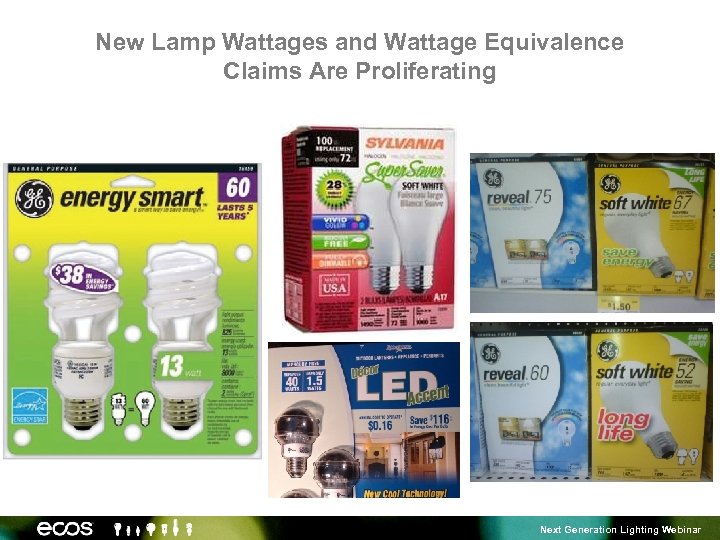
New Lamp Wattages and Wattage Equivalence Claims Are Proliferating Next Generation Lighting Webinar
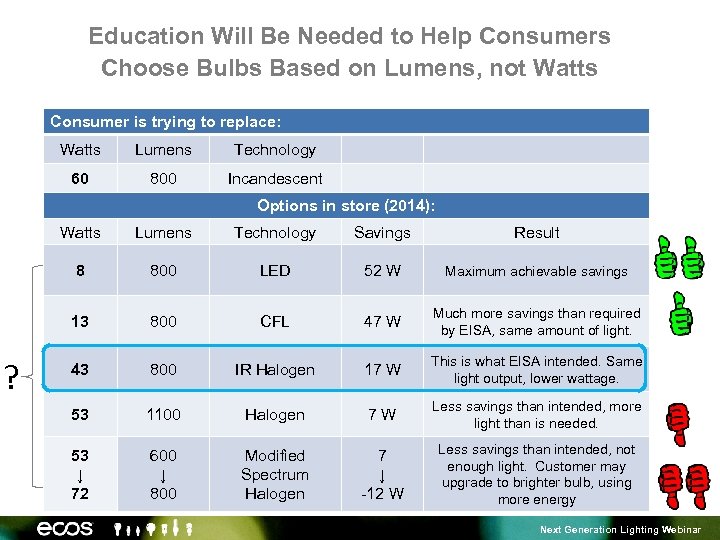
Education Will Be Needed to Help Consumers Choose Bulbs Based on Lumens, not Watts Consumer is trying to replace: Watts Lumens Technology 60 800 Incandescent Options in store (2014): Watts Technology Savings Result 8 800 LED 52 W Maximum achievable savings 13 ? Lumens 800 CFL 47 W Much more savings than required by EISA, same amount of light. 43 800 IR Halogen 17 W This is what EISA intended. Same light output, lower wattage. 53 1100 Halogen 7 W Less savings than intended, more light than is needed. 53 ↓ 72 600 ↓ 800 Modified Spectrum Halogen 7 ↓ -12 W Less savings than intended, not enough light. Customer may upgrade to brighter bulb, using more energy Next Generation Lighting Webinar
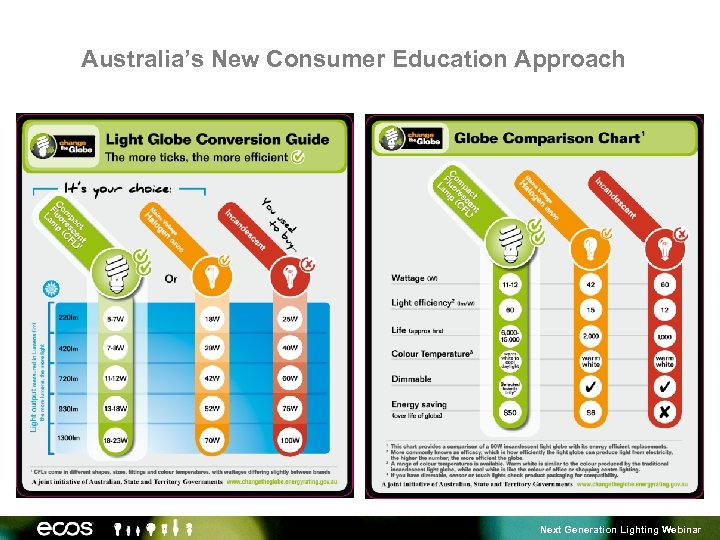
Australia’s New Consumer Education Approach Next Generation Lighting Webinar
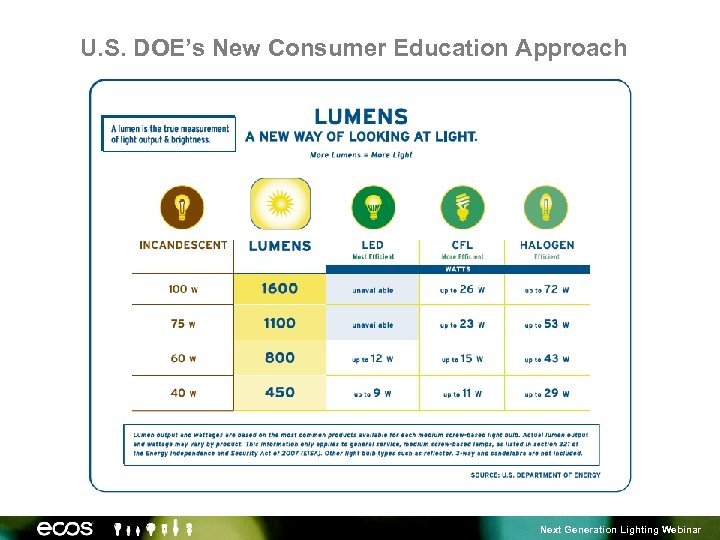
U. S. DOE’s New Consumer Education Approach Next Generation Lighting Webinar
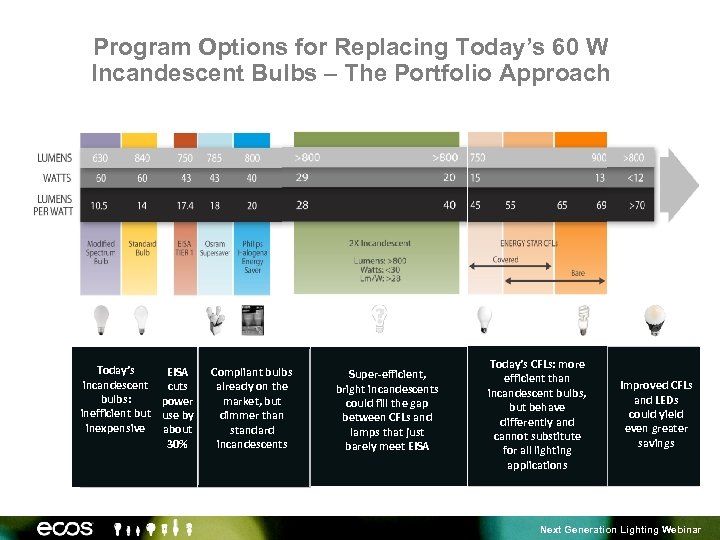
Program Options for Replacing Today’s 60 W Incandescent Bulbs – The Portfolio Approach Today’s EISA incandescent cuts bulbs: power inefficient but use by inexpensive about 30% Compliant bulbs already on the market, but dimmer than standard incandescents Super-efficient, bright incandescents could fill the gap between CFLs and lamps that just barely meet EISA Today’s CFLs: more efficient than incandescent bulbs, but behave differently and cannot substitute for all lighting applications Improved CFLs and LEDs could yield even greater savings Next Generation Lighting Webinar
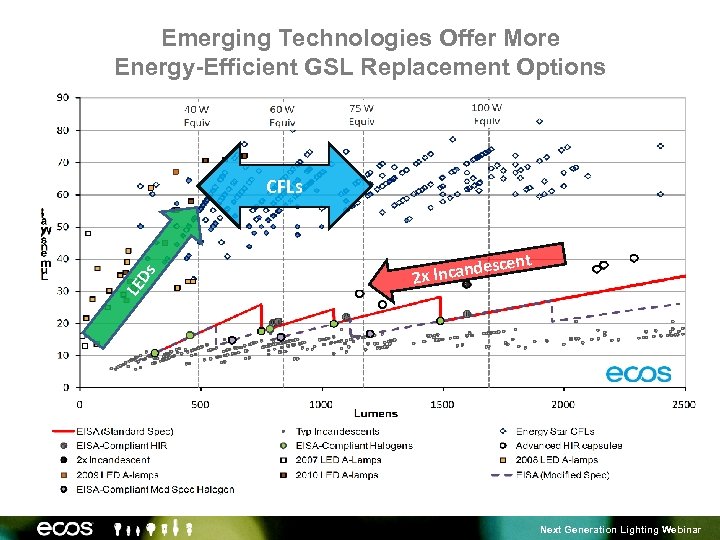
Emerging Technologies Offer More Energy-Efficient GSL Replacement Options LE Ds CFLs cent des 2 x Incan Next Generation Lighting Webinar
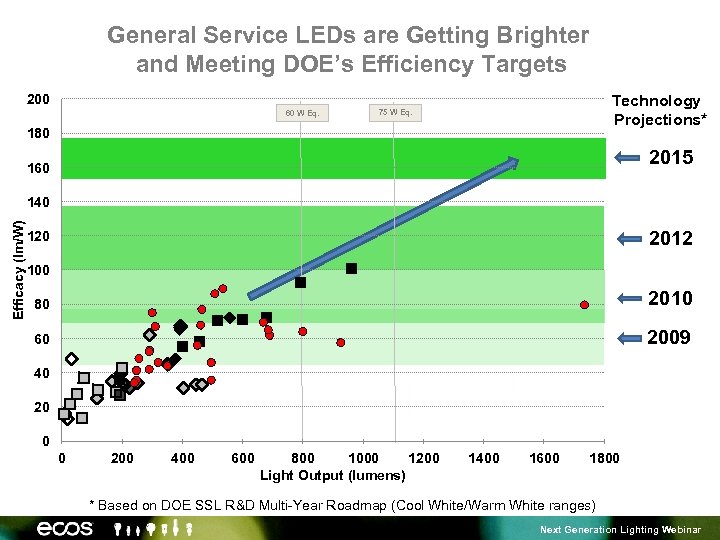
General Service LEDs are Getting Brighter and Meeting DOE’s Efficiency Targets Technology Projections* 200 60 W Eq. 75 W Eq. 180 2015 160 Efficacy (lm/W) 140 2012 120 100 80 2010 60 2009 40 20 0 0 200 400 600 800 1000 1200 Light Output (lumens) 1400 1600 1800 * Based on DOE SSL R&D Multi-Year Roadmap (Cool White/Warm White ranges) Next Generation Lighting Webinar
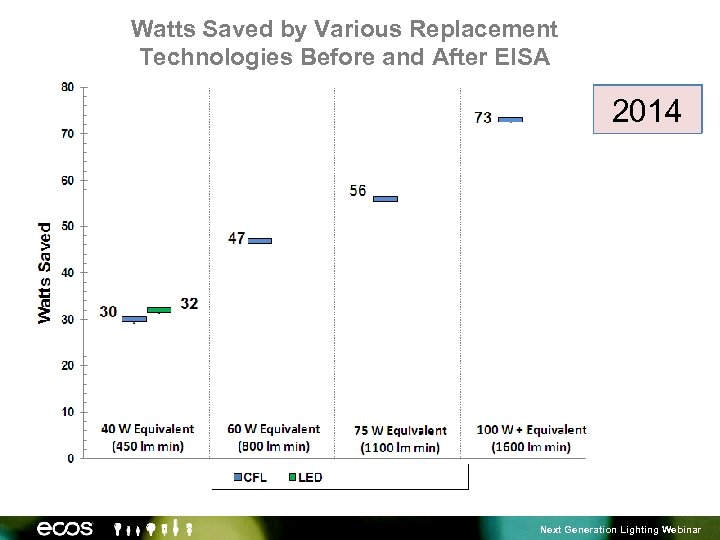
Watts Saved by Various Replacement Technologies Before and After EISA 2012 2011 2013 2014 2010 Next Generation Lighting Webinar
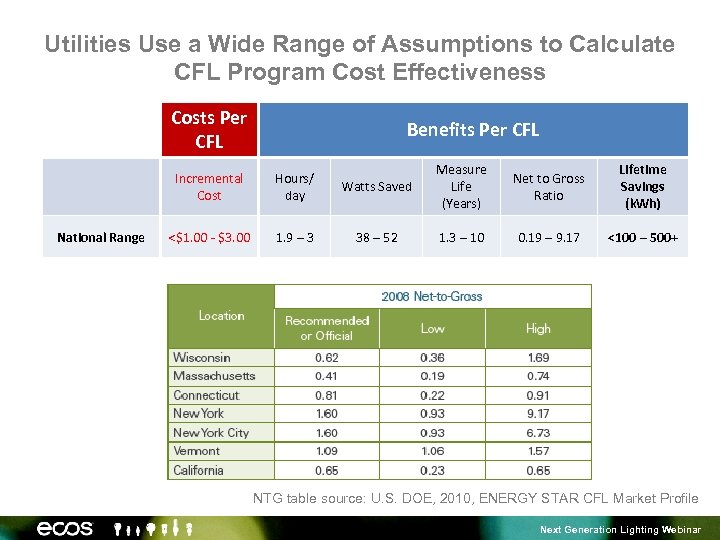
Utilities Use a Wide Range of Assumptions to Calculate CFL Program Cost Effectiveness Costs Per CFL Benefits Per CFL Incremental Cost National Range Hours/ day <$1. 00 - $3. 00 1. 9 – 3 Watts Saved Measure Life (Years) Net to Gross Ratio Lifetime Savings (k. Wh) 38 – 52 1. 3 – 10 0. 19 – 9. 17 <100 – 500+ NTG table source: U. S. DOE, 2010, ENERGY STAR CFL Market Profile Next Generation Lighting Webinar
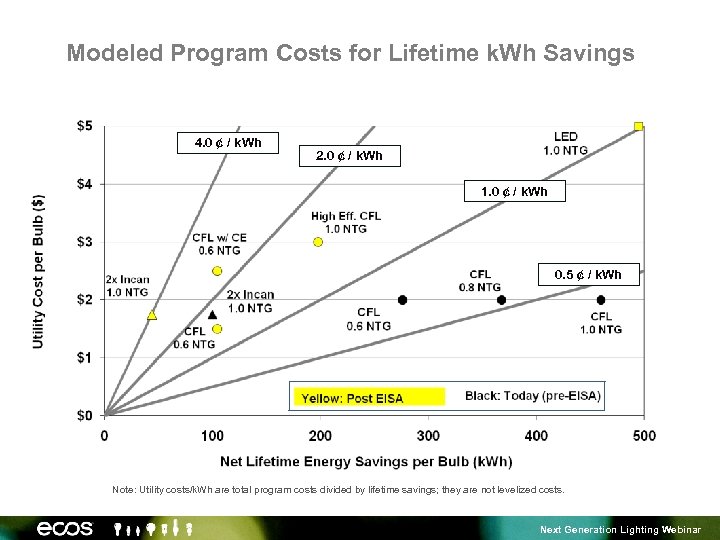
Modeled Program Costs for Lifetime k. Wh Savings 4. 0 ¢ / k. Wh 2. 0 ¢ / k. Wh 1. 0 ¢ / k. Wh 0. 5 ¢ / k. Wh Note: Utility costs/k. Wh are total program costs divided by lifetime savings; they are not levelized costs. Next Generation Lighting Webinar
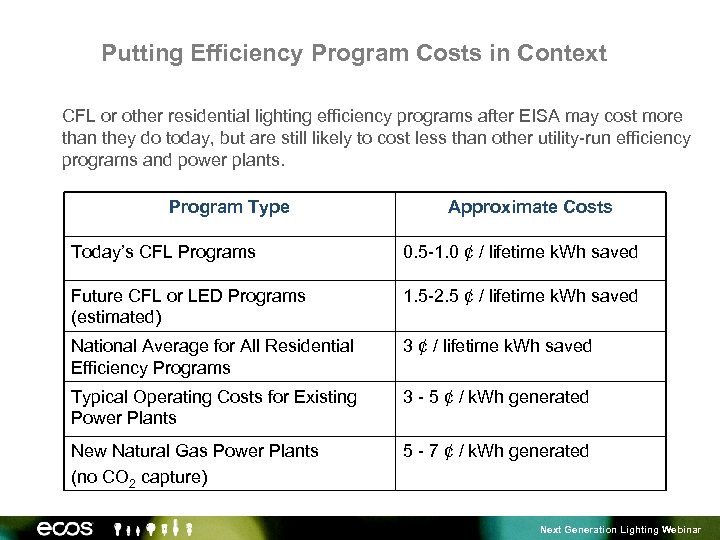
Putting Efficiency Program Costs in Context CFL or other residential lighting efficiency programs after EISA may cost more than they do today, but are still likely to cost less than other utility-run efficiency programs and power plants. Program Type Approximate Costs Today’s CFL Programs 0. 5 -1. 0 ¢ / lifetime k. Wh saved Future CFL or LED Programs (estimated) 1. 5 -2. 5 ¢ / lifetime k. Wh saved National Average for All Residential Efficiency Programs 3 ¢ / lifetime k. Wh saved Typical Operating Costs for Existing Power Plants 3 - 5 ¢ / k. Wh generated New Natural Gas Power Plants (no CO 2 capture) 5 - 7 ¢ / k. Wh generated Next Generation Lighting Webinar
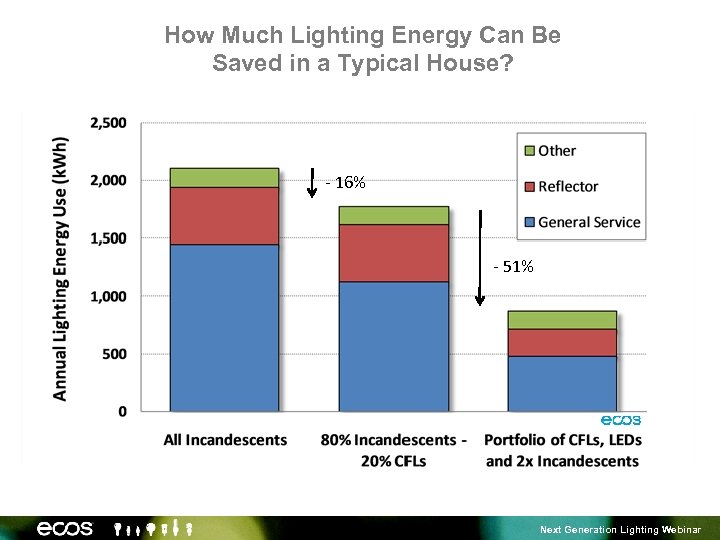
How Much Lighting Energy Can Be Saved in a Typical House? - 16% - 51% -51% Next Generation Lighting Webinar
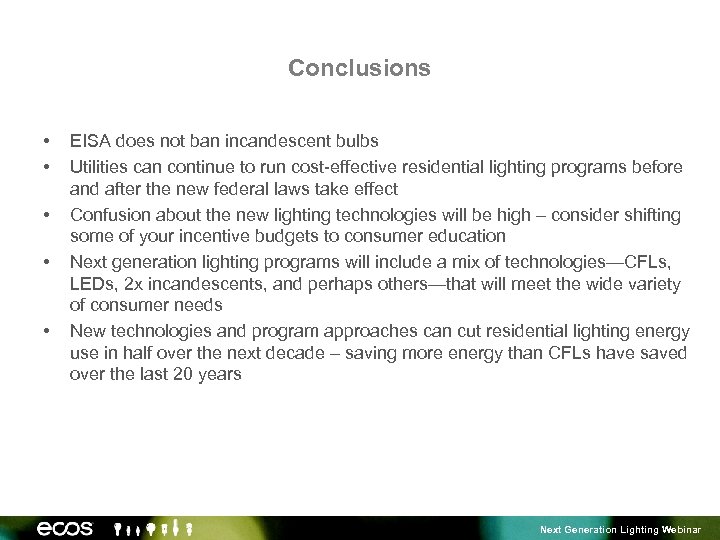
Conclusions • • • EISA does not ban incandescent bulbs Utilities can continue to run cost-effective residential lighting programs before and after the new federal laws take effect Confusion about the new lighting technologies will be high – consider shifting some of your incentive budgets to consumer education Next generation lighting programs will include a mix of technologies—CFLs, LEDs, 2 x incandescents, and perhaps others—that will meet the wide variety of consumer needs New technologies and program approaches can cut residential lighting energy use in half over the next decade – saving more energy than CFLs have saved over the last 20 years Next Generation Lighting Webinar
Questions and Answers Contact Information Ted Schultz SVP Strategy & Innovation Charlotte, NC Laura Moorefield Senior Manager, Research & Policy Durango, CO tschultz@ecosconsulting. com lmoorefield@ecosconsulting. com M 704 -905 -4305 T 970 -259 -6801 ext. 310 Visit our Next Generation lighting site www. ecosconsulting. com/nextgen Next Generation Lighting Webinar
Extra Slides Next Generation Lighting Webinar
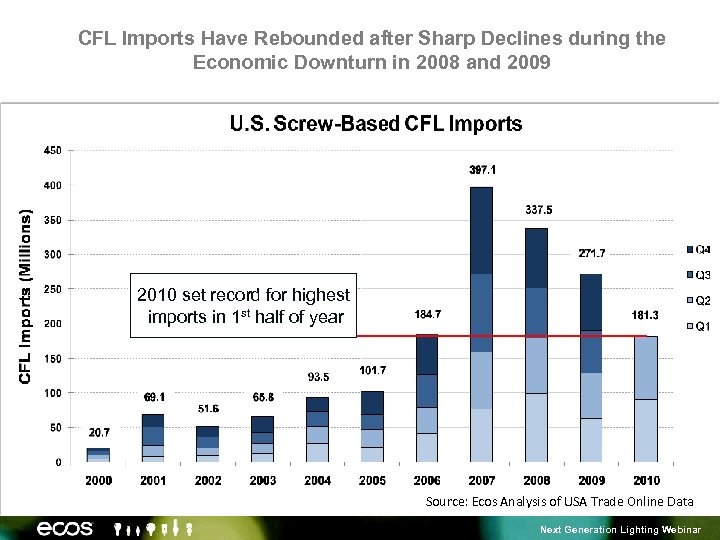
CFL Imports Have Rebounded after Sharp Declines during the Economic Downturn in 2008 and 2009 2010 set record for highest imports in 1 st half of year Data Source: USA Trade Online Source: Ecos Analysis of USA Trade Online Data Next Generation Lighting Webinar
Скачать презентацию Next Generation Lighting Webinar November 30 2010 Next
18d5764a5ae126403336618c53cce504.ppt