


 Скачать презентацию Next Generation Information Systems Current state of
d57c5b8be4928343dd96870423406445.ppt
- Количество слайдов: 5
 Next Generation Information Systems • Current state of affairs – Information explosion – Web search becoming the new normal, but limited to kw search – Democratization of content creation (blogs, wikis, bulletin boards) – Web mediated communities – Uncoordinated, “egoistic” development – Very little understanding of privacy implications (on both consumer and providers side) – Rapidly changing social & legal landscape, many open questions
 Information, economics, privacy • Joint theory of privacy, economics, and computing – Quantify loss of privacy, value received • Theory of information that includes cost of discovery – Examples: phone book vs reverse number look up, ssn on a house deed in the courthouse vs on the web. – Ease of information access should play a role in a theory of privacy. – Quantify cost of discovery – Computational cost of privacy ?
 Information quality • Can this be quantified? • Reliability of information • Interplay between democratization and authenticity • Anybody can contribute information and misinformation • Create mechanism for social certification of authenticity
 Information finding • Enhancing power of search – Putting structure on information – clustering • Semantic search and content analysis • Create economic incentives for producing metadata • Human aided computing – – Yahoo questions CMU image game ESP CAPTCHAs “Folksonomies”, del. icio. us • Use to provide better data resources
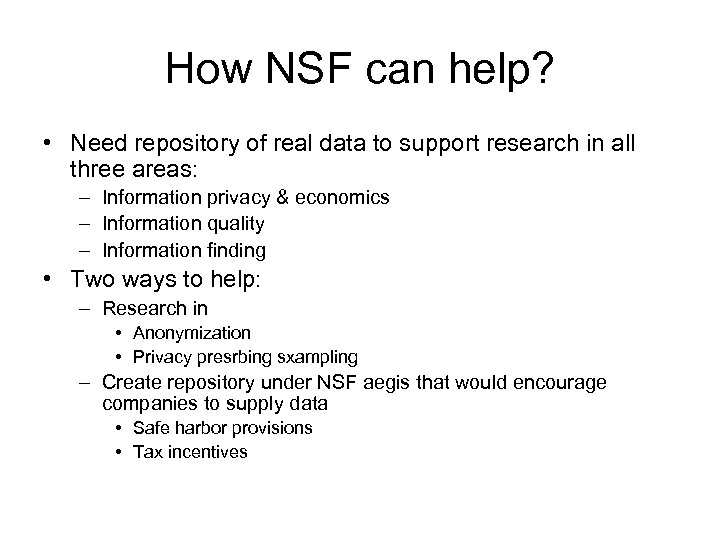 How NSF can help? • Need repository of real data to support research in all three areas: – Information privacy & economics – Information quality – Information finding • Two ways to help: – Research in • Anonymization • Privacy presrbing sxampling – Create repository under NSF aegis that would encourage companies to supply data • Safe harbor provisions • Tax incentives