


 Скачать презентацию Newton s First Law of Motion 11 18 13 11 22 13
c50f2bece6cc3cb41bdb44293cb68d2b.ppt
- Количество слайдов: 22
 Newton’s First Law of Motion 11/18/13 – 11/22/13 11/18 11/19 11/20 Weight vs Mass Textbook p 392 -393 11/21 Newton’s 1 st Law of Motion WB p. 73 -76 Quiz 11/22 Newton’s 1 st Law of Motion Workbook p 65 -68 Newton’s 1 st Law of Motion Workbook p. 69 -72
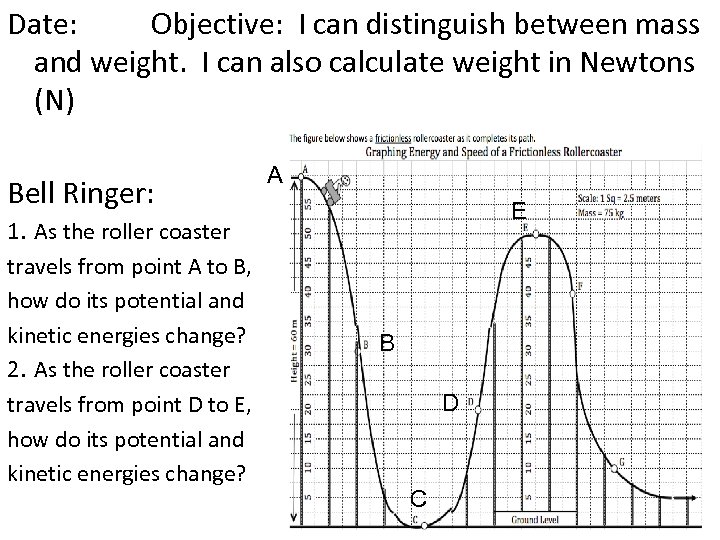 Date: Objective: I can distinguish between mass and weight. I can also calculate weight in Newtons (N) Bell Ringer: 1. As the roller coaster travels from point A to B, how do its potential and kinetic energies change? 2. As the roller coaster travels from point D to E, how do its potential and kinetic energies change? A E B D C
 Date: Objective: I can distinguish between mass and weight. I can also calculate weight in Newtons (N) Activity Titled : Textbook p. 392 Answer Investigate Part A questions 1 -5 in your Notebook Answer questions with your shoulder partner. Both partners must write their answers
 DEFINITIONS Mass- the amount of matter an object has. Matter- something that has mass and takes up space. Weight- is the amount of mass of an object, it is dependent upon gravity. 1 pound (lbs)=. 45 kilogram (kg)
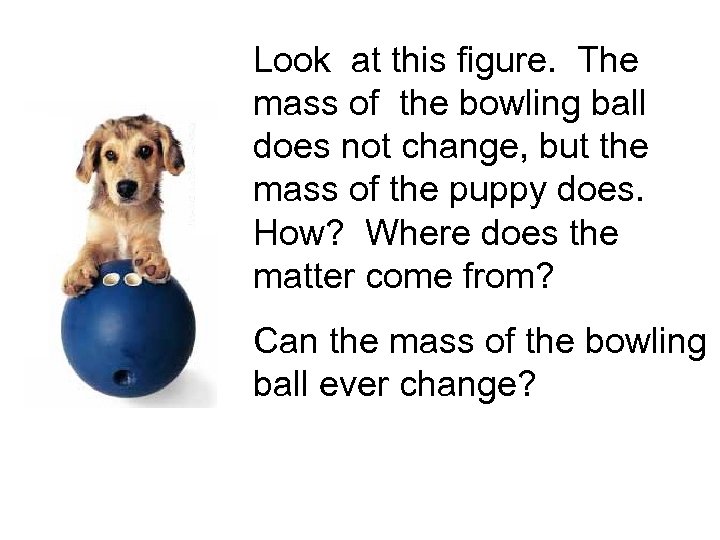 Look at this figure. The mass of the bowling ball does not change, but the mass of the puppy does. How? Where does the matter come from? Can the mass of the bowling ball ever change?
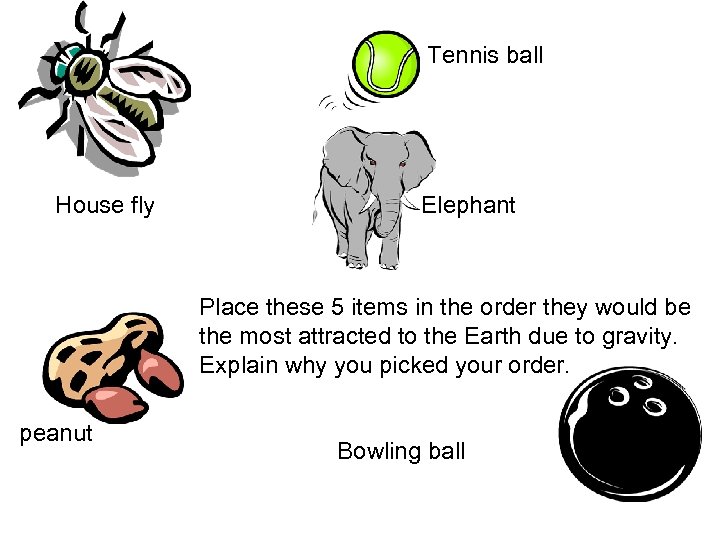 Tennis ball House fly Elephant Place these 5 items in the order they would be the most attracted to the Earth due to gravity. Explain why you picked your order. peanut Bowling ball
 Exit Question What would happen to your mass and to your weight if you went to the moon? Explain how you arrived at your answer. Singing on the moon https: //www. youtube. com/watch? v=FMnzi 8 i. Fn. G 8 Lunar Olympics https: //www. youtube. com/watch? v=16 D 0 hm. Lt-S 0
 Date: Objective: I can investigate Newton’s first law of motion Bell Ringer: 1. What would happen to your mass and to your weight if you went to the moon? Explain how you arrived at your answer. 2. Calculate the weight of a 50 kg ball? Fw=mg
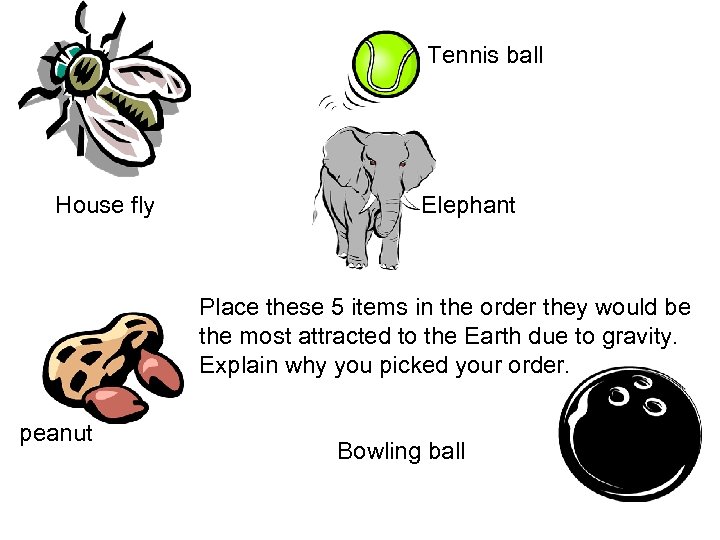 Tennis ball House fly Elephant Place these 5 items in the order they would be the most attracted to the Earth due to gravity. Explain why you picked your order. peanut Bowling ball
 Activity Workbook page 65 Read demonstration as a group Complete workbook p. 67 independently
 Activity Complete workbook p. 68
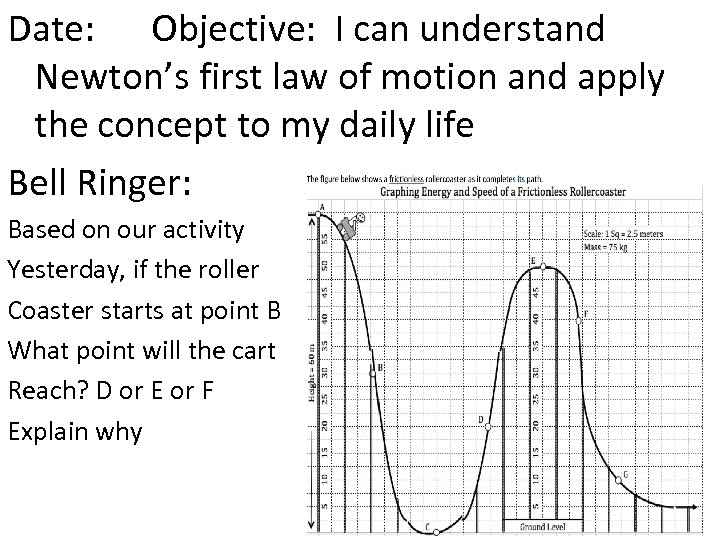 Date: Objective: I can understand Newton’s first law of motion and apply the concept to my daily life Bell Ringer: Based on our activity Yesterday, if the roller Coaster starts at point B What point will the cart Reach? D or E or F Explain why
 Read Workbook p 69 -71 independently And take cornell notes 7 minutes
 11/6/13 Newton’s 1 st Law Video
 11/15/12 Newton’s 1 st Law Workbook page 72 complete TEJ
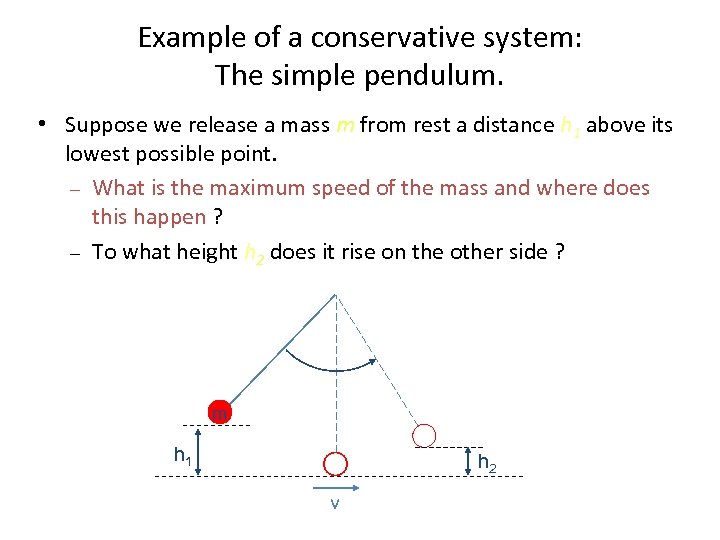 Example of a conservative system: The simple pendulum. • Suppose we release a mass m from rest a distance h 1 above its lowest possible point. – What is the maximum speed of the mass and where does this happen ? – To what height h 2 does it rise on the other side ? m h 1 h 2 v
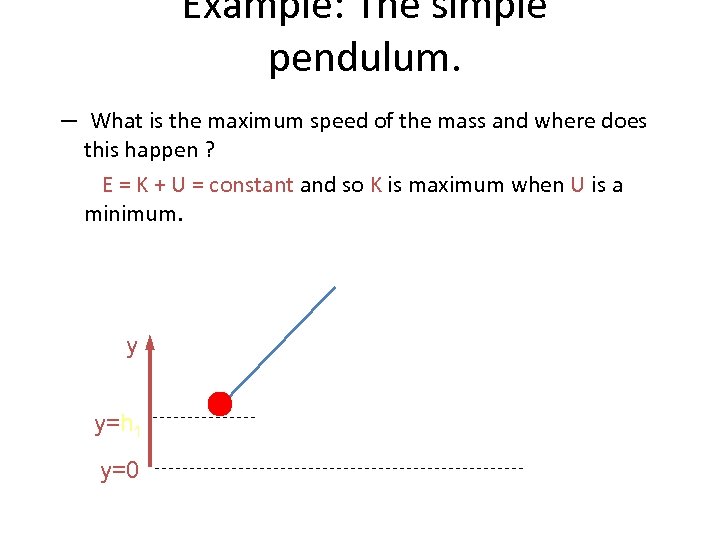 Example: The simple pendulum. – What is the maximum speed of the mass and where does this happen ? E = K + U = constant and so K is maximum when U is a minimum. y y=h 1 y=0
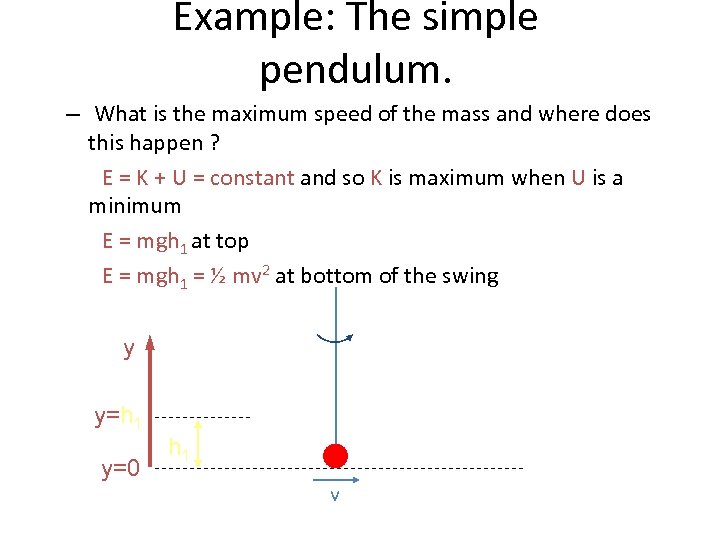 Example: The simple pendulum. – What is the maximum speed of the mass and where does this happen ? E = K + U = constant and so K is maximum when U is a minimum E = mgh 1 at top E = mgh 1 = ½ mv 2 at bottom of the swing y y=h 1 y=0 h 1 v
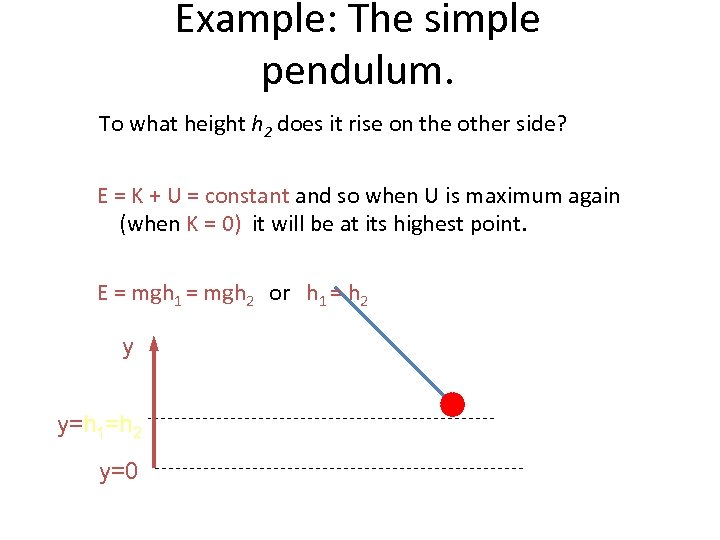 Example: The simple pendulum. To what height h 2 does it rise on the other side? E = K + U = constant and so when U is maximum again (when K = 0) it will be at its highest point. E = mgh 1 = mgh 2 or h 1 = h 2 y y=h 1=h 2 y=0
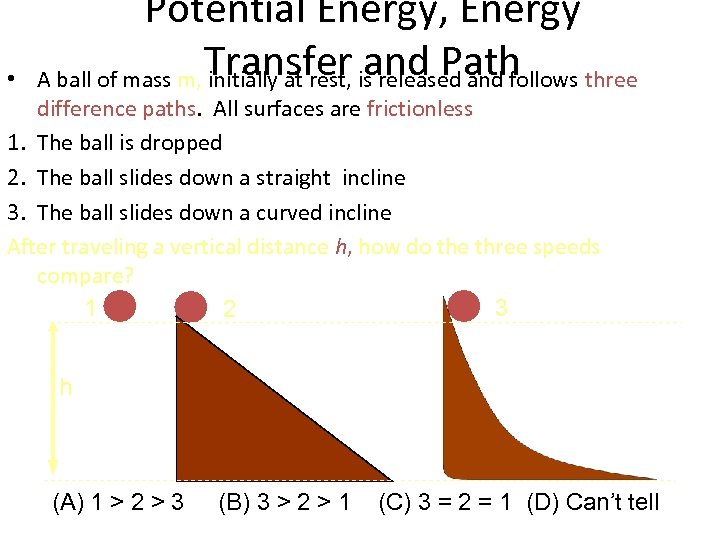 • Potential Energy, Energy Transfer and Path A ball of mass m, initially at rest, is released and follows three difference paths. All surfaces are frictionless 1. The ball is dropped 2. The ball slides down a straight incline 3. The ball slides down a curved incline After traveling a vertical distance h, how do the three speeds compare? 1 3 2 h (A) 1 > 2 > 3 (B) 3 > 2 > 1 (C) 3 = 2 = 1 (D) Can’t tell
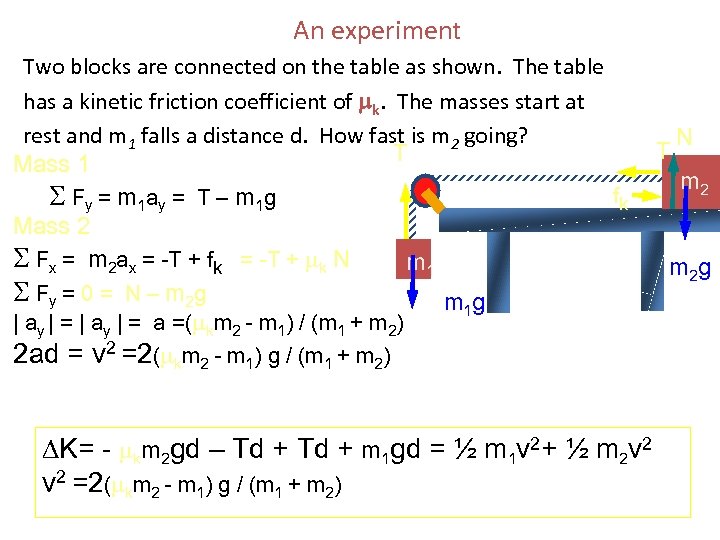 An experiment Two blocks are connected on the table as shown. The table has a kinetic friction coefficient of mk. The masses start at rest and m 1 falls a distance d. How fast is m 2 going? T Mass 1 fk S F y = m 1 a y = T – m 1 g Mass 2 S Fx = m 2 ax = -T + fk = -T + mk N m 1 S F y = 0 = N – m 2 g m 1 g | ay | = a =(mkm 2 - m 1) / (m 1 + m 2) 2 ad = v 2 =2(mkm 2 - m 1) g / (m 1 + m 2) DK= - mkm 2 gd – Td + m 1 gd = ½ m 1 v 2+ ½ m 2 v 2 =2(mkm 2 - m 1) g / (m 1 + m 2) T N m 2 g