 Скачать презентацию Newborn Care Dr C Sureshkumar Thaluk Hospital Parassala
34de994ba02719e5163bd23bfb92e9fe.ppt
- Количество слайдов: 106



Newborn Care Dr C Sureshkumar Thaluk Hospital Parassala www. similima. com 1
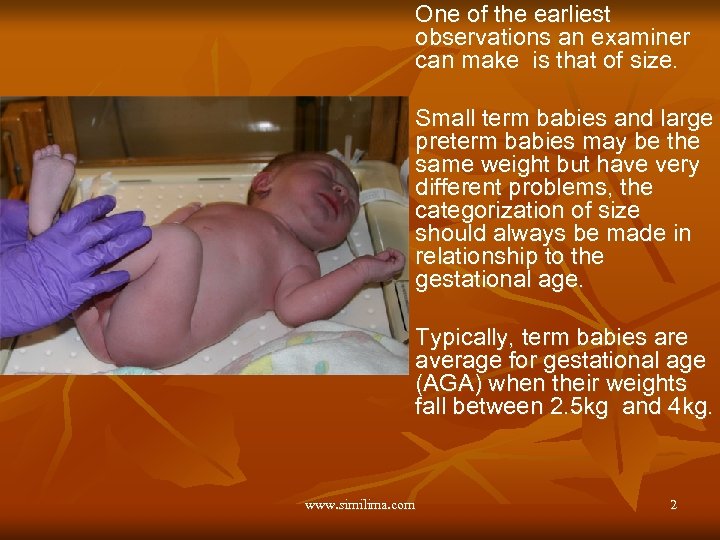
One of the earliest observations an examiner can make is that of size. Small term babies and large preterm babies may be the same weight but have very different problems, the categorization of size should always be made in relationship to the gestational age. Typically, term babies are average for gestational age (AGA) when their weights fall between 2. 5 kg and 4 kg. www. similima. com 2
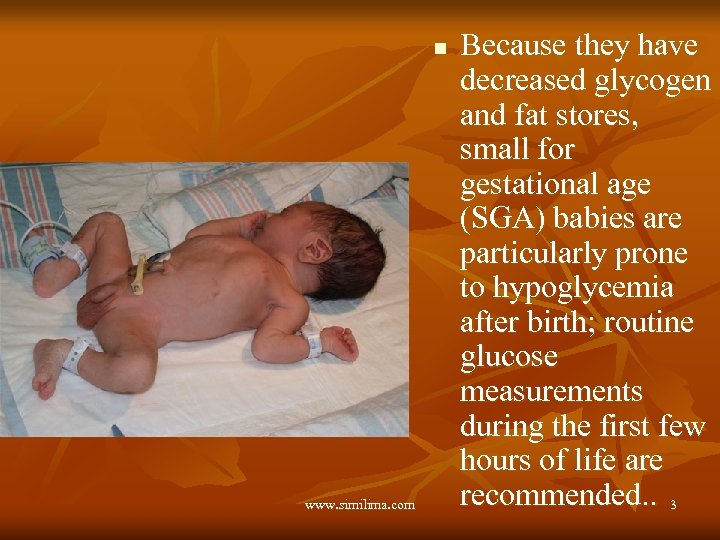
n www. similima. com Because they have decreased glycogen and fat stores, small for gestational age (SGA) babies are particularly prone to hypoglycemia after birth; routine glucose measurements during the first few hours of life are recommended. . 3
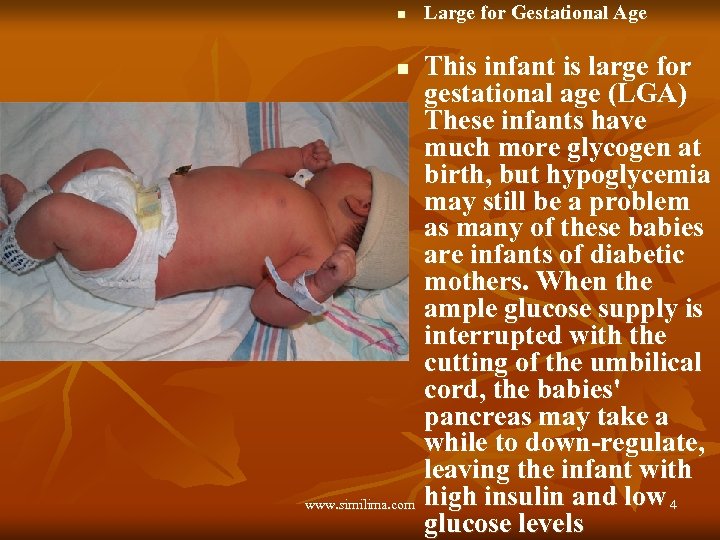
n n www. similima. com Large for Gestational Age This infant is large for gestational age (LGA) These infants have much more glycogen at birth, but hypoglycemia may still be a problem as many of these babies are infants of diabetic mothers. When the ample glucose supply is interrupted with the cutting of the umbilical cord, the babies' pancreas may take a while to down-regulate, leaving the infant with high insulin and low 4 glucose levels
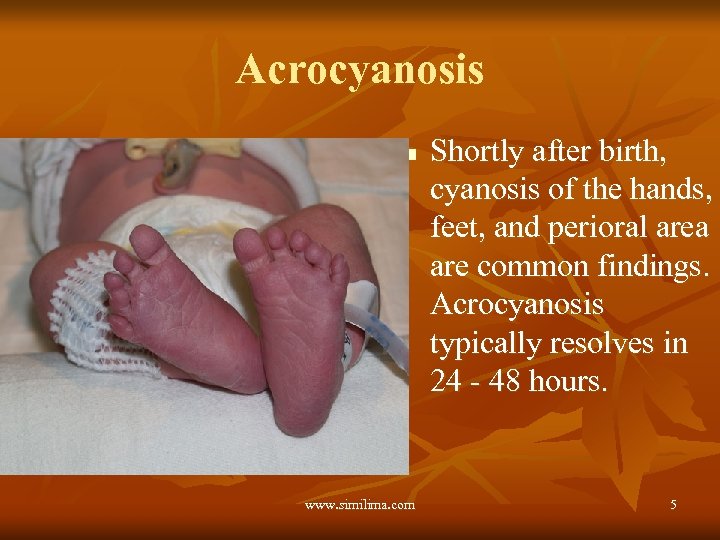
Acrocyanosis n www. similima. com Shortly after birth, cyanosis of the hands, feet, and perioral area are common findings. Acrocyanosis typically resolves in 24 - 48 hours. 5
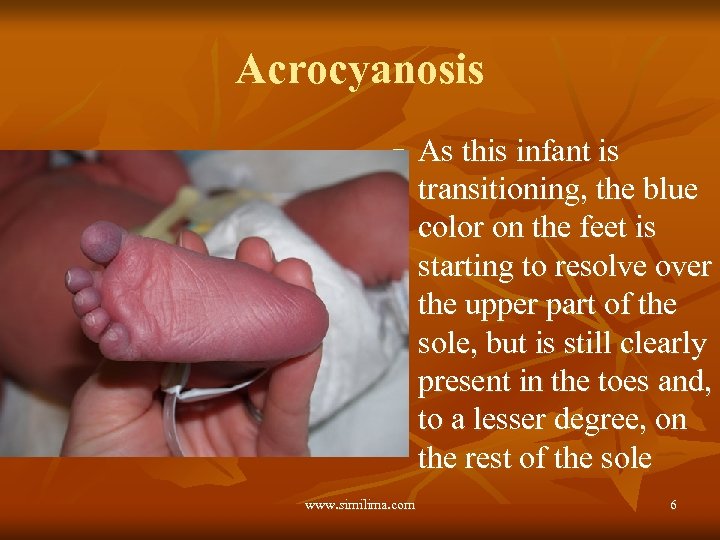
Acrocyanosis n www. similima. com As this infant is transitioning, the blue color on the feet is starting to resolve over the upper part of the sole, but is still clearly present in the toes and, to a lesser degree, on the rest of the sole 6
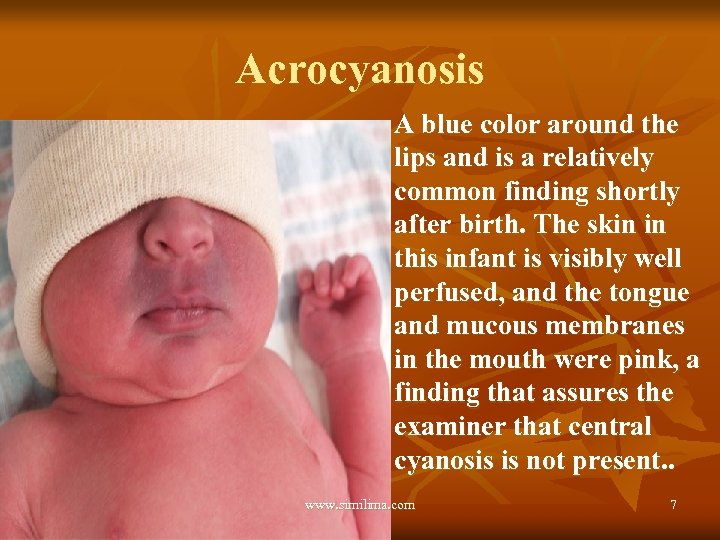
Acrocyanosis n A blue color around the lips and is a relatively common finding shortly after birth. The skin in this infant is visibly well perfused, and the tongue and mucous membranes in the mouth were pink, a finding that assures the examiner that central cyanosis is not present. . www. similima. com 7
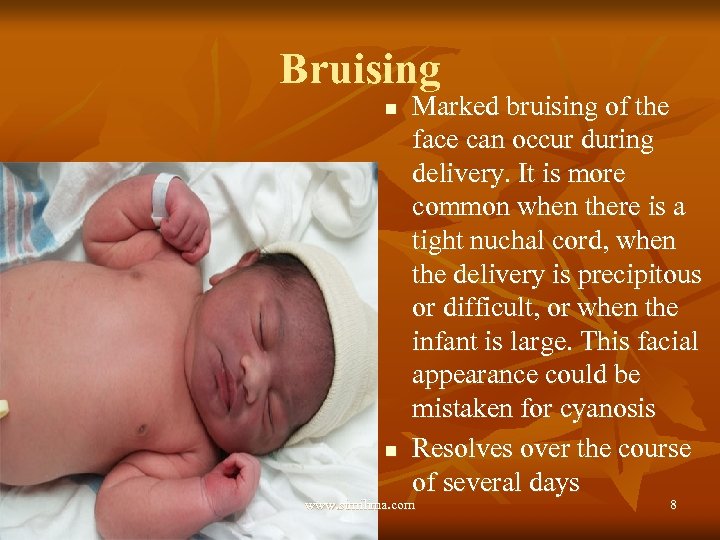
Bruising n n Marked bruising of the face can occur during delivery. It is more common when there is a tight nuchal cord, when the delivery is precipitous or difficult, or when the infant is large. This facial appearance could be mistaken for cyanosis Resolves over the course of several days www. similima. com 8
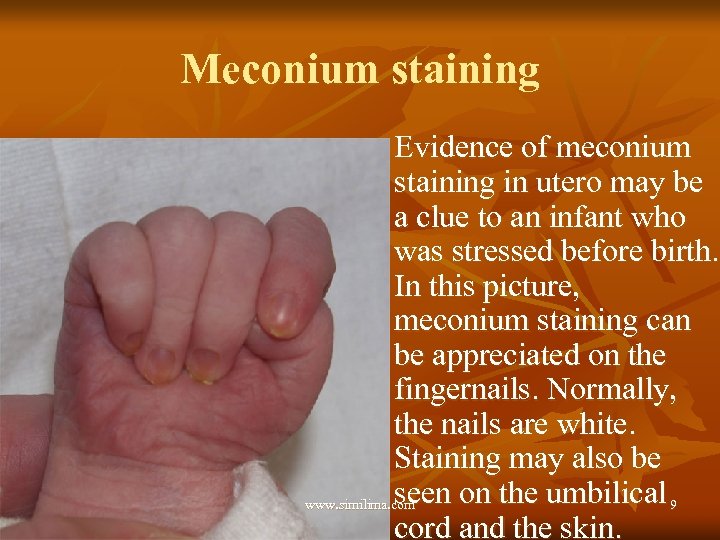
Meconium staining Evidence of meconium staining in utero may be a clue to an infant who was stressed before birth. In this picture, meconium staining can be appreciated on the fingernails. Normally, the nails are white. Staining may also be seen on the umbilical 9 www. similima. com cord and the skin. n
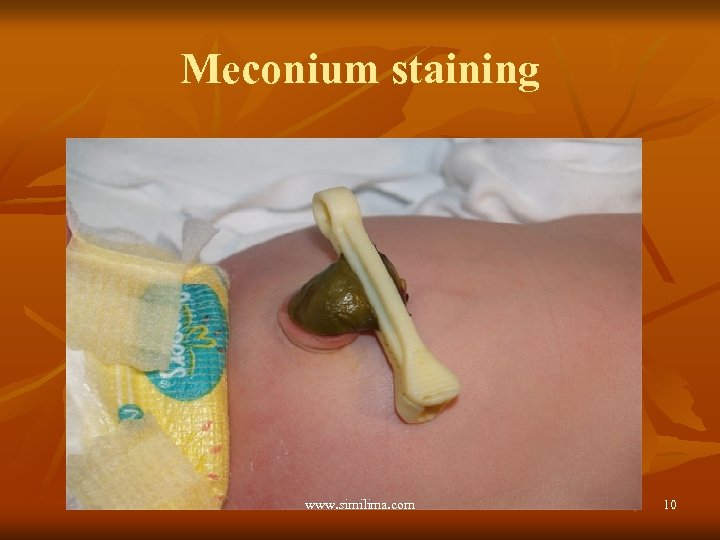
Meconium staining www. similima. com 10
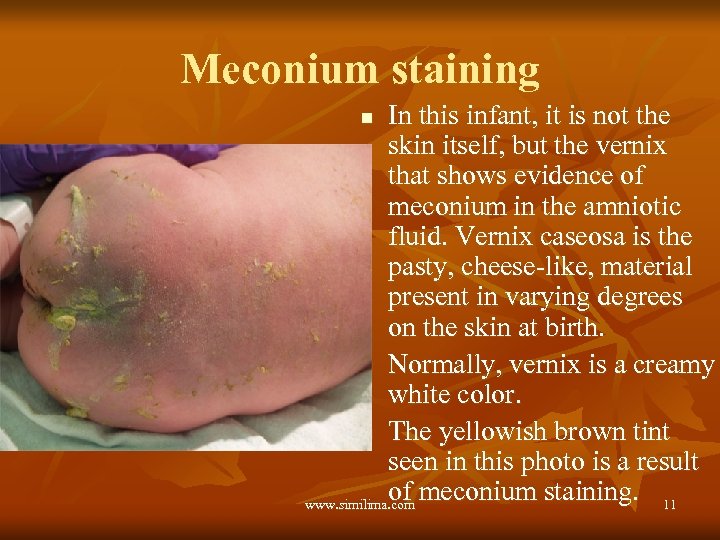
Meconium staining In this infant, it is not the skin itself, but the vernix that shows evidence of meconium in the amniotic fluid. Vernix caseosa is the pasty, cheese-like, material present in varying degrees on the skin at birth. n Normally, vernix is a creamy white color. n The yellowish brown tint seen in this photo is a result of meconium staining. 11 www. similima. com n
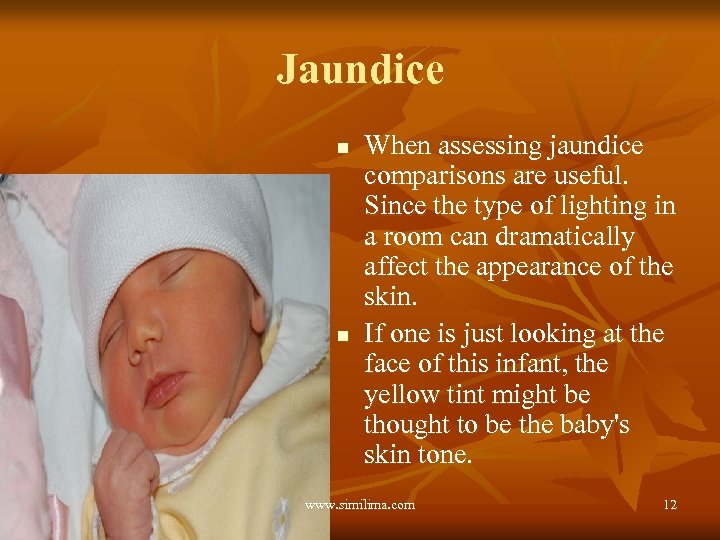
Jaundice n n When assessing jaundice comparisons are useful. Since the type of lighting in a room can dramatically affect the appearance of the skin. If one is just looking at the face of this infant, the yellow tint might be thought to be the baby's skin tone. www. similima. com 12
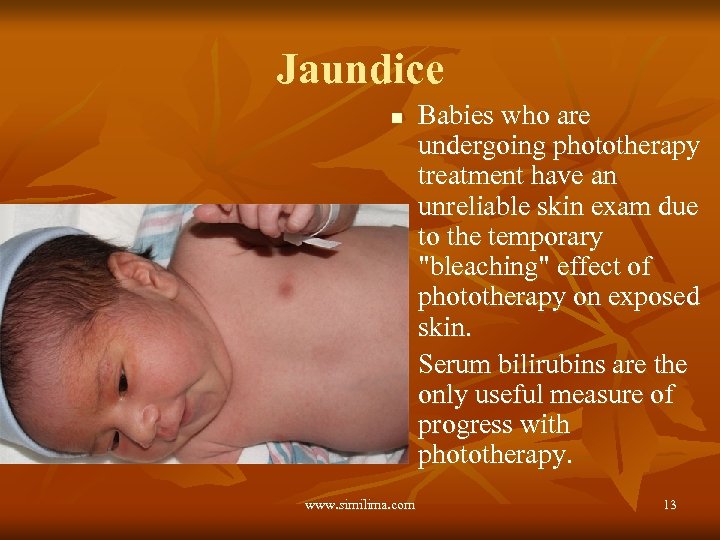
Jaundice n n www. similima. com Babies who are undergoing phototherapy treatment have an unreliable skin exam due to the temporary "bleaching" effect of phototherapy on exposed skin. Serum bilirubins are the only useful measure of progress with phototherapy. 13
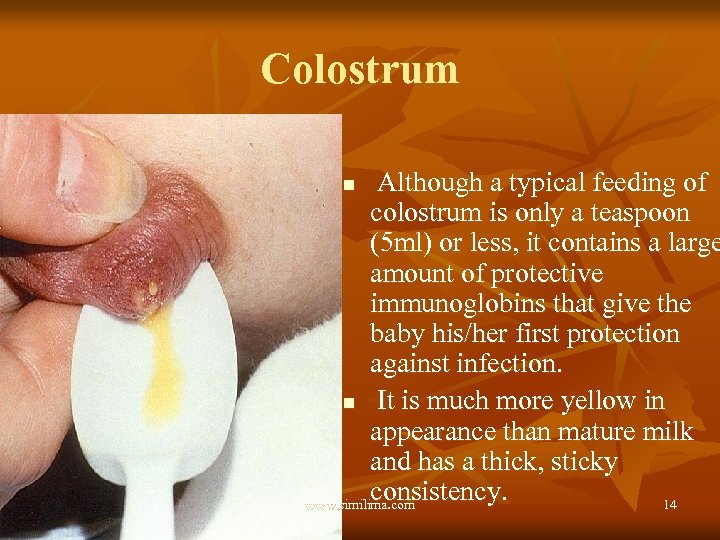
Colostrum Although a typical feeding of colostrum is only a teaspoon (5 ml) or less, it contains a large amount of protective immunoglobins that give the baby his/her first protection against infection. n It is much more yellow in appearance than mature milk and has a thick, sticky consistency. www. similima. com 14 n
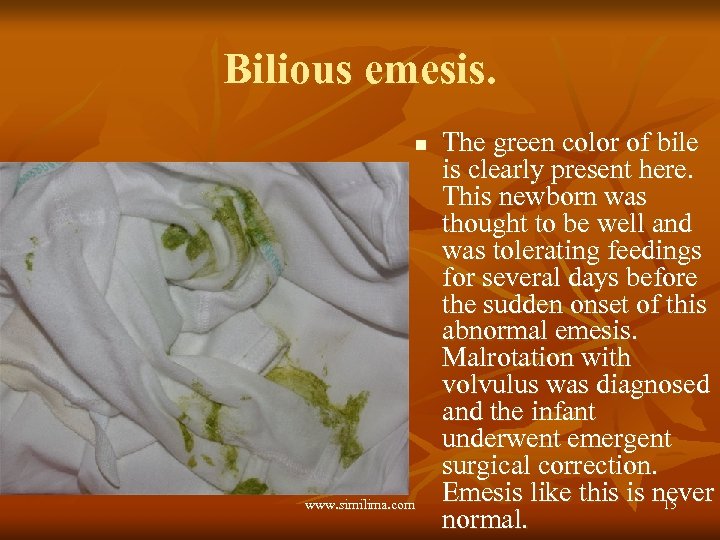
Bilious emesis. n www. similima. com The green color of bile is clearly present here. This newborn was thought to be well and was tolerating feedings for several days before the sudden onset of this abnormal emesis. Malrotation with volvulus was diagnosed and the infant underwent emergent surgical correction. Emesis like this is never 15 normal.

n ONCE THE MILK "COMES IN" AND THE VOLUME INCREASES SIGNIFICANTLY (USUALLY AROUND THE THIRD POSTPARTUM DAY), THE MILK CHANGES IN APPEARANCE FROM THE YELLOW, STICKY COLOSTRUM TO THE MORE CREAMY, LIQUID MATURE MILK. THE EXACT APPEARANCE, THOUGH, CHANGES EVEN WITHIN A FEEDING. THE MILK EXPRESSED AT THE BEGINNING OF THE FEED WILL HAVE A LOWER FAT CONTENT (AND APPEARS THINNER) THAN THE MILK EXPRESSED AS THE BREAST IS PROGRESSIVELY EMPTIED. THE LATER "HINDMILK" HAS A HIGH FAT CONTENT AND LOOKS THICKER AND CREAMIER. www. similima. com 16
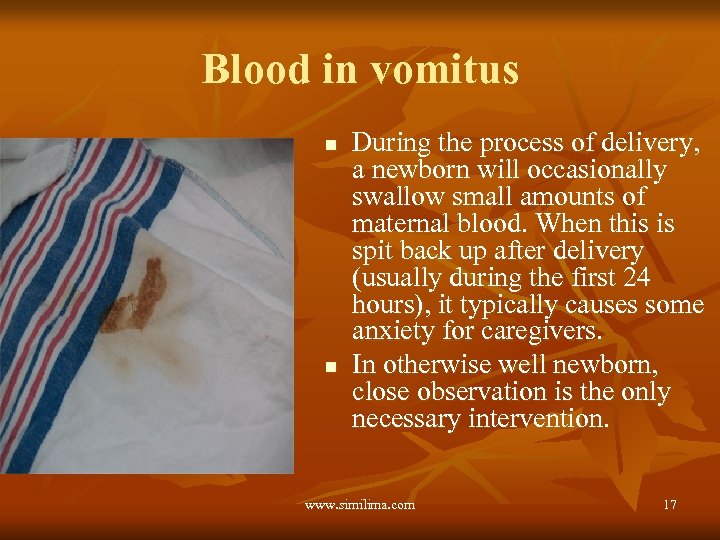
Blood in vomitus n n During the process of delivery, a newborn will occasionally swallow small amounts of maternal blood. When this is spit back up after delivery (usually during the first 24 hours), it typically causes some anxiety for caregivers. In otherwise well newborn, close observation is the only necessary intervention. www. similima. com 17
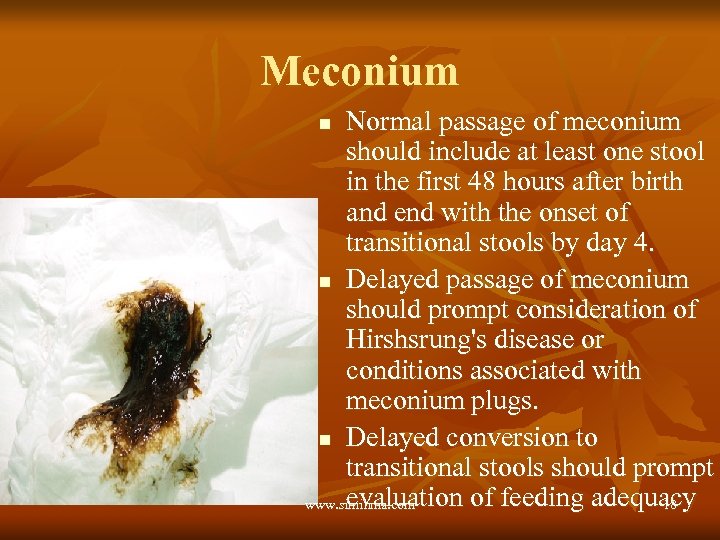
Meconium Normal passage of meconium should include at least one stool in the first 48 hours after birth and end with the onset of transitional stools by day 4. n Delayed passage of meconium should prompt consideration of Hirshsrung's disease or conditions associated with meconium plugs. n Delayed conversion to transitional stools should prompt evaluation of feeding adequacy www. similima. com 18 n

Transitional stool n n Transitional stool represents the change from meconium to the normal yellow, seedy stools that characterize infants feeding on milk only. Exclusively breastfed infants should have transitional stools by day 4 if feedings are adequate. www. similima. com 19
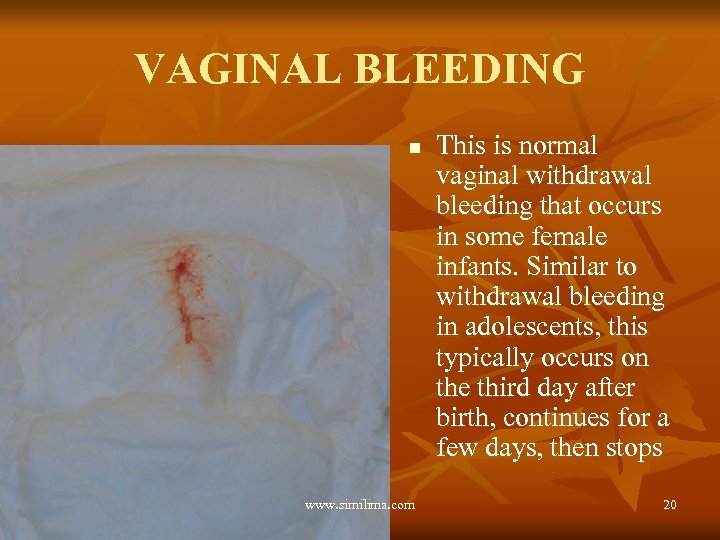
VAGINAL BLEEDING n www. similima. com This is normal vaginal withdrawal bleeding that occurs in some female infants. Similar to withdrawal bleeding in adolescents, this typically occurs on the third day after birth, continues for a few days, then stops 20
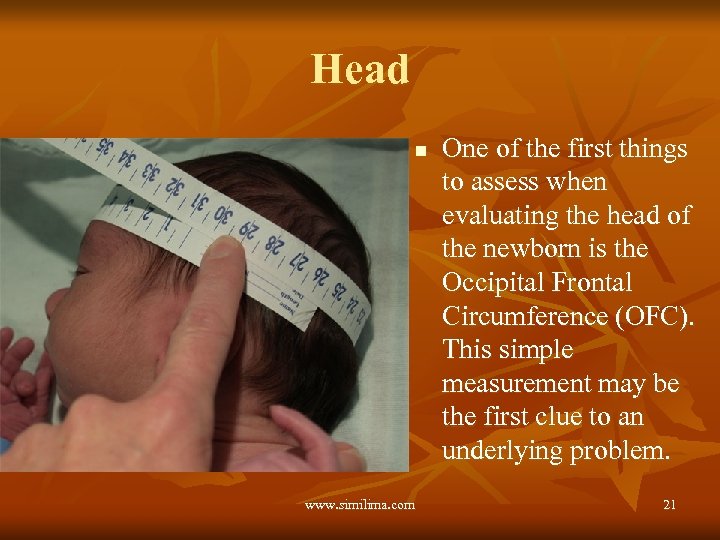
Head n www. similima. com One of the first things to assess when evaluating the head of the newborn is the Occipital Frontal Circumference (OFC). This simple measurement may be the first clue to an underlying problem. 21
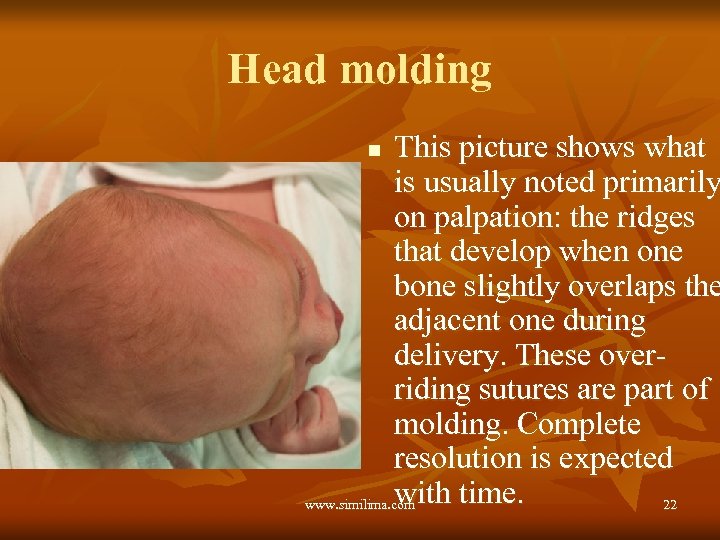
Head molding This picture shows what is usually noted primarily on palpation: the ridges that develop when one bone slightly overlaps the adjacent one during delivery. These overriding sutures are part of molding. Complete resolution is expected with time. www. similima. com 22 n
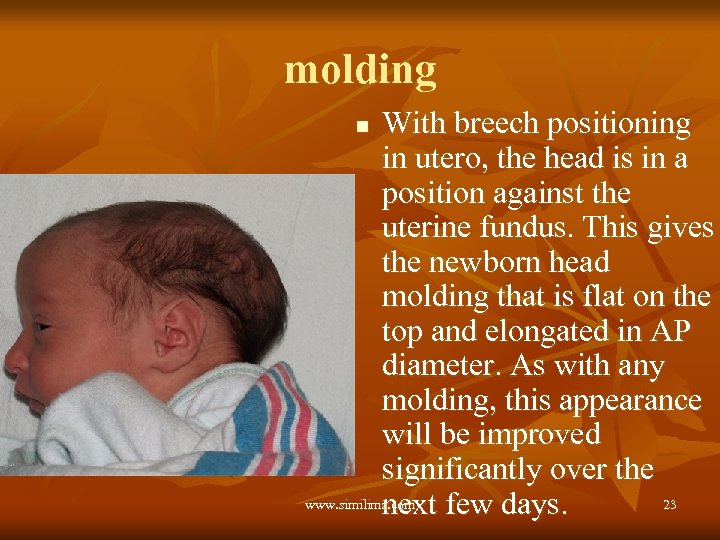
molding With breech positioning in utero, the head is in a position against the uterine fundus. This gives the newborn head molding that is flat on the top and elongated in AP diameter. As with any molding, this appearance will be improved significantly over the www. similima. com 23 next few days. n
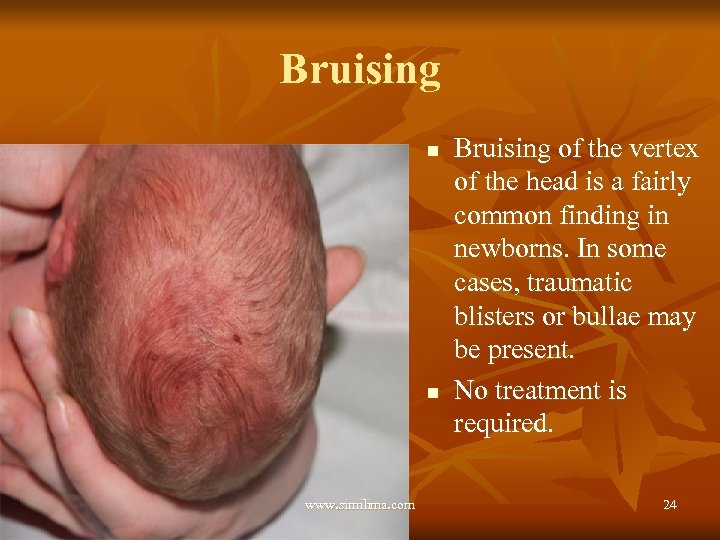
Bruising n n www. similima. com Bruising of the vertex of the head is a fairly common finding in newborns. In some cases, traumatic blisters or bullae may be present. No treatment is required. 24

Caput n www. similima. com Firm, constant pressure in one spot is i the easiest way to elicit the characteristi pitting edema of capu 25
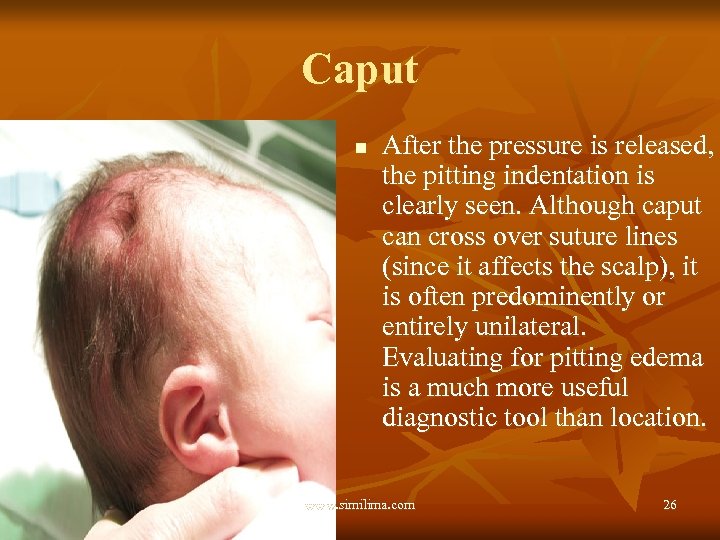
Caput n After the pressure is released, the pitting indentation is clearly seen. Although caput can cross over suture lines (since it affects the scalp), it is often predominently or entirely unilateral. Evaluating for pitting edema is a much more useful diagnostic tool than location. www. similima. com 26
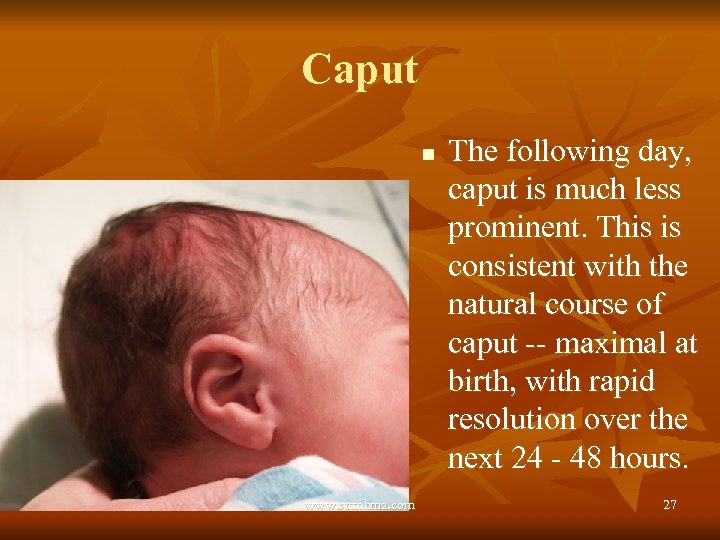
Caput n www. similima. com The following day, caput is much less prominent. This is consistent with the natural course of caput -- maximal at birth, with rapid resolution over the next 24 - 48 hours. 27
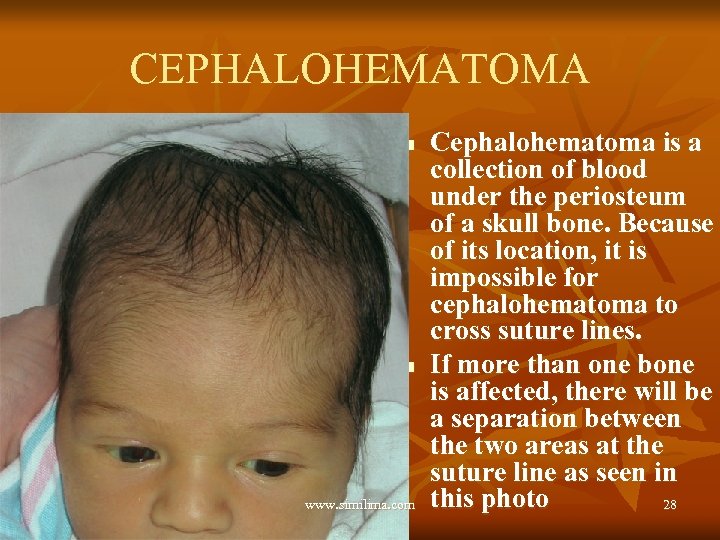
CEPHALOHEMATOMA n n www. similima. com Cephalohematoma is a collection of blood under the periosteum of a skull bone. Because of its location, it is impossible for cephalohematoma to cross suture lines. If more than one bone is affected, there will be a separation between the two areas at the suture line as seen in this photo 28
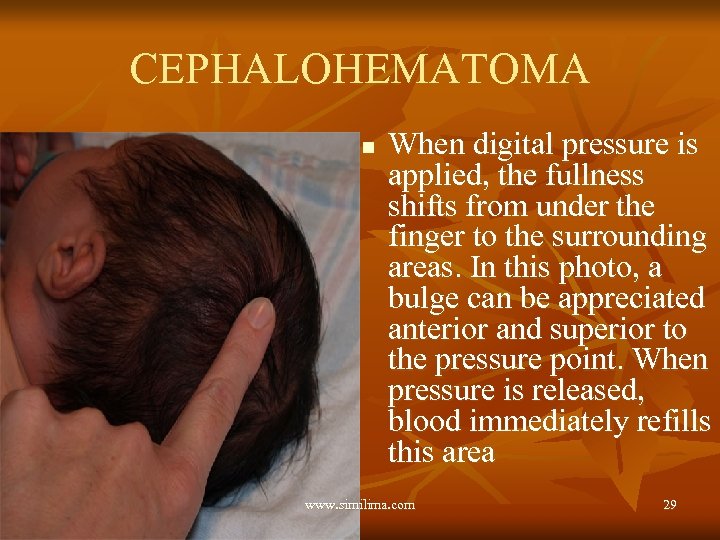
CEPHALOHEMATOMA n When digital pressure is applied, the fullness shifts from under the finger to the surrounding areas. In this photo, a bulge can be appreciated anterior and superior to the pressure point. When pressure is released, blood immediately refills this area www. similima. com 29
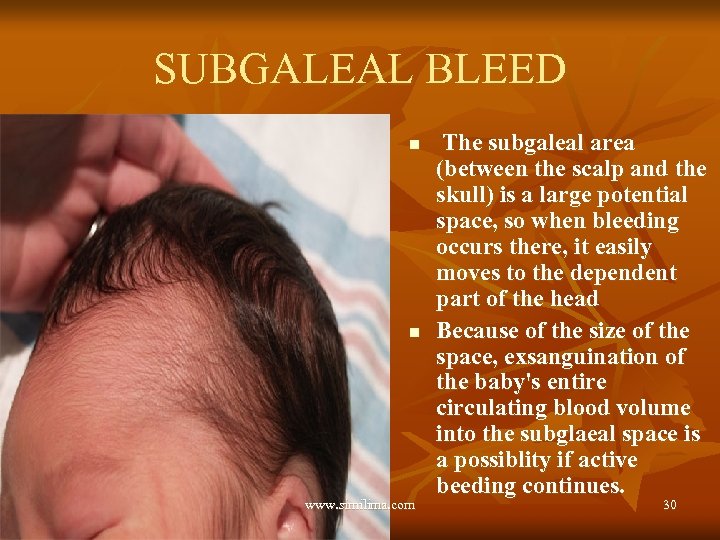
SUBGALEAL BLEED n n www. similima. com The subgaleal area (between the scalp and the skull) is a large potential space, so when bleeding occurs there, it easily moves to the dependent part of the head Because of the size of the space, exsanguination of the baby's entire circulating blood volume into the subglaeal space is a possiblity if active beeding continues. 30
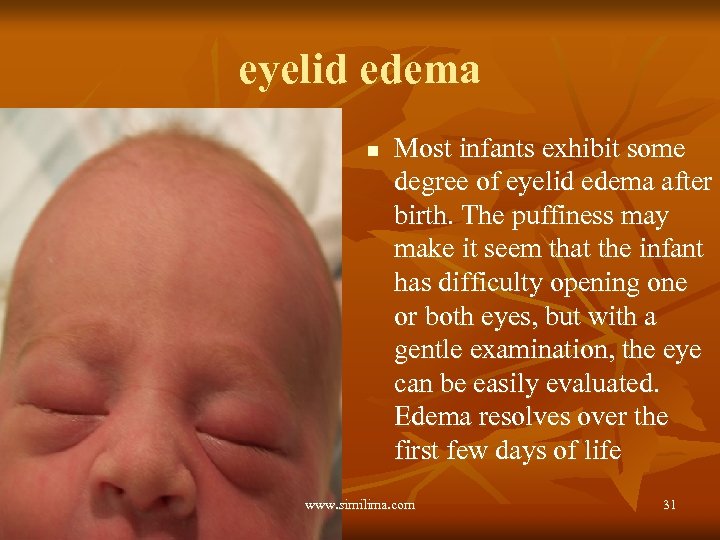
eyelid edema n Most infants exhibit some degree of eyelid edema after birth. The puffiness may make it seem that the infant has difficulty opening one or both eyes, but with a gentle examination, the eye can be easily evaluated. Edema resolves over the first few days of life www. similima. com 31
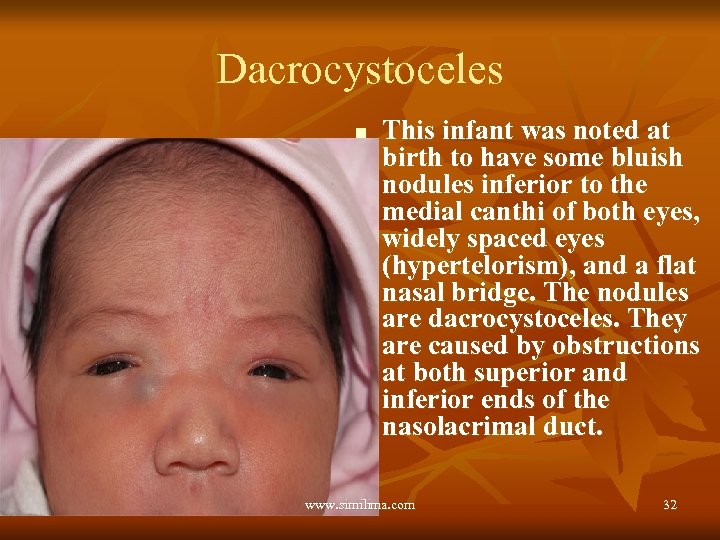
Dacrocystoceles n This infant was noted at birth to have some bluish nodules inferior to the medial canthi of both eyes, widely spaced eyes (hypertelorism), and a flat nasal bridge. The nodules are dacrocystoceles. They are caused by obstructions at both superior and inferior ends of the nasolacrimal duct. www. similima. com 32
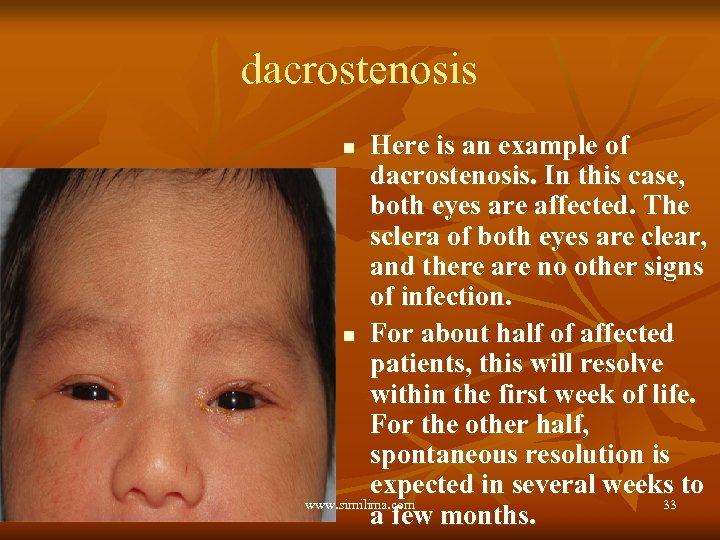
dacrostenosis Here is an example of dacrostenosis. In this case, both eyes are affected. The sclera of both eyes are clear, and there are no other signs of infection. n For about half of affected patients, this will resolve within the first week of life. For the other half, spontaneous resolution is expected in several weeks to www. similima. com 33 a few months. n
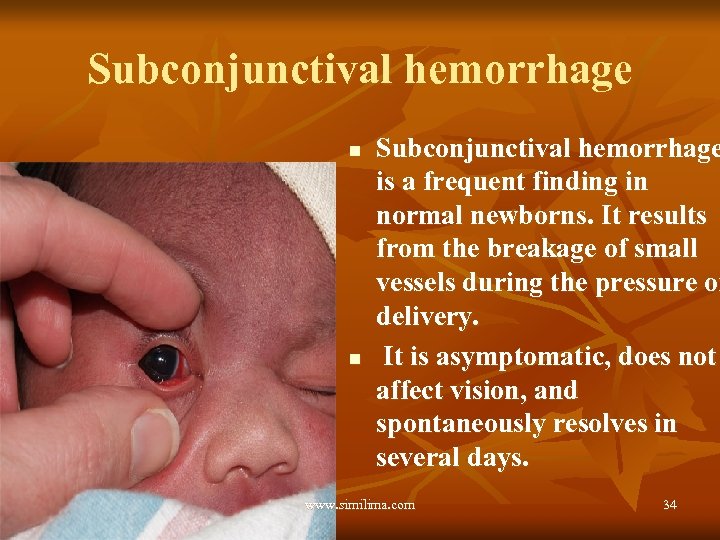
Subconjunctival hemorrhage n n Subconjunctival hemorrhage is a frequent finding in normal newborns. It results from the breakage of small vessels during the pressure of delivery. It is asymptomatic, does not affect vision, and spontaneously resolves in several days. www. similima. com 34
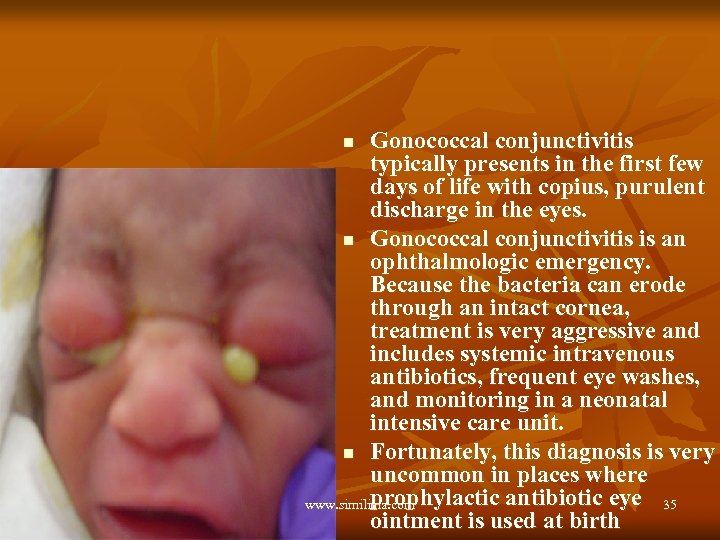
Gonococcal conjunctivitis typically presents in the first few days of life with copius, purulent discharge in the eyes. n Gonococcal conjunctivitis is an ophthalmologic emergency. Because the bacteria can erode through an intact cornea, treatment is very aggressive and includes systemic intravenous antibiotics, frequent eye washes, and monitoring in a neonatal intensive care unit. n Fortunately, this diagnosis is very uncommon in places where prophylactic antibiotic eye 35 www. similima. com ointment is used at birth n
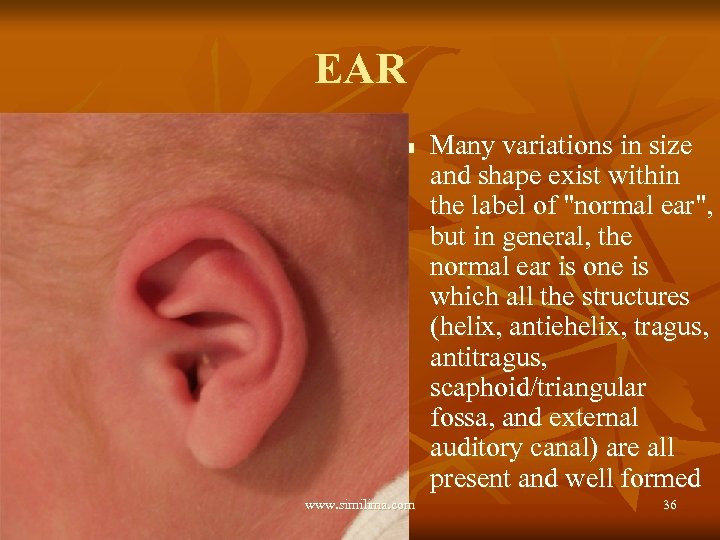
EAR n www. similima. com Many variations in size and shape exist within the label of "normal ear", but in general, the normal ear is one is which all the structures (helix, antiehelix, tragus, antitragus, scaphoid/triangular fossa, and external auditory canal) are all present and well formed 36
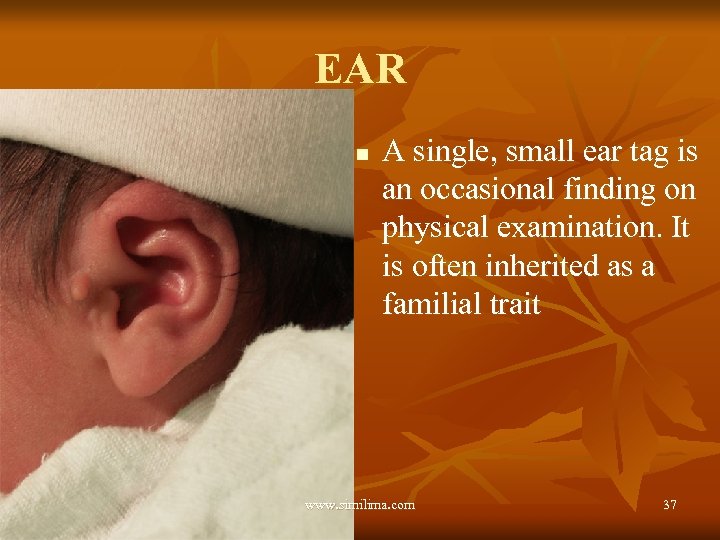
EAR n A single, small ear tag is an occasional finding on physical examination. It is often inherited as a familial trait www. similima. com 37
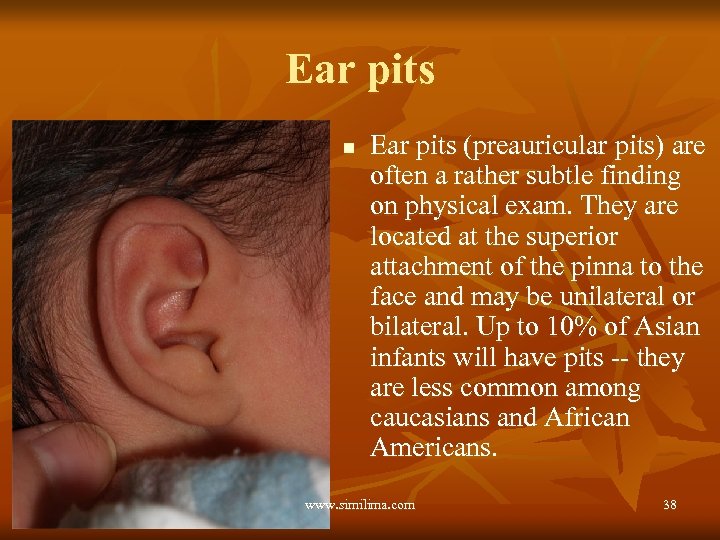
Ear pits n Ear pits (preauricular pits) are often a rather subtle finding on physical exam. They are located at the superior attachment of the pinna to the face and may be unilateral or bilateral. Up to 10% of Asian infants will have pits -- they are less common among caucasians and African Americans. www. similima. com 38
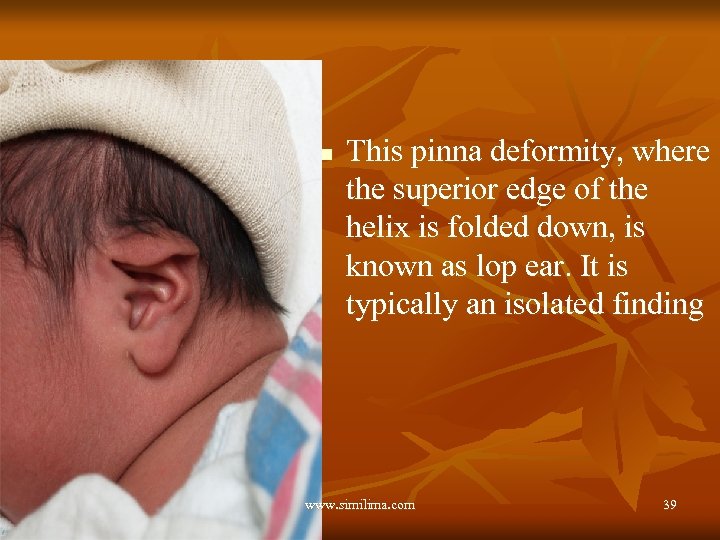
n This pinna deformity, where the superior edge of the helix is folded down, is known as lop ear. It is typically an isolated finding www. similima. com 39
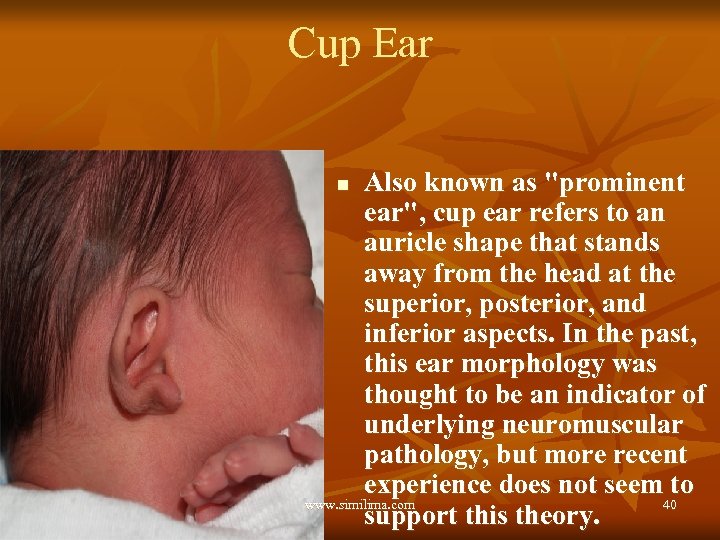
Cup Ear Also known as "prominent ear", cup ear refers to an auricle shape that stands away from the head at the superior, posterior, and inferior aspects. In the past, this ear morphology was thought to be an indicator of underlying neuromuscular pathology, but more recent experience does not seem to www. similima. com 40 support this theory. n
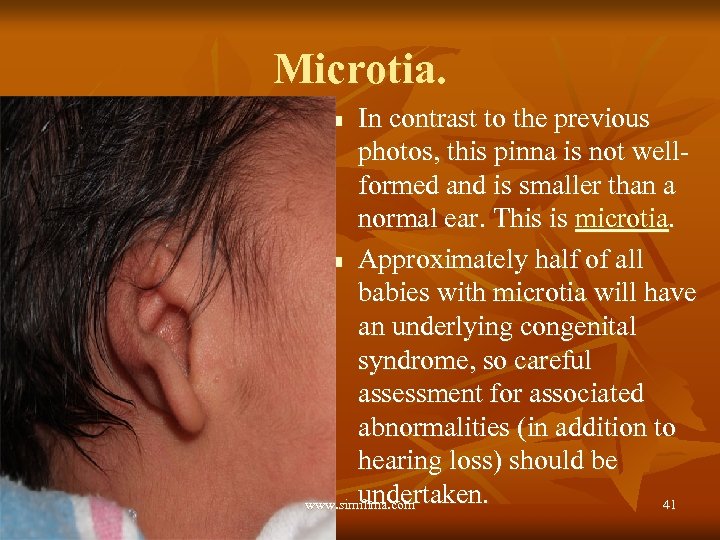
Microtia. In contrast to the previous photos, this pinna is not wellformed and is smaller than a normal ear. This is microtia. n Approximately half of all babies with microtia will have an underlying congenital syndrome, so careful assessment for associated abnormalities (in addition to hearing loss) should be undertaken. www. similima. com 41 n
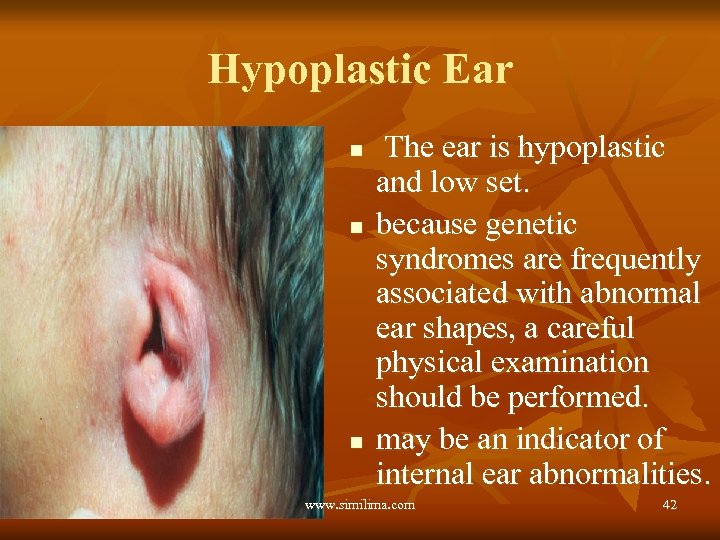
Hypoplastic Ear n n n The ear is hypoplastic and low set. because genetic syndromes are frequently associated with abnormal ear shapes, a careful physical examination should be performed. may be an indicator of internal ear abnormalities. www. similima. com 42
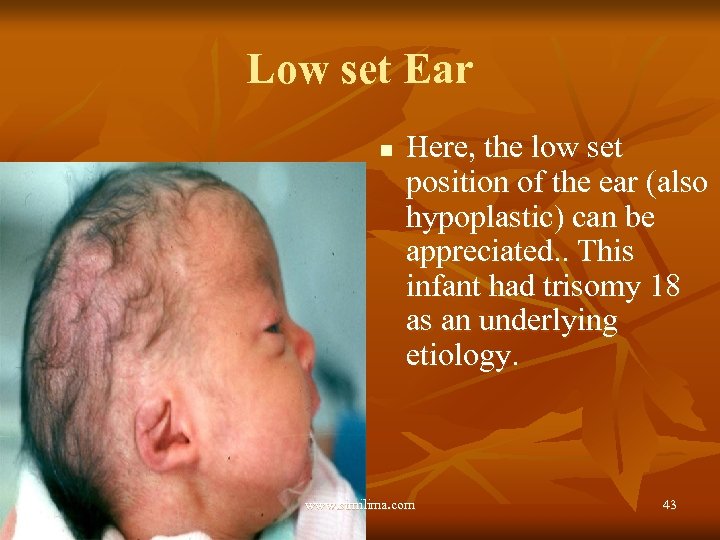
Low set Ear n Here, the low set position of the ear (also hypoplastic) can be appreciated. . This infant had trisomy 18 as an underlying etiology. www. similima. com 43
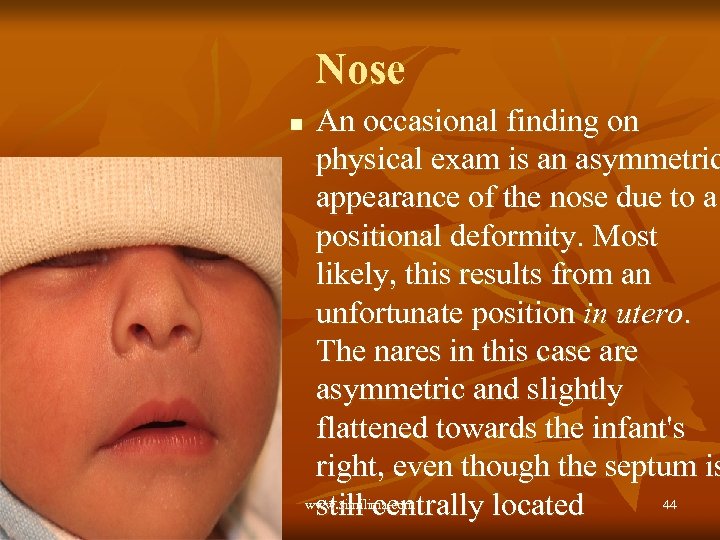
Nose n An occasional finding on physical exam is an asymmetric appearance of the nose due to a positional deformity. Most likely, this results from an unfortunate position in utero. The nares in this case are asymmetric and slightly flattened towards the infant's right, even though the septum is www. similima. com 44 still centrally located
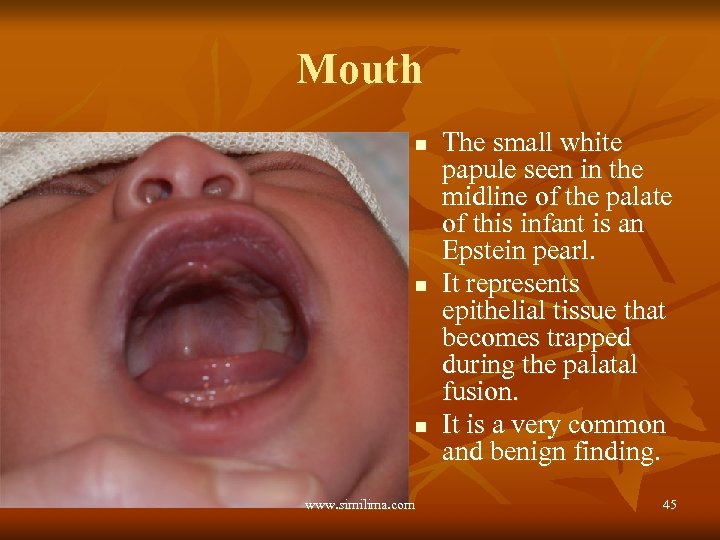
Mouth n n n www. similima. com The small white papule seen in the midline of the palate of this infant is an Epstein pearl. It represents epithelial tissue that becomes trapped during the palatal fusion. It is a very common and benign finding. 45
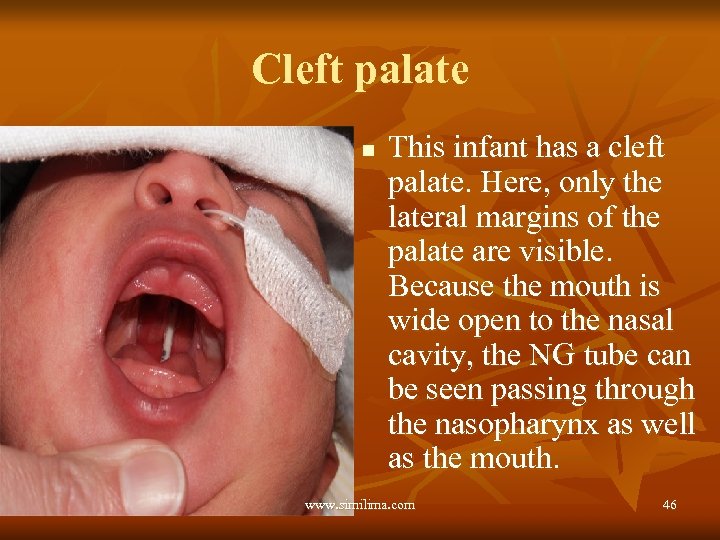
Cleft palate n This infant has a cleft palate. Here, only the lateral margins of the palate are visible. Because the mouth is wide open to the nasal cavity, the NG tube can be seen passing through the nasopharynx as well as the mouth. www. similima. com 46
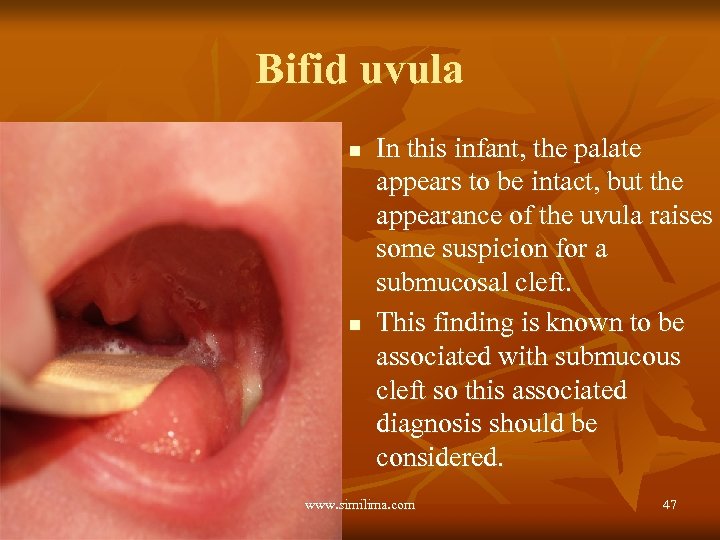
Bifid uvula n n In this infant, the palate appears to be intact, but the appearance of the uvula raises some suspicion for a submucosal cleft. This finding is known to be associated with submucous cleft so this associated diagnosis should be considered. www. similima. com 47
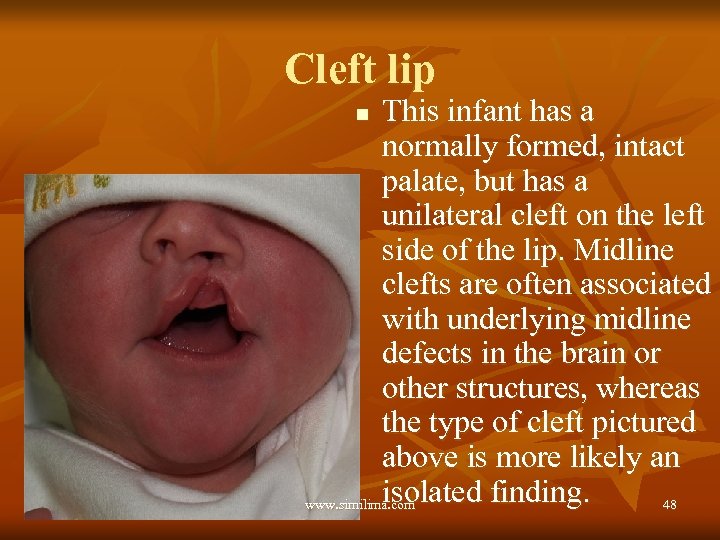
Cleft lip This infant has a normally formed, intact palate, but has a unilateral cleft on the left side of the lip. Midline clefts are often associated with underlying midline defects in the brain or other structures, whereas the type of cleft pictured above is more likely an isolated finding. www. similima. com 48 n
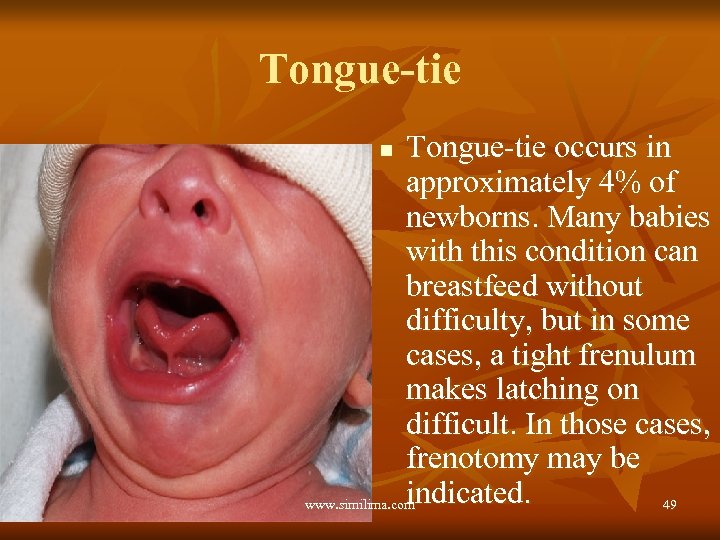
Tongue-tie occurs in approximately 4% of newborns. Many babies with this condition can breastfeed without difficulty, but in some cases, a tight frenulum makes latching on difficult. In those cases, frenotomy may be indicated. www. similima. com 49 n
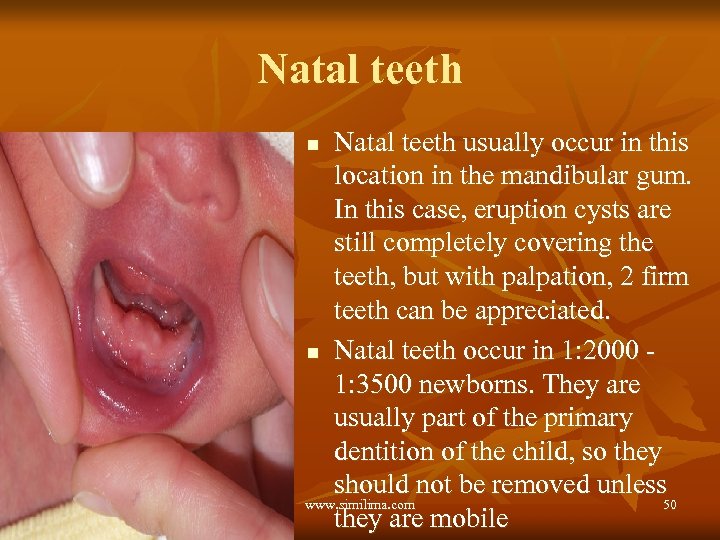
Natal teeth usually occur in this location in the mandibular gum. In this case, eruption cysts are still completely covering the teeth, but with palpation, 2 firm teeth can be appreciated. n Natal teeth occur in 1: 2000 1: 3500 newborns. They are usually part of the primary dentition of the child, so they should not be removed unless www. similima. com 50 they are mobile n
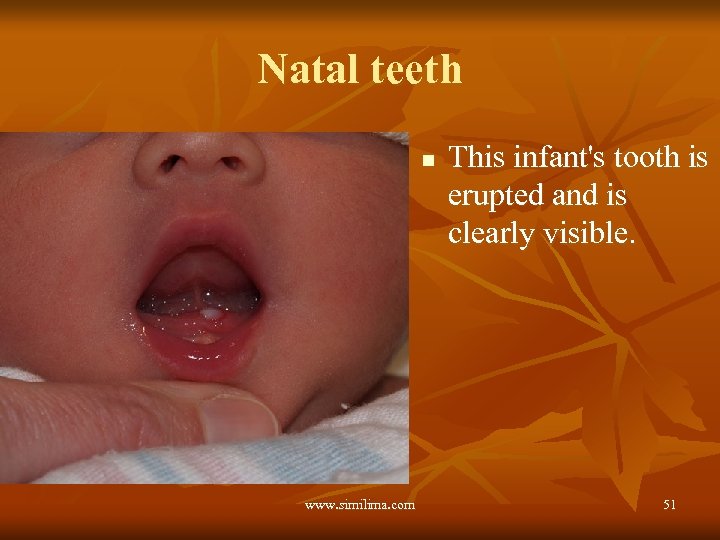
Natal teeth n www. similima. com This infant's tooth is erupted and is clearly visible. 51
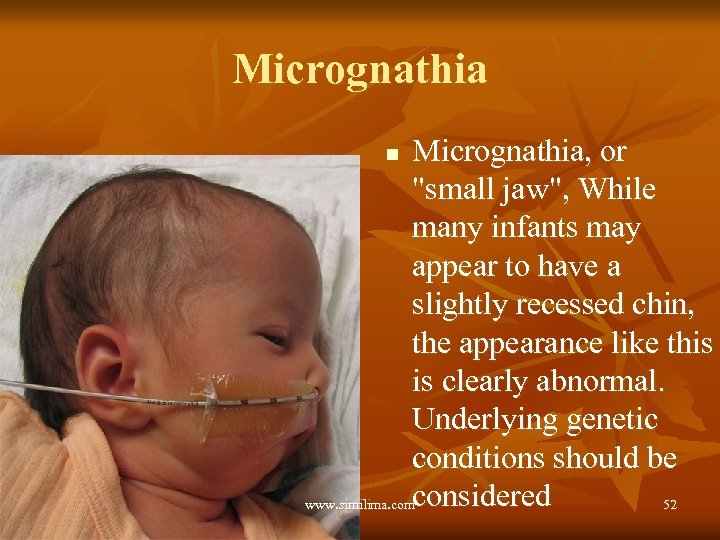
Micrognathia, or "small jaw", While many infants may appear to have a slightly recessed chin, the appearance like this is clearly abnormal. Underlying genetic conditions should be considered www. similima. com 52 n
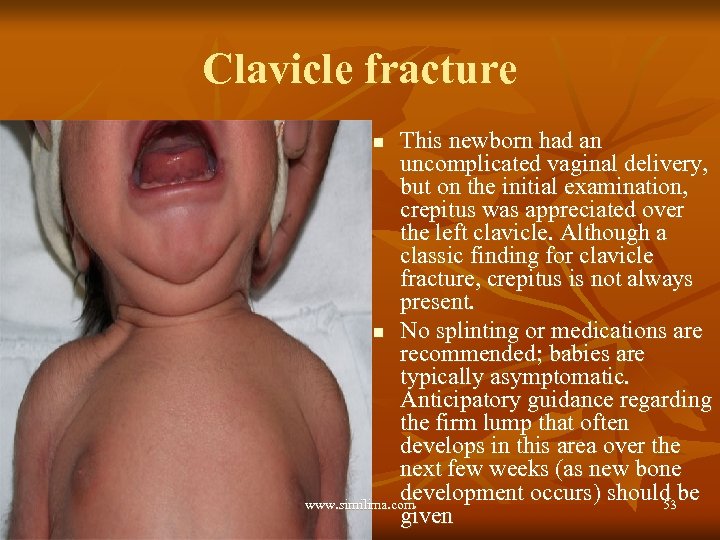
Clavicle fracture This newborn had an uncomplicated vaginal delivery, but on the initial examination, crepitus was appreciated over the left clavicle. Although a classic finding for clavicle fracture, crepitus is not always present. n No splinting or medications are recommended; babies are typically asymptomatic. Anticipatory guidance regarding the firm lump that often develops in this area over the next few weeks (as new bone development occurs) should be www. similima. com 53 given n
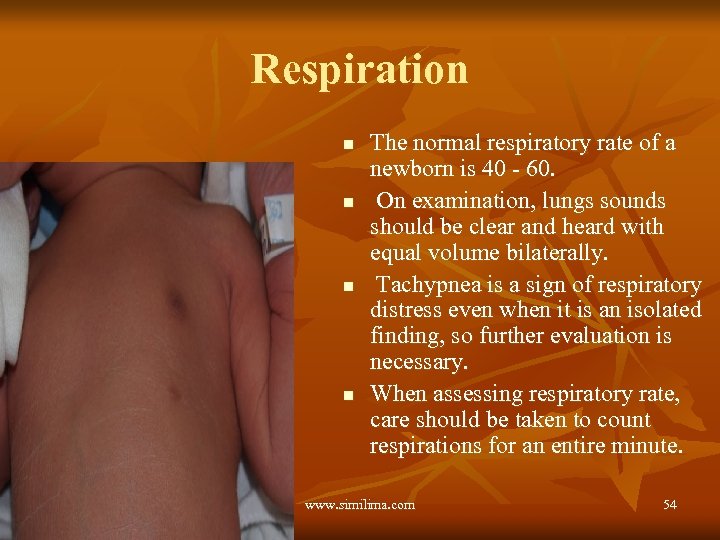
Respiration n n The normal respiratory rate of a newborn is 40 - 60. On examination, lungs sounds should be clear and heard with equal volume bilaterally. Tachypnea is a sign of respiratory distress even when it is an isolated finding, so further evaluation is necessary. When assessing respiratory rate, care should be taken to count respirations for an entire minute. www. similima. com 54
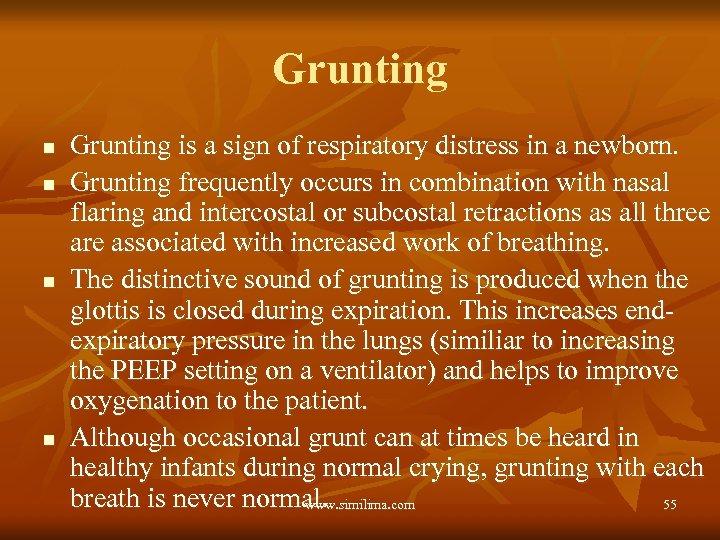
Grunting n n Grunting is a sign of respiratory distress in a newborn. Grunting frequently occurs in combination with nasal flaring and intercostal or subcostal retractions as all three are associated with increased work of breathing. The distinctive sound of grunting is produced when the glottis is closed during expiration. This increases endexpiratory pressure in the lungs (similiar to increasing the PEEP setting on a ventilator) and helps to improve oxygenation to the patient. Although occasional grunt can at times be heard in healthy infants during normal crying, grunting with each breath is never normal. www. similima. com 55
Stridor n n n Stridor is an occasionally encountered sound in an otherwise healthy newborn. It is a high-pitched whistling sound that occurs on inspiration and is typically audible without using a stethescope. In newborns, it is most commonly caused by laryngomalacia, however other congenital anomalies (vascular slings, double aortic arch, vocal cord paresis, etc) should be considered. www. similima. com 56
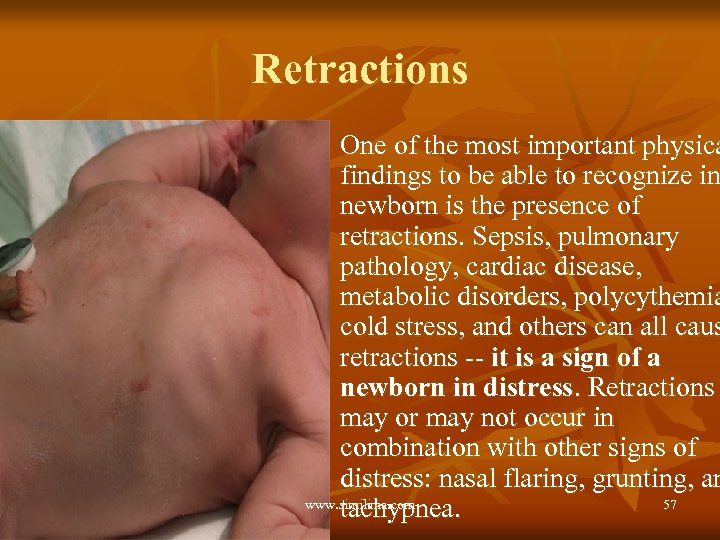
Retractions One of the most important physica findings to be able to recognize in newborn is the presence of retractions. Sepsis, pulmonary pathology, cardiac disease, metabolic disorders, polycythemia cold stress, and others can all caus retractions -- it is a sign of a newborn in distress. Retractions may or may not occur in combination with other signs of distress: nasal flaring, grunting, an www. similima. com 57 tachypnea. n
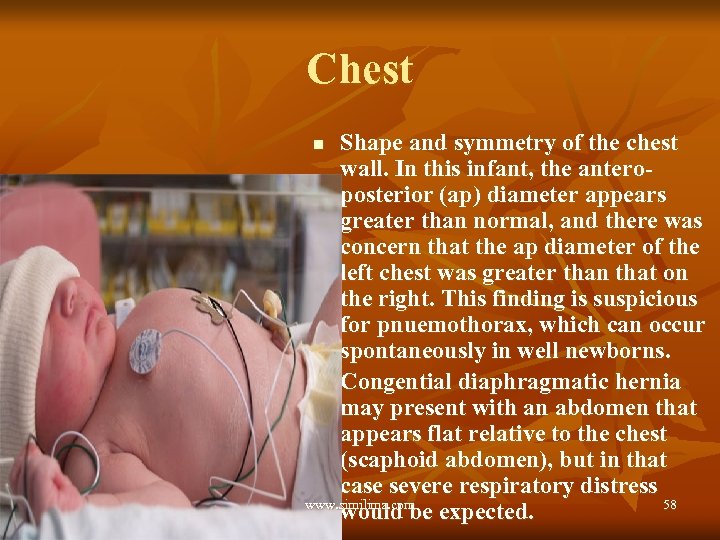
Chest Shape and symmetry of the chest wall. In this infant, the anteroposterior (ap) diameter appears greater than normal, and there was concern that the ap diameter of the left chest was greater than that on the right. This finding is suspicious for pnuemothorax, which can occur spontaneously in well newborns. n Congential diaphragmatic hernia may present with an abdomen that appears flat relative to the chest (scaphoid abdomen), but in that case severe respiratory distress www. similima. com 58 would be expected. n
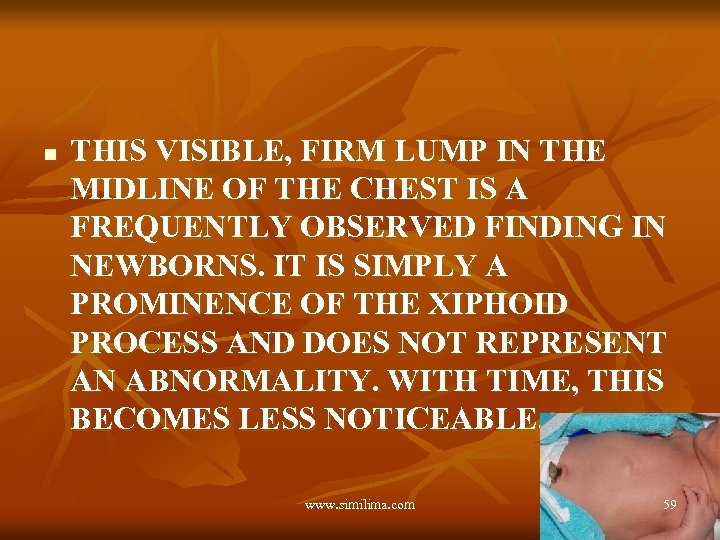
n THIS VISIBLE, FIRM LUMP IN THE MIDLINE OF THE CHEST IS A FREQUENTLY OBSERVED FINDING IN NEWBORNS. IT IS SIMPLY A PROMINENCE OF THE XIPHOID PROCESS AND DOES NOT REPRESENT AN ABNORMALITY. WITH TIME, THIS BECOMES LESS NOTICEABLE. www. similima. com 59
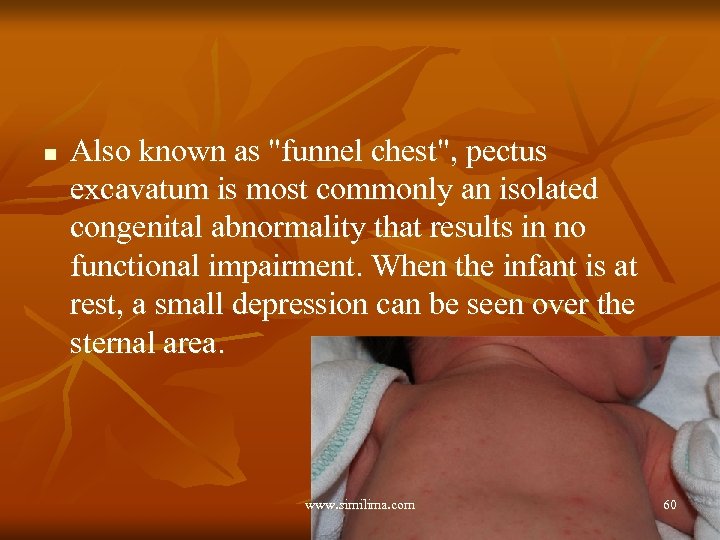
n Also known as "funnel chest", pectus excavatum is most commonly an isolated congenital abnormality that results in no functional impairment. When the infant is at rest, a small depression can be seen over the sternal area. www. similima. com 60
Heart n The normal heart rate at this age is 120 - 160 beats per minute. At times, healthy babies may have resting heart rates as low as 90 s or 100, but further evaluation of those few is prudent to rule out the possibility of pathology. www. similima. com 61
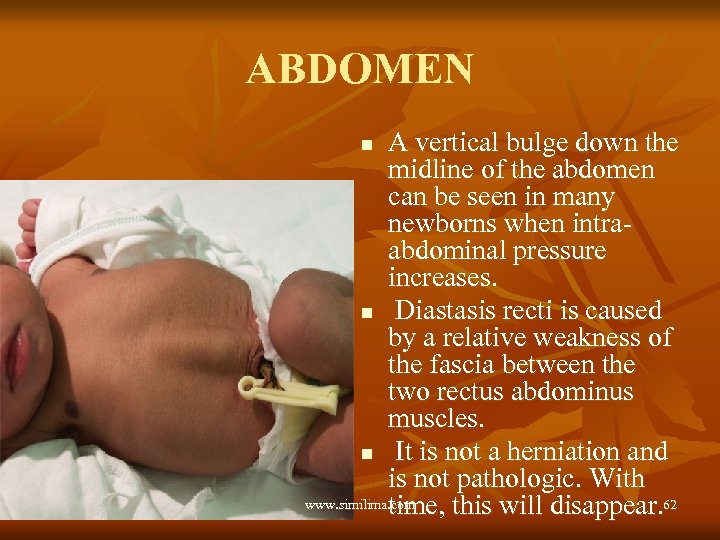
ABDOMEN A vertical bulge down the midline of the abdomen can be seen in many newborns when intraabdominal pressure increases. n Diastasis recti is caused by a relative weakness of the fascia between the two rectus abdominus muscles. n It is not a herniation and is not pathologic. With www. similima. com time, this will disappear. 62 n
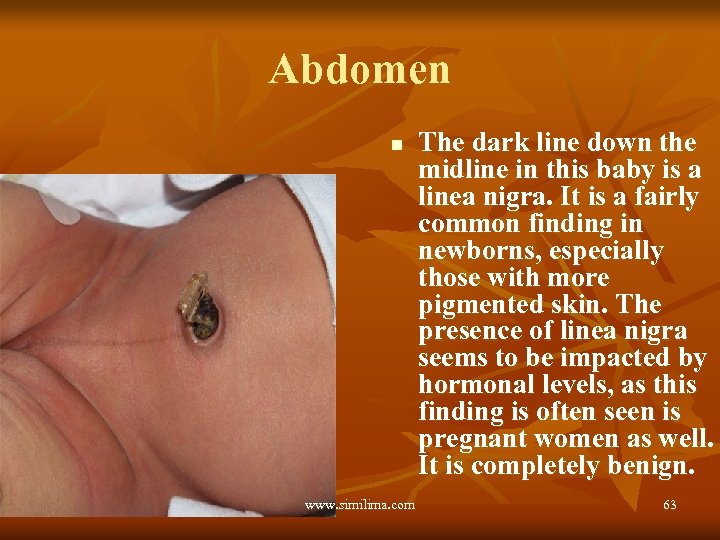
Abdomen n www. similima. com The dark line down the midline in this baby is a linea nigra. It is a fairly common finding in newborns, especially those with more pigmented skin. The presence of linea nigra seems to be impacted by hormonal levels, as this finding is often seen is pregnant women as well. It is completely benign. 63
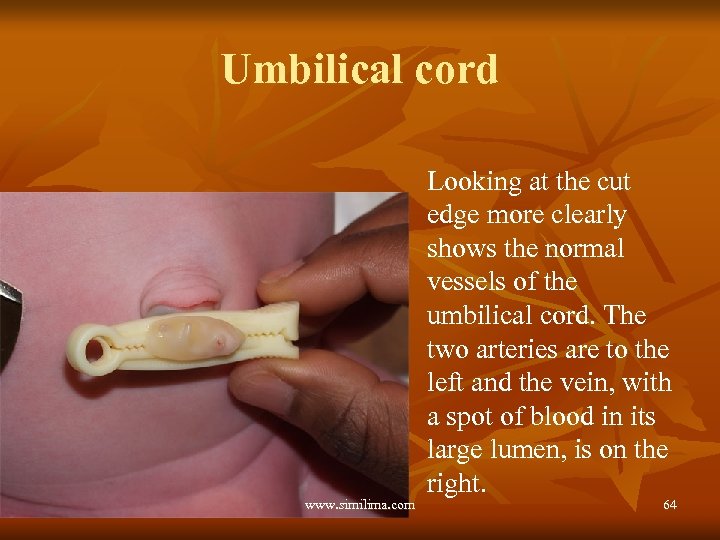
Umbilical cord www. similima. com Looking at the cut edge more clearly shows the normal vessels of the umbilical cord. The two arteries are to the left and the vein, with a spot of blood in its large lumen, is on the right. 64

n AFTER A COUPLE OF DAYS, THE CORD IS A STIFF, DRY STUMP. THE BULGE OF SKIN AROUND THE EDGE IS A NORMAL VARIANT AND DOES NOT REPRESENT AN ABNORMALITY. www. similima. com 65
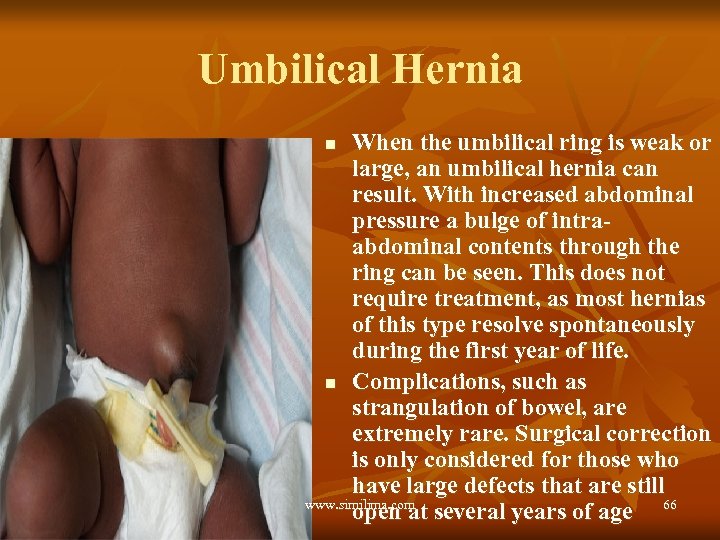
Umbilical Hernia When the umbilical ring is weak or large, an umbilical hernia can result. With increased abdominal pressure a bulge of intraabdominal contents through the ring can be seen. This does not require treatment, as most hernias of this type resolve spontaneously during the first year of life. n Complications, such as strangulation of bowel, are extremely rare. Surgical correction is only considered for those who have large defects that are still www. similima. com open at several years of age 66 n
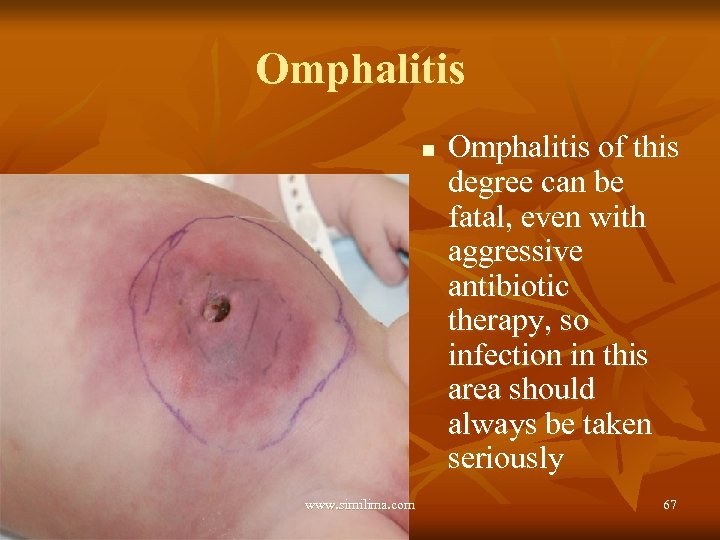
Omphalitis n www. similima. com Omphalitis of this degree can be fatal, even with aggressive antibiotic therapy, so infection in this area should always be taken seriously 67
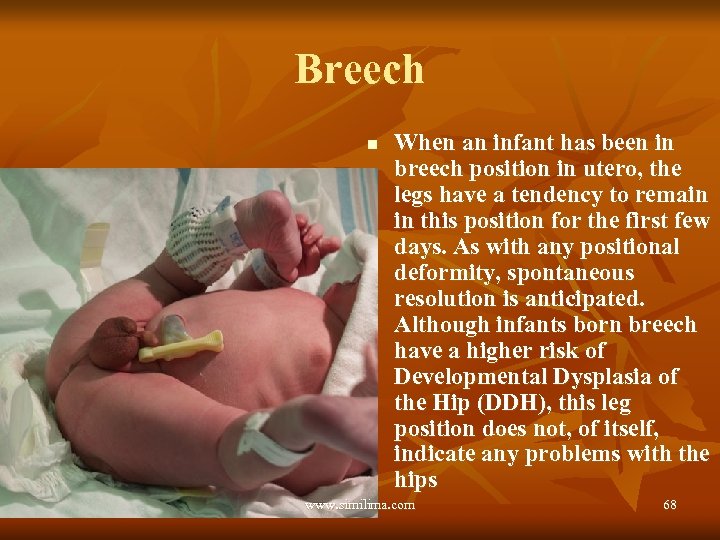
Breech n When an infant has been in breech position in utero, the legs have a tendency to remain in this position for the first few days. As with any positional deformity, spontaneous resolution is anticipated. Although infants born breech have a higher risk of Developmental Dysplasia of the Hip (DDH), this leg position does not, of itself, indicate any problems with the hips www. similima. com 68
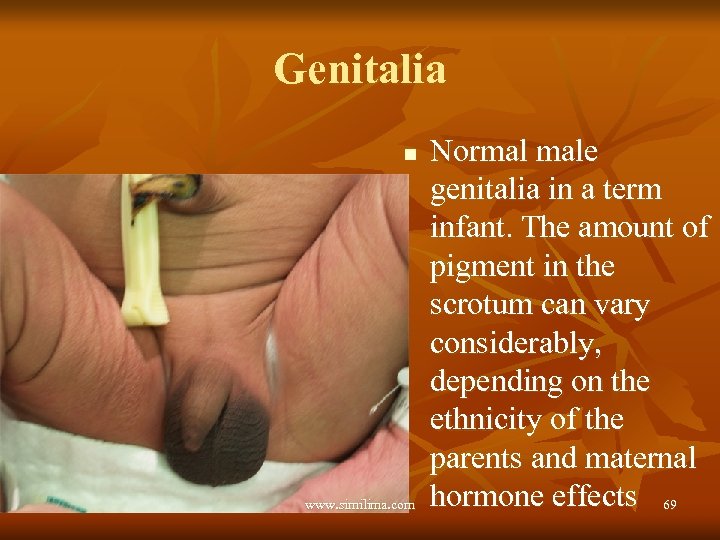
Genitalia n www. similima. com Normal male genitalia in a term infant. The amount of pigment in the scrotum can vary considerably, depending on the ethnicity of the parents and maternal hormone effects 69
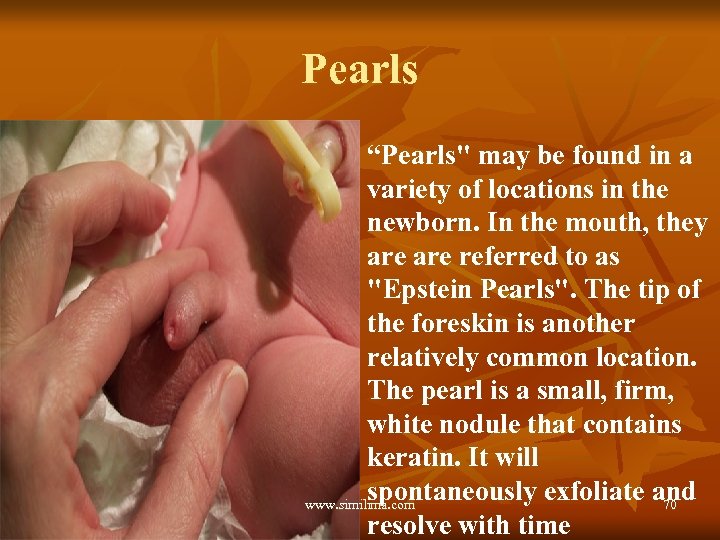
Pearls “Pearls" may be found in a variety of locations in the newborn. In the mouth, they are referred to as "Epstein Pearls". The tip of the foreskin is another relatively common location. The pearl is a small, firm, white nodule that contains keratin. It will spontaneously exfoliate and www. similima. com 70 resolve with time
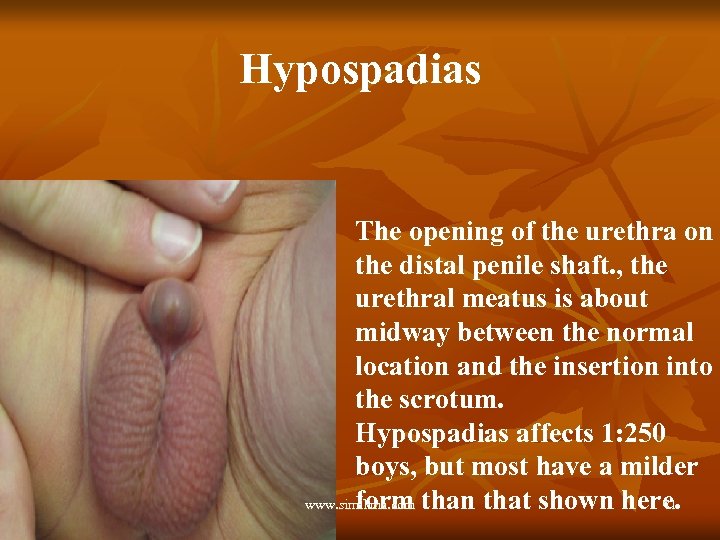
Hypospadias The opening of the urethra on the distal penile shaft. , the urethral meatus is about midway between the normal location and the insertion into the scrotum. Hypospadias affects 1: 250 boys, but most have a milder form www. similima. com than that shown here. 71
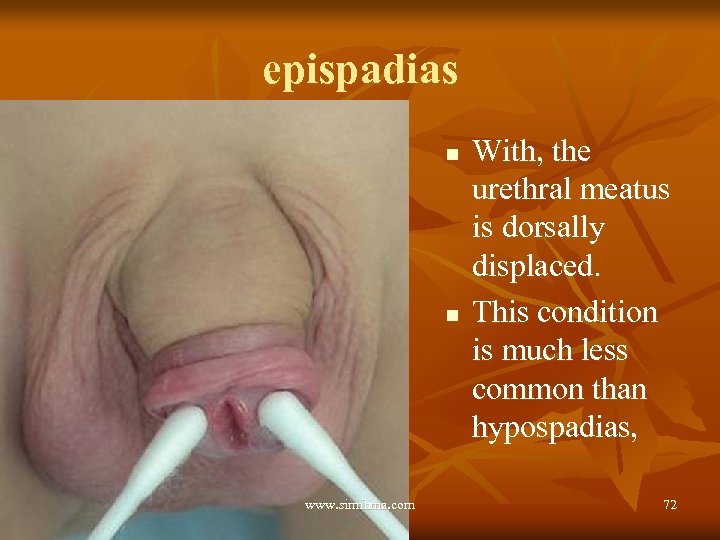
epispadias n n www. similima. com With, the urethral meatus is dorsally displaced. This condition is much less common than hypospadias, 72
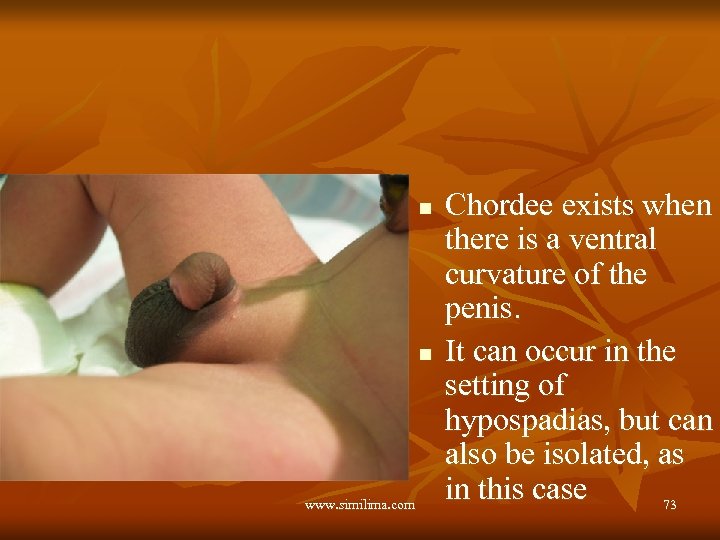
n n www. similima. com Chordee exists when there is a ventral curvature of the penis. It can occur in the setting of hypospadias, but can also be isolated, as in this case 73

n MOST NEWBORNS HAVE TWO MAJOR CREASES ON THE PALM, NEITHER OF WHICH COMPLETELY EXTEND FROM ONE SIDE OF THE PALM TO THE OTHER. www. similima. com 74
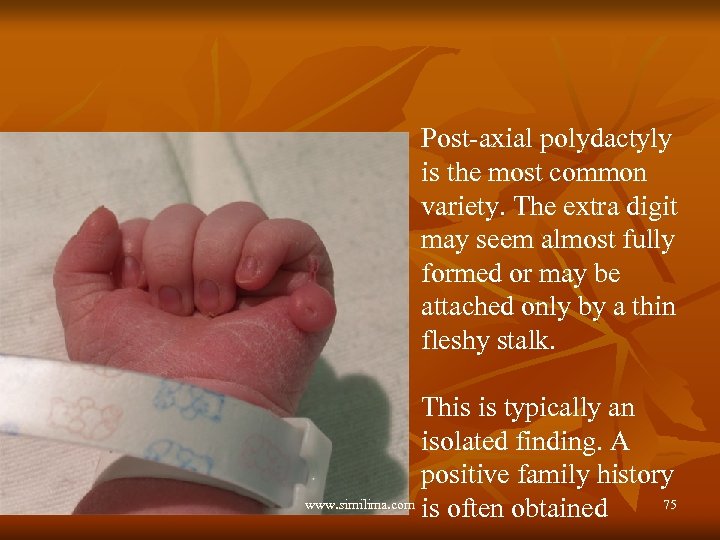
Post-axial polydactyly is the most common variety. The extra digit may seem almost fully formed or may be attached only by a thin fleshy stalk. This is typically an isolated finding. A positive family history www. similima. com 75 is often obtained
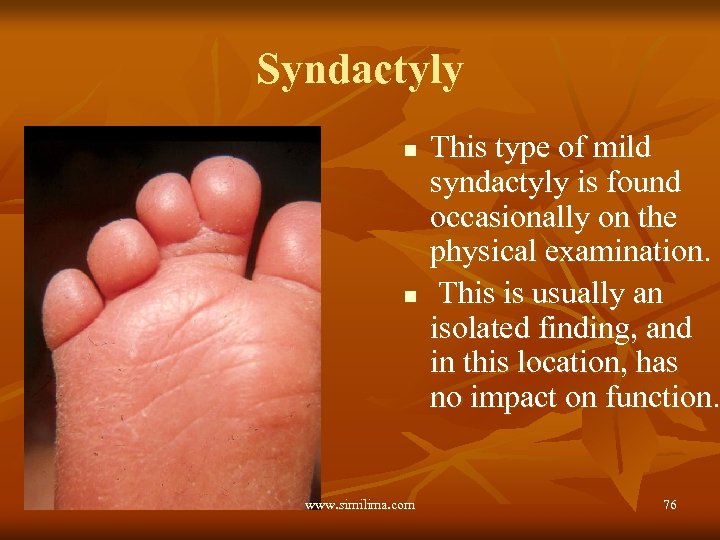
Syndactyly n n www. similima. com This type of mild syndactyly is found occasionally on the physical examination. This is usually an isolated finding, and in this location, has no impact on function. 76
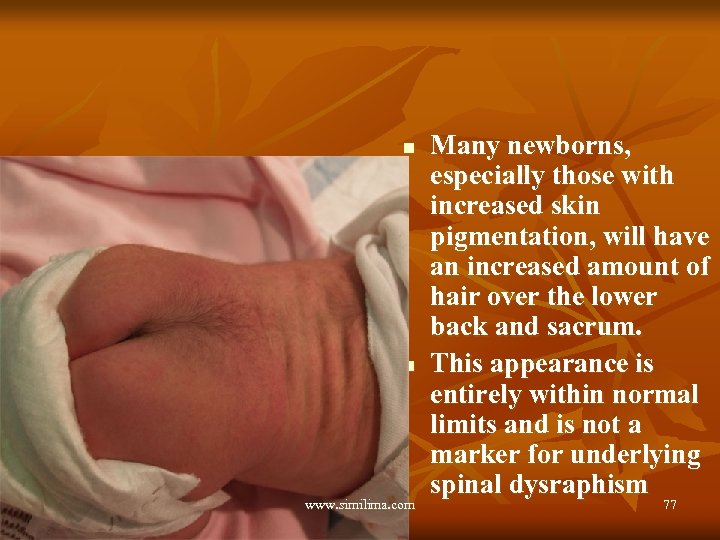
n n www. similima. com Many newborns, especially those with increased skin pigmentation, will have an increased amount of hair over the lower back and sacrum. This appearance is entirely within normal limits and is not a marker for underlying spinal dysraphism 77
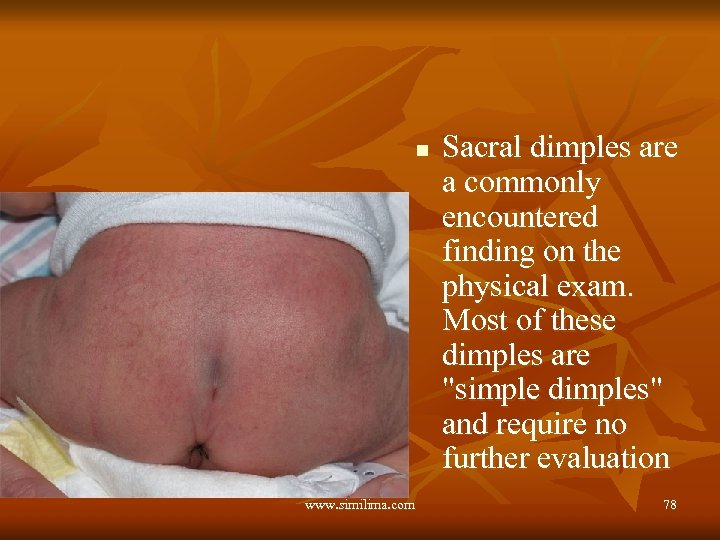
n www. similima. com Sacral dimples are a commonly encountered finding on the physical exam. Most of these dimples are "simple dimples" and require no further evaluation 78
IMMUNISATION Dr C Sureshkumar www. similima. com 79
DEFINITION n n Protection from preventable diseases, disabilities and deaths. Birth right of every child Most costeffective healthcare intervention Greek word ‘ímmune’ means ‘ to be protected ’. www. similima. com 80

n n Acquired immunity: protection offered by introduction of various antigens or antibodies The process by which this is obtained is known as immunisation Active immunisation: Specific antigens evoke the needed immune response Passive immunisation: Antibodies are supplied readymade as immunoglobulins and sera. www. similima. com 81
History n n n n Jenner: Cowpox vaccine – 1796 Pasteur: Rabies prophylaxis – 1885 EPI: WHO 1974, India – 1978 UIP: India – 1985 Child vaccine initiative: with support from several international agencies – 1991 Global programme on vaccines: WHO – 1993 Global alliance for vaccine and immunisation - 1999 www. similima. com 82
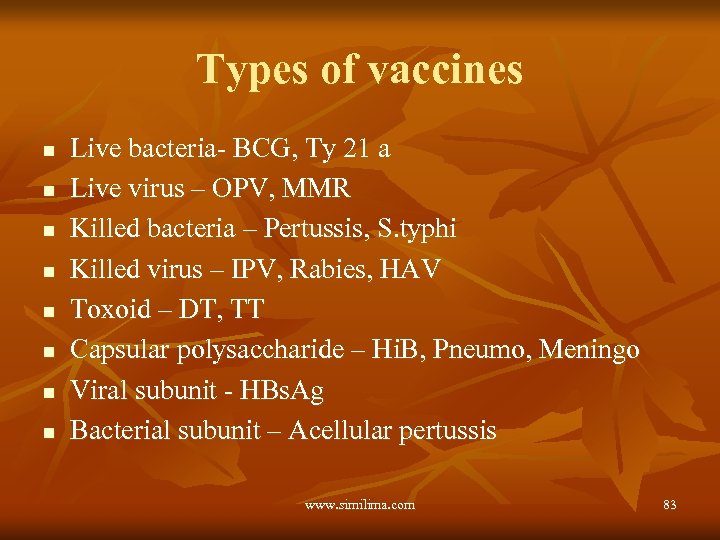
Types of vaccines n n n n Live bacteria- BCG, Ty 21 a Live virus – OPV, MMR Killed bacteria – Pertussis, S. typhi Killed virus – IPV, Rabies, HAV Toxoid – DT, TT Capsular polysaccharide – Hi. B, Pneumo, Meningo Viral subunit - HBs. Ag Bacterial subunit – Acellular pertussis www. similima. com 83
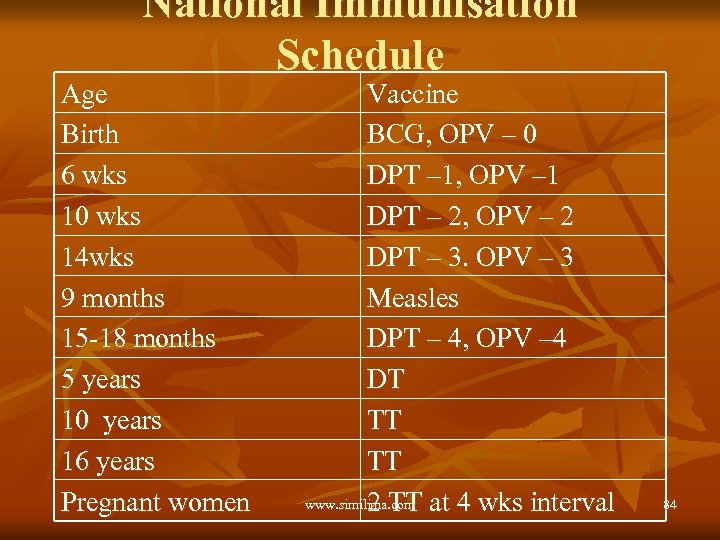
National Immunisation Schedule Age Birth 6 wks 10 wks 14 wks 9 months 15 -18 months 5 years 10 years 16 years Pregnant women Vaccine BCG, OPV – 0 DPT – 1, OPV – 1 DPT – 2, OPV – 2 DPT – 3. OPV – 3 Measles DPT – 4, OPV – 4 DT TT TT www. similima. com at 4 wks interval 2 TT 84
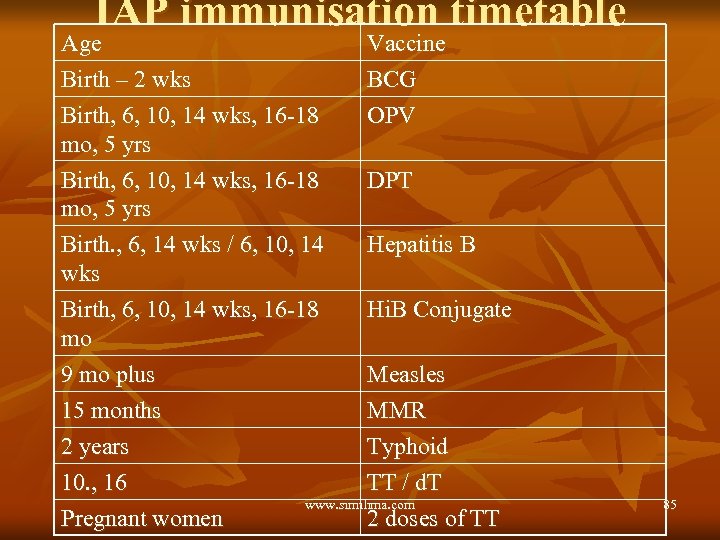
IAP immunisation timetable Age Birth – 2 wks Vaccine BCG Birth, 6, 10, 14 wks, 16 -18 mo, 5 yrs Birth. , 6, 14 wks / 6, 10, 14 wks Birth, 6, 10, 14 wks, 16 -18 mo 9 mo plus OPV 15 months 2 years 10. , 16 Pregnant women DPT Hepatitis B Hi. B Conjugate Measles MMR Typhoid TT / d. T www. similima. com 2 doses of TT 85
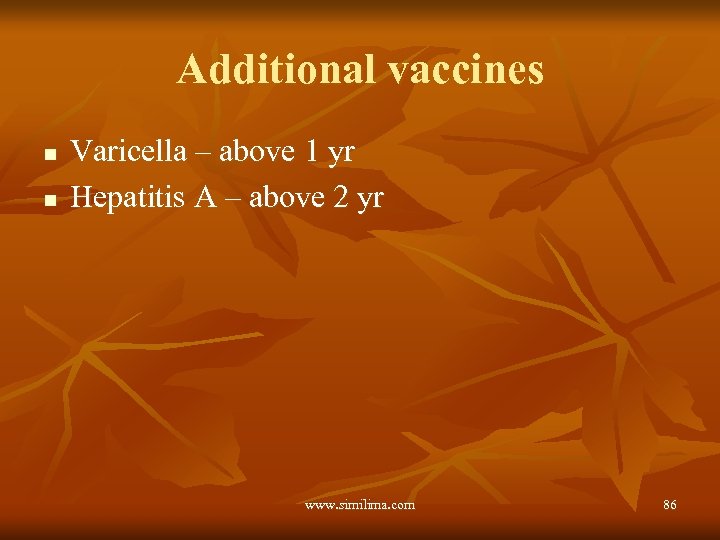
Additional vaccines n n Varicella – above 1 yr Hepatitis A – above 2 yr www. similima. com 86
BCG Vaccine n n n Attenuated M. Bovis developed in 1921 Protects against TB meningitis , Miliary T B Maternal antibodies do not interfere as CMI not transplacentally transferred Induces long term protection Supplied freeze dried and stored frozen or refrigerated Reconstituted vaccine to be used w/I 4 -6 hrs Dose 0. 05 ml(infants), 0. 1 ml(infants and children) Intra-dermal over left deltoid Local lesion due to bacterial multiplication which heals leaving a scar in 12 wks(repeat if no scar) C/I- Immune deficiency www. similima. com Side effect-Axillary adenitis 87
OPV n n n Live attenuated polio virus types 1, 2&3 -developed by sabin , 1961 Temperature sensitive store frozen or refrigerated Can be given simultaneous with any other vaccine Multiple doses necessary to ensure vaccine virus take and response to all three types of viruses IAP recommends additional doses of opv as a part of pulse polio program every year till age of 5 yrs www. similima. com 88
Why PULSE POLIO? n n On national immunisation days(NIDs) pulse doses of oral polio vaccine has to be administered as simultaneous feeding of vaccine to all susceptibles is neede to produce immunity, by preventing wild polio viruses from multiplying in the gut It is mandatory to give all reccomended doses in NIDs so that no wild virus remains in circulation OPV is contraindicated in immunodeficiency, HIV, active viral infections No side effects www. similima. com 89
IPV n n Formaldehyde killed polio virus grown in monkey kidney or human diploid cell Contains 20, 8, 32 D antigen units against type 1, 2, 3 polio viruses respectively Seroconversion 90 -95% after 2 doses, 99% after 3 doses Thermo stable and indicated in immunocompromised and HIV www. similima. com 90
DPT n n n n Diphteria toxoid(Ramon &Glenny, 1923) Killed Bordetella pertusis(Madsen , 1923) Tetanus toxoid(Ramon & Zoeller, 1927) Toxoids adjuvated (Aluminium hydroxide/ phosphate) Vaccine supplied as liquid, stored refrigerated Aluminium adjuvated vaccine must not be frozen 0. 5 ml injected IM on anterolateral asoect of thigh. www. similima. com 91
n n Parents must be alerted about local reaction and fever(PCT given) IAP recommends 2 nd booster at 5 yrs H/O convulsion not contradiction Progressive neurological disease or serious adverse reaction to earlier dose are contraindications for DPT(replace with DT) www. similima. com 92
Measles n n n n n Live attenuated vaccine developed by Enders-1960 Vaccine further attenuated by Schwarz, Edmonston-Zagreb Supplied freeze dried- store frozen or refrigerated Use reconstituted vaccine in 4 -6 hrs(refrigerate do not freeze) 0. 5 ml injected S/C preferably right upper arm Age at which recommended 9 months During outbreak>6 months If given < 9 mo repeat dose after 3 mo Possibility of fever for 5 -10 days MMR-0. 5 ml S/C over deltoid(15 mo) www. similima. com 93
Typhoid n n n n WHOLE CELL: Killed S. typhi often with S. paratyphi A(TA) Developed by Wright , 1896 Liquid, store refrigerated, inject S/C Primary course: 2 doses 4 wks apart at 6 -9 mo of age or at any age Boosters once in 3 -5 yrs Dose : 0. 25 -0. 5 ml S/C for primary, 0. 1 ml for booster www. similima. com 94
n n n Vi POLSACCHARIDE: Developed by Robbins, 1984 Liquid, adjuvated, store refrigerated Inject IM at or after 2 yrs of age(0. 5 ml) Booster after 3 yrs www. similima. com 95
n n n ORAL: Live attenuated S. typhi developed by Germanier, 1975 Strain name: Ty 21 a Enteric coated capsules, store refrigerated, administer orally 3 doses on alternate days Repeat 3 -5 yrs later Recommende age 7 yrs or above www. similima. com 96
Hib vaccine n n n H. Influenza B-capsular polysaccharide Liquid or freeze dried Age of initiation 6 wks 3 doses 6, 10, 14 wks/2, 4, 6 mo Booster 1 yr after primary dose Dose 0. 5 ml SC/IM over deltoid or anterolateral aspect of thigh www. similima. com 97
ADDITIONAL VACCINES n n n n Varicella vaccine: Developed by Takahashi in 1971, Japan Live attenuated Oka strain. Vaccine available as lyophilized powder Dissolve in 0. 5 ml diluent SC 0. 5 ml Single dose 1 -12 yrs >13 yrs 2 doses at 1 mo interval www. similima. com 98
Hepatitis A n n n Inactivated vaccine containing H M 175 strain grown in MRC 5 cell line. Pediatric formulation 720 ELU IM; 2 doses 6 mo apart between 2 -18 yrs >19 yrs 1440 ELU 2 doses 6 months apart Efficacy 94 -100% No boosters www. similima. com 99
Vaccines recommended during epidemics n n Japanese B Encephalitis vaccine Meningococcal A&C www. similima. com 100
Vaccines for high risk group n n n PNEUMOCOCCAL VACCINE: Polysaccharide vaccine(23 valent) 7 Valent conjugated with CRM 197 diphtheria toxin 23 valent effective after 2 yrs of age Single dose 0. 5 ml IM with booster every 3 -5 yrs www. similima. com 101
Indications n n n n Sickle cell disease Nephrotic syndrome in remission Congenital or acquired asplenia/splenic dys function HIV Chronic cardiac/pulmonary disease Immunodeficient conditions CSF leak Diabetes mellitus www. similima. com 102
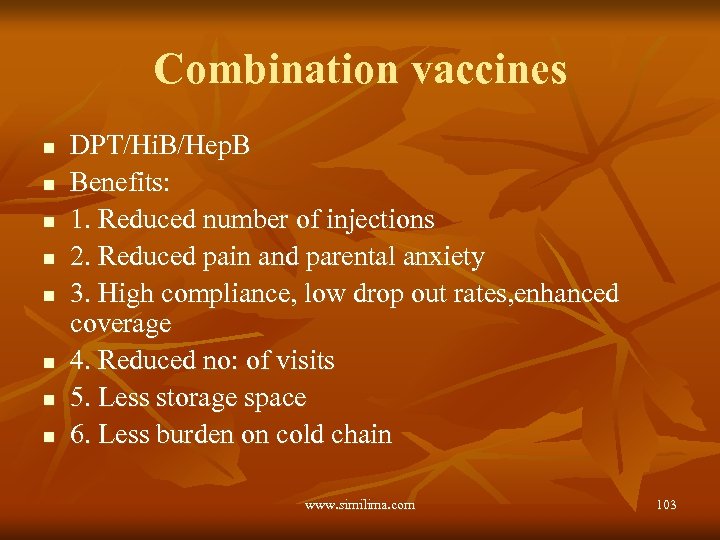
Combination vaccines n n n n DPT/Hi. B/Hep. B Benefits: 1. Reduced number of injections 2. Reduced pain and parental anxiety 3. High compliance, low drop out rates, enhanced coverage 4. Reduced no: of visits 5. Less storage space 6. Less burden on cold chain www. similima. com 103
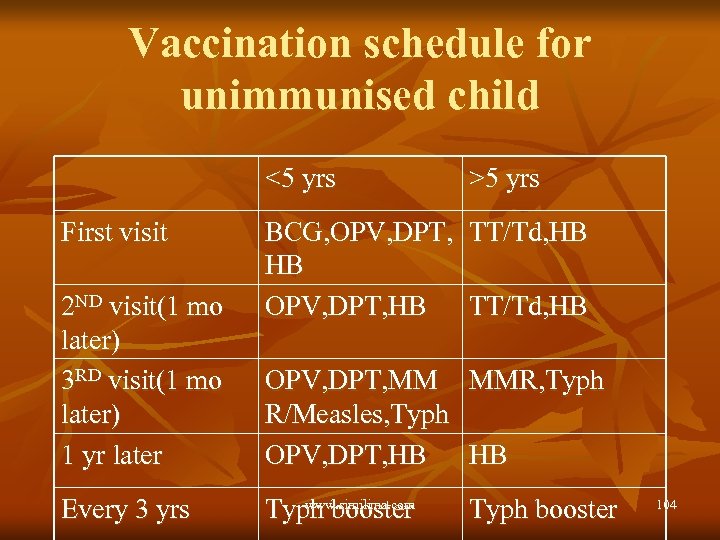
Vaccination schedule for unimmunised child <5 yrs First visit 2 ND visit(1 mo later) 3 RD visit(1 mo later) 1 yr later Every 3 yrs >5 yrs BCG, OPV, DPT, TT/Td, HB HB OPV, DPT, HB TT/Td, HB OPV, DPT, MM MMR, Typh R/Measles, Typh OPV, DPT, HB HB www. similima. com Typh booster 104
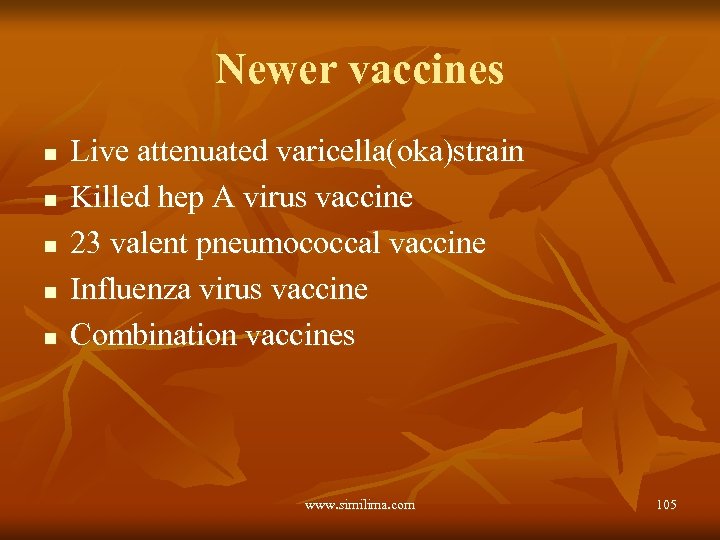
Newer vaccines n n n Live attenuated varicella(oka)strain Killed hep A virus vaccine 23 valent pneumococcal vaccine Influenza virus vaccine Combination vaccines www. similima. com 105
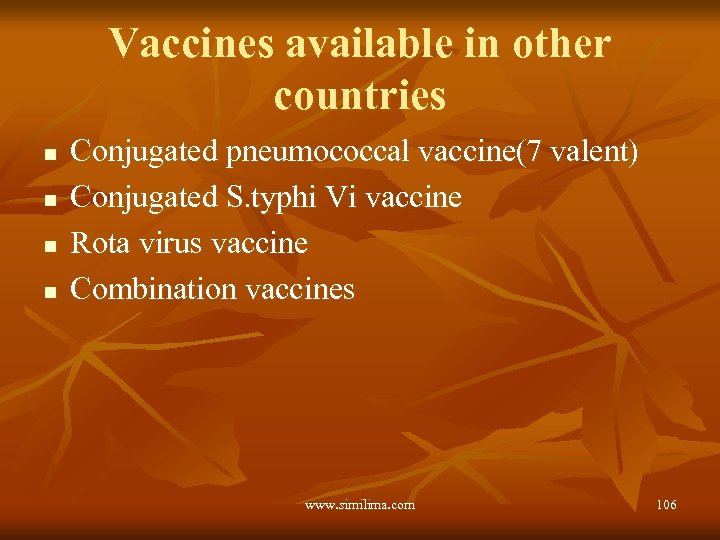
Vaccines available in other countries n n Conjugated pneumococcal vaccine(7 valent) Conjugated S. typhi Vi vaccine Rota virus vaccine Combination vaccines www. similima. com 106
Скачать презентацию Newborn Care Dr C Sureshkumar Thaluk Hospital Parassala
34de994ba02719e5163bd23bfb92e9fe.ppt