 Скачать презентацию New Ways of Listening to Library Users New
87114775b9947944df5e7dc7344ad378.ppt
- Количество слайдов: 77



New Ways of Listening to Library Users: New Tools for Measuring Service Quality A. Parasuraman University of Miami Washington, DC November 4, 2005
Defining, Assessing, and Measuring Service Quality: A Conceptual Overview © A. Parasuraman, University of Miami; not to be reproduced or disseminated without the author’s permission 2
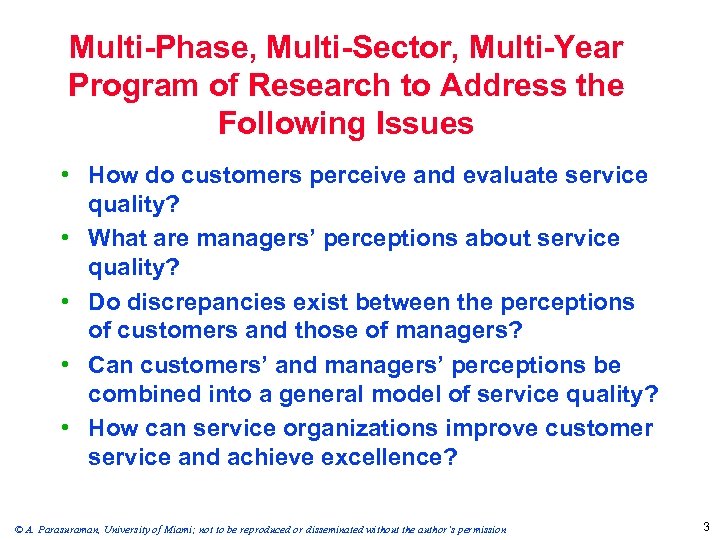
Multi-Phase, Multi-Sector, Multi-Year Program of Research to Address the Following Issues • How do customers perceive and evaluate service quality? • What are managers’ perceptions about service quality? • Do discrepancies exist between the perceptions of customers and those of managers? • Can customers’ and managers’ perceptions be combined into a general model of service quality? • How can service organizations improve customer service and achieve excellence? © A. Parasuraman, University of Miami; not to be reproduced or disseminated without the author’s permission 3
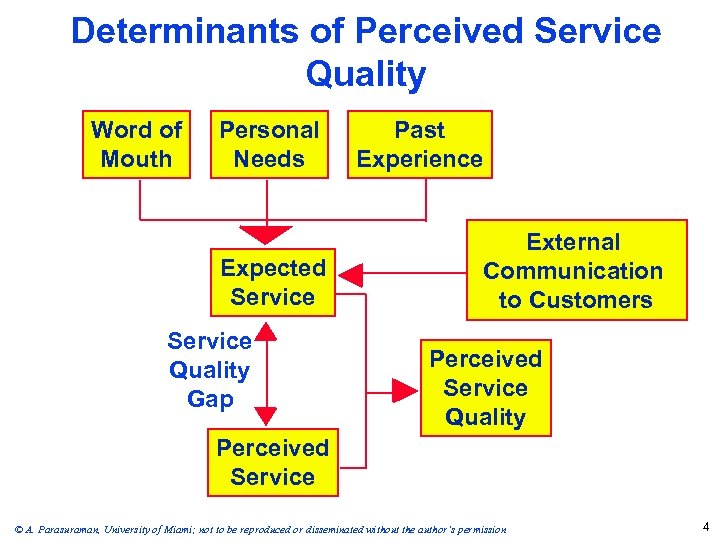
Determinants of Perceived Service Quality Word of Mouth Personal Needs Expected Service Quality Gap Past Experience External Communication to Customers Perceived Service Quality Perceived Service © A. Parasuraman, University of Miami; not to be reproduced or disseminated without the author’s permission 4
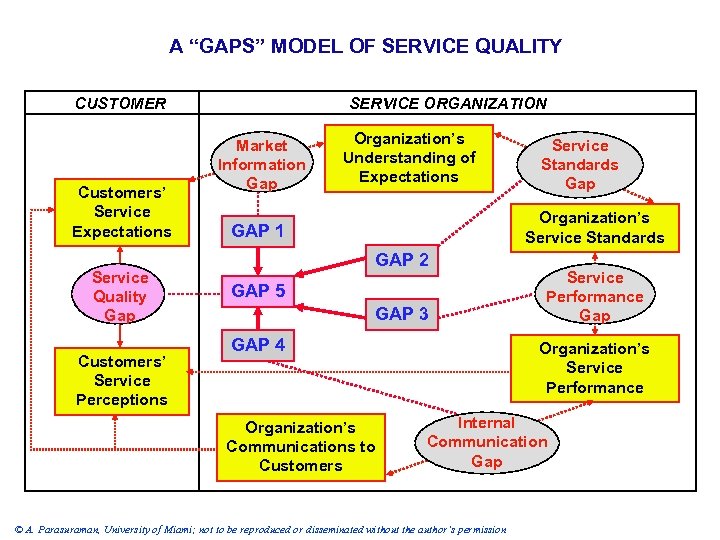
A “GAPS” MODEL OF SERVICE QUALITY CUSTOMER Customers’ Service Expectations Service Quality Gap Customers’ Service Perceptions SERVICE ORGANIZATION Market Information Gap Organization’s Understanding of Expectations Service Standards Gap Organization’s Service Standards GAP 1 GAP 2 GAP 5 GAP 3 GAP 4 Organization’s Communications to Customers Service Performance Gap Organization’s Service Performance Internal Communication Gap © A. Parasuraman, University of Miami; not to be reproduced or disseminated without the author’s permission
![POTENTIAL CAUSES OF INTERNAL SERVICE GAPS [GAPS 1 - 4] © A. Parasuraman, University](https://present5.com/presentation/87114775b9947944df5e7dc7344ad378/image-6.jpg "POTENTIAL CAUSES OF INTERNAL SERVICE GAPS [GAPS 1 - 4] © A. Parasuraman, University")
POTENTIAL CAUSES OF INTERNAL SERVICE GAPS [GAPS 1 - 4] © A. Parasuraman, University of Miami; not to be reproduced or disseminated without the author’s permission
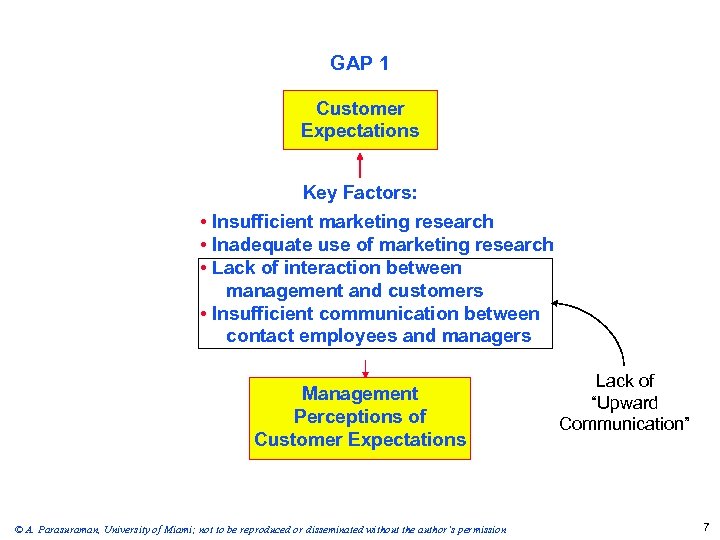
GAP 1 Customer Expectations Key Factors: • Insufficient marketing research • Inadequate use of marketing research • Lack of interaction between management and customers • Insufficient communication between contact employees and managers Management Perceptions of Customer Expectations © A. Parasuraman, University of Miami; not to be reproduced or disseminated without the author’s permission Lack of “Upward Communication” 7
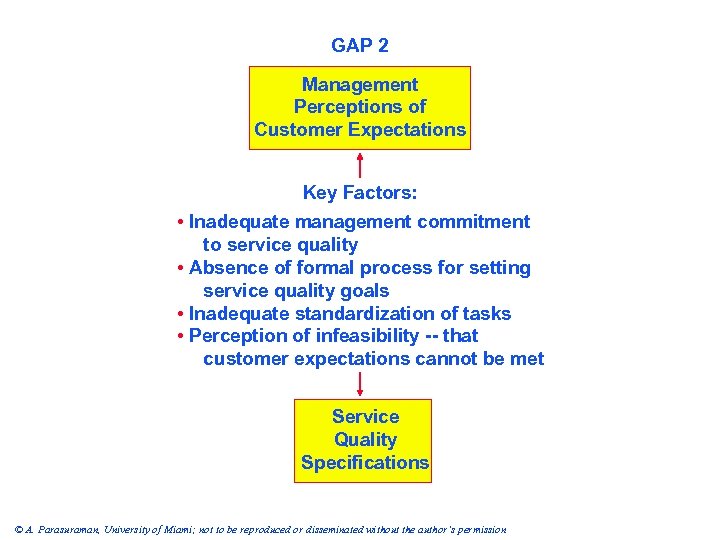
GAP 2 Management Perceptions of Customer Expectations Key Factors: • Inadequate management commitment to service quality • Absence of formal process for setting service quality goals • Inadequate standardization of tasks • Perception of infeasibility -- that customer expectations cannot be met Service Quality Specifications © A. Parasuraman, University of Miami; not to be reproduced or disseminated without the author’s permission
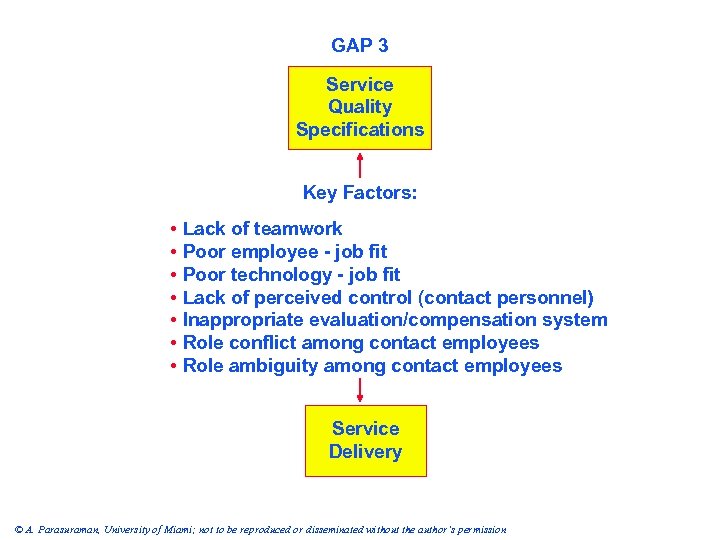
GAP 3 Service Quality Specifications Key Factors: • Lack of teamwork • Poor employee - job fit • Poor technology - job fit • Lack of perceived control (contact personnel) • Inappropriate evaluation/compensation system • Role conflict among contact employees • Role ambiguity among contact employees Service Delivery © A. Parasuraman, University of Miami; not to be reproduced or disseminated without the author’s permission
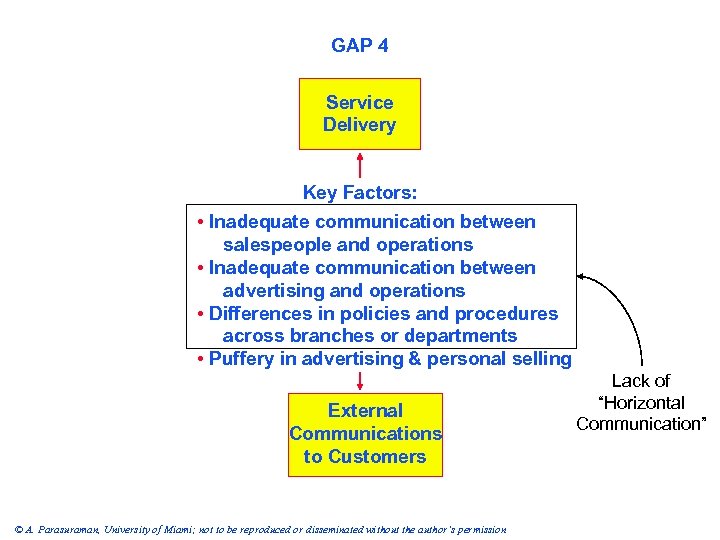
GAP 4 Service Delivery Key Factors: • Inadequate communication between salespeople and operations • Inadequate communication between advertising and operations • Differences in policies and procedures across branches or departments • Puffery in advertising & personal selling External Communications to Customers © A. Parasuraman, University of Miami; not to be reproduced or disseminated without the author’s permission Lack of “Horizontal Communication”
![SUGGESTIONS FOR CLOSING INTERNAL SERVICE GAPS [GAPS 1 - 4] © A. Parasuraman, University](https://present5.com/presentation/87114775b9947944df5e7dc7344ad378/image-11.jpg "SUGGESTIONS FOR CLOSING INTERNAL SERVICE GAPS [GAPS 1 - 4] © A. Parasuraman, University")
SUGGESTIONS FOR CLOSING INTERNAL SERVICE GAPS [GAPS 1 - 4] © A. Parasuraman, University of Miami; not to be reproduced or disseminated without the author’s permission
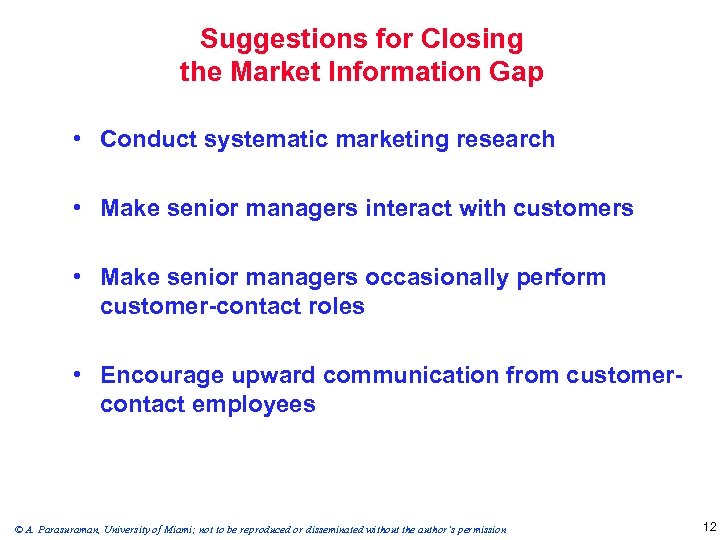
Suggestions for Closing the Market Information Gap • Conduct systematic marketing research • Make senior managers interact with customers • Make senior managers occasionally perform customer-contact roles • Encourage upward communication from customercontact employees © A. Parasuraman, University of Miami; not to be reproduced or disseminated without the author’s permission 12
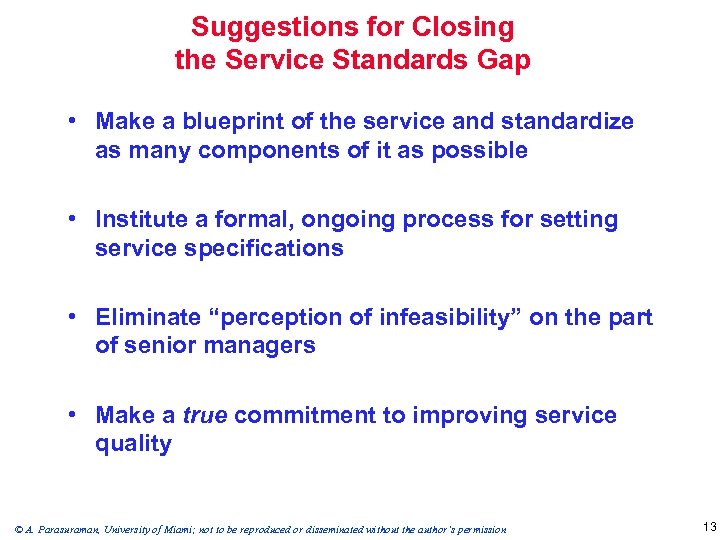
Suggestions for Closing the Service Standards Gap • Make a blueprint of the service and standardize as many components of it as possible • Institute a formal, ongoing process for setting service specifications • Eliminate “perception of infeasibility” on the part of senior managers • Make a true commitment to improving service quality © A. Parasuraman, University of Miami; not to be reproduced or disseminated without the author’s permission 13
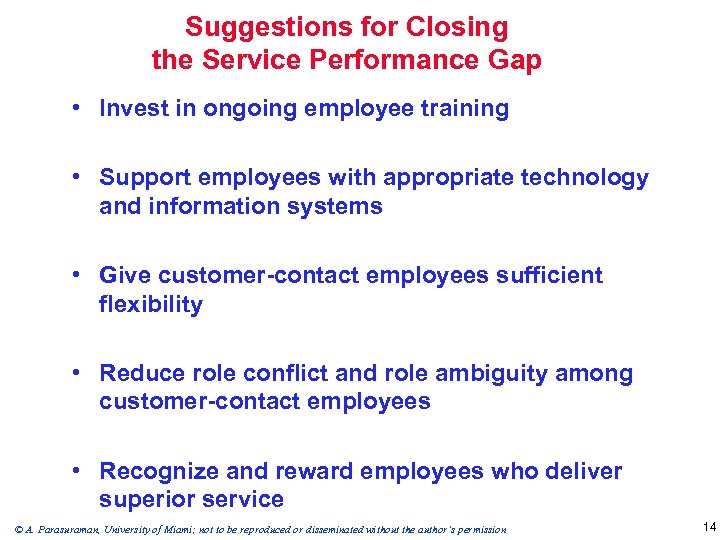
Suggestions for Closing the Service Performance Gap • Invest in ongoing employee training • Support employees with appropriate technology and information systems • Give customer-contact employees sufficient flexibility • Reduce role conflict and role ambiguity among customer-contact employees • Recognize and reward employees who deliver superior service © A. Parasuraman, University of Miami; not to be reproduced or disseminated without the author’s permission 14
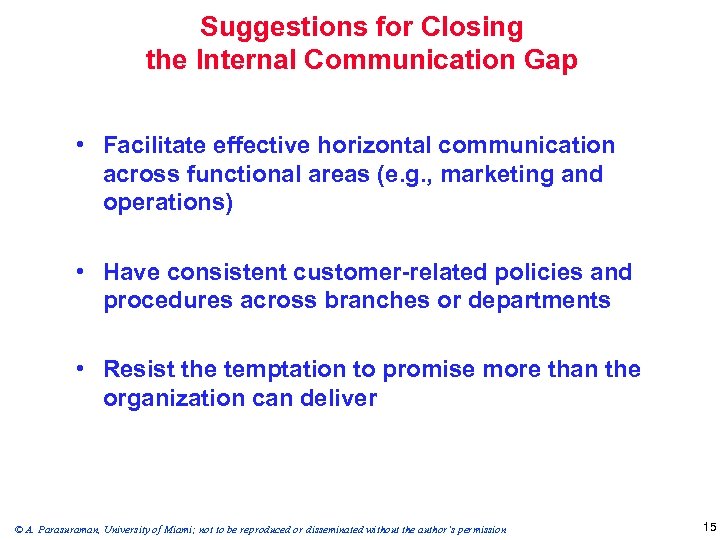
Suggestions for Closing the Internal Communication Gap • Facilitate effective horizontal communication across functional areas (e. g. , marketing and operations) • Have consistent customer-related policies and procedures across branches or departments • Resist the temptation to promise more than the organization can deliver © A. Parasuraman, University of Miami; not to be reproduced or disseminated without the author’s permission 15
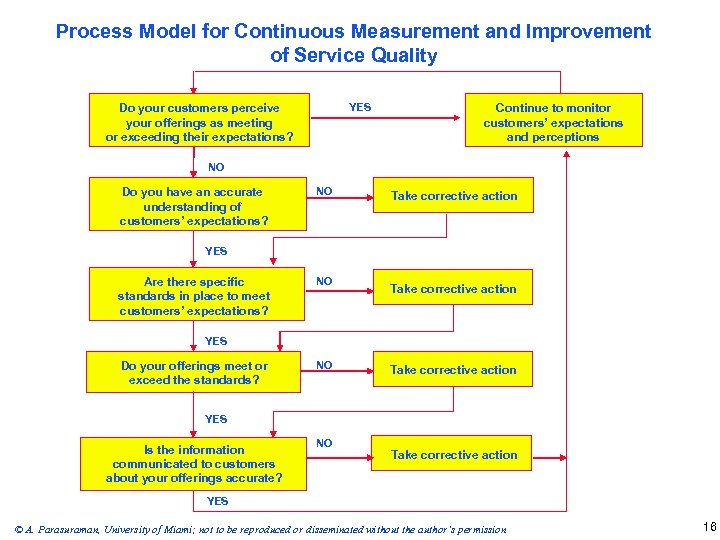
Process Model for Continuous Measurement and Improvement of Service Quality YES Do your customers perceive your offerings as meeting or exceeding their expectations? Continue to monitor customers’ expectations and perceptions NO Do you have an accurate understanding of customers’ expectations? NO Take corrective action YES Are there specific standards in place to meet customers’ expectations? NO Take corrective action YES Do your offerings meet or exceed the standards? NO Take corrective action YES Is the information communicated to customers about your offerings accurate? NO Take corrective action YES © A. Parasuraman, University of Miami; not to be reproduced or disseminated without the author’s permission 16
SERVQUAL: Development, Refinement, and Empirical Findings © A. Parasuraman, University of Miami; not to be reproduced or disseminated without the author’s permission
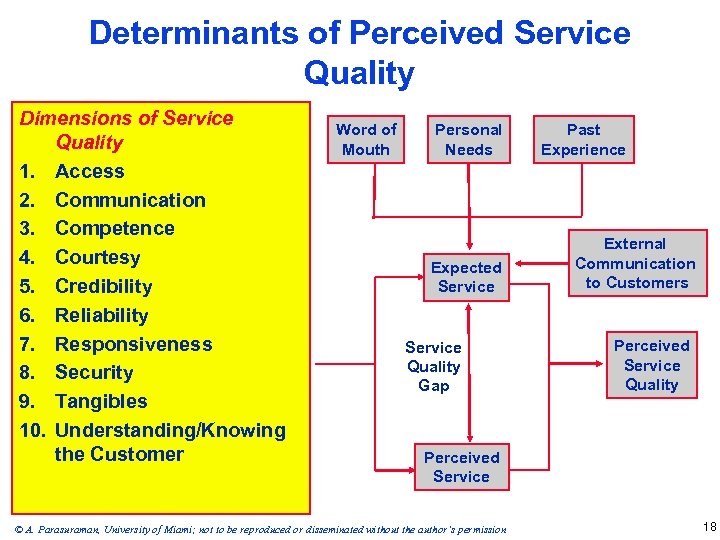
Determinants of Perceived Service Quality Dimensions of Service Quality 1. Access 2. Communication 3. Competence 4. Courtesy 5. Credibility 6. Reliability 7. Responsiveness 8. Security 9. Tangibles 10. Understanding/Knowing the Customer Word of Mouth Personal Needs Expected Service Quality Gap Past Experience External Communication to Customers Perceived Service Quality Perceived Service © A. Parasuraman, University of Miami; not to be reproduced or disseminated without the author’s permission 18
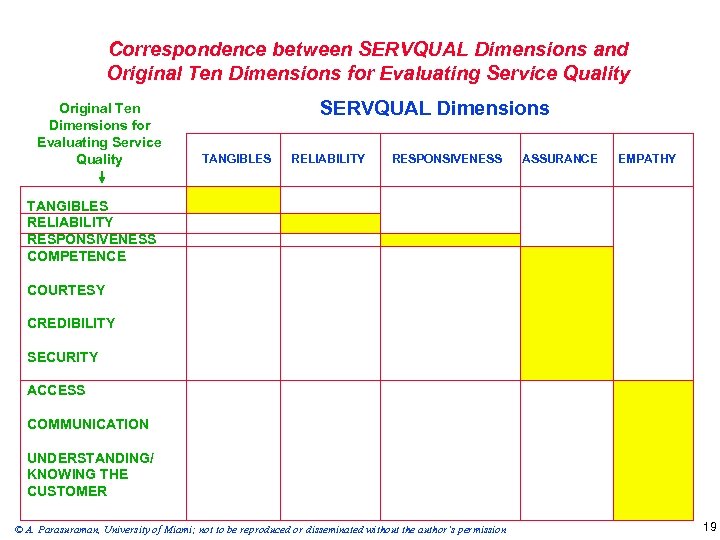
Correspondence between SERVQUAL Dimensions and Original Ten Dimensions for Evaluating Service Quality SERVQUAL Dimensions TANGIBLES RELIABILITY RESPONSIVENESS ASSURANCE EMPATHY TANGIBLES RELIABILITY RESPONSIVENESS COMPETENCE COURTESY CREDIBILITY SECURITY ACCESS COMMUNICATION UNDERSTANDING/ KNOWING THE CUSTOMER © A. Parasuraman, University of Miami; not to be reproduced or disseminated without the author’s permission 19
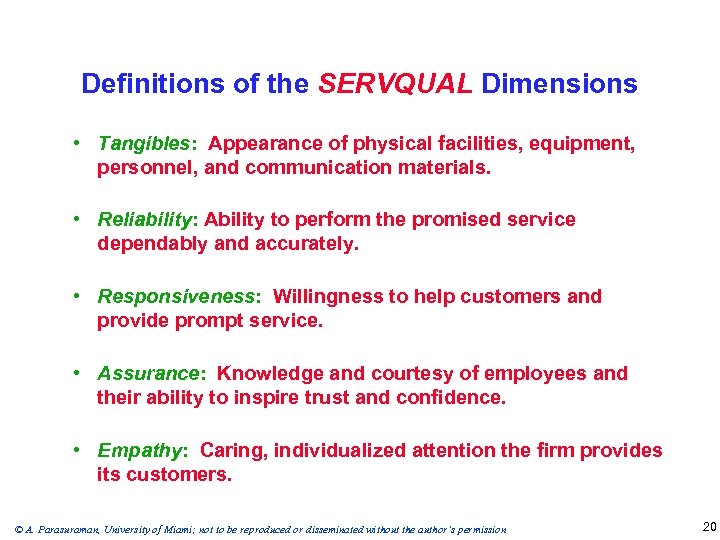
Definitions of the SERVQUAL Dimensions • Tangibles: Appearance of physical facilities, equipment, personnel, and communication materials. • Reliability: Ability to perform the promised service dependably and accurately. • Responsiveness: Willingness to help customers and provide prompt service. • Assurance: Knowledge and courtesy of employees and their ability to inspire trust and confidence. • Empathy: Caring, individualized attention the firm provides its customers. © A. Parasuraman, University of Miami; not to be reproduced or disseminated without the author’s permission 20
![Relative Importance of Service Dimensions When Respondents Allocate 100 Points [Study 1] RELIABILITY 32%](https://present5.com/presentation/87114775b9947944df5e7dc7344ad378/image-21.jpg "Relative Importance of Service Dimensions When Respondents Allocate 100 Points [Study 1] RELIABILITY 32%")
Relative Importance of Service Dimensions When Respondents Allocate 100 Points [Study 1] RELIABILITY 32% TANGIBLES 11% RESPONSIVENESS EMPATHY 16% 22% ASSURANCE 19% © A. Parasuraman, University of Miami; not to be reproduced or disseminated without the author’s permission 21
![Relative Importance of Service Quality Dimensions [Study 2] Mean Number of Points Allocated out](https://present5.com/presentation/87114775b9947944df5e7dc7344ad378/image-22.jpg "Relative Importance of Service Quality Dimensions [Study 2] Mean Number of Points Allocated out")
Relative Importance of Service Quality Dimensions [Study 2] Mean Number of Points Allocated out of 100 Points 37 9 23 18 13 Computer Manufacturer All Companies Auto Insurer Reliability Responsiveness Retail Chain Life Insurer Assurance Empathy © A. Parasuraman, University of Miami; not to be reproduced or disseminated without the author’s permission Tangibles
![Mean SERVQUAL Scores by Service Dimension [Study 1] 1. 00 0. 00 -1. 00](https://present5.com/presentation/87114775b9947944df5e7dc7344ad378/image-23.jpg "Mean SERVQUAL Scores by Service Dimension [Study 1] 1. 00 0. 00 -1. 00")
Mean SERVQUAL Scores by Service Dimension [Study 1] 1. 00 0. 00 -1. 00 -2. 00 Tangibles Reliability Responsive- Assurance ness © A. Parasuraman, University of Miami; not to be reproduced or disseminated without the author’s permission Empathy
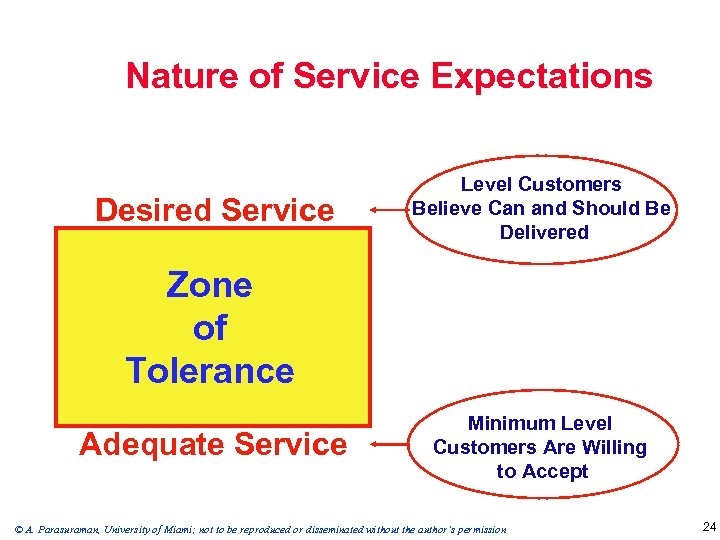
Nature of Service Expectations Desired Service Level Customers Believe Can and Should Be Delivered Zone of Tolerance Adequate Service Minimum Level Customers Are Willing to Accept © A. Parasuraman, University of Miami; not to be reproduced or disseminated without the author’s permission 24
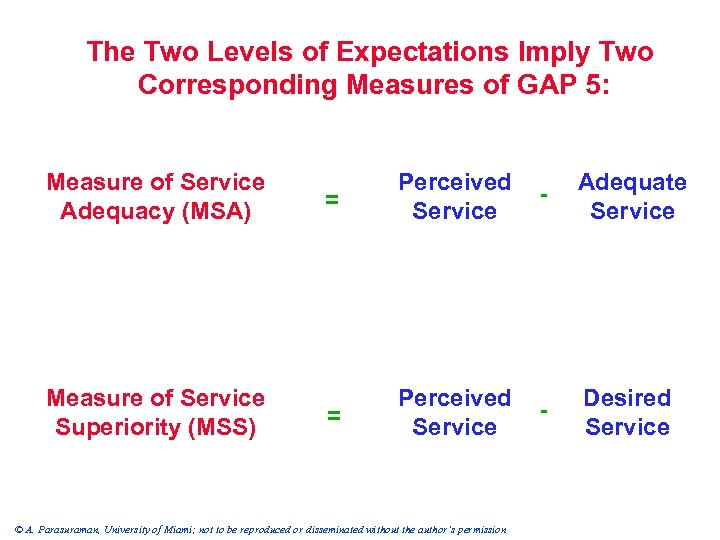
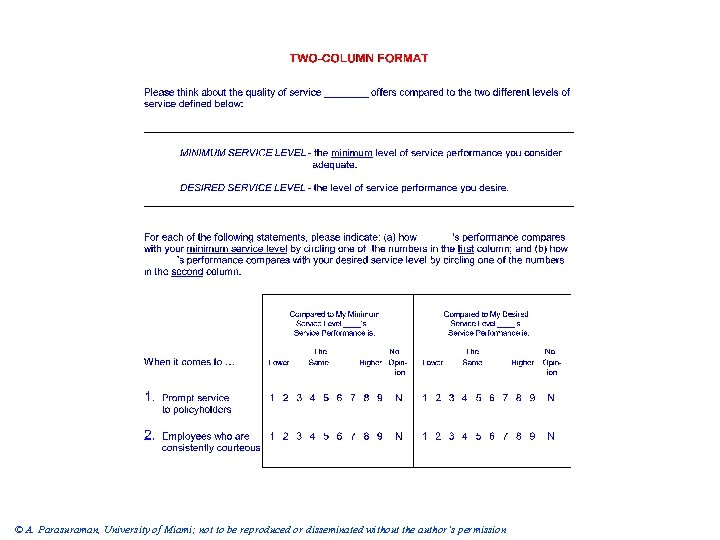
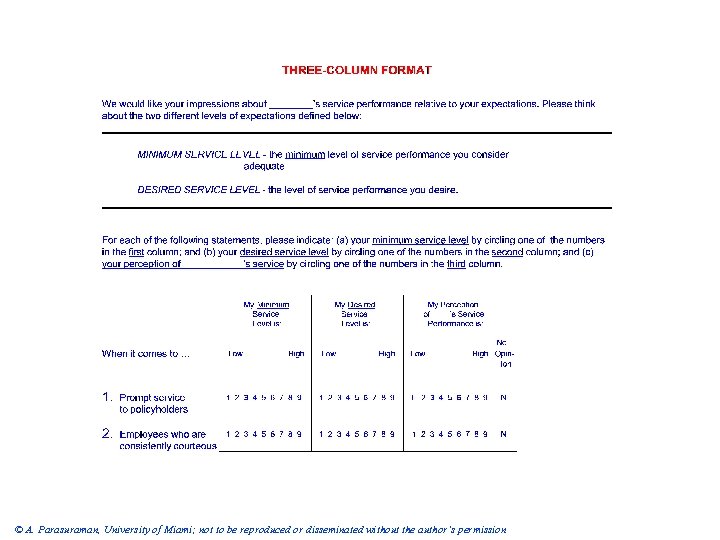
The Two Levels of Expectations Imply Two Corresponding Measures of GAP 5: Measure of Service Adequacy (MSA) Measure of Service Superiority (MSS) = Perceived Service - Adequate Service = Perceived Service - Desired Service © A. Parasuraman, University of Miami; not to be reproduced or disseminated without the author’s permission
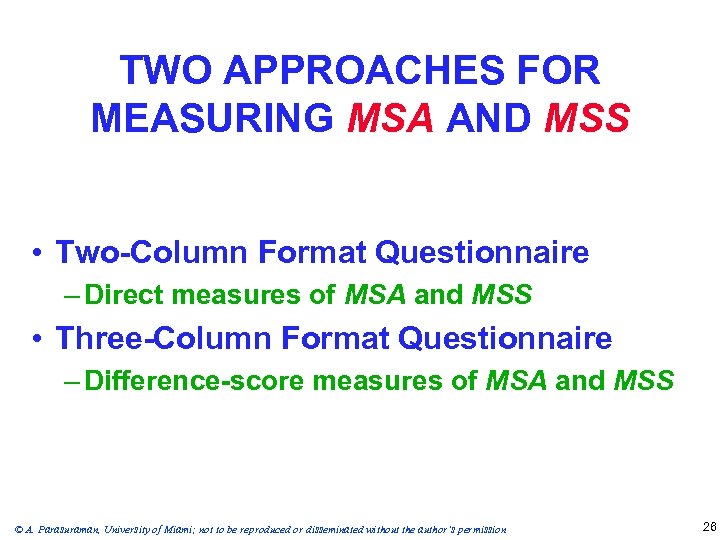
TWO APPROACHES FOR MEASURING MSA AND MSS • Two-Column Format Questionnaire – Direct measures of MSA and MSS • Three-Column Format Questionnaire – Difference-score measures of MSA and MSS © A. Parasuraman, University of Miami; not to be reproduced or disseminated without the author’s permission 26
© A. Parasuraman, University of Miami; not to be reproduced or disseminated without the author’s permission
© A. Parasuraman, University of Miami; not to be reproduced or disseminated without the author’s permission
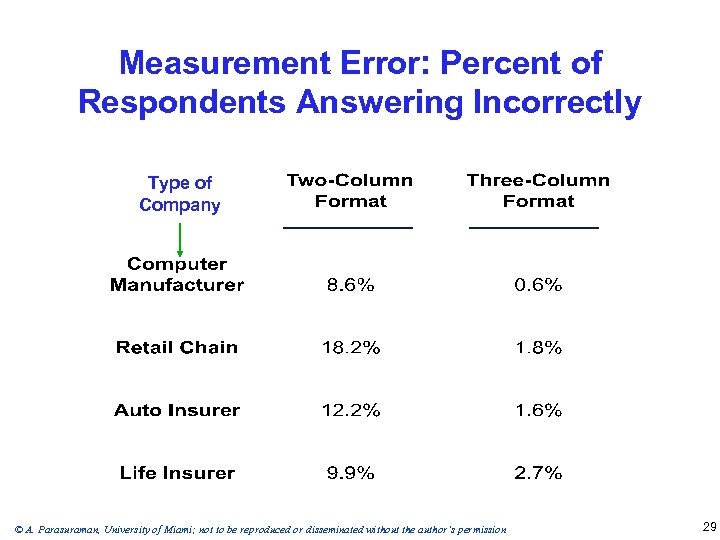
Measurement Error: Percent of Respondents Answering Incorrectly Type of Company © A. Parasuraman, University of Miami; not to be reproduced or disseminated without the author’s permission 29
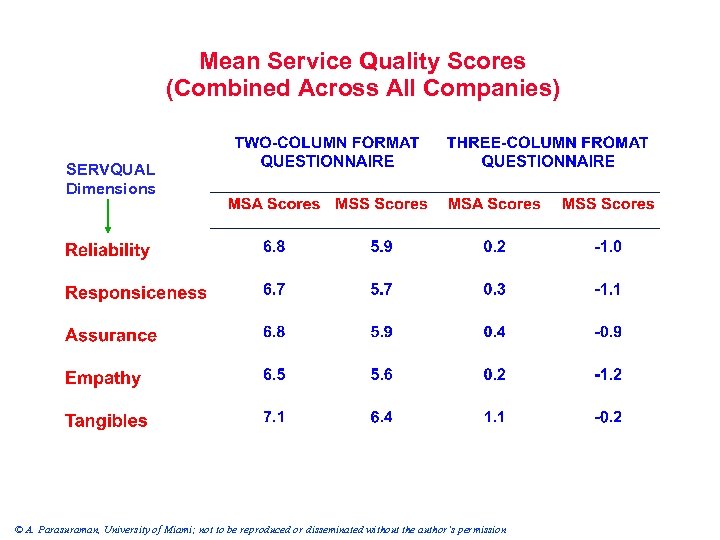
Mean Service Quality Scores (Combined Across All Companies) SERVQUAL Dimensions © A. Parasuraman, University of Miami; not to be reproduced or disseminated without the author’s permission
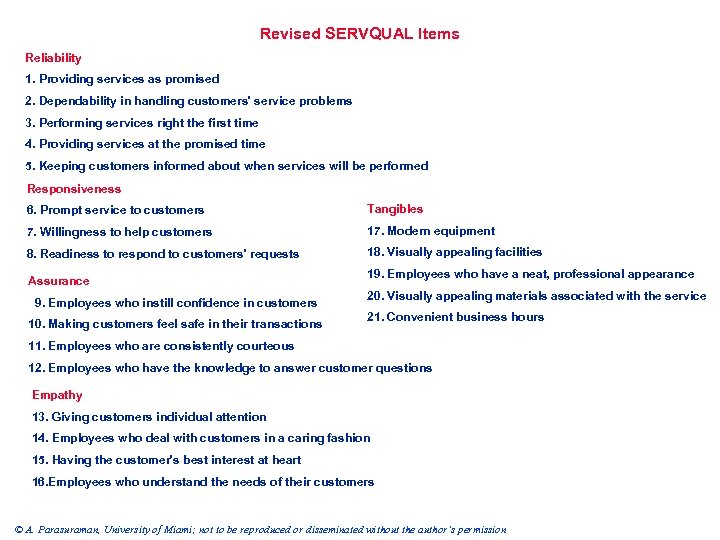
Revised SERVQUAL Items Reliability 1. Providing services as promised 2. Dependability in handling customers' service problems 3. Performing services right the first time 4. Providing services at the promised time 5. Keeping customers informed about when services will be performed Responsiveness 6. Prompt service to customers Tangibles 7. Willingness to help customers 17. Modern equipment 8. Readiness to respond to customers' requests 18. Visually appealing facilities Assurance 9. Employees who instill confidence in customers 10. Making customers feel safe in their transactions 19. Employees who have a neat, professional appearance 20. Visually appealing materials associated with the service 21. Convenient business hours 11. Employees who are consistently courteous 12. Employees who have the knowledge to answer customer questions Empathy 13. Giving customers individual attention 14. Employees who deal with customers in a caring fashion 15. Having the customer's best interest at heart 16. Employees who understand the needs of their customers © A. Parasuraman, University of Miami; not to be reproduced or disseminated without the author’s permission
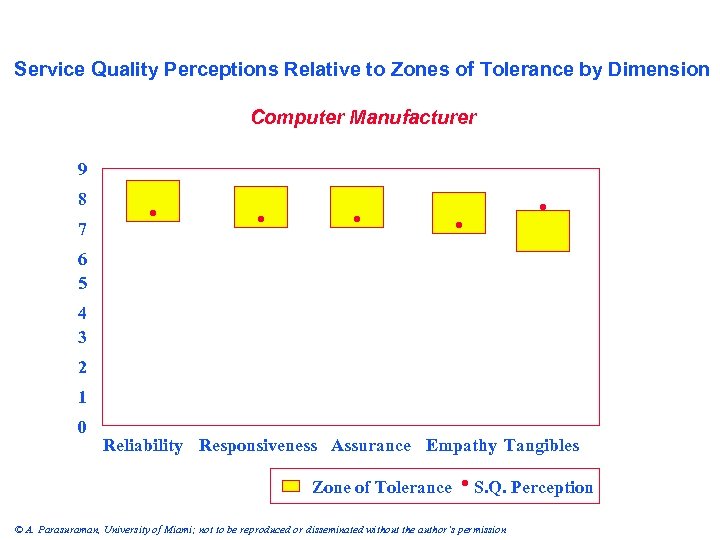
Service Quality Perceptions Relative to Zones of Tolerance by Dimension Computer Manufacturer 9 8 7 6 5 4 3 2 1 0 Reliability Responsiveness Assurance Empathy Tangibles Zone of Tolerance S. Q. Perception © A. Parasuraman, University of Miami; not to be reproduced or disseminated without the author’s permission
Service Quality Perceptions Relative to Zones of Tolerance by Dimension Computer Manufacturer 9 8 7 6 5 4 3 2 1 0 Reliability Responsiveness Assurance Empathy Tangibles Zone of Tolerance S. Q. Perception © A. Parasuraman, University of Miami; not to be reproduced or disseminated without the author’s permission
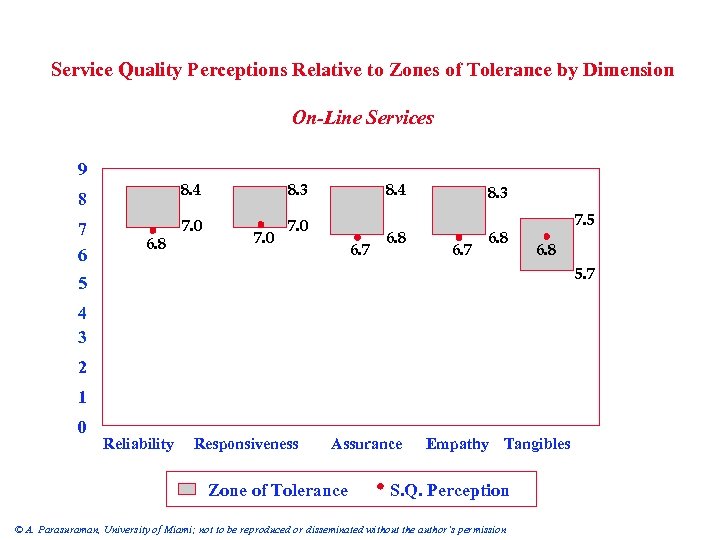
Service Quality Perceptions Relative to Zones of Tolerance by Dimension On-Line Services 9 8. 4 8 7 6 6. 8 8. 3 7. 0 8. 4 6. 7 6. 8 8. 3 6. 7 6. 8 7. 5 6. 8 5. 7 5 4 3 2 1 0 Reliability Responsiveness Assurance Zone of Tolerance Empathy Tangibles S. Q. Perception © A. Parasuraman, University of Miami; not to be reproduced or disseminated without the author’s permission
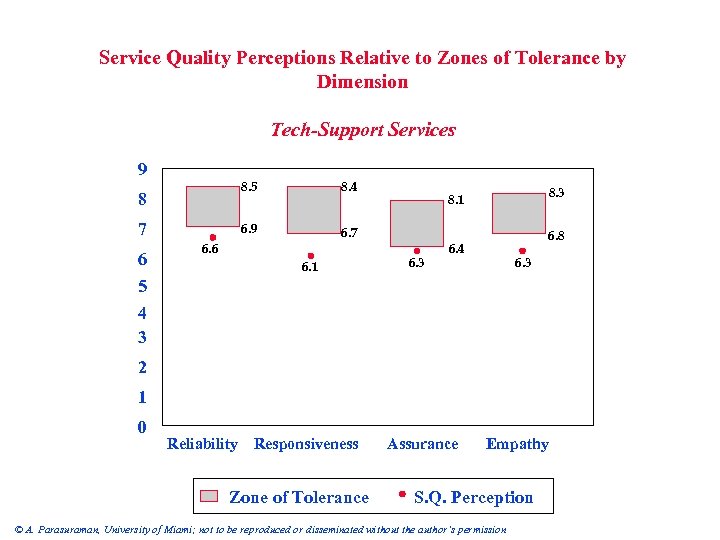
Service Quality Perceptions Relative to Zones of Tolerance by Dimension Tech-Support Services 9 8. 5 6. 9 8 7 6 5 4 3 8. 4 6. 7 6. 6 6. 1 8. 3 8. 1 6. 3 6. 8 6. 4 6. 3 2 1 0 Reliability Responsiveness Zone of Tolerance Assurance Empathy S. Q. Perception © A. Parasuraman, University of Miami; not to be reproduced or disseminated without the author’s permission
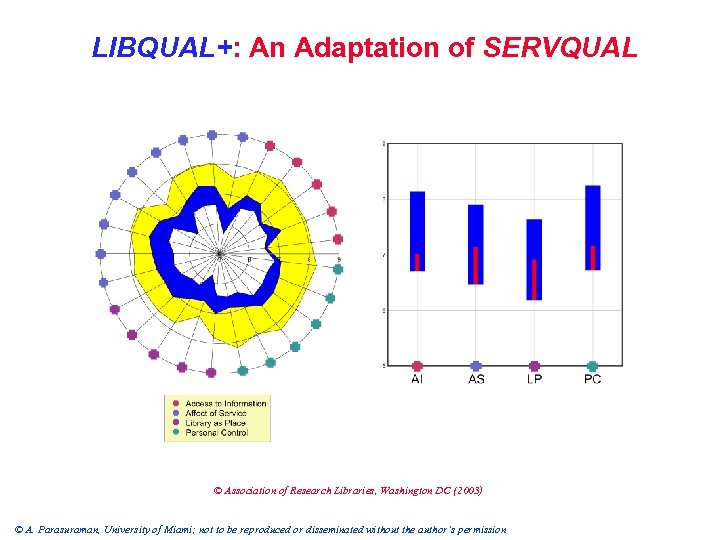
LIBQUAL+: An Adaptation of SERVQUAL © Association of Research Libraries, Washington DC (2003) © A. Parasuraman, University of Miami; not to be reproduced or disseminated without the author’s permission
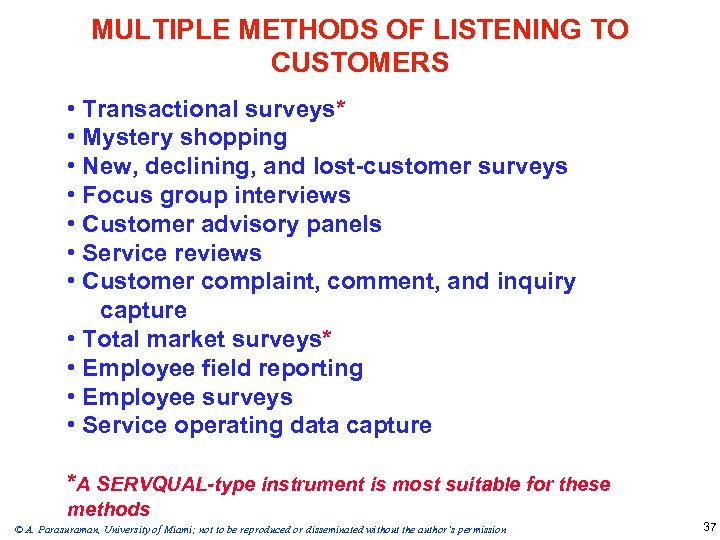
MULTIPLE METHODS OF LISTENING TO CUSTOMERS • Transactional surveys* • Mystery shopping • New, declining, and lost-customer surveys • Focus group interviews • Customer advisory panels • Service reviews • Customer complaint, comment, and inquiry capture • Total market surveys* • Employee field reporting • Employee surveys • Service operating data capture *A SERVQUAL-type instrument is most suitable for these methods © A. Parasuraman, University of Miami; not to be reproduced or disseminated without the author’s permission 37
The Role Of Technology In Service Delivery: Electronic Service Quality (e-SQ) and Technology Readiness (TR) © A. Parasuraman, University of Miami; not to be reproduced or disseminated without the author’s permission
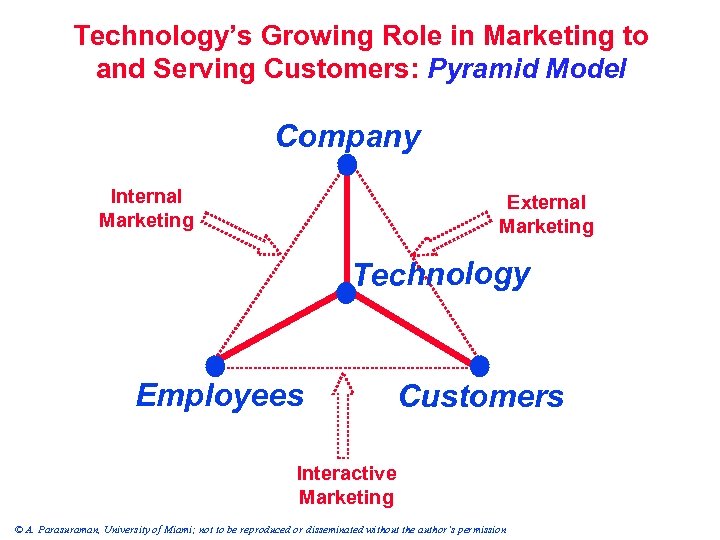
Technology’s Growing Role in Marketing to and Serving Customers: Pyramid Model Company Internal Marketing External Marketing Technology Employees Customers Interactive Marketing © A. Parasuraman, University of Miami; not to be reproduced or disseminated without the author’s permission
Ongoing Research on e-Service Quality: Conceptual Framework and Preliminary Findings © A. Parasuraman, University of Miami; not to be reproduced or disseminated without the author’s permission
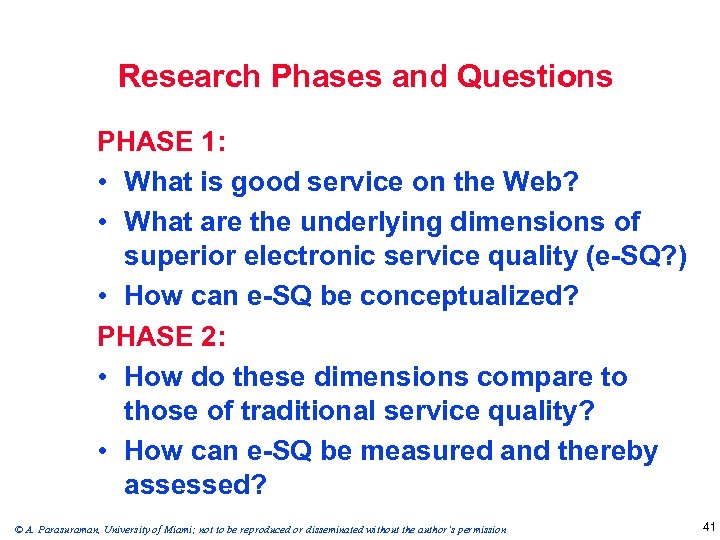
Research Phases and Questions PHASE 1: • What is good service on the Web? • What are the underlying dimensions of superior electronic service quality (e-SQ? ) • How can e-SQ be conceptualized? PHASE 2: • How do these dimensions compare to those of traditional service quality? • How can e-SQ be measured and thereby assessed? © A. Parasuraman, University of Miami; not to be reproduced or disseminated without the author’s permission 41
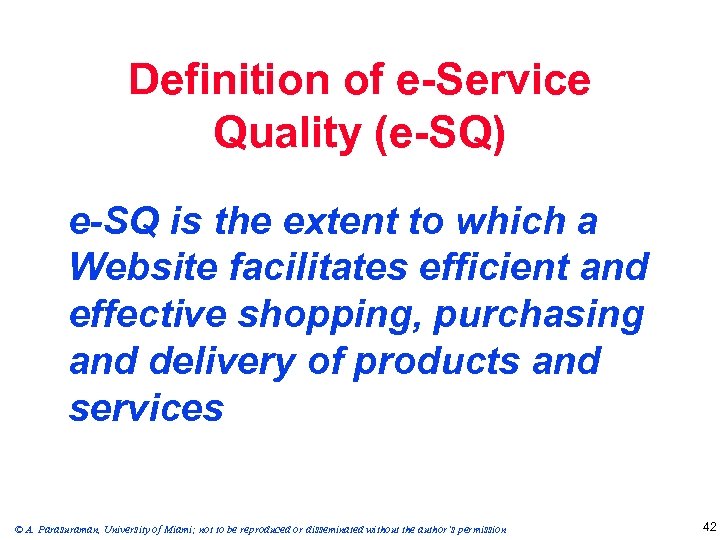
Definition of e-Service Quality (e-SQ) e-SQ is the extent to which a Website facilitates efficient and effective shopping, purchasing and delivery of products and services © A. Parasuraman, University of Miami; not to be reproduced or disseminated without the author’s permission 42
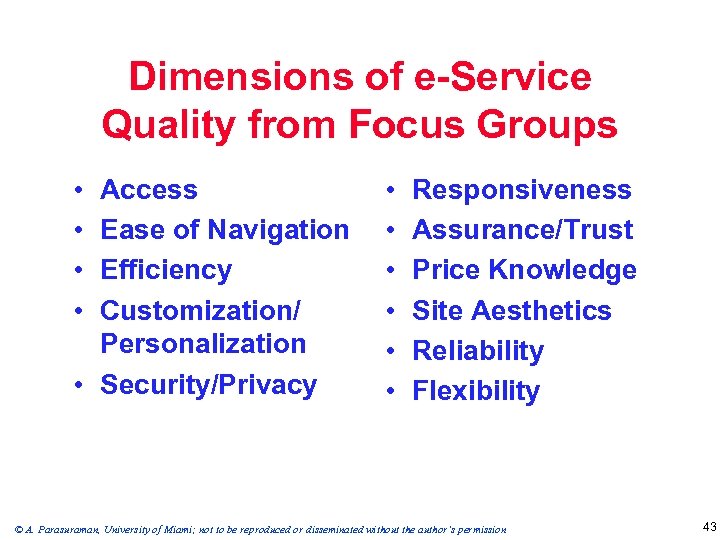
Dimensions of e-Service Quality from Focus Groups • • Access Ease of Navigation Efficiency Customization/ Personalization • Security/Privacy • • • Responsiveness Assurance/Trust Price Knowledge Site Aesthetics Reliability Flexibility © A. Parasuraman, University of Miami; not to be reproduced or disseminated without the author’s permission 43
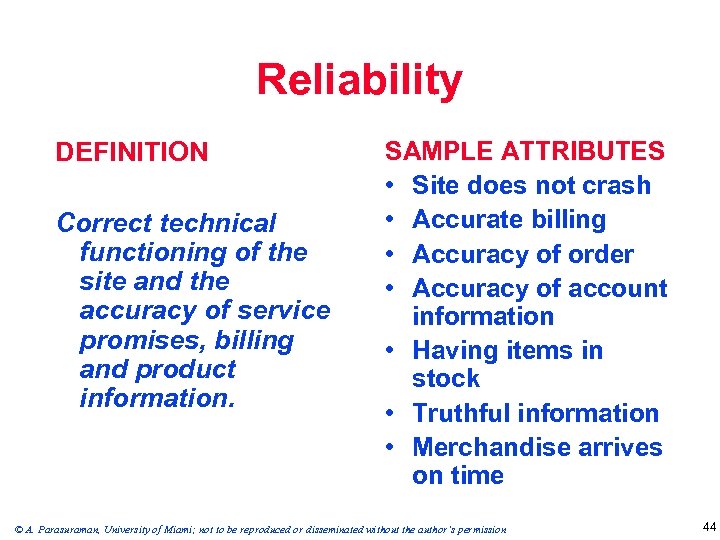
Reliability DEFINITION Correct technical functioning of the site and the accuracy of service promises, billing and product information. SAMPLE ATTRIBUTES • Site does not crash • Accurate billing • Accuracy of order • Accuracy of account information • Having items in stock • Truthful information • Merchandise arrives on time © A. Parasuraman, University of Miami; not to be reproduced or disseminated without the author’s permission 44
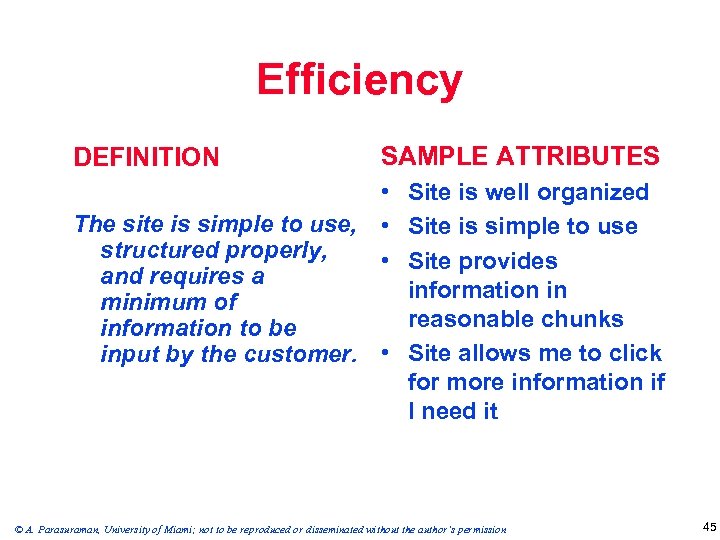
Efficiency DEFINITION SAMPLE ATTRIBUTES • Site is well organized The site is simple to use, • Site is simple to use structured properly, • Site provides and requires a information in minimum of reasonable chunks information to be input by the customer. • Site allows me to click for more information if I need it © A. Parasuraman, University of Miami; not to be reproduced or disseminated without the author’s permission 45
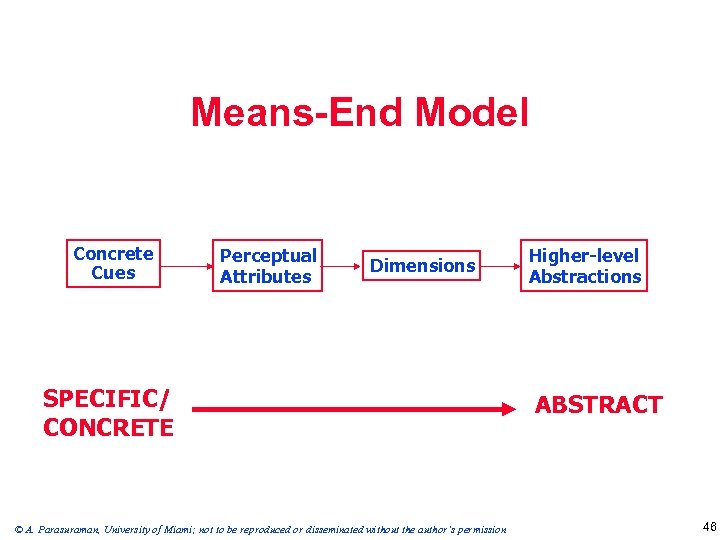
Means-End Model Concrete Cues Perceptual Attributes Dimensions SPECIFIC/ CONCRETE © A. Parasuraman, University of Miami; not to be reproduced or disseminated without the author’s permission Higher-level Abstractions ABSTRACT 46
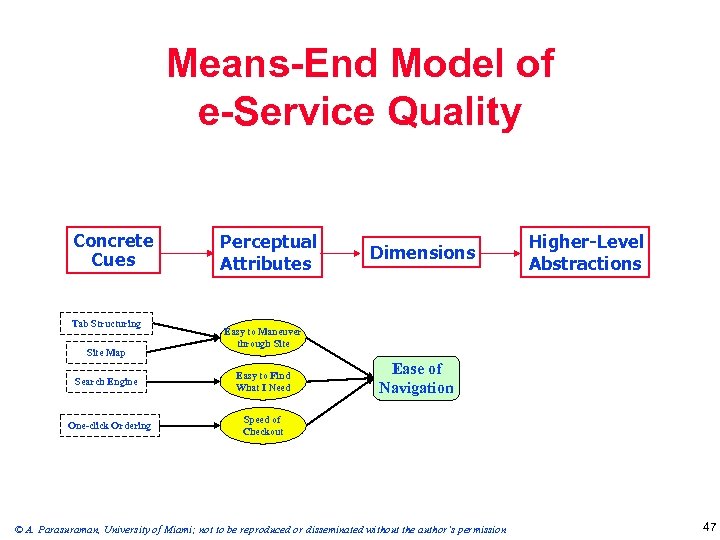
Means-End Model of e-Service Quality Concrete Cues Tab Structuring Site Map Search Engine One-click Ordering Perceptual Attributes Dimensions Higher-Level Abstractions Easy to Maneuver through Site Easy to Find What I Need Ease of Navigation Speed of Checkout © A. Parasuraman, University of Miami; not to be reproduced or disseminated without the author’s permission 47
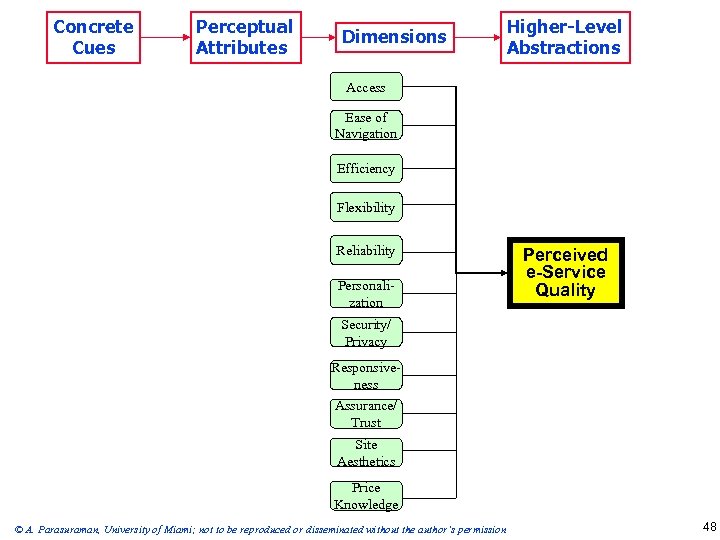
Concrete Cues Perceptual Attributes Dimensions Higher-Level Abstractions Access Ease of Navigation Efficiency Flexibility Reliability Personalization Perceived e-Service Quality Security/ Privacy Responsiveness Assurance/ Trust Site Aesthetics Price Knowledge © A. Parasuraman, University of Miami; not to be reproduced or disseminated without the author’s permission 48
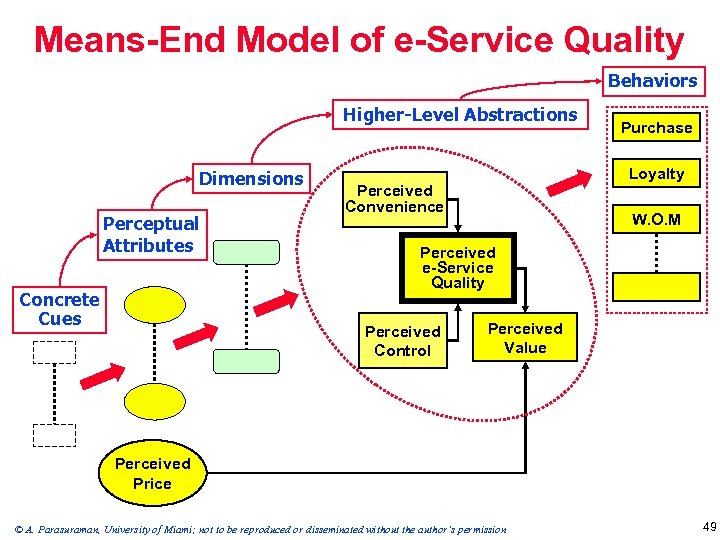
Means-End Model of e-Service Quality Behaviors Higher-Level Abstractions Dimensions Perceptual Attributes Concrete Cues Purchase Loyalty Perceived Convenience W. O. M Perceived e-Service Quality Perceived Control Perceived Value Perceived Price © A. Parasuraman, University of Miami; not to be reproduced or disseminated without the author’s permission 49
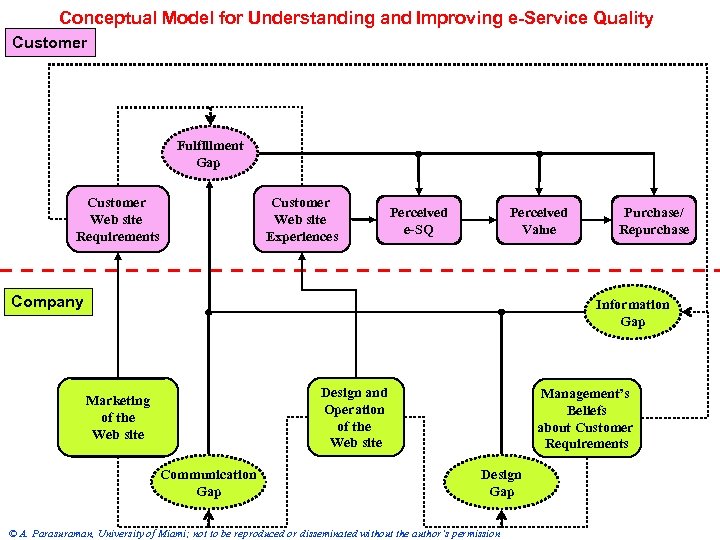
Conceptual Model for Understanding and Improving e-Service Quality Customer Fulfillment Gap Customer Web site Experiences Customer Web site Requirements Perceived e-SQ Perceived Value Company Purchase/ Repurchase Information Gap Design and Operation of the Web site Marketing of the Web site Communication Gap Management’s Beliefs about Customer Requirements Design Gap © A. Parasuraman, University of Miami; not to be reproduced or disseminated without the author’s permission
![Dimensions of e-SQ Core Dimensions [E-S-QUAL] • Efficiency • Fulfillment • System Availability •](https://present5.com/presentation/87114775b9947944df5e7dc7344ad378/image-51.jpg "Dimensions of e-SQ Core Dimensions [E-S-QUAL] • Efficiency • Fulfillment • System Availability •")
Dimensions of e-SQ Core Dimensions [E-S-QUAL] • Efficiency • Fulfillment • System Availability • Privacy Recovery Dimensions [E-Rec. S-QUAL] • Responsiveness • Compensation • Contact Source: Parasuraman, Zeithaml, and Malhotra, “E-S-QUAL: A Multiple-Item Scale for Assessing Electronic Service Quality, ” Journal of Service Research, February 2005. © A. Parasuraman, University of Miami; not to be reproduced or disseminated without the author’s permission 51
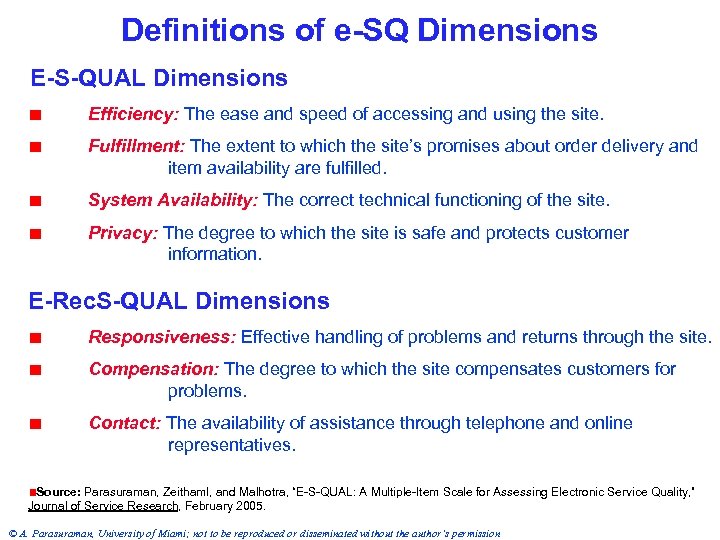
Definitions of e-SQ Dimensions E-S-QUAL Dimensions Efficiency: The ease and speed of accessing and using the site. Fulfillment: The extent to which the site’s promises about order delivery and item availability are fulfilled. System Availability: The correct technical functioning of the site. Privacy: The degree to which the site is safe and protects customer information. E-Rec. S-QUAL Dimensions Responsiveness: Effective handling of problems and returns through the site. Compensation: The degree to which the site compensates customers for problems. Contact: The availability of assistance through telephone and online representatives. Source: Parasuraman, Zeithaml, and Malhotra, “E-S-QUAL: A Multiple-Item Scale for Assessing Electronic Service Quality, ” Journal of Service Research, February 2005. © A. Parasuraman, University of Miami; not to be reproduced or disseminated without the author’s permission
An Important Implication of the Pyramid Model An organization’s ability to use technology effectively in marketing to and serving customers critically depends on the technology readiness of its customers and employees © A. Parasuraman, University of Miami; not to be reproduced or disseminated without the author’s permission 53
![What is Technology Readiness [TR]? TR refers to “people’s propensity to embrace and use](https://present5.com/presentation/87114775b9947944df5e7dc7344ad378/image-54.jpg "What is Technology Readiness [TR]? TR refers to “people’s propensity to embrace and use")
What is Technology Readiness [TR]? TR refers to “people’s propensity to embrace and use new technologies for accomplishing goals in home life and at work” © A. Parasuraman, University of Miami; not to be reproduced or disseminated without the author’s permission
Multinational Research Studies on Technology Readiness • Began in 1997 in the USA and still ongoing • Being conducted in collaboration with Charles Colby, President, Rockbridge Associates • Have thus far involved several qualitative and quantitative studies • Completed studies include three “National Technology Readiness Surveys” in the USA [NTRS 1999, 2000, 2001, 2002 and 2004] • National studies also have been done or are underway in Austria, Chile, Germany, Singapore and Sweden © A. Parasuraman, University of Miami; not to be reproduced or disseminated without the author’s permission 55
Key Insights from Qualitative Research Studies • TR doesn’t just refer to possessing technical skills; TR is much more a function of people’s beliefs and feelings about technology • People’s beliefs can be positive about some aspects of technology but negative about other aspects • The relative strengths of the of positive and negative beliefs determine a person’s receptivity to technology © A. Parasuraman, University of Miami; not to be reproduced or disseminated without the author’s permission 56
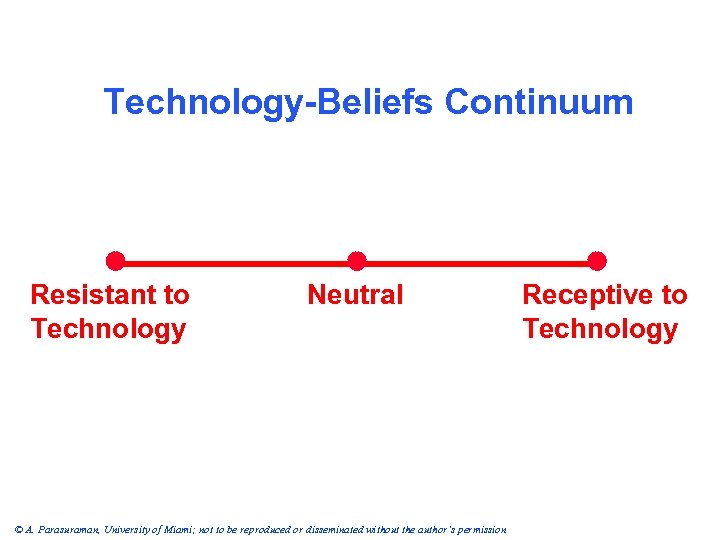
Technology-Beliefs Continuum Resistant to Technology Neutral © A. Parasuraman, University of Miami; not to be reproduced or disseminated without the author’s permission Receptive to Technology
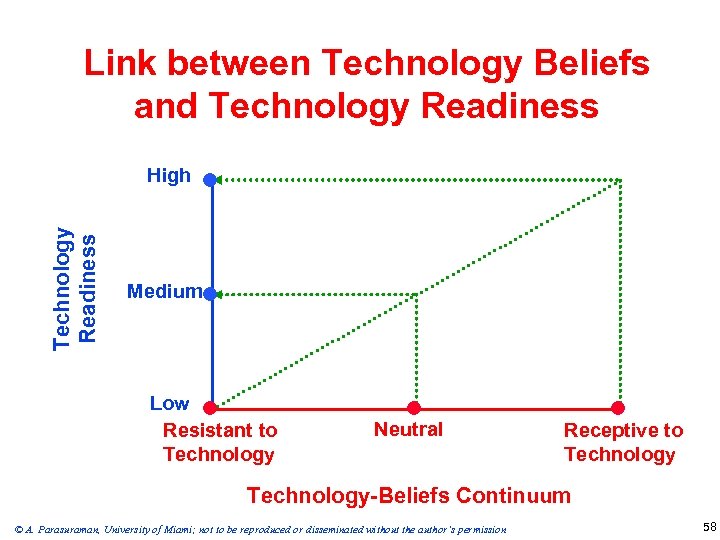
Link between Technology Beliefs and Technology Readiness High Medium Low Resistant to Technology Neutral Receptive to Technology-Beliefs Continuum © A. Parasuraman, University of Miami; not to be reproduced or disseminated without the author’s permission 58
Quantitative Survey Methodology • Each NTRS in the U. S. included a random sample of adults: – 1000 respondents 1999 & 2000 and 500 respondents in 2001, 2002 & 2004 • Data collected via computer-assisted telephone interviewing • Survey included questions about technology beliefs, demographics, psychographics, and technology-related behaviors and preferences © A. Parasuraman, University of Miami; not to be reproduced or disseminated without the author’s permission 59
Key Insights from Quantitative Research Studies • TR consists of four facets or dimensions that are fairly independent of one another • People’s ratings on a set of belief statements about technology can be combined to create a reliable and valid measure of TR -- i. e. , a “Technology Readiness Index” [TRI] • The TRI is a good predictor of people’s technology-related behaviors and preferences • A meaningful typology of customers can be created based on their TR scores on the four dimensions © A. Parasuraman, University of Miami; not to be reproduced or disseminated without the author’s permission 60
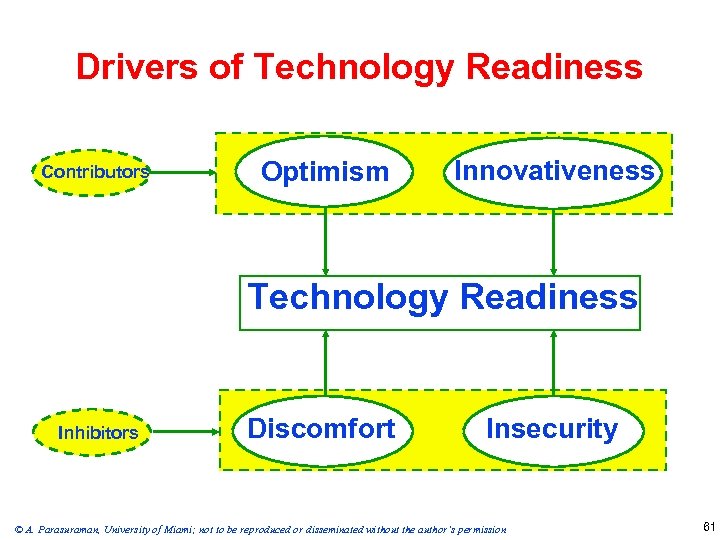
Drivers of Technology Readiness Contributors Optimism Innovativeness Technology Readiness Inhibitors Discomfort Insecurity © A. Parasuraman, University of Miami; not to be reproduced or disseminated without the author’s permission 61
Definitions of the TR Drivers • Optimism: Positive view of technology; belief that it offers increased control, flexibility and efficiency • Innovativeness: Tendency to be a technology pioneer and thought leader • Discomfort: Perceived lack of control over technology and a feeling of being overwhelmed by it • Insecurity: Distrust of technology and skepticism about its working properly © A. Parasuraman, University of Miami; not to be reproduced or disseminated without the author’s permission 62
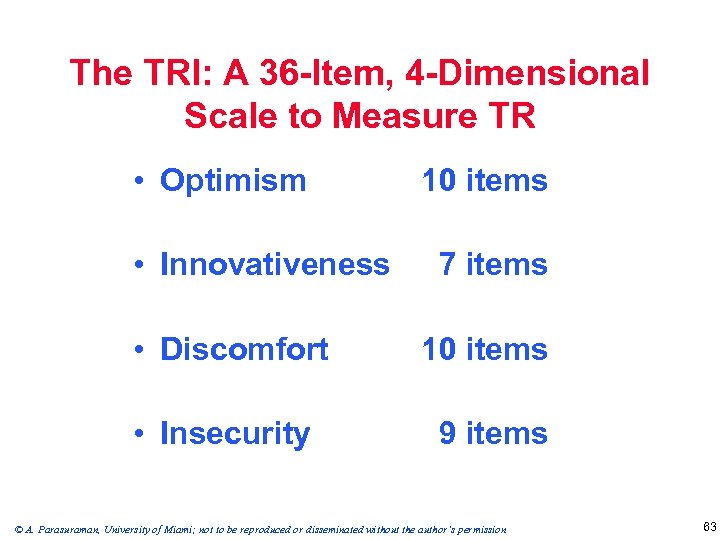
The TRI: A 36 -Item, 4 -Dimensional Scale to Measure TR • Optimism • Innovativeness 10 items 7 items • Discomfort 10 items • Insecurity 9 items © A. Parasuraman, University of Miami; not to be reproduced or disseminated without the author’s permission 63
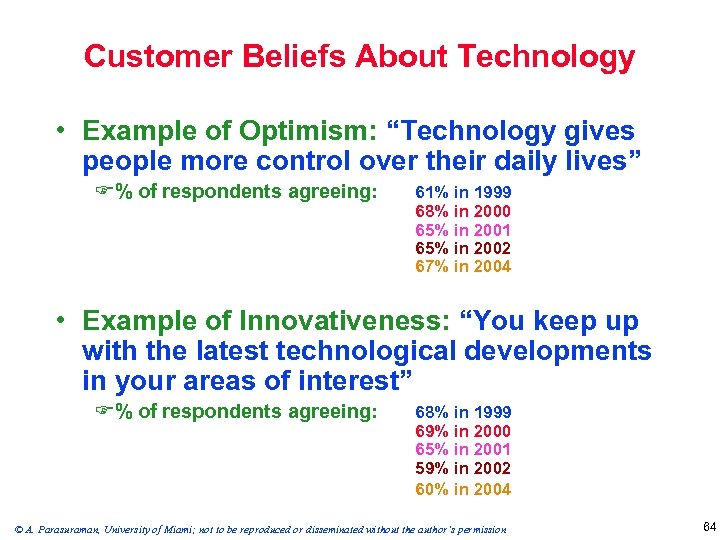
Customer Beliefs About Technology • Example of Optimism: “Technology gives people more control over their daily lives” F% of respondents agreeing: 61% in 1999 68% in 2000 65% in 2001 65% in 2002 67% in 2004 • Example of Innovativeness: “You keep up with the latest technological developments in your areas of interest” F% of respondents agreeing: 68% in 1999 69% in 2000 65% in 2001 59% in 2002 60% in 2004 © A. Parasuraman, University of Miami; not to be reproduced or disseminated without the author’s permission 64
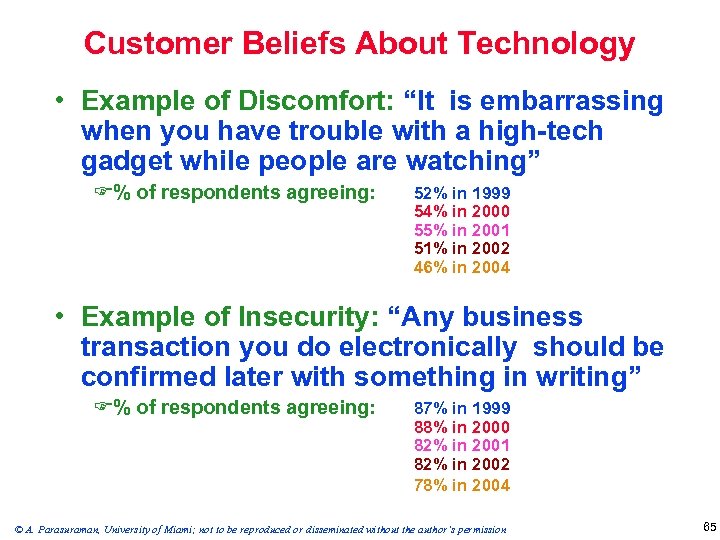
Customer Beliefs About Technology • Example of Discomfort: “It is embarrassing when you have trouble with a high-tech gadget while people are watching” F% of respondents agreeing: 52% in 1999 54% in 2000 55% in 2001 51% in 2002 46% in 2004 • Example of Insecurity: “Any business transaction you do electronically should be confirmed later with something in writing” F% of respondents agreeing: 87% in 1999 88% in 2000 82% in 2001 82% in 2002 78% in 2004 © A. Parasuraman, University of Miami; not to be reproduced or disseminated without the author’s permission 65
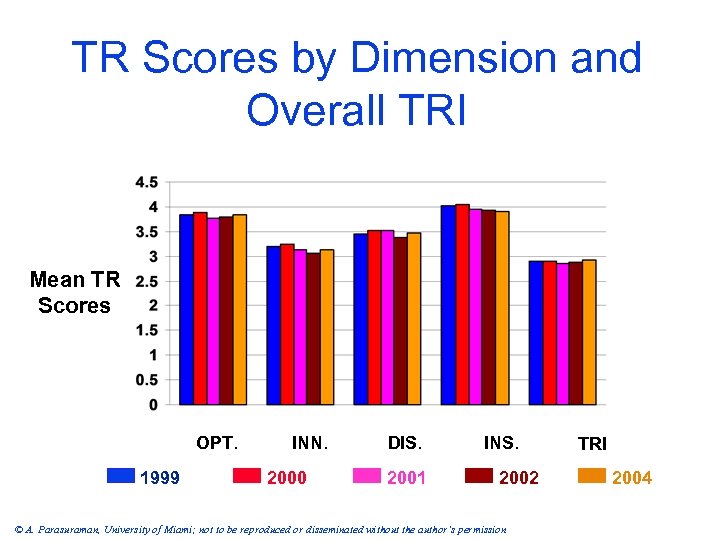
TR Scores by Dimension and Overall TRI Mean TR Scores OPT. 1999 INN. 2000 DIS. 2001 INS. 2002 © A. Parasuraman, University of Miami; not to be reproduced or disseminated without the author’s permission TRI 2004
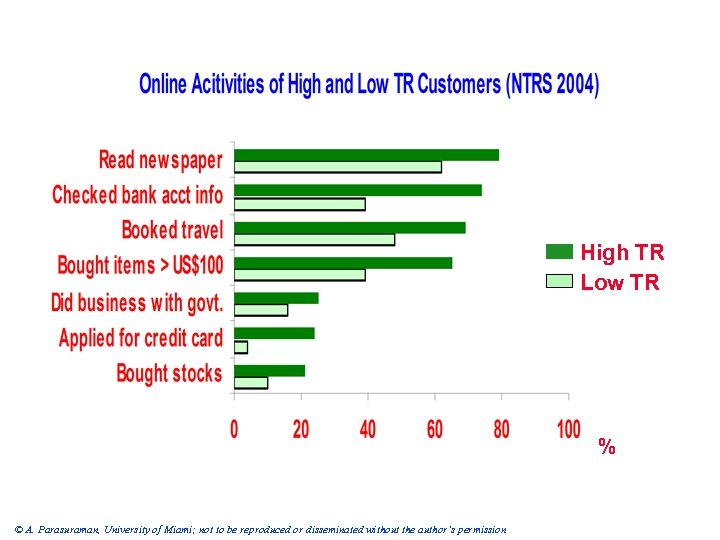
High TR Low TR % © A. Parasuraman, University of Miami; not to be reproduced or disseminated without the author’s permission
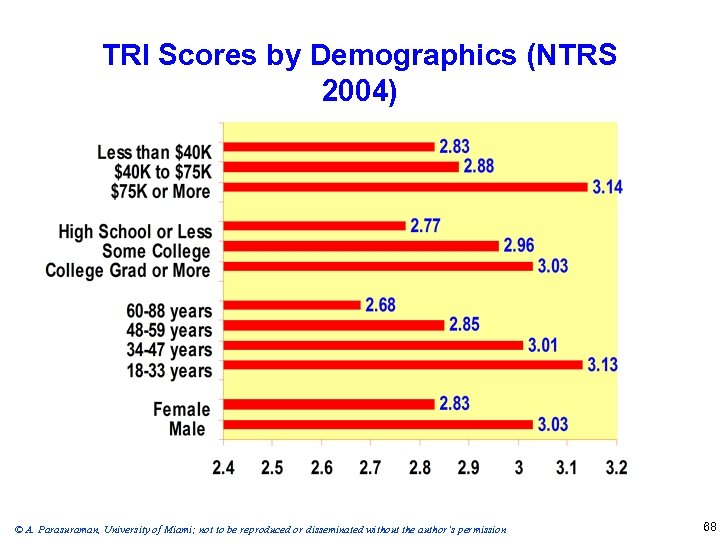
TRI Scores by Demographics (NTRS 2004) © A. Parasuraman, University of Miami; not to be reproduced or disseminated without the author’s permission 68
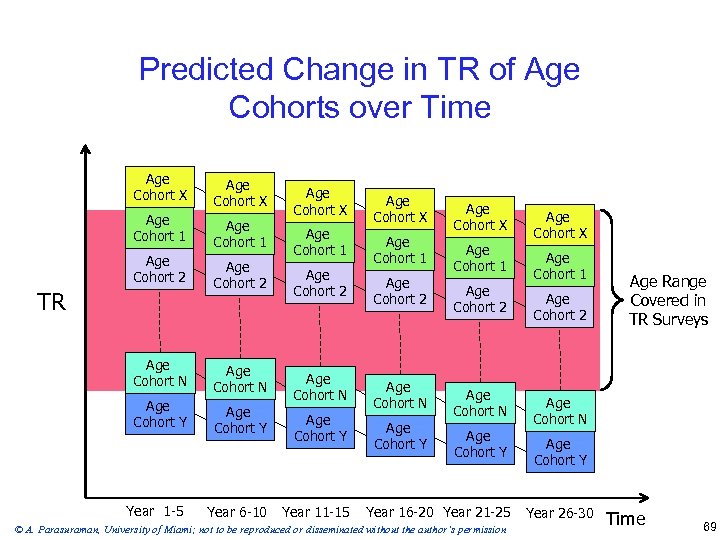
Predicted Change in TR of Age Cohorts over Time Age Cohort X Age Cohort 1 Age Cohort 2 TR Age Cohort N Age Cohort Y Year 1 -5 Year 6 -10 Age Cohort X Age Cohort 1 Age Cohort 2 Age Cohort N Age Cohort Y Year 11 -15 Age Cohort X Age Cohort 1 Age Cohort 2 Age Cohort N Age Cohort Y Year 16 -20 Year 21 -25 © A. Parasuraman, University of Miami; not to be reproduced or disseminated without the author’s permission Age Cohort X Age Cohort 1 Age Cohort 2 Age Range Covered in TR Surveys Age Cohort N Age Cohort Y Year 26 -30 Time 69
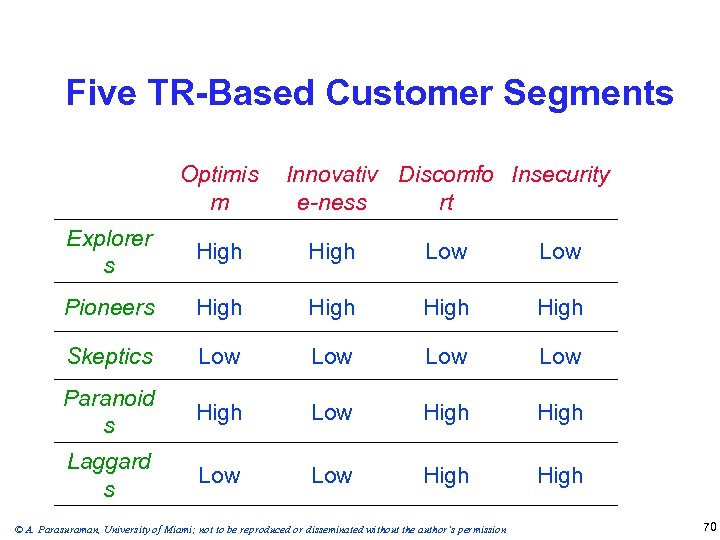
Five TR-Based Customer Segments Optimis m Innovativ Discomfo Insecurity e-ness rt Explorer s High Low Pioneers High Skeptics Low Low Paranoid s High Low High Laggard s Low High © A. Parasuraman, University of Miami; not to be reproduced or disseminated without the author’s permission 70
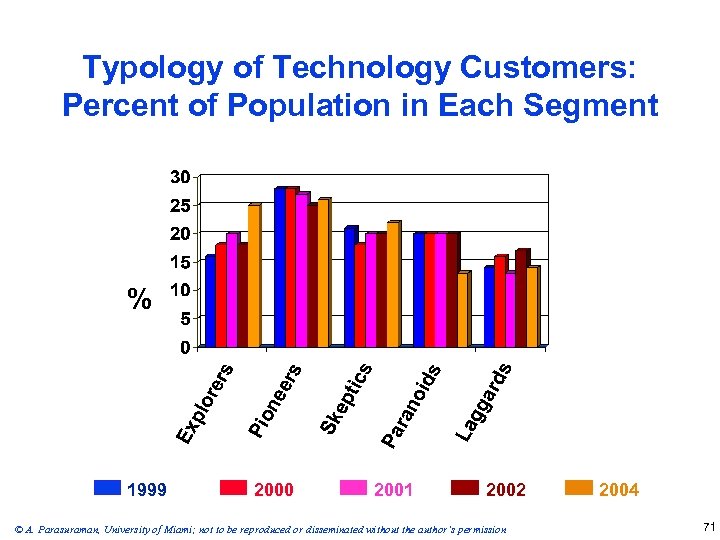
Typology of Technology Customers: Percent of Population in Each Segment % 1999 2000 2001 2002 © A. Parasuraman, University of Miami; not to be reproduced or disseminated without the author’s permission 2004 71
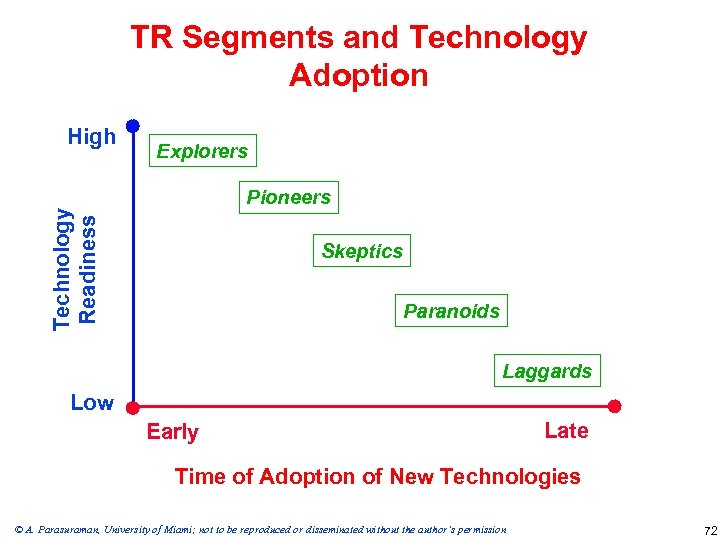
TR Segments and Technology Adoption Explorers Pioneers Technology Readiness High Skeptics Paranoids Laggards Low Early Late Time of Adoption of New Technologies © A. Parasuraman, University of Miami; not to be reproduced or disseminated without the author’s permission 72
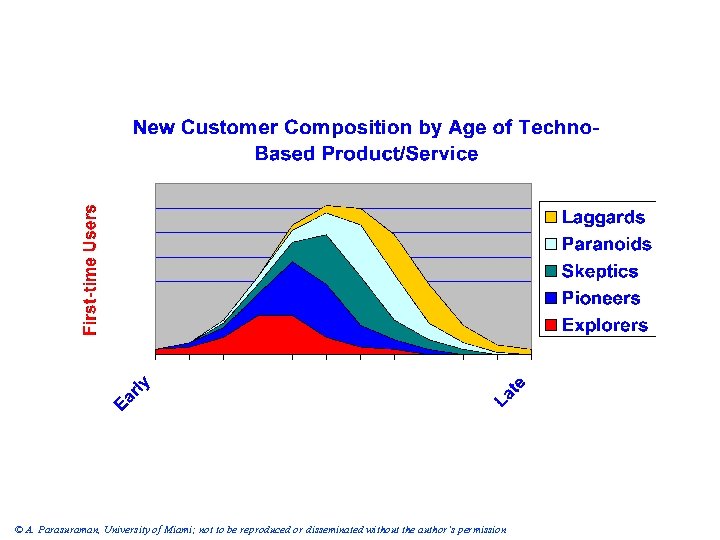
© A. Parasuraman, University of Miami; not to be reproduced or disseminated without the author’s permission
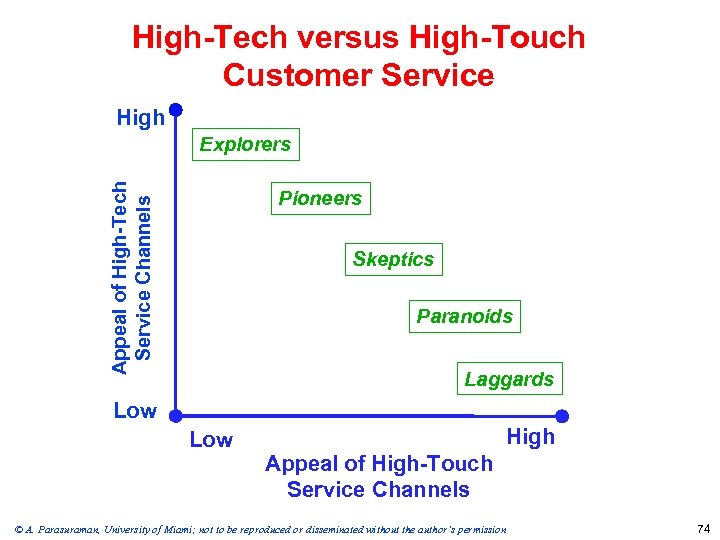
High-Tech versus High-Touch Customer Service High Appeal of High-Tech Service Channels Explorers Pioneers Skeptics Paranoids Laggards Low High Appeal of High-Touch Service Channels © A. Parasuraman, University of Miami; not to be reproduced or disseminated without the author’s permission 74
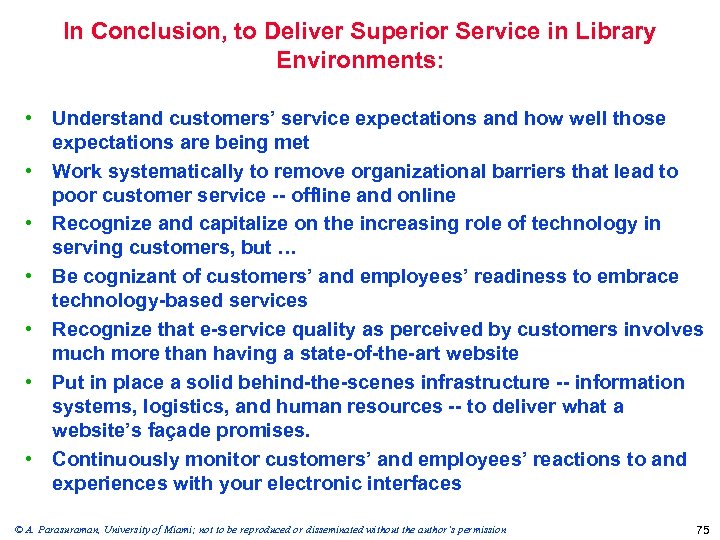
In Conclusion, to Deliver Superior Service in Library Environments: • Understand customers’ service expectations and how well those expectations are being met • Work systematically to remove organizational barriers that lead to poor customer service -- offline and online • Recognize and capitalize on the increasing role of technology in serving customers, but … • Be cognizant of customers’ and employees’ readiness to embrace technology-based services • Recognize that e-service quality as perceived by customers involves much more than having a state-of-the-art website • Put in place a solid behind-the-scenes infrastructure -- information systems, logistics, and human resources -- to deliver what a website’s façade promises. • Continuously monitor customers’ and employees’ reactions to and experiences with your electronic interfaces © A. Parasuraman, University of Miami; not to be reproduced or disseminated without the author’s permission 75
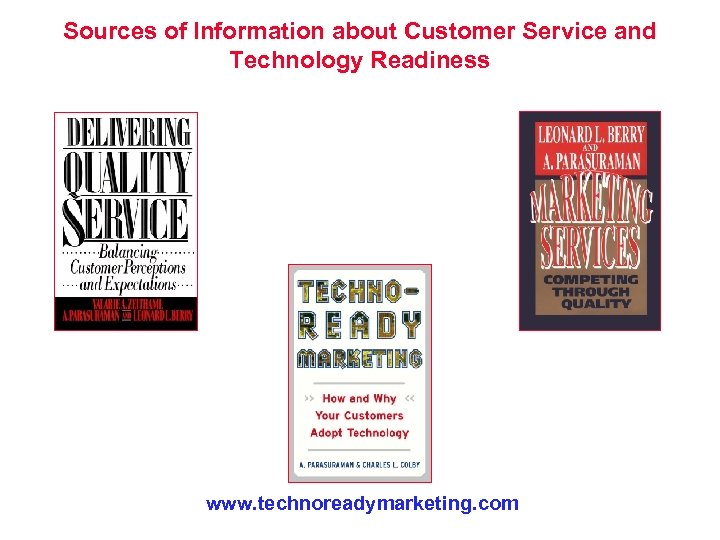
Sources of Information about Customer Service and Technology Readiness www. technoreadymarketing. com
Thank You! © A. Parasuraman, University of Miami; not to be reproduced or disseminated without the author’s permission
Скачать презентацию New Ways of Listening to Library Users New
87114775b9947944df5e7dc7344ad378.ppt