


 Скачать презентацию NEW VERSION OF ISOLA SOFTWARE TO INVERT FULL
a1a9600df26f6bdc62e23c2cce1e220d.ppt
- Количество слайдов: 32
 NEW VERSION OF ISOLA SOFTWARE TO INVERT FULL WAVEFORMS INTO SEISMIC SOURCE MODELS Efthimios Sokos 1) and Jiri Zahradnik 2) 1) University of Patras, Greece 2) Charles University in Prague, Czech Republic http: //seismo. geology. upatras. gr/isola
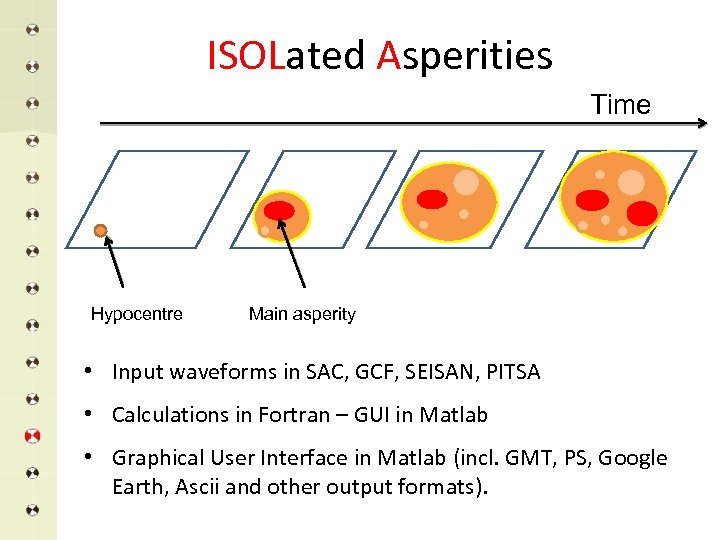 ISOLated Asperities Time Hypocentre Main asperity • Input waveforms in SAC, GCF, SEISAN, PITSA • Calculations in Fortran – GUI in Matlab • Graphical User Interface in Matlab (incl. GMT, PS, Google Earth, Ascii and other output formats).
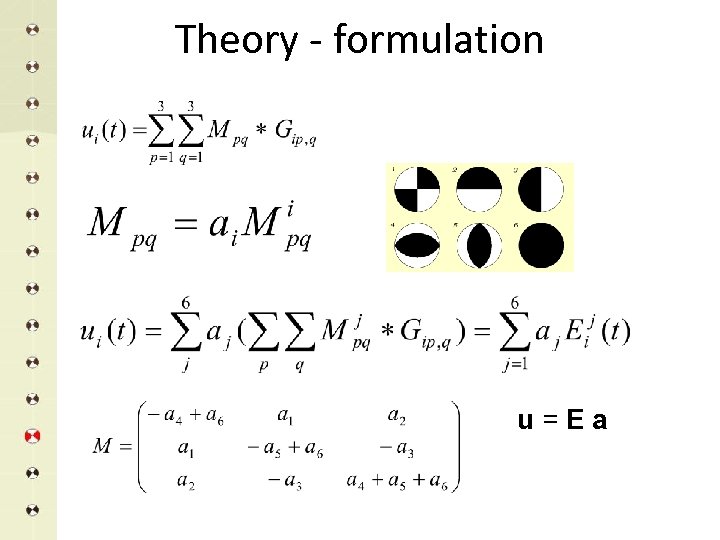 Theory - formulation u=Ea
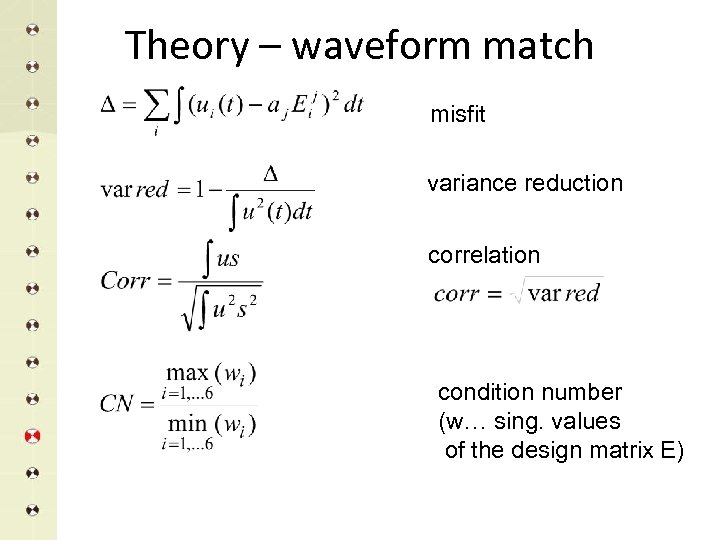 Theory – waveform match misfit variance reduction correlation condition number (w… sing. values of the design matrix E)
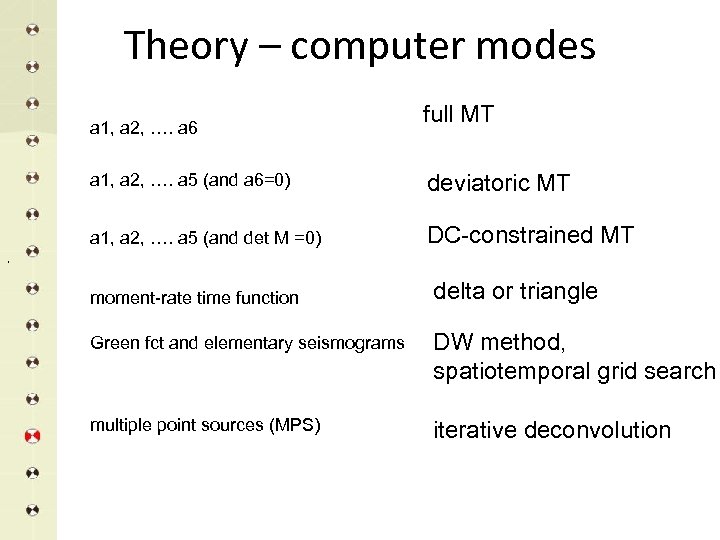 Theory – computer modes a 1, a 2, …. a 6 full MT a 1, a 2, …. a 5 (and a 6=0) deviatoric MT a 1, a 2, …. a 5 (and det M =0) DC-constrained MT , moment-rate time function delta or triangle Green fct and elementary seismograms DW method, spatiotemporal grid search multiple point sources (MPS) iterative deconvolution
 Previous summary
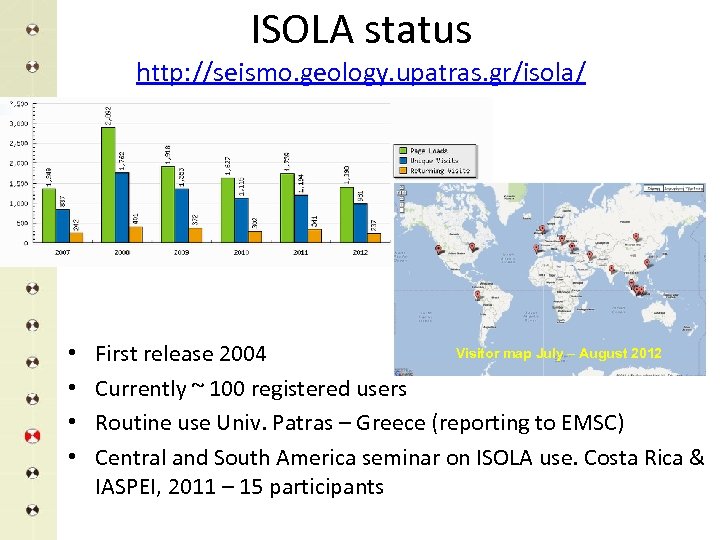 ISOLA status http: //seismo. geology. upatras. gr/isola/ • • Visitor map July – August 2012 First release 2004 Currently ~ 100 registered users Routine use Univ. Patras – Greece (reporting to EMSC) Central and South America seminar on ISOLA use. Costa Rica & IASPEI, 2011 – 15 participants
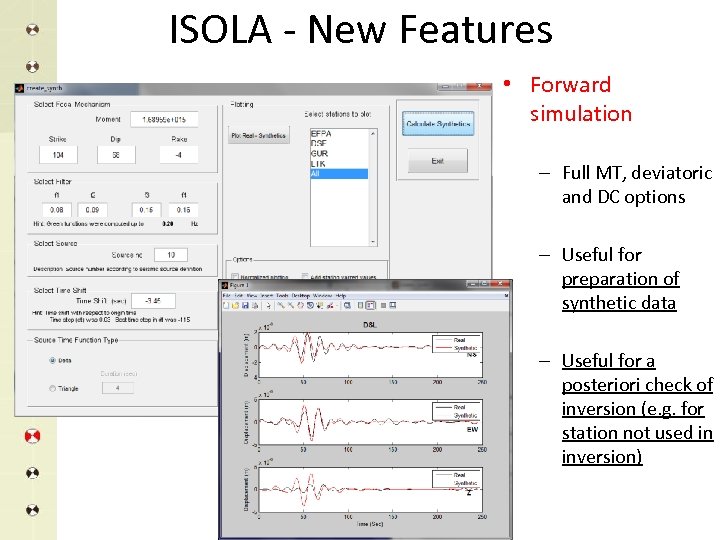 ISOLA - New Features • Forward simulation – Full MT, deviatoric and DC options – Useful for preparation of synthetic data – Useful for a posteriori check of inversion (e. g. for station not used in inversion)
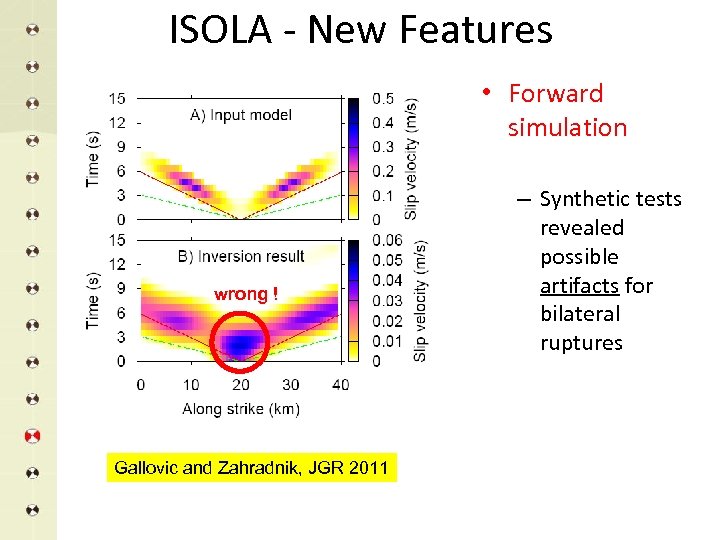 ISOLA - New Features • Forward simulation wrong ! Gallovic and Zahradnik, JGR 2011 – Synthetic tests revealed possible artifacts for bilateral ruptures
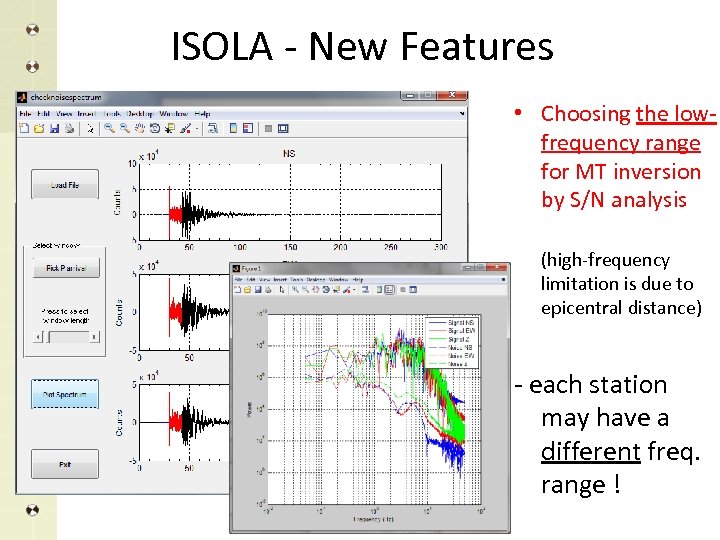 ISOLA - New Features • Choosing the lowfrequency range for MT inversion by S/N analysis (high-frequency limitation is due to epicentral distance) - each station may have a different freq. range !
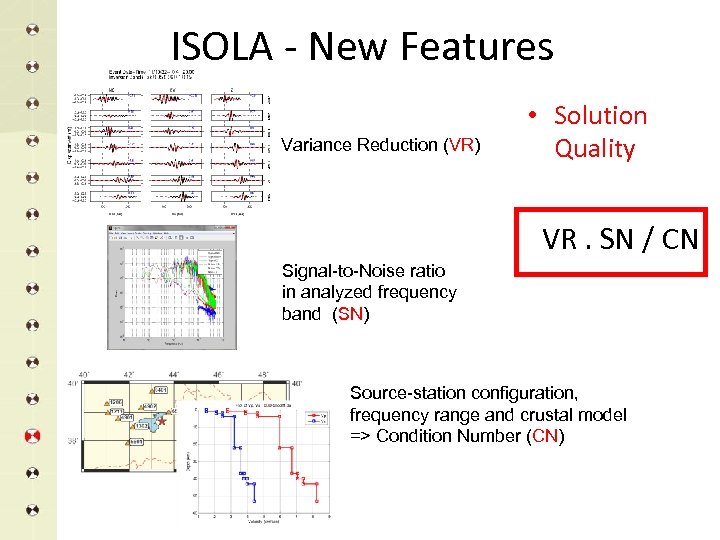 ISOLA - New Features Variance Reduction (VR) • Solution Quality VR. SN / CN Signal-to-Noise ratio in analyzed frequency band (SN) Source-station configuration, frequency range and crustal model => Condition Number (CN)
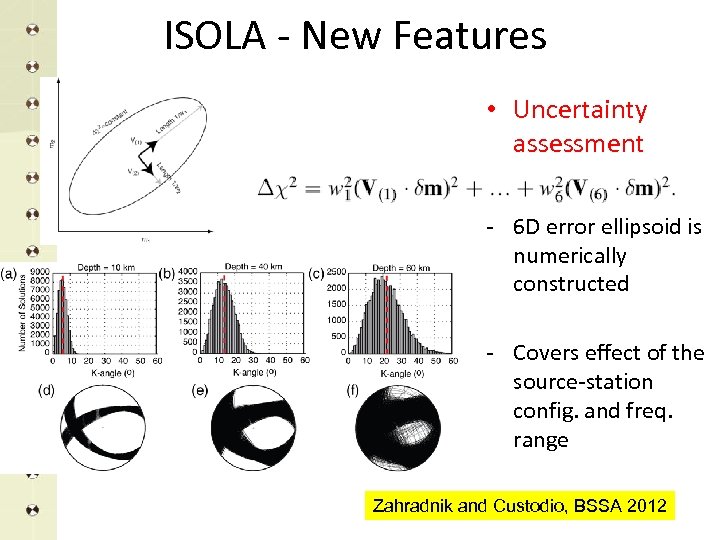 ISOLA - New Features • Uncertainty assessment - 6 D error ellipsoid is numerically constructed - Covers effect of the source-station config. and freq. range Zahradnik and Custodio, BSSA 2012
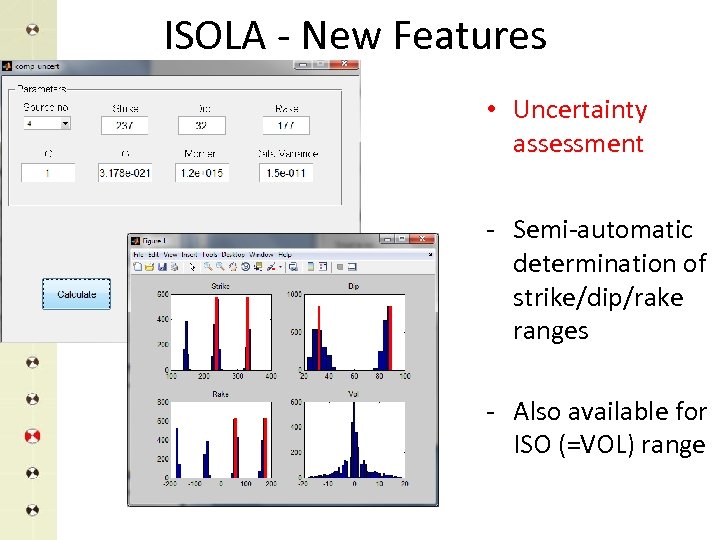 ISOLA - New Features • Uncertainty assessment - Semi-automatic determination of strike/dip/rake ranges - Also available for ISO (=VOL) range
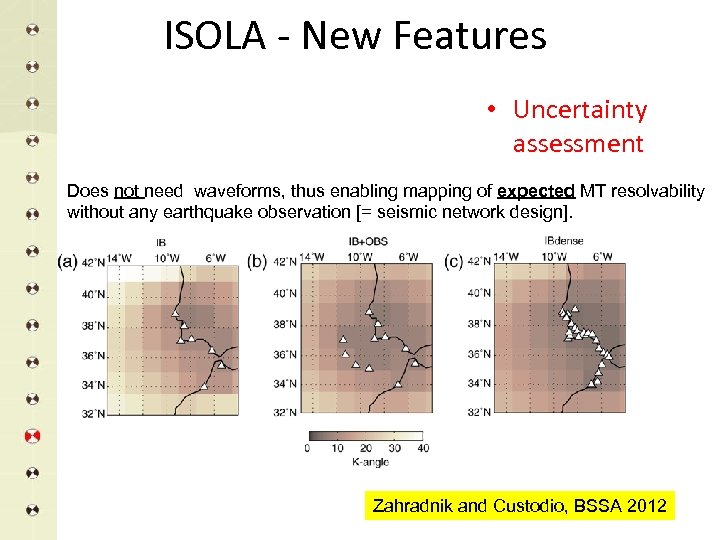 ISOLA - New Features • Uncertainty assessment Does not need waveforms, thus enabling mapping of expected MT resolvability without any earthquake observation [= seismic network design]. Zahradnik and Custodio, BSSA 2012
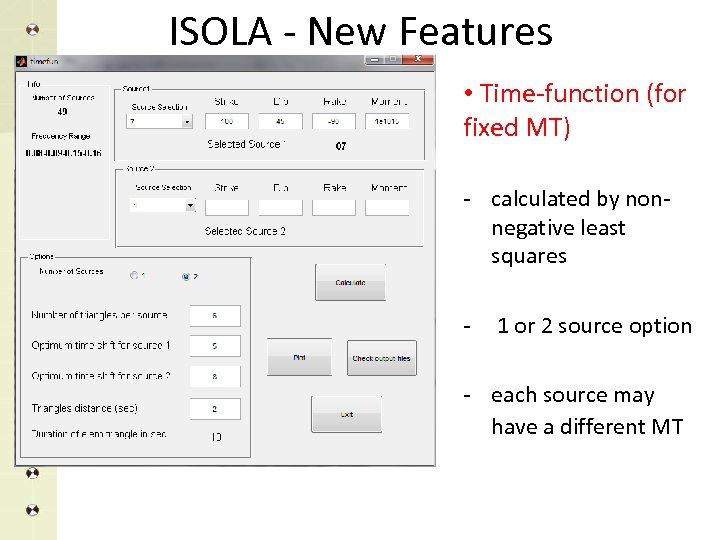 ISOLA - New Features • Time-function (for fixed MT) - calculated by nonnegative least squares - 1 or 2 source option - each source may have a different MT
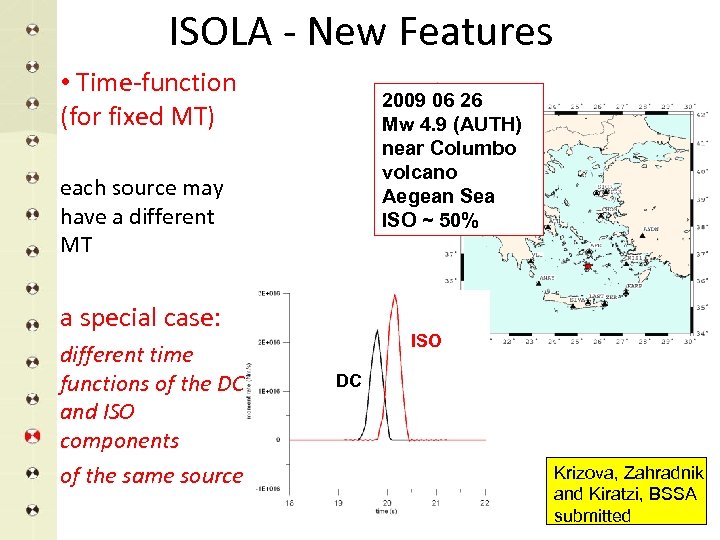 ISOLA - New Features • Time-function (for fixed MT) 2009 06 26 Mw 4. 9 (AUTH) near Columbo volcano Aegean Sea ISO ~ 50% each source may have a different MT a special case: different time functions of the DC and ISO components of the same source ISO DC Krizova, Zahradnik and Kiratzi, BSSA submitted
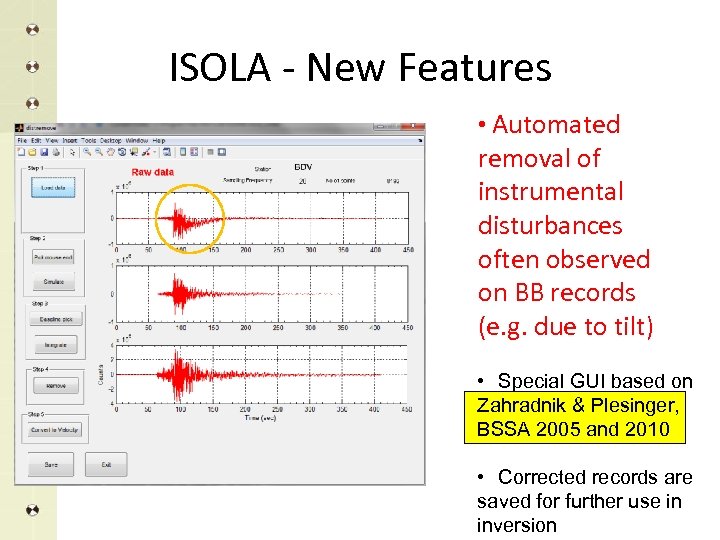 ISOLA - New Features • Automated removal of instrumental disturbances often observed on BB records (e. g. due to tilt) • Special GUI based on Zahradnik & Plesinger, BSSA 2005 and 2010 • Corrected records are saved for further use in inversion
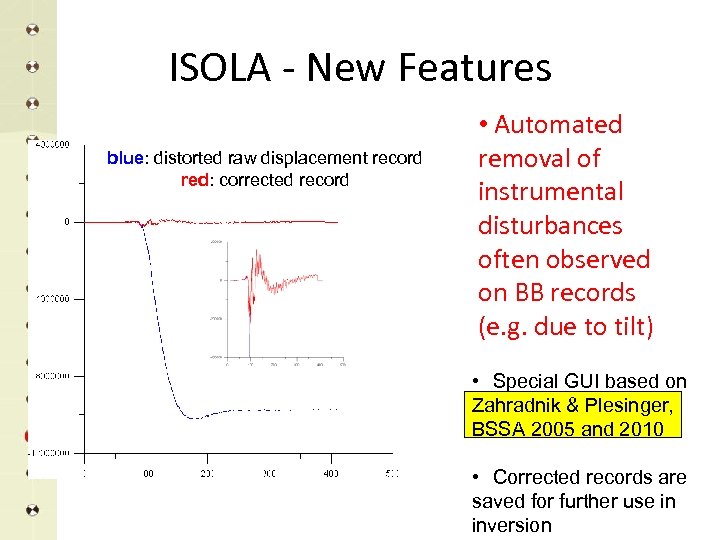 ISOLA - New Features blue: distorted raw displacement record red: corrected record • Automated removal of instrumental disturbances often observed on BB records (e. g. due to tilt) • Special GUI based on Zahradnik & Plesinger, BSSA 2005 and 2010 • Corrected records are saved for further use in inversion
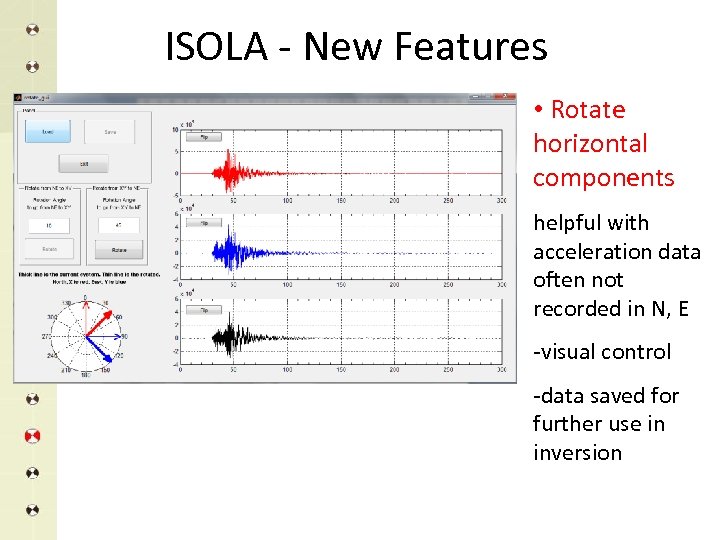 ISOLA - New Features • Rotate horizontal components helpful with acceleration data often not recorded in N, E -visual control -data saved for further use in inversion
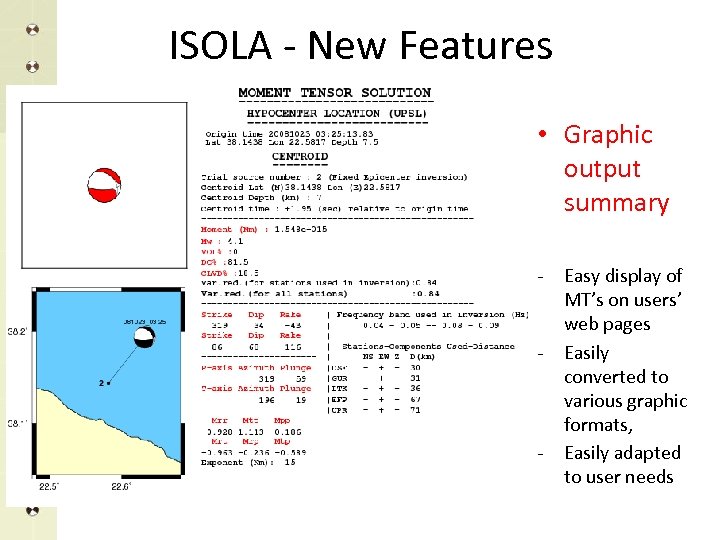 ISOLA - New Features • Graphic output summary - - - Easy display of MT’s on users’ web pages Easily converted to various graphic formats, Easily adapted to user needs
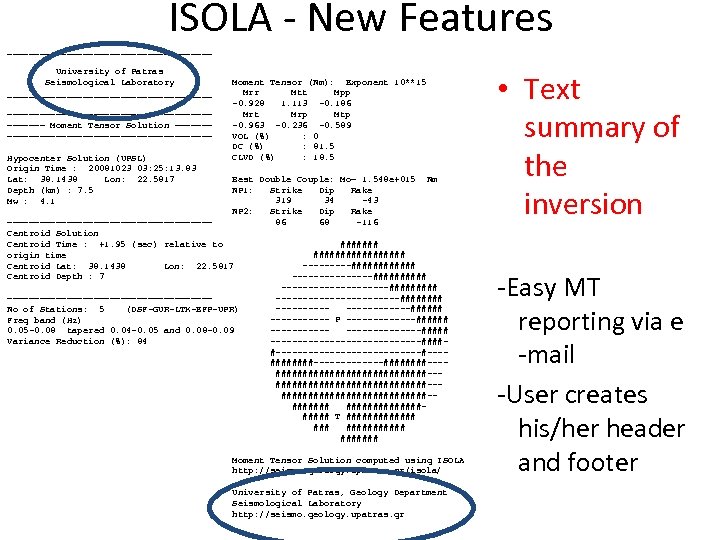 ISOLA - New Features ___________________ University of Patras Seismological Laboratory ___________________ =================== Moment Tensor Solution ======================= Hypocenter Solution (UPSL) Origin Time : 20081023 03: 25: 13. 83 Lat: 38. 1438 Lon: 22. 5817 Depth (km) : 7. 5 Mw : 4. 1 Moment Tensor (Nm): Exponent 10**15 Mrr Mtt Mpp -0. 928 1. 113 -0. 186 Mrt Mrp Mtp -0. 963 -0. 236 -0. 589 VOL (%) : 0 DC (%) : 81. 5 CLVD (%) : 18. 5 Best Double Couple: Mo= 1. 548 e+015 NP 1: Strike Dip Rake 319 34 -43 NP 2: Strike Dip Rake 86 68 -116 =================== Centroid Solution Centroid Time : +1. 95 (sec) relative to origin time Centroid Lat: 38. 1438 Lon: 22. 5817 Centroid Depth : 7 =================== No of Stations: 5 (DSF-GUR-LTK-EFP-UPR) Freq band (Hz) 0. 05 -0. 08 tapered 0. 04 -0. 05 and 0. 08 -0. 09 Variance Reduction (%): 84 Nm ############ -----###### --------##### ----------##### ------------###### ------ P -------###### ----------------------------#####--------------#---####-------####---############################--##############-########## T ####### ####### Moment Tensor Solution computed using ISOLA http: //seismo. geology. upatras. gr/isola/ University of Patras, Geology Department Seismological Laboratory http: //seismo. geology. upatras. gr • Text summary of the inversion -Easy MT reporting via e -mail -User creates his/her header and footer
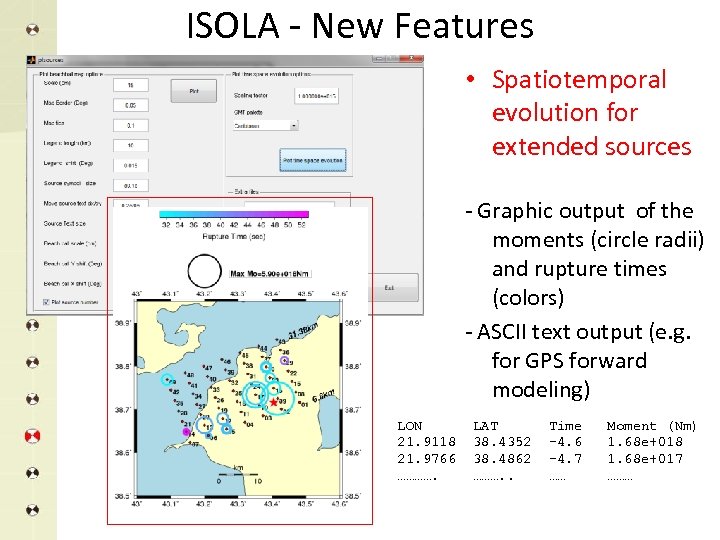 ISOLA - New Features • Spatiotemporal evolution for extended sources - Graphic output of the moments (circle radii) and rupture times (colors) - ASCII text output (e. g. for GPS forward modeling) LON 21. 9118 21. 9766 …………. LAT 38. 4352 38. 4862 ………. . Time -4. 6 -4. 7 …… Moment (Nm) 1. 68 e+018 1. 68 e+017 ………
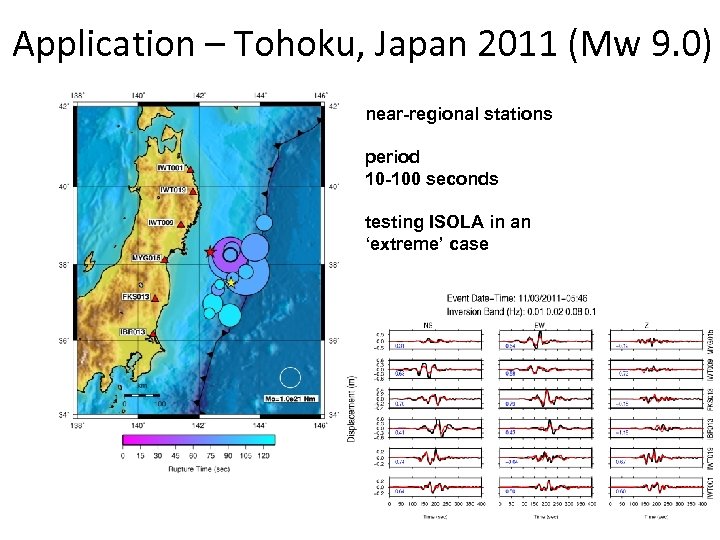 Application – Tohoku, Japan 2011 (Mw 9. 0) near-regional stations period 10 -100 seconds testing ISOLA in an ‘extreme’ case
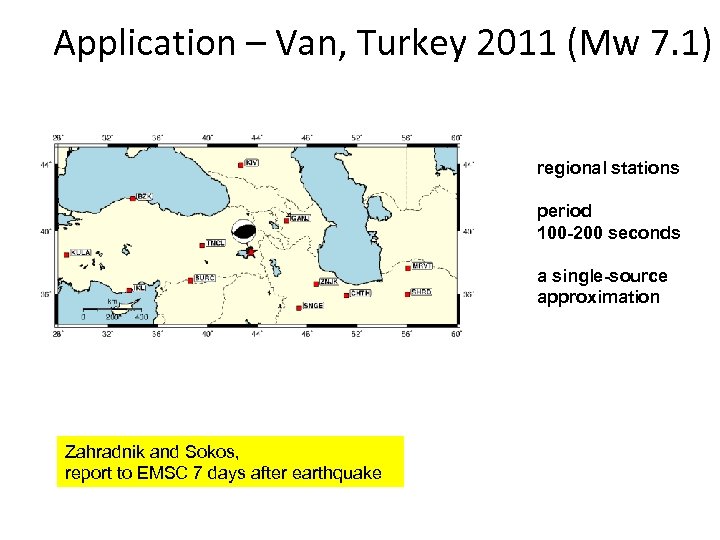 Application – Van, Turkey 2011 (Mw 7. 1) regional stations period 100 -200 seconds a single-source approximation Zahradnik and Sokos, report to EMSC 7 days after earthquake
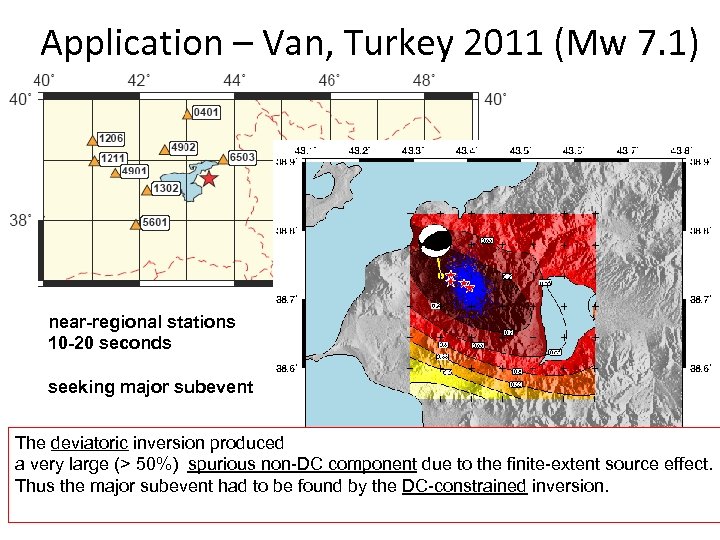 Application – Van, Turkey 2011 (Mw 7. 1) near-regional stations 10 -20 seconds seeking major subevent The deviatoric inversion produced a very large (> 50%) spurious non-DC component due to the finite-extent source effect. Thus the major subevent had to be found by the DC-constrained inversion.
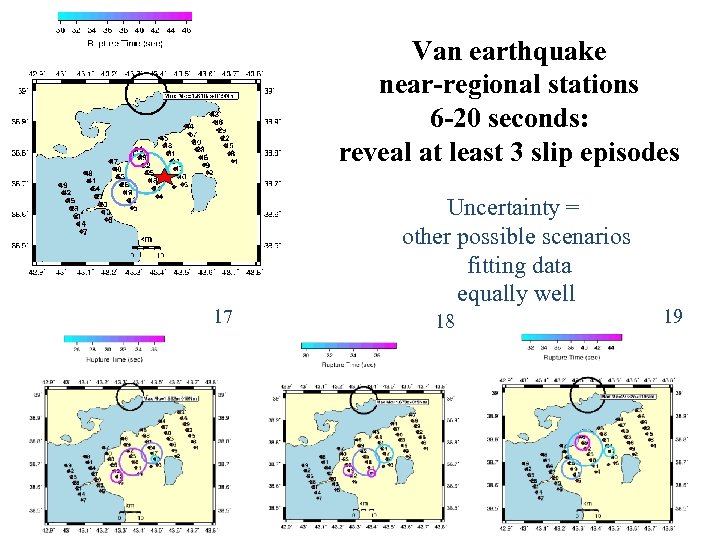 Van earthquake near-regional stations 6 -20 seconds: reveal at least 3 slip episodes 17 Uncertainty = other possible scenarios fitting data equally well 18 19
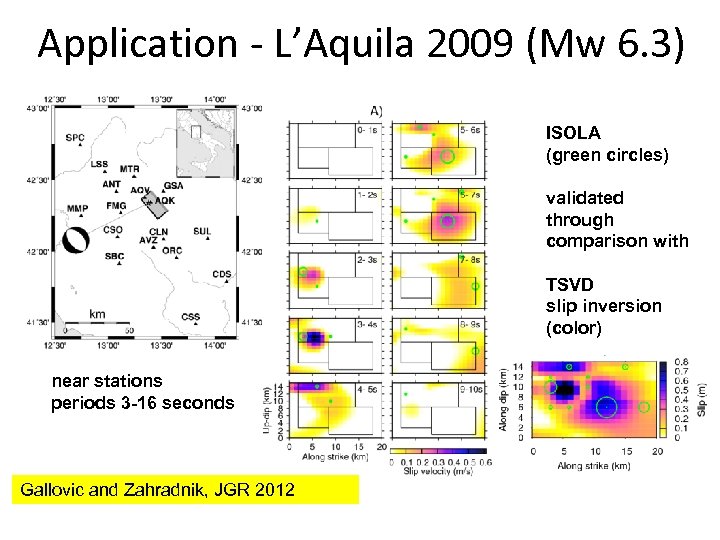 Application - L’Aquila 2009 (Mw 6. 3) ISOLA (green circles) validated through comparison with TSVD slip inversion (color) near stations periods 3 -16 seconds Gallovic and Zahradnik, JGR 2012
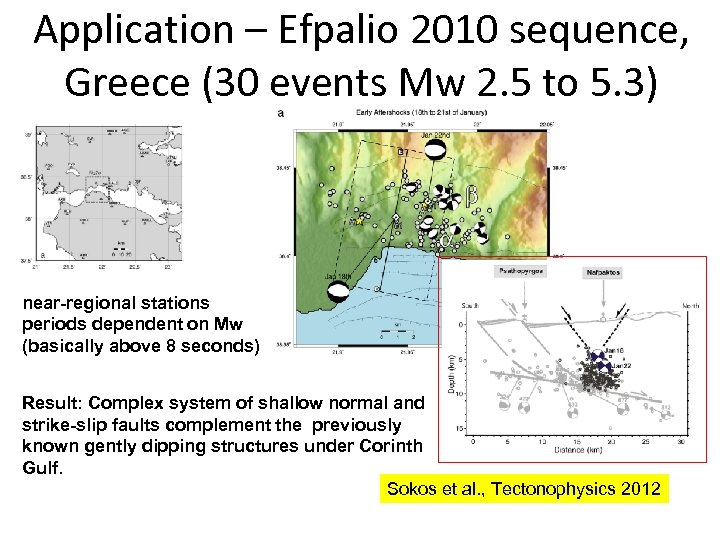 Application – Efpalio 2010 sequence, Greece (30 events Mw 2. 5 to 5. 3) near-regional stations periods dependent on Mw (basically above 8 seconds) Result: Complex system of shallow normal and strike-slip faults complement the previously known gently dipping structures under Corinth Gulf. Sokos et al. , Tectonophysics 2012
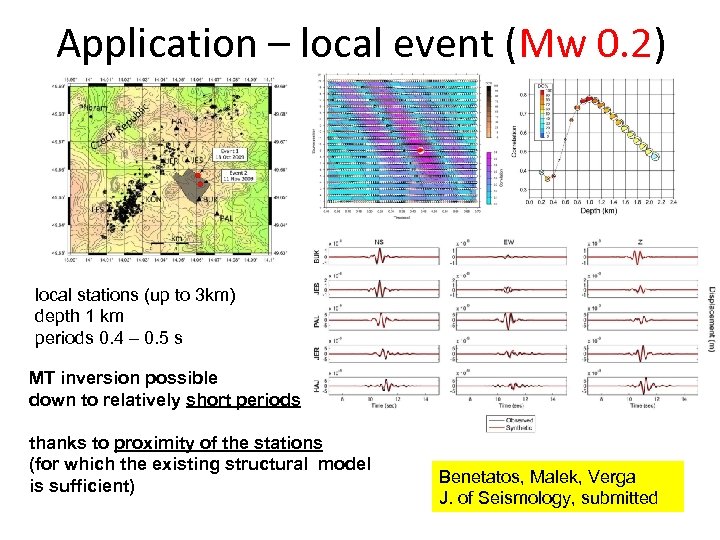 Application – local event (Mw 0. 2) local stations (up to 3 km) depth 1 km periods 0. 4 – 0. 5 s MT inversion possible down to relatively short periods thanks to proximity of the stations (for which the existing structural model is sufficient) Benetatos, Malek, Verga J. of Seismology, submitted
 Conclusion - why to use ISOLA • Compact package (“all in one”): From raw records up to publication-quality figures • Routine tool for point source inversion (regional to local distances), research tool for complex finiteextent sources • Tested on events Mw 0. 2 to 9. 0 • Windows (most user friendly), Linux and Mac. Os • All source codes provided to users • Continuous e-mail consultations • Continuing software development & Manual and Web page
 Thank you for your attention !
 ISOLA - New Features - Overview • Inversion – – – Choosing suitable frequency range by S/N analysis Different frequency range for different stations Non-negative moment-rate time function retrieval (for fixed MT) Removal of instrumental disturbances Forward simulation tool to design synthetic tests – Spatiotemporal visualization of source complexity – Different crustal models for different source-station paths • Uncertainty estimation – Strike, dip, rake and ISO ranges – Seismic network MT resolvability – Validation of spatiotemporal scenarios by perturbations