


 Скачать презентацию New Testament Survey Welcome to Session 3 Capernaum
26f3686dfbda6ee3d6699bf4e4ceb2c2.ppt
- Количество слайдов: 122
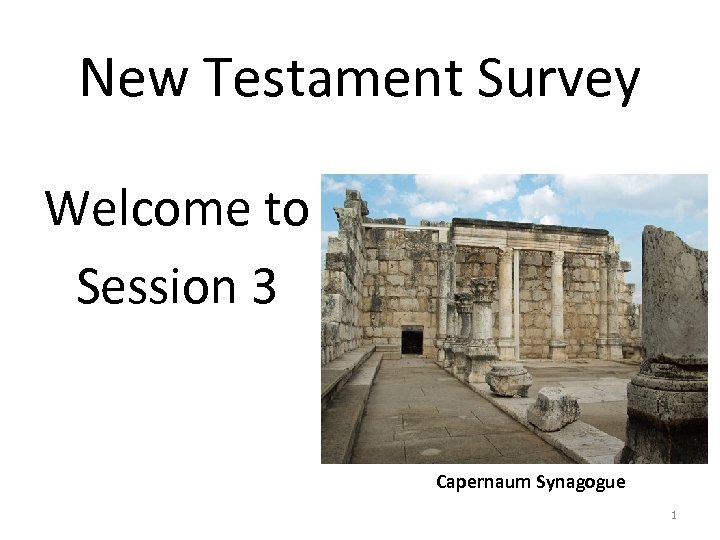 New Testament Survey Welcome to Session 3 Capernaum Synagogue 1
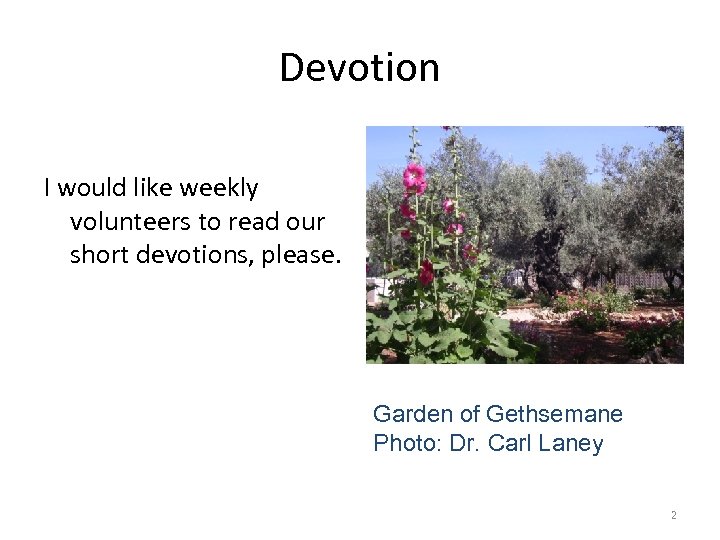 Devotion I would like weekly volunteers to read our short devotions, please. Garden of Gethsemane Photo: Dr. Carl Laney 2
 288 -page Syllabus Each week, pages are assigned from the syllabus that compliment our Bible reading. Remember to have a parent initial each week’s Syllabus reading on the Checklist! It is important that you read ALL pages assigned if you are hoping to earn a high grade in this class. 3
 NT SURVEY SYLLABUS READING SESSION 1 SYLLABUS: pp. 17, 108 -112, 117 -119, pp 150 -151 Capernaum Map, The Christmas Story & Marriage, Life & Times of Jesus, Jesus Baptized SESSION 2 SYLLABUS: p. 161 -164, 165, 193 Death of John the Baptist, "Tough Questions, " Bethsaida Archaeology SESSION 3 SYLLABUS: pp. 1 -6, 116, 140 -142, 273 -275, 276 -288 review charts of Life of Christ and Life of Paul, Disciples, Greek SESSION 4 SYLLABUS: pp. 16, 17, 34 -45 Herod, Resurrection Appearances List, Parables, Antony and Cleopatra 4
 Schedule Review SESSION 3 THE DISCIPLES; PARABLE OF TEN VIRGINS TURN IN: Definitions, written in complete sentences, defined in context of the Bible CLASSROOM: Greek Alphabet; 12 Apostles; Pharisees and Sadducees; the Five Morons READING: Matthew 19 - 27 SYLLABUS: pp. 1 -6, 116, 140 -142, 273 -275, 276 -288 review charts of Life of Christ and Life of Paul, Disciples, Greek WRITING: Practice the Greek alphabet until you know it. Turn in your practice papers/cards to get credit 5
 Assignment due next week WRITING: Practice the Greek alphabet until you know it. Turn in your practice papers/cards to get credit 6
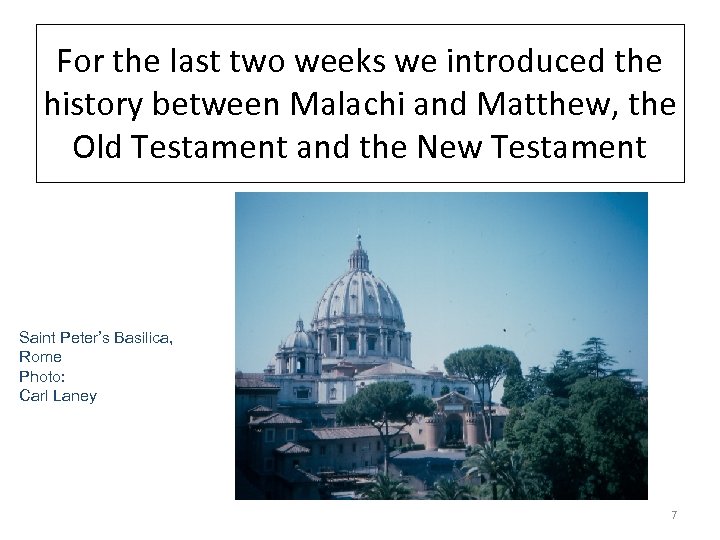 For the last two weeks we introduced the history between Malachi and Matthew, the Old Testament and the New Testament Saint Peter’s Basilica, Rome Photo: Carl Laney 7
 A Relative Pronoun in Matthew’s Genealogy What is a “relative pronoun”? Matt. 1: 16 “Jacob was the father of Joseph, the husband of Mary—of whom Jesus was born, who is called the Christ. ” 8
 A Relative Pronoun in Matthew’s Genealogy A “relative pronoun” is a Matt. 1: 16 word which introduces “Jacob was the father of relative clauses, which Joseph, the husband of are a type of dependent Mary—of whom Jesus clause. “The word, was born, who is called phrase, or idea modified the Christ. ” is called the antecedent. ” O. W. L (Online Writing Lab) 9
 A Relative Pronoun in Matthew’s Genealogy Matt. 1: 16 Relative pronouns include “Jacob was the father of that, who/whoever, Joseph, the husband of whom/whomever, Mary—of whom Jesus whose, which, where, was born, who is called when, and why. the Christ. ” 10
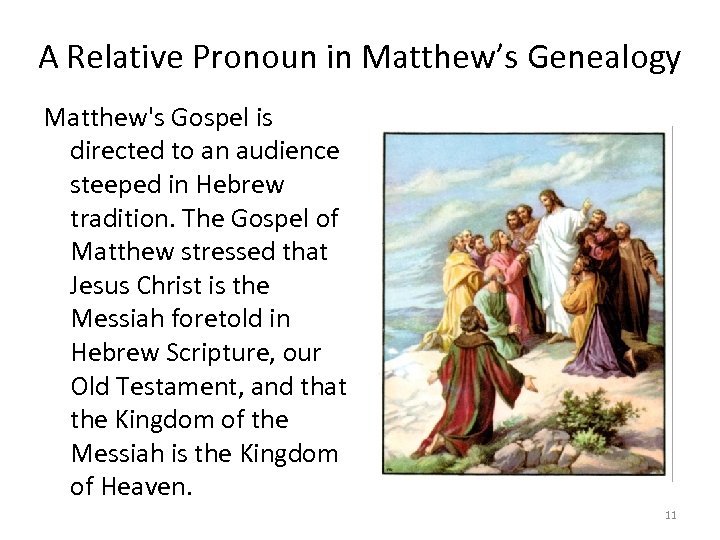 A Relative Pronoun in Matthew’s Genealogy Matthew's Gospel is directed to an audience steeped in Hebrew tradition. The Gospel of Matthew stressed that Jesus Christ is the Messiah foretold in Hebrew Scripture, our Old Testament, and that the Kingdom of the Messiah is the Kingdom of Heaven. 11
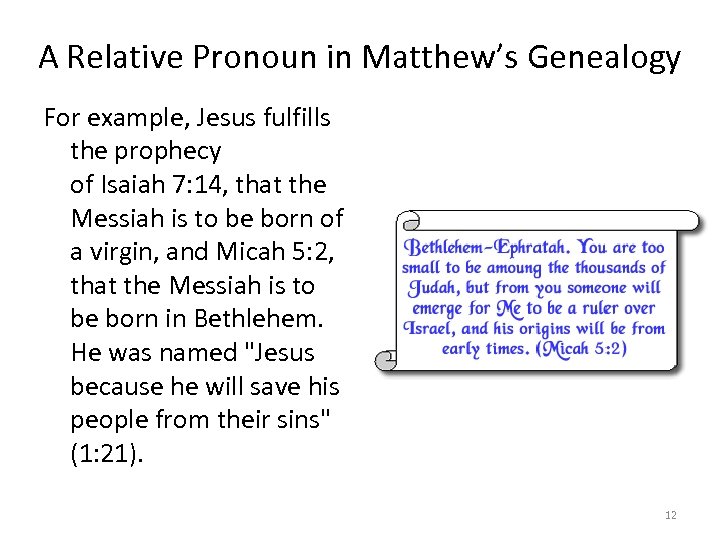 A Relative Pronoun in Matthew’s Genealogy For example, Jesus fulfills the prophecy of Isaiah 7: 14, that the Messiah is to be born of a virgin, and Micah 5: 2, that the Messiah is to be born in Bethlehem. He was named "Jesus because he will save his people from their sins" (1: 21). 12
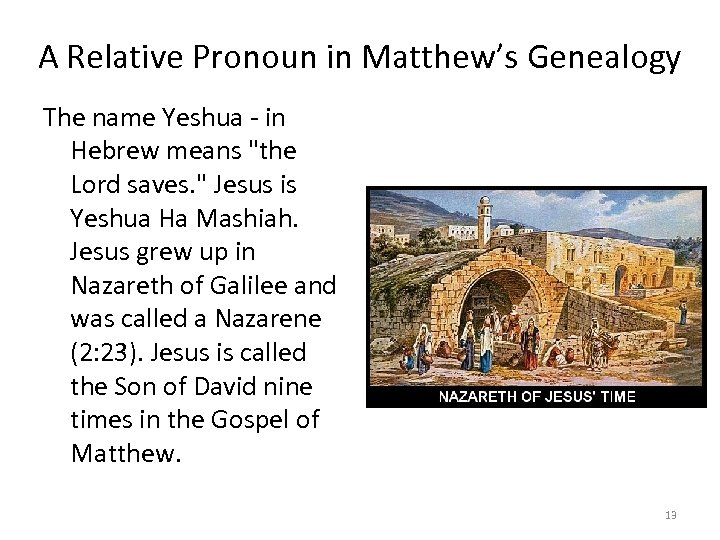 A Relative Pronoun in Matthew’s Genealogy The name Yeshua - in Hebrew means "the Lord saves. " Jesus is Yeshua Ha Mashiah. Jesus grew up in Nazareth of Galilee and was called a Nazarene (2: 23). Jesus is called the Son of David nine times in the Gospel of Matthew. 13
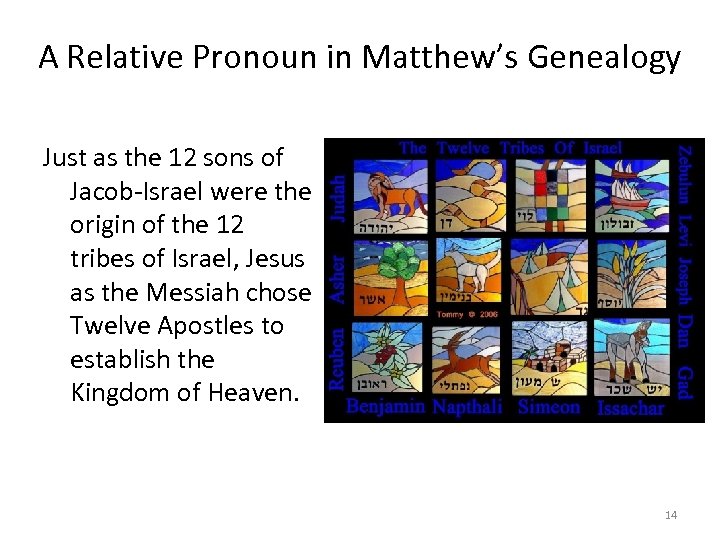 A Relative Pronoun in Matthew’s Genealogy Just as the 12 sons of Jacob-Israel were the origin of the 12 tribes of Israel, Jesus as the Messiah chose Twelve Apostles to establish the Kingdom of Heaven. 14
 A Relative Pronoun in Matthew’s Genealogy The Gospel begins with the genealogy of Jesus Christ, the Son of David, Matt. 1: 16 the son of Abraham “Jacob was the father of (1: 1). Matthew names Joseph, the husband of five women in the Mary—of whom Jesus Genealogy: Tamar, was born, who is called Rahab, Ruth, the wife of the Christ. ” Uriah (Bathsheba), and Mary, the mother of Jesus. 15
 A Relative Pronoun in Matthew’s Genealogy The genealogy regularly notes the male who fathers a child, but Matt. 1: 16 Matthew delivers an “Jacob was the father of exact, grammatically Joseph, the husband of restrictive statement Mary—of whom Jesus when he reaches was born, who is called Joseph, "the husband of the Christ. ” Mary, of whom Jesus was born. " 16
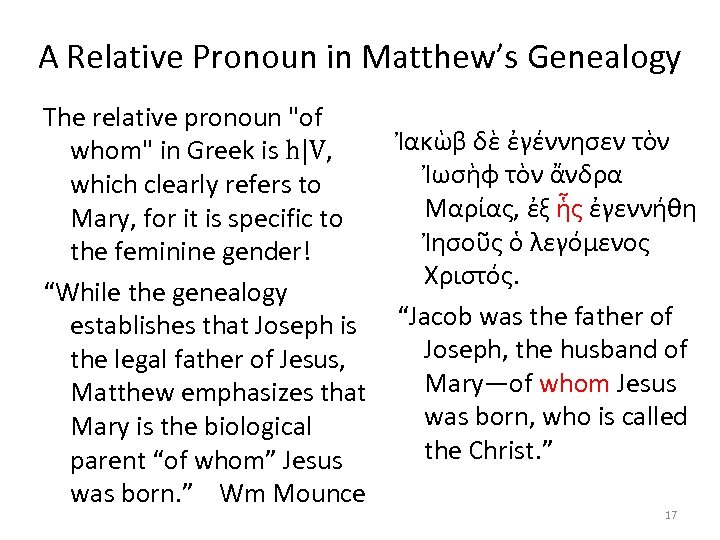 A Relative Pronoun in Matthew’s Genealogy The relative pronoun "of Ἰακὼβ δὲ ἐγέννησεν τὸν whom" in Greek is h|V, Ἰωσὴφ τὸν ἄνδρα which clearly refers to Μαρίας, ἐξ ἧς ἐγεννήθη Mary, for it is specific to Ἰησοῦς ὁ λεγόμενος the feminine gender! Χριστός. “While the genealogy establishes that Joseph is “Jacob was the father of Joseph, the husband of the legal father of Jesus, Mary—of whom Jesus Matthew emphasizes that was born, who is called Mary is the biological the Christ. ” parent “of whom” Jesus was born. ” Wm Mounce 17
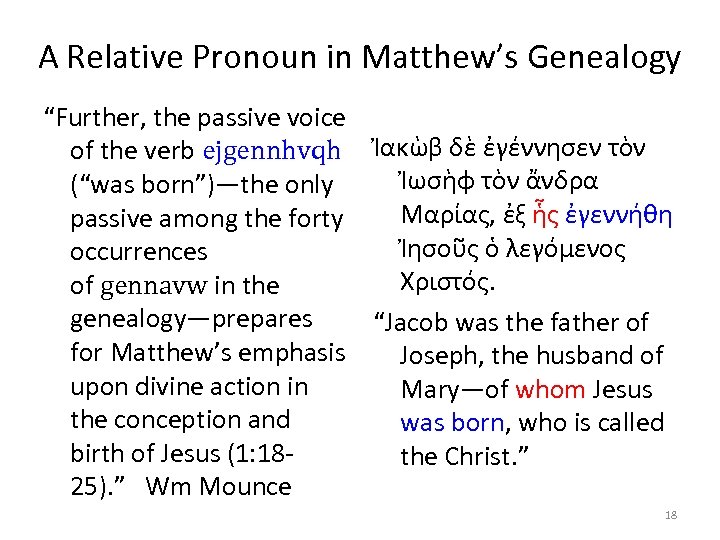 A Relative Pronoun in Matthew’s Genealogy “Further, the passive voice of the verb ejgennhvqh Ἰακὼβ δὲ ἐγέννησεν τὸν Ἰωσὴφ τὸν ἄνδρα (“was born”)—the only Μαρίας, ἐξ ἧς ἐγεννήθη passive among the forty Ἰησοῦς ὁ λεγόμενος occurrences Χριστός. of gennavw in the genealogy—prepares “Jacob was the father of for Matthew’s emphasis Joseph, the husband of upon divine action in Mary—of whom Jesus the conception and was born, who is called birth of Jesus (1: 18 the Christ. ” 25). ” Wm Mounce 18
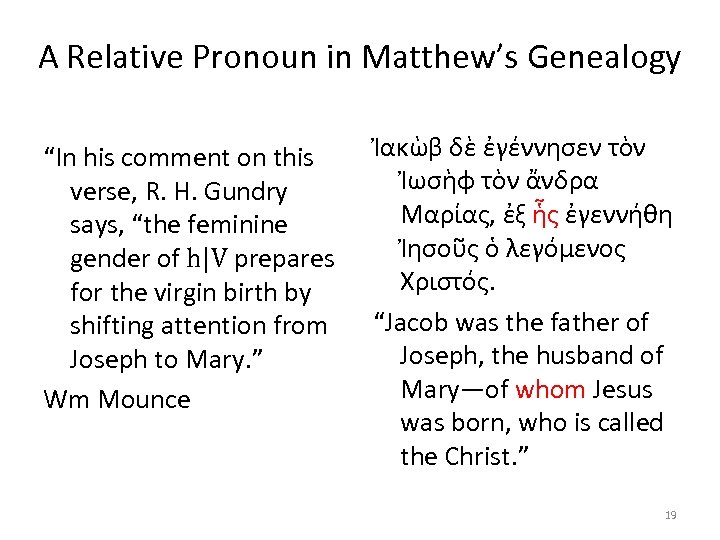 A Relative Pronoun in Matthew’s Genealogy “In his comment on this verse, R. H. Gundry says, “the feminine gender of h|V prepares for the virgin birth by shifting attention from Joseph to Mary. ” Wm Mounce Ἰακὼβ δὲ ἐγέννησεν τὸν Ἰωσὴφ τὸν ἄνδρα Μαρίας, ἐξ ἧς ἐγεννήθη Ἰησοῦς ὁ λεγόμενος Χριστός. “Jacob was the father of Joseph, the husband of Mary—of whom Jesus was born, who is called the Christ. ” 19
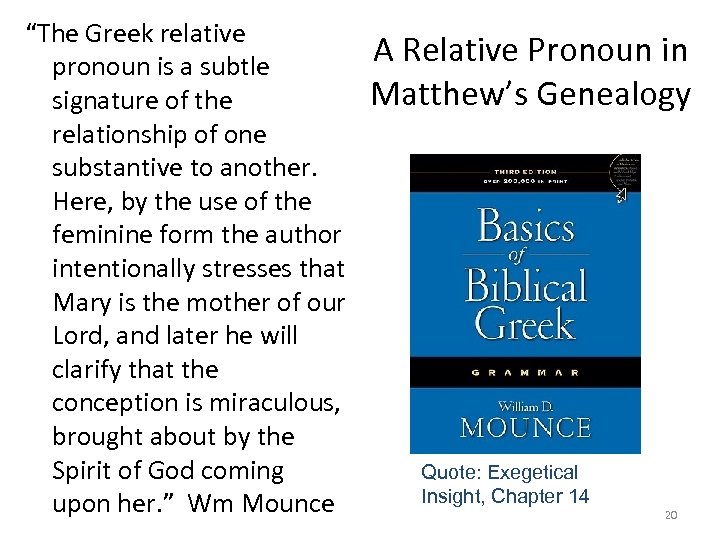 “The Greek relative pronoun is a subtle signature of the relationship of one substantive to another. Here, by the use of the feminine form the author intentionally stresses that Mary is the mother of our Lord, and later he will clarify that the conception is miraculous, brought about by the Spirit of God coming upon her. ” Wm Mounce A Relative Pronoun in Matthew’s Genealogy Quote: Exegetical Insight, Chapter 14 20
 The Beatitudes 21
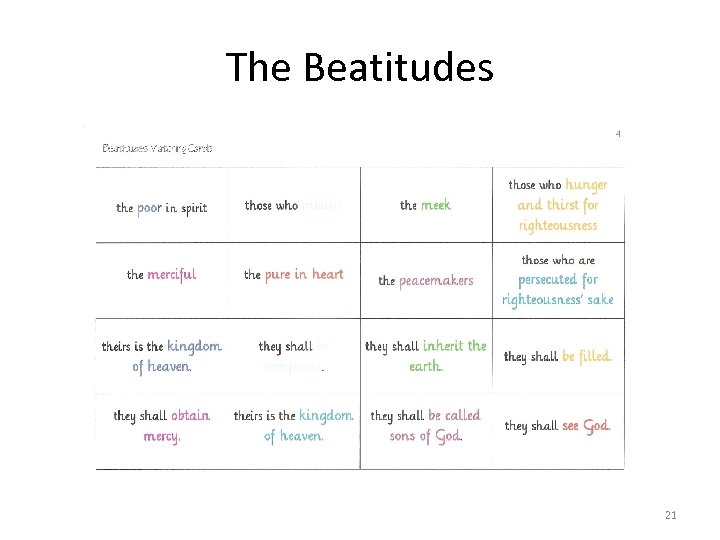
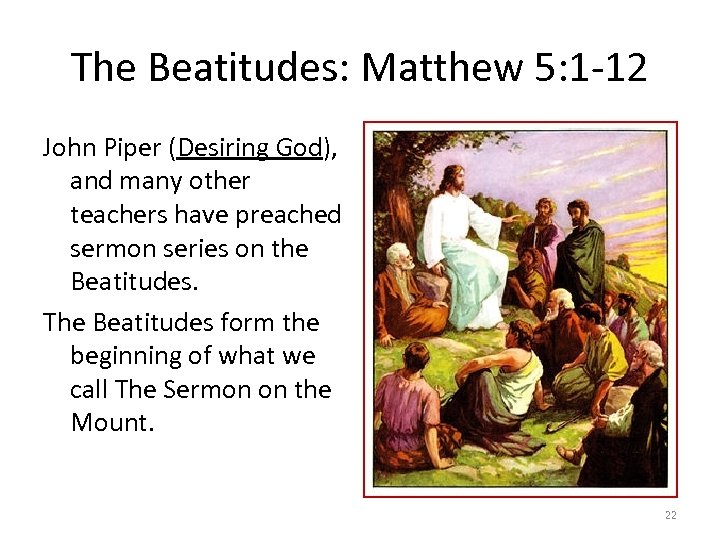 The Beatitudes: Matthew 5: 1 -12 John Piper (Desiring God), and many other teachers have preached sermon series on the Beatitudes. The Beatitudes form the beginning of what we call The Sermon on the Mount. 22
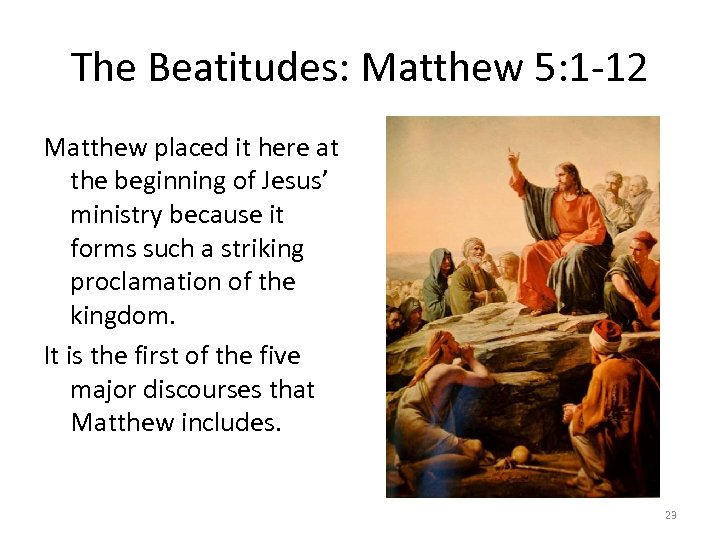 The Beatitudes: Matthew 5: 1 -12 Matthew placed it here at the beginning of Jesus’ ministry because it forms such a striking proclamation of the kingdom. It is the first of the five major discourses that Matthew includes. 23
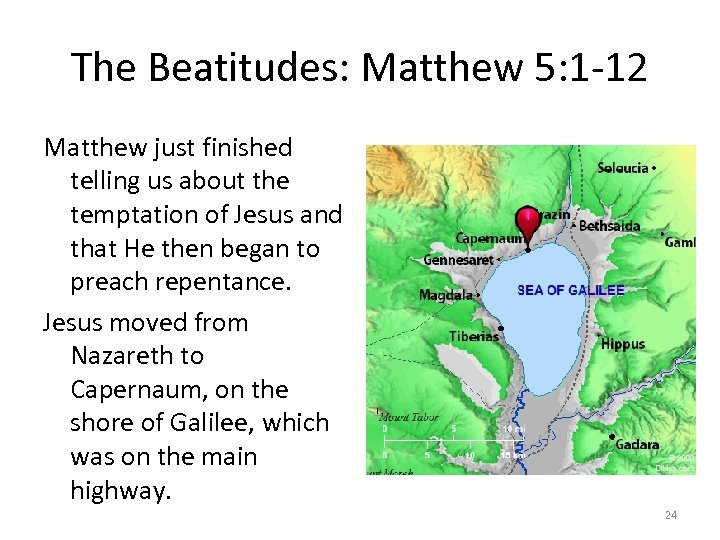 The Beatitudes: Matthew 5: 1 -12 Matthew just finished telling us about the temptation of Jesus and that He then began to preach repentance. Jesus moved from Nazareth to Capernaum, on the shore of Galilee, which was on the main highway. 24
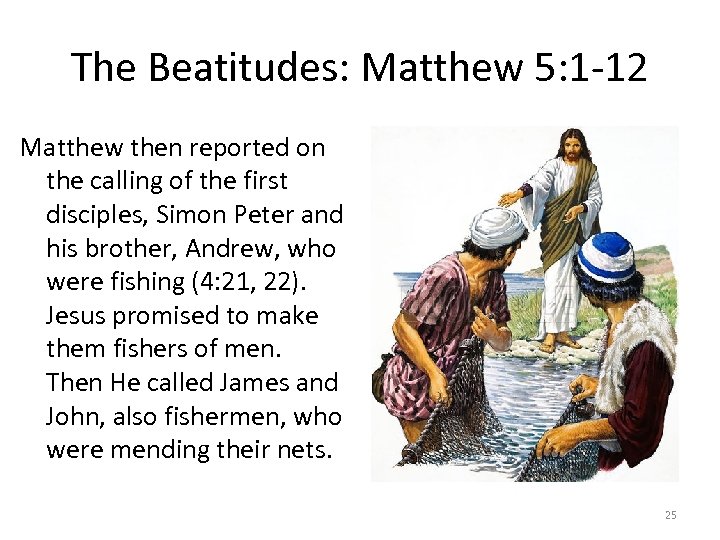 The Beatitudes: Matthew 5: 1 -12 Matthew then reported on the calling of the first disciples, Simon Peter and his brother, Andrew, who were fishing (4: 21, 22). Jesus promised to make them fishers of men. Then He called James and John, also fishermen, who were mending their nets. 25
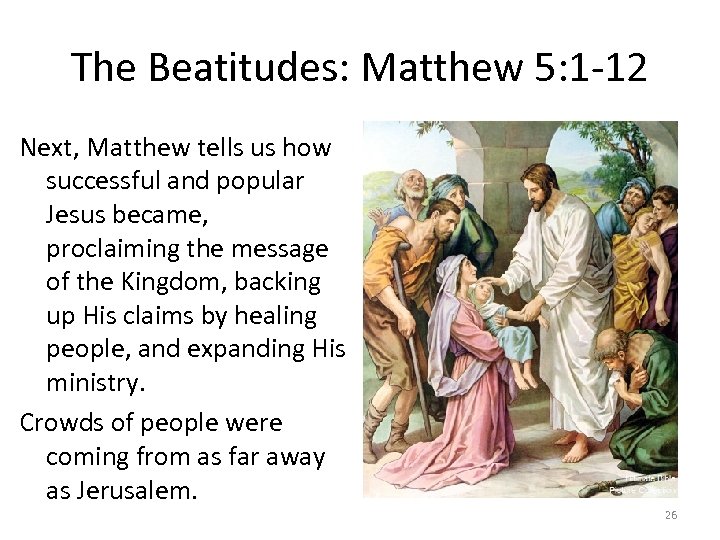 The Beatitudes: Matthew 5: 1 -12 Next, Matthew tells us how successful and popular Jesus became, proclaiming the message of the Kingdom, backing up His claims by healing people, and expanding His ministry. Crowds of people were coming from as far away as Jerusalem. 26
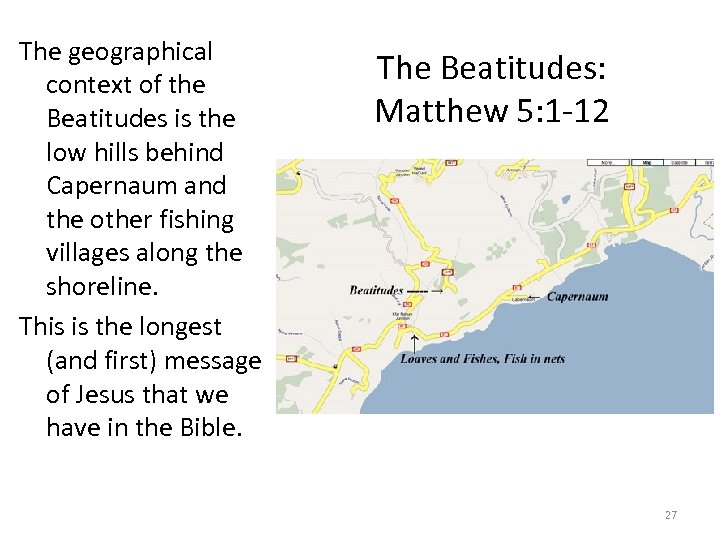 The geographical context of the Beatitudes is the low hills behind Capernaum and the other fishing villages along the shoreline. This is the longest (and first) message of Jesus that we have in the Bible. The Beatitudes: Matthew 5: 1 -12 27
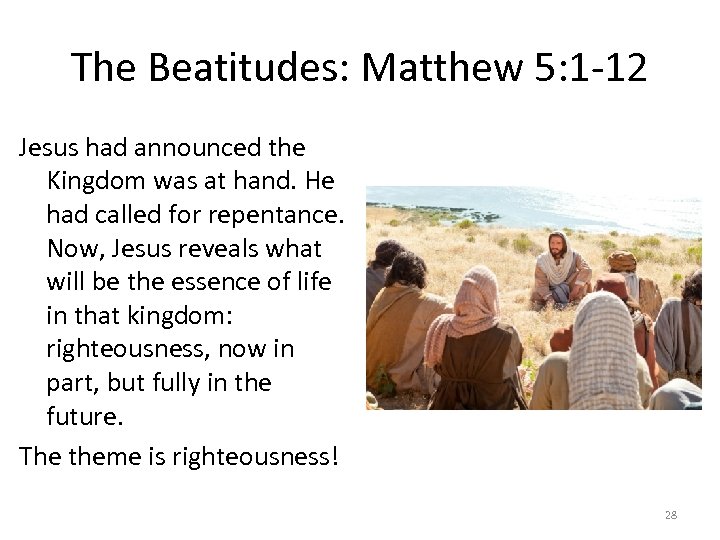 The Beatitudes: Matthew 5: 1 -12 Jesus had announced the Kingdom was at hand. He had called for repentance. Now, Jesus reveals what will be the essence of life in that kingdom: righteousness, now in part, but fully in the future. The theme is righteousness! 28
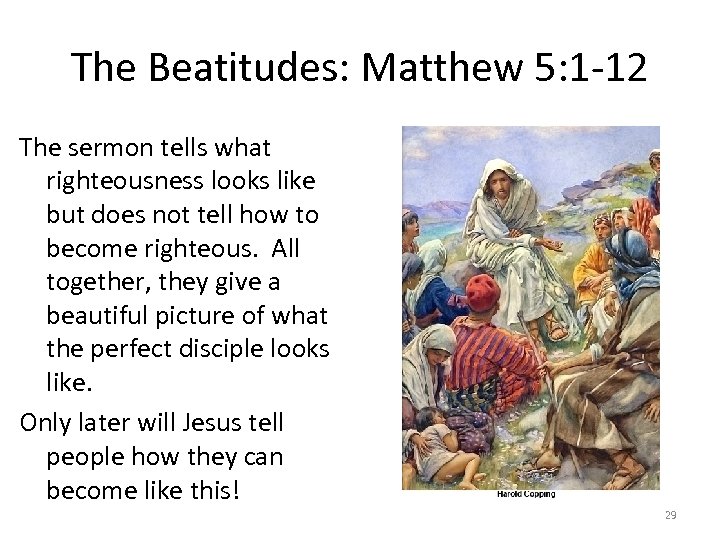 The Beatitudes: Matthew 5: 1 -12 The sermon tells what righteousness looks like but does not tell how to become righteous. All together, they give a beautiful picture of what the perfect disciple looks like. Only later will Jesus tell people how they can become like this! 29
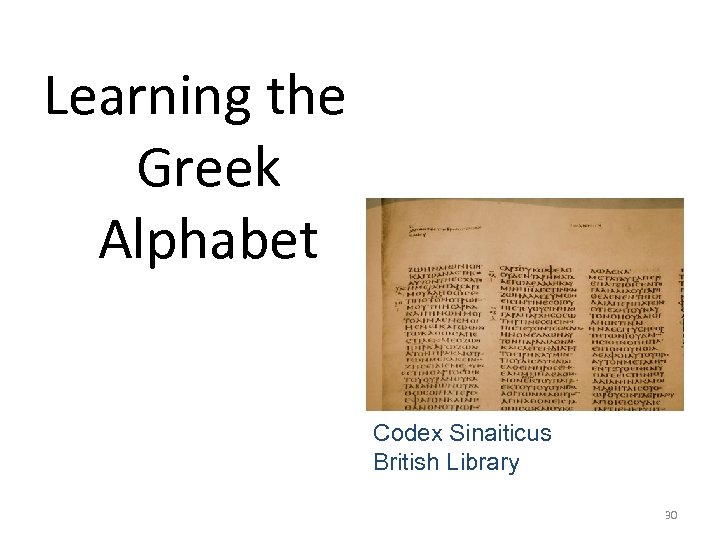 Learning the Greek Alphabet Codex Sinaiticus British Library 30
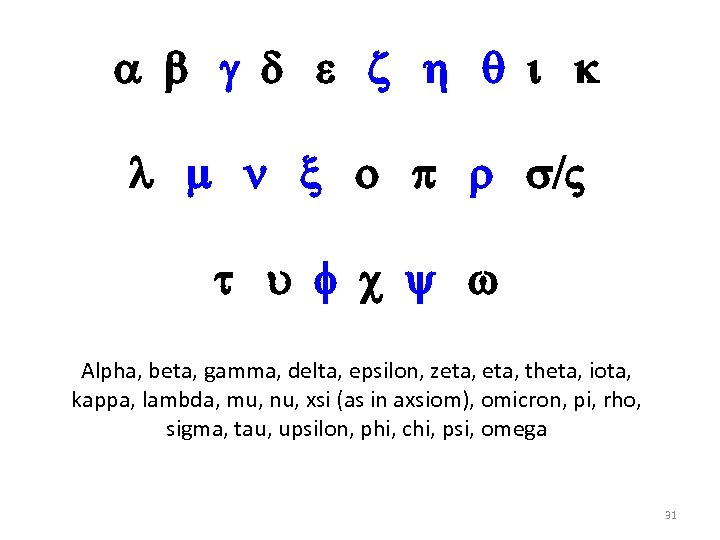 a b g d e z h q i k l m n x o p r s/ t u f c y w Alpha, beta, gamma, delta, epsilon, zeta, theta, iota, kappa, lambda, mu, nu, xsi (as in axsiom), omicron, pi, rho, sigma, tau, upsilon, phi, chi, psi, omega 31
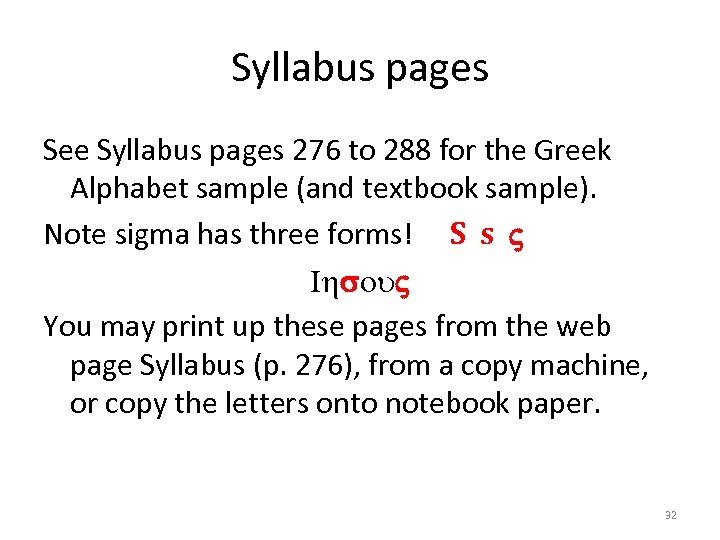 Syllabus pages See Syllabus pages 276 to 288 for the Greek Alphabet sample (and textbook sample). Note sigma has three forms! S s Ihsou You may print up these pages from the web page Syllabus (p. 276), from a copy machine, or copy the letters onto notebook paper. 32
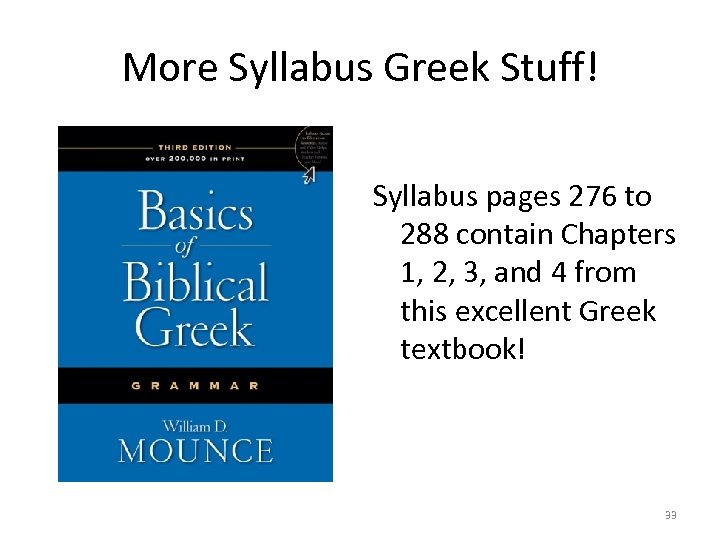 More Syllabus Greek Stuff! Syllabus pages 276 to 288 contain Chapters 1, 2, 3, and 4 from this excellent Greek textbook! 33
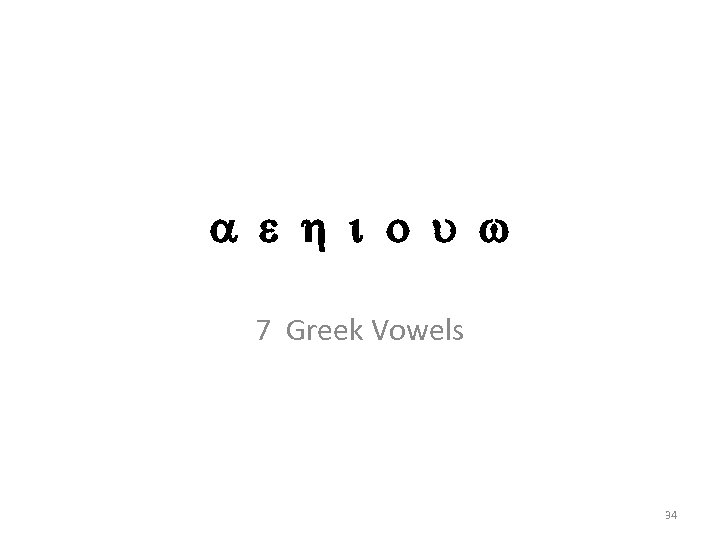 a e h i o u w 7 Greek Vowels 34
 Vowels are similar to English vowels No one knows what ancient Greek sounded like! 35
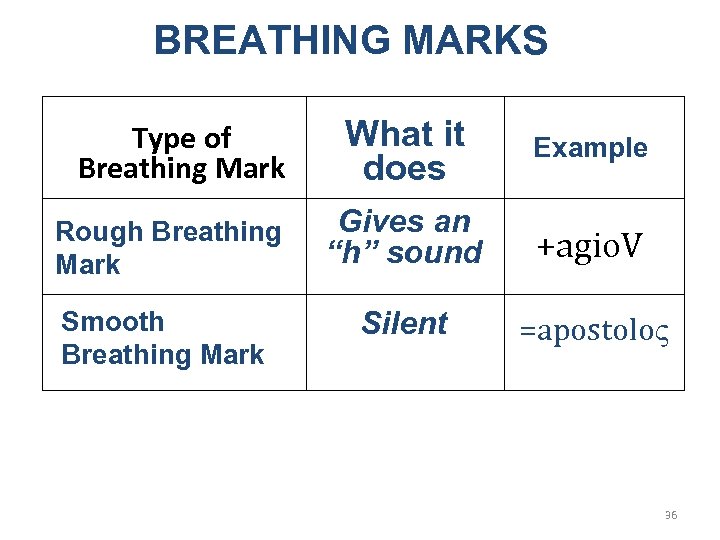 BREATHING MARKS What it does Example Rough Breathing Mark Gives an “h” sound +agio. V Smooth Breathing Mark Silent =apostolo Type of Breathing Mark 36
 ) soft breathing mark Any word that starts with a vowel has a breathing mark over it 37
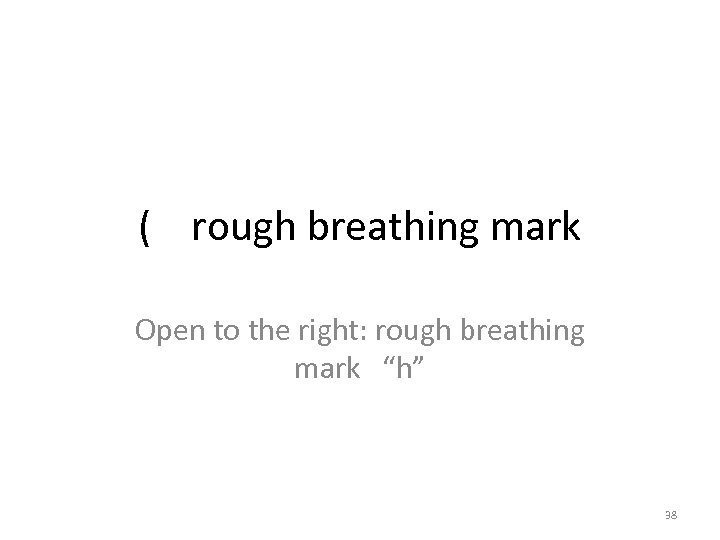 ( rough breathing mark Open to the right: rough breathing mark “h” 38
 Ou ai ei oi ui Dipthongs: 2 vowels make one sound Oo; ai as in aisle; ei as in eight; oi as in oil; ui as in suite 39
 The Greek Alphabet From Alpha to Omega Letter by Letter! 40
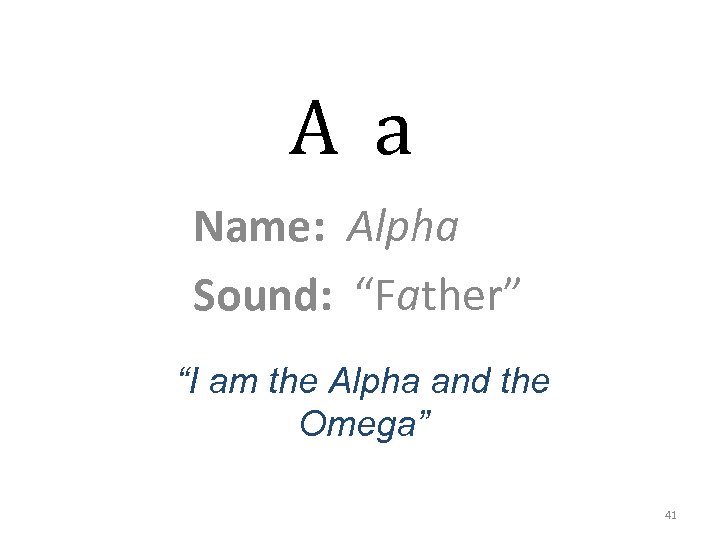 A a Name: Alpha Sound: “Father” “I am the Alpha and the Omega” 41
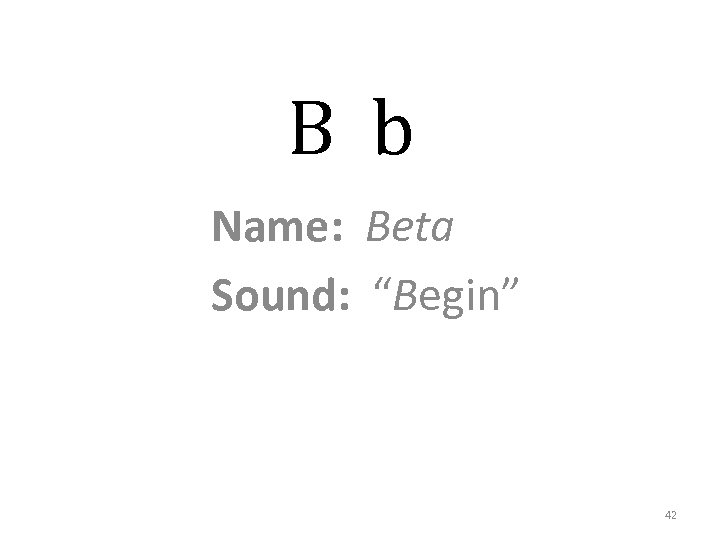 B b Name: Beta Sound: “Begin” 42
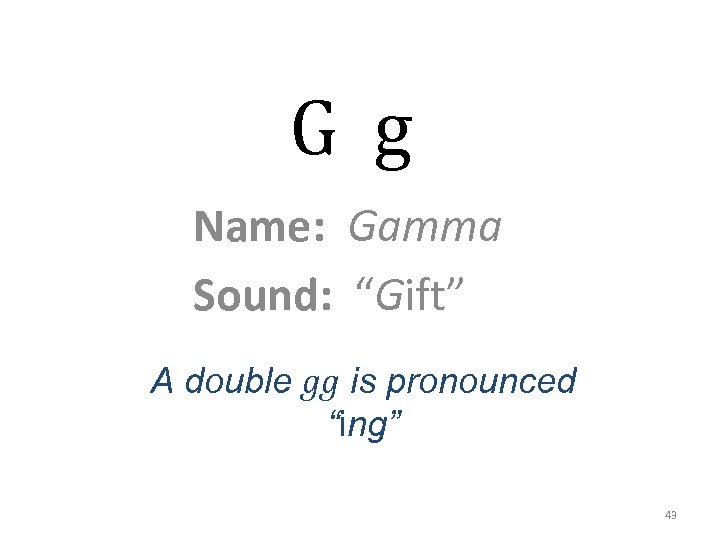 G g Name: Gamma Sound: “Gift” A double gg is pronounced “ing” 43
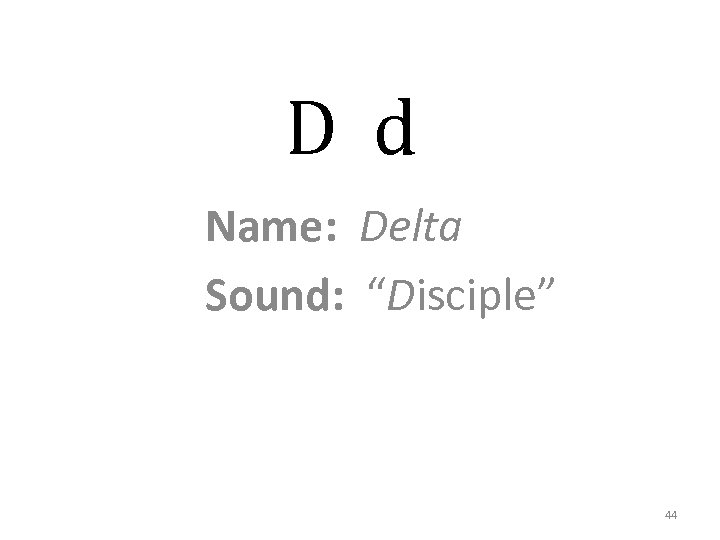 D d Name: Delta Sound: “Disciple” 44
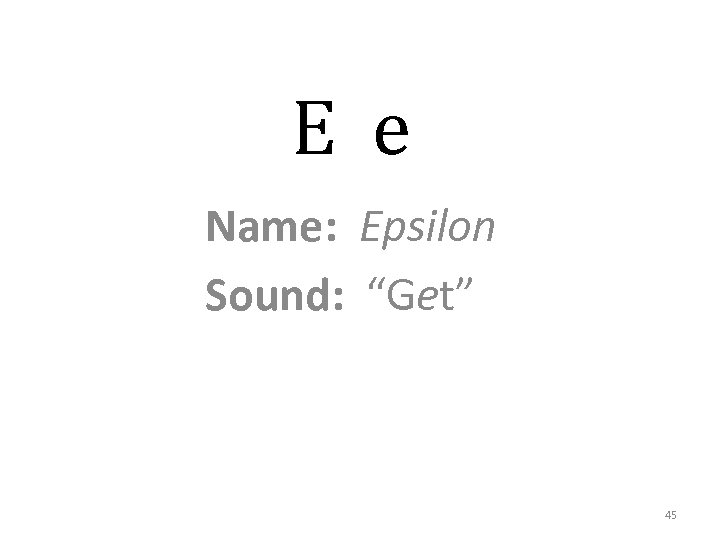 E e Name: Epsilon Sound: “Get” 45
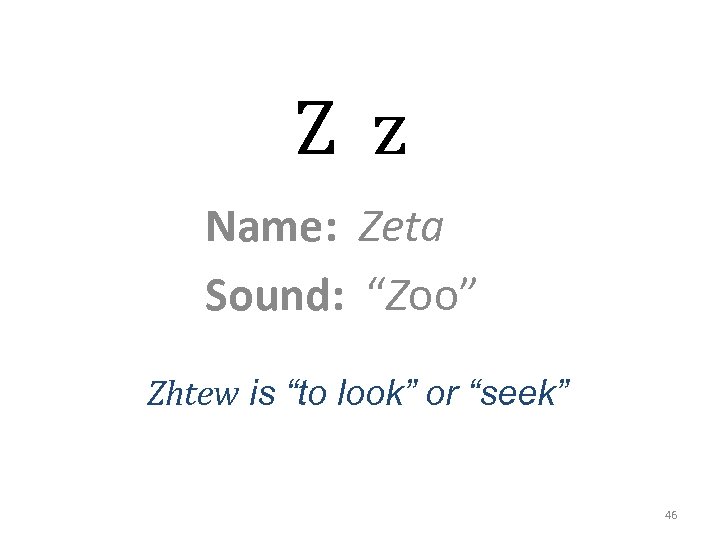 Z z Name: Zeta Sound: “Zoo” Zhtew is “to look” or “seek” 46
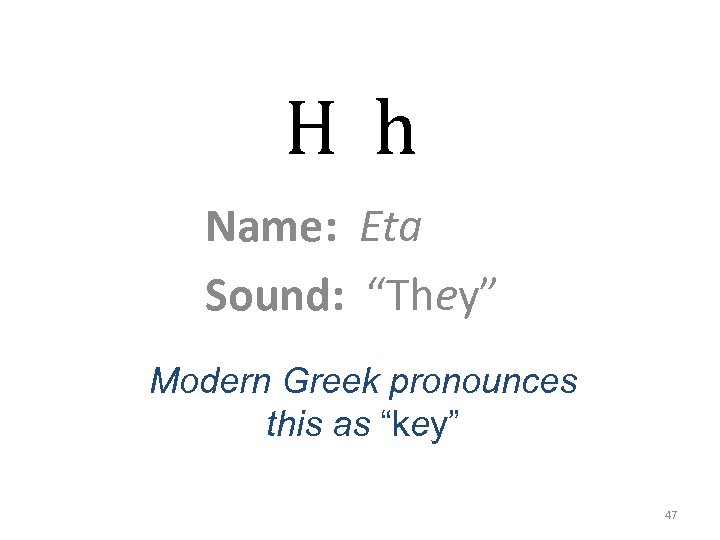 H h Name: Eta Sound: “They” Modern Greek pronounces this as “key” 47
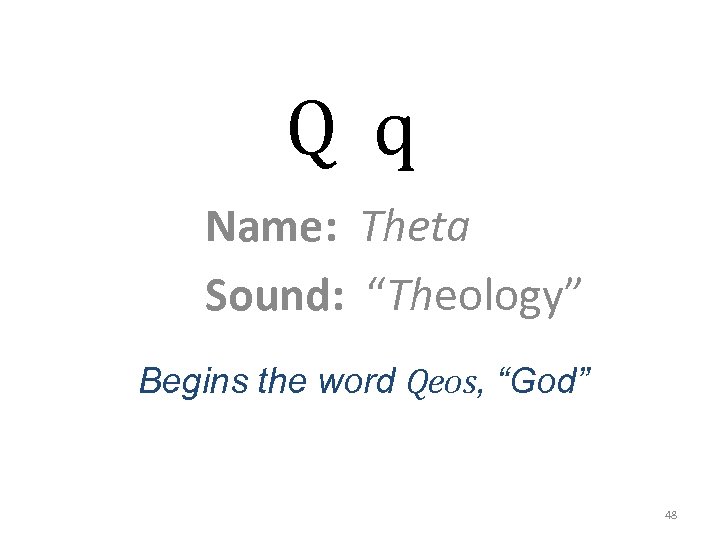 Q q Name: Theta Sound: “Theology” Begins the word Qeos, “God” 48
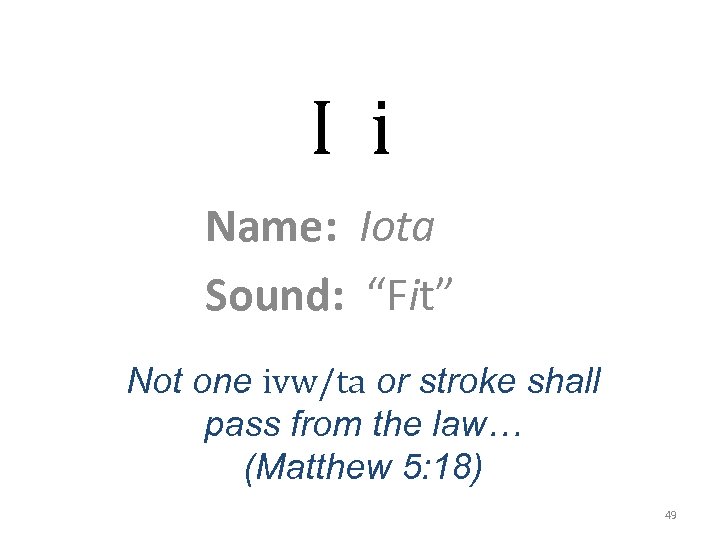 I i Name: Iota Sound: “Fit” Not one ivw/ta or stroke shall pass from the law… (Matthew 5: 18) 49
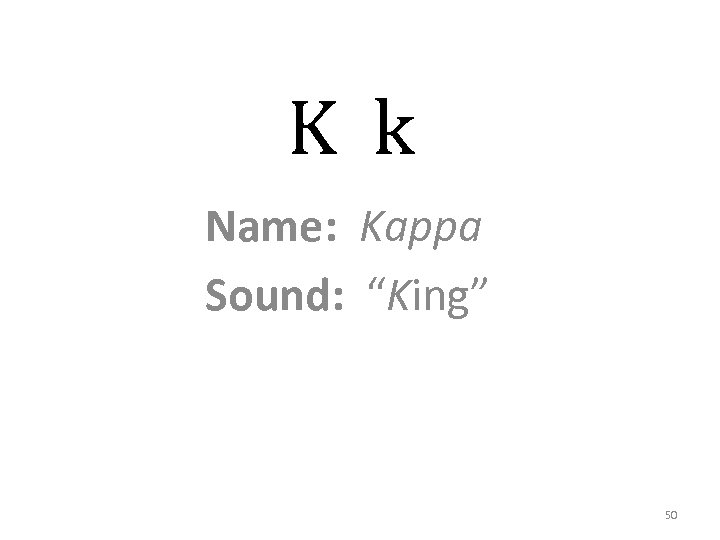 K k Name: Kappa Sound: “King” 50
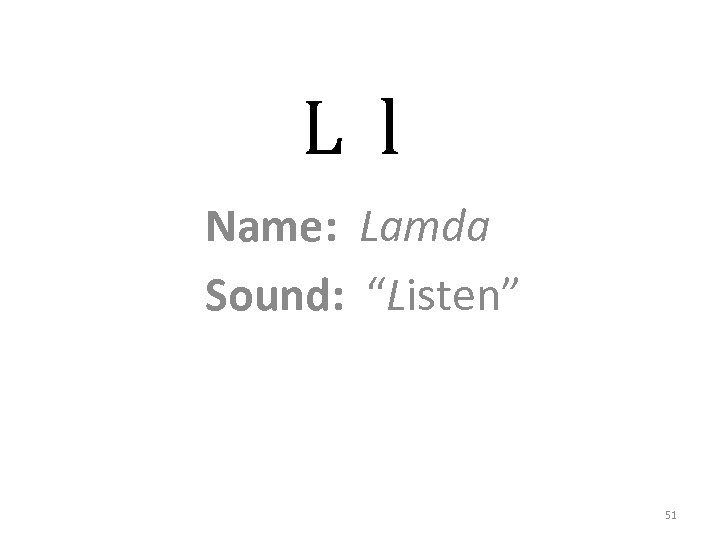 L l Name: Lamda Sound: “Listen” 51
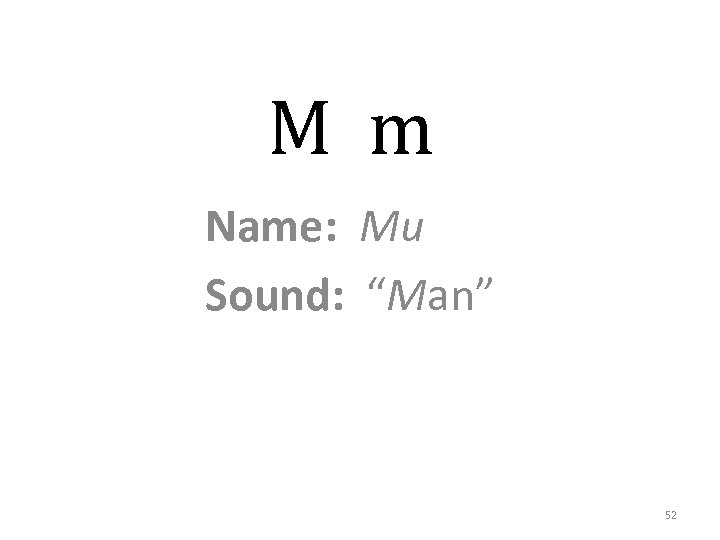 M m Name: Mu Sound: “Man” 52
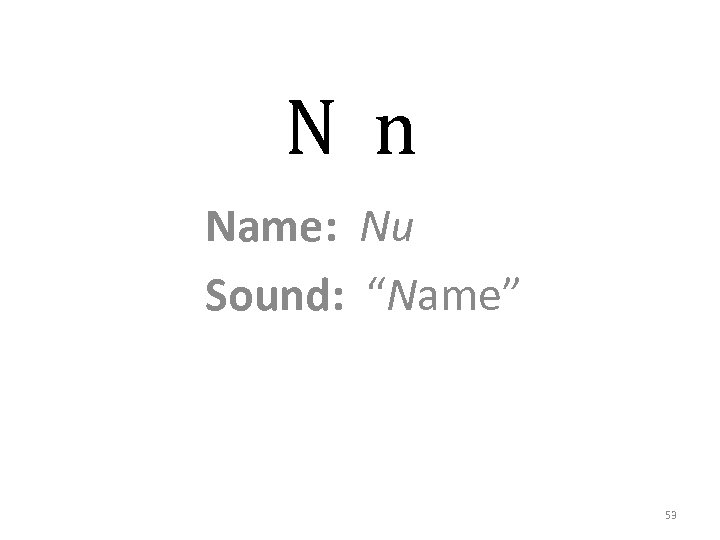 N n Name: Nu Sound: “Name” 53
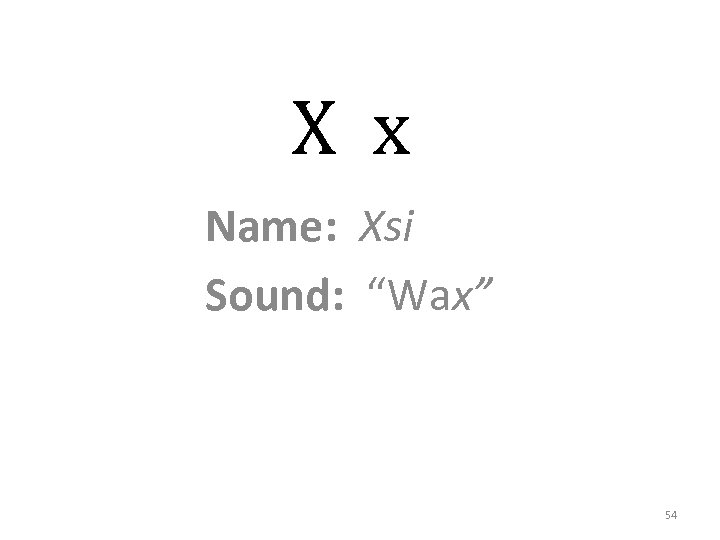 X x Name: Xsi Sound: “Wax” 54
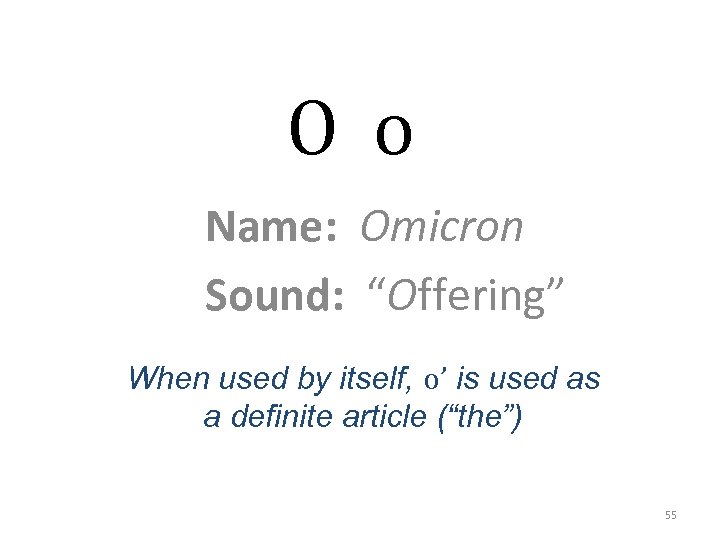 O o Name: Omicron Sound: “Offering” When used by itself, o’ is used as a definite article (“the”) 55
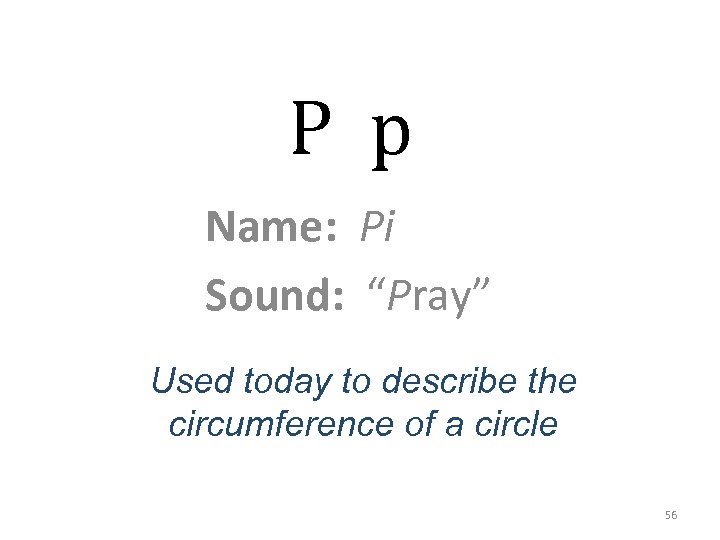 P p Name: Pi Sound: “Pray” Used today to describe the circumference of a circle 56
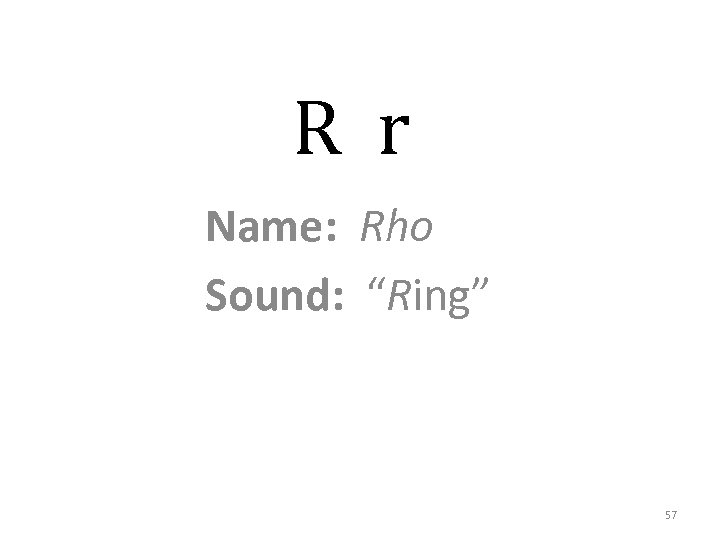 R r Name: Rho Sound: “Ring” 57
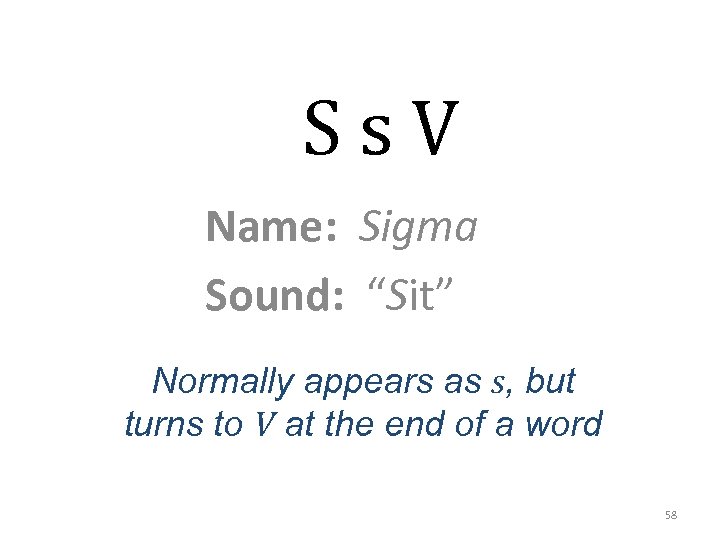 Ss. V Name: Sigma Sound: “Sit” Normally appears as s, but turns to V at the end of a word 58
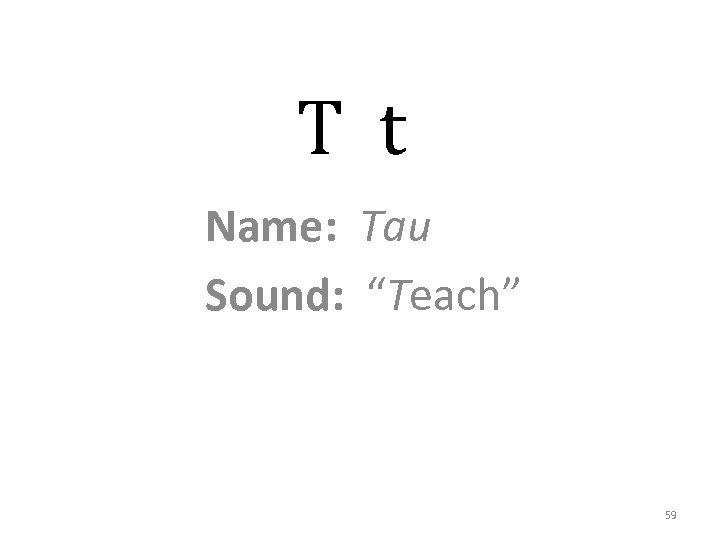 T t Name: Tau Sound: “Teach” 59
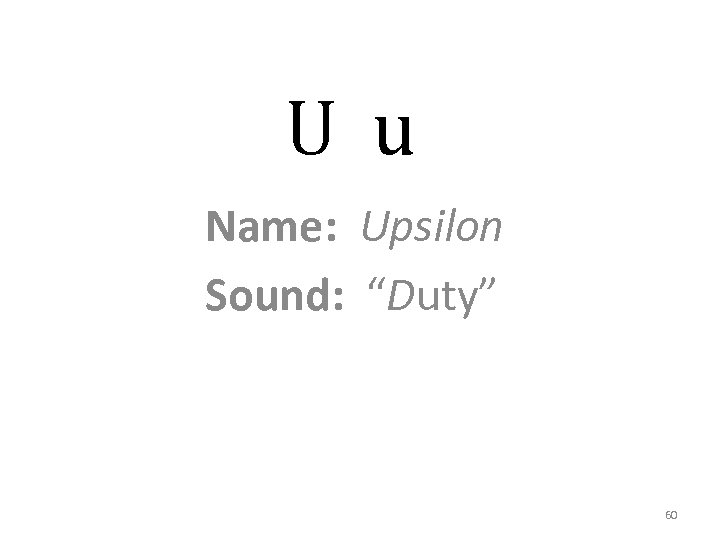 U u Name: Upsilon Sound: “Duty” 60
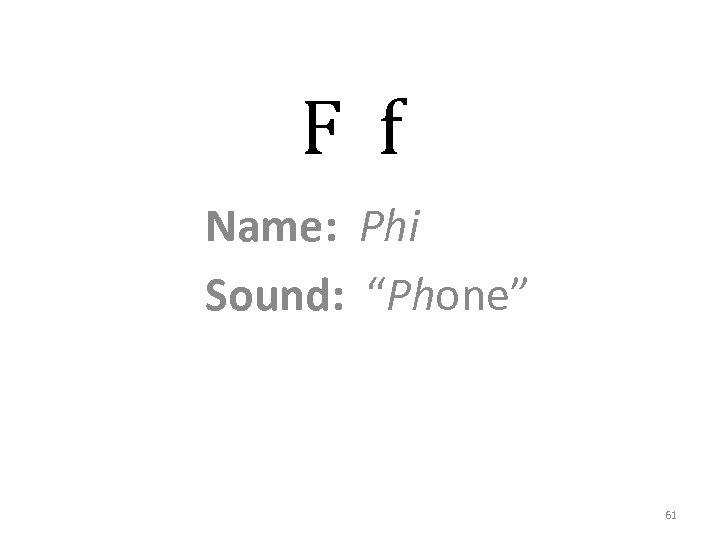 F f Name: Phi Sound: “Phone” 61
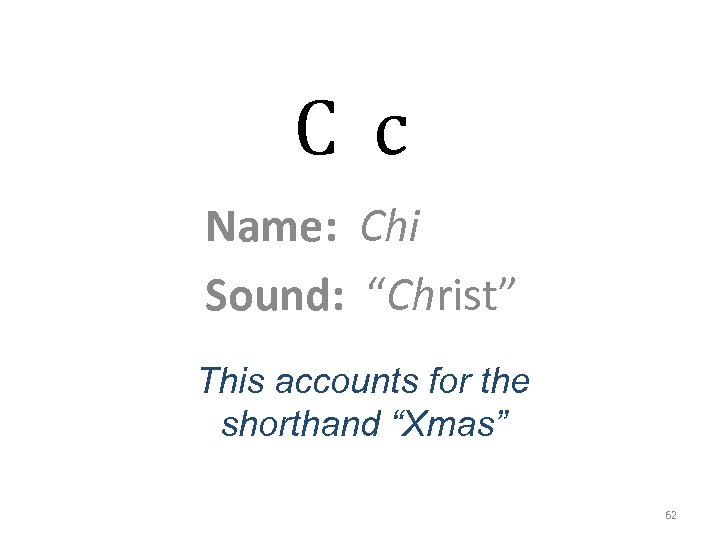 C c Name: Chi Sound: “Christ” This accounts for the shorthand “Xmas” 62
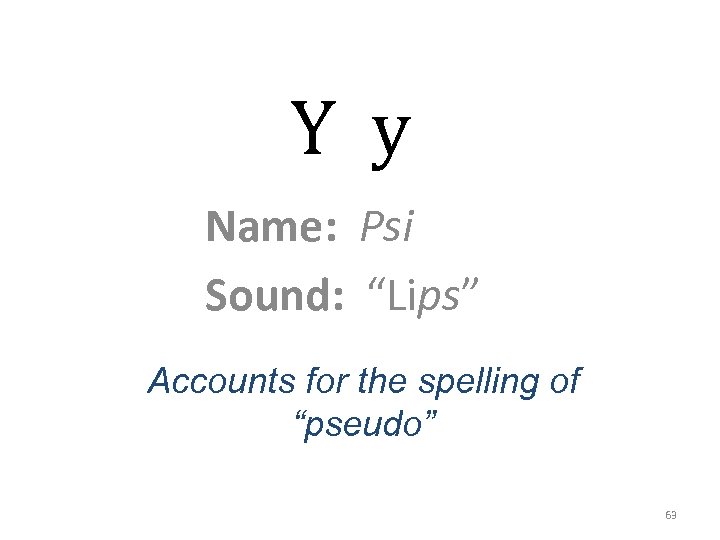 Y y Name: Psi Sound: “Lips” Accounts for the spelling of “pseudo” 63
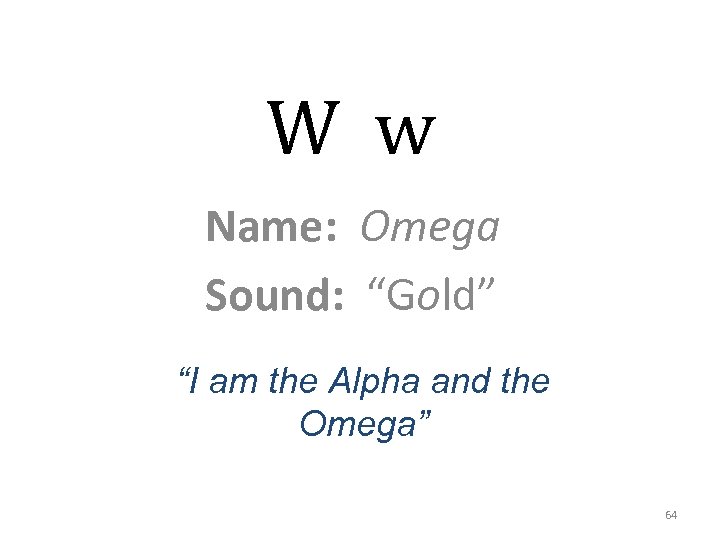 W w Name: Omega Sound: “Gold” “I am the Alpha and the Omega” 64
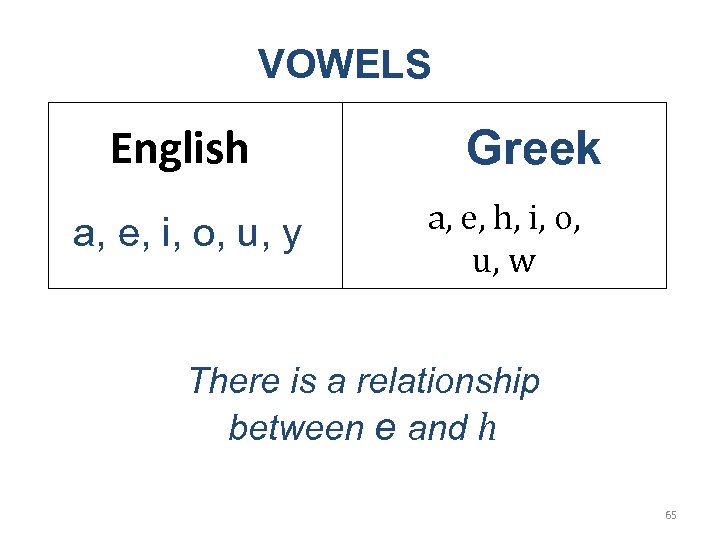 VOWELS English a, e, i, o, u, y Greek a, e, h, i, o, u, w There is a relationship between e and h 65
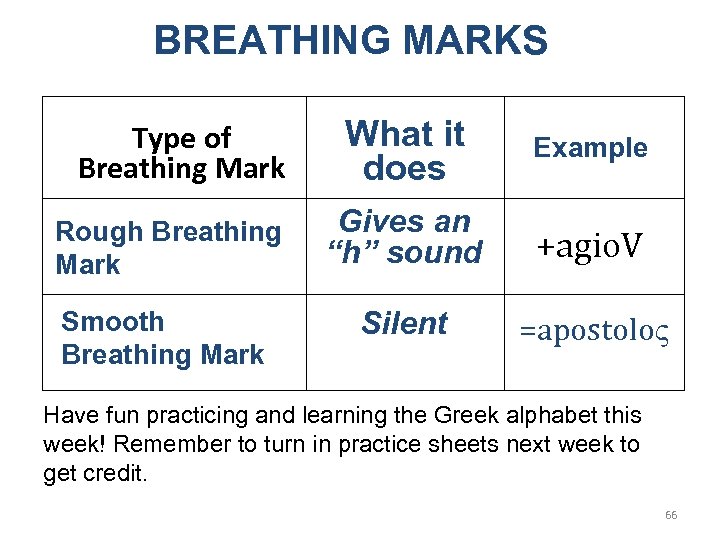 BREATHING MARKS What it does Example Rough Breathing Mark Gives an “h” sound +agio. V Smooth Breathing Mark Silent =apostolo Type of Breathing Mark Have fun practicing and learning the Greek alphabet this week! Remember to turn in practice sheets next week to get credit. 66
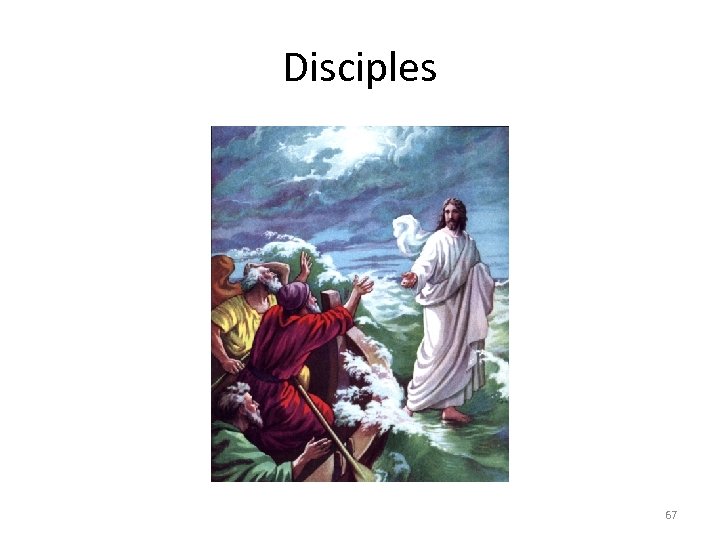 Disciples 67
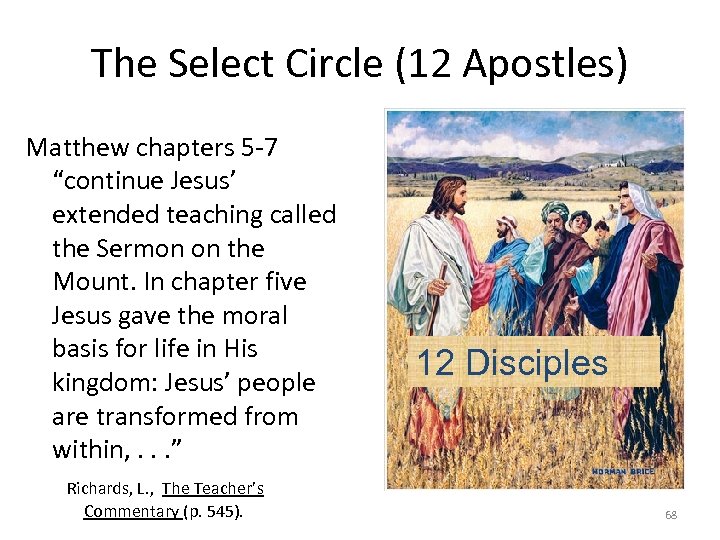 The Select Circle (12 Apostles) Matthew chapters 5 -7 “continue Jesus’ extended teaching called the Sermon on the Mount. In chapter five Jesus gave the moral basis for life in His kingdom: Jesus’ people are transformed from within, . . . ” 12 Disciples Richards, L. , The Teacher’s Commentary (p. 545). 68
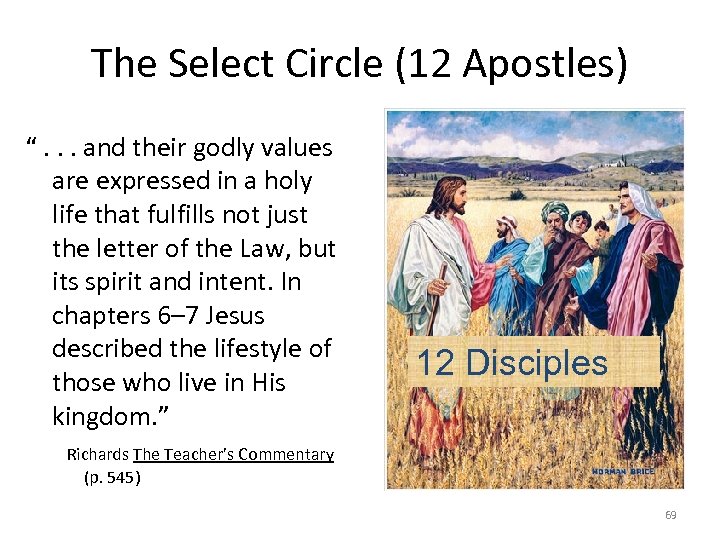 The Select Circle (12 Apostles) “. . . and their godly values are expressed in a holy life that fulfills not just the letter of the Law, but its spirit and intent. In chapters 6– 7 Jesus described the lifestyle of those who live in His kingdom. ” 12 Disciples Richards The Teacher’s Commentary (p. 545) 69
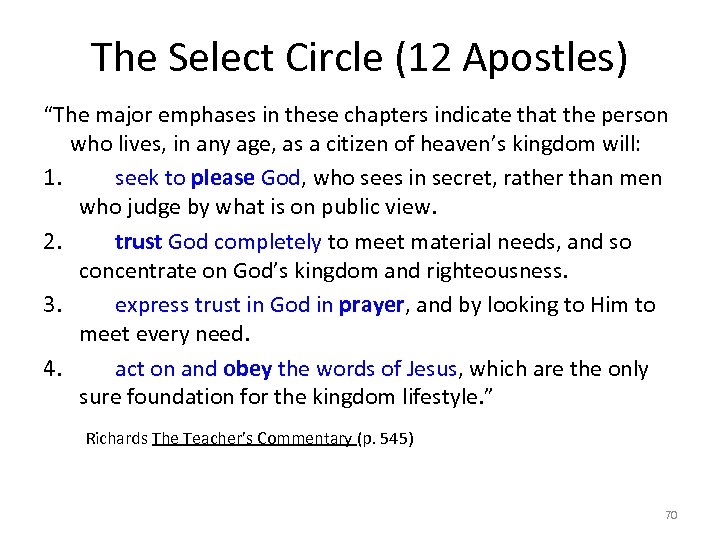 The Select Circle (12 Apostles) “The major emphases in these chapters indicate that the person who lives, in any age, as a citizen of heaven’s kingdom will: 1. seek to please God, who sees in secret, rather than men who judge by what is on public view. 2. trust God completely to meet material needs, and so concentrate on God’s kingdom and righteousness. 3. express trust in God in prayer, and by looking to Him to meet every need. 4. act on and obey the words of Jesus, which are the only sure foundation for the kingdom lifestyle. ” Richards The Teacher’s Commentary (p. 545) 70
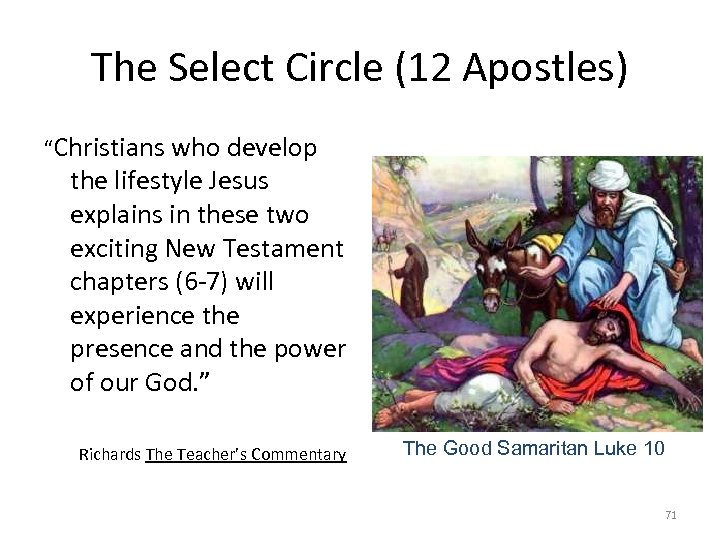 The Select Circle (12 Apostles) “Christians who develop the lifestyle Jesus explains in these two exciting New Testament chapters (6 -7) will experience the presence and the power of our God. ” Richards The Teacher’s Commentary The Good Samaritan Luke 10 71
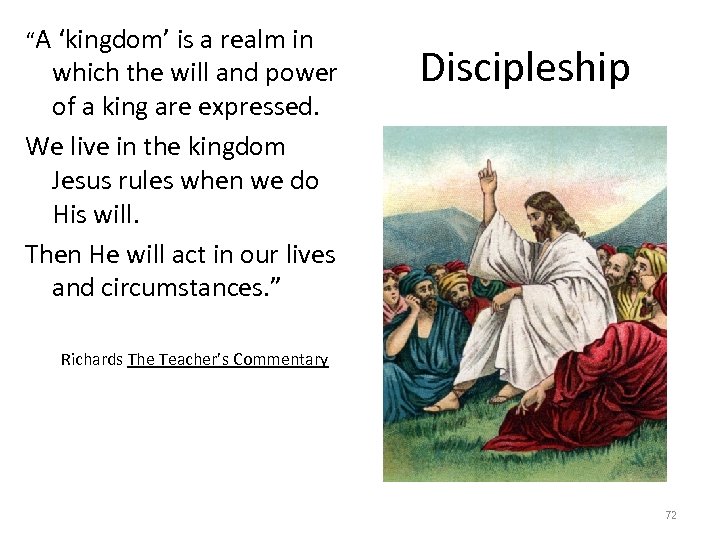 “A ‘kingdom’ is a realm in which the will and power of a king are expressed. We live in the kingdom Jesus rules when we do His will. Then He will act in our lives and circumstances. ” Discipleship Richards The Teacher’s Commentary The Good Samaritan Luke 10 72
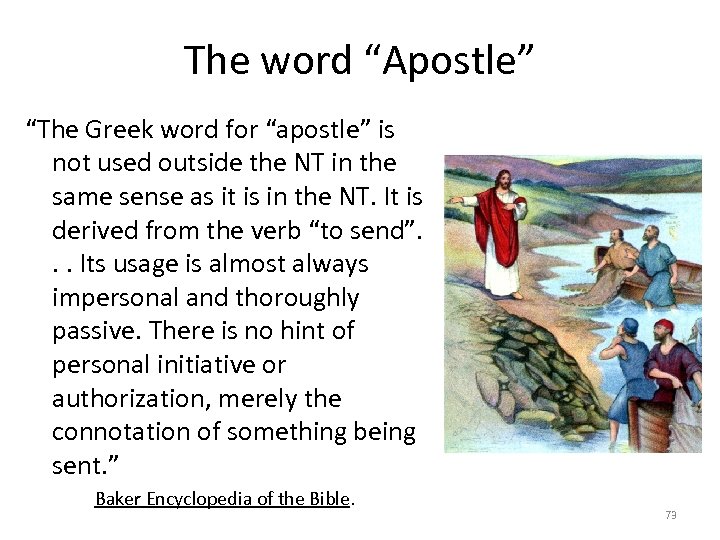 The word “Apostle” “The Greek word for “apostle” is not used outside the NT in the same sense as it is in the NT. It is derived from the verb “to send”. . . Its usage is almost always impersonal and thoroughly passive. There is no hint of personal initiative or authorization, merely the connotation of something being sent. ” Baker Encyclopedia of the Bible. 73
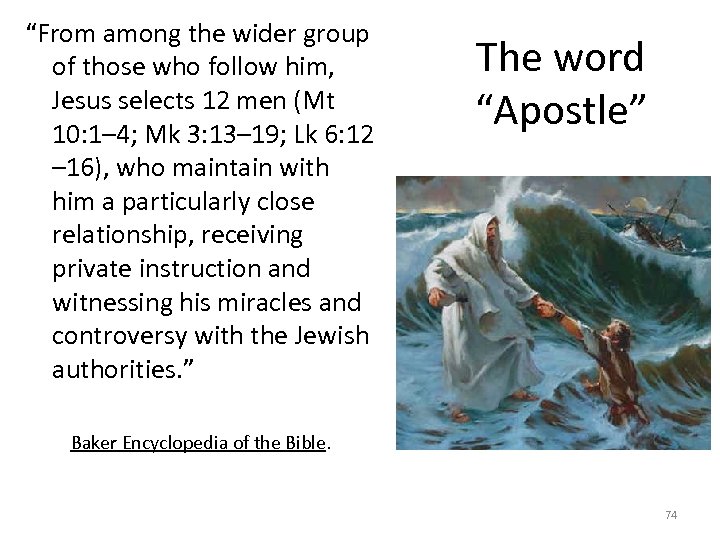 “From among the wider group of those who follow him, Jesus selects 12 men (Mt 10: 1– 4; Mk 3: 13– 19; Lk 6: 12 – 16), who maintain with him a particularly close relationship, receiving private instruction and witnessing his miracles and controversy with the Jewish authorities. ” The word “Apostle” Baker Encyclopedia of the Bible. 74
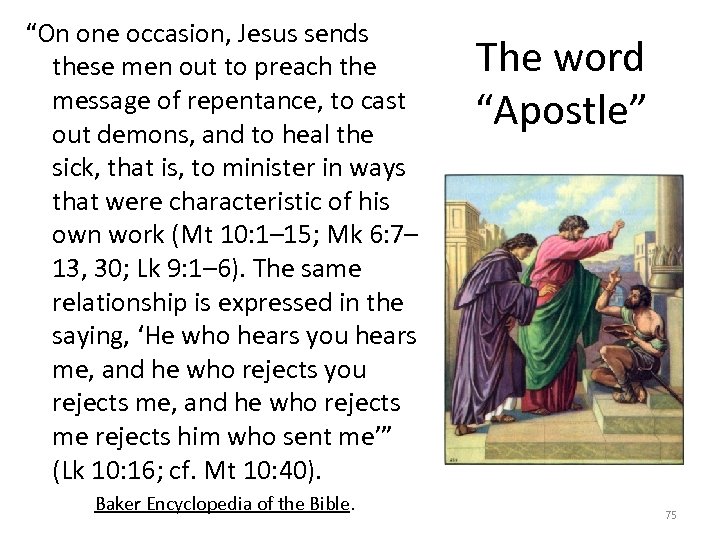 “On one occasion, Jesus sends these men out to preach the message of repentance, to cast out demons, and to heal the sick, that is, to minister in ways that were characteristic of his own work (Mt 10: 1– 15; Mk 6: 7– 13, 30; Lk 9: 1– 6). The same relationship is expressed in the saying, ‘He who hears you hears me, and he who rejects you rejects me, and he who rejects me rejects him who sent me’” (Lk 10: 16; cf. Mt 10: 40). Baker Encyclopedia of the Bible. The word “Apostle” 75
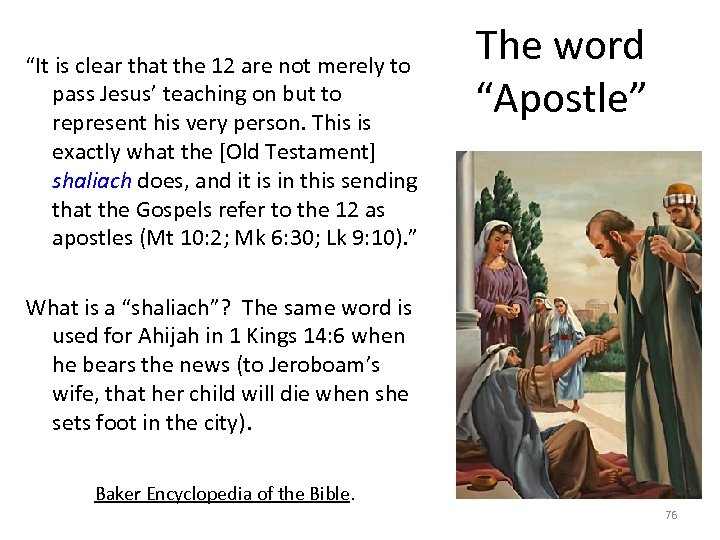 “It is clear that the 12 are not merely to pass Jesus’ teaching on but to represent his very person. This is exactly what the [Old Testament] shaliach does, and it is in this sending that the Gospels refer to the 12 as apostles (Mt 10: 2; Mk 6: 30; Lk 9: 10). ” The word “Apostle” What is a “shaliach”? The same word is used for Ahijah in 1 Kings 14: 6 when he bears the news (to Jeroboam’s wife, that her child will die when she sets foot in the city). Baker Encyclopedia of the Bible. 76
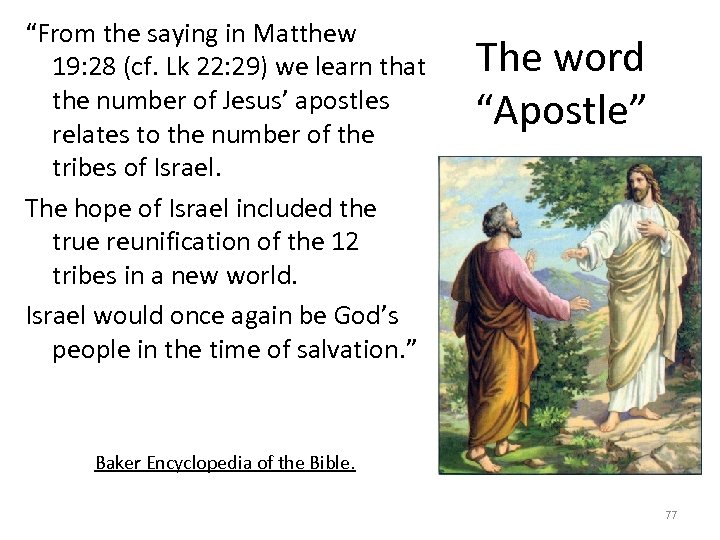 “From the saying in Matthew 19: 28 (cf. Lk 22: 29) we learn that the number of Jesus’ apostles relates to the number of the tribes of Israel. The hope of Israel included the true reunification of the 12 tribes in a new world. Israel would once again be God’s people in the time of salvation. ” The word “Apostle” Baker Encyclopedia of the Bible. 77
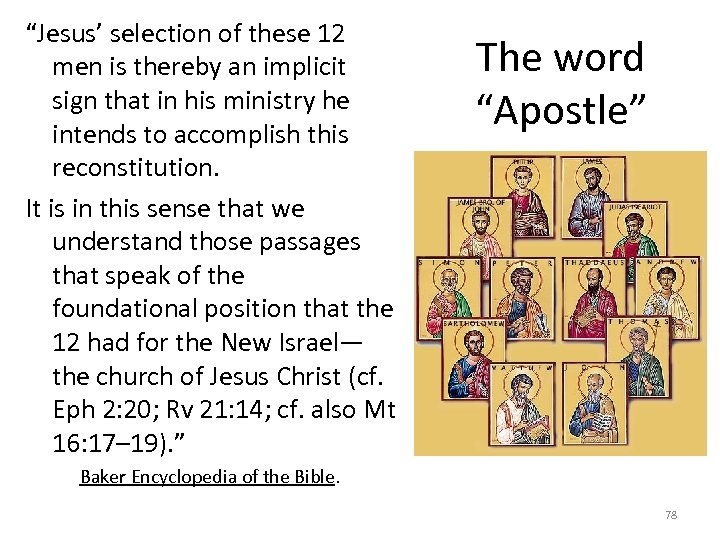 “Jesus’ selection of these 12 men is thereby an implicit sign that in his ministry he intends to accomplish this reconstitution. It is in this sense that we understand those passages that speak of the foundational position that the 12 had for the New Israel— the church of Jesus Christ (cf. Eph 2: 20; Rv 21: 14; cf. also Mt 16: 17– 19). ” The word “Apostle” Baker Encyclopedia of the Bible. 78
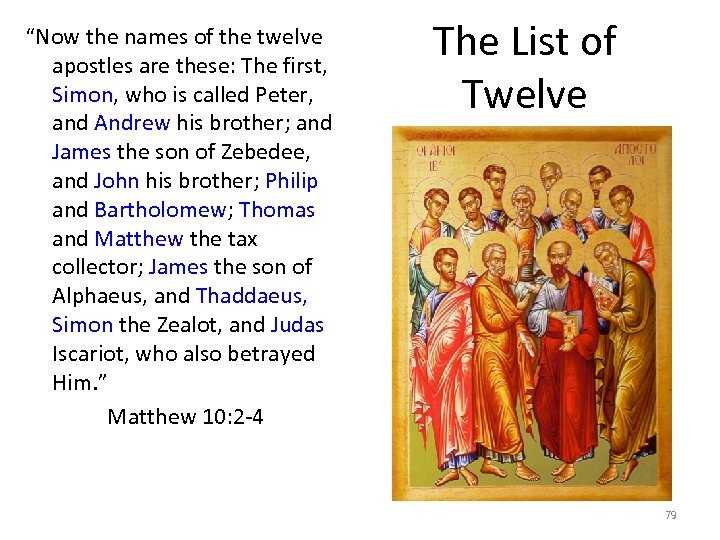 “Now the names of the twelve apostles are these: The first, Simon, who is called Peter, and Andrew his brother; and James the son of Zebedee, and John his brother; Philip and Bartholomew; Thomas and Matthew the tax collector; James the son of Alphaeus, and Thaddaeus, Simon the Zealot, and Judas Iscariot, who also betrayed Him. ” Matthew 10: 2 -4 The List of Twelve 79
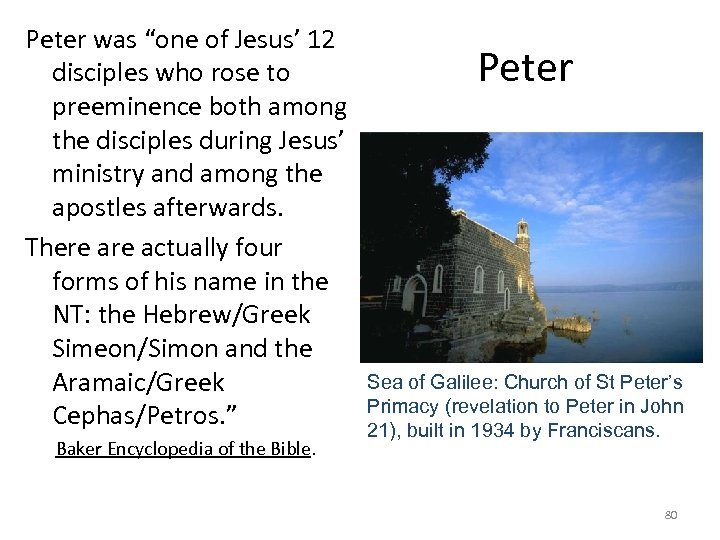 Peter was “one of Jesus’ 12 disciples who rose to preeminence both among the disciples during Jesus’ ministry and among the apostles afterwards. There actually four forms of his name in the NT: the Hebrew/Greek Simeon/Simon and the Aramaic/Greek Cephas/Petros. ” Baker Encyclopedia of the Bible. Peter Sea of Galilee: Church of St Peter’s Primacy (revelation to Peter in John 21), built in 1934 by Franciscans. 80
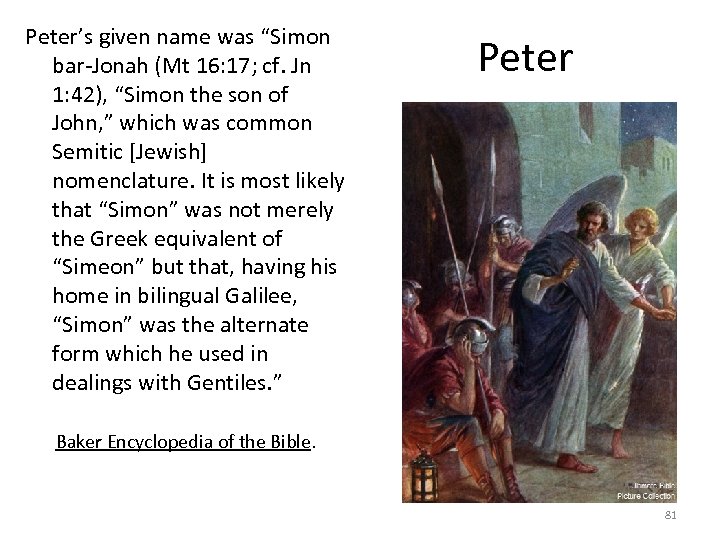 Peter’s given name was “Simon bar-Jonah (Mt 16: 17; cf. Jn 1: 42), “Simon the son of John, ” which was common Semitic [Jewish] nomenclature. It is most likely that “Simon” was not merely the Greek equivalent of “Simeon” but that, having his home in bilingual Galilee, “Simon” was the alternate form which he used in dealings with Gentiles. ” Peter Baker Encyclopedia of the Bible. 81
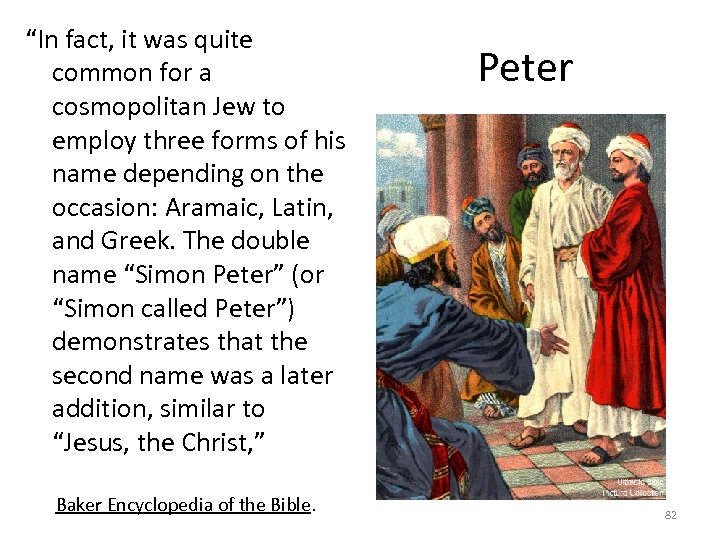 “In fact, it was quite common for a cosmopolitan Jew to employ three forms of his name depending on the occasion: Aramaic, Latin, and Greek. The double name “Simon Peter” (or “Simon called Peter”) demonstrates that the second name was a later addition, similar to “Jesus, the Christ, ” Baker Encyclopedia of the Bible. Peter 82
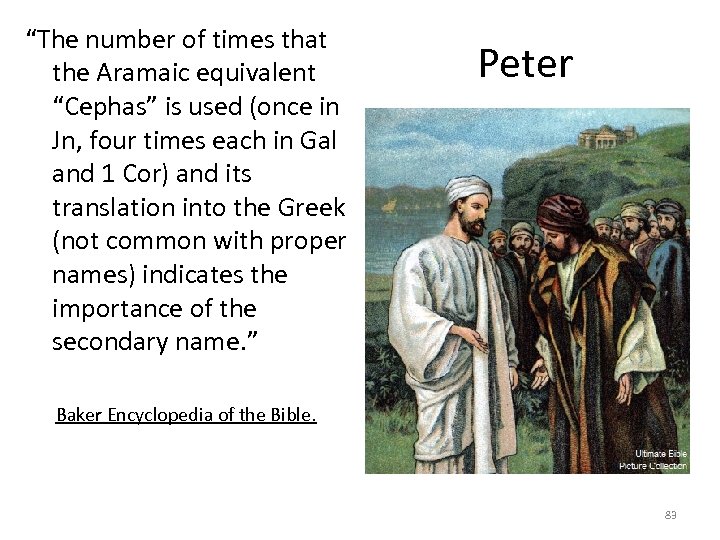 “The number of times that the Aramaic equivalent “Cephas” is used (once in Jn, four times each in Gal and 1 Cor) and its translation into the Greek (not common with proper names) indicates the importance of the secondary name. ” Peter Baker Encyclopedia of the Bible. 83
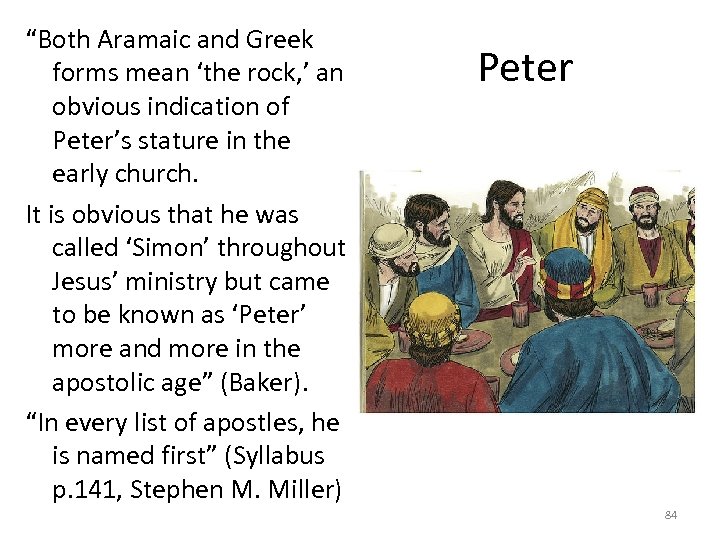 “Both Aramaic and Greek forms mean ‘the rock, ’ an obvious indication of Peter’s stature in the early church. It is obvious that he was called ‘Simon’ throughout Jesus’ ministry but came to be known as ‘Peter’ more and more in the apostolic age” (Baker). “In every list of apostles, he is named first” (Syllabus p. 141, Stephen M. Miller) Peter 84
![“For example, Paul never uses the patronym [form of Peter], not even in the](https://present5.com/presentation/26f3686dfbda6ee3d6699bf4e4ceb2c2/image-85.jpg "“For example, Paul never uses the patronym [form of Peter], not even in the") “For example, Paul never uses the patronym [form of Peter], not even in the form of the double name “Simon Peter, ” but always uses “Peter” (x 2) or “Cephas” (x 8); and the Petrine letters use “Peter” (1 Pt 1: 1) or “Simon Peter” (2 Pt 1: 1). Acts uses “Peter” 42 times, “Simon Peter” 4 times, and “Simon” only 9 times. ” Baker Encyclopedia of the Bible. Peter 85
“For example, Paul never uses the patronym [form of Peter], not even in the form of the double name “Simon Peter, ” but always uses “Peter” (x 2) or “Cephas” (x 8); and the Petrine letters use “Peter” (1 Pt 1: 1) or “Simon Peter” (2 Pt 1: 1). Acts uses “Peter” 42 times, “Simon Peter” 4 times, and “Simon” only 9 times. ” Baker Encyclopedia of the Bible. Peter 85
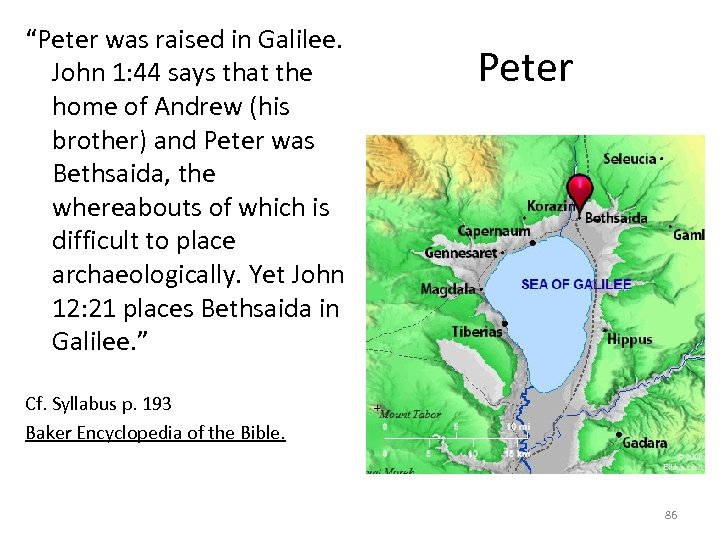 “Peter was raised in Galilee. John 1: 44 says that the home of Andrew (his brother) and Peter was Bethsaida, the whereabouts of which is difficult to place archaeologically. Yet John 12: 21 places Bethsaida in Galilee. ” Peter Cf. Syllabus p. 193 Baker Encyclopedia of the Bible. 86
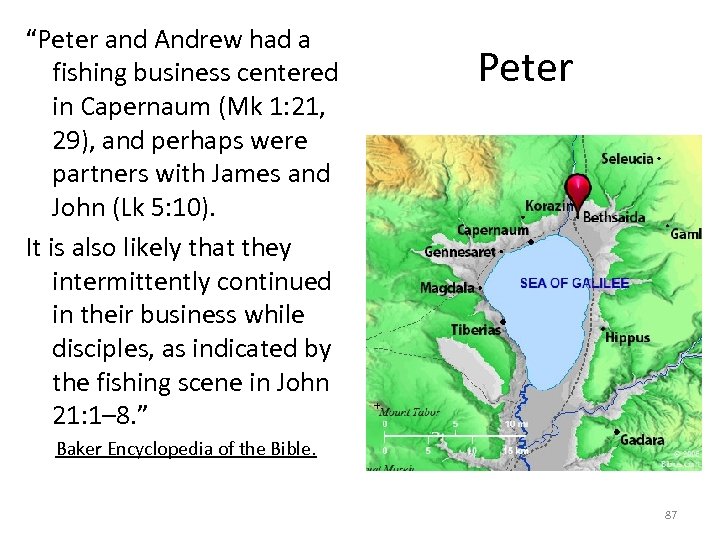 “Peter and Andrew had a fishing business centered in Capernaum (Mk 1: 21, 29), and perhaps were partners with James and John (Lk 5: 10). It is also likely that they intermittently continued in their business while disciples, as indicated by the fishing scene in John 21: 1– 8. ” Peter Baker Encyclopedia of the Bible. 87
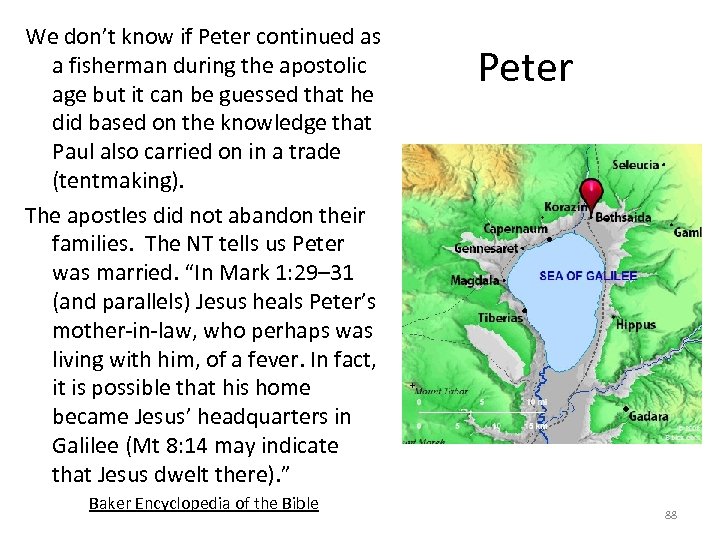 We don’t know if Peter continued as a fisherman during the apostolic age but it can be guessed that he did based on the knowledge that Paul also carried on in a trade (tentmaking). The apostles did not abandon their families. The NT tells us Peter was married. “In Mark 1: 29– 31 (and parallels) Jesus heals Peter’s mother-in-law, who perhaps was living with him, of a fever. In fact, it is possible that his home became Jesus’ headquarters in Galilee (Mt 8: 14 may indicate that Jesus dwelt there). ” Baker Encyclopedia of the Bible Peter 88
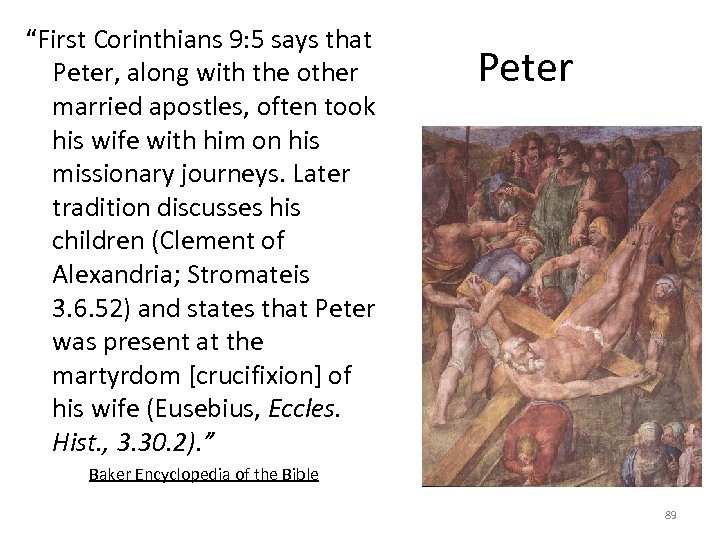 “First Corinthians 9: 5 says that Peter, along with the other married apostles, often took his wife with him on his missionary journeys. Later tradition discusses his children (Clement of Alexandria; Stromateis 3. 6. 52) and states that Peter was present at the martyrdom [crucifixion] of his wife (Eusebius, Eccles. Hist. , 3. 30. 2). ” Peter Baker Encyclopedia of the Bible 89
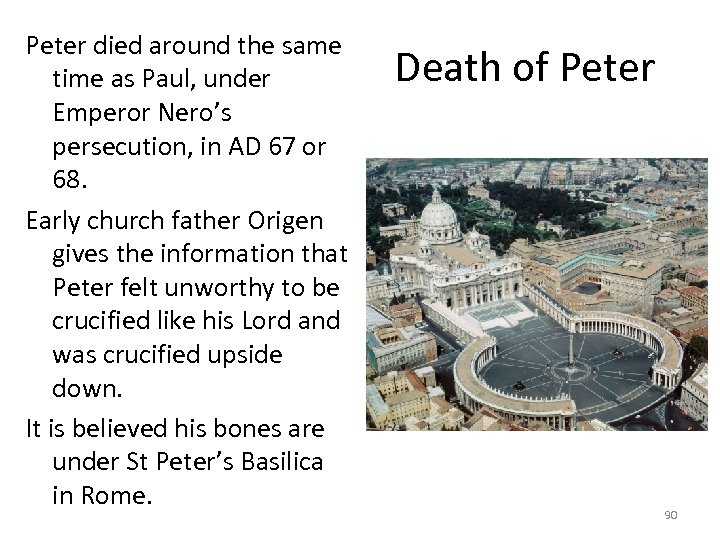 Peter died around the same time as Paul, under Emperor Nero’s persecution, in AD 67 or 68. Early church father Origen gives the information that Peter felt unworthy to be crucified like his Lord and was crucified upside down. It is believed his bones are under St Peter’s Basilica in Rome. Death of Peter 90
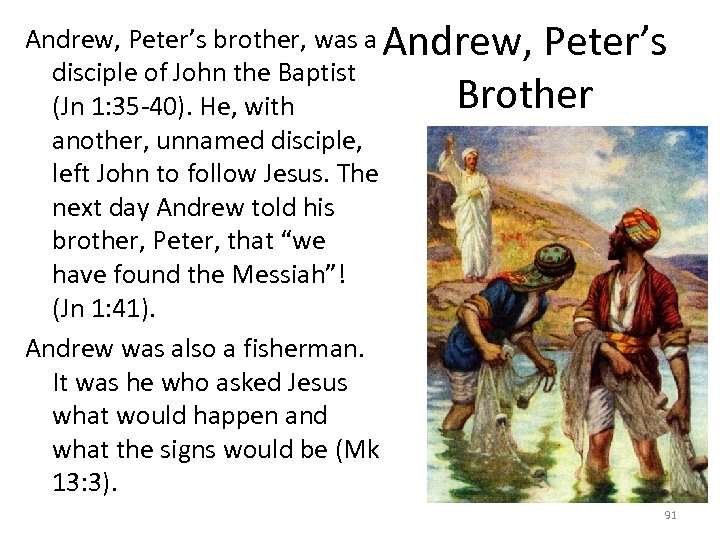 Andrew, Peter’s brother, was a Andrew, Peter’s disciple of John the Baptist Brother (Jn 1: 35 -40). He, with another, unnamed disciple, left John to follow Jesus. The next day Andrew told his brother, Peter, that “we have found the Messiah”! (Jn 1: 41). Andrew was also a fisherman. It was he who asked Jesus what would happen and what the signs would be (Mk 13: 3). 91
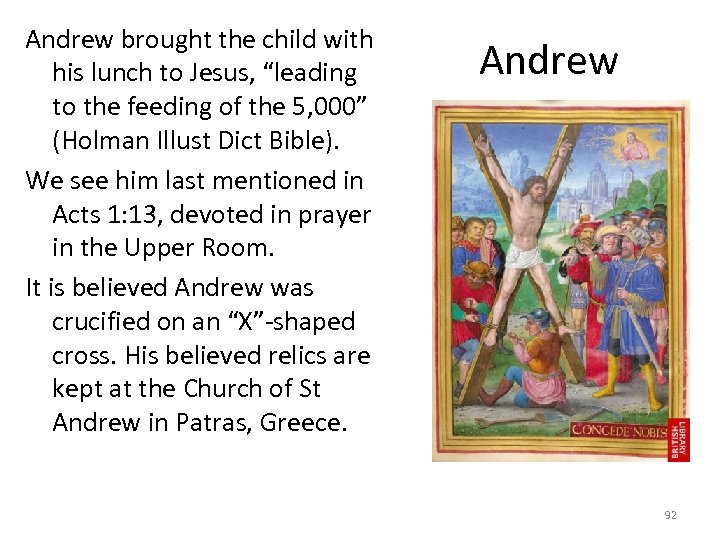 Andrew brought the child with his lunch to Jesus, “leading to the feeding of the 5, 000” (Holman Illust Dict Bible). We see him last mentioned in Acts 1: 13, devoted in prayer in the Upper Room. It is believed Andrew was crucified on an “X”-shaped cross. His believed relics are kept at the Church of St Andrew in Patras, Greece. Andrew 92
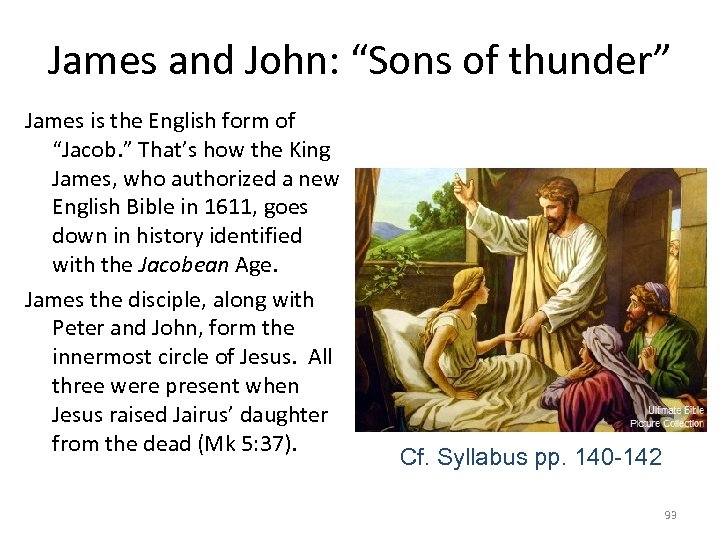 James and John: “Sons of thunder” James is the English form of “Jacob. ” That’s how the King James, who authorized a new English Bible in 1611, goes down in history identified with the Jacobean Age. James the disciple, along with Peter and John, form the innermost circle of Jesus. All three were present when Jesus raised Jairus’ daughter from the dead (Mk 5: 37). Cf. Syllabus pp. 140 -142 93
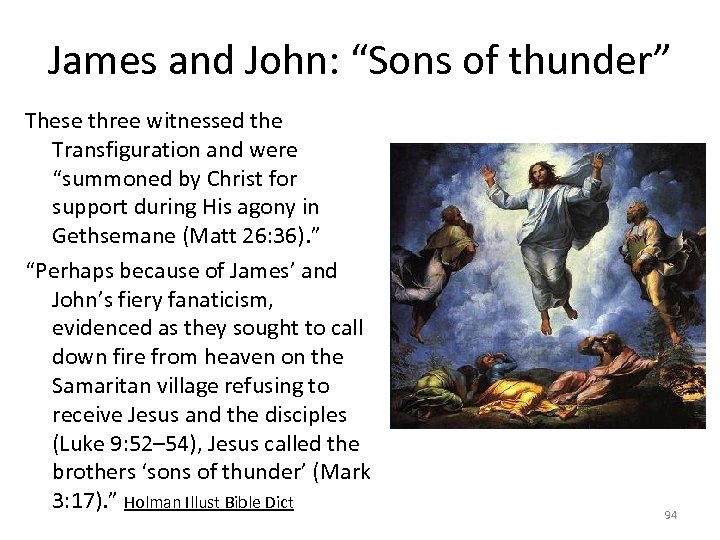 James and John: “Sons of thunder” These three witnessed the Transfiguration and were “summoned by Christ for support during His agony in Gethsemane (Matt 26: 36). ” “Perhaps because of James’ and John’s fiery fanaticism, evidenced as they sought to call down fire from heaven on the Samaritan village refusing to receive Jesus and the disciples (Luke 9: 52– 54), Jesus called the brothers ‘sons of thunder’ (Mark 3: 17). ” Holman Illust Bible Dict 94
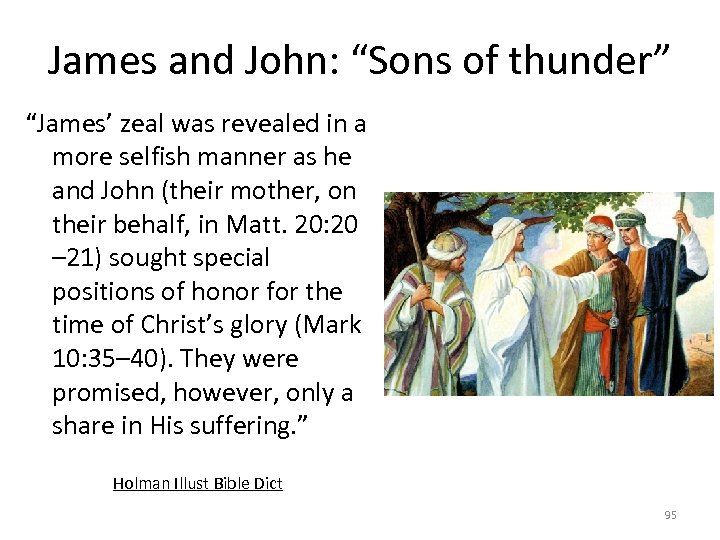 James and John: “Sons of thunder” “James’ zeal was revealed in a more selfish manner as he and John (their mother, on their behalf, in Matt. 20: 20 – 21) sought special positions of honor for the time of Christ’s glory (Mark 10: 35– 40). They were promised, however, only a share in His suffering. ” Holman Illust Bible Dict 95
 James and John: “Sons of thunder” “James was the first of the 12 to be martyred (Acts 12: 2). His “About that time Herod the king laid execution (about AD 44), by violent hands on some who order of King Herod Agrippa I of belonged to the church. He killed Judea, was part of a larger James the brother of John with persecution in which Peter was the sword, and when he saw that it pleased the Jews, he proceeded arrested (Acts 12: 1– 3). ” to arrest Peter also. ” This James is not the brother of Acts 12: 1 -3 ESV Jesus - the one who believed after the Resurrection and was an early church leader (and wrote the book of James). Holman Illust Bible Dict 74
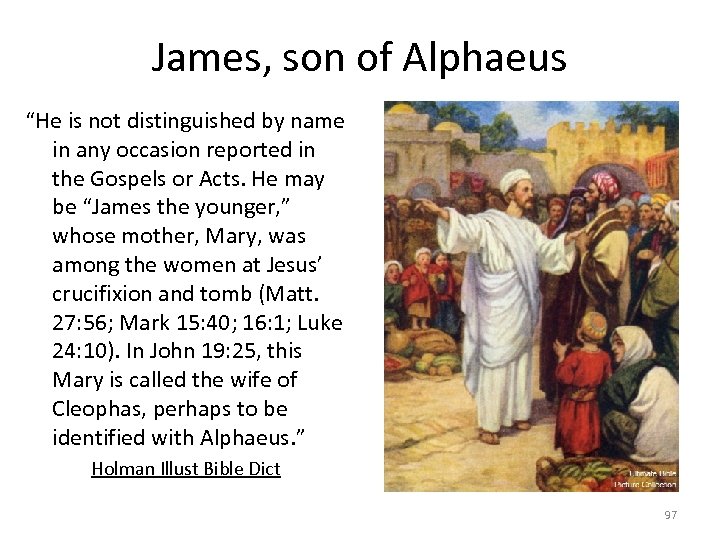 James, son of Alphaeus “He is not distinguished by name in any occasion reported in the Gospels or Acts. He may be “James the younger, ” whose mother, Mary, was among the women at Jesus’ crucifixion and tomb (Matt. 27: 56; Mark 15: 40; 16: 1; Luke 24: 10). In John 19: 25, this Mary is called the wife of Cleophas, perhaps to be identified with Alphaeus. ” Holman Illust Bible Dict 97
![“Although the Synoptic Gospels [Matt, Mk, Luke] list Philip as one of Jesus’ twelve](https://present5.com/presentation/26f3686dfbda6ee3d6699bf4e4ceb2c2/image-98.jpg "“Although the Synoptic Gospels [Matt, Mk, Luke] list Philip as one of Jesus’ twelve") “Although the Synoptic Gospels [Matt, Mk, Luke] list Philip as one of Jesus’ twelve disciples, John is the only Gospel in which Philip engages in a dialogue with Jesus and other disciples. ” Philip Lexham Bible Dictionary Acts 8 98
“Although the Synoptic Gospels [Matt, Mk, Luke] list Philip as one of Jesus’ twelve disciples, John is the only Gospel in which Philip engages in a dialogue with Jesus and other disciples. ” Philip Lexham Bible Dictionary Acts 8 98
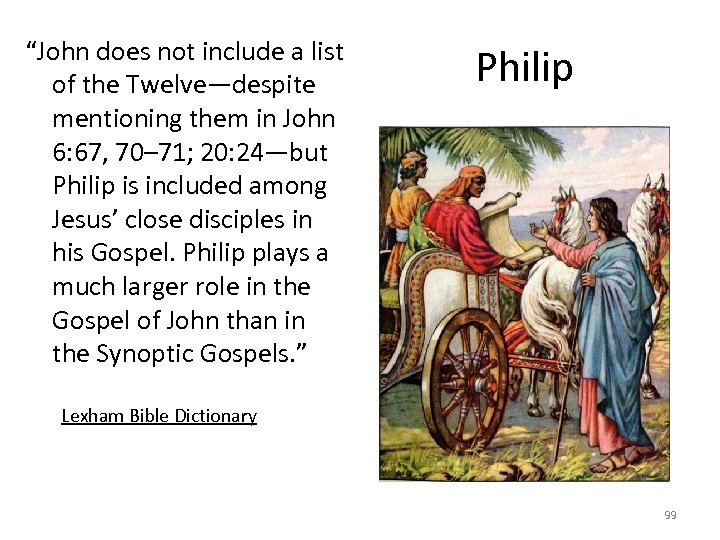 “John does not include a list of the Twelve—despite mentioning them in John 6: 67, 70– 71; 20: 24—but Philip is included among Jesus’ close disciples in his Gospel. Philip plays a much larger role in the Gospel of John than in the Synoptic Gospels. ” Philip Lexham Bible Dictionary 99
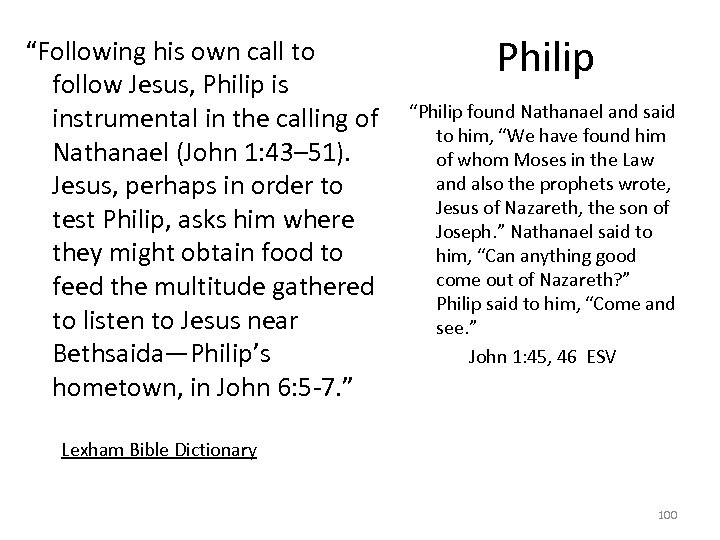 “Following his own call to follow Jesus, Philip is instrumental in the calling of Nathanael (John 1: 43– 51). Jesus, perhaps in order to test Philip, asks him where they might obtain food to feed the multitude gathered to listen to Jesus near Bethsaida—Philip’s hometown, in John 6: 5 -7. ” Philip “Philip found Nathanael and said to him, “We have found him of whom Moses in the Law and also the prophets wrote, Jesus of Nazareth, the son of Joseph. ” Nathanael said to him, “Can anything good come out of Nazareth? ” Philip said to him, “Come and see. ” John 1: 45, 46 ESV Lexham Bible Dictionary 100
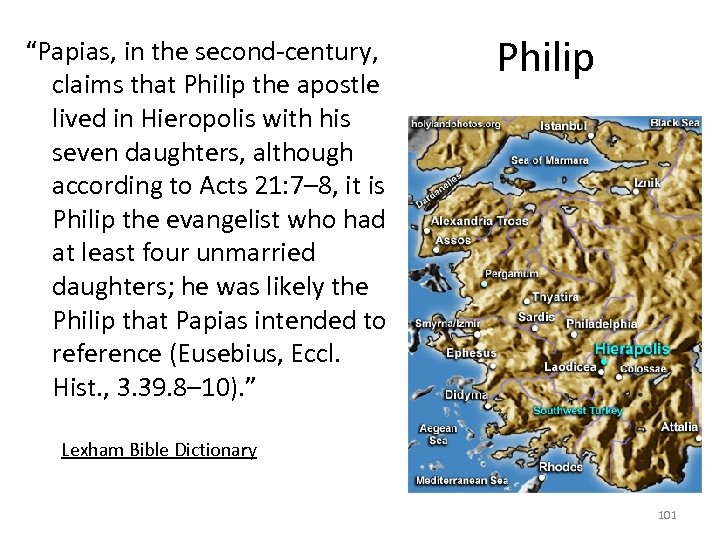 “Papias, in the second-century, claims that Philip the apostle lived in Hieropolis with his seven daughters, although according to Acts 21: 7– 8, it is Philip the evangelist who had at least four unmarried daughters; he was likely the Philip that Papias intended to reference (Eusebius, Eccl. Hist. , 3. 39. 8– 10). ” Philip Lexham Bible Dictionary 101
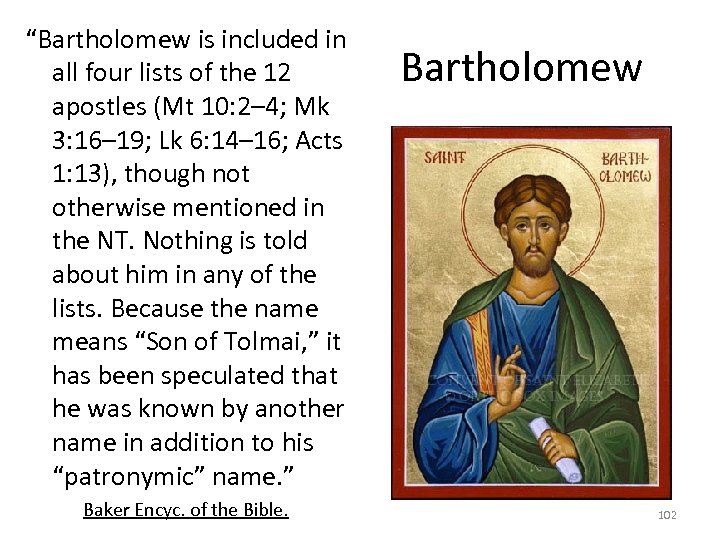 “Bartholomew is included in all four lists of the 12 apostles (Mt 10: 2– 4; Mk 3: 16– 19; Lk 6: 14– 16; Acts 1: 13), though not otherwise mentioned in the NT. Nothing is told about him in any of the lists. Because the name means “Son of Tolmai, ” it has been speculated that he was known by another name in addition to his “patronymic” name. ” Baker Encyc. of the Bible. Bartholomew 102
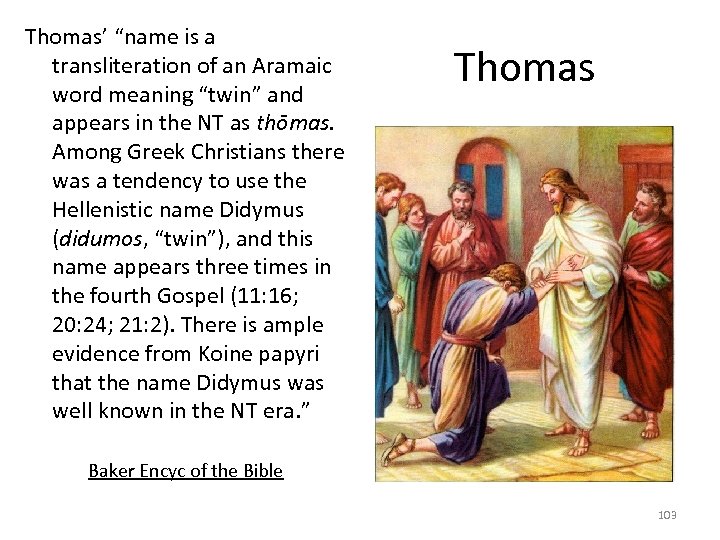 Thomas’ “name is a transliteration of an Aramaic word meaning “twin” and appears in the NT as thōmas. Among Greek Christians there was a tendency to use the Hellenistic name Didymus (didumos, “twin”), and this name appears three times in the fourth Gospel (11: 16; 20: 24; 21: 2). There is ample evidence from Koine papyri that the name Didymus was well known in the NT era. ” Thomas Baker Encyc of the Bible 103
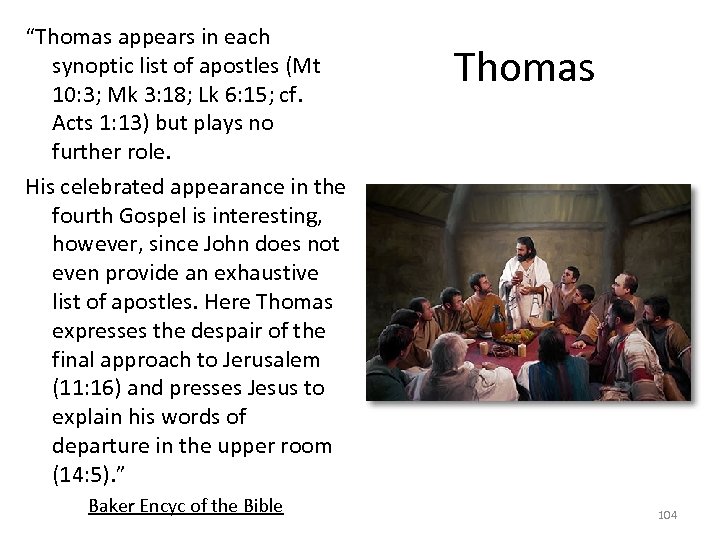 “Thomas appears in each synoptic list of apostles (Mt 10: 3; Mk 3: 18; Lk 6: 15; cf. Acts 1: 13) but plays no further role. His celebrated appearance in the fourth Gospel is interesting, however, since John does not even provide an exhaustive list of apostles. Here Thomas expresses the despair of the final approach to Jerusalem (11: 16) and presses Jesus to explain his words of departure in the upper room (14: 5). ” Baker Encyc of the Bible Thomas 104
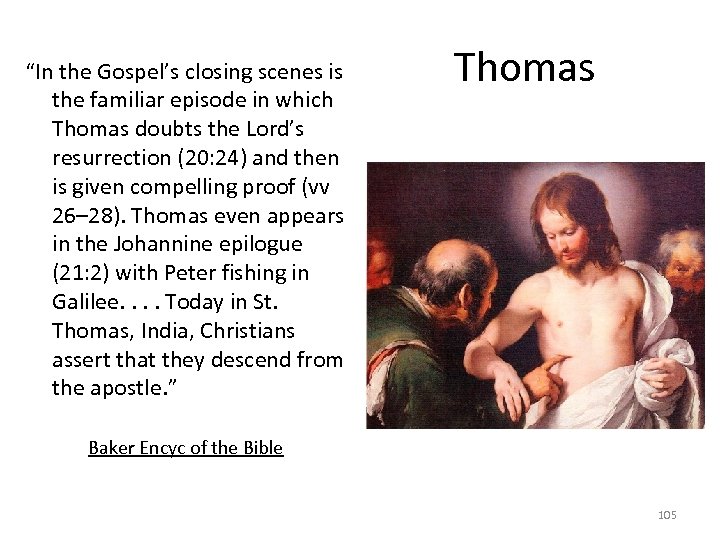 “In the Gospel’s closing scenes is the familiar episode in which Thomas doubts the Lord’s resurrection (20: 24) and then is given compelling proof (vv 26– 28). Thomas even appears in the Johannine epilogue (21: 2) with Peter fishing in Galilee. . Today in St. Thomas, India, Christians assert that they descend from the apostle. ” Thomas Baker Encyc of the Bible 105
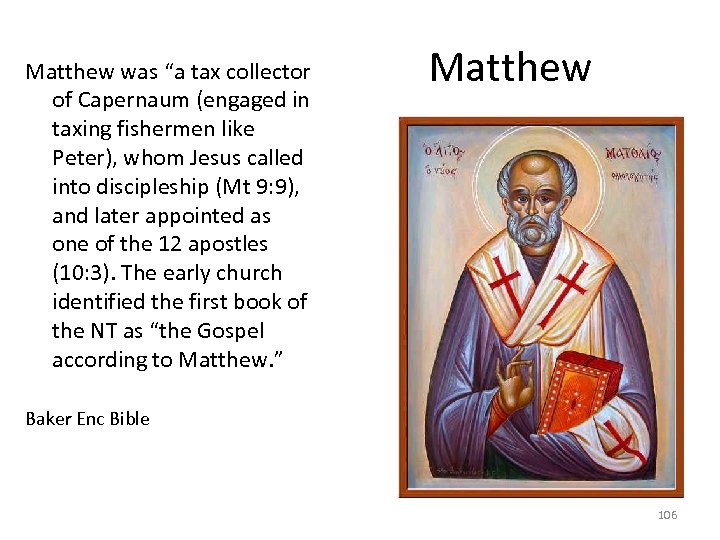 Matthew was “a tax collector of Capernaum (engaged in taxing fishermen like Peter), whom Jesus called into discipleship (Mt 9: 9), and later appointed as one of the 12 apostles (10: 3). The early church identified the first book of the NT as “the Gospel according to Matthew. ” Matthew Baker Enc Bible 106
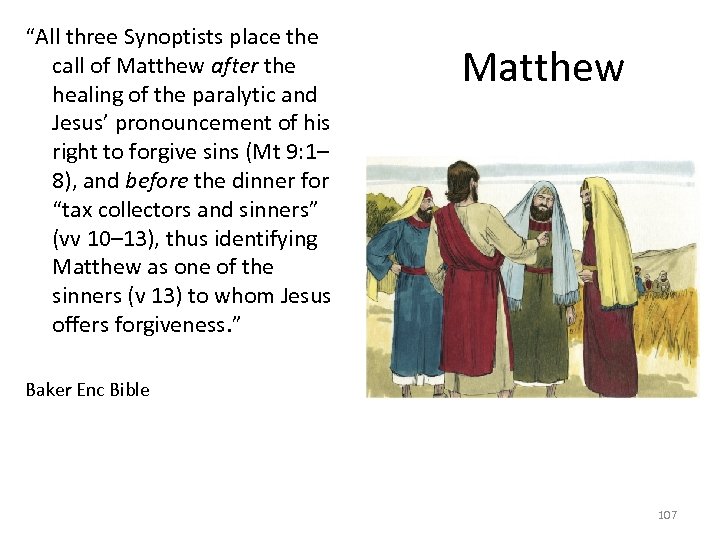 “All three Synoptists place the call of Matthew after the healing of the paralytic and Jesus’ pronouncement of his right to forgive sins (Mt 9: 1– 8), and before the dinner for “tax collectors and sinners” (vv 10– 13), thus identifying Matthew as one of the sinners (v 13) to whom Jesus offers forgiveness. ” Matthew Baker Enc Bible 107
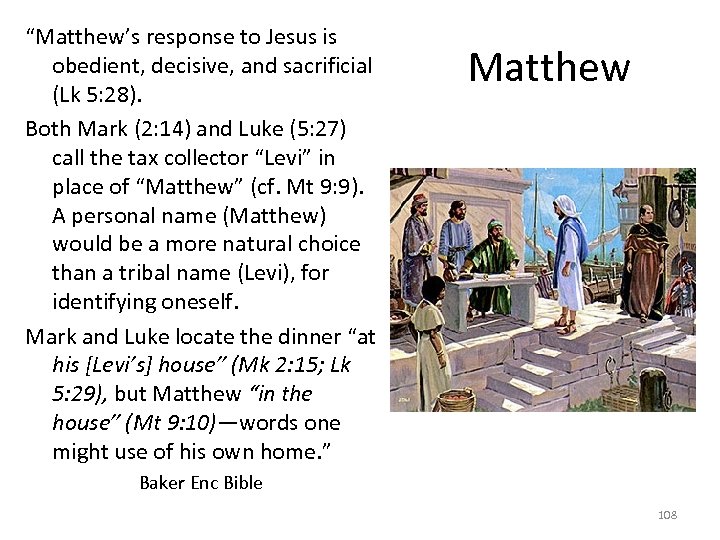 “Matthew’s response to Jesus is obedient, decisive, and sacrificial (Lk 5: 28). Both Mark (2: 14) and Luke (5: 27) call the tax collector “Levi” in place of “Matthew” (cf. Mt 9: 9). A personal name (Matthew) would be a more natural choice than a tribal name (Levi), for identifying oneself. Mark and Luke locate the dinner “at his [Levi’s] house” (Mk 2: 15; Lk 5: 29), but Matthew “in the house” (Mt 9: 10)—words one might use of his own home. ” Matthew Baker Enc Bible 108
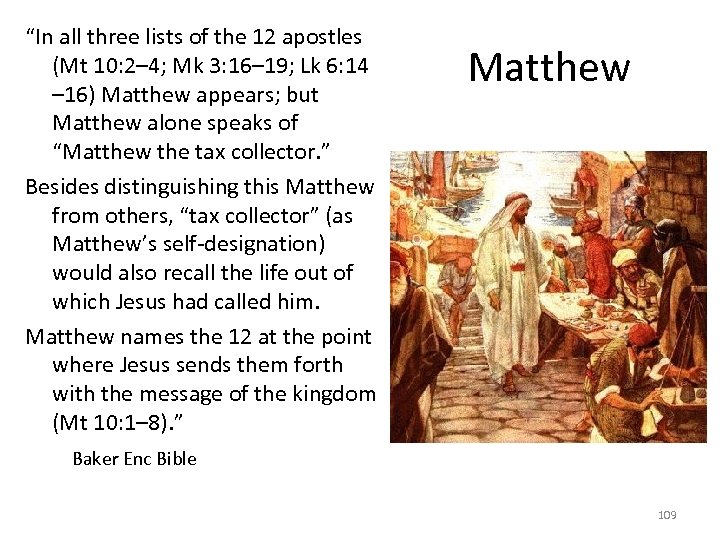 “In all three lists of the 12 apostles (Mt 10: 2– 4; Mk 3: 16– 19; Lk 6: 14 – 16) Matthew appears; but Matthew alone speaks of “Matthew the tax collector. ” Besides distinguishing this Matthew from others, “tax collector” (as Matthew’s self-designation) would also recall the life out of which Jesus had called him. Matthew names the 12 at the point where Jesus sends them forth with the message of the kingdom (Mt 10: 1– 8). ” Baker Enc Bible Matthew 109
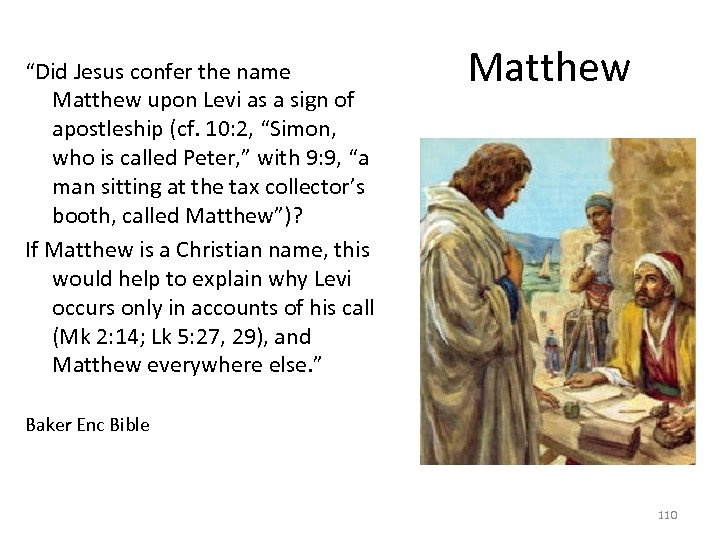 “Did Jesus confer the name Matthew upon Levi as a sign of apostleship (cf. 10: 2, “Simon, who is called Peter, ” with 9: 9, “a man sitting at the tax collector’s booth, called Matthew”)? If Matthew is a Christian name, this would help to explain why Levi occurs only in accounts of his call (Mk 2: 14; Lk 5: 27, 29), and Matthew everywhere else. ” Matthew Baker Enc Bible 110
 “All three Synoptists number “James son of Alphaeus” among the 12 apostles. As Mark 2: 14 identifies Matthew as “Levi son of Alphaeus, ” it is possible that James and Levi are brothers. Yet this is unlikely; for the evangelists do not make the identification explicit, as they do in the case of Peter and Andrew and the sons of Zebedee. ” Legend says Matthew died a martyr’s death in Ethiopia. Baker Enc Bible Matthew 111
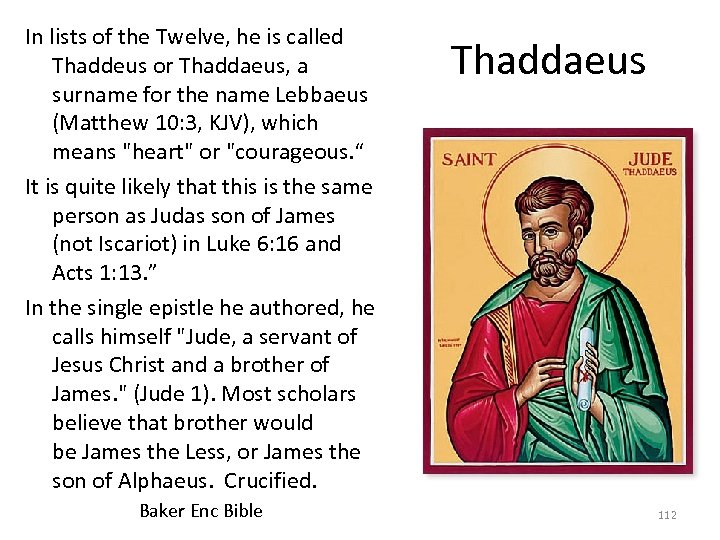 In lists of the Twelve, he is called Thaddeus or Thaddaeus, a surname for the name Lebbaeus (Matthew 10: 3, KJV), which means "heart" or "courageous. “ It is quite likely that this is the same person as Judas son of James (not Iscariot) in Luke 6: 16 and Acts 1: 13. ” In the single epistle he authored, he calls himself "Jude, a servant of Jesus Christ and a brother of James. " (Jude 1). Most scholars believe that brother would be James the Less, or James the son of Alphaeus. Crucified. Baker Enc Bible Thaddaeus 112
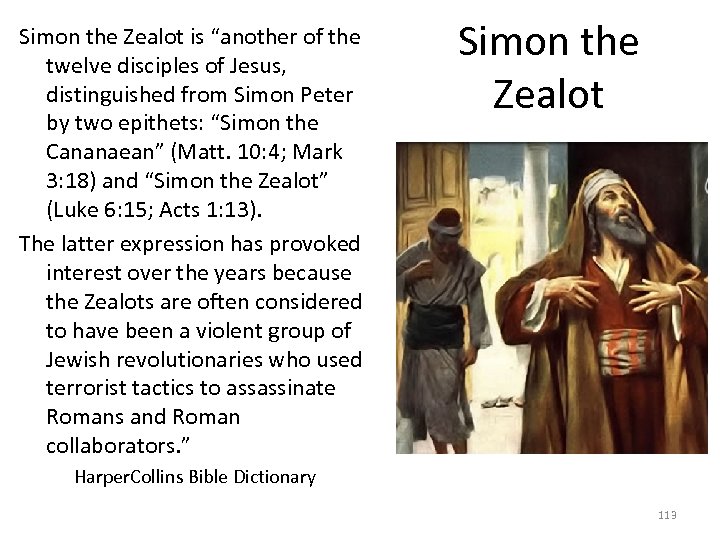 Simon the Zealot is “another of the twelve disciples of Jesus, distinguished from Simon Peter by two epithets: “Simon the Cananaean” (Matt. 10: 4; Mark 3: 18) and “Simon the Zealot” (Luke 6: 15; Acts 1: 13). The latter expression has provoked interest over the years because the Zealots are often considered to have been a violent group of Jewish revolutionaries who used terrorist tactics to assassinate Romans and Roman collaborators. ” Simon the Zealot Harper. Collins Bible Dictionary 113
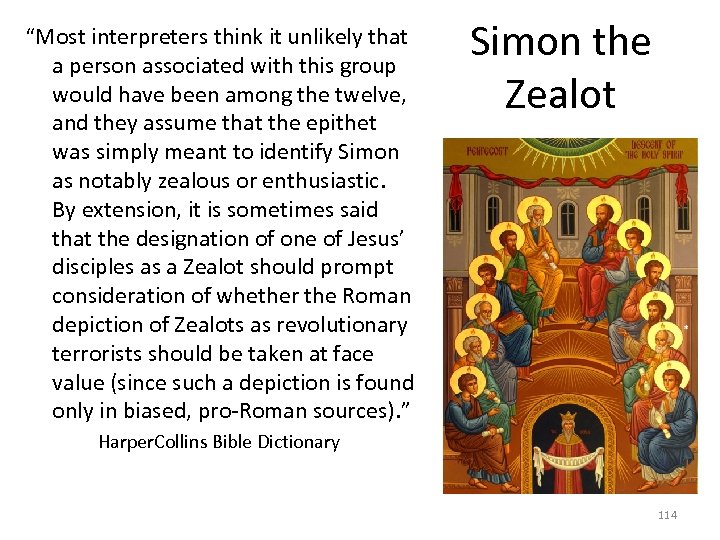 “Most interpreters think it unlikely that a person associated with this group would have been among the twelve, and they assume that the epithet was simply meant to identify Simon as notably zealous or enthusiastic. By extension, it is sometimes said that the designation of one of Jesus’ disciples as a Zealot should prompt consideration of whether the Roman depiction of Zealots as revolutionary terrorists should be taken at face value (since such a depiction is found only in biased, pro-Roman sources). ” Simon the Zealot Harper. Collins Bible Dictionary 114
![“All of the Gospels place [Judas] at the end of the list of disciples](https://present5.com/presentation/26f3686dfbda6ee3d6699bf4e4ceb2c2/image-115.jpg "“All of the Gospels place [Judas] at the end of the list of disciples") “All of the Gospels place [Judas] at the end of the list of disciples because of his role as betrayer. Iscariot is an Aramaic word which means “man of Kerioth, ” a town near Hebron. He was the only disciple from Judea. He acted as treasurer for the disciples but was known as a miser and a thief (John 12: 4– 6). He was present at the Last Supper, during which Jesus predicted his betrayal (Luke 22: 21; Matt. 26: 20– 21). ” Holman Illustrated Bible Dictionary Judas Iscariot 115
“All of the Gospels place [Judas] at the end of the list of disciples because of his role as betrayer. Iscariot is an Aramaic word which means “man of Kerioth, ” a town near Hebron. He was the only disciple from Judea. He acted as treasurer for the disciples but was known as a miser and a thief (John 12: 4– 6). He was present at the Last Supper, during which Jesus predicted his betrayal (Luke 22: 21; Matt. 26: 20– 21). ” Holman Illustrated Bible Dictionary Judas Iscariot 115
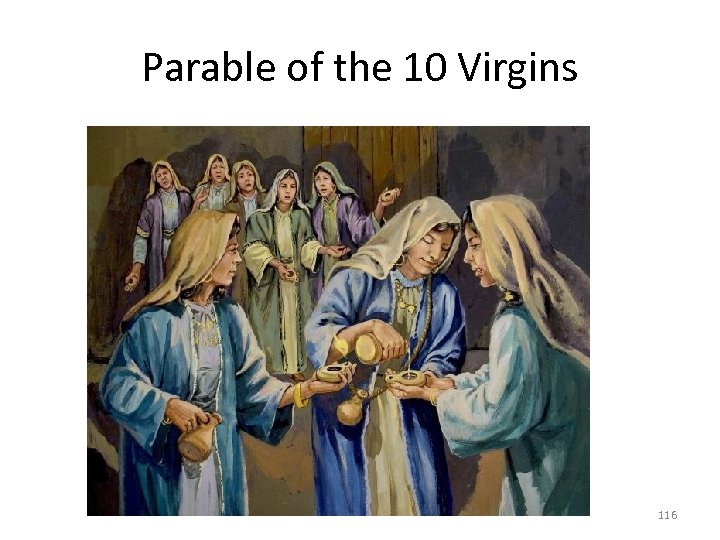 Parable of the 10 Virgins 116
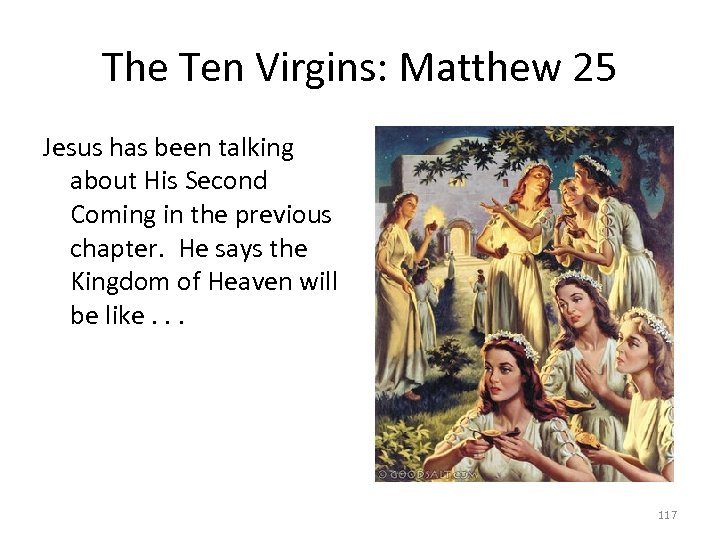 The Ten Virgins: Matthew 25 Jesus has been talking about His Second Coming in the previous chapter. He says the Kingdom of Heaven will be like. . . 117
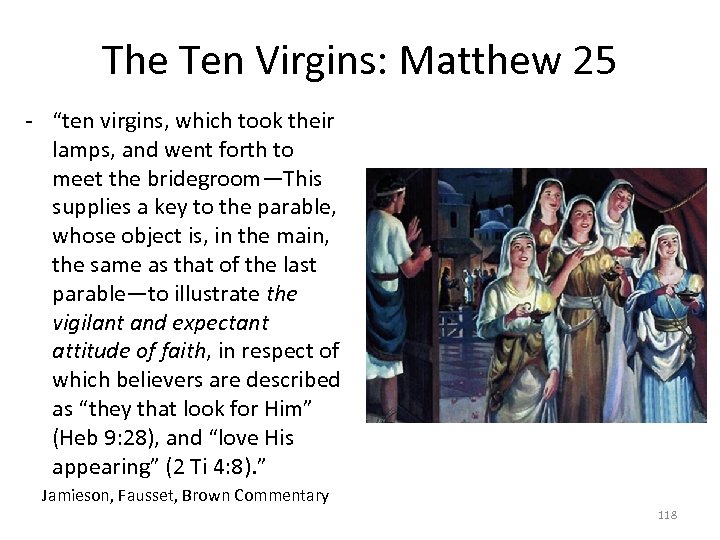 The Ten Virgins: Matthew 25 - “ten virgins, which took their lamps, and went forth to meet the bridegroom—This supplies a key to the parable, whose object is, in the main, the same as that of the last parable—to illustrate the vigilant and expectant attitude of faith, in respect of which believers are described as “they that look for Him” (Heb 9: 28), and “love His appearing” (2 Ti 4: 8). ” Jamieson, Fausset, Brown Commentary 118
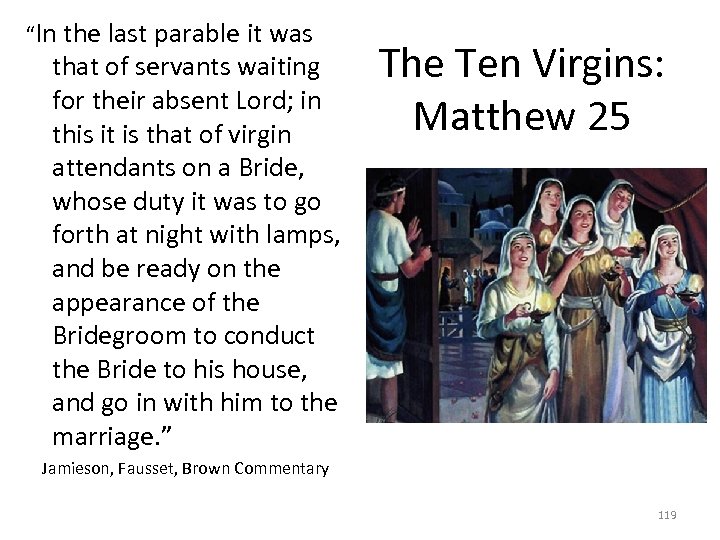 “In the last parable it was that of servants waiting for their absent Lord; in this it is that of virgin attendants on a Bride, whose duty it was to go forth at night with lamps, and be ready on the appearance of the Bridegroom to conduct the Bride to his house, and go in with him to the marriage. ” The Ten Virgins: Matthew 25 Jamieson, Fausset, Brown Commentary 119
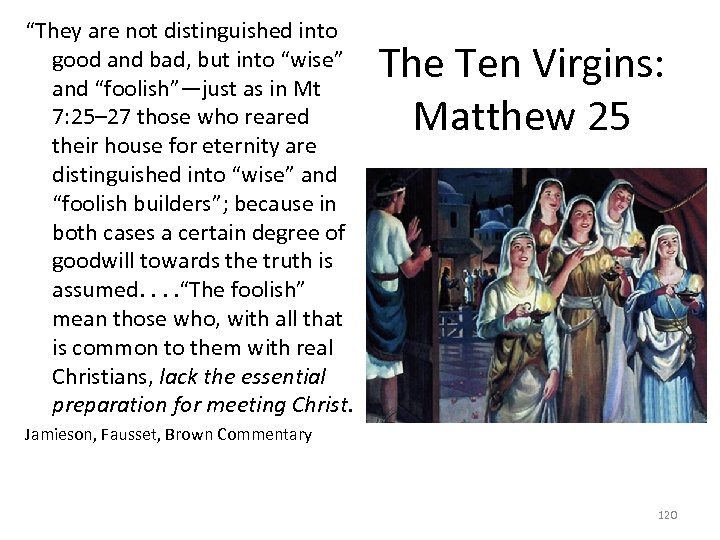 “They are not distinguished into good and bad, but into “wise” and “foolish”—just as in Mt 7: 25– 27 those who reared their house for eternity are distinguished into “wise” and “foolish builders”; because in both cases a certain degree of goodwill towards the truth is assumed. . “The foolish” mean those who, with all that is common to them with real Christians, lack the essential preparation for meeting Christ. The Ten Virgins: Matthew 25 Jamieson, Fausset, Brown Commentary 120
 SESSION 3 THE DISCIPLES; PARABLE OF TEN VIRGINS TURN IN: Definitions, written in complete sentences, defined in context of the Bible CLASSROOM: Greek Alphabet; 12 Apostles; Pharisees and Sadducees; the Five Morons READING: Matthew 19 - 27 SYLLABUS: pp. 1 -6, 116, 140 -142, 273 -275, 276 -288 review charts of Life of Christ and Life of Paul, Disciples, Greek WRITING: Practice the Greek alphabet until you know it. Turn in your practice papers/cards to get credit 121
 Sources Utilized Dr. Carl Laney photo collection William Mounce, Basics of Biblical Greek textbook Richards, L. , & Richards, L. O. (1987). The Teacher’s Commentary. Wheaton, IL: Victor Books. Elwell, W. A. , & Beitzel, B. J. (1988). Baker encyclopedia of the Bible. Grand Rapids, MI: Baker Book House. Glaze, J. E. (2003). James. In (C. Brand, C. Draper, A. England, S. Bond, E. R. Clendenen, & T. C. Butler, Eds. ) Holman Illustrated Bible Dictionary. Nashville, TN: Holman Bible Publishers. Roberts, R. (2012). Philip the Apostle. In (J. D. Barry & L. Wentz, Eds. )The Lexham Bible Dictionary. Bellingham, WA: Lexham Press. Shuler, P. L. (2011). Simon. In (M. A. Powell, Ed. )The Harper. Collins Bible Dictionary (Revised and Updated). New York: Harper. Collins. www. holylandphotos. org Jamieson, Fausset, Brown D. (1997). Commentary Critical and Explanatory on the Whole Bible (Mt 25: 1). Oak Harbor, WA: Logos Research Systems, Inc. 122