


 Скачать презентацию New Technologies Challenges in optimizing the heart
62af2b2b6d0f791434e860d1a94fa17c.ppt
- Количество слайдов: 21
 New Technologies & Challenges in optimizing the “heart health” of Australia Professor Simon Stewart Head, Preventative Cardiology simon. stewart@baker. edu. au
 Presentation Overview ♥ The inevitable link between age & heart disease ♥ Chronic heart failure: an exemplar of poor outcomes, hope and plenty of costs! ♥ Back to the future: the potential value in better systems of care
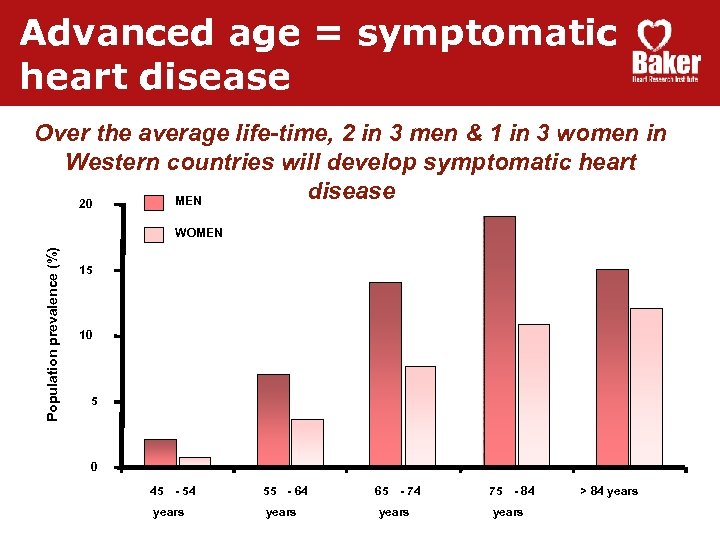 Advanced age = symptomatic heart disease Over the average life-time, 2 in 3 men & 1 in 3 women in Western countries will develop symptomatic heart disease MEN 20 Population prevalence (%) WOMEN 15 10 5 0 45 - 54 55 - 64 65 - 74 75 - 84 years > 84 years
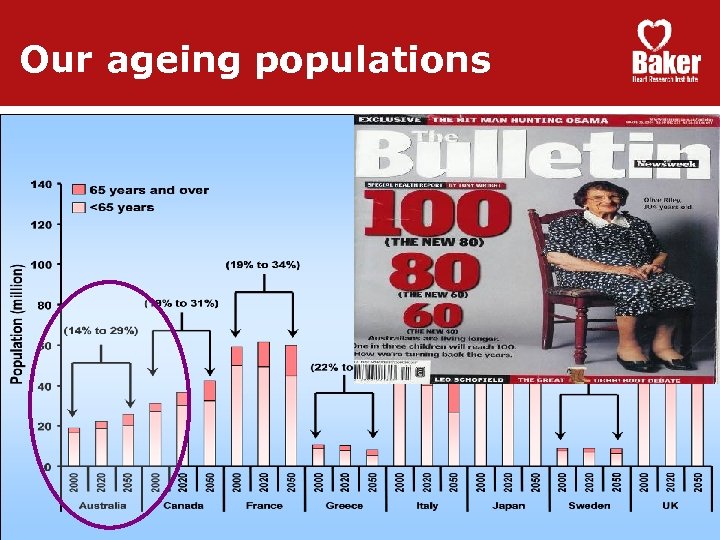 Our ageing populations
 Presentation Overview ♥ The inevitable link between age & heart disease ♥ Chronic heart failure: an exemplar of poor outcomes, hope and plenty of costs!
 Chronic heart failure An “epidemic” characterised by: ♥ Damaged heart with system wide impact (lungs, kidneys & brain) ♥ Very poor quality of life: shortness of breath & fatigue ♥ Clinical instability: costly admissions! ♥ Premature death: sudden versus slow!
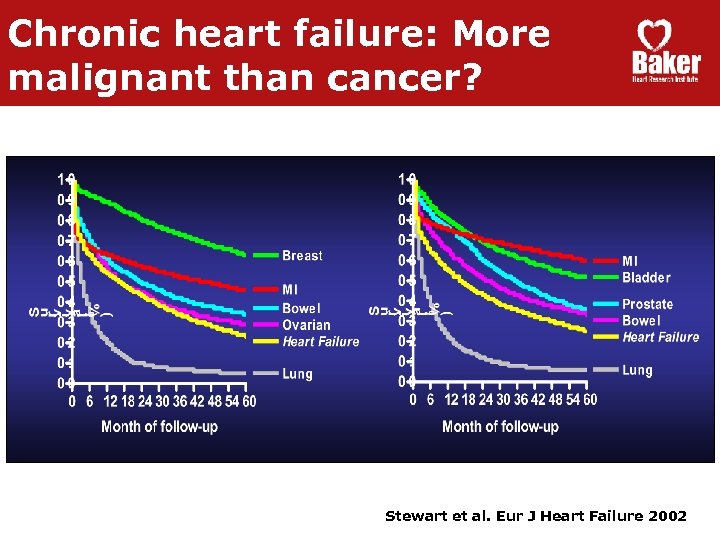 Chronic heart failure: More malignant than cancer? Stewart et al. Eur J Heart Failure 2002
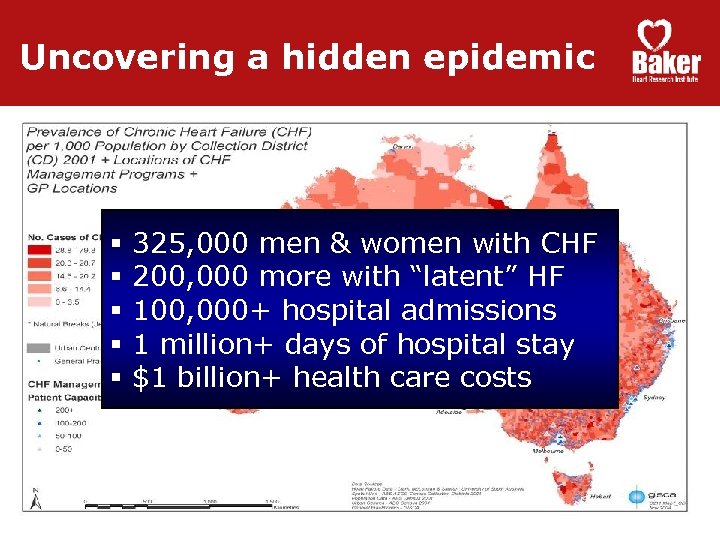 Uncovering a hidden epidemic § § § 325, 000 men & women with CHF 200, 000 more with “latent” HF 100, 000+ hospital admissions 1 million+ days of hospital stay $1 billion+ health care costs
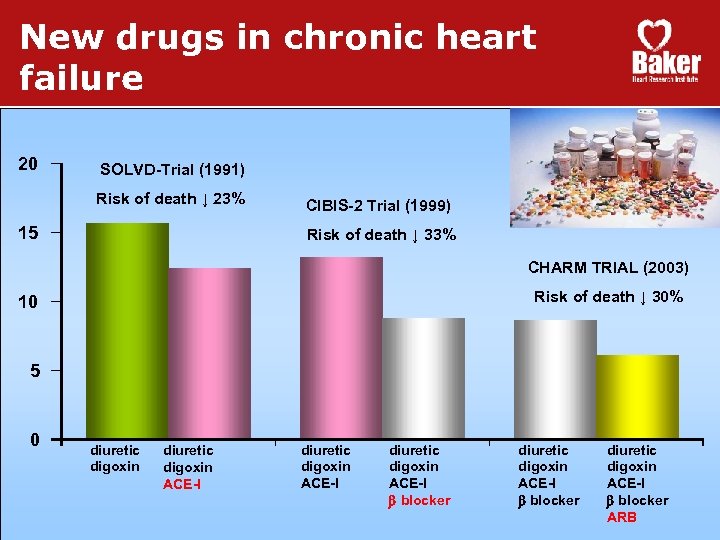 New drugs in chronic heart failure 20 SOLVD-Trial (1991) Risk of death ↓ 23% 15 CIBIS-2 Trial (1999) Risk of death ↓ 33% CHARM TRIAL (2003) Risk of death ↓ 30% 10 5 0 diuretic digoxin ACE-I blocker diuretic digoxin ACE-I blocker ARB
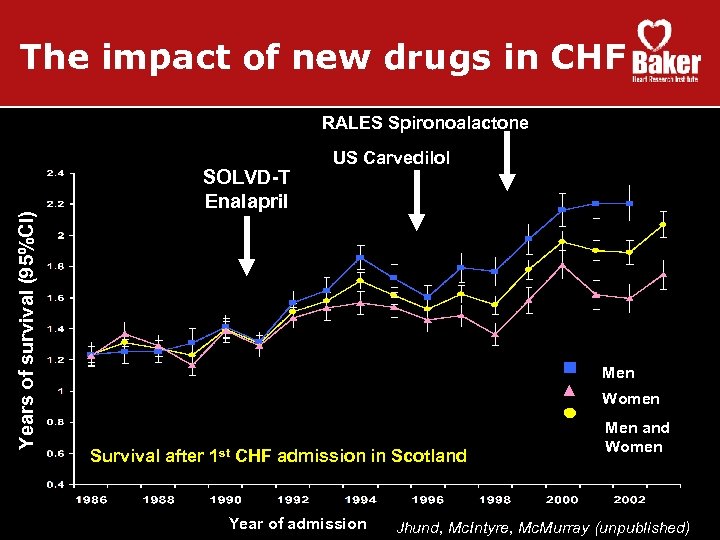 The impact of new drugs in CHF Years of survival (95%CI) RALES Spironoalactone SOLVD-T Enalapril US Carvedilol Men Women Survival after 1 st CHF admission in Scotland Year of admission Men and Women Jhund, Mc. Intyre, Mc. Murray (unpublished)
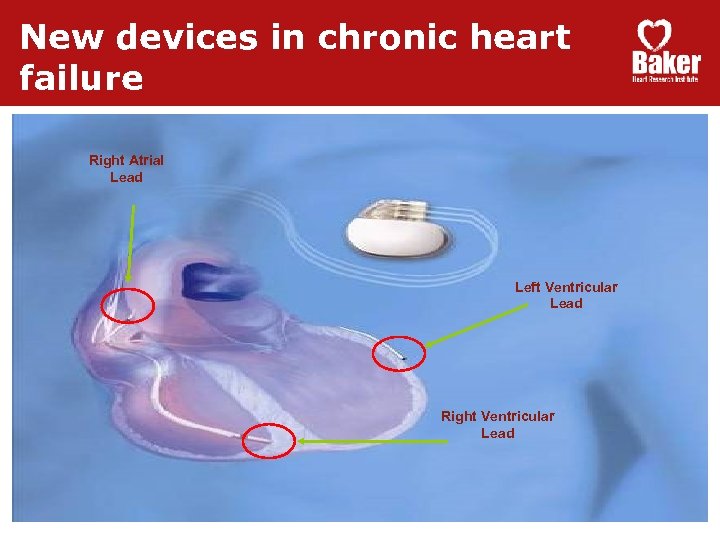 New devices in chronic heart failure While cardiac transplantation is a “niche” Right Atrial Lead treatment, more focus on implanting: ♥ “Smart” pacing wires to synchronise the heart’s pumping action Left Ventricular Lead ♥ “Automated” defibrillators to start the heart when it stops ♥ “Assist” devices that “turbo-charge” Right Ventricular Lead blood flow in the heart ♥ New cells to re-grow the heart
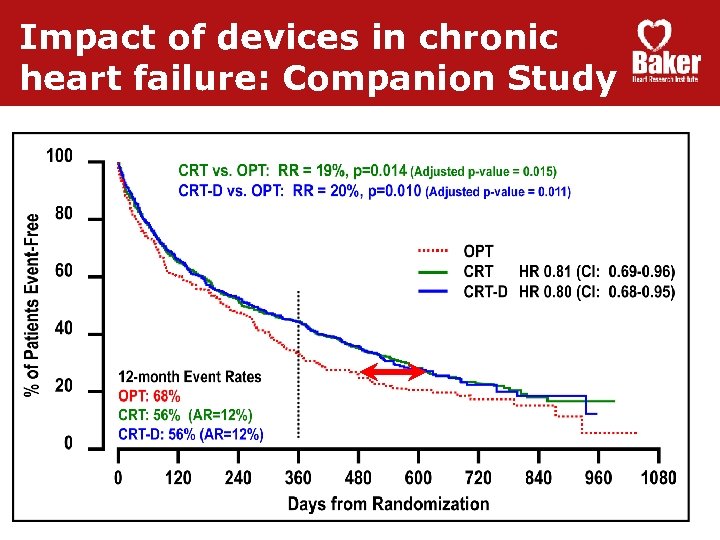 Impact of devices in chronic heart failure: Companion Study
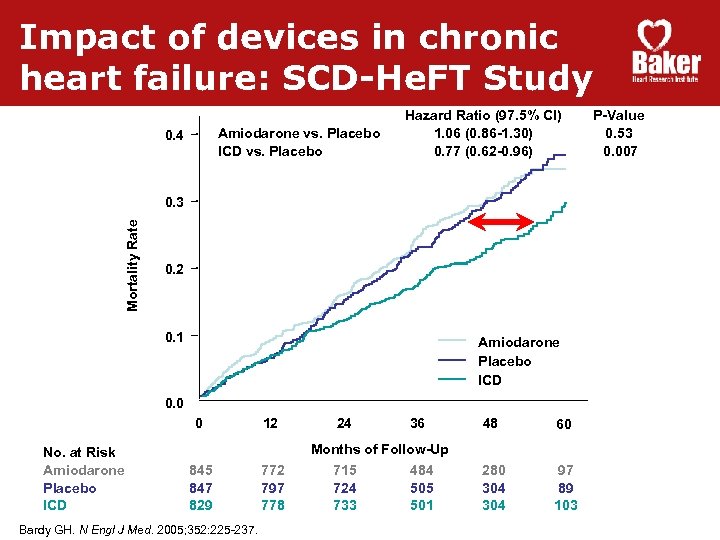 Impact of devices in chronic heart failure: SCD-He. FT Study Amiodarone vs. Placebo ICD vs. Placebo 0. 4 Hazard Ratio (97. 5% Cl) 1. 06 (0. 86 -1. 30) 0. 77 (0. 62 -0. 96) Mortality Rate 0. 3 0. 2 0. 1 Amiodarone Placebo ICD 0. 0 0 No. at Risk Amiodarone Placebo ICD 845 847 829 Bardy GH. N Engl J Med. 2005; 352: 225 -237. 12 772 797 778 24 36 Months of Follow-Up 715 484 724 505 733 501 48 60 280 304 97 89 103 P-Value 0. 53 0. 007
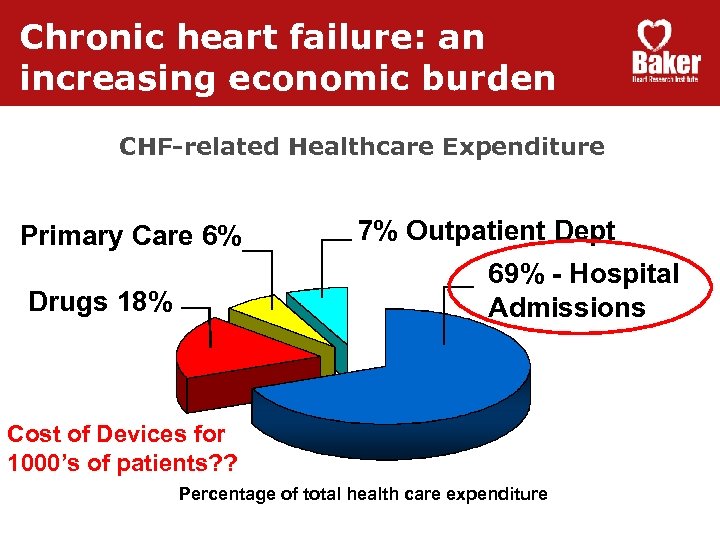 Chronic heart failure: an increasing economic burden CHF-related Healthcare Expenditure Sweden (1996) SEK 2579 m (74%) UK (1991) Primary Care 6% £UK 360 m (60%) 7% Outpatient Dept FF 11. 4 b (64%) 69% - Hospital Admissions $US 9 b (71%) France (1990) Drugs 18% USA (1989) NL (1988) NLG 444 m (67%) UK (2000) £UK 1042 m (70%) Cost of Devices for 0. 0 1000’s of patients? ? 0. 5 1. 0 1. 5 2. 0 Percentage of total health care expenditure
 Presentation Overview ♥ The inevitable link between age & heart disease ♥ Chronic heart failure: an exemplar of poor outcomes, hope and plenty of costs! ♥ Back to the future: the potential value in better systems of care
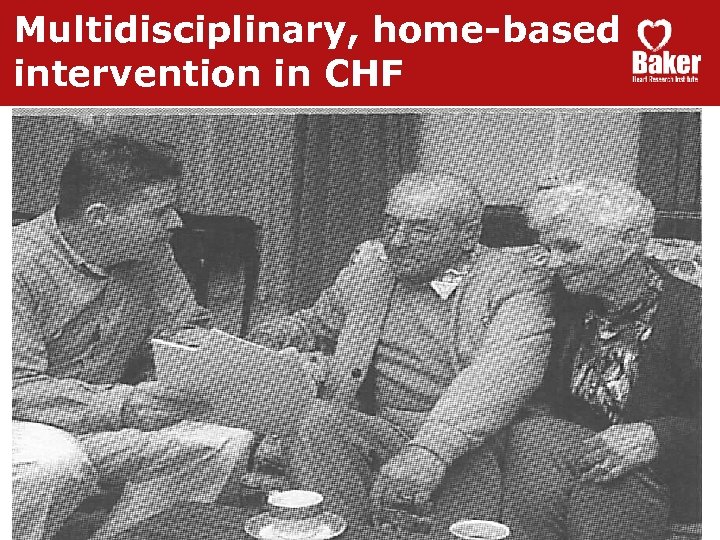 Multidisciplinary, home-based intervention in CHF ♥ Home visit at 1 -2 weeks post discharge by a nurse & pharmacist ♥ ♥ ♥ Clinical history and physical assessment Patient education – warning signs Medication management Psycho-social status Repeat phone calls & patient initiated calls ♥ More intensive/appropriate follow-up ♥ Promote self-care behaviour ♥ Increase GP & cardiology vigilance for high risk patients ♥ Trigger long-term community management
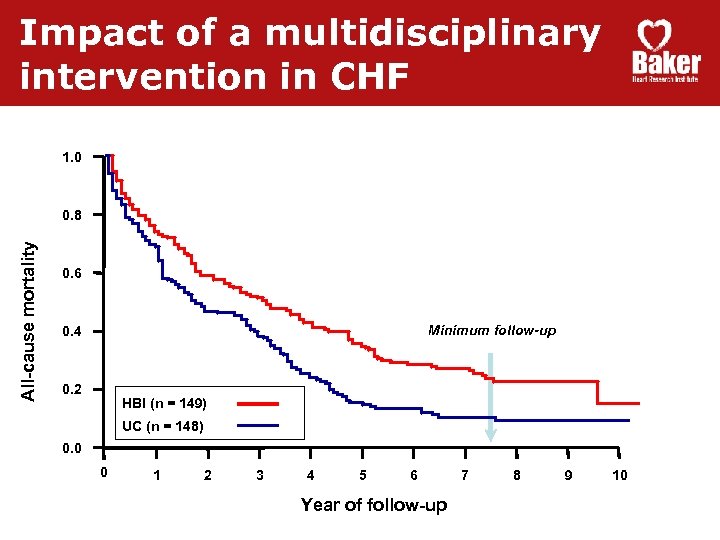 Impact of a multidisciplinary intervention in CHF All-cause mortality Total unplanned readmissions 1. 0 600 HBI (n = 149) UC (n = 148) 0. 8 500 400 0. 6 300 0. 4 Minimum follow-up 200 0. 2 100 HBI (n = 149) UC (n = 148) 0. 0 0 1 1 2 2 3 3 4 4 5 5 6 6 Year of follow-up 7 7 8 8 9 9 10 10
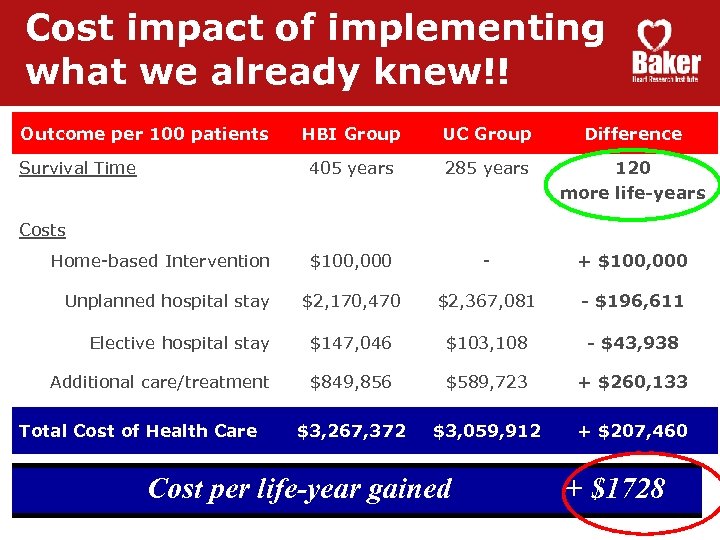 Cost impact of implementing what we already knew!! Outcome per 100 patients HBI Group UC Group Difference 405 years 285 years 120 more life-years $100, 000 - + $100, 000 $2, 170, 470 $2, 367, 081 - $196, 611 Elective hospital stay $147, 046 $103, 108 - $43, 938 Additional care/treatment $849, 856 $589, 723 + $260, 133 $3, 267, 372 $3, 059, 912 + $207, 460 Survival Time Costs Home-based Intervention Unplanned hospital stay Total Cost of Health Care Cost per life-year gained + $1728
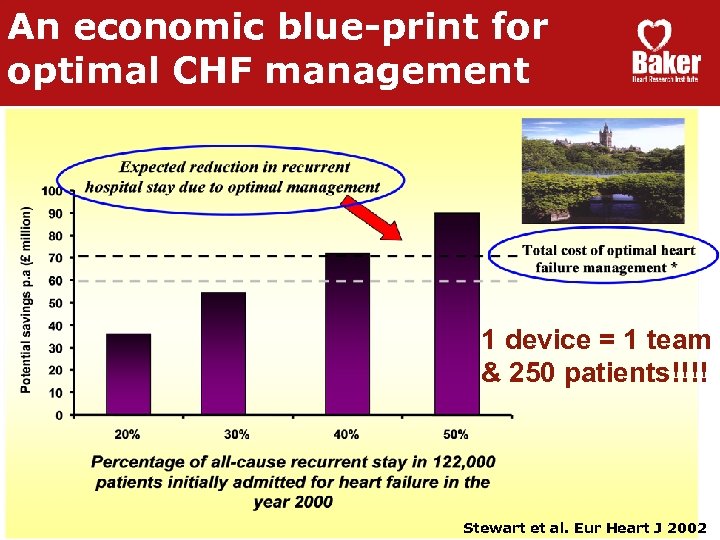 An economic blue-print for optimal CHF management 1 device = 1 team & 250 patients!!!! Stewart et al. Eur Heart J 2002
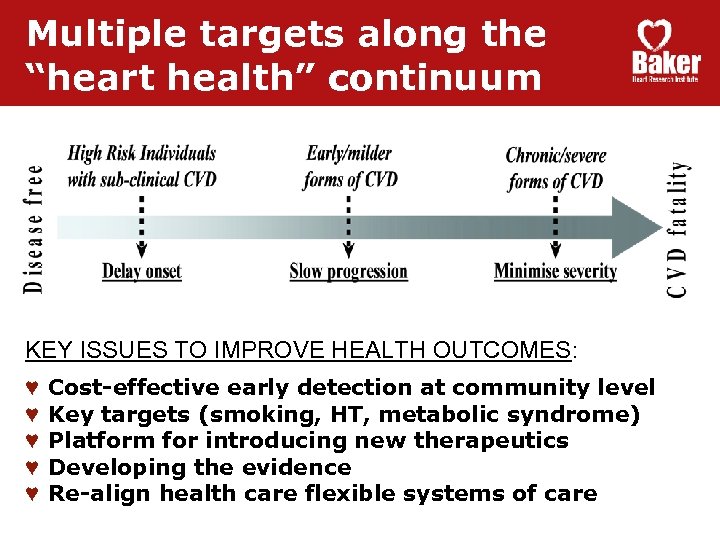 Multiple targets along the “heart health” continuum KEY ISSUES TO IMPROVE HEALTH OUTCOMES: ♥ ♥ ♥ Cost-effective early detection at community level Key targets (smoking, HT, metabolic syndrome) Platform for introducing new therapeutics Developing the evidence Re-align health care flexible systems of care
 Summary Key challenges to the “heart health” of Australia: ♥ Improve flow of information on evolving epidemic: geo-mapping & linked data ♥ Picking the right individuals for more expensive therapies ♥ Going back to “basics” to apply what we already know will improve outcomes!