 Скачать презентацию New States and Charmonium Spectroscopy at BABAR Bill
09753da7b1e0f77fff3b04d922421ce5.ppt
- Количество слайдов: 39



New States and Charmonium Spectroscopy at BABAR Bill Dunwoodie (SLAC) On behalf of the BABAR Collaboration PANIC 08 Nov 9 th – 15 th, 2008, Eilat, Israel Outline • e+e-→γISRY(4260), Y(4260)→J/ψπ+π • B→X(3872)K, X(3872)→J/ψγ, ψ(2 S)γ ar. Xiv: 0809. 0042 (Submitted to PRL) • B→Y(3940)K, Y(3940)→J/ψω PRL 101, 082001 (2008) • B→Z(4430)-K, Z(4430)-→J/ψπ-, ψ(2 S)π- ar. Xiv: 0811. 0564 (Submitted to PRD) • Summary & conclusions Update of talk by Arafat G. Mokhtar at ICHEP 08: http: //www. hep. upenn. edu/ichep 08/talks/misc/download_slides? Talk_id=411 * The use of charge conjugate reactions is implied throughout this presentation 1 /22
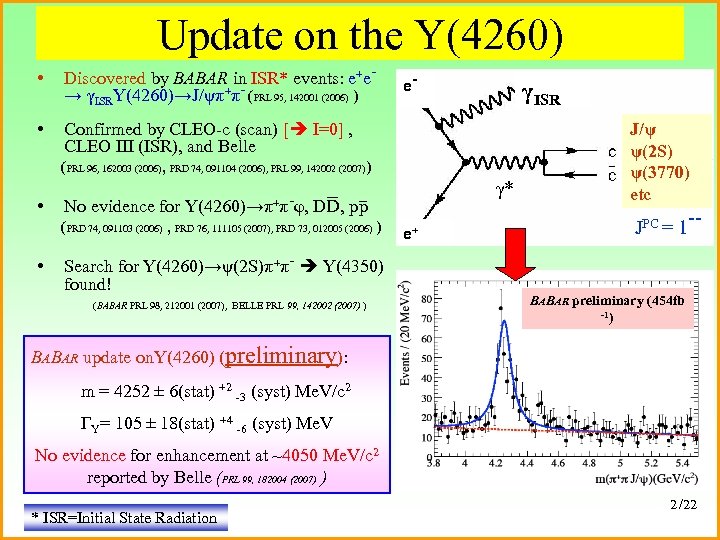
Update on the Y(4260) • Discovered by BABAR in ISR* events: e+e→ γISRY(4260)→J/ψπ+π- (PRL 95, 142001 (2006) ) • Confirmed by CLEO-c (scan) [ I=0] , CLEO III (ISR), and Belle e- γISR (PRL 96, 162003 (2006), PRD 74, 091104 (2006), PRL 99, 142002 (2007)) • No evidence for Y(4260)→π+π-φ, DD, pp (PRD 74, 091103 (2006) , PRD 76, 111105 (2007), PRD 73, 012005 (2006) ) • γ* Search for Y(4260)→ψ(2 S)π+π- Y(4350) found! (BABAR PRL 98, 212001 (2007), BELLE PRL 99, 142002 (2007) ) e+ J/ψ ψ(2 S) Y(4050)? ψ(3770) etc JPC = 1 -- BABAR preliminary (454 fb -1) BABAR update on. Y(4260) (preliminary): m = 4252 ± 6(stat) +2 -3 (syst) Me. V/c 2 ΓY= 105 ± 18(stat) +4 -6 (syst) Me. V No evidence for enhancement at ~4050 Me. V/c 2 reported by Belle (PRL 99, 182004 (2007) ) * ISR=Initial State Radiation 2 /22
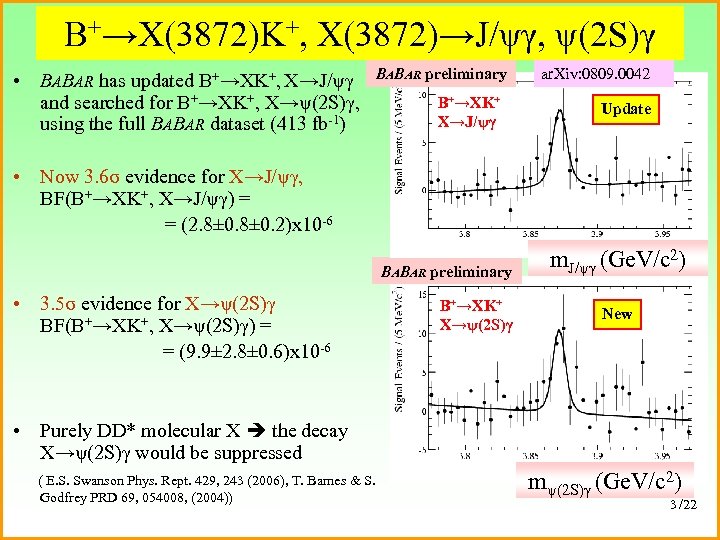
B+→X(3872)K+, X(3872)→J/ψγ, ψ(2 S)γ • BABAR has updated B+→XK+, X→J/ψγ and searched for B+→XK+, X→ψ(2 S)γ, using the full BABAR dataset (413 fb-1) BABAR preliminary B+→XK+ X→J/ψγ ar. Xiv: 0809. 0042 Update • Now 3. 6σ evidence for X→J/ψγ, BF(B+→XK+, X→J/ψγ) = = (2. 8± 0. 2)x 10 -6 BABAR preliminary • 3. 5σ evidence for X→ψ(2 S)γ BF(B+→XK+, X→ψ(2 S)γ) = = (9. 9± 2. 8± 0. 6)x 10 -6 B+→XK+ X→ψ(2 S)γ m. J/ψγ (Ge. V/c 2) New • Purely DD* molecular X the decay X→ψ(2 S)γ would be suppressed ( E. S. Swanson Phys. Rept. 429, 243 (2006), T. Barnes & S. Godfrey PRD 69, 054008, (2004)) mψ(2 S)γ (Ge. V/c 2) 3 /22
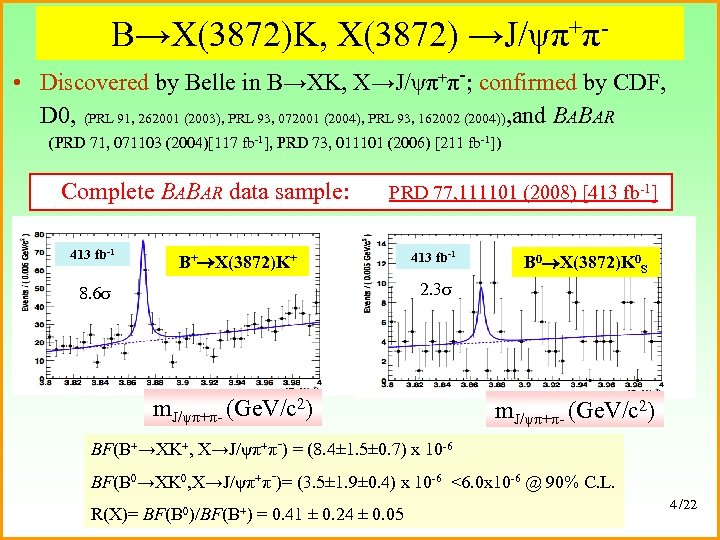
B→X(3872)K, X(3872) →J/ψπ+π • Discovered by Belle in B→XK, X→J/ψπ+π-; confirmed by CDF, D 0, (PRL 91, 262001 (2003), PRL 93, 072001 (2004), PRL 93, 162002 (2004)), and BABAR (PRD 71, 071103 (2004)[117 fb-1], PRD 73, 011101 (2006) [211 fb-1]) Complete BABAR data sample: 413 fb-1 PRD 77, 111101 (2008) [413 fb-1] B+ X(3872)K+ 413 fb-1 B 0 X(3872)K 0 S 2. 3 8. 6 m. J/ψπ+π- (Ge. V/c 2) BF(B+→XK+, X→J/ψπ+π-) = (8. 4± 1. 5± 0. 7) x 10 -6 BF(B 0→XK 0, X→J/ψπ+π-)= (3. 5± 1. 9± 0. 4) x 10 -6 <6. 0 x 10 -6 @ 90% C. L. R(X)= BF(B 0)/BF(B+) = 0. 41 ± 0. 24 ± 0. 05 4 /22
![The Y(3940)→J/ψω (347 fb-1) • Discovered by Belle in B→YK [PRL 94, 182002(2005)] •](https://present5.com/presentation/09753da7b1e0f77fff3b04d922421ce5/image-5.jpg "The Y(3940)→J/ψω (347 fb-1) • Discovered by Belle in B→YK [PRL 94, 182002(2005)] •")
The Y(3940)→J/ψω (347 fb-1) • Discovered by Belle in B→YK [PRL 94, 182002(2005)] • Confirmed by BABAR [PRL 101, 082001 (2008)] • mass and width: – m = 3914. 6+3. 8 -3. 4 ± 2. 0 Me. V/c 2 – Γ = 34+12 -8 ± 5 Me. V Belle: m = 3943± 11± 13 Me. V/c 2; Γ = 87± 22 ± 26 Me. V • B+ and B 0 BF’s measured separately • B 0/B+ in the Y region: – RY =0. 27 +0. 28 -0. 23 +0. 04 -0. 01 3σ below the isospin expectation • Similar to X(3872) from BABAR: B+→J/ψωK+ B 0→J/ψωK 0 [PRD 77, 111101(2008)] – Rx = 0. 41 ± 0. 24 ± 0. 05 cf. Rψ(2 S) = 0. 81 ± 0. 05 ± 0. 01; RJ/ψ = 0. 865 ± 0. 044 (PDG) 5 /22
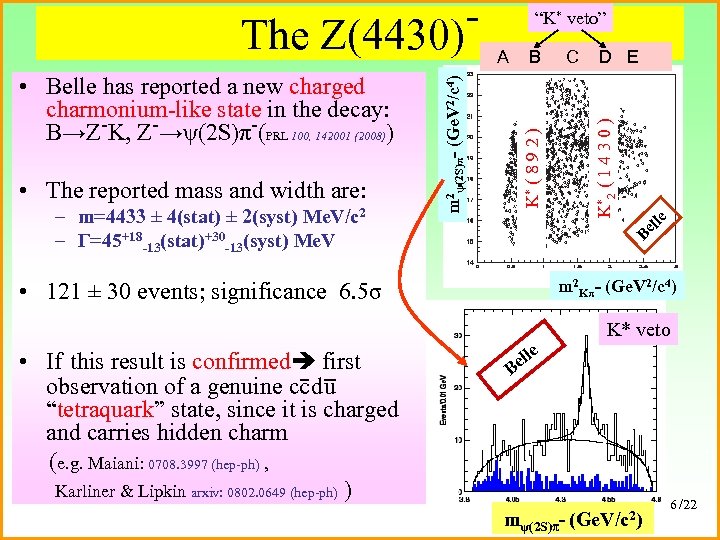
– m=4433 ± 4(stat) ± 2(syst) Me. V/c 2 – Γ=45+18 -13(stat)+30 -13(syst) Me. V A B C D E K* 2 ( 1 4 3 0 ) • The reported mass and width are: “K* veto” K* ( 8 9 2 ) • Belle has reported a new charged charmonium-like state in the decay: B→Z-K, Z-→ψ(2 S)π-(PRL 100, 142001 (2008)) m 2ψ(2 S)π- (Ge. V 2/c 4) The Z(4430) le l Be m 2 Kπ- (Ge. V 2/c 4) • 121 ± 30 events; significance 6. 5σ K* veto • If this result is confirmed first observation of a genuine ccdu “tetraquark” state, since it is charged and carries hidden charm (e. g. Maiani: 0708. 3997 (hep-ph) , Karliner & Lipkin arxiv: 0802. 0649 (hep-ph) ) e ell B mψ(2 S)π - (Ge. V/c 2) 6 /22
- at BABAR Search for the Z(4430) • Search for the Z(4430)- in the decay modes B-0→ψπ-K 0+ (*) • Describe the Kπ- system in detail, since structure in the Kπmass and angular distributions dominates each Dalitz plot • Correct the data for efficiency event-by-event across the Dalitz plot, and describe using only Kπ- S-, P-, and D-wave intensity contributions Project each Kπ- description onto the relevant ψπ- mass distribution to investigate the need for Z(4430)- signal above this “Kπ- background” • Mass resolution at m. Z: ~ 7 Me. V/c 2 for J/ψπ- and ~4 Me. V/c 2 for ψ(2 S)π- no significant effect on any Z(4430)- signal * We use “ψ” to denote “J/ψ or ψ(2 S)” unless otherwise indicated 7 /22
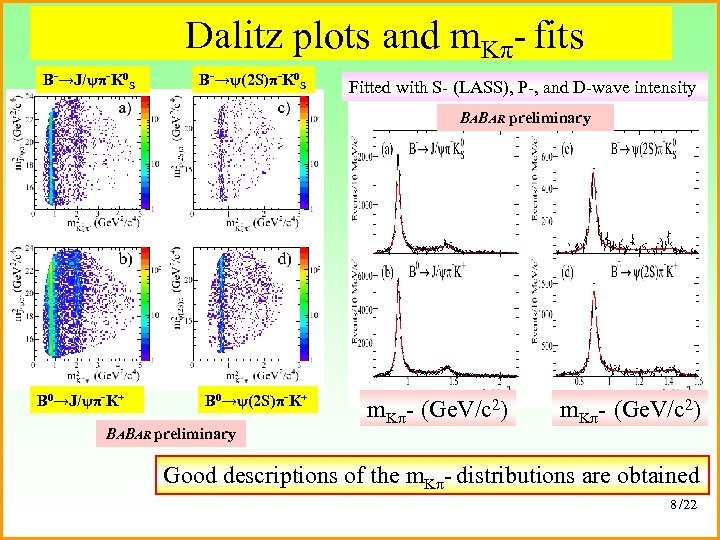
Dalitz plots and m. Kπ- fits B-→J/ψπ-K 0 S B-→ψ(2 S)π-K 0 S Fitted with S- (LASS), P-, and D-wave intensity BABAR preliminary B 0→J/ψπ-K+ B 0→ψ(2 S)π-K+ BABAR preliminary m. Kπ- (Ge. V/c 2) Good descriptions of the m. Kπ- distributions are obtained 8 /22
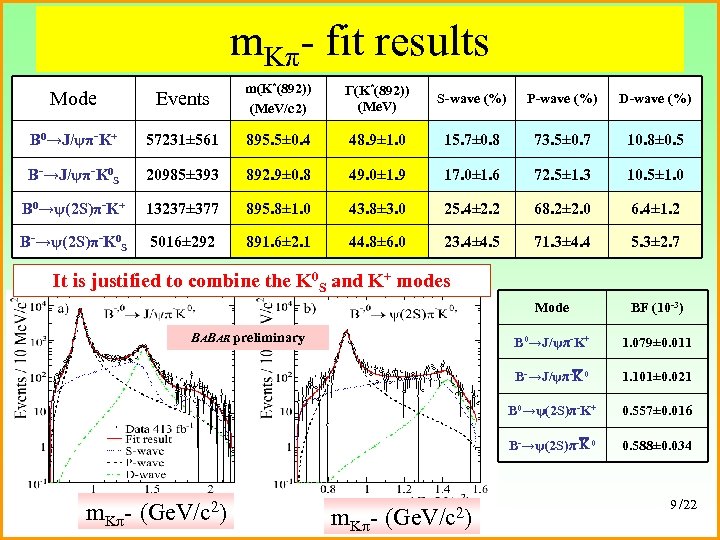
m. Kπ- fit results Mode Events m(K*(892)) (Me. V/c 2) B 0→J/ψπ-K+ 57231± 561 895. 5± 0. 4 48. 9± 1. 0 15. 7± 0. 8 73. 5± 0. 7 10. 8± 0. 5 B-→J/ψπ-K 0 S 20985± 393 892. 9± 0. 8 49. 0± 1. 9 17. 0± 1. 6 72. 5± 1. 3 10. 5± 1. 0 B 0→ψ(2 S)π-K+ 13237± 377 895. 8± 1. 0 43. 8± 3. 0 25. 4± 2. 2 68. 2± 2. 0 6. 4± 1. 2 B-→ψ(2 S)π-K 0 S 5016± 292 891. 6± 2. 1 44. 8± 6. 0 23. 4± 4. 5 71. 3± 4. 4 5. 3± 2. 7 Mode BF (10 -3) B 0→J/ψπ-K+ 1. 079± 0. 011 B-→J/ψπ-K 0 1. 101± 0. 021 B 0→ψ(2 S)π-K+ 0. 557± 0. 016 B-→ψ(2 S)π-K 0 0. 588± 0. 034 Γ(K*(892)) (Me. V) S-wave (%) P-wave (%) D-wave (%) It is justified to combine the K 0 S and K+ modes BABAR preliminary m. Kπ- (Ge. V/c 2) 9 /22
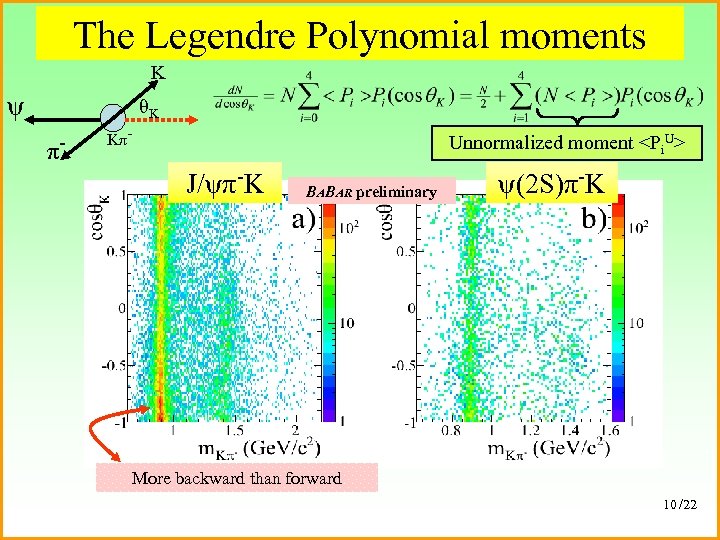
The Legendre Polynomial moments K ψ θK π- Kπ- Unnormalized moment <Pi. U> J/ψπ-K BABAR preliminary ψ(2 S)π-K More backward than forward 10 /22
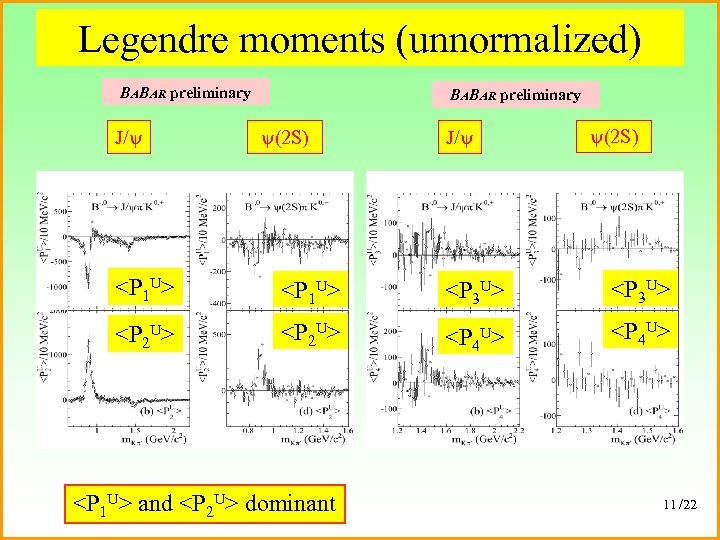
Legendre moments (unnormalized) BABAR preliminary J/y BABAR preliminary y(2 S) J/y y(2 S) <P 1 U> <P 3 U> <P 2 U> <P 4 U> <P 1 U> and <P 2 U> dominant 11 /22
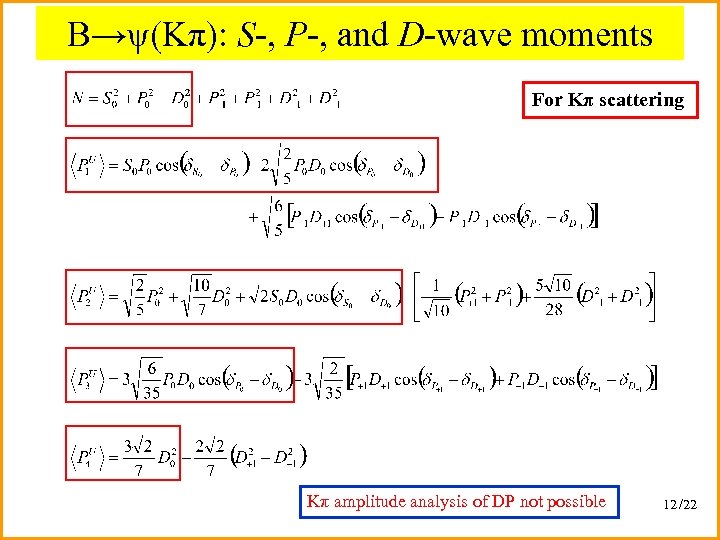
B→ψ(Kπ): S-, P-, and D-wave moments For Kπ scattering Kπ amplitude analysis of DP not possible 12 /22
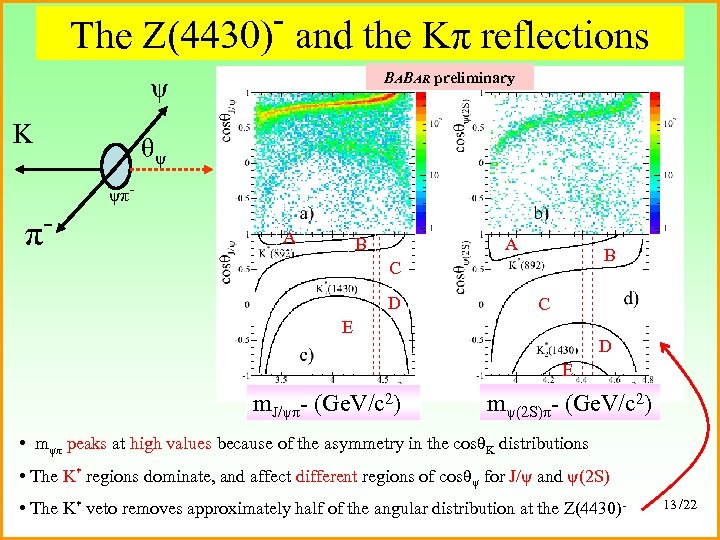
- and the Kπ reflections The Z(4430) BABAR preliminary ψ K θψ ψπ- π A B C D C E D E m. J/ψπ- (Ge. V/c 2) mψ(2 S)π- (Ge. V/c 2) • mψπ peaks at high values because of the asymmetry in the cosθK distributions • The K* regions dominate, and affect different regions of cosθψ for J/ψ and ψ(2 S) • The K* veto removes approximately half of the angular distribution at the Z(4430)- 13 /22
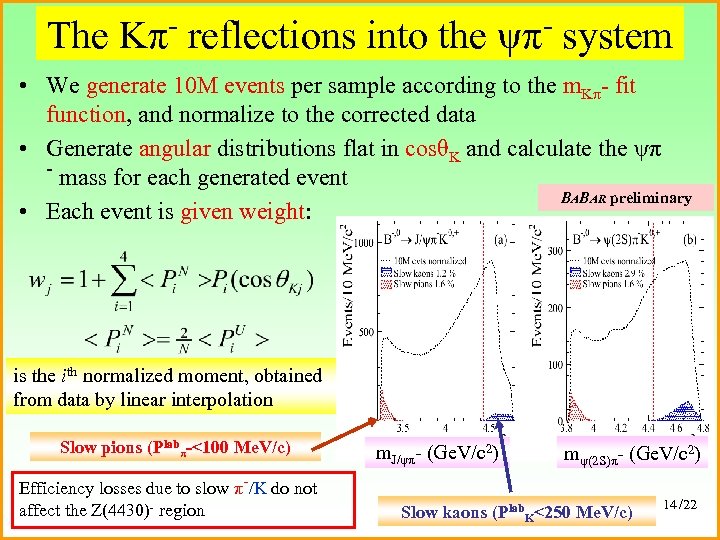
The Kπ- reflections into the ψπ- system • We generate 10 M events per sample according to the m. Kπ- fit function, and normalize to the corrected data • Generate angular distributions flat in cosθK and calculate the ψπ - mass for each generated event BABAR preliminary • Each event is given weight: is the ith normalized moment, obtained from data by linear interpolation Slow pions (Plabπ-<100 Me. V/c) Efficiency losses due to slow π-/K do not affect the Z(4430)- region m. J/ψπ- (Ge. V/c 2) mψ(2 S)π- (Ge. V/c 2) Slow kaons (Plab. K<250 Me. V/c) 14 /22
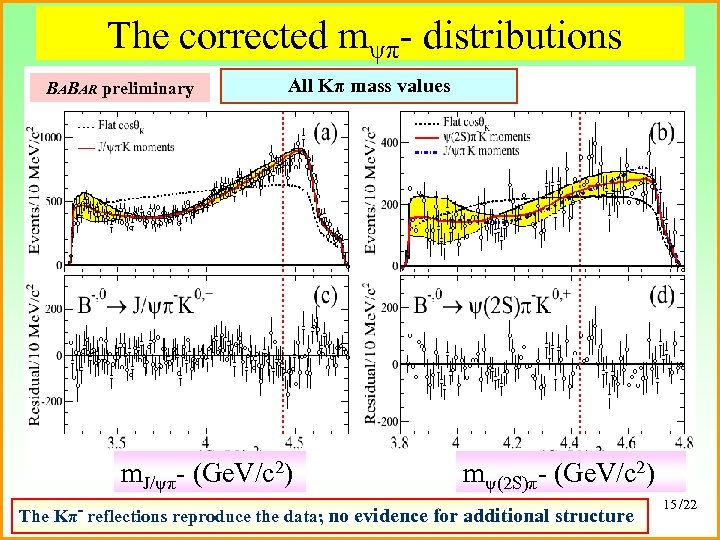
The corrected mψπ- distributions BABAR preliminary All Kπ mass values m. J/ψπ- (Ge. V/c 2) mψ(2 S)π- (Ge. V/c 2) The Kπ- reflections reproduce the data; no evidence for additional structure 15 /22
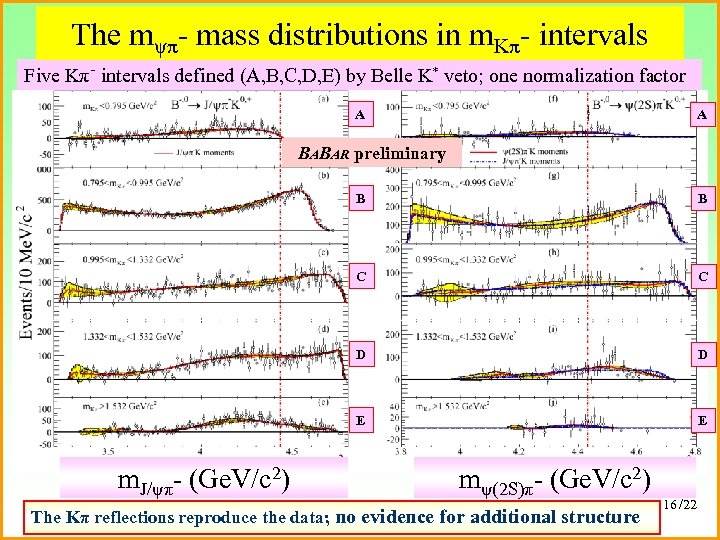
The mψπ- mass distributions in m. Kπ- intervals Five Kπ- intervals defined (A, B, C, D, E) by Belle K* veto; one normalization factor A A BABAR preliminary B C C D D E m. J/ψπ- (Ge. V/c 2) B E mψ(2 S)π- (Ge. V/c 2) The Kπ reflections reproduce the data; no evidence for additional structure 16 /22
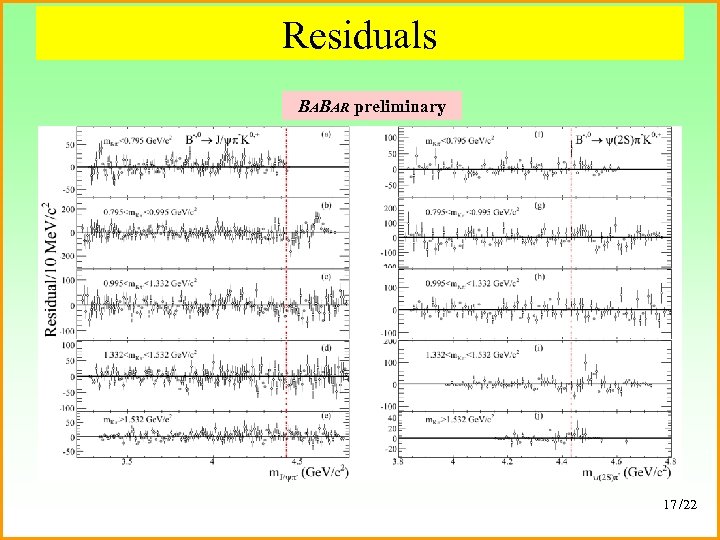
Residuals BABAR preliminary 17 /22
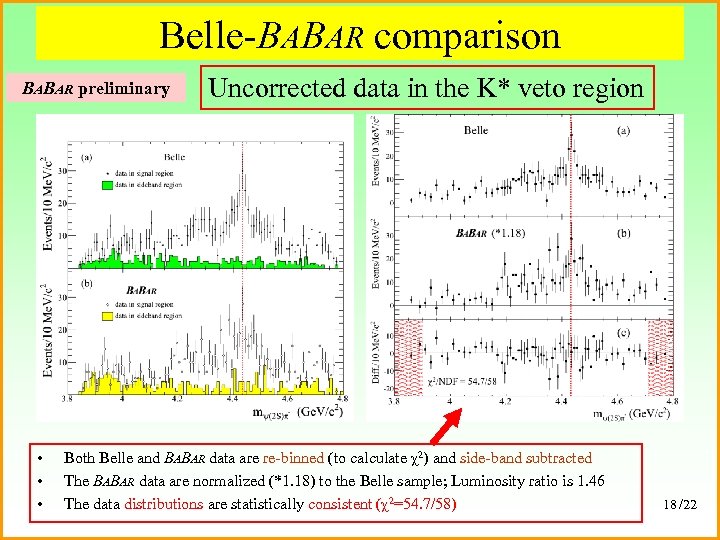
Belle-BABAR comparison BABAR preliminary • • • Uncorrected data in the K* veto region Both Belle and BABAR data are re-binned (to calculate χ2) and side-band subtracted The BABAR data are normalized (*1. 18) to the Belle sample; Luminosity ratio is 1. 46 The data distributions are statistically consistent (χ2=54. 7/58) 18 /22
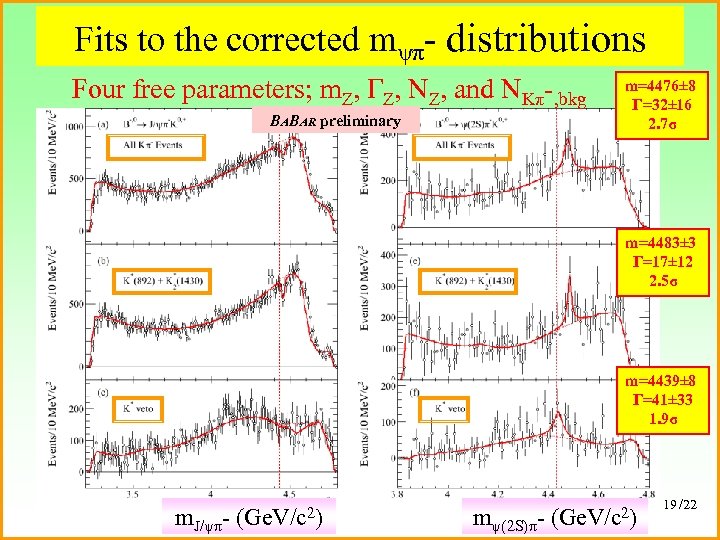
Fits to the corrected mψπ- distributions Four free parameters; m. Z, ΓZ, NZ, and NKπ-, bkg BABAR preliminary m=4476± 8 Γ=32± 16 2. 7σ m=4483± 3 Γ=17± 12 2. 5σ m=4439± 8 Γ=41± 33 1. 9σ m. J/ψπ- (Ge. V/c 2) mψ(2 S)π- (Ge. V/c 2) 19 /22
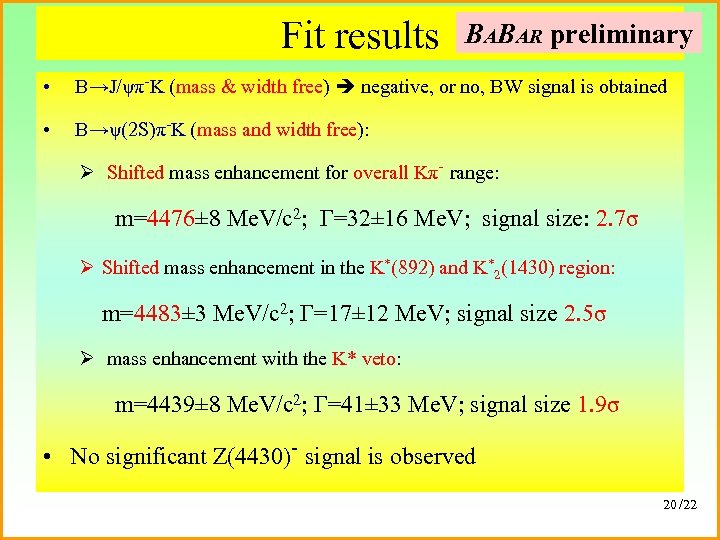
Fit results BABAR preliminary • B→J/ψπ-K (mass & width free) negative, or no, BW signal is obtained • B→ψ(2 S)π-K (mass and width free): Ø Shifted mass enhancement for overall Kπ- range: m=4476± 8 Me. V/c 2; Γ=32± 16 Me. V; signal size: 2. 7σ Ø Shifted mass enhancement in the K*(892) and K*2(1430) region: m=4483± 3 Me. V/c 2; Γ=17± 12 Me. V; signal size 2. 5σ Ø mass enhancement with the K* veto: m=4439± 8 Me. V/c 2; Γ=41± 33 Me. V; signal size 1. 9σ • No significant Z(4430)- signal is observed 20 /22
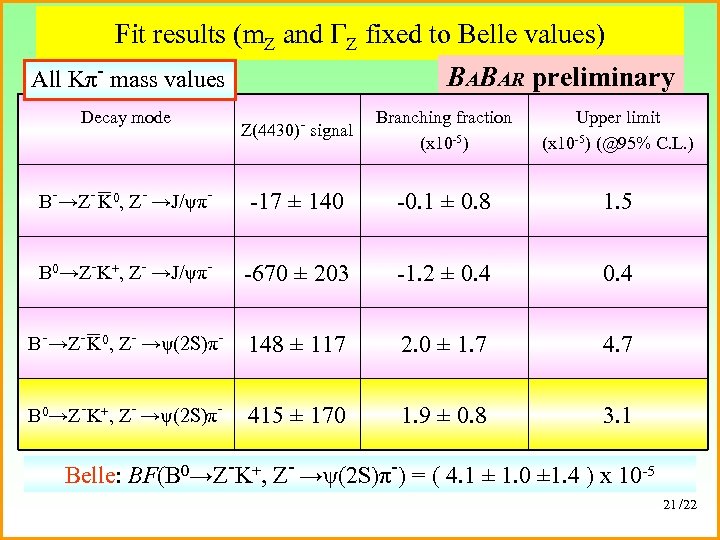
Fit results (m. Z and ΓZ fixed to Belle values) All Kπ- mass values BABAR preliminary Decay mode Z(4430)- signal Branching fraction (x 10 -5) Upper limit (x 10 -5) (@95% C. L. ) B-→Z-K 0, Z- →J/ψπ- -17 ± 140 -0. 1 ± 0. 8 1. 5 B 0→Z-K+, Z- →J/ψπ- -670 ± 203 -1. 2 ± 0. 4 B-→Z-K 0, Z- →ψ(2 S)π- 148 ± 117 2. 0 ± 1. 7 4. 7 B 0→Z-K+, Z- →ψ(2 S)π- 415 ± 170 1. 9 ± 0. 8 3. 1 Belle: BF(B 0→Z-K+, Z- →ψ(2 S)π-) = ( 4. 1 ± 1. 0 ± 1. 4 ) x 10 -5 21 /22
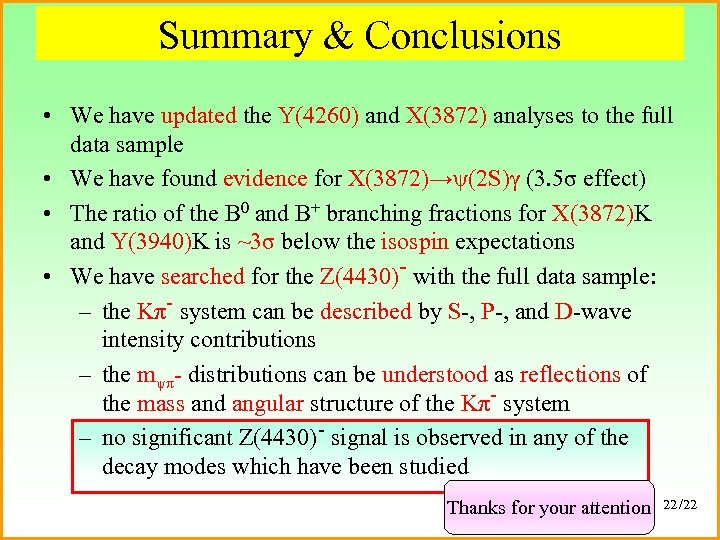
Summary & Conclusions • We have updated the Y(4260) and X(3872) analyses to the full data sample • We have found evidence for X(3872)→ψ(2 S)γ (3. 5σ effect) • The ratio of the B 0 and B+ branching fractions for X(3872)K and Y(3940)K is ~3σ below the isospin expectations • We have searched for the Z(4430)- with the full data sample: – the Kπ- system can be described by S-, P-, and D-wave intensity contributions – the mψπ- distributions can be understood as reflections of the mass and angular structure of the Kπ- system – no significant Z(4430)- signal is observed in any of the decay modes which have been studied Thanks for your attention 22 /22

Backup slides 23 /22
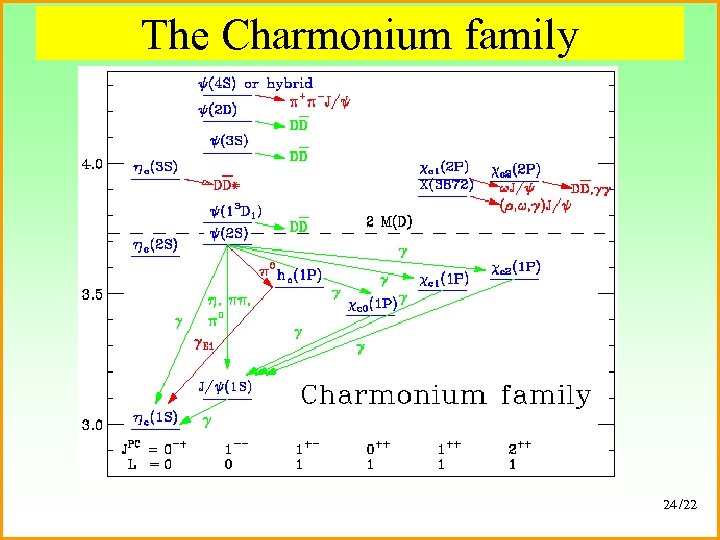
The Charmonium family 24 /22
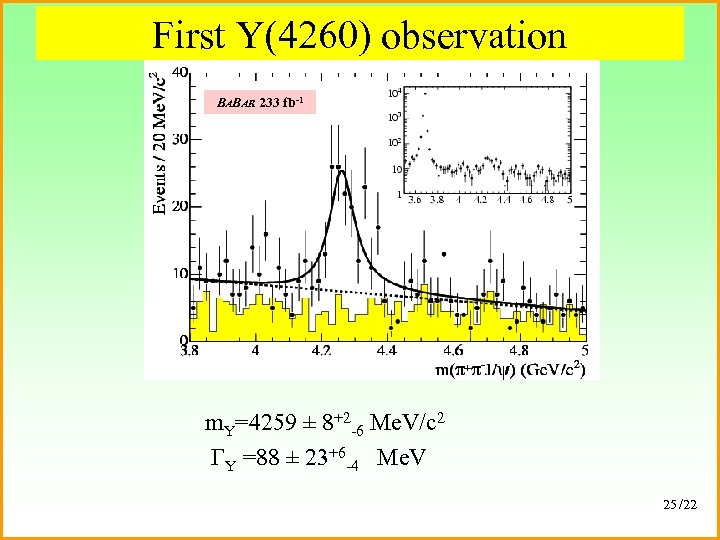
First Y(4260) observation BABAR 233 fb-1 m. Y=4259 ± 8+2 -6 Me. V/c 2 ΓY =88 ± 23+6 -4 Me. V 25 /22
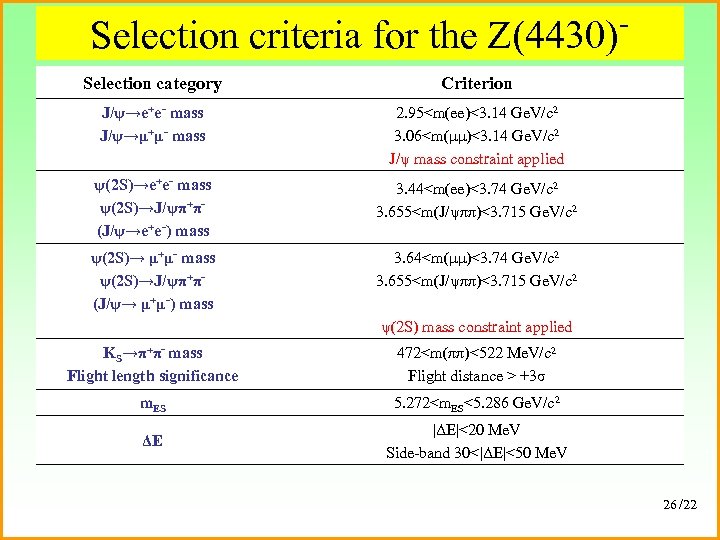
Selection criteria for the Z(4430)Selection category Criterion J/ψ→e+e- mass J/ψ→μ+μ- mass 2. 95<m(ee)<3. 14 Ge. V/c 2 3. 06<m(μμ)<3. 14 Ge. V/c 2 J/ψ mass constraint applied ψ(2 S)→e+e- mass ψ(2 S)→J/ψπ+π(J/ψ→e+e-) mass 3. 44<m(ee)<3. 74 Ge. V/c 2 3. 655<m(J/ψππ)<3. 715 Ge. V/c 2 ψ(2 S)→ μ+μ- mass ψ(2 S)→J/ψπ+π(J/ψ→ μ+μ-) mass 3. 64<m(μμ)<3. 74 Ge. V/c 2 3. 655<m(J/ψππ)<3. 715 Ge. V/c 2 ψ(2 S) mass constraint applied KS→π+π- mass Flight length significance 472<m(ππ)<522 Me. V/c 2 Flight distance > +3σ m. ES 5. 272<m. ES<5. 286 Ge. V/c 2 ΔE |ΔE|<20 Me. V Side-band 30<|ΔE|<50 Me. V 26 /22
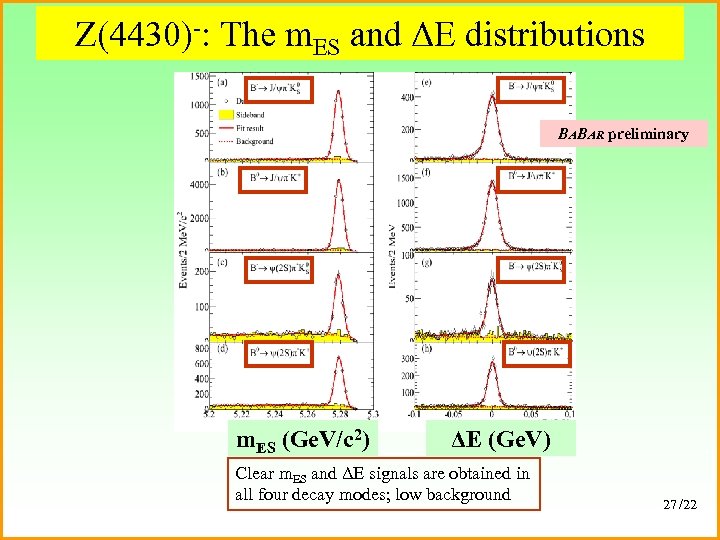
Z(4430)-: The m. ES and ΔE distributions BABAR preliminary m. ES (Ge. V/c 2) ΔE (Ge. V) Clear m. ES and ΔE signals are obtained in all four decay modes; low background 27 /22
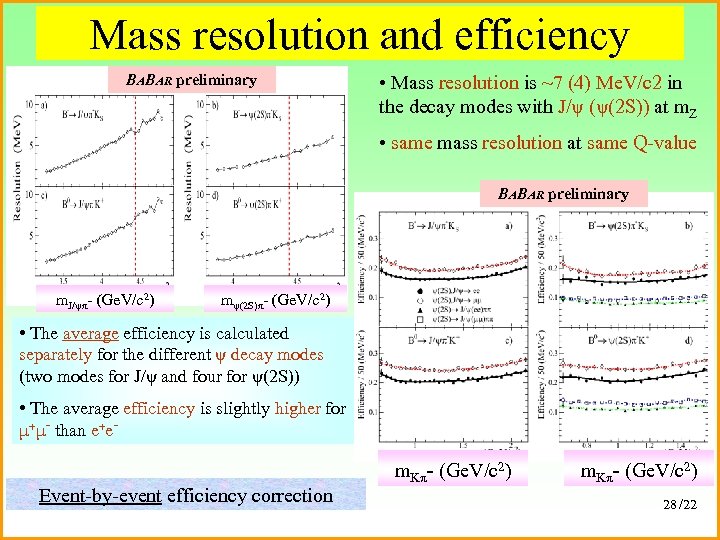
Mass resolution and efficiency BABAR preliminary • Mass resolution is ~7 (4) Me. V/c 2 in the decay modes with J/ψ (ψ(2 S)) at m. Z • same mass resolution at same Q-value BABAR preliminary m. J/ψπ- (Ge. V/c 2) mψ(2 S)π- (Ge. V/c 2) • The average efficiency is calculated separately for the different ψ decay modes (two modes for J/ψ and four for ψ(2 S)) • The average efficiency is slightly higher for μ+μ- than e+e- Event-by-event efficiency correction m. Kπ- (Ge. V/c 2) 28 /22
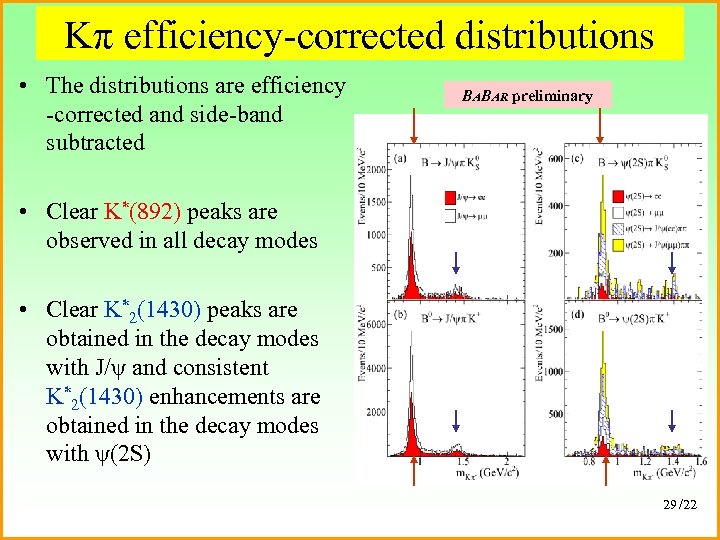
Kπ efficiency-corrected distributions • The distributions are efficiency -corrected and side-band subtracted BABAR preliminary • Clear K*(892) peaks are observed in all decay modes • Clear K*2(1430) peaks are obtained in the decay modes with J/ψ and consistent K*2(1430) enhancements are obtained in the decay modes with ψ(2 S) 29 /22
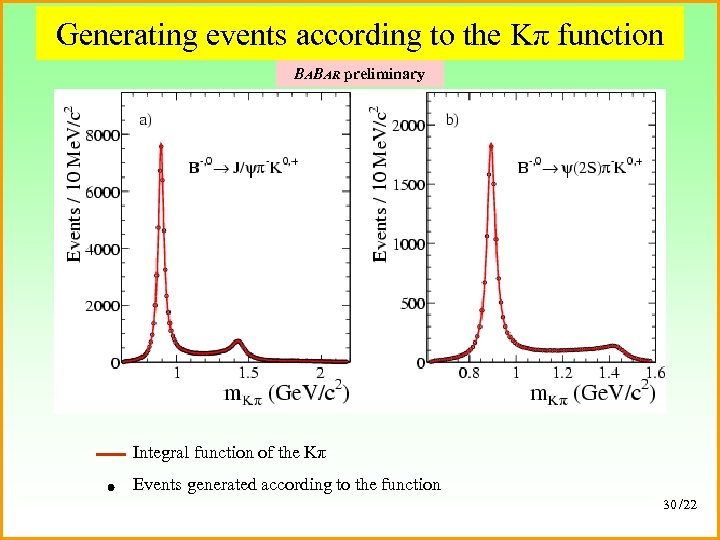
Generating events according to the Kπ function BABAR preliminary Integral function of the Kπ Events generated according to the function 30 /22
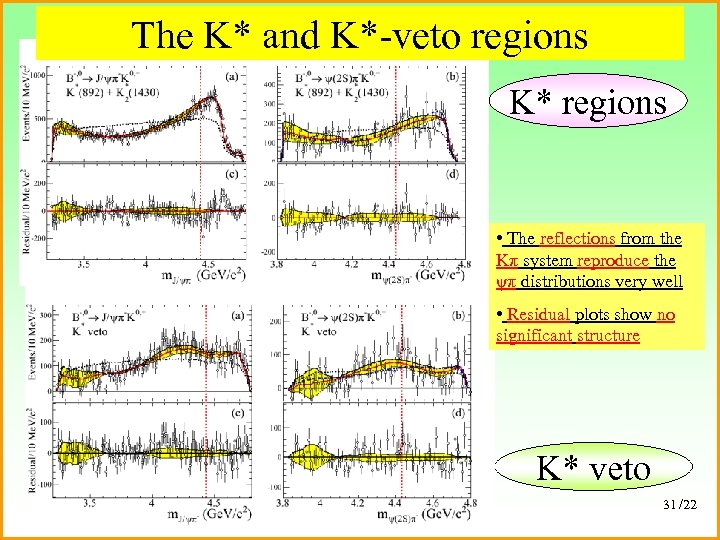
The K* and K*-veto regions K* regions • The reflections from the Kπ system reproduce the ψπ distributions very well • Residual plots show no significant structure K* veto 31 /22
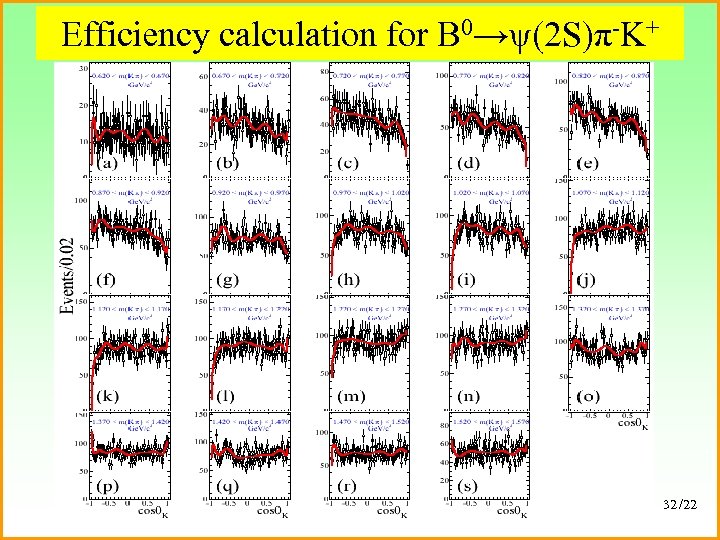
Efficiency calculation for B 0→ψ(2 S)π-K+ 32 /22
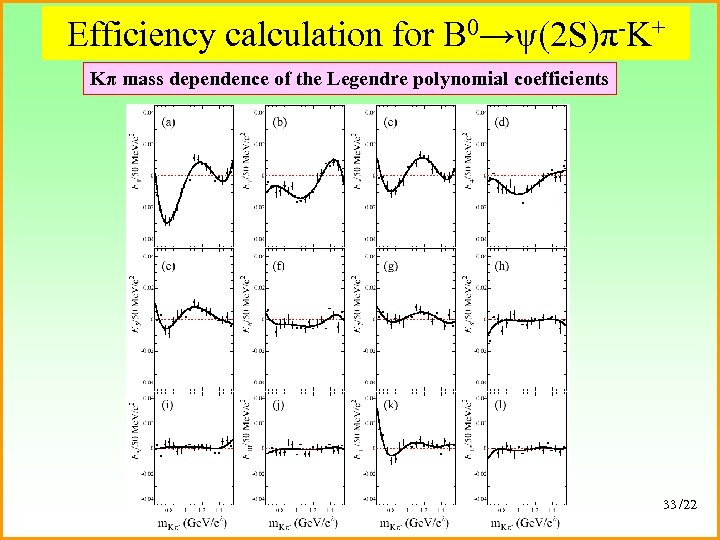
Efficiency calculation for B 0→ψ(2 S)π-K+ Kπ mass dependence of the Legendre polynomial coefficients 33 /22
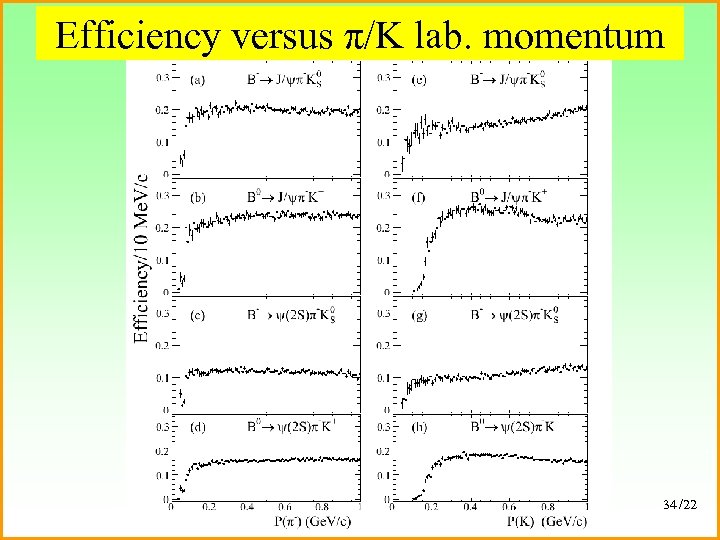
Efficiency versus π/K lab. momentum 34 /22
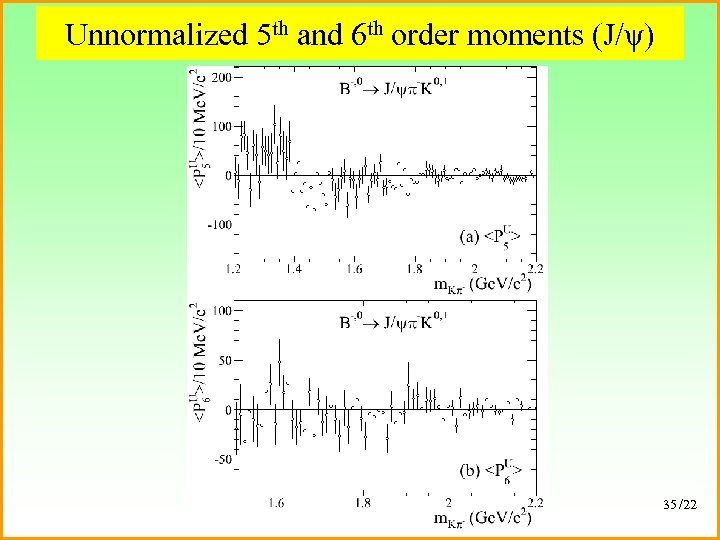
Unnormalized 5 th and 6 th order moments (J/ψ) 35 /22
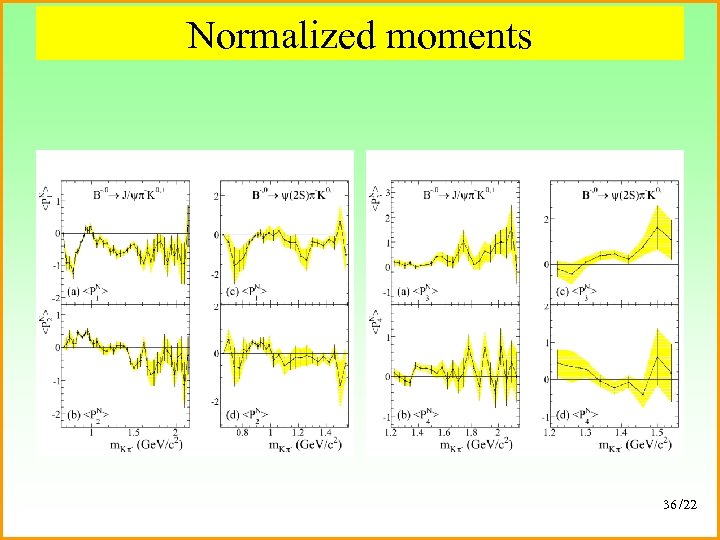
Normalized moments 36 /22
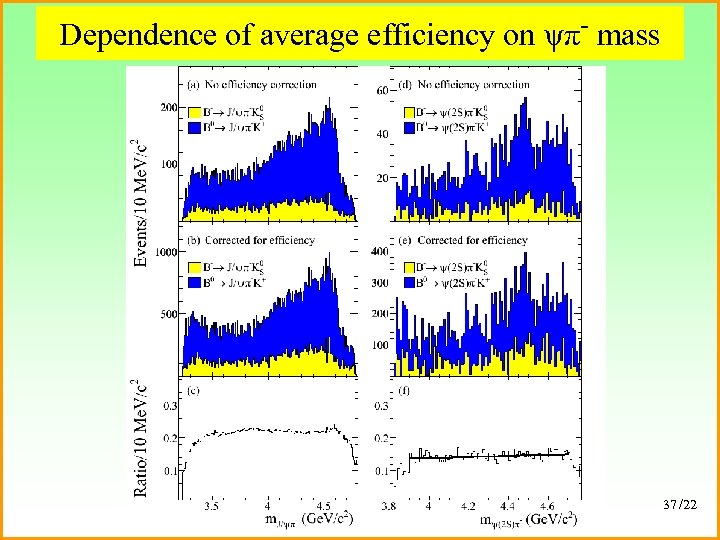
Dependence of average efficiency on ψπ- mass 37 /22
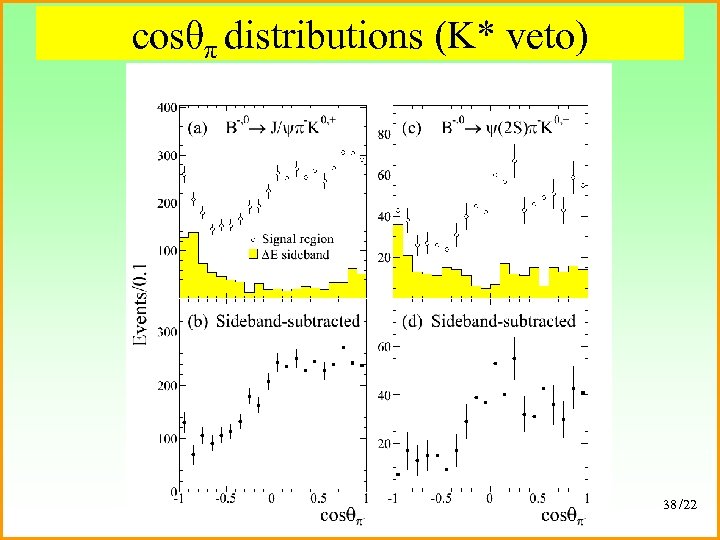
cosθπ distributions (K* veto) 38 /22
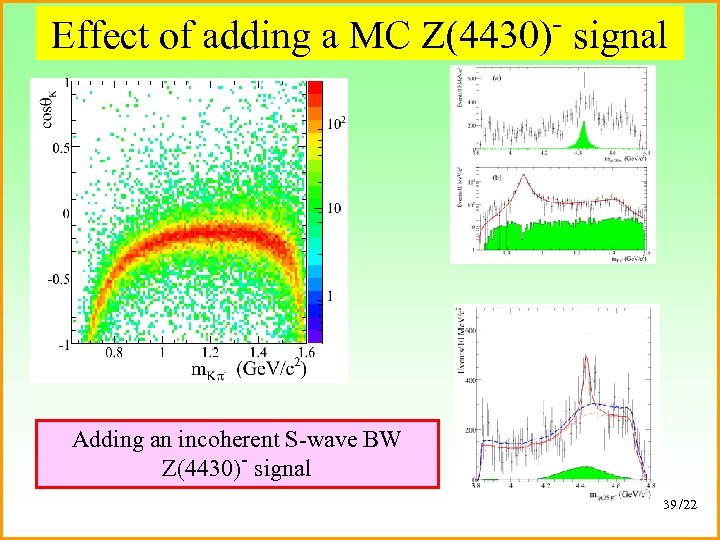
Effect of adding a MC Z(4430)- signal Adding an incoherent S-wave BW Z(4430)- signal 39 /22
Скачать презентацию New States and Charmonium Spectroscopy at BABAR Bill
09753da7b1e0f77fff3b04d922421ce5.ppt