


 Скачать презентацию New Rules of the Road Implementing the 2008
aa8a003825b31ce1747bcbbe8aeffe54.ppt
- Количество слайдов: 48
 New Rules of the Road: Implementing the 2008 Farm Bill Patrick Westhoff (westhoffp@missouri. edu) Food and Agricultural Policy Research Institute (FAPRI) at the University of Missouri–Columbia www. fapri. missouri. edu National Farm Business Management Conference St. Louis, June 15, 2009
 Agenda n 2008 Farm Bill provisions q q n Implementation issues q q n Modifications of previous law New programs ACRE and other new programs Payment limitations Other policies affecting farm sector q q Biofuel and climate change legislation Budgetary issues
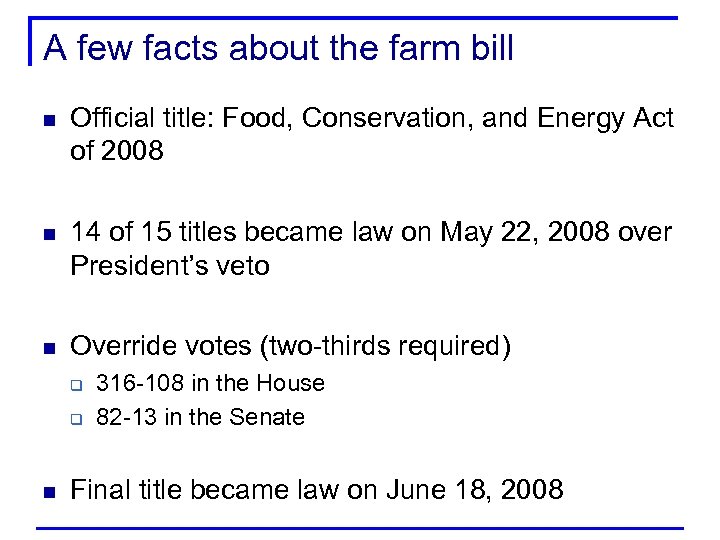 A few facts about the farm bill n Official title: Food, Conservation, and Energy Act of 2008 n 14 of 15 titles became law on May 22, 2008 over President’s veto n Override votes (two-thirds required) q q n 316 -108 in the House 82 -13 in the Senate Final title became law on June 18, 2008
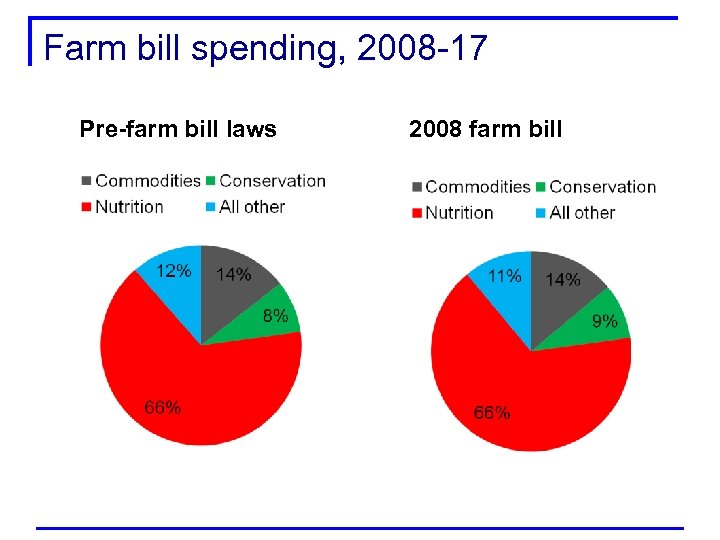 Farm bill spending, 2008 -17 Pre-farm bill laws 2008 farm bill
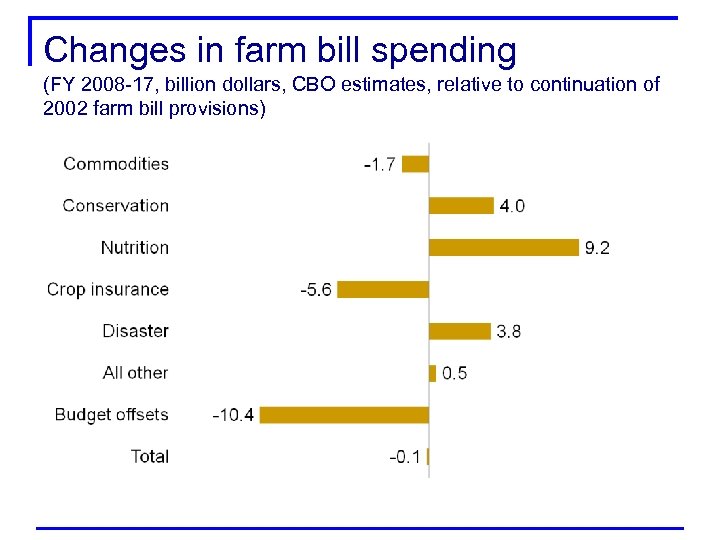 Changes in farm bill spending (FY 2008 -17, billion dollars, CBO estimates, relative to continuation of 2002 farm bill provisions)
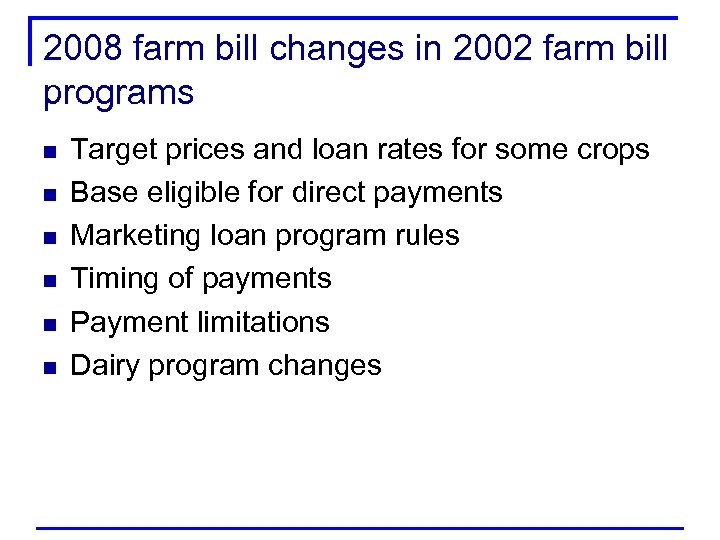 2008 farm bill changes in 2002 farm bill programs n n n Target prices and loan rates for some crops Base eligible for direct payments Marketing loan program rules Timing of payments Payment limitations Dairy program changes
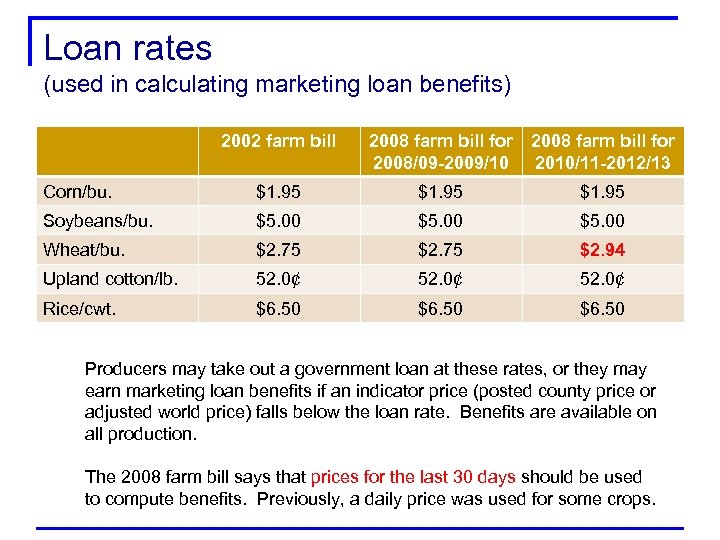 Loan rates (used in calculating marketing loan benefits) 2002 farm bill 2008 farm bill for 2008/09 -2009/10 2008 farm bill for 2010/11 -2012/13 Corn/bu. $1. 95 Soybeans/bu. $5. 00 Wheat/bu. $2. 75 $2. 94 Upland cotton/lb. 52. 0¢ Rice/cwt. $6. 50 Producers may take out a government loan at these rates, or they may earn marketing loan benefits if an indicator price (posted county price or adjusted world price) falls below the loan rate. Benefits are available on all production. The 2008 farm bill says that prices for the last 30 days should be used to compute benefits. Previously, a daily price was used for some crops.
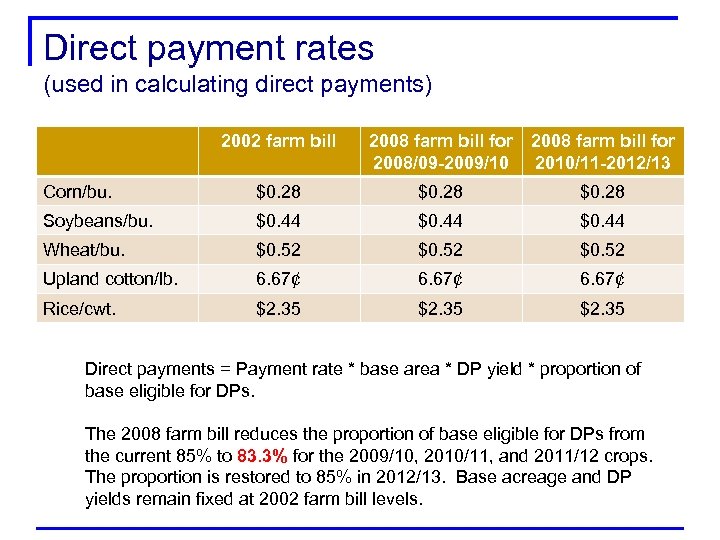 Direct payment rates (used in calculating direct payments) 2002 farm bill 2008 farm bill for 2008/09 -2009/10 2008 farm bill for 2010/11 -2012/13 Corn/bu. $0. 28 Soybeans/bu. $0. 44 Wheat/bu. $0. 52 Upland cotton/lb. 6. 67¢ Rice/cwt. $2. 35 Direct payments = Payment rate * base area * DP yield * proportion of base eligible for DPs. The 2008 farm bill reduces the proportion of base eligible for DPs from the current 85% to 83. 3% for the 2009/10, 2010/11, and 2011/12 crops. The proportion is restored to 85% in 2012/13. Base acreage and DP yields remain fixed at 2002 farm bill levels.
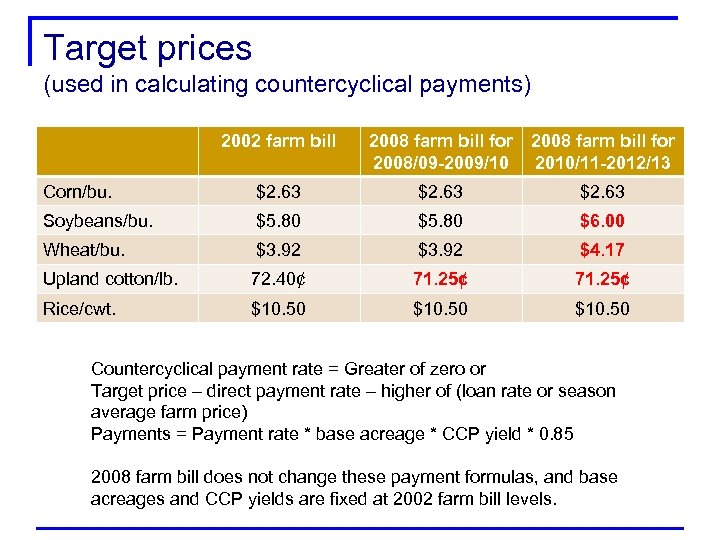 Target prices (used in calculating countercyclical payments) 2002 farm bill 2008 farm bill for 2008/09 -2009/10 2008 farm bill for 2010/11 -2012/13 Corn/bu. $2. 63 Soybeans/bu. $5. 80 $6. 00 Wheat/bu. $3. 92 $4. 17 Upland cotton/lb. 72. 40¢ 71. 25¢ Rice/cwt. $10. 50 Countercyclical payment rate = Greater of zero or Target price – direct payment rate – higher of (loan rate or season average farm price) Payments = Payment rate * base acreage * CCP yield * 0. 85 2008 farm bill does not change these payment formulas, and base acreages and CCP yields are fixed at 2002 farm bill levels.
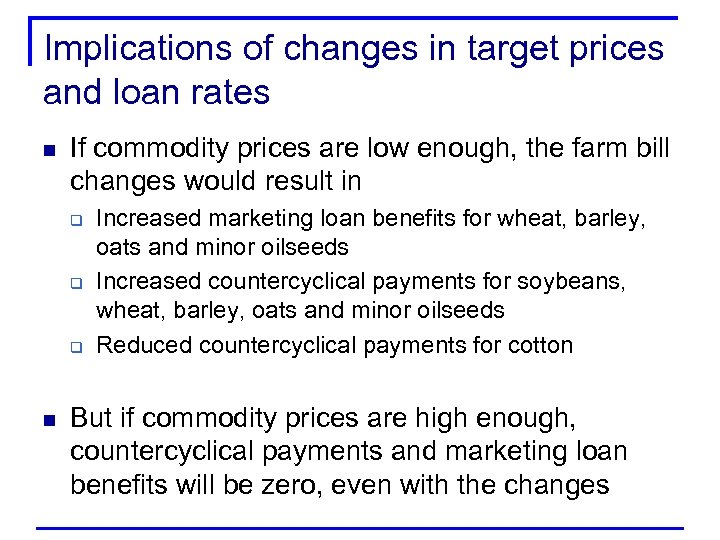 Implications of changes in target prices and loan rates n If commodity prices are low enough, the farm bill changes would result in q q q n Increased marketing loan benefits for wheat, barley, oats and minor oilseeds Increased countercyclical payments for soybeans, wheat, barley, oats and minor oilseeds Reduced countercyclical payments for cotton But if commodity prices are high enough, countercyclical payments and marketing loan benefits will be zero, even with the changes
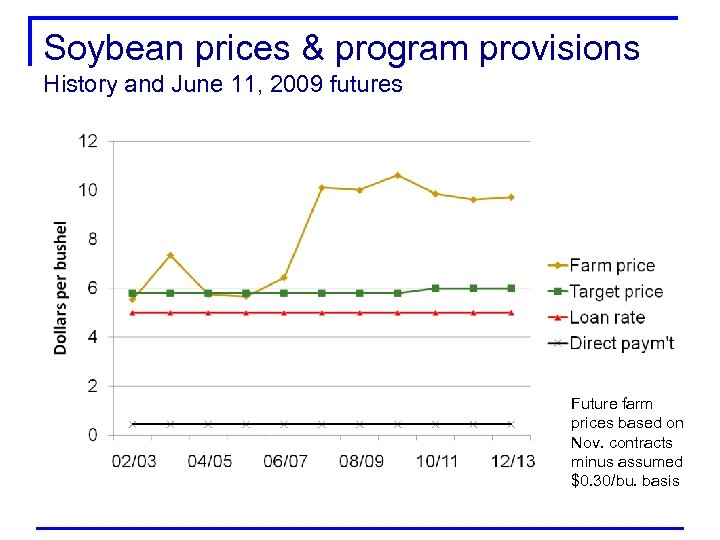 Soybean prices & program provisions History and June 11, 2009 futures Future farm prices based on Nov. contracts minus assumed $0. 30/bu. basis
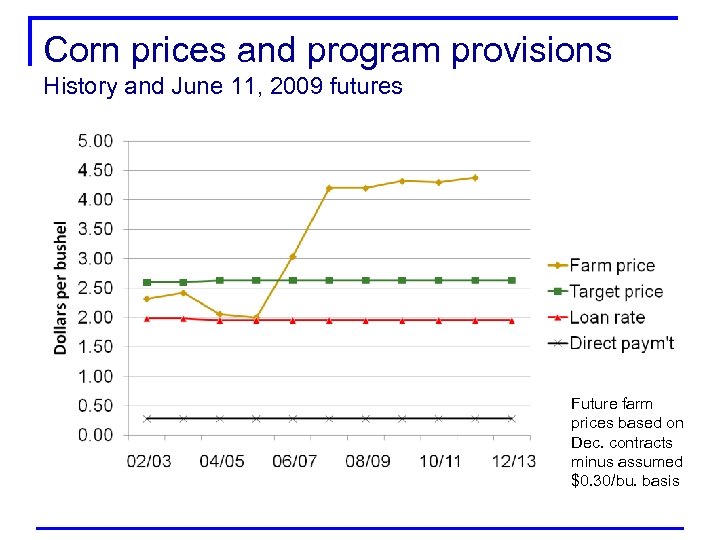 Corn prices and program provisions History and June 11, 2009 futures Future farm prices based on Dec. contracts minus assumed $0. 30/bu. basis
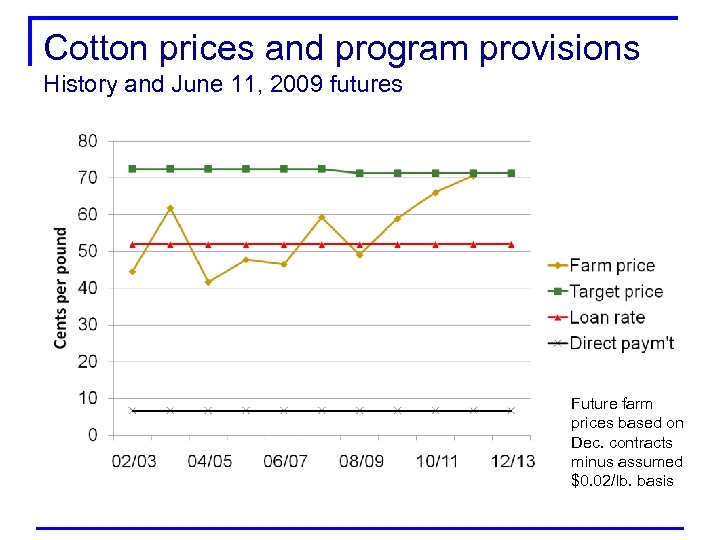 Cotton prices and program provisions History and June 11, 2009 futures Future farm prices based on Dec. contracts minus assumed $0. 02/lb. basis
 Implications of changes in target prices and loan rates revisited n At projected prices, appears CCPs and loan benefits for most crops are unlikely q n Thus, higher target prices, loan rates may have little impact on CCPs and loan program benefits Likely exception: cotton, where the lower target price may reduce payments q Reduction in cotton payments could exceed increase in payments for other crops
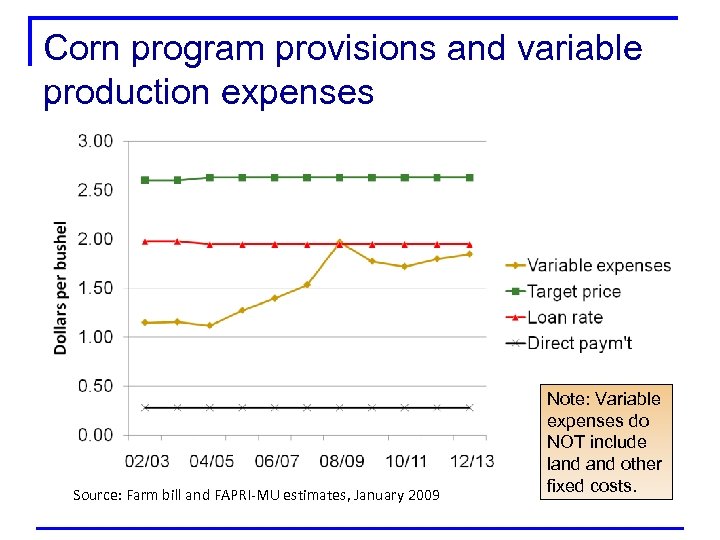 Corn program provisions and variable production expenses Source: Farm bill and FAPRI-MU estimates, January 2009 Note: Variable expenses do NOT include land other fixed costs.
 Timing of payments n Farm bills specify when payments can be made n 2008 farm bill delays some payments n These delays are intended to shift government spending from one fiscal year to another to achieve budgetary targets
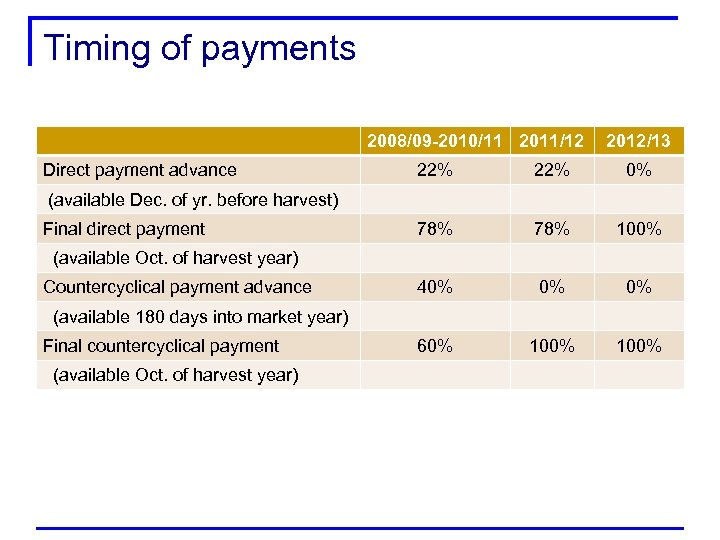 Timing of payments 2008/09 -2010/11 2011/12 Direct payment advance 2012/13 22% 0% 78% 100% 40% 0% 0% 60% 100% (available Dec. of yr. before harvest) Final direct payment (available Oct. of harvest year) Countercyclical payment advance (available 180 days into market year) Final countercyclical payment (available Oct. of harvest year)
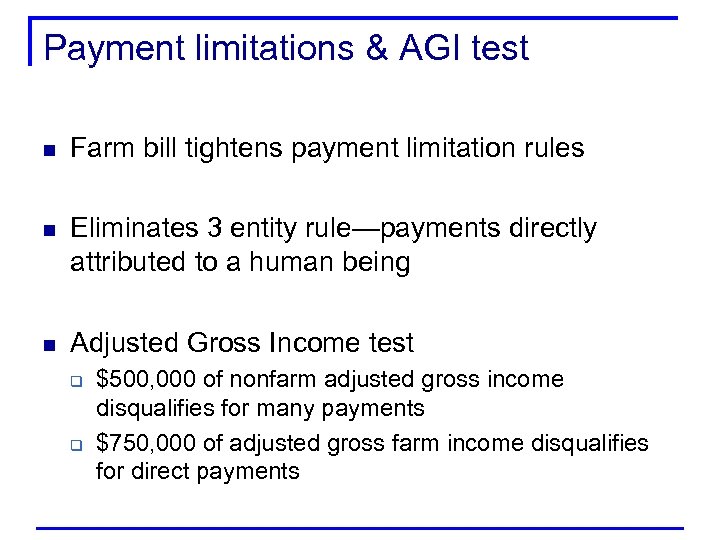 Payment limitations & AGI test n Farm bill tightens payment limitation rules n Eliminates 3 entity rule—payments directly attributed to a human being n Adjusted Gross Income test q q $500, 000 of nonfarm adjusted gross income disqualifies for many payments $750, 000 of adjusted gross farm income disqualifies for direct payments
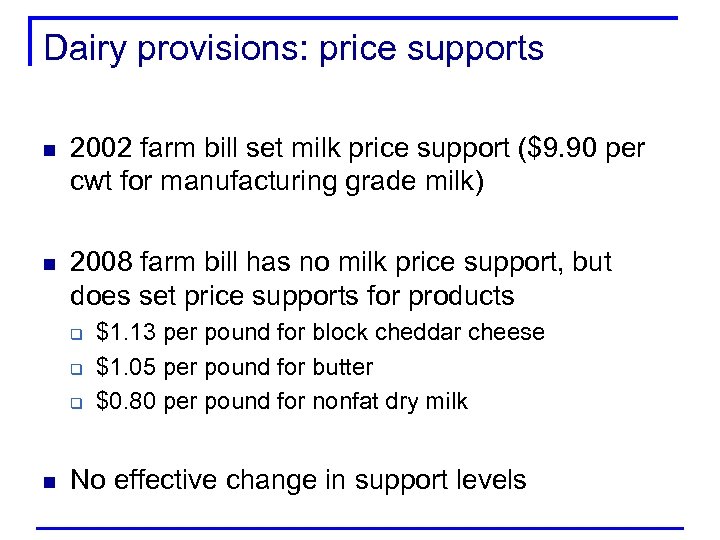 Dairy provisions: price supports n 2002 farm bill set milk price support ($9. 90 per cwt for manufacturing grade milk) n 2008 farm bill has no milk price support, but does set price supports for products q q q n $1. 13 per pound for block cheddar cheese $1. 05 per pound for butter $0. 80 per pound for nonfat dry milk No effective change in support levels
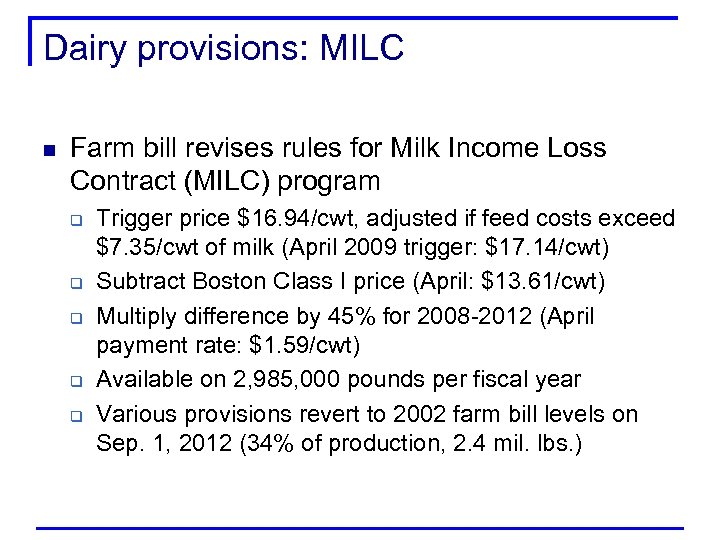 Dairy provisions: MILC n Farm bill revises rules for Milk Income Loss Contract (MILC) program q q q Trigger price $16. 94/cwt, adjusted if feed costs exceed $7. 35/cwt of milk (April 2009 trigger: $17. 14/cwt) Subtract Boston Class I price (April: $13. 61/cwt) Multiply difference by 45% for 2008 -2012 (April payment rate: $1. 59/cwt) Available on 2, 985, 000 pounds per fiscal year Various provisions revert to 2002 farm bill levels on Sep. 1, 2012 (34% of production, 2. 4 mil. lbs. )
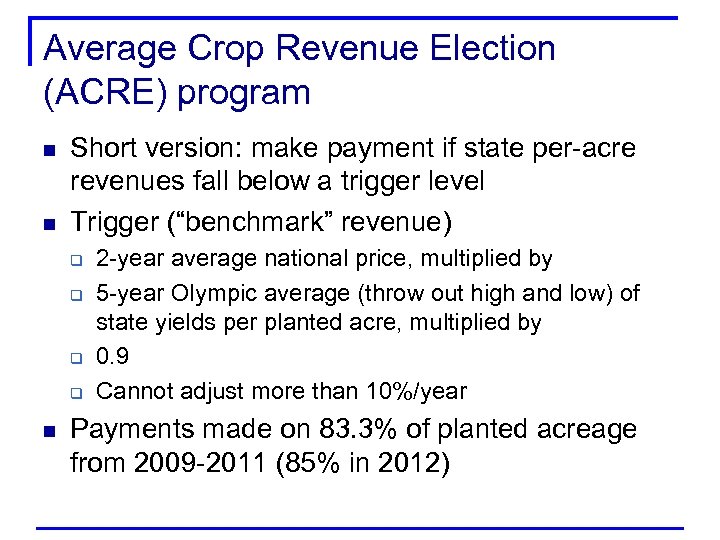 Average Crop Revenue Election (ACRE) program n n Short version: make payment if state per-acre revenues fall below a trigger level Trigger (“benchmark” revenue) q q n 2 -year average national price, multiplied by 5 -year Olympic average (throw out high and low) of state yields per planted acre, multiplied by 0. 9 Cannot adjust more than 10%/year Payments made on 83. 3% of planted acreage from 2009 -2011 (85% in 2012)
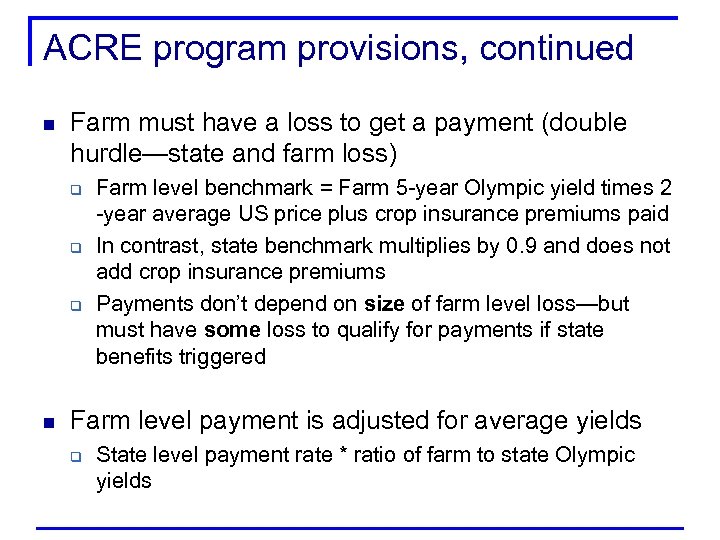 ACRE program provisions, continued n Farm must have a loss to get a payment (double hurdle—state and farm loss) q q q n Farm level benchmark = Farm 5 -year Olympic yield times 2 -year average US price plus crop insurance premiums paid In contrast, state benchmark multiplies by 0. 9 and does not add crop insurance premiums Payments don’t depend on size of farm level loss—but must have some loss to qualify for payments if state benefits triggered Farm level payment is adjusted for average yields q State level payment rate * ratio of farm to state Olympic yields
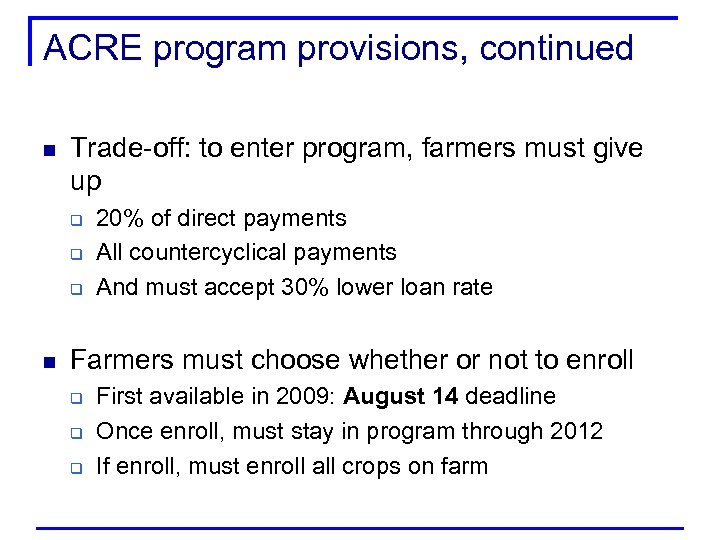 ACRE program provisions, continued n Trade-off: to enter program, farmers must give up q q q n 20% of direct payments All countercyclical payments And must accept 30% lower loan rate Farmers must choose whether or not to enroll q q q First available in 2009: August 14 deadline Once enroll, must stay in program through 2012 If enroll, must enroll all crops on farm
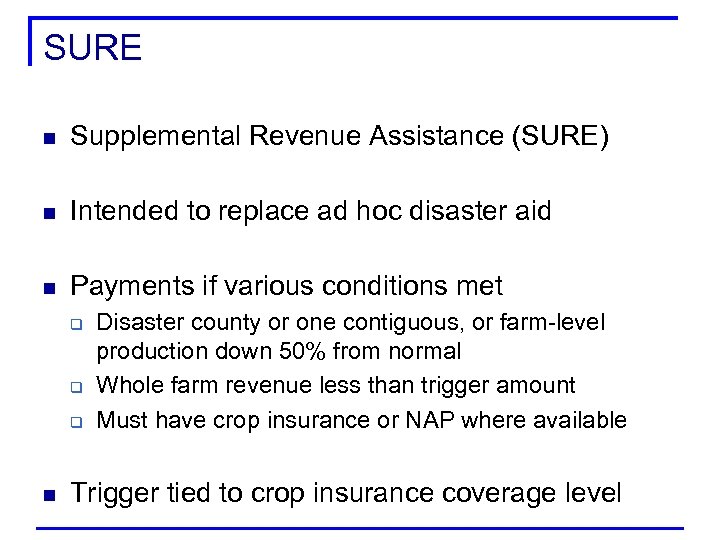 SURE n Supplemental Revenue Assistance (SURE) n Intended to replace ad hoc disaster aid n Payments if various conditions met q q q n Disaster county or one contiguous, or farm-level production down 50% from normal Whole farm revenue less than trigger amount Must have crop insurance or NAP where available Trigger tied to crop insurance coverage level
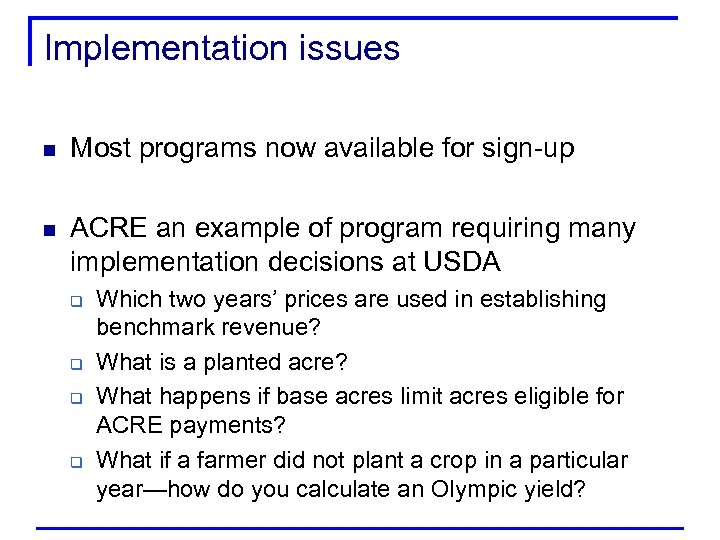 Implementation issues n Most programs now available for sign-up n ACRE an example of program requiring many implementation decisions at USDA q q Which two years’ prices are used in establishing benchmark revenue? What is a planted acre? What happens if base acres limit acres eligible for ACRE payments? What if a farmer did not plant a crop in a particular year—how do you calculate an Olympic yield?
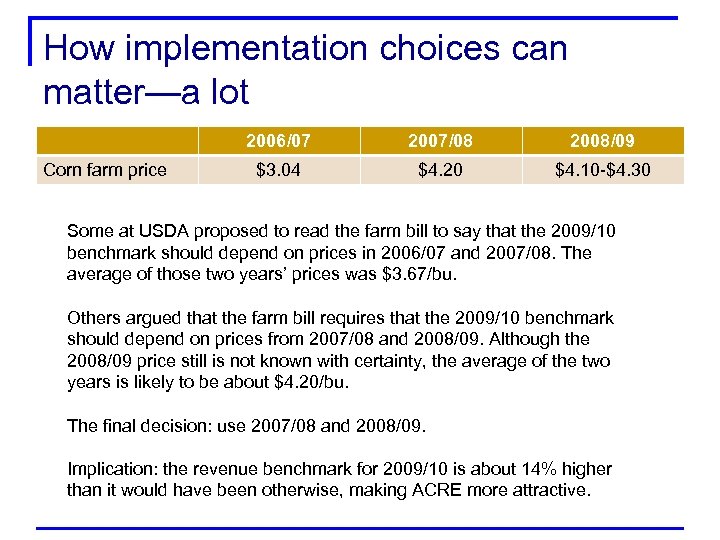 How implementation choices can matter—a lot 2006/07 Corn farm price 2007/08 2008/09 $3. 04 $4. 20 $4. 10 -$4. 30 Some at USDA proposed to read the farm bill to say that the 2009/10 benchmark should depend on prices in 2006/07 and 2007/08. The average of those two years’ prices was $3. 67/bu. Others argued that the farm bill requires that the 2009/10 benchmark should depend on prices from 2007/08 and 2008/09. Although the 2008/09 price still is not known with certainty, the average of the two years is likely to be about $4. 20/bu. The final decision: use 2007/08 and 2008/09. Implication: the revenue benchmark for 2009/10 is about 14% higher than it would have been otherwise, making ACRE more attractive.
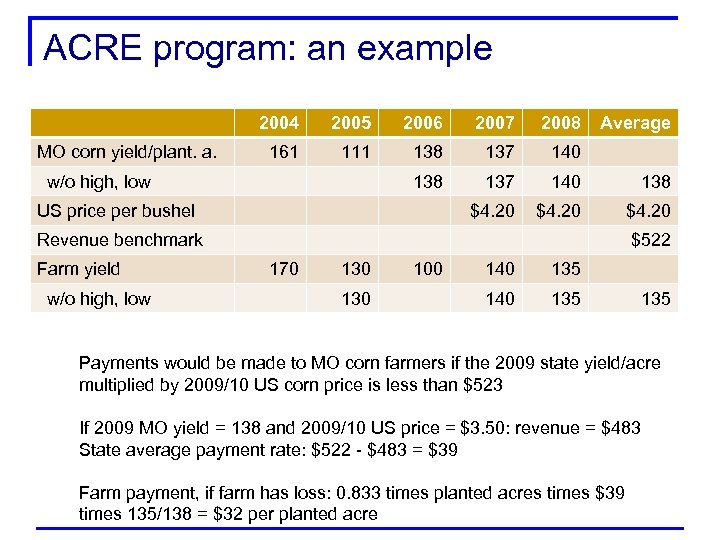 ACRE program: an example 2004 MO corn yield/plant. a. 2005 2006 2007 2008 161 111 138 137 140 138 $4. 20 w/o high, low US price per bushel Average Revenue benchmark Farm yield w/o high, low $522 170 130 100 140 135 135 Payments would be made to MO corn farmers if the 2009 state yield/acre multiplied by 2009/10 US corn price is less than $523 If 2009 MO yield = 138 and 2009/10 US price = $3. 50: revenue = $483 State average payment rate: $522 - $483 = $39 Farm payment, if farm has loss: 0. 833 times planted acres times $39 times 135/138 = $32 per planted acre
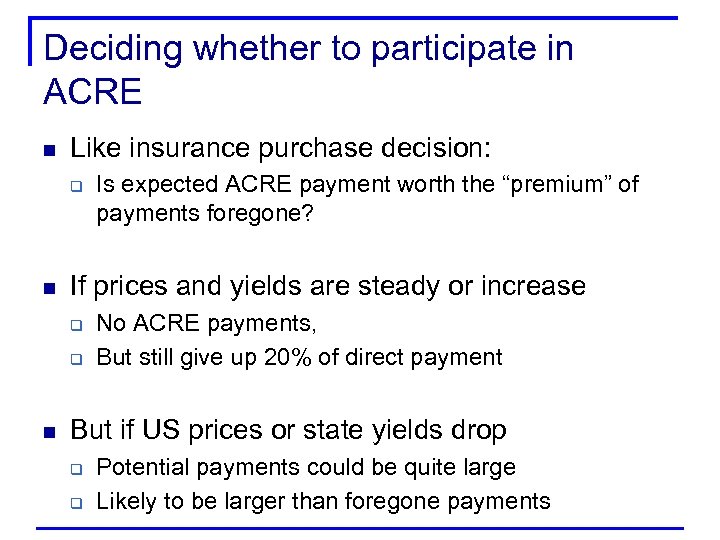 Deciding whether to participate in ACRE n Like insurance purchase decision: q n If prices and yields are steady or increase q q n Is expected ACRE payment worth the “premium” of payments foregone? No ACRE payments, But still give up 20% of direct payment But if US prices or state yields drop q q Potential payments could be quite large Likely to be larger than foregone payments
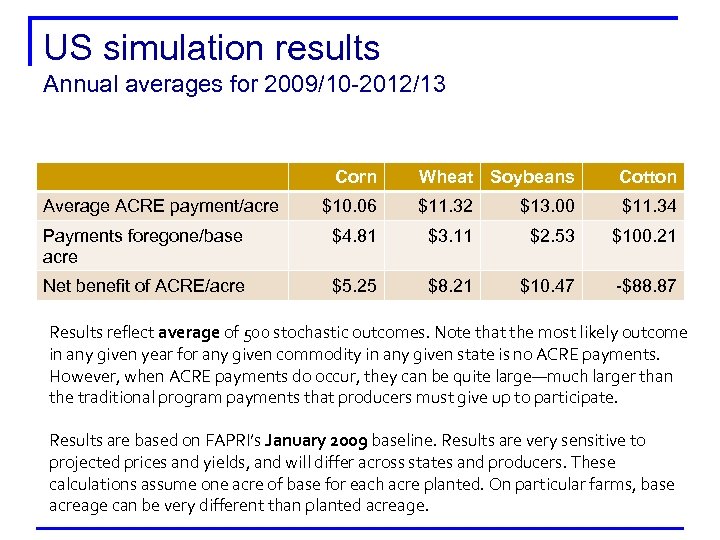 US simulation results Annual averages for 2009/10 -2012/13 Corn Wheat Soybeans Cotton $10. 06 $11. 32 $13. 00 $11. 34 Payments foregone/base acre $4. 81 $3. 11 $2. 53 $100. 21 Net benefit of ACRE/acre $5. 25 $8. 21 $10. 47 -$88. 87 Average ACRE payment/acre Results reflect average of 500 stochastic outcomes. Note that the most likely outcome in any given year for any given commodity in any given state is no ACRE payments. However, when ACRE payments do occur, they can be quite large—much larger than the traditional program payments that producers must give up to participate. Results are based on FAPRI’s January 2009 baseline. Results are very sensitive to projected prices and yields, and will differ across states and producers. These calculations assume one acre of base for each acre planted. On particular farms, base acreage can be very different than planted acreage.
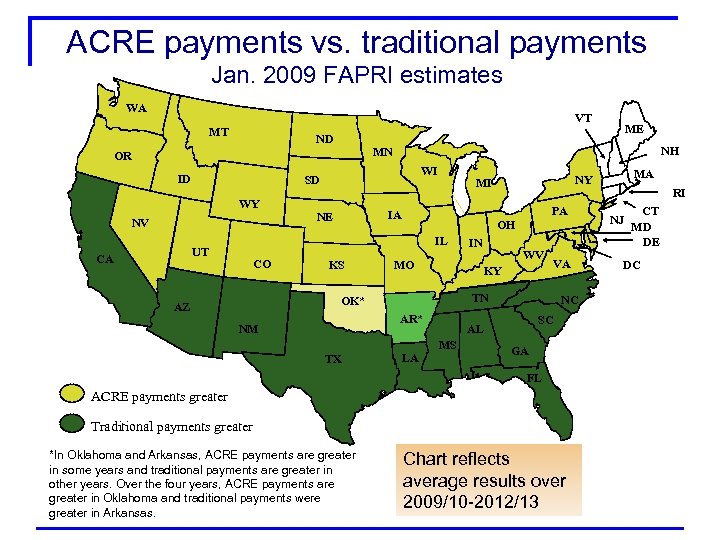 ACRE payments vs. traditional payments Jan. 2009 FAPRI estimates WA VT MT ME ND NH MN OR ID WY NV PA IA NE CO KS OH MO TX WV VA TN AR* NM IN KY OK* AZ LA NC SC AL MS GA FL ACRE payments greater Traditional payments greater *In Oklahoma and Arkansas, ACRE payments are greater in some years and traditional payments are greater in other years. Over the four years, ACRE payments are greater in Oklahoma and traditional payments were greater in Arkansas. MA NY MI IL UT CA WI SD Chart reflects average results over 2009/10 -2012/13 RI NJ CT MD DE DC
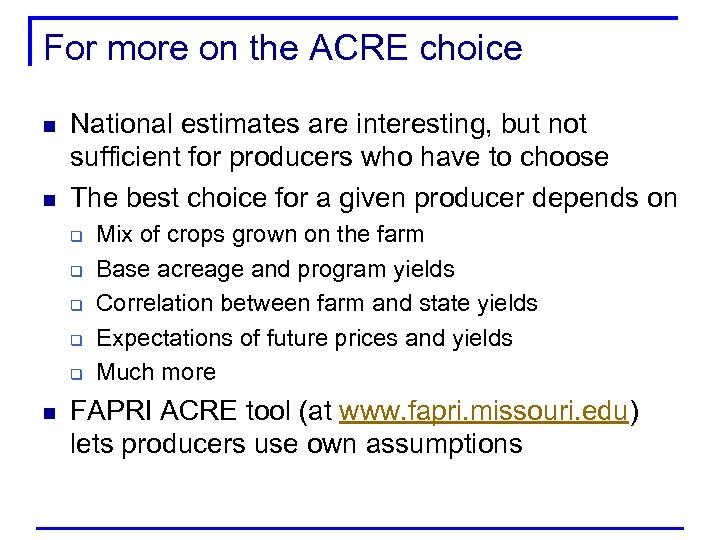 For more on the ACRE choice n n National estimates are interesting, but not sufficient for producers who have to choose The best choice for a given producer depends on q q q n Mix of crops grown on the farm Base acreage and program yields Correlation between farm and state yields Expectations of future prices and yields Much more FAPRI ACRE tool (at www. fapri. missouri. edu) lets producers use own assumptions
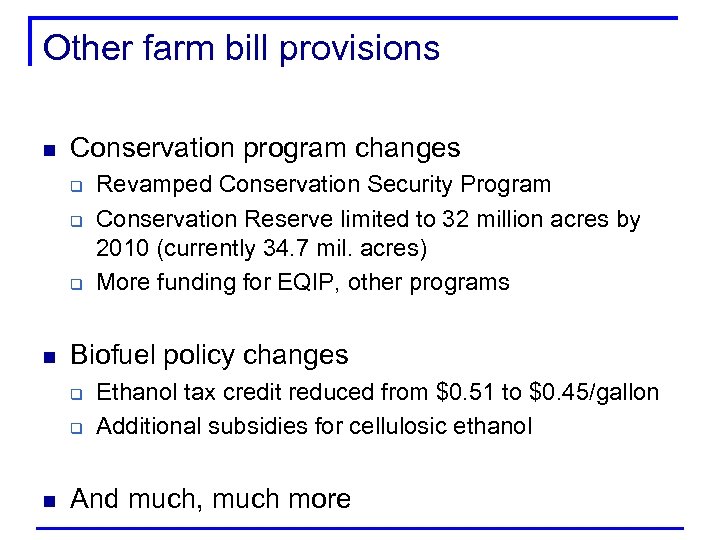 Other farm bill provisions n Conservation program changes q q q n Biofuel policy changes q q n Revamped Conservation Security Program Conservation Reserve limited to 32 million acres by 2010 (currently 34. 7 mil. acres) More funding for EQIP, other programs Ethanol tax credit reduced from $0. 51 to $0. 45/gallon Additional subsidies for cellulosic ethanol And much, much more
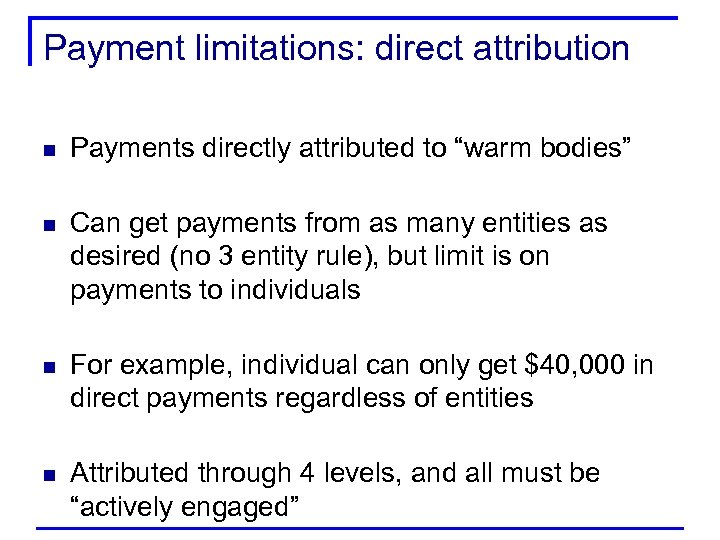 Payment limitations: direct attribution n Payments directly attributed to “warm bodies” n Can get payments from as many entities as desired (no 3 entity rule), but limit is on payments to individuals n For example, individual can only get $40, 000 in direct payments regardless of entities n Attributed through 4 levels, and all must be “actively engaged”
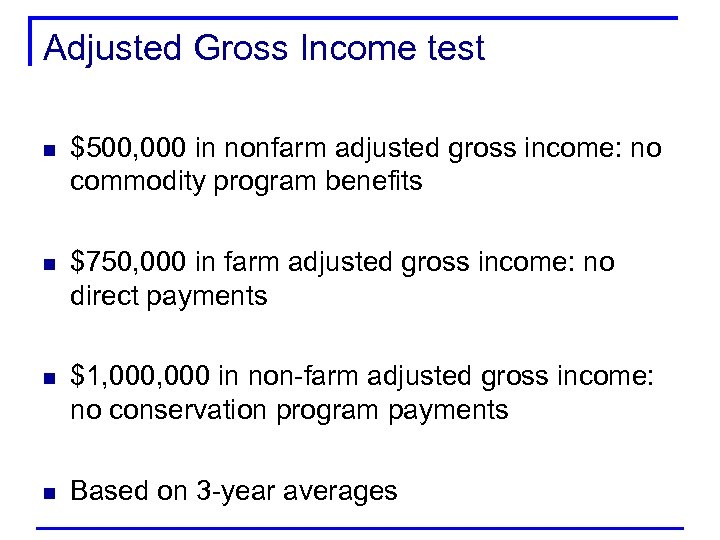 Adjusted Gross Income test n $500, 000 in nonfarm adjusted gross income: no commodity program benefits n $750, 000 in farm adjusted gross income: no direct payments n $1, 000 in non-farm adjusted gross income: no conservation program payments n Based on 3 -year averages
 Talk to an expert n n n Payment limitation rules are complex 2008 farm bill makes major changes Many issues still being resolved by FSA People are still learning how to operate under the new rules As my wife, the attorney, reminds me, I’m just an economist and not the right person to go to for legal advice
 Other policy issues affecting the farm sector n Implementation of 2007 energy bill and other biofuel issues n Climate change legislation n Health care legislation n Future budget legislation
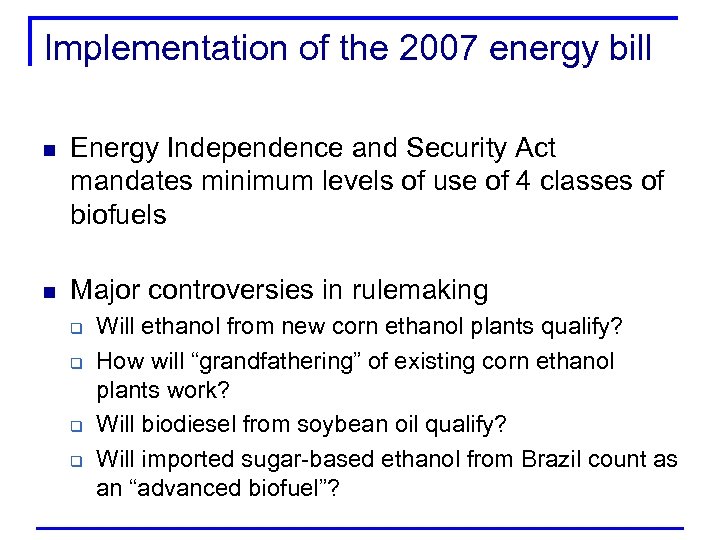 Implementation of the 2007 energy bill n Energy Independence and Security Act mandates minimum levels of use of 4 classes of biofuels n Major controversies in rulemaking q q Will ethanol from new corn ethanol plants qualify? How will “grandfathering” of existing corn ethanol plants work? Will biodiesel from soybean oil qualify? Will imported sugar-based ethanol from Brazil count as an “advanced biofuel”?
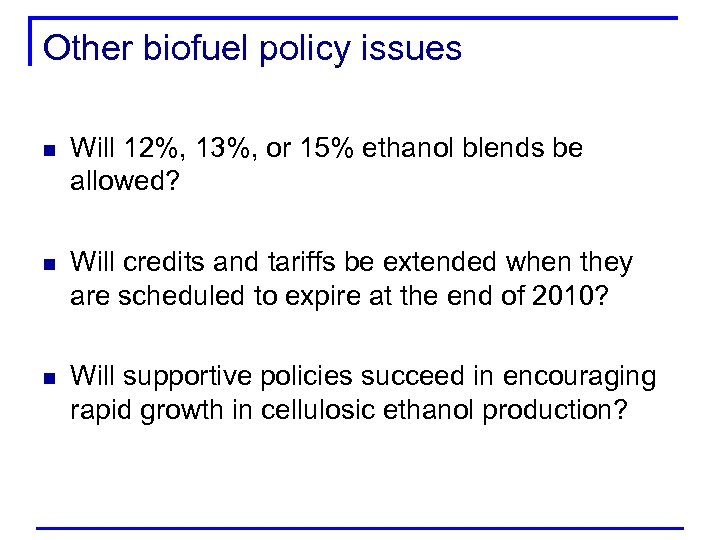 Other biofuel policy issues n Will 12%, 13%, or 15% ethanol blends be allowed? n Will credits and tariffs be extended when they are scheduled to expire at the end of 2010? n Will supportive policies succeed in encouraging rapid growth in cellulosic ethanol production?
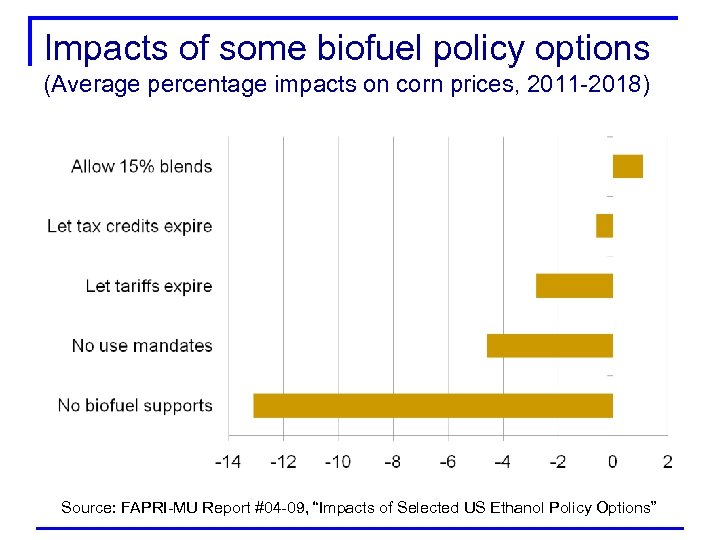 Impacts of some biofuel policy options (Average percentage impacts on corn prices, 2011 -2018) Source: FAPRI-MU Report #04 -09, “Impacts of Selected US Ethanol Policy Options”
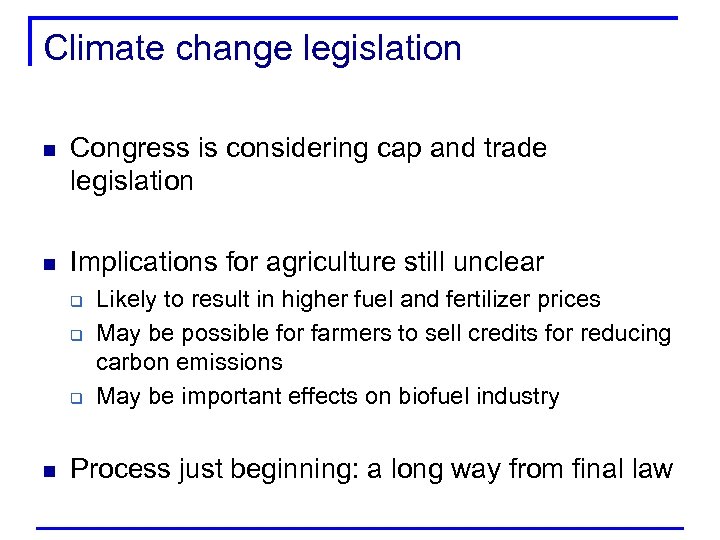 Climate change legislation n Congress is considering cap and trade legislation n Implications for agriculture still unclear q q q n Likely to result in higher fuel and fertilizer prices May be possible for farmers to sell credits for reducing carbon emissions May be important effects on biofuel industry Process just beginning: a long way from final law
 Health care legislation n Under consideration in Congressional committees n More likely to become law in 2009 than climate change legislation n Possible impacts on agriculture q q Cost of health care services and insurance Taxes or other budgetary offsets
 Future budget legislation n FY 2009 now expected to be on the order of $1. 8 trillion, and FY 2010 only slightly smaller n For perspective, previous record deficit: $455 billion in FY 2008 n Likely to mean future budget cuts across all of government, including farm programs n But when will this occur?
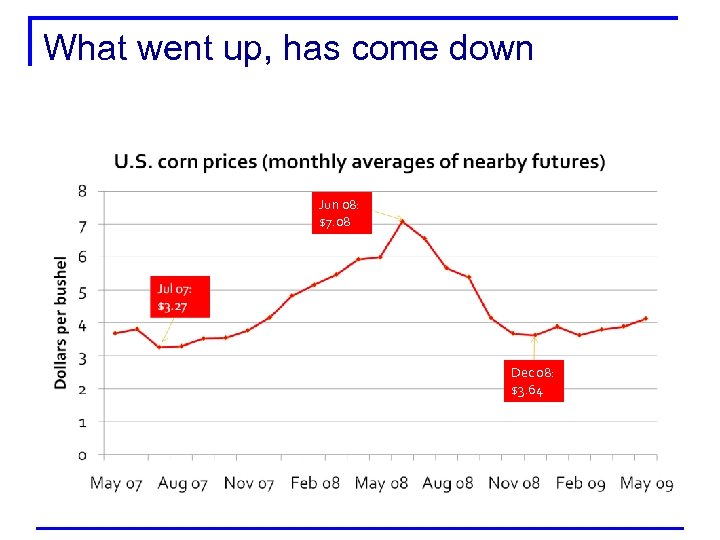 What went up, has come down Jun 08: $7. 08 Dec 08: $3. 64
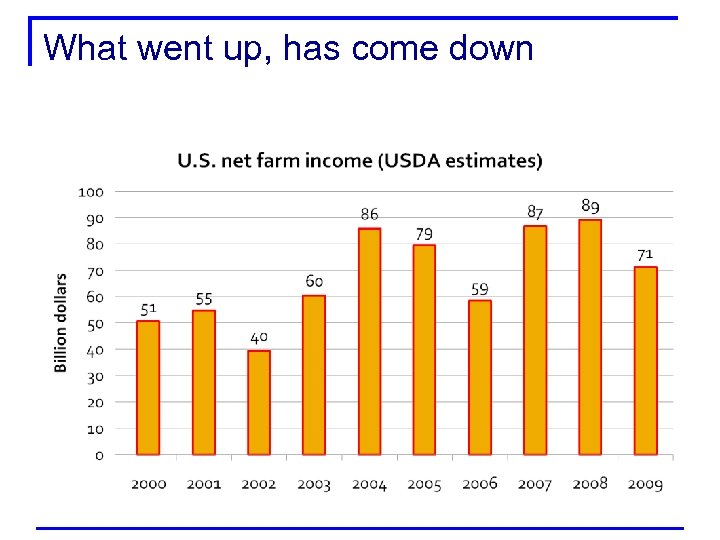 What went up, has come down
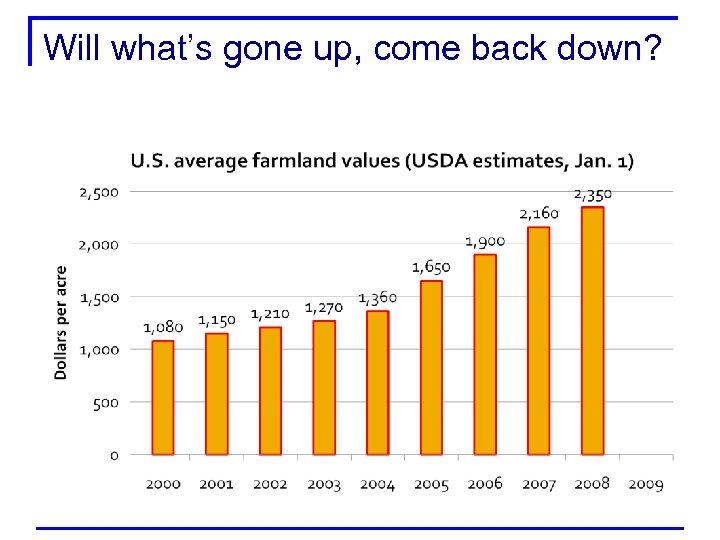 Will what’s gone up, come back down?
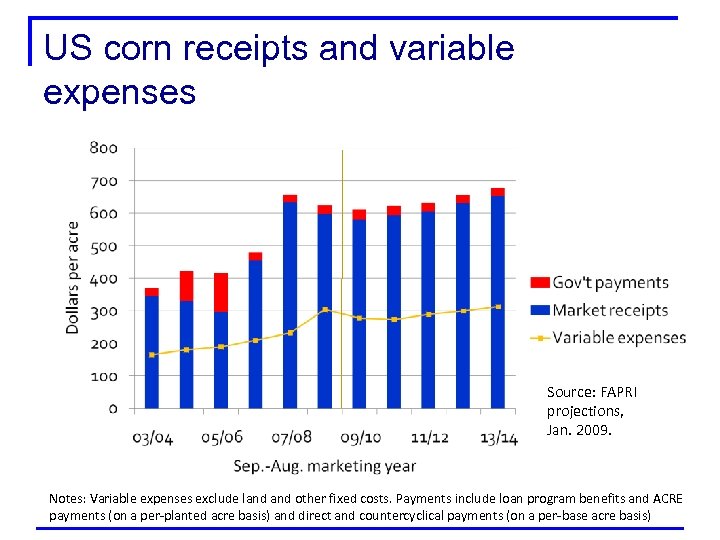 US corn receipts and variable expenses Source: FAPRI projections, Jan. 2009. Notes: Variable expenses exclude land other fixed costs. Payments include loan program benefits and ACRE payments (on a per-planted acre basis) and direct and countercyclical payments (on a per-base acre basis)
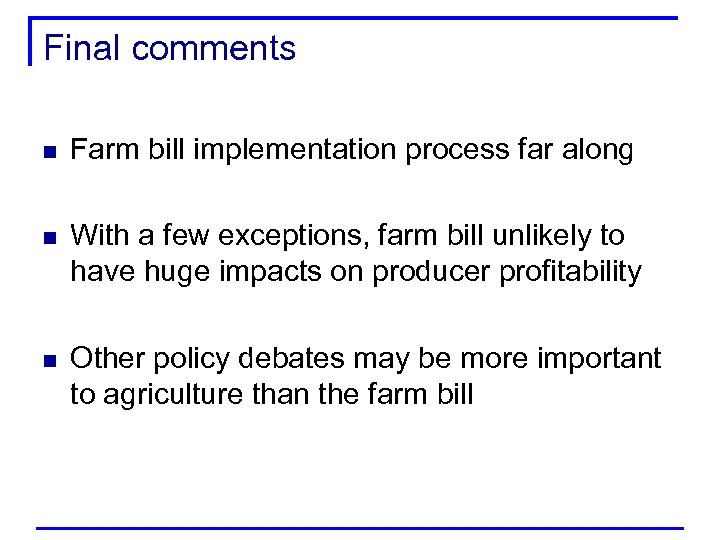 Final comments n Farm bill implementation process far along n With a few exceptions, farm bill unlikely to have huge impacts on producer profitability n Other policy debates may be more important to agriculture than the farm bill
 Thanks! n Contact me at westhoffp@missouri. edu or 573 -882 -4647 n Visit FAPRI-MU web page at www. fapri. missouri. edu