


 Скачать презентацию New Results from HARP A HAd Ron Production
2a70b8e76046ad5ef25cfa4214c930ee.ppt
- Количество слайдов: 32
 New Results from HARP A HAd. Ron Production experiment at the CERN PS (PS 214) Alain Blondel, University of Geneva, on behalf of the HARP collaboration Atmospheric Neutrino Flux Accelerator Neutrinos: K 2 K, Mini. Boo. NE, Sci. Boo. NE Hadron Production Models Neutrino Factory Overview of new results July 2007 HARP results EPS 2007 Manchester Alain Blondel
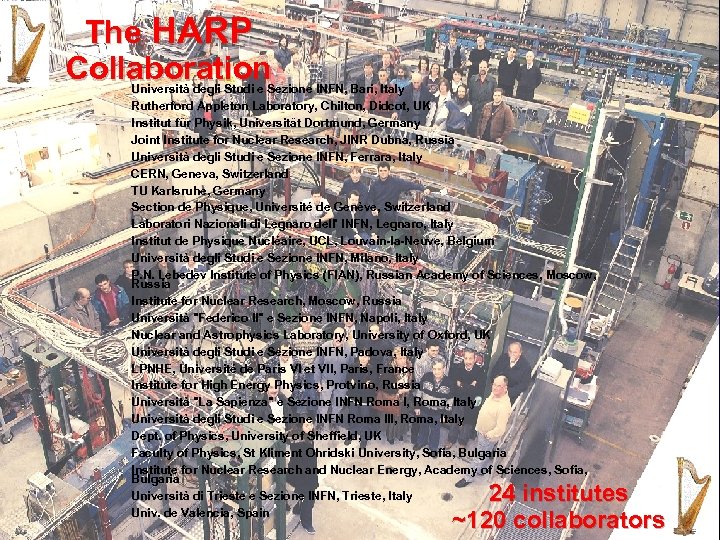 The HARP Collaboration Università degli Studi e Sezione INFN, Bari, Italy Rutherford Appleton Laboratory, Chilton, Didcot, UK Institut für Physik, Universität Dortmund, Germany Joint Institute for Nuclear Research, JINR Dubna, Russia Università degli Studi e Sezione INFN, Ferrara, Italy CERN, Geneva, Switzerland TU Karlsruhe, Germany Section de Physique, Université de Genève, Switzerland Laboratori Nazionali di Legnaro dell' INFN, Legnaro, Italy Institut de Physique Nucléaire, UCL, Louvain-la-Neuve, Belgium Università degli Studi e Sezione INFN, Milano, Italy P. N. Lebedev Institute of Physics (FIAN), Russian Academy of Sciences, Moscow, Russia Institute for Nuclear Research, Moscow, Russia Università "Federico II" e Sezione INFN, Napoli, Italy Nuclear and Astrophysics Laboratory, University of Oxford, UK Università degli Studi e Sezione INFN, Padova, Italy LPNHE, Université de Paris VI et VII, Paris, France Institute for High Energy Physics, Protvino, Russia Università "La Sapienza" e Sezione INFN Roma I, Roma, Italy Università degli Studi e Sezione INFN Roma III, Roma, Italy Dept. of Physics, University of Sheffield, UK Faculty of Physics, St Kliment Ohridski University, Sofia, Bulgaria Institute for Nuclear Research and Nuclear Energy, Academy of Sciences, Sofia, Bulgaria Università di Trieste e Sezione INFN, Trieste, Italy Univ. de Valencia, Spain 24 institutes ~120 collaborators July 2007 HARP results EPS 2007 Manchester Alain Blondel
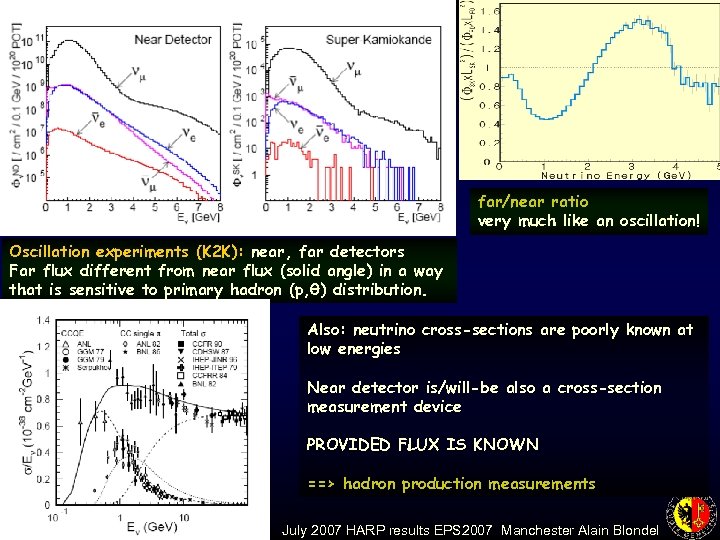 far/near ratio very much like an oscillation! Oscillation experiments (K 2 K): near, far detectors Far flux different from near flux (solid angle) in a way that is sensitive to primary hadron (p, θ) distribution. Also: neutrino cross-sections are poorly known at low energies Near detector is/will-be also a cross-section measurement device PROVIDED FLUX IS KNOWN ==> hadron production measurements July 2007 HARP results EPS 2007 Manchester Alain Blondel
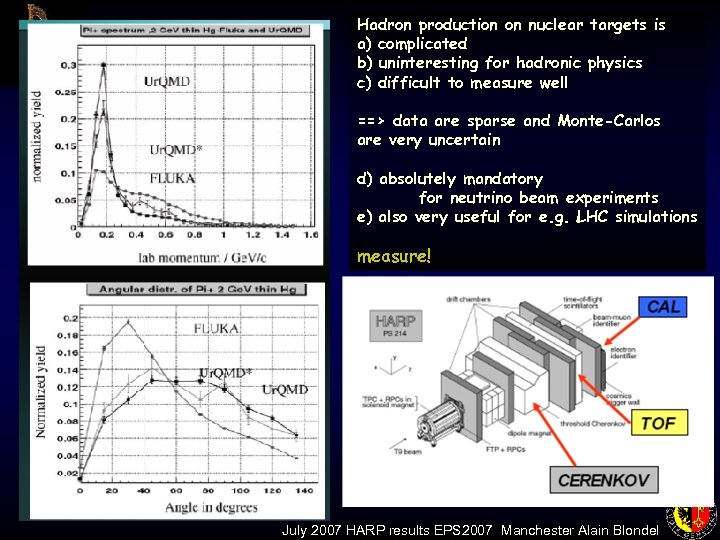 Hadron production on nuclear targets is a) complicated b) uninteresting for hadronic physics c) difficult to measure well ==> data are sparse and Monte-Carlos are very uncertain d) absolutely mandatory for neutrino beam experiments e) also very useful for e. g. LHC simulations measure! July 2007 HARP results EPS 2007 Manchester Alain Blondel
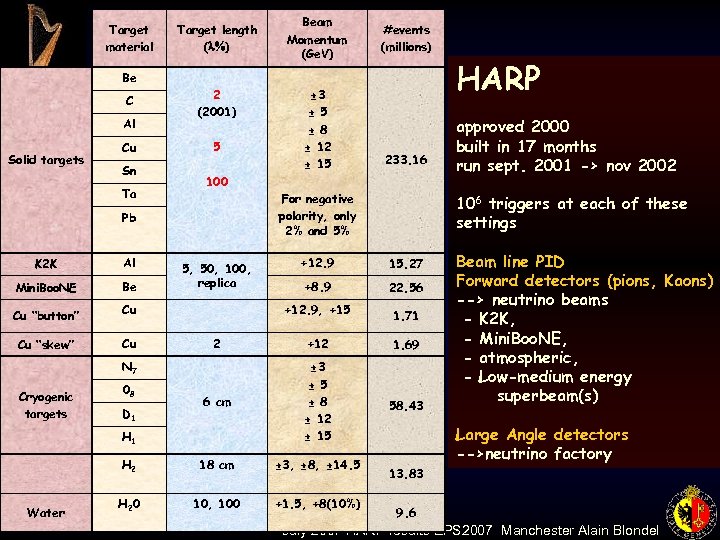 Target material Target length (l%) Beam Momentum (Ge. V) #events (millions) HARP Be C Al Solid targets Cu Sn Ta 2 (2001) 5 Al Mini. Boo. NE Be Cu “button” Cu “skew” For negative polarity, only 2% and 5% 5, 50, 100, replica Cu Cu 08 D 1 15. 27 +8. 9 22. 56 +12 1. 69 6 cm ± 3 ± 5 ± 8 ± 12 ± 15 58. 43 H 2 Water 1. 71 2 H 1 18 cm ± 3, ± 8, ± 14. 5 H 20 10, 100 +1. 5, +8(10%) approved 2000 built in 17 months run sept. 2001 -> nov 2002 106 triggers at each of these settings +12. 9, +15 N 7 Cryogenic targets 233. 16 100 Pb K 2 K ± 3 ± 5 ± 8 ± 12 ± 15 Beam line PID Forward detectors (pions, Kaons) --> neutrino beams - K 2 K, - Mini. Boo. NE, - atmospheric, - Low-medium energy superbeam(s) Large Angle detectors -->neutrino factory 13. 83 9. 6 July 2007 HARP results EPS 2007 Manchester Alain Blondel
 July 2007 HARP results EPS 2007 Manchester Alain Blondel
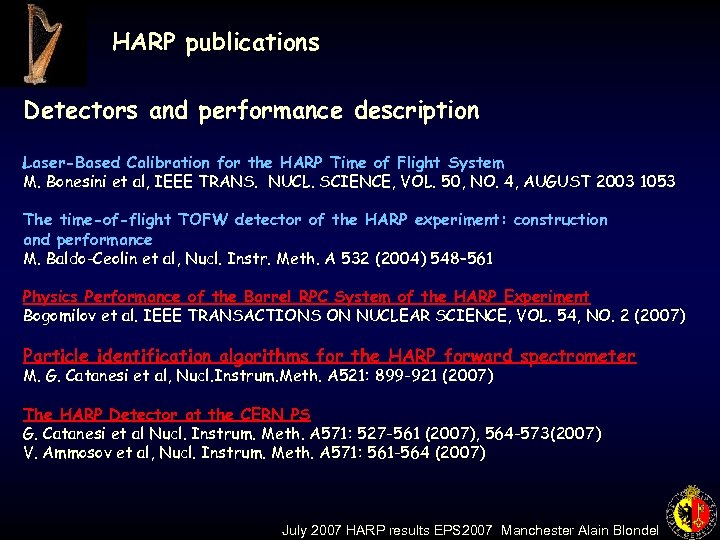 HARP publications Detectors and performance description Laser-Based Calibration for the HARP Time of Flight System M. Bonesini et al, IEEE TRANS. NUCL. SCIENCE, VOL. 50, NO. 4, AUGUST 2003 1053 The time-of-flight TOFW detector of the HARP experiment: construction and performance M. Baldo-Ceolin et al, Nucl. Instr. Meth. A 532 (2004) 548– 561 Physics Performance of the Barrel RPC System of the HARP Experiment Bogomilov et al. IEEE TRANSACTIONS ON NUCLEAR SCIENCE, VOL. 54, NO. 2 (2007) Particle identification algorithms for the HARP forward spectrometer M. G. Catanesi et al, Nucl. Instrum. Meth. A 521: 899 -921 (2007) The HARP Detector at the CERN PS G. Catanesi et al Nucl. Instrum. Meth. A 571: 527 -561 (2007), 564 -573(2007) V. Ammosov et al, Nucl. Instrum. Meth. A 571: 561 -564 (2007) July 2007 HARP results EPS 2007 Manchester Alain Blondel
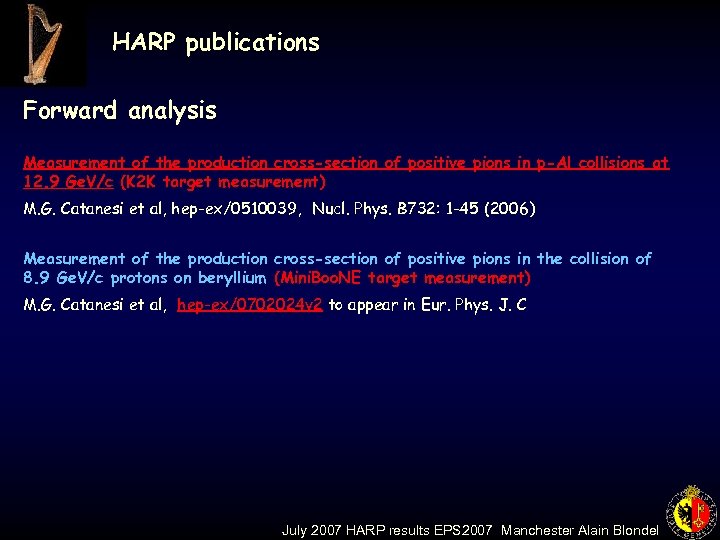 HARP publications Forward analysis Measurement of the production cross-section of positive pions in p-Al collisions at 12. 9 Ge. V/c (K 2 K target measurement) M. G. Catanesi et al, hep-ex/0510039, Nucl. Phys. B 732: 1 -45 (2006) Measurement of the production cross-section of positive pions in the collision of 8. 9 Ge. V/c protons on beryllium (Mini. Boo. NE target measurement) M. G. Catanesi et al, hep-ex/0702024 v 2 to appear in Eur. Phys. J. C July 2007 HARP results EPS 2007 Manchester Alain Blondel
 HARP publications Large Angle analysis (Neutrino Factory measurements) Measurement of the production of charged pions by protons on a tantalum target M. G. Catanesi et al, ar. Xiv: 0706. 1600 v 1 to appear in Eur. Phys. J. C Charged pion production by 3 Ge. V/c– 12 Ge. V/c protons on a carbon target M. G. Catanesi et al, submitted to Eur. Phys. J. C Large-angle production of charged pions by 3 Ge. V/c– 12 Ge. V/c protons on copper and tin targets M. G. Catanesi et al, submitted to Eur. Phys. J. C July 2007 HARP results EPS 2007 Manchester Alain Blondel
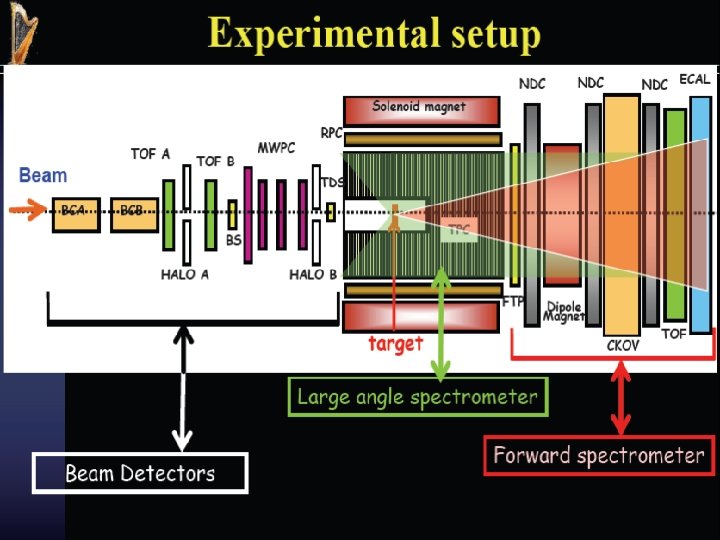
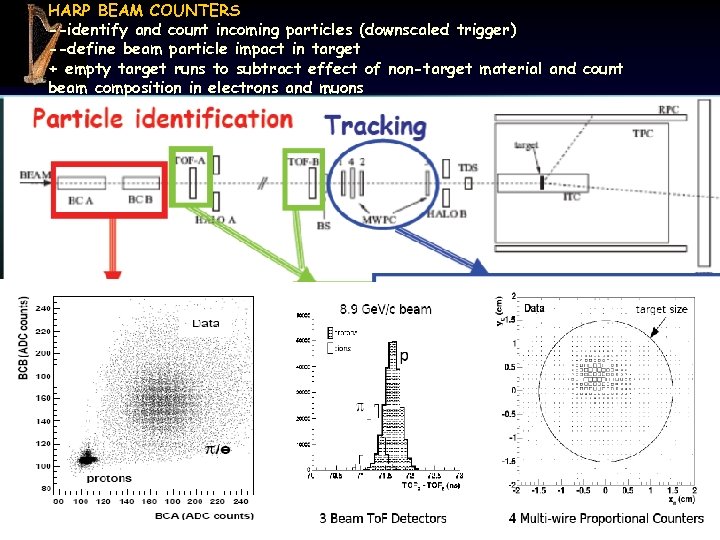 HARP BEAM COUNTERS --identify and count incoming particles (downscaled trigger) --define beam particle impact in target + empty target runs to subtract effect of non-target material and count beam composition in electrons and muons July 2007 HARP results EPS 2007 Manchester Alain Blondel
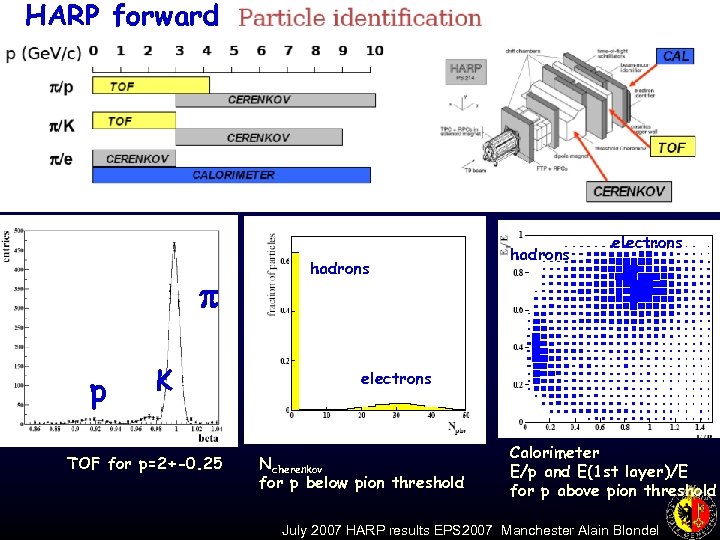 HARP forward p p K TOF for p=2+-0. 25 hadrons electrons Ncherenkov for p below pion threshold Calorimeter E/p and E(1 st layer)/E for p above pion threshold July 2007 HARP results EPS 2007 Manchester Alain Blondel
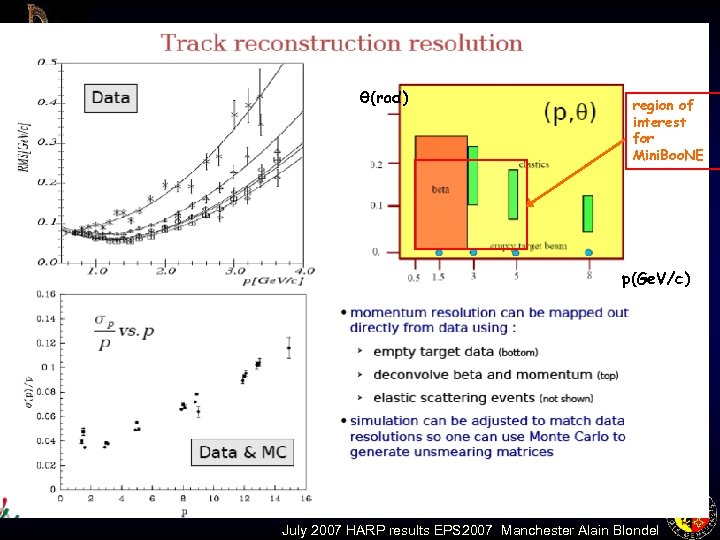 θ(rad) region of interest for Mini. Boo. NE p(Ge. V/c) July 2007 HARP results EPS 2007 Manchester Alain Blondel
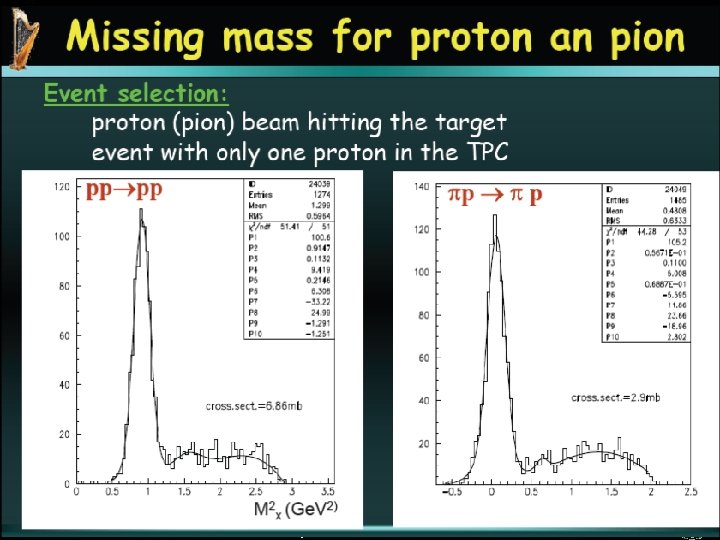
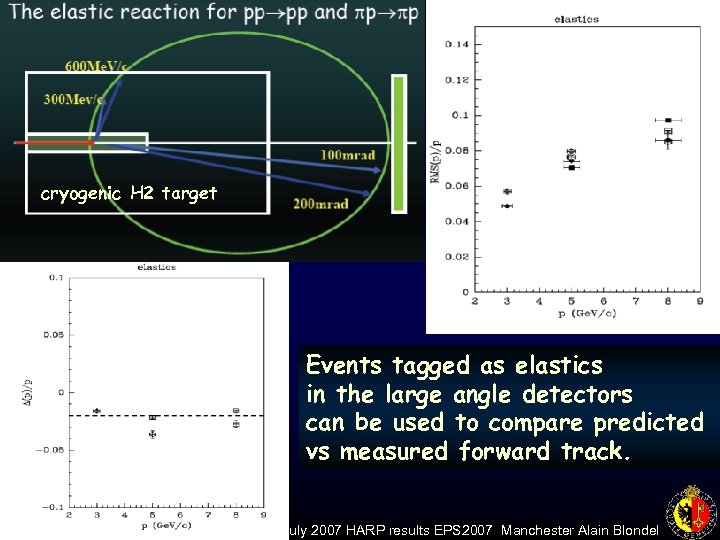 cryogenic H 2 target Events tagged as elastics in the large angle detectors can be used to compare predicted vs measured forward track. July 2007 HARP results EPS 2007 Manchester Alain Blondel
 July 2007 HARP results EPS 2007 Manchester Alain Blondel
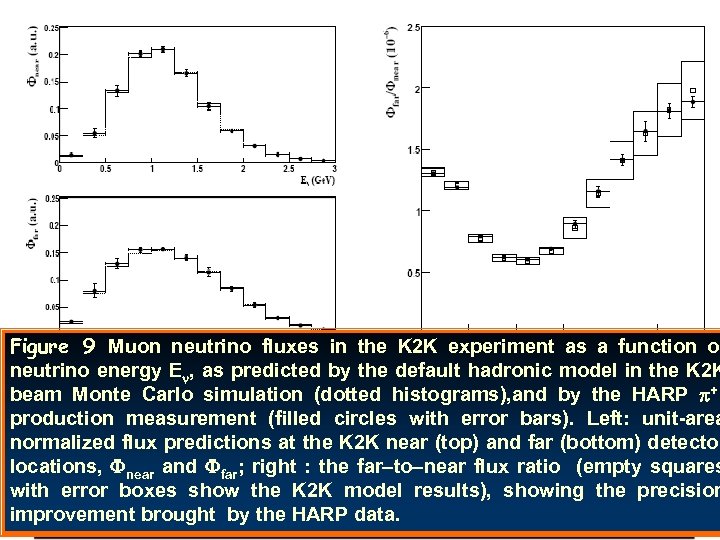 Figure 9 Muon neutrino fluxes in the K 2 K experiment as a function of neutrino energy En, as predicted by the default hadronic model in the K 2 K beam Monte Carlo simulation (dotted histograms), and by the HARP p+ production measurement (filled circles with error bars). Left: unit-area normalized flux predictions at the K 2 K near (top) and far (bottom) detector locations, Fnear and Ffar; right : the far–to–near flux ratio (empty squares with error boxes show the K 2 K model results), showing the precision improvement brought by the HARP data. July 2007 HARP results EPS 2007 Manchester Alain Blondel
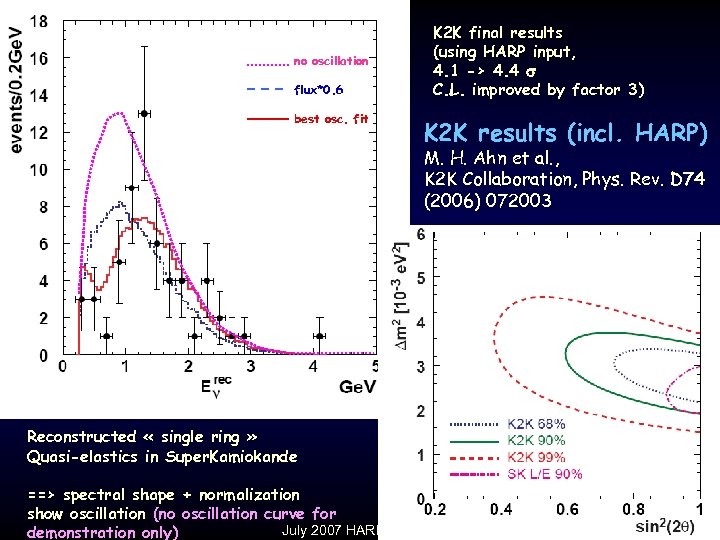 no oscillation flux*0. 6 best osc. fit K 2 K final results (using HARP input, 4. 1 -> 4. 4 s C. L. improved by factor 3) K 2 K results (incl. HARP) M. H. Ahn et al. , K 2 K Collaboration, Phys. Rev. D 74 (2006) 072003 Reconstructed « single ring » Quasi-elastics in Super. Kamiokande ==> spectral shape + normalization show oscillation (no oscillation curve for July 2007 HARP results EPS 2007 Manchester Alain Blondel demonstration only)
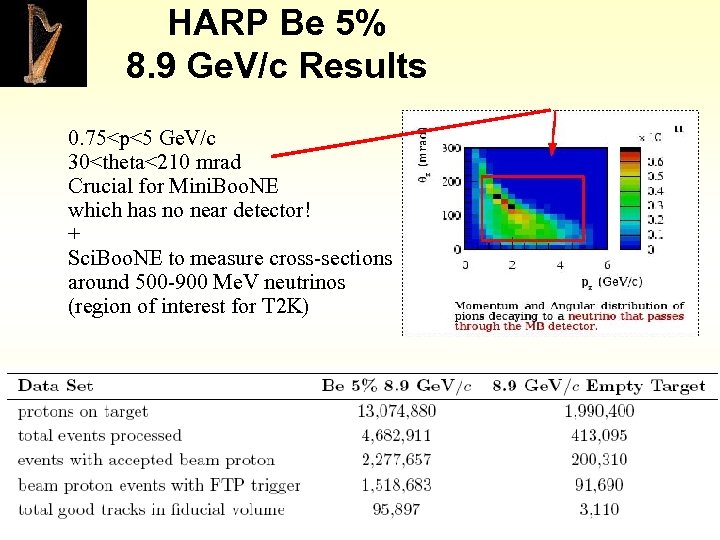 HARP Be 5% 8. 9 Ge. V/c Results 0. 75
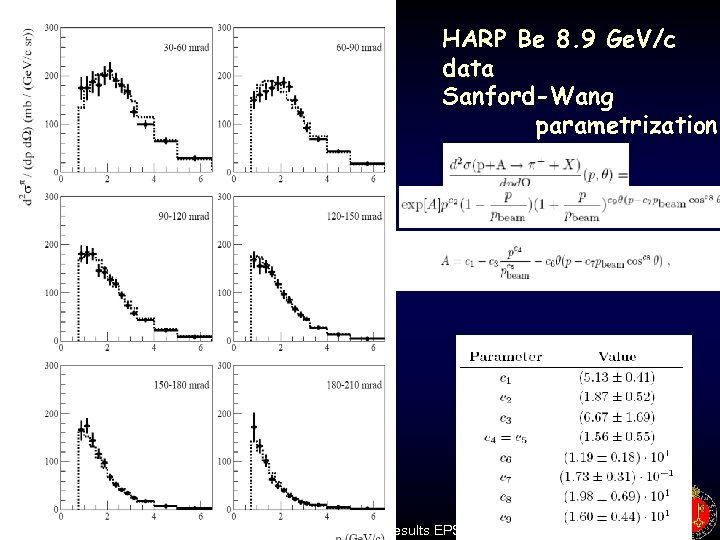 HARP Be 8. 9 Ge. V/c data Sanford-Wang parametrization July 2007 HARP results EPS 2007 Manchester Alain Blondel
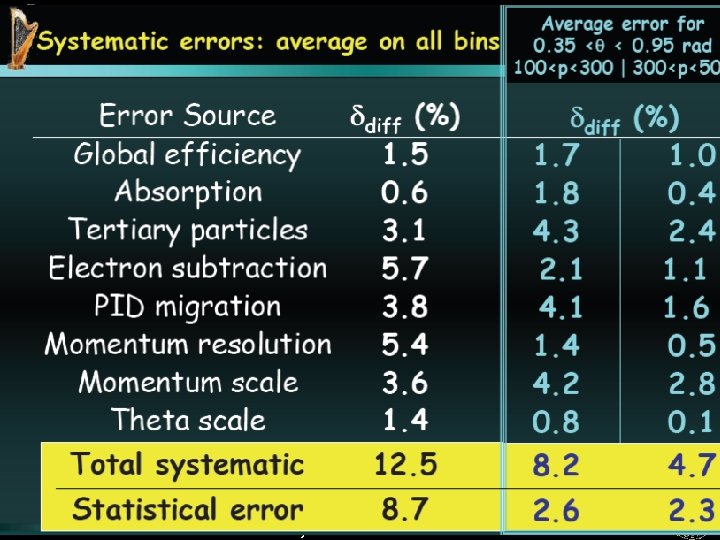
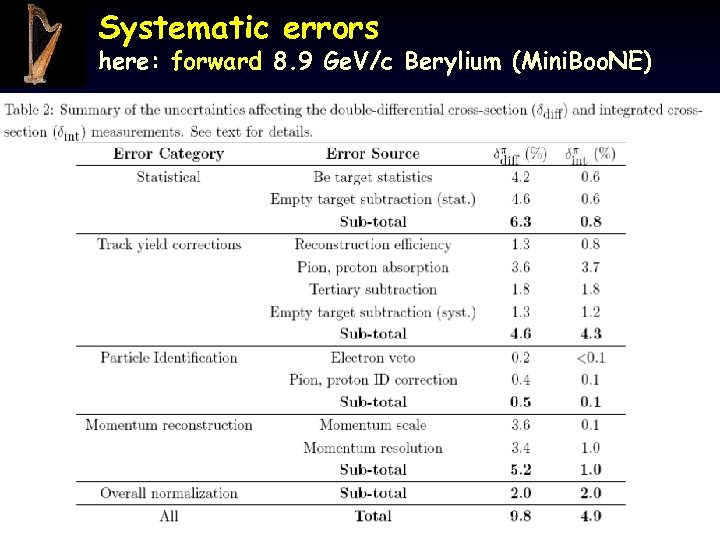 Systematic errors here: forward 8. 9 Ge. V/c Berylium (Mini. Boo. NE) July 2007 HARP results EPS 2007 Manchester Alain Blondel
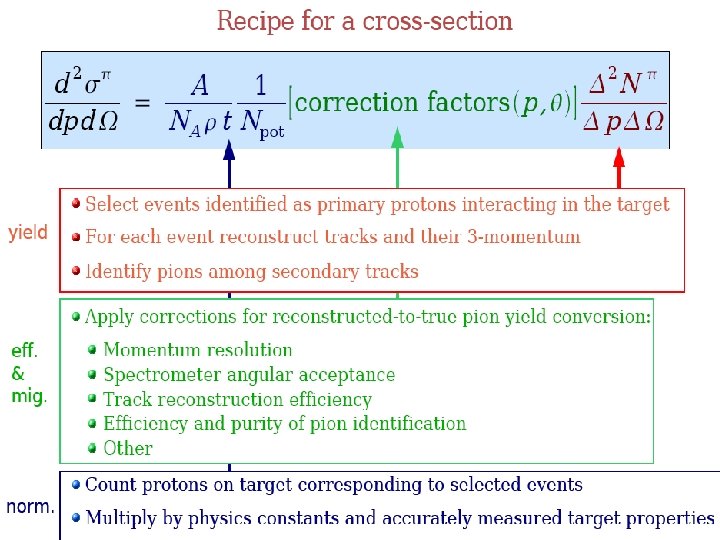
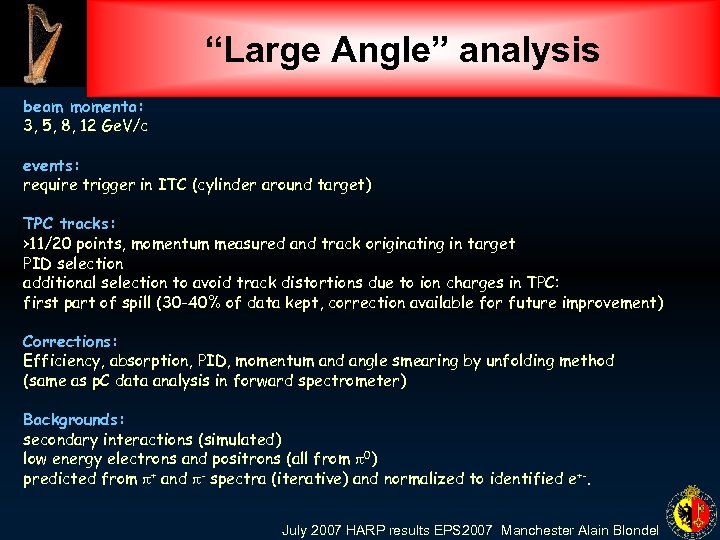 “Large Angle” analysis beam momenta: 3, 5, 8, 12 Ge. V/c events: require trigger in ITC (cylinder around target) TPC tracks: >11/20 points, momentum measured and track originating in target PID selection additional selection to avoid track distortions due to ion charges in TPC: first part of spill (30 -40% of data kept, correction available for future improvement) Corrections: Efficiency, absorption, PID, momentum and angle smearing by unfolding method (same as p. C data analysis in forward spectrometer) Backgrounds: secondary interactions (simulated) low energy electrons and positrons (all from p 0) predicted from p+ and p- spectra (iterative) and normalized to identified e+-. July 2007 HARP results EPS 2007 Manchester Alain Blondel
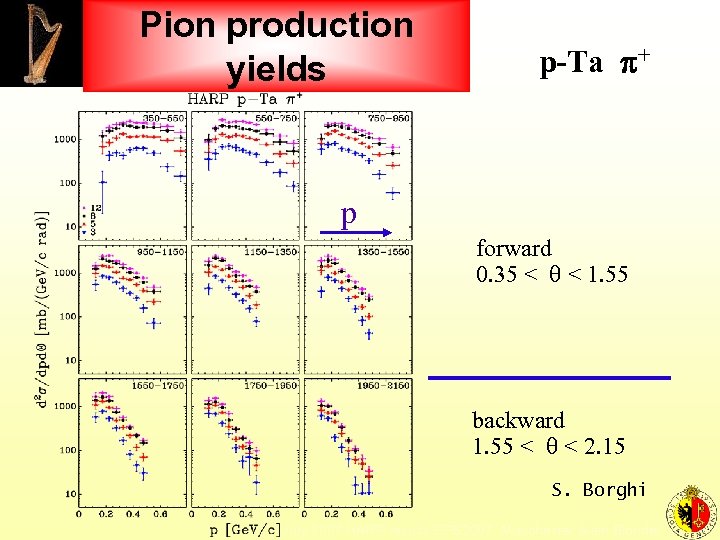 Pion production yields p-Ta p+ p forward 0. 35 < q < 1. 55 backward 1. 55 < q < 2. 15 S. Borghi July 2007 HARP results EPS 2007 Manchester Alain Blondel
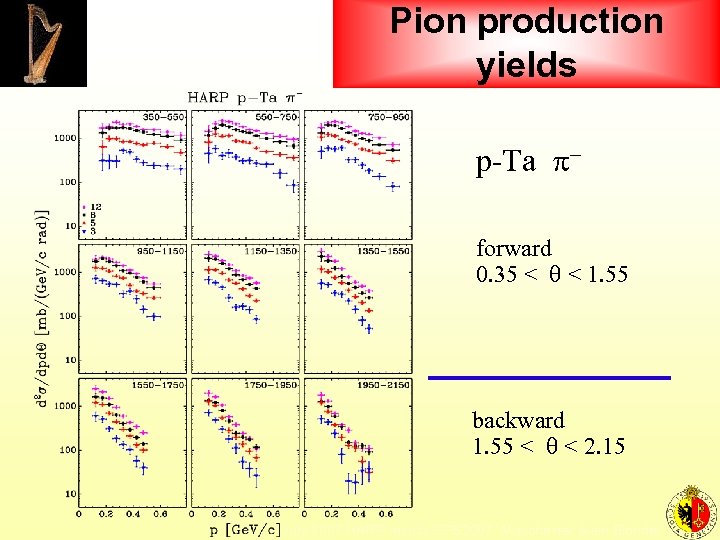 Pion production yields p-Ta pforward 0. 35 < q < 1. 55 backward 1. 55 < q < 2. 15 July 2007 HARP results EPS 2007 Manchester Alain Blondel
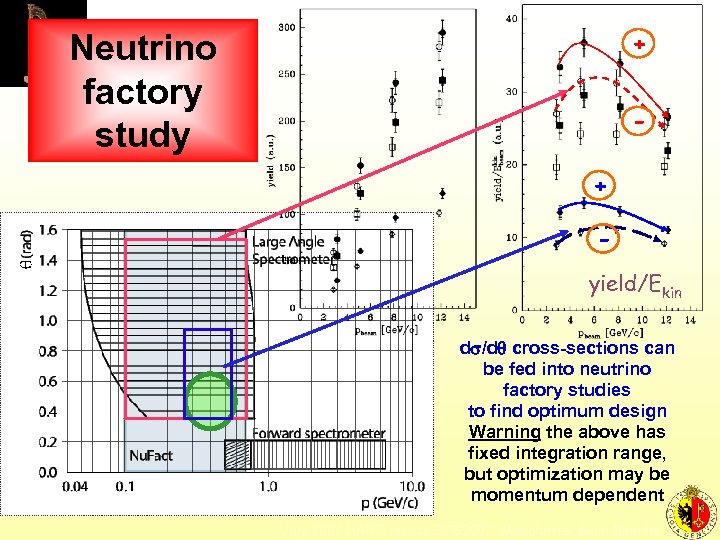 + Neutrino factory study + yield/Ekin ds/dq cross-sections can be fed into neutrino factory studies to find optimum design Warning the above has fixed integration range, but optimization may be momentum dependent July 2007 HARP results EPS 2007 Manchester Alain Blondel
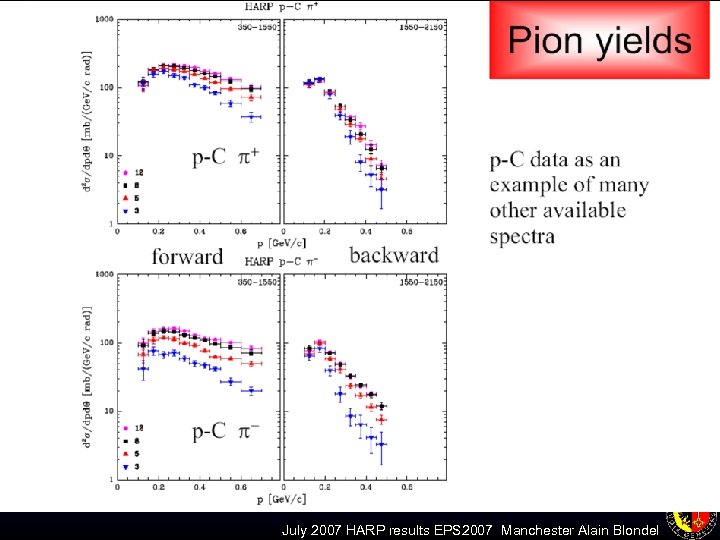 July 2007 HARP results EPS 2007 Manchester Alain Blondel
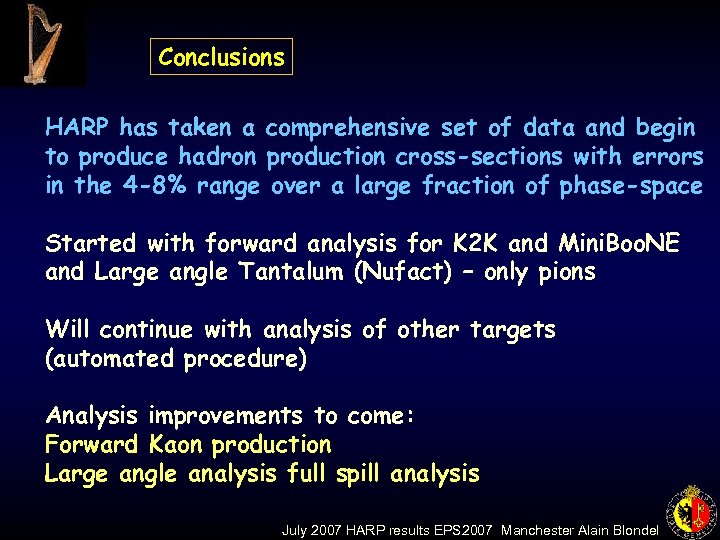 Conclusions HARP has taken a comprehensive set of data and begin to produce hadron production cross-sections with errors in the 4 -8% range over a large fraction of phase-space Started with forward analysis for K 2 K and Mini. Boo. NE and Large angle Tantalum (Nufact) – only pions Will continue with analysis of other targets (automated procedure) Analysis improvements to come: Forward Kaon production Large angle analysis full spill analysis July 2007 HARP results EPS 2007 Manchester Alain Blondel
 back ups July 2007 HARP results EPS 2007 Manchester Alain Blondel
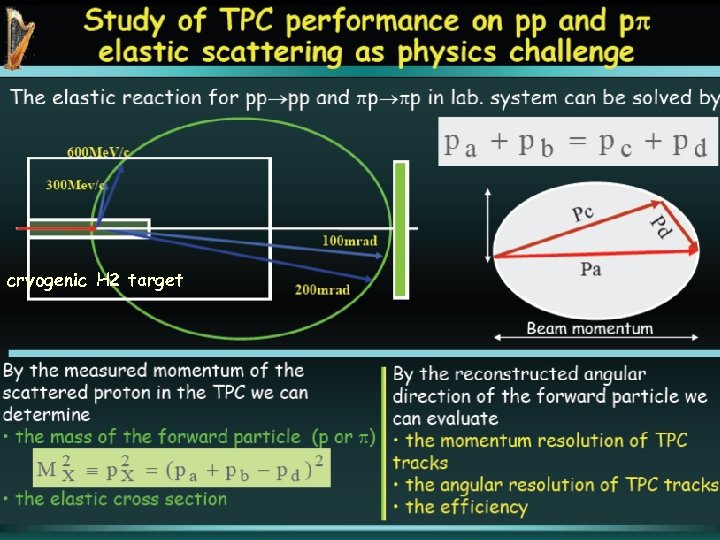 cryogenic H 2 target July 2007 HARP results EPS 2007 Manchester Alain Blondel
 July 2007 HARP results EPS 2007 Manchester Alain Blondel
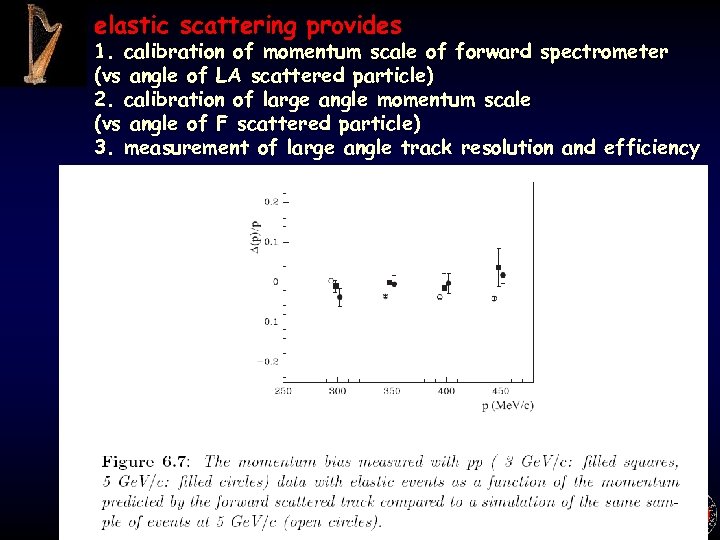 elastic scattering provides 1. calibration of momentum scale of forward spectrometer (vs angle of LA scattered particle) 2. calibration of large angle momentum scale (vs angle of F scattered particle) 3. measurement of large angle track resolution and efficiency July 2007 HARP results EPS 2007 Manchester Alain Blondel
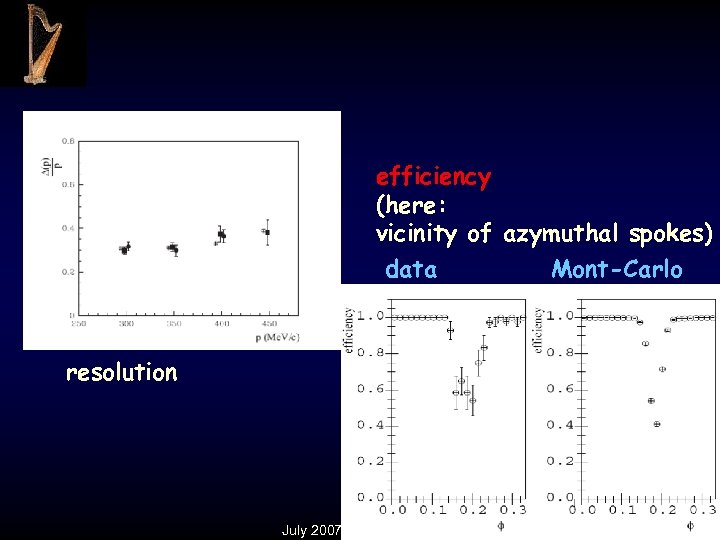 efficiency (here: vicinity of azymuthal spokes) data Mont-Carlo resolution July 2007 HARP results EPS 2007 Manchester Alain Blondel
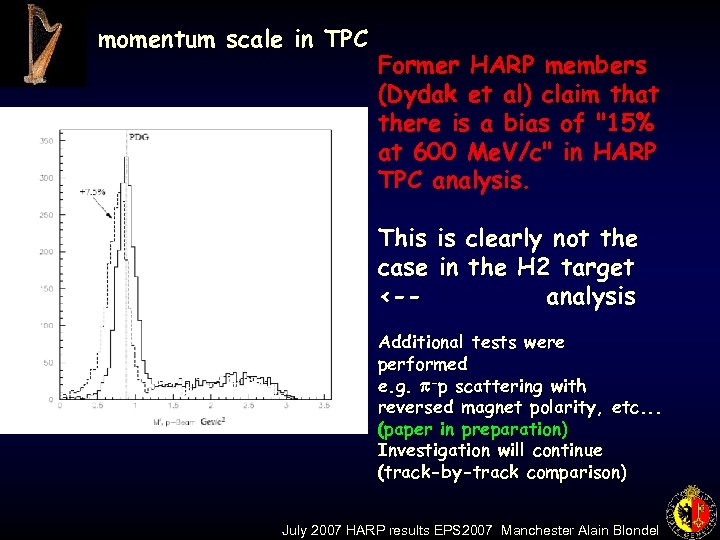 momentum scale in TPC Former HARP members (Dydak et al) claim that there is a bias of "15% at 600 Me. V/c" in HARP TPC analysis. This is clearly not the case in the H 2 target <-analysis Additional tests were performed e. g. p-p scattering with reversed magnet polarity, etc. . . (paper in preparation) Investigation will continue (track-by-track comparison) July 2007 HARP results EPS 2007 Manchester Alain Blondel
 July 2007 HARP results EPS 2007 Manchester Alain Blondel