


 Скачать презентацию New Provider Residential Services Orientation State of Georgia
8502c6bc9c43758bcb638401f7650848.ppt
- Количество слайдов: 89
 +New Provider Residential Services Orientation State of Georgia Orientation 1
 Introduction • What We Will Do - Educate • Presented By – Georgia Association of Homes & Services for Children (GAHSC) – Department of Human Services (DHS) • Office of Residential Child Care (ORCC) Licensing • Division of Family and Children Services (DFCS) – Division of Behavioral Health and Developmental Disabilities (DBHDD) – Department of Juvenile Justice (DJJ)
 Who Should Attend Applicants for the Licensing of: • Child Caring Institution – (Group Home, Emergency Shelters, Second Chance Homes) • Outdoor Child Caring Institutions • Child Placing Agency (Foster Care, TFC) Orientation 3
 Who Should NOT Attend • Day Care Center Operators • Foster Parent wantabe’s • Adult Personal Care Home Applicants • Psychiatric Hospital Applicants • Maternity Homes Applicants • Insect Exterminators Applicants • Beauty Shop Operators Applicants • Road Contractors Applicants Orientation 4
 Overview Normer Adams Executive Director Georgia Association of Homes & Services for Children www. gahsc. org normer@gahsc. org 404 572 6170
 Steps to Provision of Services Presentation Organization 1. - Organizational Capacity and Needs Assessments 2. - Licensure 3. - Contracting with the State 4. - Referrals and Payments
 Steps to Provision of Services Step one - Organizational Capacity and Needs Assessments
 FIRST PRIORITY Develop the “BUSINESS PLAN” The Plan vs. Good Intentions -Board -Budgets -Constituency -Facilities -Legal Issues -Policies & Procedures Organizational Capacity Assessement
 FIRST PRIORITY THE BUSINESS PLAN (continued) • Research – The Need – The Competition • Interviews • Field Trips Needs Assessment
 FIRST PRIORITY What will I be When I grow Up? Child Placing – An agency that recruits, supports and places children in foster homes Child Caring Institution – Group home or other congregate care environment where facilities are built for the placement and care of children. Outdoor Child Caring Institutions – Programs using a wilderness model for care and treatment of children. Needs Assessment
 FIRST PRIORITY What will I be When I grow Up? Child Placing – An agency that recruits, supports and places children in foster homes • • First placement priority for state. 75% of all foster children go into this placement. Lowest cost per day per child Regulations require that they be not-for-profit. You can not own them, profit from them or sell them. Needs Assessment
 FIRST PRIORITY What will I be When I grow Up? Child Caring Institution – Group home or other congregate care environment where facilities are built for the placement and care of children. • This is last placement choice for children with basic needs. • DFCS is not issuing any new contracts for this service • Only 14% of all foster children are placed in these facilities. Needs Assessment
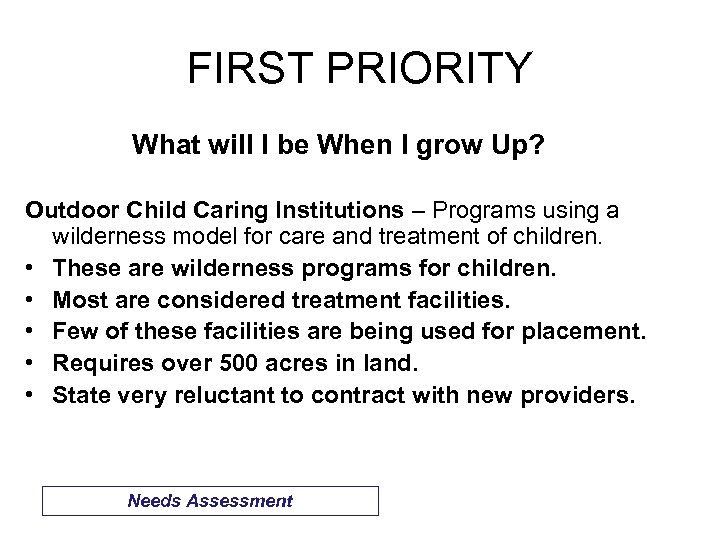 FIRST PRIORITY What will I be When I grow Up? Outdoor Child Caring Institutions – Programs using a wilderness model for care and treatment of children. • These are wilderness programs for children. • Most are considered treatment facilities. • Few of these facilities are being used for placement. • Requires over 500 acres in land. • State very reluctant to contract with new providers. Needs Assessment
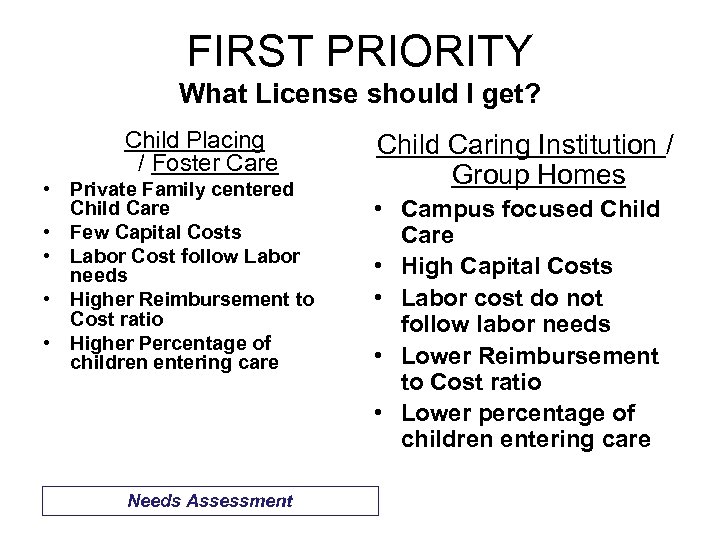 FIRST PRIORITY What License should I get? Child Placing / Foster Care • Private Family centered Child Care • Few Capital Costs • Labor Cost follow Labor needs • Higher Reimbursement to Cost ratio • Higher Percentage of children entering care Needs Assessment Child Caring Institution / Group Homes • Campus focused Child Care • High Capital Costs • Labor cost do not follow labor needs • Lower Reimbursement to Cost ratio • Lower percentage of children entering care
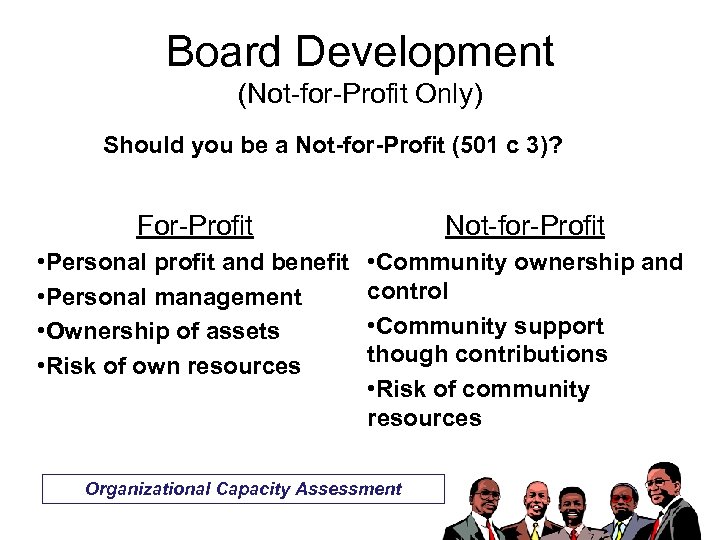 Board Development (Not-for-Profit Only) Should you be a Not-for-Profit (501 c 3)? For-Profit Not-for-Profit • Personal profit and benefit • Personal management • Ownership of assets • Risk of own resources • Community ownership and control • Community support though contributions • Risk of community resources Organizational Capacity Assessment
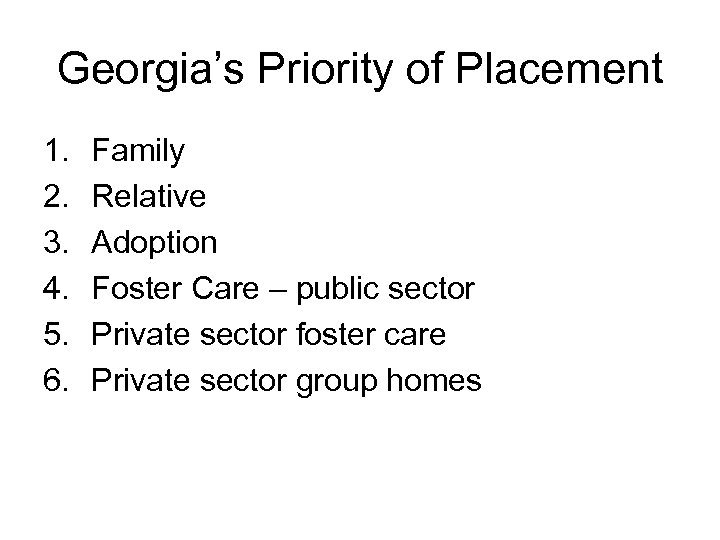 Georgia’s Priority of Placement 1. 2. 3. 4. 5. 6. Family Relative Adoption Foster Care – public sector Private sector foster care Private sector group homes
 Board Development (Those who are accountable for the organization) Truism - An organization is as strong as its Board. – Choose people who can help you – Go beyond friends and family – Movers and Shakers of community make good Board Members Organizational Capacity Assessment
 Executive Director (He/She who manages the organization) • Choose person of experience, integrity, responsibility and history • He/She will represent your organization • He/She will carry out your policies and procedures Organizational Capacity Assessment
 Budgets and Budgeting Budget Development Expenses Income • Staff--Base Pay • Benefits • Insurance--Property, Casualty, & Liability • Food • Clothing • Transportation • Other • State Fees • Contributions-nonprofit only Organizational Capacity Assessment – Charity gifts – Grants – Endowments
 Budgets and Budgeting Medical Care Covered by Medicaid – Nearly all children in residential care qualify for Medicaid. Organizational Capacity Assessment
 Fundraising Grants for Startup List of all the Foundations and Charities that give to new organizations starting children homes and group homes. Organizational Capacity Assessment
 Fundraising Grants for Startup All Foundations and Charities: 1. 2. 3. Organizational Capacity Assessment
 Fundraising Grants for Startup • Very Few • Only to Existing Groups • Need 501(c)(3) status – Not-for-Profit • Anticipate 18 months for startup support • Build constituency Organizational Capacity Assessment
 Not-for-profit Organization (Nearly all are 501(c)3) • Internal Revenue Service (IRS) Regulations for securing tax deductible contributions • Takes at least 1 year to secure • A knowledgeable person can do it without lawyer Organizational Capacity Assessment
 Your Facilities • Fire Inspection - # 1 Problem Area – Most Expensive to Correct – State Regulations, County Interpretations and enforcement Organizational Capacity Assessment
 Your Facilities Truism- If Community Support starts off negative, walk away. It will never turn positive. • Community Support - # 2 Problem Area – Build Support Carefully – If negative, hard to overcome – Use community leaders to lead Organizational Capacity Assessment
 Your Facilities Zoning – The “Tip Off” to the Community -- Required before Licensing -- Zone for “a licensed childcare institution for six or more unrelated children” -- Movers and Shakers of community can help with this Organizational Capacity Assessment
 Policies & Procedures (Provides the why and how of the organization) Truism – If your director can not explain them, they should not be your director. • Get a person who has done residential child care to prepare your policies and procedures • These are your rule books for operations • You will live and die by them • They become your Bible for operation Organizational Capacity Assessment
 Technical & Clinical Assistance (Gut instinct is not enough. ) Truism – Education and Experience is more valuable than gut instinct. • A compliant child may be a depressed child. • An attentive, indulgent staff may be a pedophile. • Money in your pocket may not mean money in the bank. • Your High School Joe might like your facility as coed, but you won’t.
 Staff & Personnel Issues (They make or break your organization) Truism - Your program is as good as your worst staff. • A thorough background check is essential. • “Would you let these folks care for your child? ” Organizational Capacity Assessment
 Reporting Requirements Truism – God Forgives but the State never Forgets • Child Abuse Reporting Requirements • Stuff will happen! Self-report. • The law requires you to report abuse and neglect. • Do not even THINK of not reporting. Organizational Capacity Assessment
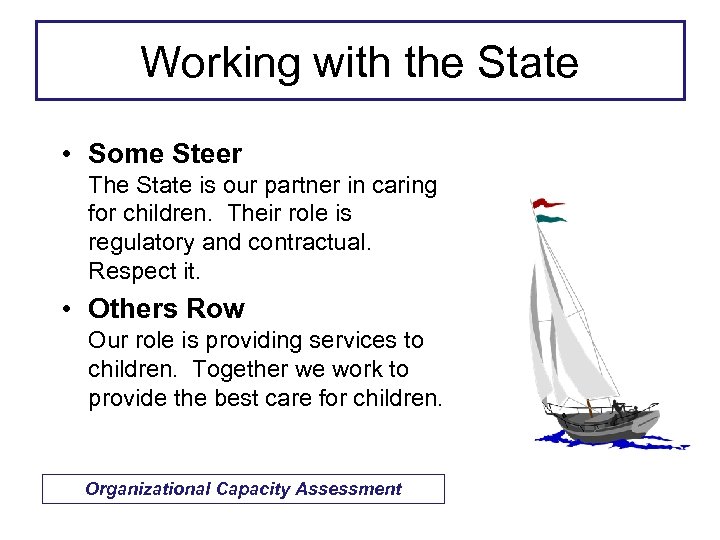 Working with the State • Some Steer The State is our partner in caring for children. Their role is regulatory and contractual. Respect it. • Others Row Our role is providing services to children. Together we work to provide the best care for children. Organizational Capacity Assessment
 Budgeting/Rate Setting Truism – Child Welfare programming makes for a bad business investment. Truism – If you are in it for the money, you are in it for the money. Georgia’s regulations prohibit any organization from making money. Your daily per diem will be the lesser of (your costs or the maximum rate. ) Organizational Capacity Assessment
 Budgeting/Rate Setting Truism – If you in it for the money, you are in a world of trouble. There is no profit in child welfare. • Funding remains the top priority for any administrator! • Without money, nothing happens. • The State is your number # 1 customer, and quite often, your only customer! • In Georgia, there are only a hand full of For-Profit agencies. (There is a reason for this. There is no profit in child welfare!) Organizational Capacity Assessment
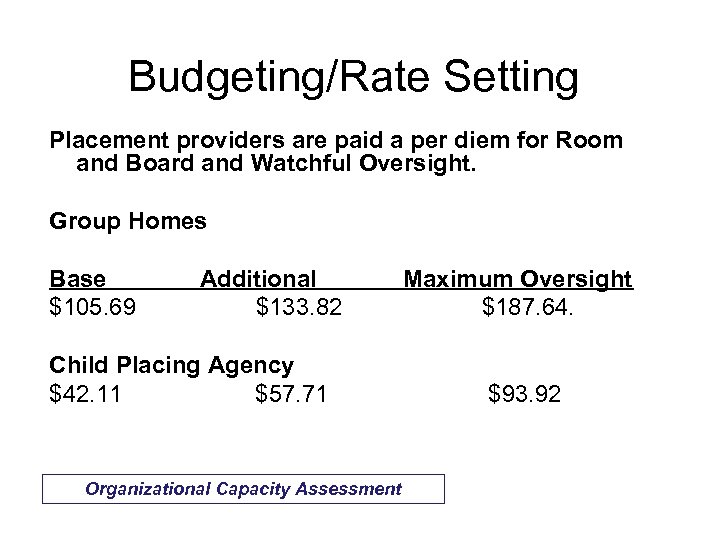 Budgeting/Rate Setting Placement providers are paid a per diem for Room and Board and Watchful Oversight. Group Homes Base $105. 69 Additional $133. 82 Child Placing Agency $42. 11 $57. 71 Organizational Capacity Assessment Maximum Oversight $187. 64. $93. 92
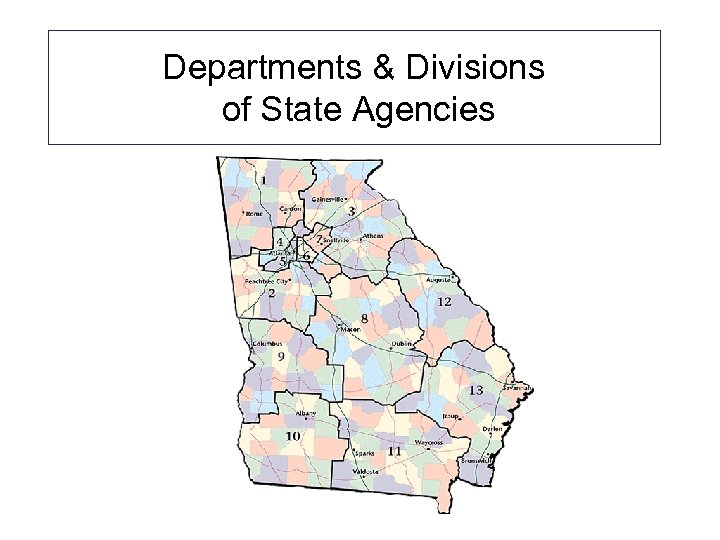 Departments & Divisions of State Agencies
 DHS Office of Residential Child Care Licensing Office of the State Rhonda James #2 Peachtree St. , 32 nd Floor 404 -657 -5589 http: //ors. dhr. georgia. gov/portal/site/DHR-ORS
 Steps to Provision of Services • Step Two - Licensure
 DHS Office of Residential Child Care Licensing • License Categories: – CPA – Child Placing Agency - Placement of children in foster and or adoptive homes **Both domestic and international placement** Home Study Services – CCI – Child Caring Institutions includes emergency shelters, group homes, and children's homes. 6 or more residents 6 -17 years old *Medically fragile children – OCC – Outdoor Child Caring Institution - Wilderness Camps – Determine the type of program you want to be Licensure
 How to Apply for Licensure 1. All CCIs must obtain local zoning and fire approval before submitting an application 2. Purchase licensure application package 3. Familiarize yourself with ORS rules and regulations--develop a working knowledge of the meaning and intent of these rules and regulations 4. Develop policies and procedures to address each rule 5. Prepare your agency for compliance with the regulations Licensure
 Staff Qualifications for CCI • Director: Masters/2 years related experience or Bachelors/4 Years experience • Human Services Professional (Social Services): Bachelors/2 Years Experience or supervised by Masters • Child Care Worker: 21 Years Old/ High School or GED • Director and owner must document a satisfactory criminal records check Licensure
 Staff Qualifications for CPA • Director: Bachelors/2 Years related experience unless doing clinical supervision of staff • Case Work Supervisor (Social Services): Qualified Masters/2 Years CPA experience • Case Worker: Bachelors degree • Director and Owner must document a satisfactory criminal records check Licensure
 Criminal Records Check Law • Must be in compliance with Criminal Records Checks Law. • If employee’s check reveals any crime, person cannot be hired until resolved. • Must submit fingerprints to Office of Investigative Services for clearance. Licensure
 Physical Plant for CCI 1. 2. 3. 4. 5. 6. 7. Water/Sewage Bedrooms: 63 Square Feet per resident (double occupancy. Single: 75 Square Feet Bedrooms – must document space capacity to serve at least six residents Bathrooms – one sink/toilet per 8 kids, 1 shower per 10 kids. Separate bathroom for staff. Staff may not enter into a resident bedroom to access the bathroom. SAFETY FIRST--Inside and Outside Licensure
 Behavior Management • Develop behavior management policies and procedures • Policies should address behavior management techniques for type of children served • Behavior management plan must be documented in the resident’s service plan. Licensure
 Behavior Management (continued) • The policies address form of discipline that shall not be used. • Examples - Verbal Abuse, Ridicule or Humiliation - Denial of sleep, shelter or clothing - Corporal punishment Licensure
 Behavior Management (cont’d) • Develop policies on emergency safety interventions • Emergency safety means those behavioral interventions techniques that are authorized under and an approved emergency safety intervention • Plans are utilized by properly trained staff in an urgent situation to prevent a child from doing immediate harm to self or others - List of approved programs attached Licensure
 Approved Emergency Prevention Providers 1. Crisis Prevention Institute 3315 -H North 124 th Street Brookfield, WI 53005 Web: www. crisisprevention. com 2. Devereux Crisis Intervention (CP/I) 444 Devereux Drive Villanova, PA 19085 Web: www. devereux. org
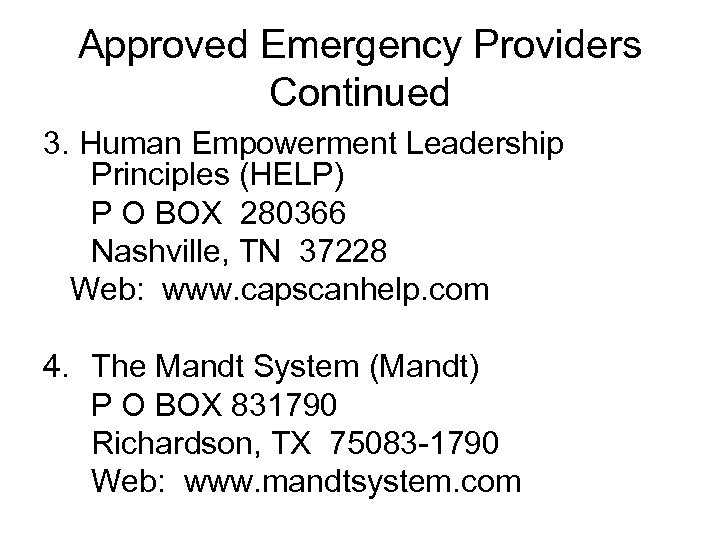 Approved Emergency Providers Continued 3. Human Empowerment Leadership Principles (HELP) P O BOX 280366 Nashville, TN 37228 Web: www. capscanhelp. com 4. The Mandt System (Mandt) P O BOX 831790 Richardson, TX 75083 -1790 Web: www. mandtsystem. com
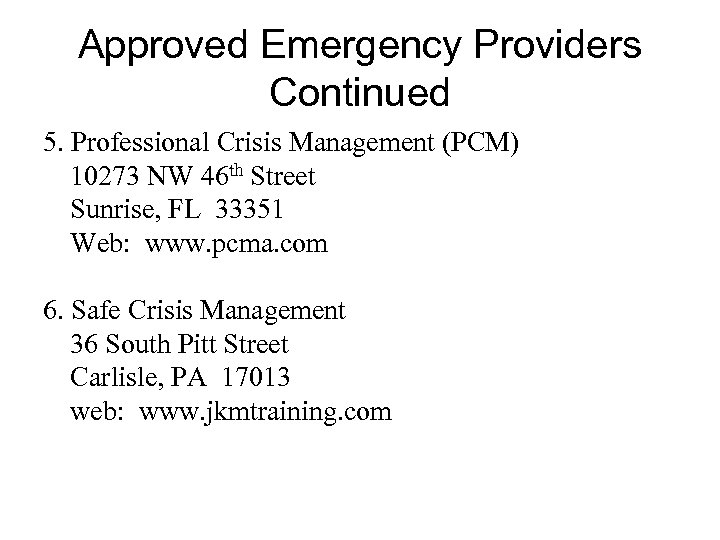 Approved Emergency Providers Continued 5. Professional Crisis Management (PCM) 10273 NW 46 th Street Sunrise, FL 33351 Web: www. pcma. com 6. Safe Crisis Management 36 South Pitt Street Carlisle, PA 17013 web: www. jkmtraining. com
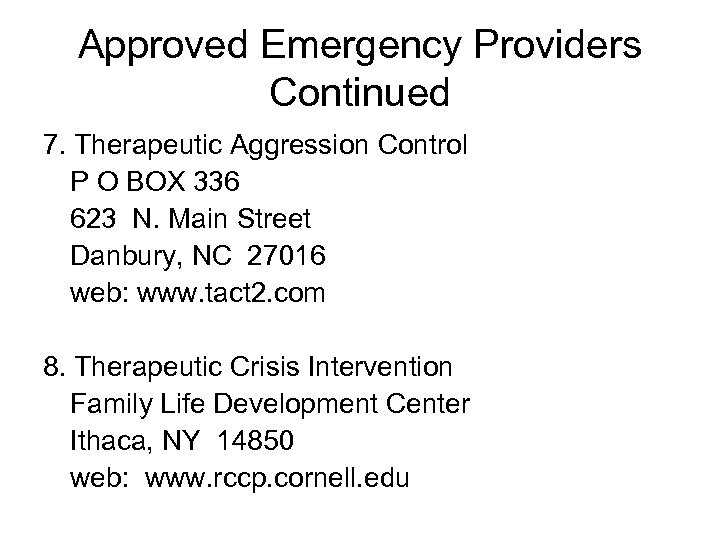 Approved Emergency Providers Continued 7. Therapeutic Aggression Control P O BOX 336 623 N. Main Street Danbury, NC 27016 web: www. tact 2. com 8. Therapeutic Crisis Intervention Family Life Development Center Ithaca, NY 14850 web: www. rccp. cornell. edu
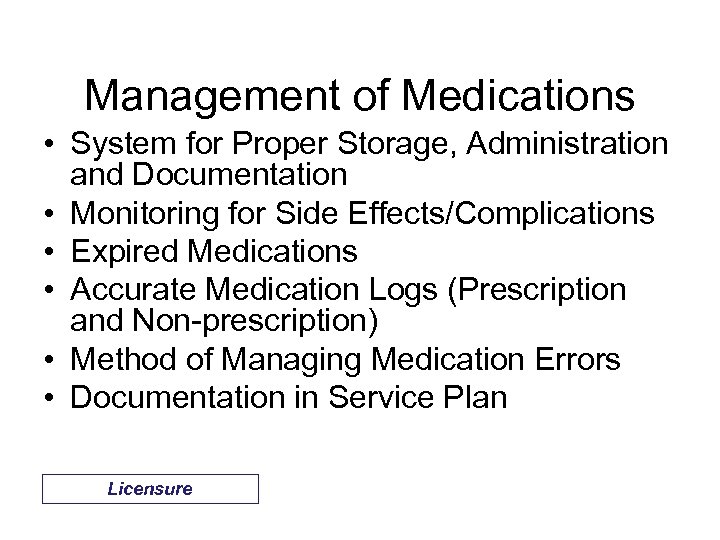 Management of Medications • System for Proper Storage, Administration and Documentation • Monitoring for Side Effects/Complications • Expired Medications • Accurate Medication Logs (Prescription and Non-prescription) • Method of Managing Medication Errors • Documentation in Service Plan Licensure
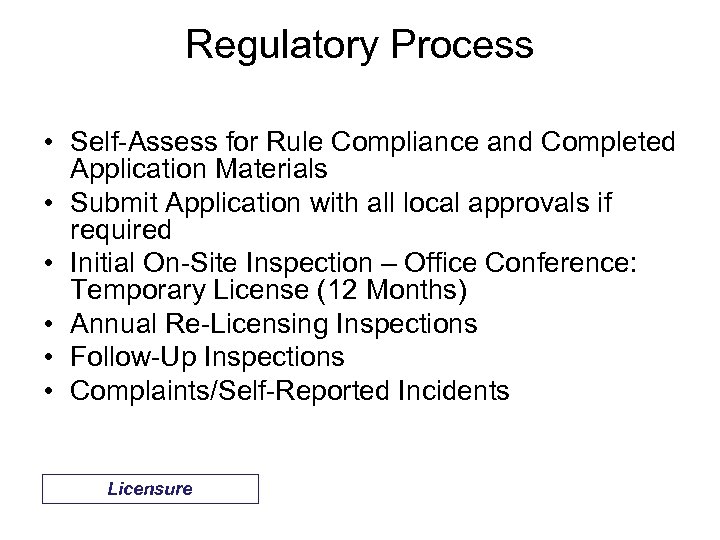 Regulatory Process • Self-Assess for Rule Compliance and Completed Application Materials • Submit Application with all local approvals if required • Initial On-Site Inspection – Office Conference: Temporary License (12 Months) • Annual Re-Licensing Inspections • Follow-Up Inspections • Complaints/Self-Reported Incidents Licensure
 Break
Break
 Steps to Provision of Services Step Three - Contractual Process for Providers
 Division of Family & Children’s Services DFCS • Provider Relations Unit • 404 -657 -3572 • http: //www. dfcs. dhr. georgia. gov/portal/site/DHRDFCS/
 Prior to July 1, 2009 Department of Human Resources Division of Family & Children’s Services Provider Relations Unit Phone: 404 -657 -3572 / Fax: 404 -656 -9905 2 Peachtree Street, Suite 18 -407 http: //www. dfcs. dhr. georgia. gov/portal/site/DHR-DFCS/ Yvonne Rodgers, Program Director - Provider Relations
 Strategic Planning The process by which we envision our future and develop the necessary procedures and operations to reach our destination.
 Department of Human Services *Division of Family and Children Services* Provider Relations Phone: 404 -657 -3572 / Fax: 404 -656 -9905 2 Peachtree Street, Suite 18 -407 http: //www. dfcs. dhr. georgia. gov/portal/site/DHR-DFCS Point of Contact: Yvonne Rodgers
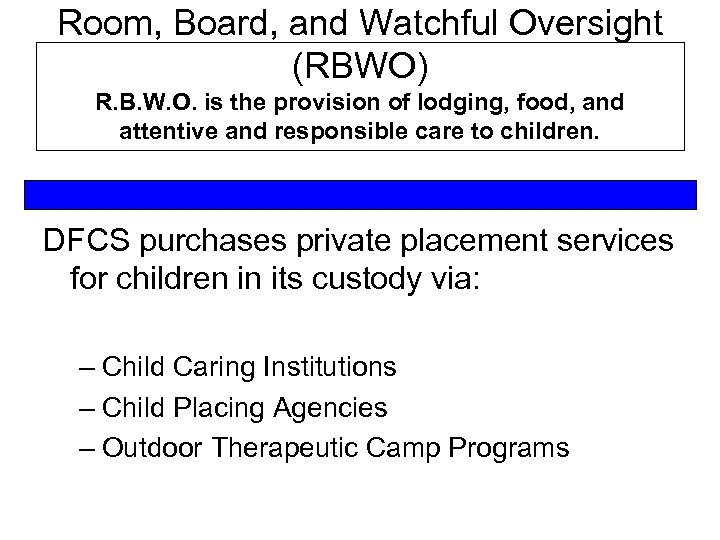 Room, Board, and Watchful Oversight (RBWO) R. B. W. O. is the provision of lodging, food, and attentive and responsible care to children. DFCS purchases private placement services for children in its custody via: – Child Caring Institutions – Child Placing Agencies – Outdoor Therapeutic Camp Programs
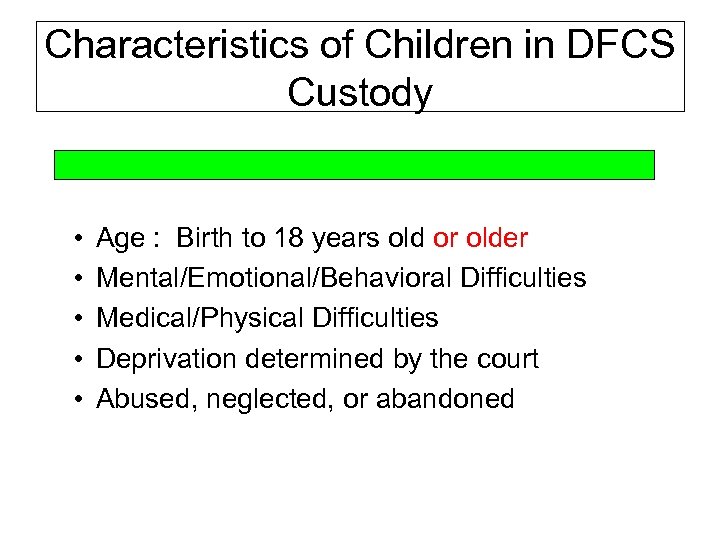 Characteristics of Children in DFCS Custody • • • Age : Birth to 18 years old or older Mental/Emotional/Behavioral Difficulties Medical/Physical Difficulties Deprivation determined by the court Abused, neglected, or abandoned
 KIDSTAR To view Provider Requirements and Child Characteristics please visit: www. kidstarga. com
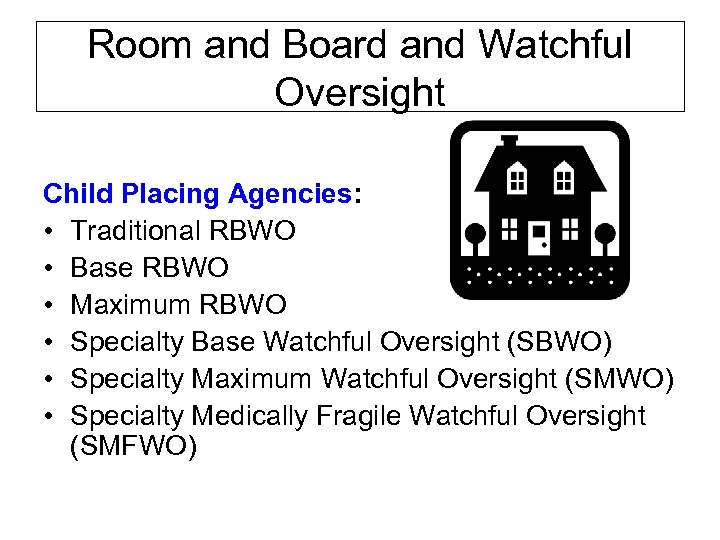 Room and Board and Watchful Oversight Child Placing Agencies: • Traditional RBWO • Base RBWO • Maximum RBWO • Specialty Base Watchful Oversight (SBWO) • Specialty Maximum Watchful Oversight (SMWO) • Specialty Medically Fragile Watchful Oversight (SMFWO)
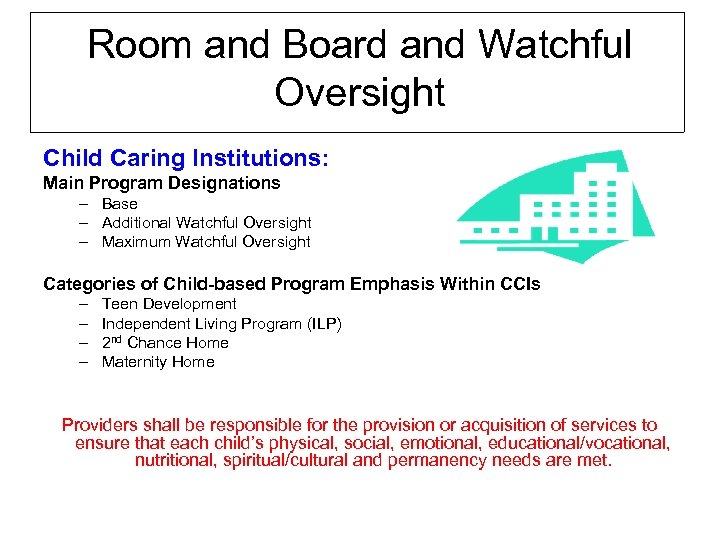 Room and Board and Watchful Oversight Child Caring Institutions: Main Program Designations – Base – Additional Watchful Oversight – Maximum Watchful Oversight Categories of Child-based Program Emphasis Within CCIs – – Teen Development Independent Living Program (ILP) 2 nd Chance Home Maternity Home Providers shall be responsible for the provision or acquisition of services to ensure that each child’s physical, social, emotional, educational/vocational, nutritional, spiritual/cultural and permanency needs are met.
 What do we Want? *Placement and support services focused on under served populations. – Teenagers – Sex offending or sexual aggressive – Behaviorally disordered children – Multiple/Diverse needs – Large sibling groups – Facilities with expansion ability
 WHAT WE DO NOT NEED? • 8 Bed & under Group Homes • Base Watchful Oversight Programs • Service Providers disconnected from the community • Providers with limited diversity in there program format and service delivery model
 DFCS Provider Relations Pre-Application Conference • Highly recommended but not required. • Preferably face to face. • Can include anyone from your core team, staff, board, etc. • Provider will be expected to present a preliminary business plan. • Internal team may include Unit Director, Finance Director and Regional Supervisor.
 DFCS: Provider Relations Contract Application Process • Prospective Provider requests application package from the Provider Relations Unit. • Package Includes: ü Application with attachments ü RBWO Child Characteristics ü Provider Minimum Requirements Approval Process of Vendors
 DFCS Contract Application Process • Completed Application is submitted to the Provider Relations Unit. • Application is reviewed by Provider Relations Unit. Approval Process of Vendors
 Contract Approval Process Three Possible Outcomes: (A) If application accepted, we will review the program. Subsequent site visit(s) will be scheduled. (B) Application incomplete – we will include an explanation of application items for which more information is needed. (C) Application denied – we will include an explanation of the basis for the denial. Approval Process of Vendors
 Contract Approval Process (continued) • If approved to serve children who are in the custody of DFCS, a notification letter will be sent to the provider and contract process initiated. • DFCS Provider Relations Unit notifies all county DFCS offices of the approval status and availability of placement. Approval Process of Vendors
 Automatic Denials The following condition will merit the denial of a Contract: • A person’s private residence located in a licensed facility. • Cut doors in a child room to meet fire code. Sprinklers are preferred for fire safety. • Directors who are qualified by regulation/standards but not accessible to DFCS/DJJ and are not accountable to the Board of the agency • Staff to child ratio’s for direct care staff should be the same for all shifts. If there is a variance, use of sleep staff or a video surveillance system to meet staffing requirements is unacceptable. Approval Process of Vendors
 Referral Process Program may receive referrals directly from county DFCS offices, from the Provider Relations Unit, other agencies or parental custody with or without Department of Behavioral Health involvement. Referrals and Payments
 DJJ Department of Juvenile Justice DIVISION OF COMMUNITY CORRECTIONS • Community Corrections (404)-657 -2431 • Marie Martin (478) 952 -5592 • www. djj. georgia. gov
 Department of Juvenile Justice Division of Community Programs Serves to Protect the Citizens of Georgia by Providing Prevention Services, Court Services and Supervision, Treatment and Rehabilitation of Youthful Offenders. Approval Process of Vendors
 DJJ Contract Application Process · Upon Obtaining Licensure, Contact the Residential Placement Specialist (RPS) in the District in which Your Facility is Located · Potential Provider requests application package from the Residential Placement Specialist. · Completed Application is submitted to the Residential Placement Specialist. · Application is reviewed by Residential Placement Specialist and supervisor. Approval Process of Vendors
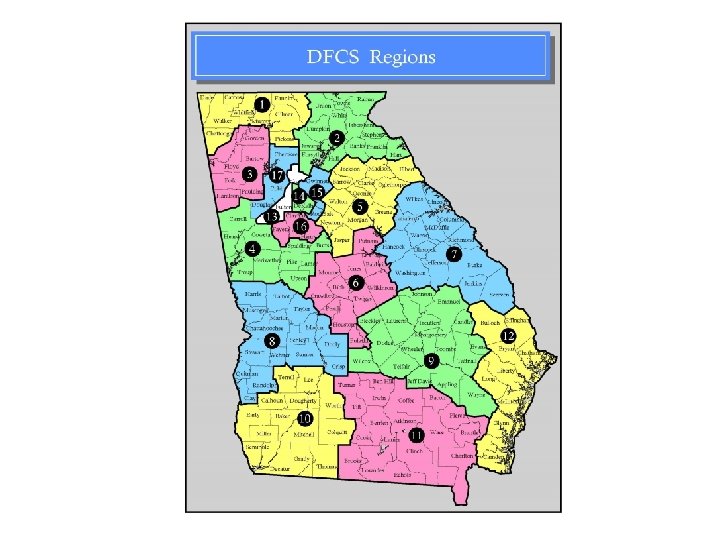
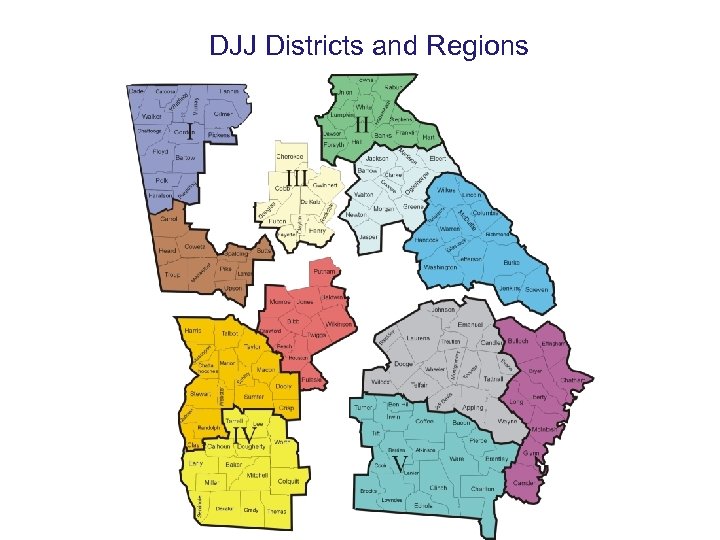 DJJ Districts and Regions
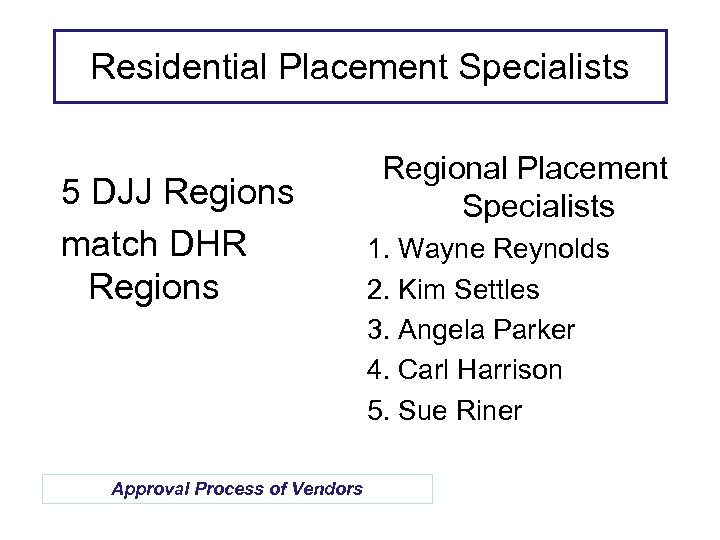 Residential Placement Specialists 5 DJJ Regions match DHR Regions Approval Process of Vendors Regional Placement Specialists 1. Wayne Reynolds 2. Kim Settles 3. Angela Parker 4. Carl Harrison 5. Sue Riner
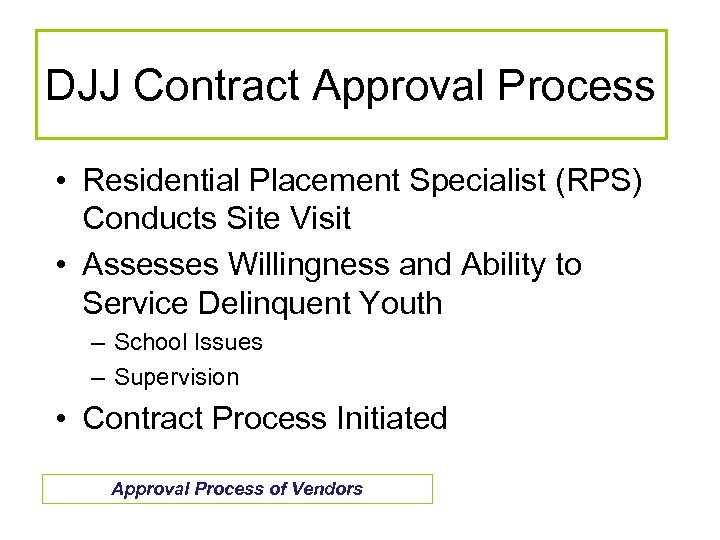 DJJ Contract Approval Process • Residential Placement Specialist (RPS) Conducts Site Visit • Assesses Willingness and Ability to Service Delinquent Youth – School Issues – Supervision • Contract Process Initiated Approval Process of Vendors
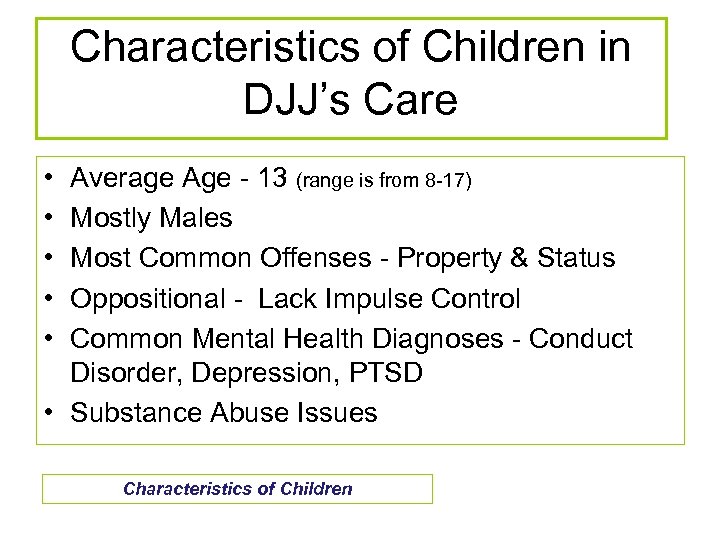 Characteristics of Children in DJJ’s Care • • • Average Age - 13 (range is from 8 -17) Mostly Males Most Common Offenses - Property & Status Oppositional - Lack Impulse Control Common Mental Health Diagnoses - Conduct Disorder, Depression, PTSD • Substance Abuse Issues Characteristics of Children
 Services to Children in DJJ’s Care • During FY 2004, 59, 000 youth were served by the Department of Juvenile Justice. Services Purchased
 Private Placements Normer Adams, GAHSC
 Private Placements Agency determines what services to sell (or give away) to the private individual or corporation (usually another state. ) The nature of these services is determined on the ability to provide those services within the Licensing framework and Approved Levels of Care. Services Purchased
 Characteristics of Children in Private Placement • Determined by agency’s mission and ability to care for the child. • And Agency’s ability to serve Characteristics of Children
 Private Placements • Client Application Process-- Licensing allows an agency to provide out-of-home services. Within the rules of Licensing, each agency develops their own application process. • Contract Approval Process -- There is no approval process save Licensure. Approval Process of Vendors and Marketing
 Private Placements Referrals and Payments • Referrals - Referrals are made by private individuals or agencies or another state. This referral network is determined by the agency. • Payments - Payments are negotiated with each referring party. Referrals and Payments
 Private Placements Referrals and Payments Most Private Placements are done on a charity basis unless the placement is done by another State. Referrals and Payments
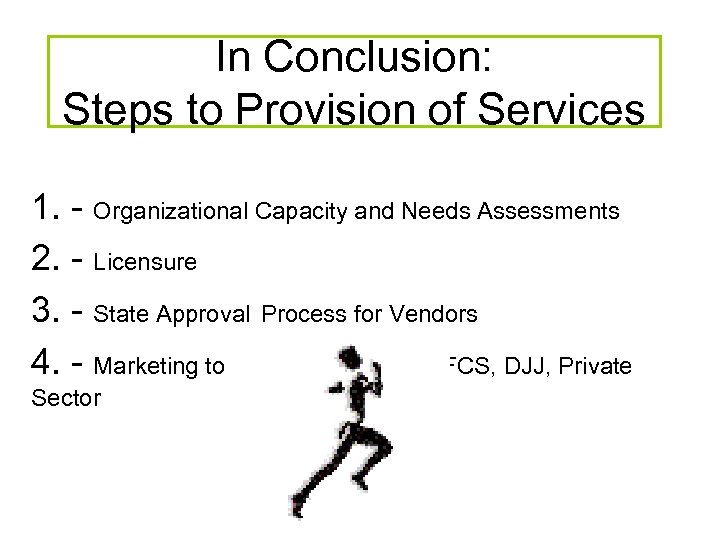 In Conclusion: Steps to Provision of Services 1. - Organizational Capacity and Needs Assessments 2. - Licensure 3. - State Approval Process for Vendors 4. - Marketing to Referral Sources, DFCS, DJJ, Private Sector