


 Скачать презентацию NEW PRODUCT LICENSING Why do companies license their
9dcc514d995eeaae339bb9b602d77bf7.ppt
- Количество слайдов: 22
 NEW PRODUCT LICENSING: Why do companies license their IP? Feryal Erhun Enis Kayis Management Science and Engineering Stanford University Mark Wilkinson Intel Corporation MSOM Conference 2005 1
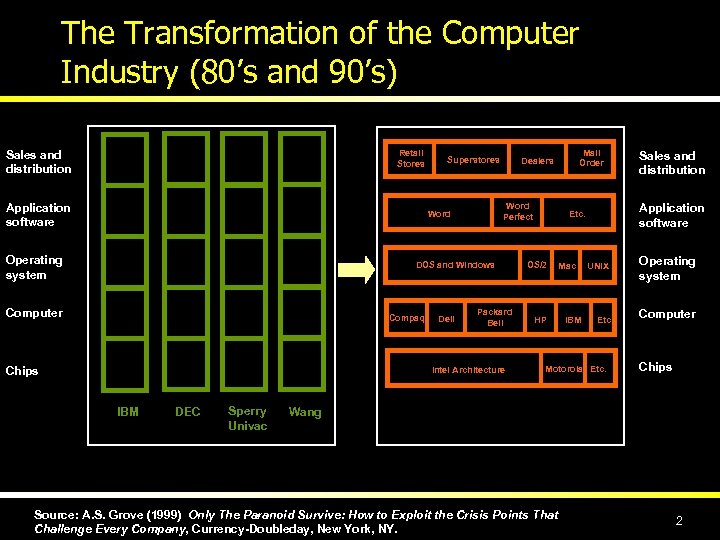 The Transformation of the Computer Industry (80’s and 90’s) Sales and distribution Retail Stores Application software Superstores Word Perfect Word Operating system DOS and Windows Computer Compaq Chips Dell Packard Bell Intel Architecture IBM DEC Sperry Univac Mail Order Dealers Application software Etc. OS/2 HP Mac IBM Sales and distribution UNIX Etc. Motorola Etc. Operating system Computer Chips Wang Source: A. S. Grove (1999) Only The Paranoid Survive: How to Exploit the Crisis Points That Challenge Every Company, Currency-Doubleday, New York, NY. 2
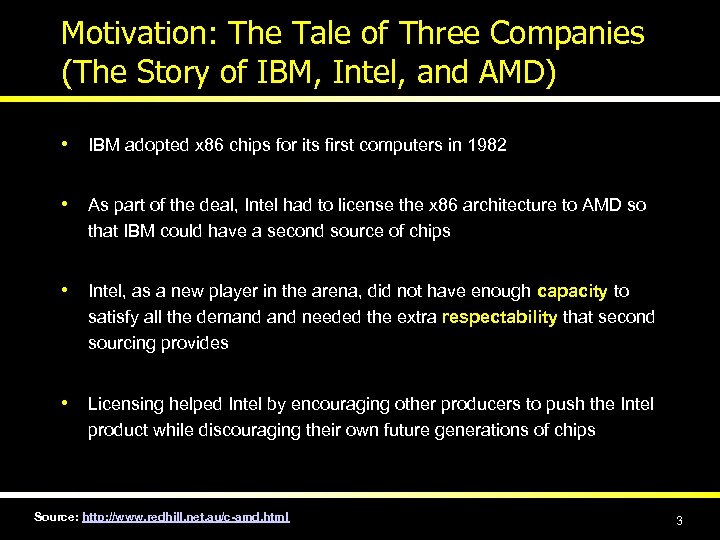 Motivation: The Tale of Three Companies (The Story of IBM, Intel, and AMD) • IBM adopted x 86 chips for its first computers in 1982 • As part of the deal, Intel had to license the x 86 architecture to AMD so that IBM could have a second source of chips • Intel, as a new player in the arena, did not have enough capacity to satisfy all the demand needed the extra respectability that second sourcing provides • Licensing helped Intel by encouraging other producers to push the Intel product while discouraging their own future generations of chips Source: http: //www. redhill. net. au/c-amd. html 3
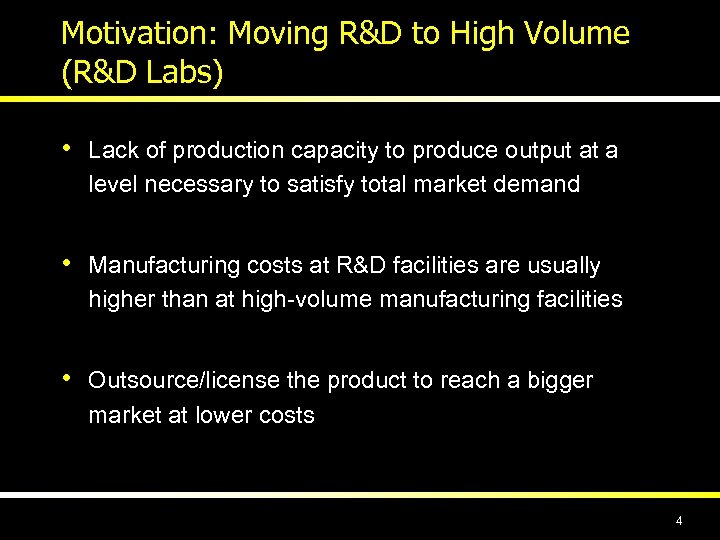 Motivation: Moving R&D to High Volume (R&D Labs) • Lack of production capacity to produce output at a level necessary to satisfy total market demand • Manufacturing costs at R&D facilities are usually higher than at high-volume manufacturing facilities • Outsource/license the product to reach a bigger market at lower costs 4
 Research Questions • Why/when would a company license its intellectual property (IP)? • What is the role of an inventor’s capacity in the market equilibrium? • What is the role of manufacturing cost in product licensing? 5
 Agenda • Model Definition • Analysis of the Model • Conclusion 6
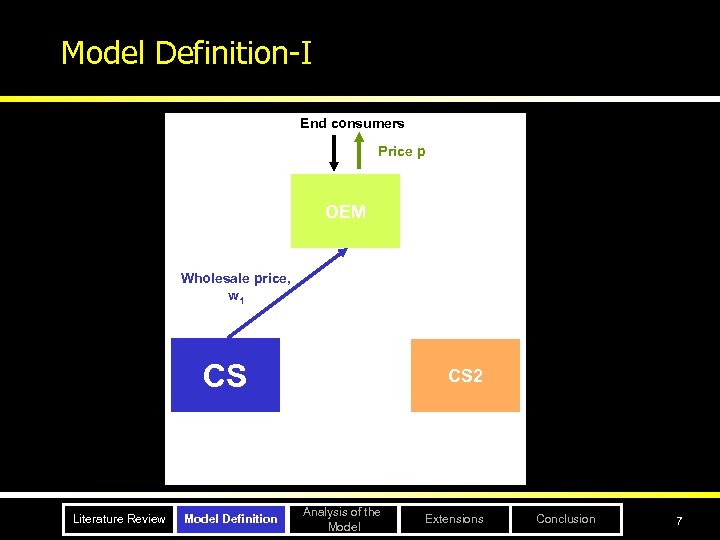 Model Definition-I End consumers Price p OEM Wholesale price, w 1 CS Literature Review Model Definition CS 2 Analysis of the Model Extensions Conclusion 7
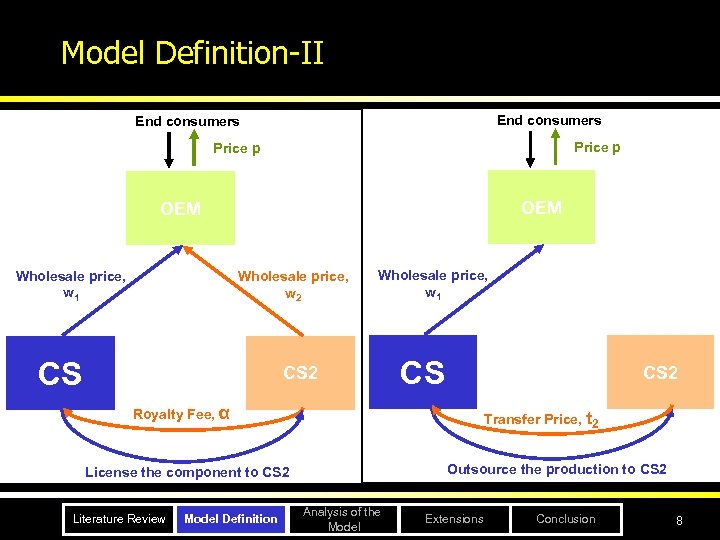 Model Definition-II End consumers Price p OEM Wholesale price, w 1 Wholesale price, w 2 CS Wholesale price, w 1 CS 2 CS CS 2 Royalty Fee, α Transfer Price, t 2 Outsource the production to CS 2 License the component to CS 2 Literature Review Model Definition Analysis of the Model Extensions Conclusion 8
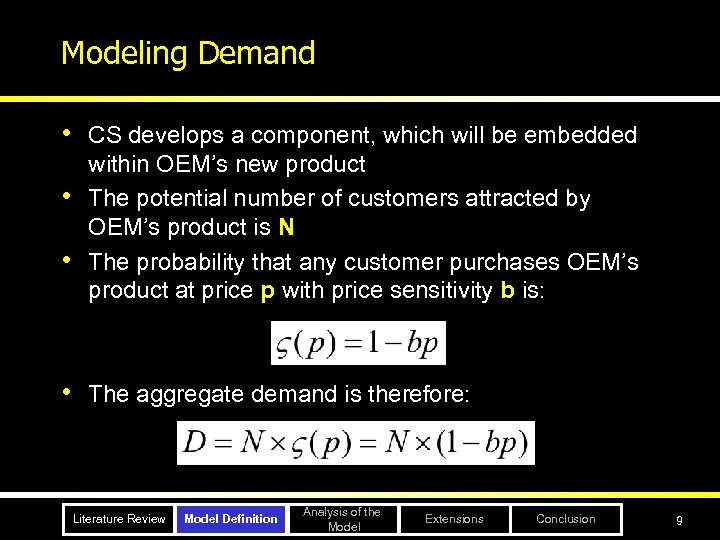 Modeling Demand • CS develops a component, which will be embedded • • within OEM’s new product The potential number of customers attracted by OEM’s product is N The probability that any customer purchases OEM’s product at price p with price sensitivity b is: • The aggregate demand is therefore: Literature Review Model Definition Analysis of the Model Extensions Conclusion 9
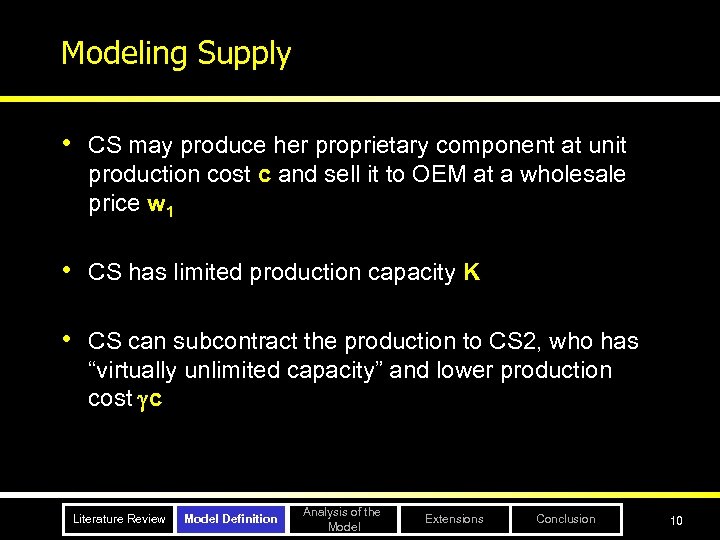 Modeling Supply • CS may produce her proprietary component at unit production cost c and sell it to OEM at a wholesale price w 1 • CS has limited production capacity K • CS can subcontract the production to CS 2, who has “virtually unlimited capacity” and lower production cost c Literature Review Model Definition Analysis of the Model Extensions Conclusion 10
 Agenda • Model Definition • Analysis of the Model • Licensing • Conclusion 11
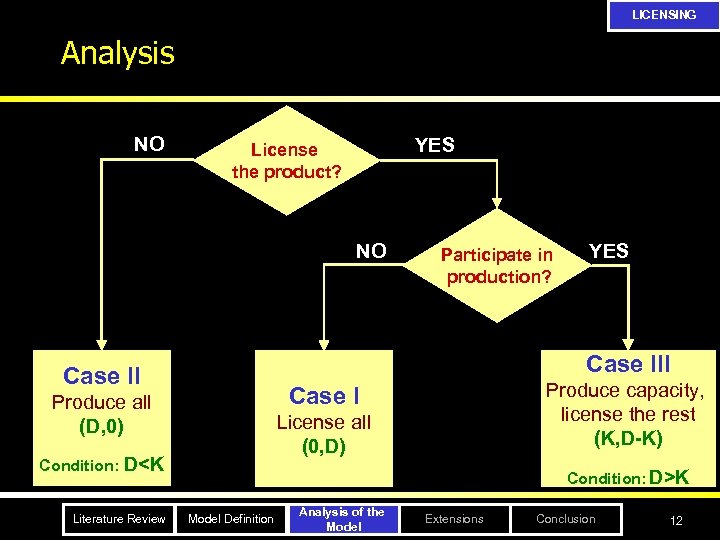 LICENSING Analysis NO YES License the product? NO YES Case III Case II Produce capacity, license the rest (K, D-K) Case I Produce all (D, 0) License all (0, D) Condition: D
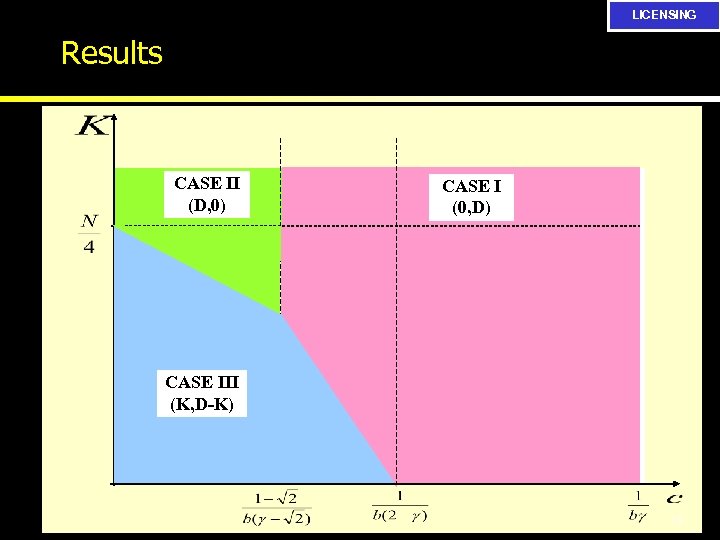 LICENSING Results CASE II (D, 0) CASE I (0, D) CASE III (K, D-K) 13
 LICENSING Summary of the Results - Licensing • Royalty fee is independent of CS’s capacity § It depends only on price sensitivity and CS 2’s cost • Even when CS has “virtually unlimited capacity, ” she may still want to license • When the capacity is limited, licensing creates competition for CS 2 § CS 2 produces more than he wants • More capacity is not always good for CS Literature Review Model Definition Analysis of the Model Extensions Conclusion 14
 Agenda • Model Definition • Analysis of the Model • Licensing • Outsourcing • Conclusion 15
 OUTSOURCING Analysis • Similar to licensing contracts, three cases to analyze: § CASE A: CS 2 sets transfer price t 2
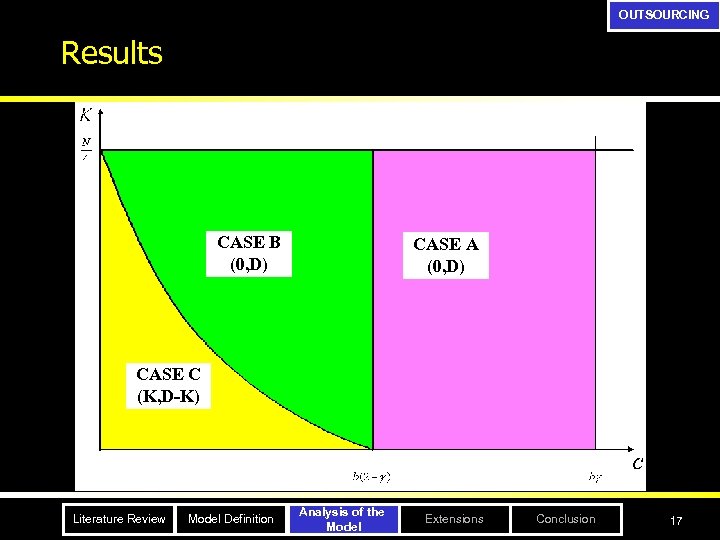 OUTSOURCING Results CASE B (0, D) CASE A (0, D) CASE C (K, D-K) Literature Review Model Definition Analysis of the Model Extensions Conclusion 17
 OUTSOURCING Summary of the Results - Outsourcing • CS 2 has “virtually” moved up in the supply chain Hence it is: § Driving the supply chain § Getting most out of the relation § Always participates in production • CS’s capacity can be used strategically when she does not have “virtually unlimited capacity” § CS does not participate in production even if she has too much capacity Literature Review Model Definition Analysis of the Model Extensions Conclusion 18
 Agenda • Model Definition • Analysis of the Model • Licensing • Outsourcing • Comparison • Conclusion 19
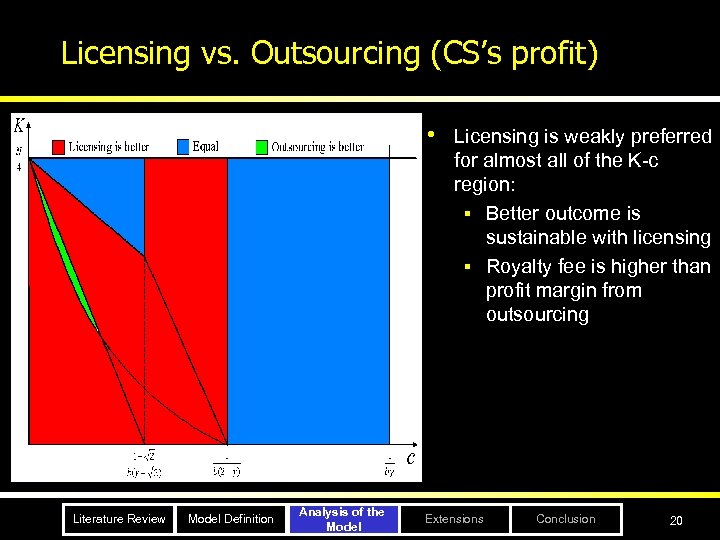 Licensing vs. Outsourcing (CS’s profit) • Licensing is weakly preferred for almost all of the K-c region: § Better outcome is sustainable with licensing § Royalty fee is higher than profit margin from outsourcing Literature Review Model Definition Analysis of the Model Extensions Conclusion 20
 Conclusion • Licensing is a reasonable alternative to outsourcing for a low cost, under-capacity supplier • Capacity can be used strategically by both suppliers to achieve higher profits, especially when CS’s capacity is low • Even when building capacity is free, it is not always in CS’s best interest to increase her capacity, especially when her supply chain partners know her exact capacity § CS does not always produce more when her capacity increases Literature Review Model Definition Analysis of the Model Extensions Conclusion 21
 THANK YOU! QUESTIONS? } Service & Repair } Concept } Functioning } Mechanical Design } } } Services Procure Components Plastics PCBA Mfg. Testing Final Packaging Design } Strategic Sourcing } Chip Packaging } 2 nd Source Manufacturing } Chip Design (GPU & MCP) } Fabless Mfg. Copyright 1995 -2003, Agile Software Corporation. Confidential and Proprietary Information. All Rights 22