 Скачать презентацию New Members May 2015 Congratulations
f00b5aaabfbb11e1ff51dc5c051daa69.ppt
- Количество слайдов: 79



New Members May 2015
Congratulations! • • • Introductions A bit of background What’s your job going to be? What does UDC do? How the Council works Types of meeting Allowances Tour of building What next?
A word about Uttlesford • Half the area of London, 80, 000 population (all fit in Wembley stadium with room to spare) • 3500 listed buildings • 35 conservation areas • 2 country parks, ancient woodland • International airport • M 11/A 120. Railways. Marina • Negligible unemployment • Prosperous, healthy, well-educated • 17, 900 commute out, 17, 600 in and 13, 000 live and work here • Always in top 10 places to live in UK • Lowest Council Tax in Essex
A word about the Council • This is a small, welcoming Council • Not lavish – no restaurant/canteen, no gym, no crèche nor bar for staff or members. • Members’ room. Opposition room. Vending machines or bring your own. • Only Council where NHB exceeds central funding • We are well managed but do not have bottomless pockets • The economic future for local government and the rest of the unprotected public sector is harsh • A “low risk” Council
The “job description” • To participate constructively in the good governance of the District • To contribute actively to the formation and scrutiny of the authority’s policies, budget, strategies and service delivery • To represent effectively the interests of the Ward for which you were elected, and deal with constituents’ enquiries and representations • To champion the improvement of the quality of life of the community in terms of equity, economy and environment • To represent the council effectively, when appointed to an outside body, such as a charitable trust or association, etc. • To act at all times with probity and propriety in the best interest of the Council
What is expected of a councillor? • Politeness and listening skills • Good communication and interpersonal skills, • Ability to relate and deal with the public in a professional and timely manner, • Ability to work effectively with Council officers and outside organisations, • Community leadership skills • Time commitment • Being a councillor is not just about attending meetings • Frequent and/or prolonged speaking at council meetings is not necessarily a measure of effectiveness
So - what will take up your time if its not all about meetings? • Explaining what the Council doesn’t do • Parish Councils • Escalated neighbour disputes and small planning issues • Enforcement complaints • Tenancy • Benefits entitlement/CT issues • Poo, bins and street cleaning • Almost anything
Allowances • Basic allowance paid in 12 monthly instalments, currently £ 5, 000 pa • Portfolio holders and group leaders receive additional special responsibility allowances. • Also entitled to claim mileage for travel to and from meetings where you are a member of the committee or for Member Briefings and full Council @ 45 p per mile • Each Member has £ 3, 000 to spend in his/her ward per year – terms and conditions apply
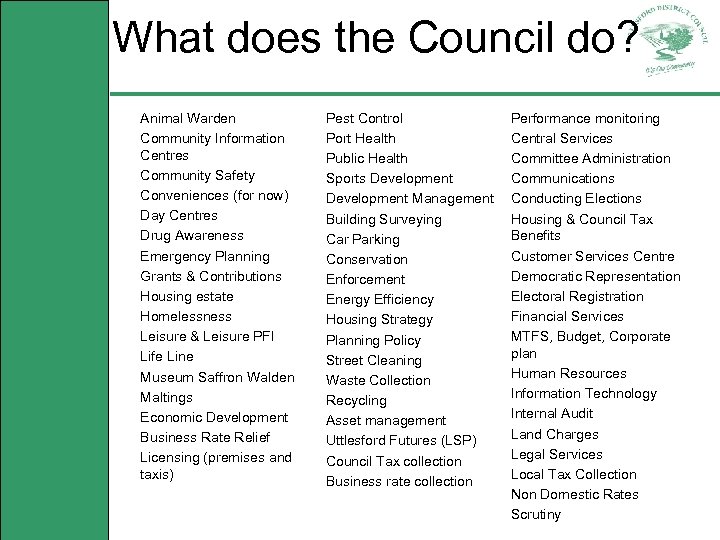
What does the Council do? Animal Warden Community Information Centres Community Safety Conveniences (for now) Day Centres Drug Awareness Emergency Planning Grants & Contributions Housing estate Homelessness Leisure & Leisure PFI Life Line Museum Saffron Walden Maltings Economic Development Business Rate Relief Licensing (premises and taxis) Pest Control Port Health Public Health Sports Development Management Building Surveying Car Parking Conservation Enforcement Energy Efficiency Housing Strategy Planning Policy Street Cleaning Waste Collection Recycling Asset management Uttlesford Futures (LSP) Council Tax collection Business rate collection Performance monitoring Central Services Committee Administration Communications Conducting Elections Housing & Council Tax Benefits Customer Services Centre Democratic Representation Electoral Registration Financial Services MTFS, Budget, Corporate plan Human Resources Information Technology Internal Audit Land Charges Legal Services Local Tax Collection Non Domestic Rates Scrutiny
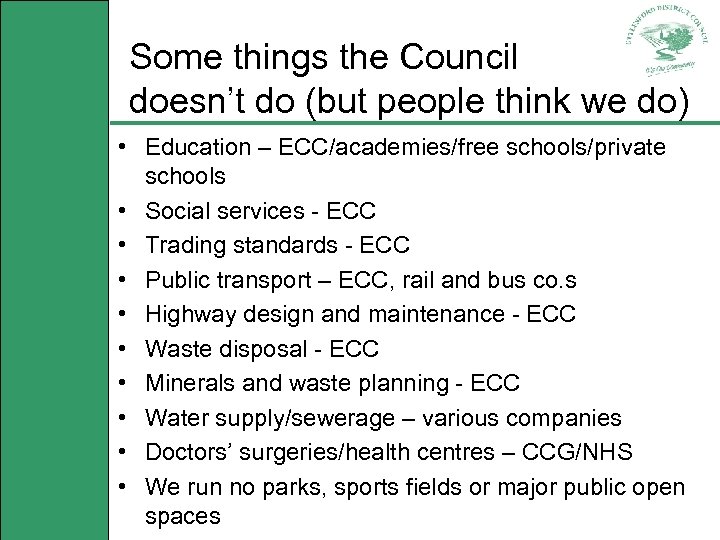
Some things the Council doesn’t do (but people think we do) • Education – ECC/academies/free schools/private schools • Social services - ECC • Trading standards - ECC • Public transport – ECC, rail and bus co. s • Highway design and maintenance - ECC • Waste disposal - ECC • Minerals and waste planning - ECC • Water supply/sewerage – various companies • Doctors’ surgeries/health centres – CCG/NHS • We run no parks, sports fields or major public open spaces
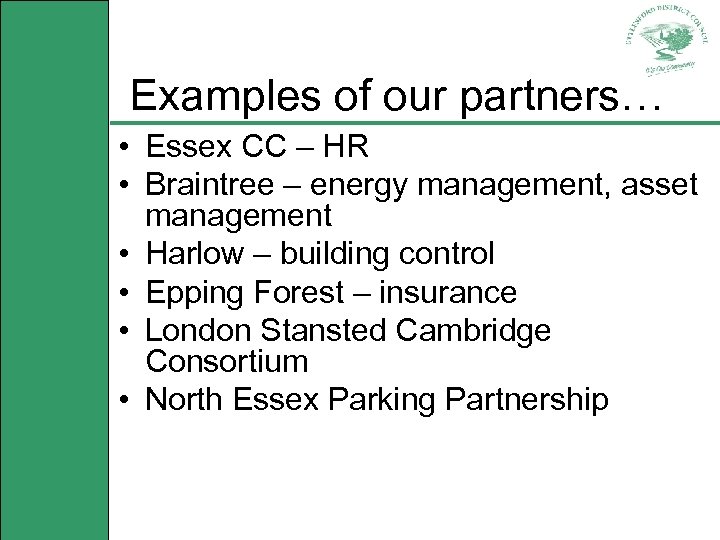
Examples of our partners… • Essex CC – HR • Braintree – energy management, asset management • Harlow – building control • Epping Forest – insurance • London Stansted Cambridge Consortium • North Essex Parking Partnership
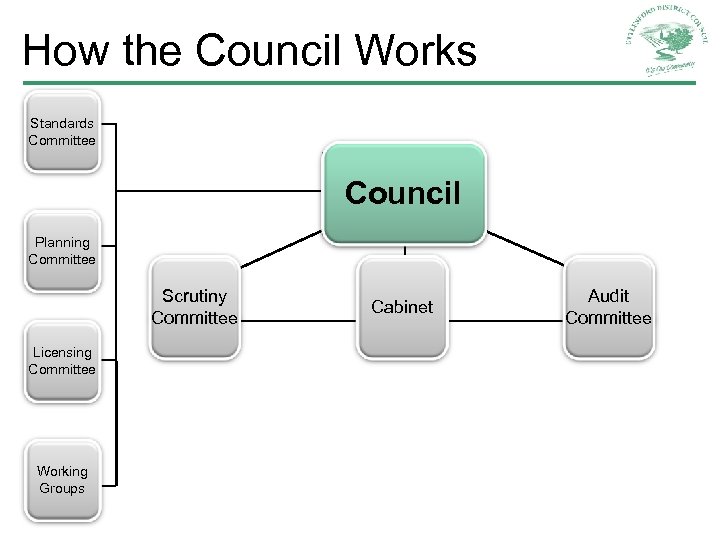
How the Council Works Standards Committee Council Planning Committee Scrutiny Committee Licensing Committee Working Groups Cabinet Audit Committee
Types of meeting • • • Full Council Cabinet Regulatory Committees Scrutiny and Audit Committees Working Groups Task Groups Outside bodies Ad-hoc meetings e. g. Locality Board The Planning Committee is not independent of the Council
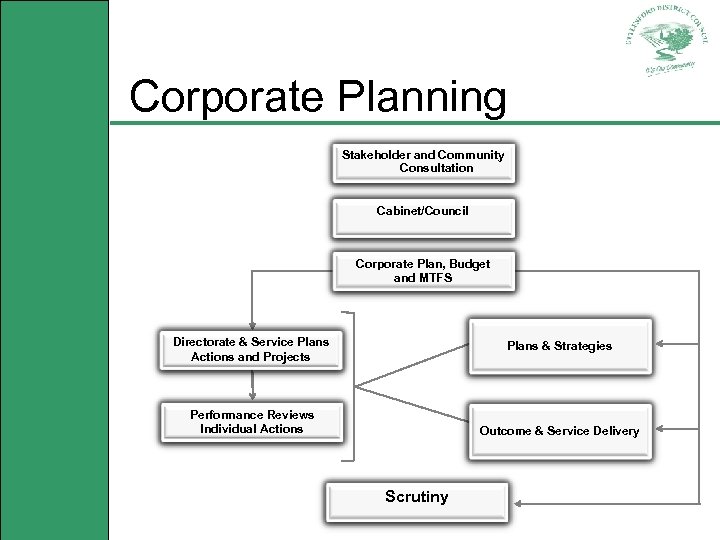
Corporate Planning Stakeholder and Community Consultation Cabinet/Council Corporate Plan, Budget and MTFS Directorate & Service Plans Actions and Projects Plans & Strategies Performance Reviews Individual Actions Outcome & Service Delivery Scrutiny
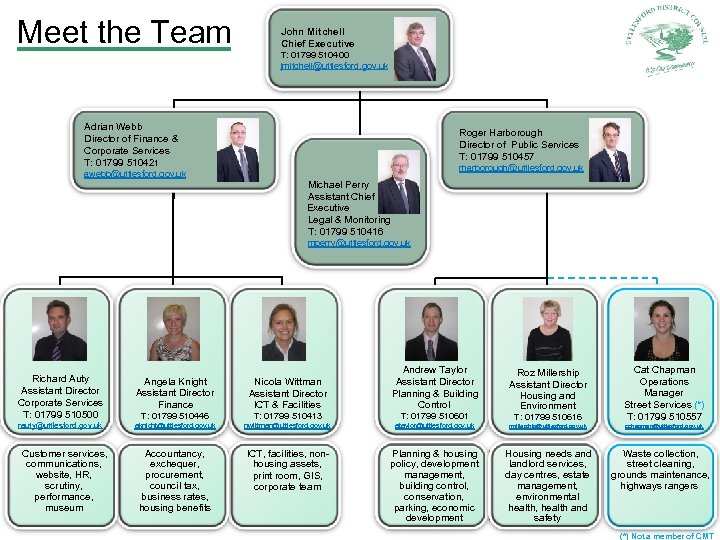
Meet the Team John Mitchell Chief Executive T: 01799 510400 jmitchell@uttlesford. gov. uk Adrian Webb Director of Finance & Corporate Services T: 01799 510421 Roger Harborough Director of Public Services T: 01799 510457 rharborough@uttlesford. gov. uk awebb@uttlesford. gov. uk Michael Perry Assistant Chief Executive Legal & Monitoring T: 01799 510416 mperry@uttlesford. gov. uk Andrew Taylor Assistant Director Planning & Building Control Richard Auty Assistant Director Corporate Services T: 01799 510500 Angela Knight Assistant Director Finance rauty@uttlesford. gov. uk T: 01799 510446 T: 01799 510413 T: 01799 510601 aknight@uttlesford. gov. uk nwittman@uttlesford. gov. uk ataylor@uttlesford. gov. uk Accountancy, exchequer, procurement, council tax, business rates, housing benefits ICT, facilities, nonhousing assets, print room, GIS, corporate team Planning & housing policy, development management, building control, conservation, parking, economic development Customer services, communications, website, HR, scrutiny, performance, museum Nicola Wittman Assistant Director ICT & Facilities T: 01799 510616 Cat Chapman Operations Manager Street Services (*) T: 01799 510557 rmillership@uttlesford. gov. uk cchapman@uttlesford. gov. uk Roz Millership Assistant Director Housing and Environment Housing needs and landlord services, day centres, estate management, environmental health, health and safety Waste collection, street cleaning, grounds maintenance, highways rangers (*) Not a member of CMT
Staff • 345 employees, approximately 307 fte’s, vast majority are Uttlesford residents • Small Council, we punch above our weight, lean and effective, have always needed partners • Management team of 9 • Unusually, housing, grounds maintenance, office cleaning and waste collection remain in-house • 3 depots: Dunmow, Shire Hill, Newport • Outsourcing/partnerships have been discouraged politically • Near bottom of lowest quartile for pay • No perks • Living Wage Employer
Our immediate challenges… • Our own governance • Forecast severe government spending cuts (we have a plan) • Devolution and the implications for UDC autonomy • Staff recruitment and retention • Stansted Airport expansion • Homelessness and housing • Getting planning into perspective • Public health / wellbeing
Tips • Never lose sight of the Council’s finances • Be mindful of the law and the code of conduct • You have many customers, not just our residents • The quality of service is what matters, not who delivers it
Democratic Services
Democratic Services (1) • Who we are – Peter Snow - Democratic and Electoral Services Manager psnow@uttlesford. gov. uk 01799 510430 – Rebecca Dobson – Principal Democratic Services Officer rdobson@uttlesford. gov. uk 01799 510433 – Maggie Cox – Democratic Services Officer mcox@uttlesford. gov. uk 01799 510369 – Adam Rees – Democratic and Electoral Services Officer arees@uttlesford. gov. uk 01799 510548 – Group email: committee@uttlesford. gov. uk
Democratic Services (2) What we do: • Ensure compliance of public meetings with law and the constitution • Co-ordinate the meetings, and the associated agendas, reports and minutes for Council, Cabinet, Committees, Working and Task Groups • Member induction training • Provide information for members
Democratic Services (3) • What else do we do? • Publish required items such as – All meetings documents – Advance notices of key decisions, part 2 (exempt from publication items), urgent items – Notices of decisions taken (which starts the timescale for a potential call in of a decision) – Notices of executive decisions taken
Democratic Services (4) • We look after CMIS - where you access meetings documents • We maintain and publish: – Members’ attendance records – Members’ declarations of registrable interests, gifts and hospitality – Members’ bulletin
Democratic Services (5) Members’ allowances scheme • We receive and authorise members’ claims for travel/subsistence in pursuance of authorised duties as set out in the members’ allowances scheme in Part 6 of the Constitution • Send your form (monthly please) to committee@uttlesford. gov. uk with original receipts and VAT receipts (for fuel where mileage is being claimed) • Claims for expenses must be received by the end of the month after which they were incurred, otherwise they will not be paid • Certain approved duties require advance written agreement of Leader or Group Leader
Democratic Services (6) • Contact for Members in relation to: – Giving apologies prior to any meetings which you would be expected to attend – Help with CMIS eg problems accessing agendas and reports – Car parking badges for display when parking at the Council’s London Road offices in case you are blocked in or have to double park (the number on your car park badge is ext 430)
Political Balance (1) • Membership of committees is determined by the political balance calculation • Legislation provides committee membership is in direct proportion to the composition of political groups on the Council • Political groups do not exist until written notice is received from each party having elected members
Political Balance (2) • Political groups must consist of at least two members (so the single independent member will be excluded from committee membership unless he becomes part of a group or a seat is given up by one of the groups) • Size of committees is presently uncertain – subject to discussion between now and the Annual Meeting
Political Balance (3) • Nominations will be invited from groups once they have been formed and once the size of committees has been decided • All appointments (including some working groups) will then be made at Annual Council • Majority of appointments to working groups falls to Cabinet – will be made at first Cabinet meeting
Structure of Local Government
What is Local Government? • It is local and it is government • One size does not fit all: there are several forms depending on local circumstances • Structure is important but communities will always come together to govern themselves • But it must operate within the law of the land: we are not a Republic
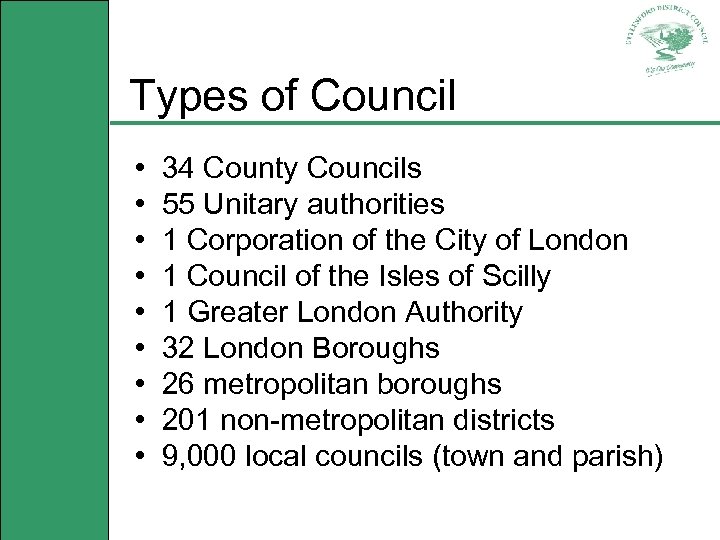
Types of Council • • • 34 County Councils 55 Unitary authorities 1 Corporation of the City of London 1 Council of the Isles of Scilly 1 Greater London Authority 32 London Boroughs 26 metropolitan boroughs 201 non-metropolitan districts 9, 000 local councils (town and parish)
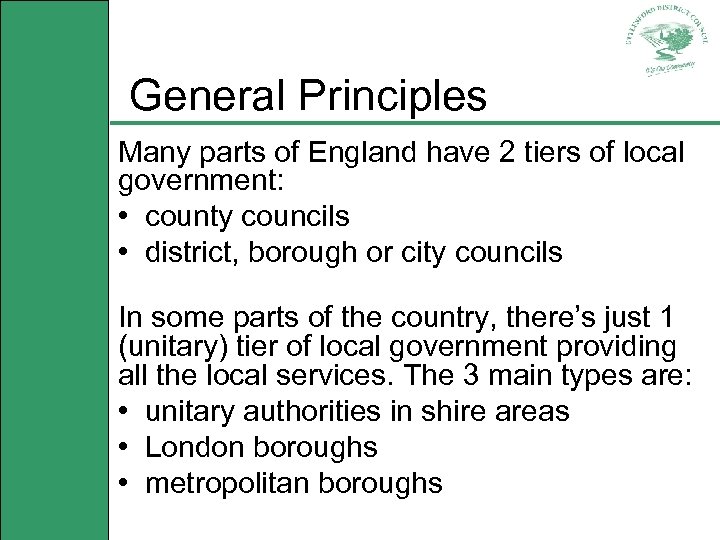
General Principles Many parts of England have 2 tiers of local government: • county councils • district, borough or city councils In some parts of the country, there’s just 1 (unitary) tier of local government providing all the local services. The 3 main types are: • unitary authorities in shire areas • London boroughs • metropolitan boroughs
County Councils • • • Education – huge area of work Social care – huge area of work Transport – highways, buses Economic Strategy Libraries Waste management – disposal rather than collection • Trading standards • Minerals and Waste Planning • Fire and public safety
District Borough and City Councils • Smaller area than county councils. • City and Boroughs elect a Mayor as civic head • Districts elect a Chairman as civic head • Functions set out in previous presentation • Some District Councils share managemen teams
What does the Council do? Animal Warden Community Information Centres Community Safety Conveniences (for now) Day Centres Drug Awareness Emergency Planning Grants & Contributions Housing estate Homelessness Leisure & Leisure PFI Life Line Museum Saffron Walden Maltings Economic Development Business Rate Relief Licensing (premises and taxis) Pest Control Port Health Public Health Sports Development Management Building Surveying Car Parking Conservation Enforcement Energy Efficiency Housing Strategy Planning Policy Street Cleaning Waste Collection Recycling Asset management Uttlesford Futures (LSP) Council Tax collection Business rate collection Performance monitoring Central Services Committee Administration Communications Conducting Elections Housing & Council Tax Benefits Customer Services Centre Democratic Representation Electoral Registration Financial Services MTFS, Budget, Corporate plan Human Resources Information Technology Internal Audit Land Charges Legal Services Local Tax Collection Non Domestic Rates Scrutiny
Parish and Town Councils • • Support and encouragement of arts and crafts Provision of village halls Provisions and maintenance of recreation grounds, parks, children's play areas, playing fields and swimming baths Provision and maintenance of cemeteries and crematoria Maintenance of closed churchyards Cleaning and drainage of ponds, watercourses and ditches Control of litter Provision and maintenance of public toilets • • • Creation and maintenance of footpaths and bridleways Provision of cycle and motorcycle parking Acquisition and maintenance of rights of way Provision and maintenance of public clocks Maintenance of War memorials Encouragement of tourism Bus shelters Signposting of footpaths Lighting of footpaths Off-street car parks Provision, maintenance and protection of roadside verges
Representative and Miscellaneous powers of local councils Parish councils must be notified by the district or county council of: • All planning applications in their areas • Intention to provide a burial ground in the parish • Proposals to carry out sewerage works • Footpath and bridleway (more generally, 'rights of way') surveys • Intention to make byelaws in relation to hackney carriages, music and dancing, promenades, sea shore and street naming In some cases parish councils possess the following powers: • Creation of a neighbourhood plan • Guardianship of common land • Withholding of consent to stop up unclassified highways and footpaths • Consultation on appointment of governors of primary schools • Appointing trustees of local charities
Essex – not a consistent picture • 12 Districts of which: • 1 city - Chelmsford • 3 boroughs – Basildon, Colchester, Brentwood • 8 districts – Tendring, Braintree, Uttlesford Harlow, Epping Forest, Rochford, Castle Point, Maldon • Two unitaries – Thurrock and Southend-on -Sea
Police & Community Safety • Police and Crime Commissioner – elected. Replaced Police Authority • UDC represented on Police and Crime Panel • Each District has a community safety partnership – Fire, Police, Probation, Neighbourhood Watch, Health
Other bodies • South East Local Enterprise Partnership • Greater Cambridge and Peterborough LEP • West Essex Alliance • Health and Wellbeing Board • Highways Panel • Locality Board
UDC Decision Making • COUNCIL: constitution, budget, appointing the leader, chairman and vice-chairman; TORs and membership of committees, Local Plan, bylaws, appointment of Senior Officers • LEADER: appoints the executive and decides portfolios and delegation. Decisions are made at Cabinet.
2 regulatory committees – Planning and Licensing & Environmental Health • Planning Committee exists to implement the Councils Planning Policies through determining certain planning applications, monitoring s 106 progress and appeal decisions. It is not independent of the Council • L & EH mainly taxi and premises licensing and enforcement but several other licensing and regulation regimes • Standards Committee promotes high standards and implements observation of the Code of Conduct
2 Overview and Scrutiny Committees • Performance and Audit monitors performance, risk, accounts, internal and external audit • Scrutiny Committee can review any decision or action taken in the discharge of council functions. Call in powers. Pre-scrutiny. Can be a very strong committee • Members of the Executive are disqualified from being members of either committee but may attend • Chairmen report to Cabinet • Various Working and Task Groups
Next steps • More detailed briefing on 21 st • 6. 00 pm pre-council briefing on 26 th May on how the meeting will work, and how the microphones operate + team photo • Tour of district, our depots and airport TBA • Further detailed training
Standards and The Code of Conduct
Topics for Today • Background • Code of Conduct • Members’ interests • Register of interests • Dispensations • Procedure for dealing with complaints • Sanctions
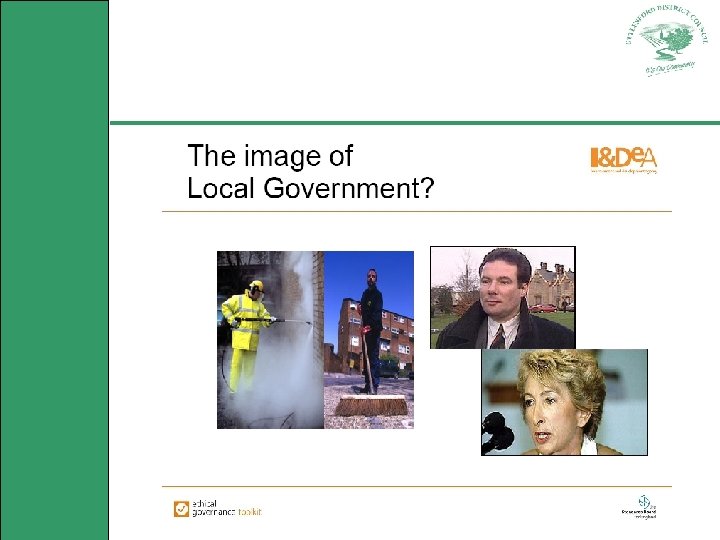
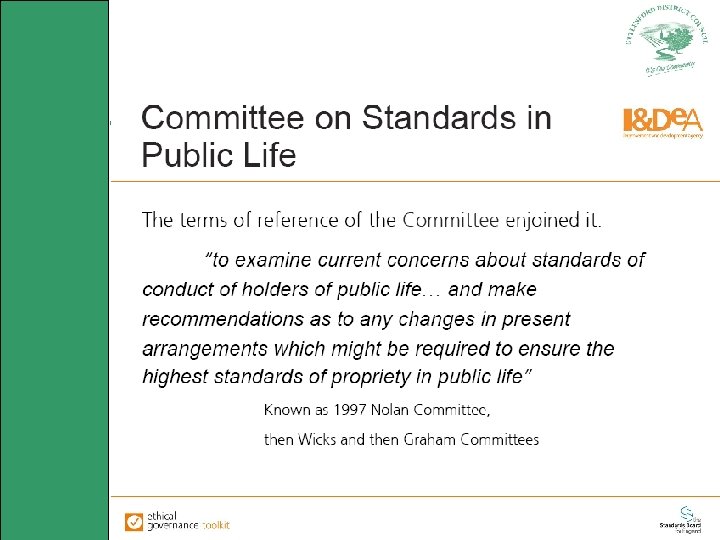
The Nolan Committee “We cannot say conclusively that standards of behaviour in public life have declined. We can say that conduct in public life is more rigorously scrutinised than it was in the past, that the standards which the public demands remain high, and that the great majority of people in public life meet those high standards. But there are weaknesses in the procedures for maintaining and enforcing those standards. As a result people in public life are not always as clear as they should be about where the boundaries of acceptable conduct lie. This we regard as the principal reason for public disquiet. ”
Local Government Act 2000 • • • Standards Board for England Ethical Standards Officers Mandatory Code of Conduct Standards Committees Sanctions Adjudication Panel/First Tier Tribunal
Localism Act 2011 • Abolished previous regime • Duty to promote and maintain high standards of conduct • Duty to adopt a Code of Conduct • Must ensure that the Code: – is consistent with s. 28 principles – includes provision for the registration and declaration of interests
Code of Conduct • ACSe. S/LGA/PLP/UDC • Parishes may adopt code of their district or their own Code • If NOT adopting code of their district must demonstrate that the Code complies with the s. 28 principles
When does the Code apply? • When conducting the business of the Council • When acting as a councillor • When acting, claiming to act or giving the impression of acting as a representative of the Council
General Obligations • To treat others with respect • To observe the Council’s protocols and codes of practice • Not cause the authority to breach its obligations under equalities legislation • Not to bully anyone • Not to seek to intimidate persons involved in investigating alleged breaches of the Code
General Obligations cont. • Not to do anything which would be likely to compromise the impartiality of staff • Not to disclose confidential information unless: – you have consent – you are required by law to do so – to obtain professional advice – it is in the public interest
General Obligations cont. • Not to prevent anyone accessing information they are entitled to by law • Not to conduct yourself in such a way as to bring the Council or your office as Councillor into disrepute • Not to try to use your position as a Councillor improperly to try and secure a benefit or disadvantage for anyone including yourself
General Obligations cont. When using the Council’s resources: - – act in accordance with the Council’s requirements – not use resources improperly for political purposes – have regard to the Local Authority Code of publicity
Members’ Interests • Must be dealt with by the Code • Disclosable pecuniary interests • Pecuniary interests • Interests other than pecuniary interests (non-pecuniary)
Disclosable Pecuniary Interests • Employment, office, trade profession or vacation • Sponsorship • Contracts • Land • Licences • Corporate tenancies • Securities
Other Pecuniary Interest • Name of your employer or someone who has appointed you to an office • Decision affects the financial position of you or a related person more than other people living or having a business in the ward or parish
Interests “other than pecuniary” • Outside bodies where you are the council’s representative • Membership of: – public bodies – charitable bodies – bodies with the object of influencing public opinion
Interests “other than pecuniary” cont. • Decision affects the wellbeing of you or a related person more than other people living or having a business in the ward or parish
Members’ Interests cont. • Disclosable pecuniary interests include those of your spouse/civil partner or cohabitee • Must be registered within 28 days of election or appointment or within 28 days of declaration of the same • Failure to do so an offence • No obligation to update (but see the Code of Conduct)
DPIs and Participation • Members with DPIs may not speak or vote without a dispensation • Council may by standing order require members with DPIs to withdraw • No statutory requirement to declare DPIs on the register but is contained in UDC’s Code of Conduct
Other Interests and Participation • Must declare existence and nature of interest • If pecuniary interest “public perception test” – if judgement likely to be affected may make representations then withdraw • Otherwise pecuniary and non-pecuniary interests may take part and vote
Members’ Interests cont. • Sensitive interests • Disclosure could lead to a member or a person associated with a member being subject to violence or intimidation • With approval of the Monitoring Officer may omit details from the register • Register may state member has an interest details of which are not given because of the exemption • Nature of interest need not be disclosed at meetings
Register of Interests • Held by the Monitoring Officer under s. 29(4) • Must be available at UDC for inspection • Must be on UDC’s website • PCs must publish on their websites (if any)
Dispensations • Can be given by the council on written request to the proper officer • Power to grant can be delegated • Grounds for grant: – Transaction of business impeded – Political balance disturbed – In the interests of local residents – All executive members conflicted out – “otherwise appropriate” • Time limited – max 4 years
The Role of the Independent Person • DC must have arrangements which include an independent person • IPs Need not be a member of the Standards Committee but in Uttlesford are non-voting members
Independent • Being Independent; • ‘Not depending on authority’ • ‘Not depending on something else for its validity’ • ‘Not depending on others for one’s opinion or conduct’ • ‘A person who acts independently of any party’ Taken from the Oxford Dictionary
Who are we? • Georgina J Butcher • Catherine Wellingbrook-Doswell • David Pearl
What do we do? • We operate in the following areas; • Consider complaints with Assistant Chief Executive - Legal and Monitoring Officer Uttlesford District Council • Give views to a Complaint Hearing Panel • Give views to a Councillor under investigation • Advise on code of conduct • Attend Standards Committee
Code of Conduct Challenges • Working with Councillors • Encouraging the right balance of the Uttlesford District Council Code of Conduct • Considering the public viewpoint • Encouraging clarity and consistency in the interpretation of the Code • Staying Independent
Procedure for dealing with complaints • Complaints must be made in writing • Requests for anonymity • Will be considered by the Monitoring Officer and an independent person • If agreement that matter should not be investigated matter closed • If MO considers investigation appropriate will be investigated • If MO considers investigation inappropriate but IP disagrees either investigation or referral to the Standards Committee to determine • No appeal against decision not to investigate
Procedure for dealing with complaints cont. • Investigator determines how the investigation will be carried out • Prepares a report containing findings of fact and statement as to whether the investigator considers the facts as found amount to a breach of the Code • If finding of no breach report is circulated to all members of the Standards Committee and if not called in decision stands • If finding of breach hearing before a Standards Committee including an independent person to decide whethere has been a breach and sanction if appropriate
Sanctions • Range of sanctions limited • To find that no further action is required. • To censure the member • To recommend that access to council premises or the use of council resources be restricted • To recommend that the member makes a written apology in a form acceptable to the Standards Committee.
Sanctions cont. • To recommend that the member undertakes specified training. • To recommend that the member undertakes specified conciliation or mediation. • To recommend that the member be removed from a committee or committees of the Council
Sanctions cont. • To recommend that the member be removed from an outside body or bodies to which the member has been appointed by the Council • To recommend that the member be removed from the Cabinet (this can only be done by the Leader of the Council) • To require the decision of the Standards Committee to be published.
 Скачать презентацию New Members May 2015 Congratulations
f00b5aaabfbb11e1ff51dc5c051daa69.ppt