


 Скачать презентацию New Media IP law in the International Arena
2358bcb83b12b6e0dfbbabee57832769.ppt
- Количество слайдов: 23
 New Media IP law in the International Arena Fundamentals and Problematics
 Slides 3 -11 review text material
 • No single global court or legal system. – But most countries have both and many of those include procedures related to IP. Some (like U. S. ) also have state or regional systems that may or may not be harmonized. • A global information & communication environment connected to a global economic environment. – The global economy within the context of national cooperation, competition, enmity. No single entity controls trade, globally. • Likewise: – The internet with no borders and no central or universal control mechanism. – Also, communication mediums with content and with some relationship to governmental control mechanisms.
 On a number of levels/aspects then, there are issues surrounding the questions: • Who’s laws apply? • Who can claim that their law has been broken? • With what effect?
 Complexities of the international scene: Trade • we export a lot • we also import a lot, though that is finally slowing a bit. • IP is a very significant portion of our exports
 Who’s in charge of our trade? • The State Department and Commerce Department are principally tasked with controlling U. S. export matters. • Much of that which is exported is subject to export licensing and Commerce Department controls under the Bureau of Export Administration commerce control list.
 Remember, global IP is not just entertainment and Info. Medical (including genetic and pharmaceuticals), agricultural, mechanical, and all forms of business methods developments.
 But even non-MM IP is MM IP Not all of these aspects involve (new) digital media. However, the global (and mostly digital) communication connectivity provided by the internet, satellite, and cell phones (among other means) has, in many cases, thrust what might have previously been local, regional, and national commerce into the global arena. Once any commercial activity digitizes and transmits company data (or some other entity does that for them or with their data), the implications of global digital IP questions come into relevance.
 Trade as “Cudgel” • We use trade as the principle way to get compliance with our IP regime • As IP has become an important part of the U. S. export scene, the U. S. IP protection scheme has become grafted into trade laws such as the U. S. Trade Act of 1974 as well as agreements signed via international forums such as the 1996 Copyright Treaty and 1997 Performances and Phonograms Treaty with the World Intellectual Property Organization (WIPO) as well as the World Trade Organization (WTO) agreements on Trade-Related Aspects of Intellectual Property Rights (TRIPS) (to name only a few of the major relevant agreements).
 Many critics decry these tactics • the U. S. approach is bad for the public distribution of knowledge, counter to aspects of IP law that foster innovation and creativity, unfair to native people in less developed countries, overly restrictive of private use— perhaps to the point of “trumping” legal protections in favor of private use even within the U. S. (as well as globally), and in general is overly protective of U. S. content industries to the point of cultural hegemony
 pushbacks • India has resisted cooption of its national sovereignty in these areas for years, to the point of incurring the political wrath of the Bush administration and being labeled an “unfair trading partner. ” • Zimbabwe, Bangladesh, and the Dutch have all taken action against the U. S. -style regime. • The European Union has been at the forefront of global legislation against genetically modified food, one of the new frontiers in the intellectual property portfolio of Western agro-business. – European Union restrictions referred to as the “Television without Frontiers Directive (TVWF Directive). ” • China • Muslim countries. • Africa
 Example of native peoples taking hold Aboriginal Knowledge and Intellectual Property Protocol Community Guide [pdf download] • This Protocol tells about the rules for researchers and shows how local Aboriginal people and researchers can work together. • Aboriginal people own their knowledge. • All research that concerns Aboriginal people must respect Aboriginal culture and knowledge. • Everyone should be equal in the research and have shared understandings. • This Protocol makes sure that researchers who work with Aboriginal people and the DKCRC do the right thing.
 Complexities of the international scene: Jurisdiction • Particular court or court system; and • Power of a court to hail a party into court and render a decision that is binding on that party – Criminal jurisdiction: there has to be some connection between the agency/org and the crime/criminal (territory, nationality, protection of national interests, protection of the people of a country) – Civil Jurisdiction: some connection between the person or property and the territory.
 Important Definitions • Venue – Location of a particular court • Service of Process – The delivery of legal papers that initiates a law suit or legal proceeding • Choice of Law – The legal process of deciding which of the jurisdiction’s law applies
 • Who Cares About Jurisdiction? – Courts – Lawyers – Parties • Why care about jurisdiction? – – – Impacts where you can be sued. Impacts law that applies to your suit. Impacts who decides the outcome. Impacts the nature of the outcome. Impacts the costs of suit. Impacts how you may decide to act in the future.
 Which Law? • When parties submit to international agency/court, they may agree to the standards of that venue • When dragged into a national/state court, the court may pick either its own national/state law or the international law that country/state recognizes.
 How does one decide about jurisdiction within Internet? • Zippo test: bases jurisdiction over a nonresident website on the degree of interactivity between the website and the forum • Effects test: focuses on the effects intentionally caused within the forum by a defendant’s online conduct outside the forum. • “Determining Jurisdiction in Cyberspace: The "Zippo" Test or the "Effects" Test? ” Julia Alpert Gladstone [pdf]
 Mardas v. New York Times Company • Court = High Court of Justice – Queens Bench (United Kingdom) • Plaintiff = John Mardas • Defendants = New York Times and International Herald Tribune • The dispute involved alleged defamatory articles published in the UK (“charlatanism” and “lying”) • The High Court is asked to determine whether the “Master” (I. e. lower court) erred in dismissing the libel suit because there was insufficient publication in the UK.
 Madras v. New York Times Company • The Master erred in dismissing the libel claims against defendants. • There were evidentiary issues concerning the nature and amount of publication in the UK. • In any event, the evidence presented suggested sufficient publication in the UK.
 Madras v. New York Times Company • What is the impact on media? – Possibility of foreign media being sued in the UK based on fairly limited publication in the UK. • “a few dozen hits could be enough to found a cause of action in England although damages would be likely to be modest. ” – Silver lining: in the UK, the loser pays attorney’s fees of the winner.
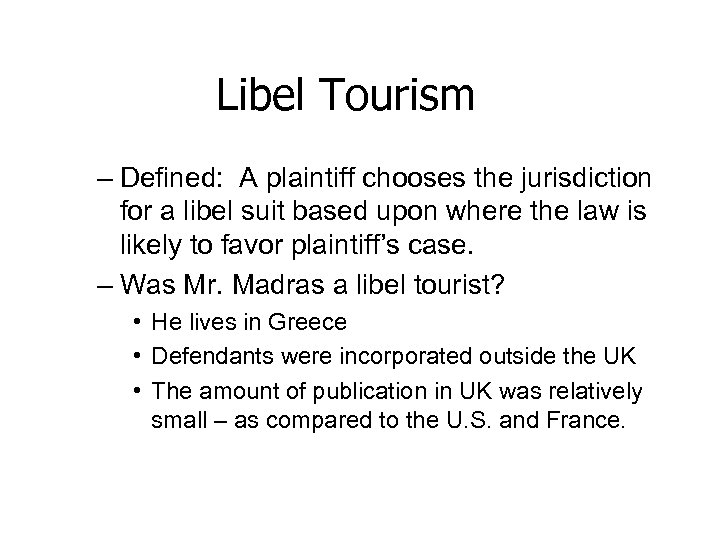 Libel Tourism – Defined: A plaintiff chooses the jurisdiction for a libel suit based upon where the law is likely to favor plaintiff’s case. – Was Mr. Madras a libel tourist? • He lives in Greece • Defendants were incorporated outside the UK • The amount of publication in UK was relatively small – as compared to the U. S. and France.
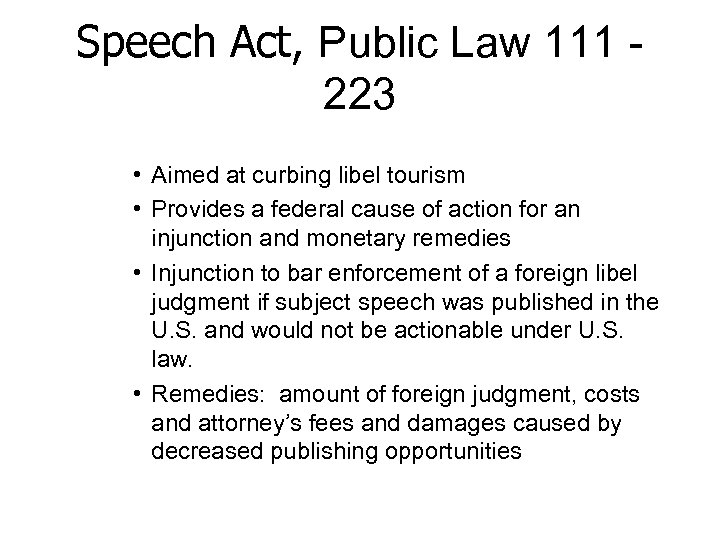 Speech Act, Public Law 111 - 223 • Aimed at curbing libel tourism • Provides a federal cause of action for an injunction and monetary remedies • Injunction to bar enforcement of a foreign libel judgment if subject speech was published in the U. S. and would not be actionable under U. S. law. • Remedies: amount of foreign judgment, costs and attorney’s fees and damages caused by decreased publishing opportunities
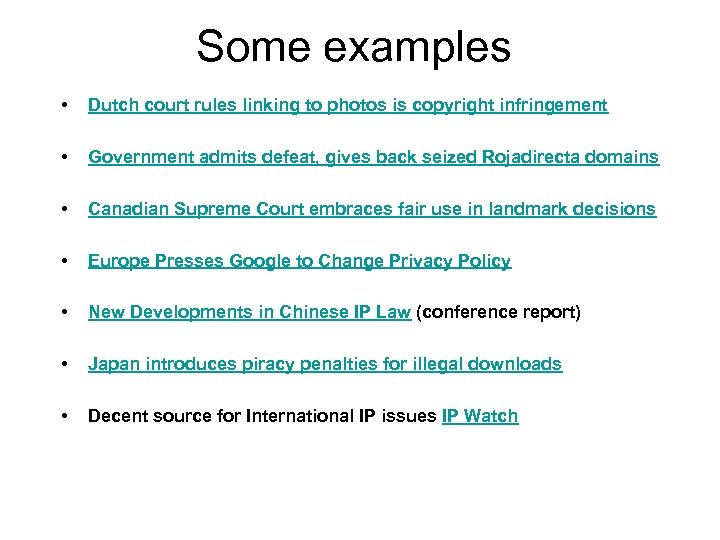 Some examples • Dutch court rules linking to photos is copyright infringement • Government admits defeat, gives back seized Rojadirecta domains • Canadian Supreme Court embraces fair use in landmark decisions • Europe Presses Google to Change Privacy Policy • New Developments in Chinese IP Law (conference report) • Japan introduces piracy penalties for illegal downloads • Decent source for International IP issues IP Watch