


 Скачать презентацию New Life Ministries International Advanced Church Planting Training
50a325a530ff5c6c7389da287fb2902f.ppt
- Количество слайдов: 76
 New Life Ministries International Advanced Church Planting Training Logistics of Running a Church Dr. James Flynn May 17, 2010
 Why this Session? Ministry and church planting rises and falls on good administration and management! § Many preachers and people with vision § Many leaders who like to be out front § Few servant leaders behind the scenes tending § § § to order Importance of excellent administration Importance of solid stewardship (management) Security of order
 Administration and Management
 Church Planters Are Administrators “Steering the Ship” § As administrative leaders, our job is to identify these people that have leadership gift potential, train, and deploy these gift for useful service in the church (1 Cor 12: 28): § § God appoints (ti, qhmi – tithemi -commits, destines, sets, assigns, places) the gift, just as He does other ministry offices in the church. The pastor him or herself may not have this gift. If not, the weakness in his or her life forces team ministry! Administration (kube, rnhsij – kubernesis – steer, govern) pictures a helmsmen of a ship steering the ship. The helmsman sets the direction at the discretion of the captain – he or she is only a member of the crew, taking orders from the captain, yet has a very important function! Cont…
 Church Planters are Managers “Setting House Law” § Stewardship (oivkonomi, a – oikonomia, literally “house law, ” from which our word “economic, ” financial law of the house, comes from) is another essential ingredient. This is the ability to provide “house law” or direction in the management of things that belong to another: § Gen 1: 28 – God originally created mankind to manage the earth and its resources. They were to set and keep things in order in God’s garden. Mankind has this longing to set things in order and shape his or her world because of a built-in need to be a steward of God’s creation § Exodus 19: 5 – It still all belongs to God – we are just using/borrowing it for a short while. Our stewardship is using these resources for the benefit of ourselves and others, producing a “profit” for the owner – God. Cont…
 Defining our Role as Leaders Authority and Power § My foundational role as a senior leader is the stewardship of God’s authority and power to accomplish His purposes with His resources, both human and physical § Rom 13: 1 makes clear that all authority originates with God. Authority (evxousi, a exousia) is the right to do ( something. § The Greek word of “power” is du, namai – dunamai which conveys “ability” to do something. Its one thing to have the right, yet another to have the ability § Senior leadership is using God’s authority (right) and God’s ability (power) to accomplish His purpose – this is the essence of stewardship
 The Lonely Struggle Trust § § § BUILDING TRUST: In order to cooperate with God’s plan to influence others (lead/manage) people must TRUST us. This occurs as they SEE God’s work and character in our lives, rather than just hear it from our mouths. THE LOOK: Talented people may LOOK like their lives are in order – conformation, but whose lives as sadly in disorder and disarray on the inside (no transformation) because they have never learned to abide in Christ (John 15: 4). INTEGRITY: This sets us up for major implosion- the life decays and crumbles from the inside our, until the corrosion ruptures the external look of order and success, and we have a “hull breach, ” and decompress. In mechanical engineering terms, this is called an integrity failure – the objects ruptures at its weakest point, often followed by loss, damage, and destruction of the vessel or those around the vessel. Need I elaborate on the parallels to the life of a leader?
 Managing Change
 Managing Change Personalities § Innovators: (2 – 3%) This small fraction of people actually thrive on change. The like to produce it, work with it, plan it, and make it happen. § Early Adopters: (8 – 18%) This slightly larger group will on board with change fairly quickly, after it has been explained and processed. § Middle Adopters: (60 – 80%) This is the majority of the people in any group. They are not quick to change, and do not like it to one degree or another. The change must be explained and then processed for a significant amount of time. They are cautious, and may need to see it work for a while before getting on board.
 Managing Change Personalities § Late Adopters: (2 – 18%) These people resist change and are the last to accept it. They will fight it for a long time, and must see that it works or is inevitable before they will come on board. Some just barely come on board and accept the change with much anxiety and frustration. In the end, they are on board, but it takes a long time § Never Adopters: (2 – 20%) This group of people will not change no matter what you do. They are set in their ways, and will wait until things fall apart, but will not change. You cannot change them. They will fight you all the way. They will fuss or leave, but they will not change.
 Managing Change § God has placed all of these personalities in the church by His sovereign hand. Managing change comes down to knowing these types of personalities and how to work with them. § If all were Innovators, we would follow every whim and consume ourselves. § Without the Middle and Late Adopters, there would be little caution and examination or planning. § Deal with each personality and the way they relate to change. Put them in appropriate places in your leadership structure to help manage change and transition. § MAKE ROOM FOR EACH PERSONALITY IN YOUR ADMINISTRATION & MANAGEMENT! Cont…
 Assembling a Leading Coalition for Change
 Assembling a Leading Coalition for Change § In building a coalition of key leaders to lead change, it is important to have a good mixture of changerelated personalities in my coalition. § Innovators – we tend to be on the cutting edge and like to “surf” change. We love new things and ideas. We are the paradigm shifters that get shot at and the paradigm pioneers that introduce the changes necessary to move organizations onward. You only need a few of us – we can wear you out quickly with our ideas, move from idea to idea, rather than stopping to think, and not allow enough time to process change before we are at it again. Only a few of us are needed! Cont…
 Assembling a Leading Coalition for Change § In building a coalition of key leaders to lead change, it is important to have a good mixture of change-related personalities in my coalition (cont. ): § Early adopters: tend to be the “high D” personality types (MBTI – NT/SP) that are right on board with the innovators in a short time. A board or change coalition should have a couple innovators, a few more early adopters, and the rest middle adopters to balance it out. Innovators should convey the vision to the early adopters, and they will win the Middle and Late adopters over for you. Cont…
 Assembling a Leading Coalition for Change § In building a coalition of key leaders to lead change, it is important to have a good mixture of change-related personalities in my coalition (cont. ): § Middle Adopters: tend to be high S/C personalities (MBTI – SJ). They prefer things to be steady and like to take their time and carefully examine change and its implications. They slow the process of change down considerably – which is good and healthy! They balance out a board and makes its decisions tolerable and well timed!
 Assembling a Leading Coalition for Change § In building a coalition of key leaders to lead change, it is important to have a good mixture of change-related personalities in my coalition (cont. ): § Late Adopters: tend to be high C personalities that are very analytical and uncomfortable with change. They slow the process of change down even more, which is ultimately good, and God designed it this way. They make great strategic planners and accountability sources! Focus them here!
 Assembling a Leading Coalition for Change § In building a coalition of key leaders to lead change, it is important to have a good mixture of changerelated personalities in my coalition (cont. ): § Never Adopters: Forget it. You will not change them. Reason with them, have them over for dinner, placate all their wants, give them titles and recognition, bury and marry their relatives. They will NEVER change, they will resist and fight you, then they will leave, take people with them, or stay around and make your life miserable. Such is life. Mark them and expect them (2 – 20% of the church, depending on your church), but love them and make sure they are not part of your guiding coalition!
 Assembling a Leading Coalition for Change § God has given you a toolbox for managing change and transition in the form of a well balanced leading coalition. As a paradigm shifter or paradigm pioneer, you role is to lead through change skillfully. This can be done in several ways: § § Catch God’s wisdom and timing with change. If it is His wisdom and His timing, He will work with you to make the changes and anoint your efforts. Develop a balanced leadership team that has a few innovators, some early adopters, and a few middle adopters. Communicate and sell them on the paradigm shift first, and they will sell others Cont…
 Assembling a Leading Coalition for Change § TAKE TIME! Double or triple the amount of time you think it will take to make the change. Everyone and each personality deserves the chance to come on board. The most common mistake in change management is trying to rush change assimilation. Just like a membrane or filter, to much pressure (change) at one will burst it, killing a great new paradigm § Hold your ground, steady and sure. Advance slowly. Expect opposition, and some who will never embrace the change. Pay the price for change as a leader, because your church is depending on your leadership
 Common Legal Issues
 Corporate Bylaws § Your corporate By-laws are of the utmost § § § importance – people neglect them and do not understand their importance! The by-laws are literally the specific laws that govern your corporation – they are just as legal as the laws that govern municipal criminal and civil codes for your city, state, and federal government! When you write or amend the By-laws, you are acting like a city government or Congress. Federal and State government will hold you specifically accountable to the By-laws you submit to them as submitted and amended.
 Corporate Bylaws § Keep in mind that the contents of the by-laws should be specific for the kind of ministry you are starting: § § § To see a general template for bylaws click HERE To see church-specific bylaws click HERE To see parachurch specific by-laws click HERE Include name and location of the corporation Include statements that describe how location and name can be changed or modified Include specific legal descriptions that clearly identify the non-profit 501 (c) 3 nature and function of the corporation
 Corporate Bylaws § There are several characteristics and components of by-laws that are well written. These include (cont. ): § § § Statements of Faith and other Core Directives that are legal and guiding distinctives of the corporation and which clearly identify it as a non-profit public charity for the public good and not for profit Trustees: Qualifications, powers, duties, responsibilities, term of tenure, meeting specifics, and quorum and manner of legal votes in meetings Non-liability and indemnification statements about Trustees: This legally sets in motion the benefits of a corporation, making the corporation legally and financially responsible rather than the individual Trustees for most actions (VERY IMPORTANT!)
 Corporate Bylaws § There are several characteristics and components of by-laws that are well written. These include (cont. ): § Corporate Officers (President, Vice-President, Secretary, and Treasurer) § How these offices work (qualifications, powers, duties, responsibilities, term of tenure, meeting specifics, and quorum and manner of legal votes in meetings) § How the ministry leaders fill or relate to these offices (varies by church polity and organization – i. e. , is the pastor the President? Is Executive Pastor the Treasurer, etc. ) § VERY IMPORTANT to relate church ministry roles to officers!
 Corporate Bylaws § There are several characteristics and components of by-laws that are well written. These include (cont. ): § § § Committees and how they are formed and operate Contracts – powers and how they operate are executed Records: What is required, how kept, and how reported Corporate Seal: makes this your “legal person’s” (corporation’s) signature! Tax Exempt statements and provisions according to IRS standards in section 509 (a) as specific to the kind of 501(c) 3 corporation you are
 Corporate Bylaws § There are several characteristics and components of by-laws that are well written. These include (cont. ): § § A specific “dissolution clause” statement that requires all assets to go to a non-profit organization of the corporation ever dissolves Statements about membership, privileges and rights Statements about how to amend the by-laws Adoption statements § By-laws become actual law when ratified and are the standards which the corporation will be held accountable to by federal and sate authorities – they are a legal document!
 Non-Profit Corporate Status § § IRS Filing: The 1023 can take between 6 months and 1. 5 years to clear the federal review process You may collect donations while your 1023 application is in process, but must tell donors that you are in process. Their gifts are tax deductible, retroactive to the date of your incorporation, IF YOU ARE APPROVED. The filing should be very detailed and carefully prepared to avoid delays or rejection. The more competent they see you, the more likely you are to be approved. The IRS is biased to talking to tax professionals and lawyers – they like it!
 State Corporate Considerations § Incorporation and laws governing the operation § of corporations vary from state to state Many times, the IRS 1023 non-profit status, when granted, is reciprocated by a state § § Contact your state’s non-profit board to determine specific tax, operational, and reporting requirements Contact your state’s Department of Consumer Affairs to check on licensing and permit issues Contact your state’s Attorney General’s Office to find out specifics on how to register your non-profit Insurances: Contact the state to find out what corporate insurances you must carry and to determine workman’s compensation law requirements for each employee
 State Corporate Considerations § Other considerations: § § Contact your state’s business office to find out about trade marking your name so it cannot be used (innocently or maliciously) by another entity Legal Advertisements: Contact your state to find out what legal requirements are to publish your incorporation and/or operation within the state (usually within a law journal or newspaper). City and County: In addition to state requirements just described, similar requirements may be in place for your city and/or county. These may also involve zoning considerations SEE WHY I RECOMMENDED A LAWYER!
 General Financial Considerations
 Corporate Checking Account § The by-laws must contain provision that empowers the corporation to have and hold a corporate business checking account § Have as FEW accounts as possible (one by preference, but not more than three). This ensures fewer ways “in and out” of the bank and is easier to track and audit
 Corporate Checking Account § Have as few people authorized to sign as possible on the checking accounts. § They should not be related § They should have at least one officer, preferably the treasurer § They should NOT be the pastor if possible § There should always be at least two signators, not stamped, but signed § Signators should be rotated § Secure the corporate seal!
 Specific Financial Considerations
 Employee Compensation § Non-profit corporations are allowed to have employees – and pay them fairly! § Payment for a job or service performed is NOT inurement to gain! § All compensation plans must follow by-laws regulations as well as state and federal guidelines and requirements
 Employee Compensation § Employee compensation guidelines can be found in IRS Publication 15. § Each employee must fill out a W-4 form that gives specific directions from the employee for tax withholding. § The corporation must fill out a W-2 form for the employee that summarized wages, taxes, and withholdings. § The corporation must file a IRS Form 941 (at least quarterly) which sates and reconciles withholding of federal taxes from employee paychecks.
 Specific Compensation Issues § Specific compensation issues have their authority and origination with the Board of Trustees and are made official (and legal) by a vote of the Board per by-laws and as recorded in the Board minutes – this is LAW! § Specific Board resolutions should be made as close to the first business meeting as possible near the time of incorporation. § It is usual to take care of incorporation, non-profit items, and salary/compensation issues right in the first minutes, using technical and legally correct format and descriptions. Click HERE to see a sample of the minutes from a first Board meeting that contains sample resolutions that can be adapted to your needs.
 Specific Compensation Issues § These original minutes of the Board may be used to define the following specific compensation issues (or this may be done later by revision of the by-laws and addition to the minutes per vote of the Board: ) § § § Definition of officers of the corporation by vote Reiteration of the purpose of the corporation Definition of ministerial (parsonage) housing allowance Definition of an Accountable Reimbursement Policy Salary Package considerations (salary, specific adoption of housing request, company vehicle and use, retirement, access and limits to accountable reimbursement benefits, cafeteria plan for benefits) § This is where solid planning saves time and money!
 Ministerial Compensation § There are multiple ways provided by federal law that can add value to a minister’s compensation package while assuring the best use of resources. THE BEST WAY TO COMPENSATE A MINISTER IS NOT BY SALARY ALONE! Considerations include: § Base salary (taxable income) § Housing (parsonage) allowance § Accountable Reimbursement Policy § Social Security Bonus (SECA Bonus) § Pension & retirement § Health and disability § Medical and Dependant Cafeteria Plans § Life Insurance § Sabbatical, Vacation, Holiday provisions § Scholarship and Educational Benefits
 Base Salary for Ministers § Base salary is an amount paid in compensation apart from special considerations. It is the most used method of compensation, but the least creative and also causes the highest tax consequences for both minister and ministry. § A minister is considered “self employed for the purposes of social security” by the federal government – that means that the minister does not pay FICA social security taxes (Federal Insurance Contribution Act – 6. 2% Social security tax up to $97, 500 income in 2007 & 1. 45% Medicare Tax with no income limit in 2007 – 7. 35% total; the employee pays this by deduction, and the employee contributes the same – total is 15. 3%) § The minister pays SECA taxes on salary (Self-Employed Contribution Act) – the entire 15. 3%!, making the salary portion a big hit in federal taxes (wage taxes, SECA taxes, state & local taxes) § Note that the minister should be given a “SECA Bonus” – more later!
 Base Salary for Ministers § Ministerial compensation is traditionally low, but there are good reasons NOT to make the minister and his or her family “suffer for Jesus: ” § Creates perception to the world that God is cheap! § Affects the attitude of the minister and his or her family § May make a second job necessary for the minister § May make it necessary for the spouse to work and leave family § Does not fulfill “workman worthy of wages” (I Tim 5: 18) § “Muzzles the ox – not benefit or incentive! (I Tim 5: 18) § Does not honor the “prophet” or God’s point person § Poor witness to outsiders § Does not model the character or heart of God (provider) § Can be a power play or source of control!
 Ministers Housing Allowance § When preparing a housing allowance request, ALL items to buy, maintain, or keep a house should be included: § Cost of buying a house (down payment, closing costs) § Rent or Mortgage (Principle and Interest) § Real estate taxes § Insurances § Improvements (remodeling, roof, room, garage, patio, fences, appliances, repairs) § Furnishings (furniture, dishwasher, dryer, freezer, refrigerator, TV, VCR, Stereo, piano, computer, beds, small kitchen items, cookware, dishes, sewing machines, garage door openers, lawnmower, hedge trimmers, etc. ) § Decoration Items (drapes, rugs, throws, pictures, knick-knacks, paintings, wallpaper, bedding, sheets, towels, etc. ) § Utilities (heat, water, sewage, garbage, Cable, phone, Internet, etc)
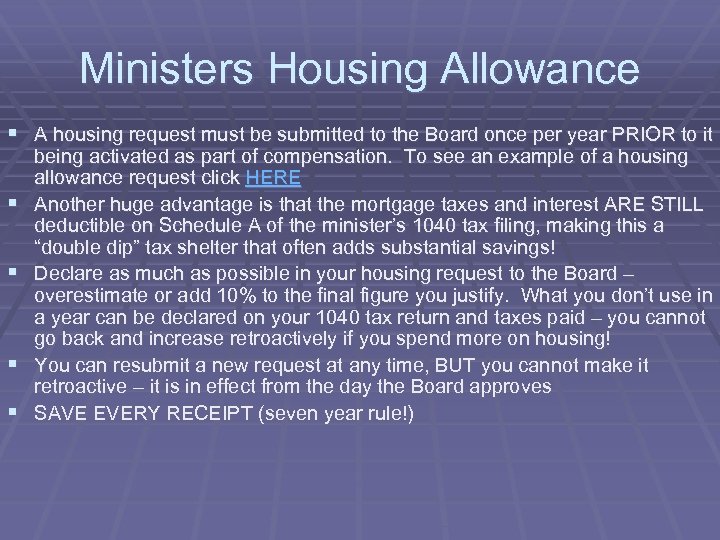 Ministers Housing Allowance § A housing request must be submitted to the Board once per year PRIOR to it § § being activated as part of compensation. To see an example of a housing allowance request click HERE Another huge advantage is that the mortgage taxes and interest ARE STILL deductible on Schedule A of the minister’s 1040 tax filing, making this a “double dip” tax shelter that often adds substantial savings! Declare as much as possible in your housing request to the Board – overestimate or add 10% to the final figure you justify. What you don’t use in a year can be declared on your 1040 tax return and taxes paid – you cannot go back and increase retroactively if you spend more on housing! You can resubmit a new request at any time, BUT you cannot make it retroactive – it is in effect from the day the Board approves SAVE EVERY RECEIPT (seven year rule!)
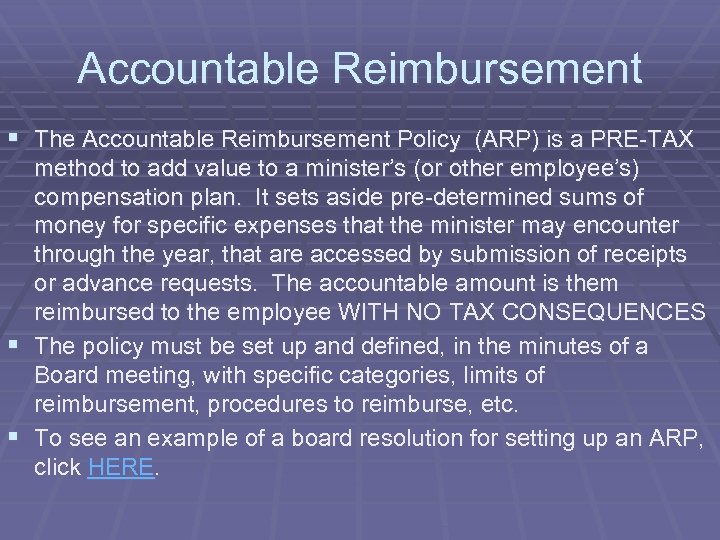 Accountable Reimbursement § The Accountable Reimbursement Policy (ARP) is a PRE-TAX method to add value to a minister’s (or other employee’s) compensation plan. It sets aside pre-determined sums of money for specific expenses that the minister may encounter through the year, that are accessed by submission of receipts or advance requests. The accountable amount is them reimbursed to the employee WITH NO TAX CONSEQUENCES § The policy must be set up and defined, in the minutes of a Board meeting, with specific categories, limits of reimbursement, procedures to reimburse, etc. § To see an example of a board resolution for setting up an ARP, click HERE.
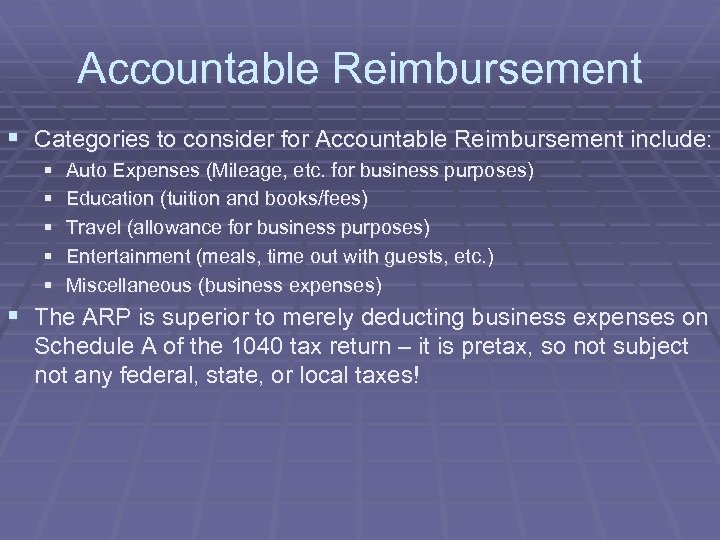 Accountable Reimbursement § Categories to consider for Accountable Reimbursement include: § § § Auto Expenses (Mileage, etc. for business purposes) Education (tuition and books/fees) Travel (allowance for business purposes) Entertainment (meals, time out with guests, etc. ) Miscellaneous (business expenses) § The ARP is superior to merely deducting business expenses on Schedule A of the 1040 tax return – it is pretax, so not subject not any federal, state, or local taxes!
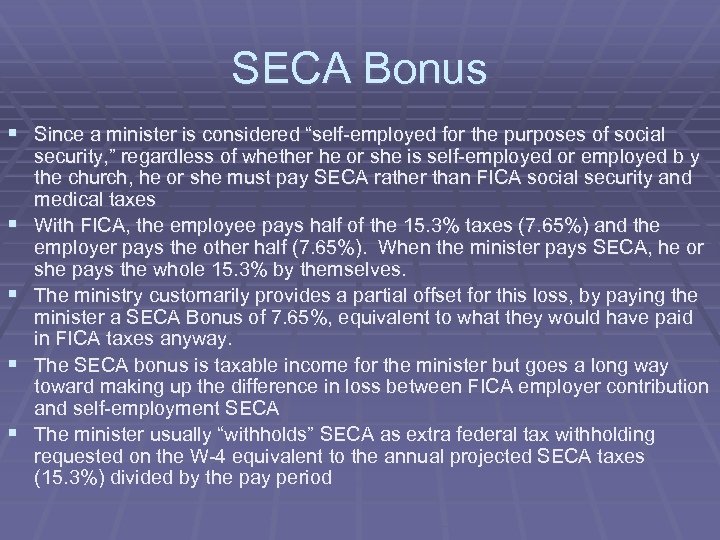 SECA Bonus § Since a minister is considered “self-employed for the purposes of social § § security, ” regardless of whether he or she is self-employed or employed b y the church, he or she must pay SECA rather than FICA social security and medical taxes With FICA, the employee pays half of the 15. 3% taxes (7. 65%) and the employer pays the other half (7. 65%). When the minister pays SECA, he or she pays the whole 15. 3% by themselves. The ministry customarily provides a partial offset for this loss, by paying the minister a SECA Bonus of 7. 65%, equivalent to what they would have paid in FICA taxes anyway. The SECA bonus is taxable income for the minister but goes a long way toward making up the difference in loss between FICA employer contribution and self-employment SECA The minister usually “withholds” SECA as extra federal tax withholding requested on the W-4 equivalent to the annual projected SECA taxes (15. 3%) divided by the pay period
 Pension and Retirement § A wonderful pre-tax benefit is savings and corporate contribution to a retirement or pension account § There a series of IRS regulations in sections 403 (b) and 408 (k) that describe the kinds of retirement and pension funds set up by non-profits, that are usually more flexible and less expensive than for-profit regulations (section 401 (a) § Consult a tax professional to construct the pre-tax plan that is right for your organization and its size
 Health and Disability § Another pretax benefit is a solid Healthcare plan with excellent medical, dental, and vision benefits § Check with small business associations to get group rates § Consider self-funding vision benefits § Offset deductibles with “Cafeteria Plans” - more later § Consider self-funding a short and long term disability plan for key employees: § Short term absence due to accident or illness might be covered after the first two weeks absence at 75% of salary for 12 weeks § Long term absence due to accident or illness might be covered after short term expires at 50% for up to 28 more weeks § These benefits can be self funded by the corporation or through an insurance plan § Define the plans in Board minutes by resolution
 Cafeteria Plans § An excellent way to allow for pre-tax benefits for specific § § § medical or dependent care purposes is a “cafeteria plan” that allows for selection of specific benefits of value to the employee In this plan, pre-tax money is set aside by employee contribution to be applied for medical or dependent care purposes, and then can be accessed by receipt and accountable reimbursement This saves all federal, state, and local taxes on anticipated expenses related to medical and dependent care Consult a tax professional for specifics on how to set up this kind of valuable plan
 Life Insurance § Life insurance was actually a Christian idea at first, to enable a community of § § people to cover the loss of one family or individual. Group Life can be provided for very little cost up to $50, 000 with no tax liability to the employee Supplemental Life policies can be added by company funded or employee funded methods – any employee provided insurance over $50, 000 have premium tax consequences for the employee “Key man” insurance, usually in $1 million increments is often gotten for the senior leader, in case of sudden loss, to provide a buffer for the ministry Prudent planning says that I should multiply my annual salary by 10 and purchase that much simple life insurance face value on a policy. That allows the survivors to invest the lump sum and live off the interest, without touching the principle, at roughly the same economic level as before their loss
 Vacation , Holiday, & Sabbatical § Rest in ministry is not an option, but rather commanded for all § § Christians Ministers are notorious for long hours, seven-day weeks, with little or no rest, followed by burn-out Vacation time off should be defined and fully funded – 3 – 4 weeks per year (may reward time served) is usual Defined vacation and holidays should be a part of a Board resolution and minutes of a meeting The senior ministers should be given sabbaticals or regular breaks (i. e. 1 month – summers) to recharge and retool – INVESTMENT IN HEALTH – Freshness!
 Corporate Tax Filing Requirements
 Non-Profit Tax Filings § There are two key tax filing requirements for non-profit § § § corporations – the 941 quarterly tax withholding reconciliation (already mentioned) and the yearly CORPORATE TAX RETURN (990 or 990 EZ). The corporation must file a yearly tax return, because it is seen as a “legal person” in the eyes of the law as a corporation. The filing date is May 15 of each year, or the Monday after a weekend on which the 15 th falls. The form you use to file (990 or 990 EZ) depends on the level of income and assets for your ministry. An example of the 990 and 990 EZ can be found in the Supplemental Materials section of this module as Exhibits # 14 and 15 respectively.
 Non-Profit Tax Filings § The form 990 and 990 EZ filings provide an accountability with the federal government for your stewardship of the non-profit tax status you hold. They report on: § § § Revenues, Expenses, Fund Balances, Assets Donors, Board members, officers Program services and accomplishments Balance sheets and use of funds to accomplish mission Audit certifications of finances and financial systems Other compliance data of interest to demonstrate strict adherence to 501(c)3 code § The 990 EZ is less involved and complicated to prepare
 Non-Profit Tax Filings § The 990 form is filed if your corporation normally has more than § § § $100, 000 in revenue in a year and/or more than $250, 000 in assets The 990 EZ is filed if your corporation normally has between $25, 000 - $100, 000 in income per year AND less than $250, 000 in assets No filing is required is your corporation has less than $25, 000 in assets per year, BUT you must use a 990 EZ form filed with the box checked “no filing required” to let them know. In the event of declining income, the form is determined by the average of the last previous three years income
 Legal Things That Make a Big Difference
 Legal Things That Make a Big Difference § As administrative leaders, your role can literally make a difference between success and disaster for a church or parachurch ministry: § Each year, many church and parachurch leaders get into legal problems because they miss the details about law – the “small things. ” § Visionary leaders are not wired to think about the small details of ministry – they must be surrounded by people who are gifted and called to deal with the “small stuff” before the small stuff creates big problems! § Each year, neglect of the small stuff results in civil and criminal actions against churches, parachurch ministries, and their leadership, costing much in terms of legal fees, damage to reputation, ministry effectiveness and even jail time Cont…
 Legal Things That Make a Big Difference: Common Liabilities § § A liability is a risk that one encounters. The degree of risk is reduced if I understand the risk, AND I take reasonable actions to minimize or eliminate the risk. A common fallacy is that all risks are “acts of God” or “in God’s hands. ” While we have no control over some risks, it is rare that we have no control at all over a risk, as far as its reduction or elimination. God’s sovereignty cannot be used as an excuse for a lack of risk assessment or failure to reduce risk – trying to make that argument in court will get you a psych evaluation! A ministry is expected to do formal or even informal risk assessment by asking itself what risks could exist, and by taking reasonable steps to reduce or eliminate those risks – common sense! This is where an administrative gifting shines! Cont…
 Legal Things That Make a Big Difference: Common Liabilities § Negligence: This is the most common liability for ministry. Negligence is simply an unintentional act or omission by an individual or group that results in the hurt, injury or death or another person or group of people § Unintentional – note that “I didn’t know” or “I didn’t mean to” is not an excuse, - in fact it proves negligence. (i. e. suicide resulting from faulty counsel) § Duty – Negligence assumes that you or your group had a reasonable expectation and responsibility for duty (i. e. supervisor in the nursery) § Proximate Cause – Direct cause is what causes the harm. Proximate cause is what allowed the harm to take place. (i. e. death from fire, but failure to follow building code is proximate cause) § Injury – There is no negligence in the eyes of the law if there is no physical, moral, mental, or other injury as a result of the real world negligence (i. e. a two foot hole in the floor is not negligence in the eyes of the law until someone falls in and breaks their leg) Cont…
 Legal Things That Make a Big Difference: Common Liabilities § § Negligence: One of the final and perhaps most important consideration in determination of negligence from a legal standpoint is the age: The younger the individual, the greater responsibility (duty) there is to reduce or eliminate the risk. This is because it is reasonable to assume that the younger the person is, the less able they are to assess and avoid risk themselves! Risk Assessment and Negligence: The most common excuse offered for things that happen is that they could not have been predicted. This make people feel better, because then they do not have to take responsibility for a problem or disaster, nor grieve over the injury of another. Pre-incident Indicators (PINS): Every incident is preceded by things that indicate the risk of that incident occurring. It is an administrator’s job (duty) to learn to recognize PINs, look into the future to construct possible risk scenarios, and build in reasonable protective systems to reduce or avoid the risk. This reduces or eliminates negligence (actual) and is the best argument against criminal (legal) negligence. Cont…
 Legal Things That Make a Big Difference: Common Liabilities § § There are common considerations for church and parachurch ministry that address the liability of negligence that every administrator should consider: Children and Ministry: The unintentional physical, mental, emotional, or other injury to a child (18 or less) because reasonable steps were not taken to reduce or eliminate risk constitutes potential criminal and/or civil neglect. § Environment: Is the area of ministry safe and free of hazards? Does it meet building (lighting, construction) and fire codes (sprinklers, alarms, extinguishers) with entrance and exit (markings, panic bars on doors, emergency lighting)? Are toys, objects, and furnishings free from hazard? § People: Have the people had a background check (formal!), people provide references, people are interviewed, record are kept. No excuse exists for a lack or background checks and record keeping – this proves negligence! Remember – child offenders love Christian organizations because we are so trusting (and gullible!). Trust your intuition! If a person does not feel right, you MUST respond. Cont…
 Legal Things That Make a Big Difference: Common Liabilities § § There are common considerations for church and parachurch ministry that address the liability of negligence that every administrator should consider: Children and Ministry: The unintentional physical, mental, emotional, or other injury to a child (18 or less) because reasonable steps were not taken to reduce or eliminate risk constitutes potential criminal and/or civil neglect. § Supervision: Each state defines the age of adult accountability differently. Assume it is under 18 years of age. It is ASSUMED that it is a duty of those in charge to completely supervise “children” under the age of 18 at all times while they are in the custody of those in charge of the ministry. Under no circumstances are they to be left alone. It is best that a worker NEVER be left alone as well – so there are two adults supervising, one as back up and witness! Cont…
 Legal Things That Make a Big Difference: Common Liabilities § § There are common considerations for church and parachurch ministry that address the liability of negligence that every administrator should consider: Children and Ministry: The unintentional physical, mental, emotional, or other injury to a child (18 or less) because reasonable steps were not taken to reduce or eliminate risk constitutes potential criminal and/or civil neglect. § Training: It is ASSUMED that is the duty of those who in charge to TRAIN the individuals that work in an area of ministry to be competent to function in that kind of ministry. This would include training in how to perform functions that pertain to the ministry itself, but also in critical areas of risk. This would include rules of appropriate physical contact, how to spot physical and/or sexual abuse, reporting responsibilities, safety protocol for fires, weather, or disasters. Failure to do any of these things invites criminal and/or civil actions related to negligence. Cont…
 Legal Things That Make a Big Difference: Common Liabilities § § There are common considerations for church and parachurch ministry that address the liability of negligence that every administrator should consider: Children and Ministry: The unintentional physical, mental, emotional, or other injury to a child (18 or less) because reasonable steps were not taken to reduce or eliminate risk constitutes potential criminal and/or civil neglect. § Reporting: Most states REQUIRE the reporting of suspected physical and/or sexual abuse – this is not an option, or something that you can decide whether or not to do. The most common mistake made is for an individual to try to decide if abuse has occurred or not – this, by definition, constitutes criminal negligence, because a person or ministry is REQUIRED to report SUSPECTED abuse – it is assumed that it the job of the authorities to determine whether or not the abuse is actual or not! Cont…
 Legal Things That Make a Big Difference: Common Liabilities § § There are common considerations for church and parachurch ministry that address the liability of negligence that every administrator should consider: General Negligence: The unintentional physical, mental, emotional, or other injury to a child or adult because reasonable steps were not taken to reduce or eliminate risk constitutes potential criminal and/or civil neglect. § Failure to Warn: Are there signs that mark tripping hazard, holes in the parking lot? Are faulty equipment marked and locked out? § Failure to Protect: Have reasonable measures been taken to be sure that safety devices (sprinklers, lighting, lightning arresters, fire extinguishers, electrical wiring and cords, hot water sources and heaters, heavy objects – filing cabinets, furniture - and nursery items (sanitized, not broken, not hazardous)) work properly and/or installed? § Failure to Supervise: The last person to leave is the adult in charge! § Failure to Train: Training programs and records Cont…
 Legal Things That Make a Big Difference: Common Liabilities § § Defamation: Defamation is the use of words that injure the reputation of another person or group of people. If these words are oral, it is called slander. If the words are written, it is called libel. Defamation is not a criminal action, but a civil action (a “tort”), and can result in a civil action filed in civil court to recover damages. It has been my experience that when some Christians get angry, there is no consideration of the Scriptures and their exhortation against “taking a brother to court. ” The threat (actually the intimidation) to sue over defamation is often used to create fear or anxiety. I have found that in persistent instances of unjustified intimidation, it is best to give the person the name of your lawyer and invite them to call and move forward. This usually disarms the intimidation factor immediately and separates intimidation (desire to create fear/anxiety) from threat (promise to act). A ministry leader has a responsibility to examine his or her words for potential to injure another and to avoid that injury if at all possible! Cont…
 Legal Things That Make a Big Difference: Common Liabilities § Defamation: There are several defenses against defamation, if wrongly accused: § § § Truthfulness: Establish the truthfulness of all communication to the best of your ability. What is the reliability of the source? How can the source’s accuracy be confirmed? What past indicators give credence to the source and/or the reliability of the information? How close is the source to the individual or circumstance? What vested interest does the source have in the outcome that might skew his or her perception of the truth? The fact is, in the execution of biblical ministry, we will need to exercise pastoral confrontation, rebuke, correction, and these actions will “hurt and individual. They might argue “injury, ” but truthfulness defends against defamation I was always counseled by my church legal counsel to seek God, pray for direction, faithfully discharge my duty as I see it, keep a written or recorded record of my words (spoken or written) and speak or write the truth – he said it was my (and his) best defense argument in a civil court of law. Cont…
 Legal Things That Make a Big Difference: Common Liabilities § Defamation: There are several other defenses against defamation as well: § § § Consent: If an individual consents to the disclosure of information, it cannot be construed as defamation. GET IN THE PRACTICE OF SIGNED DOCUMENTS RELATED TO STATEMENTS OR COUNSELING! Self-defense: I am allowed to use words that defend myself, even if those words could cause harm to another’s reputation in the course of that defense. For instance, my words might prove the person to be a liar, or expose an unseemly motive, and injure that person’s reputation, but it is not defamation, because it was done in the context of reasonable self-defense –(again, relies on the truth!). Statements for or About Church Business: Your by-laws should CLEARLY establish which of the senior leaders is the spokesperson for the church (usually the senior pastor). If in the execution of your duty to minister, protect, preserve, or support the church, you must say or write something (i. e. minutes of a board meeting or publicly address the congregation), YOU, AS DESIGNATED SPOKESPERSON have a defense against slander or libel. Your words must be carefully chosen, recorded, and be “need to know” communication! Cont…
 Legal Things That Make a Big Difference: Common Liabilities § Defamation: There is also the case or privileged communication for ministers: § § § Privileged Communication: This is communication from to or from a minister, when acting in a professional capacity as a spiritual advisor (counselor) to a member of the congregation Did you see the TRIGGER words in this definition? Your by-laws must define what a minister is (licensing and ordination requirements), what the lawful and permitted job of minister are (counseling, etc. – job descriptions!), and who members are (bylaw qualifications for membership). If you cannot point to written documents, developed in advance of an audit or investigation, you may not be able to defend against defamation and civil action/damages! (see why we talked about by-laws earlier!). Communication about sexual or physical abuse of a child should NEVER be construed as privileged communication. It is never defendable to not report SUSPECTED instances of physical or sexual abuse! Cont…
 Legal Things That Make a Big Difference: Common Liabilities § Malpractice: Another common liability is the area of professional malpractice. Ministry is a profession – a field of knowledge with established skills and expectations of performance. Malpractice is failure to perform one’s professional duties to accepted degree of skill in the discharge of professional duties. § § § Training: This is why appropriate training for ministerial duties is not only wise, but also protects fro liability Profession: There are certain things a minister should and should not engage in, unless there is proper training and experience Duty: Here we go again with “by-laws” and “job descriptions!” What are the official duties of a minister? Who qualifies as a “minister” according to the by-laws, and what are the qualifications? These are questions that will be asked right away in a civil or criminal action Cont…
 Legal Things That Make a Big Difference: Common Liabilities § Malpractice: There are several common areas of malpractice liability associated with ministry. The most common is counseling! § § § Pastoral Counseling is mainly intervention! The temptation for a pastor is to be seen as “the answer guy” who knows all and can fix anything – this is pride. Most counseling should involve limited numbers of meetings (3 – 5) in order to intervene (stabilize), correct, and instruct from the Scriptures, as well as pray and care for the individual. Most counseling involves people that will not or do not know how to take responsibility for their own problems and submit to biblical admonition not to sin. Pastoral counseling is useful to challenge and bring biblical perspective. It becomes unhealthy when I enable a victim mentality, especially if it makes me, as minister, the answer guy and savior, in place of Jesus Christ. Cont…
 Legal Things That Make a Big Difference: Common Liabilities § Malpractice: There are several common areas of malpractice liability associated with ministry. The most common is counseling! § § Pastoral Counseling is mainly intervention! If the person seems to need help beyond 3 – 5 sessions, that is when it is time, in most cases, to refer the person to properly trained medical, psychological, or psychiatric professional fro treatment or therapy. To attempt to provide these service yourself, without proper training and experience, constitutes malpractice, and exposes you and your ministry to grave liability. Pastoral counseling does not involve the dispensing of medical advice, recommendations on medication, behavioral or cognitive therapy, or other psychological or psychiatric advice. Be careful to build detailed record keeping systems that record the counseling session with enough detail to refer back to in case of need. To not keep such records (and to not keep them confidential) may expose the minister and/or ministry to grave liability Cont…
 Legal Things That Make a Big Difference: Common Liabilities § Malpractice: There also several special cases of pastoral counseling and intervention that require a great deal of thought and care: ! § § Suicide is a difficult and critical pastoral care situation that must be handled precisely and with skill Back to pre-incident indicators (PINs): It helps loved ones to think that there were no PINS and that the suicide came out of the blue, whereas there are several common PINS that we must learn to recognize: Male; age 25 – 35; attempted before; significant life change or crisis; despondency or depression (no way out/perceived alternatives); talk & especially talk of a specific manner of suicide; setting things in order (when I am gone); resolution (things are better for no reason), etc. It is my professional duty to report SUSPECTED suicidal people to the police WHO WILL DECIDE IF THE THREAT IS REAL (not my job). They will then decide on an involuntary treatment or commitment to intervene It is my job to secure a suicide location (body and surroundings) when I arrive at an intervention. I can only move or touch the body to check for life or to save the life. It must be treated as a potential crime scene and turned over for investigation Cont…
 Legal Things That Make a Big Difference: Common Liabilities § Malpractice: There also several special cases of pastoral counseling and intervention that require a great deal of thought and care: ! § § Abuse is a another difficult and critical pastoral care situation that must be handled precisely and with skill If suspected abuse is present for a child (in most states a person under the age of 18 years old), the suspected physical or sexual abuse MUST be reported to the authorities for THEM to determine if actual abuse has occurred. Reporting adult abuse varies from state to state, but it has always been my policy that physical or sexual abuse or violence is NEVER acceptable in ANY case accept self-defense, and that it is a reportable offense with consequences. I will not ever counsel a man or woman to remain in house where there is a threat of physical or sexual violence, because I believe this constitutes malpractice Cont…
 Other Small Things That Make a Big Difference
 § Other Things That Make a Big Difference: The “Fine Print” Other “little things” that make a “big difference: ” § § § Workman’s Compensation Insurance: Check your local and state requirements for workman’s comp insurance that pays benefits to people injured in the execution of their jobs – it is often required by law. Labor Laws: Be aware of age, racial, sex, and other important factors in hiring and compensation issues. Make clear policy statements about non-discrimination and follow them! A religious organization can discriminate based on religion IF they can demonstrate the need for religious purposes AND it is clearly spelled out in the by-laws as an essential part of the ministry (i. e. no Buddhists hired as pastor). Currently, ministries are allowed to discriminate on the basis of sexual orientation, but this too must be integrated into policy that is based on religious conviction and written. Unrelated Business Income Tax (UBIT): A church CAN engage in business activity that is not related to its mission, BUT it must be reported as “unrelated business income (UBIT) and IS TAXIBLE. A church can run an Internet business for its Christian School, etc. Cont…
 Other Things That Make a Big Difference: The “Fine Print” § Other “little things” that make a “big difference: ” § § § Reporting: Remember that a non-profit is required to file an income tax return once per year on or about May 15. It is also required to have employees fill out a W-4 to select tax withholding, a W-3 to transmit the information on tax withholdings to the government, and a W-2 to report year end earnings and taxes to the employee and government by January 31. Miscellaneous Income: A ministry is required to issue a form 1099 to someone who receives $600 or more in income as compensation or gift (‘love offering). Other: We could go on and on, but the details never end – not if you want to do this right. That is the realm of an administrative leader, and within his or her gift mix. NEVER STOP LEARNING AND NEVER STOP STRIVING FOR COMPLETENESS AND EXCELLENCE! Cont…